Volume 153 — ESSENCE OF PARLIAMENT.
Reading edition
Monday, August 6th.—This being Bank Holiday and the first fine day after a week's downpour, Members for the most part stayed away from Westminster. Some, it is charitably supposed, have gone to look after their allotments. Others, it is believed, have been kept away by a different reason. The taxicab-drivers, men constitutionally averse from extortion, have refused to enter the railway-station yards so long as the companies persist in exacting from them a whole penny for the privilege. Consequently some of our week-ending legislators are reported to be interned at Waterloo and Paddington, sitting disconsolately upon their portmanteaux. As an appeal to the Board of Trade elicited nothing more from Mr. G. ROBERTS than a disclaimer of personal responsibility, it is expected that redress will be sought from the Taxi-cabinet.
Mr. HENDERSON'S dual personality continues to arouse curiosity. There was some justification for Mr. KING'S inquiry whether he went to Petrograd as a Ministerial Jekyll or a Labourist Hyde. Mr. BONAR LAW assured the House that on this occasion at least Mr. HENDERSON went purely as a Cabinet Minister, guiltless of any duplicity.
Mr. PROTHERO enlivened the discussion on the Corn Production Bill by a new clause providing that where a farmer failed to destroy the rabbits on his land the Board of Agriculture should have power to do it for him and recover the expenses incurred. Sir JOHN SPEAR expected that in some cases the rabbits secured would more than defray the cost of the capture, and declared that unless the farmer was allowed to keep the rabbits the Government would be guilty of "profiteering." As other agricultural Members appeared to share this view, Mr. PROTHERO, most obliging of Ministers, agreed to alter the word "cost" to "net cost." I hope no litigious farmer will seek to evade his liabilities on the ground that, as the Act only says "net cost," he need not pay for the ferrets.
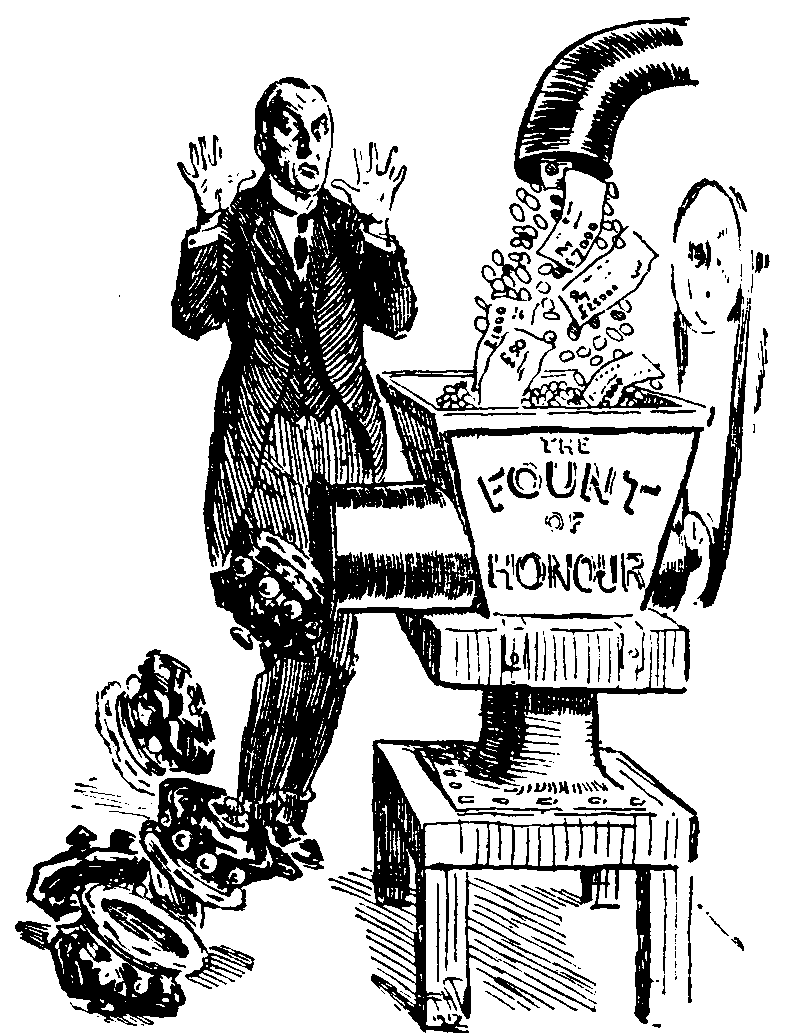
THE FOUNT OF HONOUR AT WORK.
LORD CURZON CAN HARDLY BELIEVE IT.
Tuesday, August 7th.—Those peers who were supposed to be shaking in their shoes at the thought of Lord SELBORNE'S impending revelations as to the means by which they acquired their honours might have spared their tremors. He opened his bag to-day, but no cat jumped out, not even the smallest kitten. If he had given a single concrete example of a peer who, having notoriously no public services at his back, must be presumed to have purchased his title, he would have created some effect. But the admission that all his information on the subject was confidential cut the ground from under his feet; and needless to say none of the Peers whom he hypothetically accused of buying their coronets responded to his appeal by standing forth in a white sheet and making open confession of his crime.
Lord SELBORNE was one of three heirs to peerages who a generation ago banded themselves together to resist elevation to the House of Lords. Another of them is Lord CURZON, who answered him to-night, and whose contempt for the Chamber which he now adorns seems to have grown with the years that he has spent in it. Reading between the lines of his speech a cynic could only infer that the Upper House, as at present constituted, is such a useless and superfluous assembly that it does not much matter who gets into it or by what venal ladder he climbs.
The only peers who ventured to get to close quarters with the scandal were Lord KNUTSFORD, who told a moving tale of how a potential baronet diverted £25,000 from the London Hospital to a certain party fund, and thereby achieved his purpose; and Lord SALISBURY, who declared from his knowledge of Prime Ministers that they were sick of administering the system of which Lord CURZON was so ostentatiously ignorant.
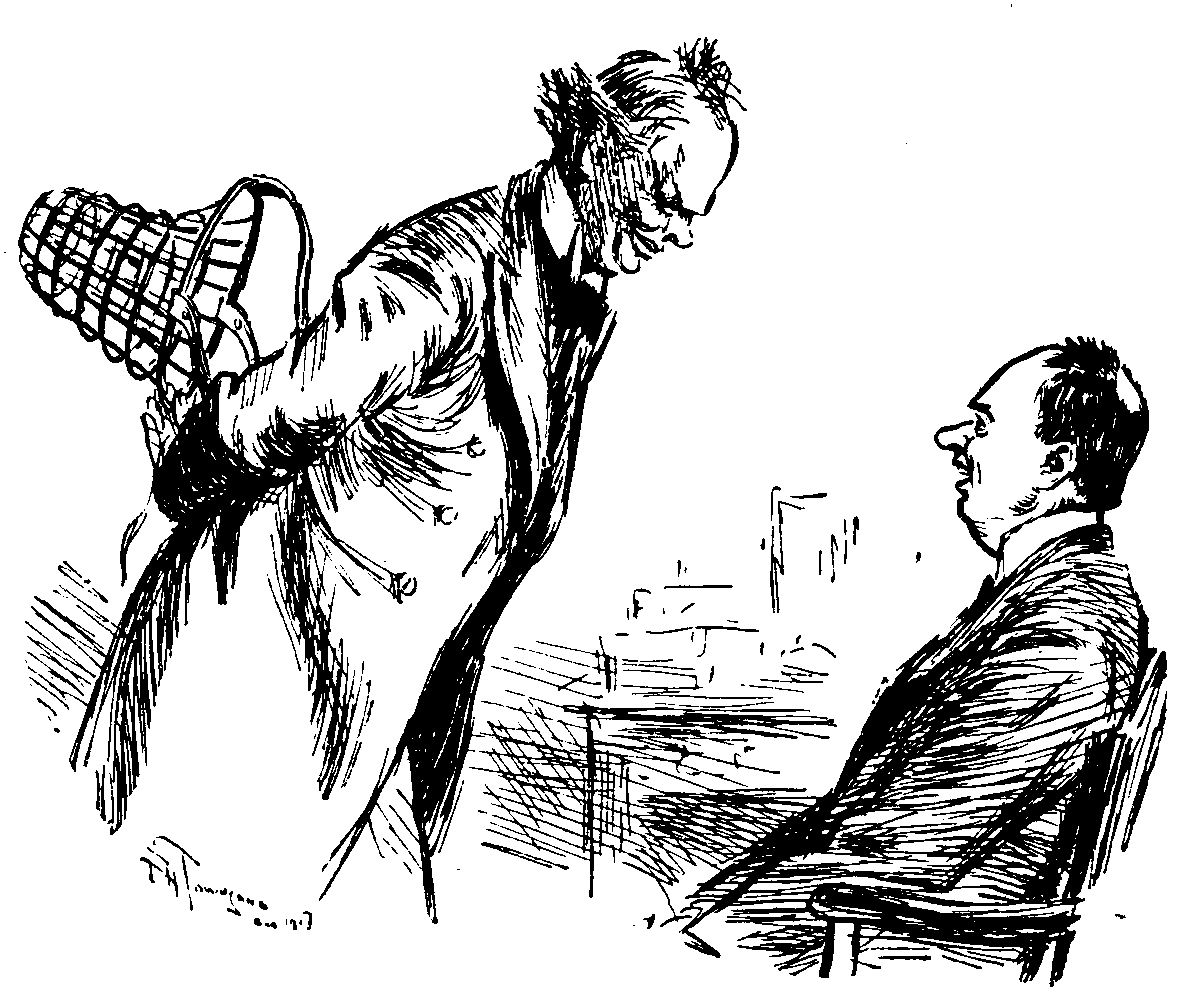
Many reasons have been assigned for Mr. CHURCHILL'S reinclusion in the Ministry, but I am inclined to think that the real one has only just been discovered. Mr. MACCALLUM SCOTT is one of the most pertinacious inquisitors of the Treasury Bench; he is also a whole-souled admirer of the Member for DUNDEE, and has written a book in eulogy of his achievements by sea and land. Mr. CHURCHILL has rewarded this devotion by appointing Mr. SCOTT his private secretary, and, as it is contrary to Parliamentary etiquette for a Member holding this position to interrogate other Ministers, has thereby conferred a distinct benefit upon his new colleagues. Mr. LLOYD GEORGE is now reported to be on the look-out for other statesmen in whom Mr. HOGGE and Mr. PRINGLE repose a similar trust, but so far without success; and it is thought that his only chance is to make Mr. PRINGLE an Under-Secretary on condition that he takes Mr. HOGGE as his âme damnée, or vice versâ.
WINSTON'S GIFT TO HIS NEW PRIVATE SECRETARY, MR. MACCALLUM SCOTT.
Wednesday, August 8th.—Lord BURNHAM shocked some of the more ancient peers by his skittish references to the coming Conference on the Second Chamber. When he expressed the hope that Lord CURZON would make an explicit statement, on the ground that their Lordships' House was in no need of a soporific, I fully expected one of the occupants of the mausoleum to rise and reprove him in the words of Dr. JOHNSON, "Sir, in order to be facetious it is not necessary to be indecent."
The advent of the feminine lawyer was rendered a little nearer when her champions successfully held up a Bill promoted by the Incorporated Law Society until the Government undertook to find time for the discussion of a measure enabling women to become solicitors. Already Shylock is trembling at the prospect.
Thursday, August 9th.—When the House on two successive occasions rejected Proportional Representation it was generally thought that nothing more would be heard of the other proposals for securing minority representation. To-night, however, after a brisk debate, the "Alternative vote" in three-cornered contests was saved in a free division by a single vote; and it was further decided that "P.R." itself should be adopted at University elections, despite the unanimous opposition of the University Representatives.
THE CHOICE.
The bright August sun certainly made the dining-room paper look dingy. It was a plain, self-coloured paper, but we were rather attached to it, and didn't like the idea of a change.
But there seemed no help for it, so I arranged to leave my office early on Friday afternoon, meet Alison at the Marble Arch tube station and go with her to choose a new paper.
When we reached the wall-paperer's lair we were ushered by an immaculate personage into a room that looked more like the dining-room of a private house than a part of business premises.
"Perhaps," I said, in an awed whisper, "you don't care to have anything to do with such trifling things as—er—wall-paper?"
"Indeed we do," said the nobleman. "Most important things, wall-papers. Where did you want it for?"
"For a room in my house, of course," I said. "Not for the garden."
"Oh, not for the garden. And what sort of house is yours?" he asked.
"A very nice house," I said.
"I meant what was the style of the house—Jacobean, Georgian?"
"Brixtonian rococo outwardly," I said, "as far as I can judge; but very snug inside. No doubt you could show us something we should like which would also satisfy your sense of propriety."
"I think it might be managed," he said, waving his hand towards two or three giant books of patterns.
"What we want," I said, "is something meaty."
"Ah, for the dining-room," he said.
"Well, it's a courtesy title," I said, "but really in these hard times we have reduced economy to such a fine art that I thought a wall-paper with body in it might help matters."
"I think I catch the idea," said the marquis. "Something that would make you feel more satisfied after dinner than you otherwise would feel, as it were."
"My dear Sir," I said, "you have hit it exactly. Yours is a sympathetic nature. How readily you have divined my thoughts! No doubt you too are suffering."
He sighed almost audibly. "How is the room furnished?" he said.
"Leading features," I said, "a Welsh dresser, rush-bottomed chairs, gate-legged table, bookcases—"
"Saxe-blue carpet," said Alison.
"A most important detail," Lord Bayswater said. "Don't you think something of a chintzy nature would ... etc."
Both Alison and I agreed that a prescription of that kind might possibly ... etc.
I don't know what is comprised under the term chintzy, but it appeared to be a comprehensive one, for the nobleman descanted on the merits of the following patterns among others:—
(1) Cockatoos on trees, cockatooing.
(2) Pheasants on trees, eating blackberries.
(3) Other birds on trees, doing nothing in particular.
(4) Roses, in full bloom, half bloom, fading, falling.
(5) Forget-me-nots in bunches, ready for sale.
(6) Grapes doing whatever it is that grapes do.
(7) Other flowers and fruits, also acting after the manner of their kind.
Many other patterns were shown us and we spent an hour or two looking at them. Our host tried hard to push the cockatoos on to us. His idea was that the pattern would act as wallpaper and pictures combined. Alison's idea was that there would be too many portraits of cockatoos round the room, and I maintained that the wretched birds looked so realistic that I should certainly feel I ought to be giving them some food, and this would of course hardly assist my idea. The noes had it.
In the end we came away with four patterns (fruits and flowers) and a promise to let Lord Bayswater know which one we preferred. One of them I chose really to show my tailor, as it was a top-hole scheme for a winter waistcoat.
Alison and I spent the evening hanging the patterns up one after the other on one wall of the dining-room, and tried to paper the rest of the walls in the mind's eye, but at eleven o'clock we knocked off for the night and went to bed with headaches.
I fancy Alison must have had a disturbed night. As I was leaving the house after breakfast she said, "Have you made up your mind about those patterns?"
"No, I haven't," I said. "I'm going to leave it to you. Choose which you like."
"I've chosen," she said with an air of finality.
"Well," said Alison, when I reached home that evening, "it's up."
"Up?" I said. "The new paper, already?"
"Come and see," Alison said.
"By Jove, how well it looks!" I said. "You've chosen well. There's something familiar about it, though it looks almost new."
"Yes," said Alison, "Ellen and I cleaned it all over with bread-crumbs."
"Poor Lord Bayswater," I said. "But you've done the right thing. Wall-paper as usual during the War."
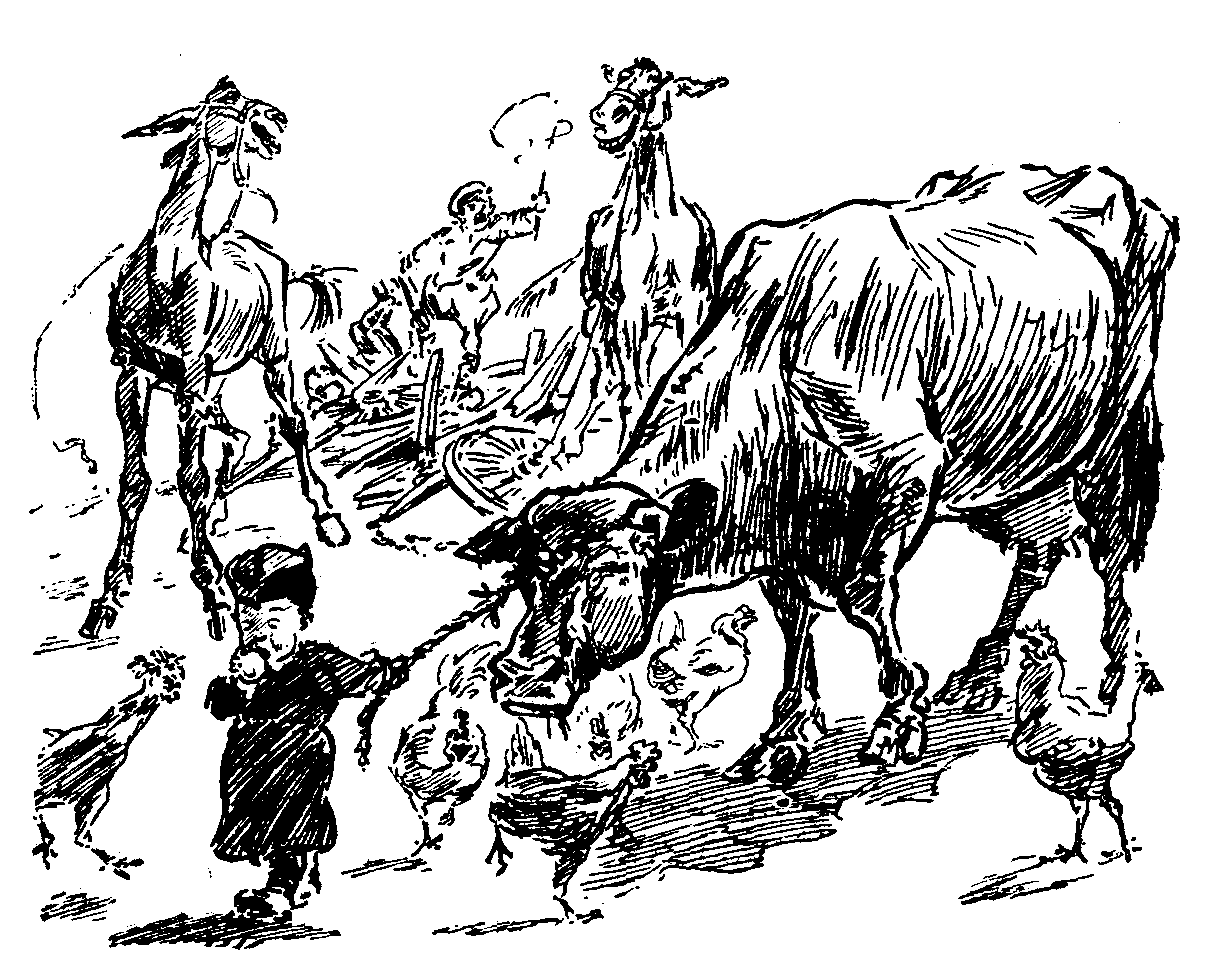
First Dangerous Mule (to Second Ditto)."DON'T YOU GO NEAR HER, MATE—SHE'LL KICK YER."
"The annual agricultural returns show that the increased area in England and Wales of corn and potatoes for the present harvest amount to no less than 347,0000 acres. This result exceeds all expectations." Bradford Daily Argus.
We can well believe it.
From a sale advertisement:—
"LACE DEPT. Ladies' Overalls and Breeches for the farm, garden, or home use, reduced in Price." Daily Paper.
Cooler and cooler.
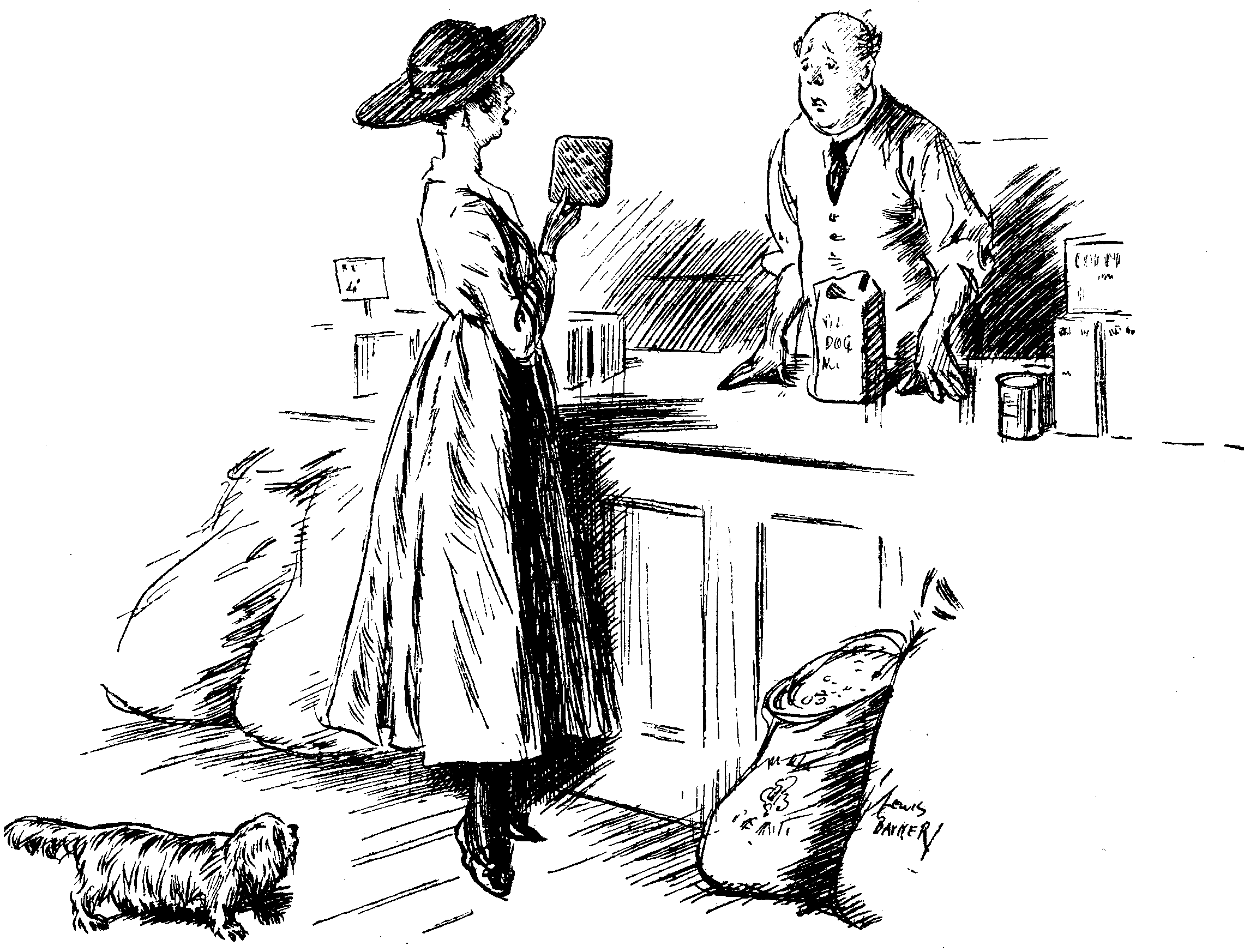
Angry Lady (On Being Told That Fido's Favourite Biscuits Are Now Unobtainable). "NOTHING BUT THESE! REALLY, THIS WAR IS GETTING BEYOND A JOKE!"
"SKILLY."
Prior to "Skilly" being taken on the regimental strength, our canteen was the paradise of a battalion of mice, from whose nightly raids nothing was sacred. But from the day "Skilly" enlisted the marauders became less and less obtrusive. And "Skilly" grew sleek.
Then came a time of scarcity. Mice fought shy of the canteen, and "Skilly" visibly suffered from lack of nourishment. A sergeant's wife provided welcome hospitality; but no sooner was "Skilly" billeted outside the canteen than the plague returned, and so she was recalled urgently to active service. Again was the enemy routed; but again came the wilting-time of dire want. Virtue, however, did not go unrewarded a second time. "Skilly" had earned honourable mention, and representations to the proper quarters resulted in an order that she should be rationed so long as she remained on canteen duty.
With times of ease came time for love. In due course "Skilly" presented an absentee and unidentifiable spouse with five bouncing baby kittens. Throughout their extreme infancy the family throve; but the time came when the devoted mother was no longer able to supply sufficient nutriment for five lusty youngsters. Clearly something must be done, and the canteen sergeant was the man to do it. He sent in a proper formal application to the regimental powers, requesting that increased feline rations be ordered as "subsistence for Canteen Skilly and family of five."
Time passed, and—let this be read and remembered by all carping critics who accuse our army of want of method and business sense—in due course the application was returned, properly entered, checked, signed and counter-signed. The verdict run thus: "Application on behalf of Canteen Skilly refused, as apparently she married off the strength of the regiment."
"No youth should be regarded educationally as a finished article at 1 years of age." Yorkshire Post.
Mr. Fisher will be pleased.
"A MERRY HEART GOES ALL THE DAY."
I jogged along the footpath way And leant against the stile; "A merry heart goes all the day," Stoutly I sang the old refrain; My own heart mocked me back again, "Yet tire you in a mile!" Well may I tire, that stand alone And turn a wistful glance On each remembered tree and stone, Familiar landmarks of a road Where once so light of heart I strode With one who sleeps in France. Heavily on the stile I lean, Not as we leant of yore, To drink the beauty of the scene, Glory of green and blue and gold, Shadow and gleam on wood and wold That he will see no more. Then came from somewhere far afield A song of thrush unseen, And suddenly there stood revealed (Oh heart so merry, song so true!) A day when we shall walk, we two, Where other worlds are green.
THE REVIEWS FOR ——.
(A specimen article for the use of those editors who have come to the realisation that the contents of our heavier periodicals never change. All that is needed is the insertion of the right month and the survey can be used as a serial.)
In The Umteenth Century and Forever, which is, as usual, alert and interesting, the place of honour is given to an article by Sir Vincent Stodge, M.P., on "Proportional Representation in New Patagonia." Sir Vincent's argument may or may not convince, but it is succinctly stated. Sir ERNEST CASSEL writes usefully on "Economy for Cottagers," and Lord Sopwith, in a paper on "Air Raids and Glowworms," shows how important it is that on dark nights there should be some compulsory extinction of the light of these dangerous and, he fears, pro-German, insects. Mr. HARRY DE WINDT describes "Galicia as I Knew It," and there are suggestive papers on "The Probable Course of History for the next Three Centuries," by the Dean of LINCOLN; "Potatoes as Food," by Sir WALTER RALEIGH; and "Hair in Relation to Eminence," by Dr. SALEEBY, in which all the strong men in history famous for their locks, from SAMSON to Mr. LLOYD GEORGE, are passed in review. An excellent number, full of mental nutriment, is brought to a close by a symposium of Bishops on the petrol restrictions.
By a strange coincidence The Shortsightly also has a valuable paper on "Proportional Representation," by Mr. and Mrs. C.N. WILLIAMSON, who thus make their bow for the first time among what might be called our thinking novelists, their effort being in some degree balanced by an essay in the same number from so inveterate a politician as Mr. J.M. HOGGE, M.P., on the "Wit and Humour of WILLIAM LE QUEUX." There is also an anonymous article of great power on "Conscientious Objectors as Food for Racehorses," which should cause discussion, both by reason of its arguments and also through the secret of its authorship, which to the initiated is only of course a secret de Polichinelle. For the rest we content ourselves with drawing attention to "The Small Holding," by Lord PIRRIE; "Women and Tobacco," by the Manager of the Piccadilly Hotel; "Feud Control," by Mr. PHILIP SNOWDEN, M.P.; "Russia as I knew it," by Mr. HARRY DE WINDT; and "The Spirit of Ireland," by Sir JOHN POWER.
The Peremptory Review opens with Lord CURZON'S well-reasoned appeal to Labour to relinquish its attitude of criticism and trust the powers that be. Other notable articles deal with the possible effect of woman's franchise on the cult of Pekinese spaniels, the case pro and con. for a tunnel under St. George's Channel, and the philosophy of E. PHILLIPS OPPENHEIM. Mr. HARRY DE WINDT writes of "Serbia as I Knew It." A spirited attack on the MINISTER of MUNITIONS by the Editor of The Morning Post brings an excellent number to a close.
Backwood's is, as usual, strong in the martial element, and is further proof that in the present conflict there is no excluding rivalry between pen and sword, but plenty of room for both. The article wittily entitled, "Mess-up-otamia" should be read by everyone who is not tired of that theme. The trenchant author of "Reflections without Rancour" displays his customary vigilance as a censor of bêtes noires, not sparing the whip even when some of the animals are dead.
In the ever iconoclastic and live Gnashing All Review Mr. Smacksy is, as usual, at his most vigorous. Among the statesmen who come in for his attacks are Mr. ASQUITH and Lord HALDANE, both of whom are probably by now quite inured to his blows. Nothing could be more amusing than the renewed play which is made with the phrase, "spiritual home." Mr. Smacksy has also something to say to members of what might be called his own Party. Other articles deal with "The Psychology of the Pacifist," a trenchant exposure; "The Teeth of American Presidents," which contains a number of curious statistics; "The Film and the Future," by Viscount CHAPLIN; "The Honours List," in which the anonymous writer makes the revolutionary suggestion that the KING'S birthday should in future be marked by the withdrawal of old titles instead of the conferring of new. Mr. HARRY DE WINDT descries "Roumania as I Knew It"; "A Suggestion for the Settlement of the Irish Problem" is offered by Mr. GINNELL, M.P.; and Mr. C.B. COCHRAN utters a disinterested plea for "The Small Theatre."
The Jinglish Review, also famous for the activity of its fighting editor, has no fewer than four articles from his pen, of which the least negligible is perhaps that of "The Partition of Europe after the War." The others deal with "The Real Germany," "Sunday Journalism as a World Asset," and "HORATIO BOTTOMLEY the Prophet." Other contributions in a varied number include a series of votive verses to Mr. EDWARD MARSH, C.B., by a band of Georgian poets, on the occasion of his resumption of his duties as private secretary to Mr. WINSTON CHURCHILL. A charming study of leprosy, translated from the Russian of Lugubriski, brings the number to a close.
LONDON PRIDE.
Upon a lily-laden tide, Where galleons rocked with sails blown wide And white swans gleamed, there was a city Whose citizens called "London Pride" The flower that some call "None-so-Pretty." It grew beside the frowning tower, By RALEGH'S walk and BOLEYN'S bower, As frail as joy, as sweet as pity; And "London Pride" they called that flower Which country folk call "None-so-Pretty." When London lads made holiday In dewy hours o' th' month o' May, And footed it with Moll and Kitty, Among the maypole garlands gay Be sure they plaited "None-so-Pretty." When London lads in battle bent Their bows beside the bows of Kent ('Tis told in many a gallant ditty) Their caps were tufted as they went With "London Pride" or "None-so-Pretty." Oh, London is what London was, And mighty food for pride she has; Her saints are wise, her sinners witty, And Picard clay and Flemish grass Are sweet with stars of "None-so-Pretty."
"SAMMIES."
À propos of the note in our issue of August 1st, a Correspondent suggests that the Americans might go into action to the tune of "Tommy make room for your Uncle."
"A Leghorn pullet, belonging to Mrs. G.R. Bell, of Coxhoe, Durham, has laid an egg 3-1/4 oz. in weight, 7-1/2 in. in diameter, and 6-1/4 in. in circumference."—Scotch Paper.
Most interesting and novel, but very disconcerting to the mathematicians.
"The procession was headed by the choristers and songmen, and included the surplus clergy and the Very Rev. the Dean." Yorkshire Herald.
No support here, you will note, for the recent suggestion that Deans are superfluous.
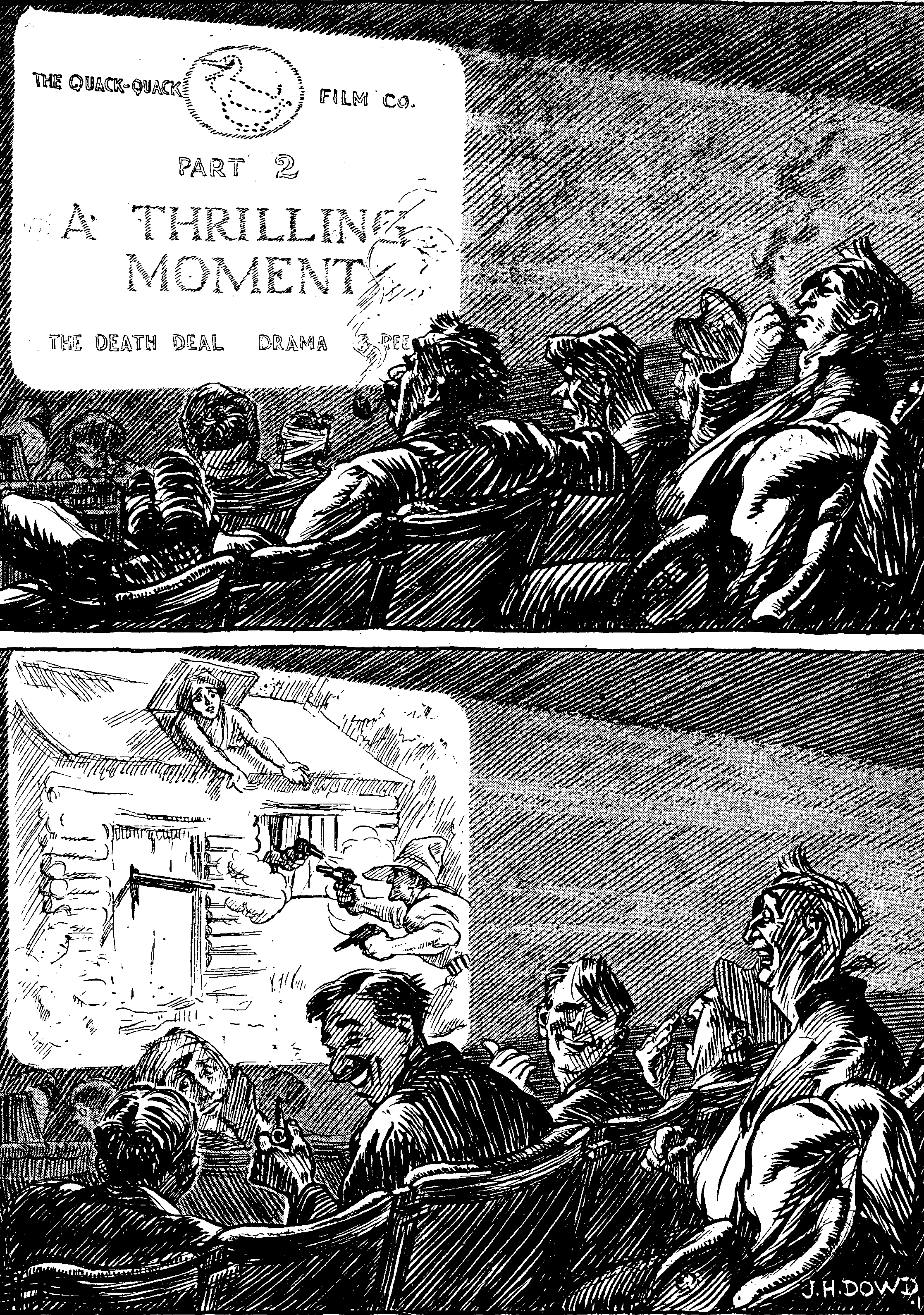
THE FAILURE OF THE FILM-THRILL.
PATIENTS FROM THE LATEST PUSH AT THE PICTURES.