SEEING THE ROYAL WEDDING PRESENTS.
Reading edition
(A Sketch at the Imperial Institute.)
Scene—The North Gallery on a Saturday afternoon, with the thermometer at considerably over 80° in the shade. The presents are arranged behind a long barrier, in front of which the Spectators form a double "queue," the outer rank facing in the opposite direction to the inner line, and both moving at an average rate of one foot every five minutes.
The Attendants (spasmodically). Pass along there, please. Keep moving!
[The crowd close to the barrier either cannot or will not pay the slightest attention to these injunctions, and remain placidly gazing at whatever happens to be in front of them; the people in the outside line, who can see just enough to tantalise them, begin to exhibit signs of impatience.
A Sour-looking Spinster. Well, I'm sure! They might remember there's others that would like to have a look besides themselves! Some of them seem to have made up their minds to spend the whole day here! (With a withering glance at a stout lady in the inner rank.) How anyone can call herself a lady and spend fifteen minutes downright gloating at nothing but cigarette cases—well, I should be sorry to be so disobliging myself!
[The stout lady, who has exhausted the cigarette cases long ago, but can't move on until those in front of her have thoroughly inspected the jewels, fans herself with a pocket-handkerchief, and pretends not to have heard.
A Cheery Old Lady (to her Grand-daughter). Well, they do make you wait, there's no denying—but we shall see everythink some time or other. 'Ot, Minnie? Yes, it is 'ot, and they're pushing in front as well as beyind, now; but lor, my dear, we must put up with sech things when we come out like this. And you can ketch a glimpse in and between like, as it is. I can see the top of a Grandfather's Clock. It won't take us 'alf an hour now, at the rate we're going, to git round the turn, and then we shall be next the barrier, and 'ave a little more room. There, they're beginning to move a bit. (The line advances about a yard.) Now we're getting along beautiful!
A Purple-faced Old Gentleman (in a perspiration). It's scandalous! These people inside aren't attempting to move along. (To the inner rank.) Will you kindly pass on, and give others a chance? Do pass along there! (The people in the inner row maintain a bland unconsciousness, which is too much for his feelings.) D—n it! why can't you pass along when you're asked to?
The Usual Comic Cockney. It's no good torkin' perlitely to 'em, guv'nor; you touch some on 'em up with your umberella. Why, there's two old ladies aside o' me that 'ave gone and 'ipnotised theirselves starin' at silver kendlesticks!
A Plaintive Female (to a smart young constable). Oh, Mr. Policeman, do make 'em 'urry up there!
[The constable prudently declines to attempt the impossible, and merely smiles with pitying superiority.
Mrs. Lavender Salt (who has insisted on her husband escorting her). Lavender, what a frightful crush! I don't believe we've moved for the last twenty minutes, and I'm nearly dead with the heat!
Mr. L. S. (with irritating common sense). Well, Mimosa, you don't suppose I'm enjoying myself? After all, if you don't like the crush, the remedy's simple. You've only to step out of it into the grounds, you know—there is some air there!
Mrs. L. S. What? and give up our places after going through so much? No, Lavender, it would be too absurd to have to go away without seeing the Royal Presents after all!
Mr. L. S. But is it worth all this pushing and squeezing? Why, you can see much the same sort of thing any day in perfect comfort by simply walking down Bond Street!
Mrs. L. S. You wouldn't say so if you had the least scrap of imagination! It isn't the things themselves one comes to see—it's the sentiment attached to them!
Mr. L. S. Oh, is that it? Well, I can make out the upper part of a weighing machine over your shoulder, but I can't say I discover any particular sentiment attached to that.
Mrs. L. S. (impatiently). Oh, if you choose to sneer at everything, of course you can, but it's looking at things like these that makes us the loyal nation we are, Lavender!
Mr. L. S. My dear Mimosa, I give you my solemn word that if I remain opposite those Chippendale bookcases ten minutes longer I shall become a gibbering anarchist! Surely we can be loyal without such a painful resemblance to a box of dried figs.
[Mrs. L. S. shudders at these revolutionary sentiments.
A New Comer (arriving with a friend, and craning curiously over the shoulders of the spectators in posse, to their intense indignation). 'Ere they are, Joe. I can see a lot o' silver inkstands. We'll get a view if we shove in 'ere.
[He attempts to edge through the double rank.
The Purple-faced Old Gentleman. I protest against your pushing in here, Sir. We're hot enough already without that. It's monstrously unfair!
The New Comer. I s'pose I've got as much right to see the bloomin' Presents as what you 'ave?
The P.-f. O. G. You've no right to push in out of your turn, Sir. You must take your proper place down at the end of the queue and wait, like everybody else.
The New Comer. What, all the way down there, and 'ow long might I have to wait, now?
The P.-f. O. G. (with tremendous dignity). That I can't say, Sir. I can only tell you this—that I have been standing here myself for over three-quarters of an hour without advancing ten yards or seeing anything distinctly, and so have all these ladies and gentlemen.
The New Comer. Hor, hor, hor! D'jear that, Joe? Ten yards in three-quarters of an hour! What price snails, eh? Well, Sir, if that's your ideer of amusin' yourself on a warm afternoon, it ain't mine, so you'll excuse me and my friend 'ere joinin' your little percession. Don't lose 'art, Sir, keep on at it. You'll git there afore bedtime if you don't overexert yourselves. Take it easy now!
[They pass on with ribald laughter, to the general relief. Eventually, after infinite delay and maddening exhortations to "keep moving," the outer queue succeed to the barrier and to the unpopularity enjoyed by their predecessors.
Along the Barrier.
Now we shan't be nearly so squeeged, Minnie! There's nothing partickler to look at just yet, except kerridges.... It's not the smallest use telling us to hurry, my good woman, because we can't move till those in front choose to go on.... Look at the 'arness, Minnie—pretty 'arness, ain't it? with their crest on it and all!... Well, I call it shabby givin' 'em a kerridge without even so much as a old moke to dror it. I'd ha' done it 'ansome, or not at all.... Lor, look at the dust on all the furniture—it will want cleanin' up!... That's a beautiful gong, Minnie; see, that's the thing they 'it it with.... Ain't that a comfortable looking chair in red moroccer? That'll be for the 'all porter to set in, I expect—there's a 'at in it. Lor no, my dear, it 'ud ha' been a better lookin' 'at than what that is, if it was one of the presents, depend on it! There's a weighin' machine.... Fancy goin' and givin' them a thing like that! Oh, I expect it's for them to weigh theirselves with. Ah, 'ere come the Jewels now. Now we shall see somethink!... I don't see our present yet, do you, 'Arriet? There's old Uncle Bill's. See, that dimond and pearl necklace. Well, if they ain't gone and put it down as "Persented by six 'undred and fifty ladies of England!" And the old man savin' up his screw for weeks for it—he will be 'urt when he 'ears of it! Some bloke's gone and given 'em a pillar-post box. I thought of sendin' the one at our corner, on'y it wouldn't come out easy: and what with the copper bein' on his beat—why, I decided I'd give 'em somethink else.... Walking-sticks? Why, he wouldn't want more if he was a—a centipede!... I wonder where they'll put all the things, I'm sure! 'Ullo, a pearl and dimond tiarer, made o' cardboard. I 'ope they thanked 'im nicely for that! Why, that's on'y a model, like. Well, and a very good model, too, what I call eckernomical.... Look at those lovely toast-racks!... Lavender, what a magnificent old mirror!—Elizabethan, I expect. I wonder who gave that?... Oh, me and 'Arriet give 'er that, mum.... Oh, dear, I wish I was them, to have all these presents.... Why, my dear, it doesn't matter to them—they have everything lovely as it is!... 'Arriet, when you and me git married, we'll 'ave a show of all our presents—not 'ere, there won't be no room. We'll take the Agricultural 'All, and have a catalogue and everythink. "Set of Elizabethian sheep's trotters, from the Hearl of Alamode." eh? "Pound of Queen Anne saveloys, from the Markis o' Mile-end." "Yard o' flypaper, from the Dook o' Shoreditch." "Packet of 'airpins, persented by seven 'underd lydies of Whitechapel." "Donkey-barrer an' kerridge-rug, from the residents in the Ole Kent Road." Etceterer ... I do wish you wouldn't go on so foolish! Why, if someone hain't sent her a set o' straw soles to keep her shoes dry—what next, I wonder!... And a very sensible thing too.... Well, my dear, I'm sure nothing can't be too good for her, and they've certainly been set up with every blessing a young couple can require—and may they live long to enjoy them!
[And so says Mr. Punch.
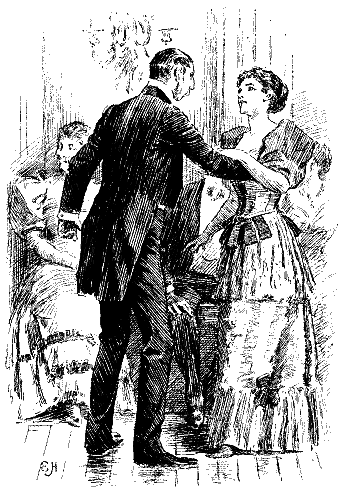
A SLAVE TO COURTESY.
He. "Do you mind stoppin' a bit now. I get rather giddy, don'tcherknow."
She. "But if you get Giddy, why do you come to Dances?"
He. "Well, I'm a Bachelor and that sort of thing, and it's the only way I can see of repayin' Hospitality."
Parliamentary Declension.
Nominative—M.P. "named." Genitive—M.P. in possession of the House. Dative—Giving it hot to M.P. Accusative—Charge against M.P. Vocative—"O! O!" and (pro-vocative cries). Ablative—M.P. is removed in custody of Serjeant-at-Arms.
The subject of conversation in the presence of Mrs. R. was the Darlington magistrates' decision in the palmistry case. "Yet," remarked our old friend, thoughtfully, "palmistry is very ancient, and practised professionally by most excellent and good people. Isn't David always spoken of as 'The Palmist'?"
THE SONG OF THE SHOPKEEPER.
Will the Season be long? Will the Season be short? Parliament's going strong! Plenty of stir at Court! Cholera rumours abroad, Summer weather at home, Us a chance may afford; I only hope it may come! Royal Marriage over! Money remarkably "tight"! Landlords may live in clover. Shopkeepers' pull seems slight. Will some of our Oracles clever Tell a poor chap what he axes? For three things go on for ever, And those are Rents, Rates, and Taxes!
THE VOLUNTEERS' VADE MECUM.
(For the Centre Weeks of July.)
Question. Do you prefer Bisley to Wimbledon?
Answer. Officially, yes; as a civilian, no.
Q. Why do you make the distinction?
A. Because I go to Bisley in a double capacity.
Q. Why do you prefer Bisley to Wimbledon officially?
A. Because there are no distractions, and the ranges are less subject to atmospheric interruption.
Q. Why do you prefer Wimbledon to Bisley as a civilian?
A. Because Wimbledon was an extremely cheery place, where you could entertain your friends to your heart's content, and have a generally good time of it.
Q. Can you not obtain the same advantages at Bisley?
A. Certainly not. You are in the neighbourhood of Woking Cemetery, and that melancholy spot influences its surroundings.
Q. But were you not always regretting the attractions of Wimbledon when you were in Surrey?
A. Certainly, because they lured me from work.
Q. Do you still regret them?
A. More than ever, because they were certainly pleasanter than the attractions of Bisley.
Q. And now, in conclusion, what do you think of this year's shooting?
A. The same as former years.
Q. What do you mean by that?
A. That those who win owe their good shots to flukes, and those who fail have to thank their rifles, and the state of the weather.
"So Like Them!"—Of all the numerous "memorials" of the Royal Wedding, Count Walery's "Wedding Number of Photographic Portraits" takes the wedding cake. It is priced at three shillings and sixpence, and for this you get one English sovereign and "royalties." If this isn't good value for money we don't know what is.
The Skirt-Dancer, or Unlimited Loie-ability.—When a theatre is doing "good business," and is crammed in every part, placards are exhibited, announcing "Pit Full, Stalls Full, Boxes Full," &c., &c. But at the Gaiety just now, where Miss Loie Fuller is appearing, the management might simply put up outside the simple statement of fact—"Fuller Every Evening!"
The Eclipse Riddle.—Why didn't La Flèche win the Eclipse Stakes?—Because she wanted to keep out of Orme's way.
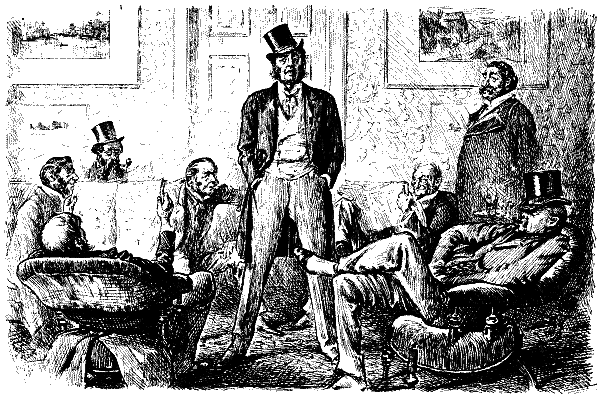
THINGS ONE WOULD RATHER HAVE EXPRESSED DIFFERENTLY.
Sir Pompey (so much in earnest that he forgets his Grammar). "Well, all I can say is this, that what I give in Charity is Nothing to Nobody!"