MRS. NICKLEBY IN THE CHAIR.
Reading edition
LAYS OF MODERN HOME.
THE FIRST COOK!
Oh! the first Cook, in that ambrosial, unwithering Halcyon, rapturous, and honeymooning prime!— She, who, aware of Helen's babyish and blithering Innocence, did a lot of mischief in her time. Oh! for her soup, a weird, insuperable fearfulness, Compound of arrowroot, and gelatine, and lard; Hard, to reject it, when a bride besought, with tearfulness, Hard, to accept, and to assimilate it, hard!
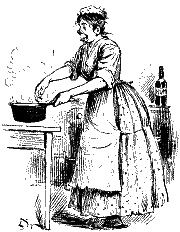
Oh! for her leather-like, her nauseating omelette, Oh! for her cutlets and potatoes black as ink! Oft, of necessity, would I the Buttons, Tommy, let Batten on luxuries that bothered him, I think.
And she would mingle, would that woman who did that to me, Proofs incontestable with everything I ate, Whereby the veriest beginner of anatomy Knew that she must be in complexion a brunette.
Wild were her sauces, like herself, devoid of reasoning; Still I have never been indubitably clear, Why the invariable factor in her seasoning Always reminded me so forcibly of Beer.
Why, when my darling sighed, "The weekly books are ready, Ted," And I rejoined that we were thin while they were fat,— Why, their increasing superfluities were credited All to a manifestly unoffending cat. Why, when a joint of whatsoever solid vastiness Quitted the dining-room, it never came again; Why my allusions to her culinary nastiness Only encouraged her, it beats me to explain. True, for our wages, which were somewhere near the "Twenty-ones," Great expectations would have been a trifle rash. Still, as her perquisites, I know, were cent.-per-cent.-y ones, Ah! how I wish a Chef had fed us for the cash! Oh! my first Cook! A gem with so much rare and rich in her, Irreconcileable, impenetrable soul, How I exulted when she fell against the kitchener, Urged by a Nemesis (and legs) beyond control. How, when my fluttered pet, believing her immaculate, Hied to her aid, and heard, "You ain't a Lady, Mum!" How I was forced to rather brutally ejaculate, "Rum! Very rum!—you see the cause of it is 'rum.'" Oh! that first year of married paradise! My attitude Somehow, my sweet, on this our second Wedding-day, Needs must be one of unadulterated gratitude, Since we survive the Cook, you wept to send away!
"Has Left but the Name."—The intention of the original starters of the Aquarium was presumably to exhibit fish of all sorts, all alive oh! and quite at home. Nowadays, very little about fish is to be found in the advertisements. The fish are, it may be supposed, "taken for granted." They are conspicuous by their absence; but instead you read how "a human being dives," how somebody conjures, how there are "miraculous feats," and "four-legged dancers," and "baby elephants" waltzing and drum-playing; how somebody of some importance "walks upside down in mid-air;" how there are "serpentine" dancers, "pantomimists," "duettists," and, finally, the "boxing kangaroo," so that altogether the Aquarium may still congratulate itself on a show of about the "queerest, oddest fish" in the world.
WHAT'S IN A NAME?
["At the World's Fair, in Chicago, the other day, the Rev. John Jameson, of Virginia, smashed a stand containing an exhibit of Irish Whiskey."]
What's this? Am I dreaming? I fancy I am: But no—it is printed without any flam. "The Reverend gentleman stood by the stand, With a hickory cudgel upraised in his hand. Then, with fury and fire in his clerical eye, This temperate priest on the bottles let fly." Oh, the waste of good liquor; to think there should be A man who with whiskey would dare to make free; And to think—which but adds to the sin and the shame— That the spoiler of whiskey should own such a name. One might sooner expect that some learned Q. C. Should abjure what he lives by, and welcomes—a fee; That a judge should break laws, or a gaoler break chains, Or a "guinea-pig" turn in disgust from his gains; That a bookie should preach, or a bishop should bet, That a slave of the Season should break etiquette; A landlord proclaim his dislike of his rent, Sleek Moses protest against eighty per cent; That a priest should cast doubts on a stole or a cope, Or Pe*rs hint a fault in the worth of his soap. Such sights would be strange, but they cannot compare With the sight that was seen t'other day at the Fair, When John Jameson smashed (or the newspapers fib it) With his hickory cudgel a whiskey-exhibit.
THE LATEST PARISIAN "ROMANCE."
(Translated from the original French Canard.)
THEY were hunting him down. They had traced him from spot to spot. Now he was in the barracks bribing the Army, now in the Ministerial Bureau offering gold to the Members of the Government, now in the office of the leading newspaper arranging for back pages in advertisements at double the scale price. His pernicious influence was felt everywhere. The whole body was permeated with a poisonous atmosphere of corruption.
"We shall have him now," said the first detective, as he looked to the lock of his revolver.
"No doubt about it," returned the other, as he loosed his sword in its scabbard. "He cannot escape us."
Then the force of cavalry, infantry and artillery in attendance raised a stealthy cheer. It had been difficult to bring the charges home to the accused, but they had succeeded. It seemed impossible to prove his identity, but now they had surrounded him. It was only a question of a few minutes, and he would be their prisoner.
The detectives entered the café. They looked around them. They could see no one answering to his description. All who were there had black beards, black shaggy hair. They could see no red tresses, no yellow Dundreary whiskers and prominent front teeth. Where could he be?
"Yes, there is one diner who has ordered a singular meal," replied a garçon, in reply to a question. "He has asked for turtle-soup, raw herrings, raw beef, raw mutton chops, plum-pudding and a barrel of porter-beer."
"It must be he," cried the detectives, in a breath; "only an Englishman would want such a meal."
"And he asked for the Times and Punch," added the waiter.
"Proof conclusive of nationality;" and in a moment the man was surrounded and seized.
"You dare not touch me," he shouted, battling with his captors. "I am sacred, and if you offer violence you pledge your country to a terrible war!"
Impressed by the stranger's vehemence, the detectives released him. Once free, he threw off his black wig, took off his false nose, and put on his blue spectacles. Then he gazed around him proudly.
"We ask your pardon, M. l'Ambassadeur," said the police.
"It is granted," returned their now-released prisoner, and he entered his carriage. "I would have preferred to preserve my incognito, but your interference has compelled me to reveal my identity. And now, home."
And the coachman drove the Ambassador to a grand mansion in the Rue Faubourg St. Honoré.
Sequel (from the original English).
And when the Ambassador read the above, he came back to his native land, and observed, "I think I have had enough of this."
And everyone at home agreed with him.
By Our Out-and-Out-every-Evening Man.—Mem. The only endurable "Squash" in this hot weather is "Lemon Squash."