OUR OPERA.
Reading edition
To hear sweet strains by Glück or Gounod, Mascagni, Wagner, one must, you know, Pass slums; at dark it Is nice in Endell Street and Bow Street; Still better in that fragrant nose treat— "Mudsalad Market." Inside, say, Orpheus sings in Hades To gallant men and noble ladies— Rank, wealth, and beauty; Outside, Elysium is forgotten. To clear away these slums, half rotten, Is no one's duty. Inside, Mascagni's Intermezzo, Though heard in many places, yet so Delightful ever; Outside, cab touts and paper sellers, And other people's pert Sam Weller's, Delightful never! Inside, some day, the newest, Falstaff, Will occupy a far from small staff Of band and chorus; Outside, as now, old slums ill-smelling, And costermongers, shouting, yelling, Will be before us. Once someone started building greatly, Walls rose, arranged to form quite stately House, foyers, lobbies. They stopped, extremely gaunt and lonely, And, now the site is used, it's only A haunt of bobbies. So still Euterpe's home is hidden In ill-paved slums, through which we've ridden With jolts that jerk us. How unlike Paris! Did we follow Her taste, we should enshrine Apollo At Regent Circus.
JUST CAUSE.
I love you for your splendid hair, Your violet eyes, your swaying waist, Whose curves exactly suit my taste; Your radiant smile, your dimples rare. I love you for your store of pelf, Of course; but most of all, my sweet, Because of this—whene'er we meet, You let me talk about myself!
ODE DE KNILL—AND CO.
Making Something of Nothing!!—Lord Mayor Knill has been created a Baronet. Sheriffs Wilkin and Renals, as being next to Nil, have been knighted.
"Nobodies" have been Baronets, but still 'Tis wondrous to create one out of Nil! The Middlesex Artillery Volunteers Will "make the Wilkin ring" with hearty cheers. And for the last, he'll bear his honours meekly, He's Renals "going strong," not "Renals Weakly." (For the last, understand Reynolds' Weekly.)
Good Egg-sample!—One egg was sold the other day for £60 18s. Vide Times of Wednesday last. The egg was a perfect specimen of that rara avis in terris, the gigantic Aepyornis Maximus of Madagascar. What did Mr. Stevens do with it? Did he have it made into several omelettes for a breakfast-party of a dozen? Of course it was a perfectly fresh egg, and the only thing at all high about it was the price.
From the Camp.—Just now Riflemen are Bis'ley engaged.
A FALLEN ART.
[A "lady palmist" has been fined ten shillings and costs for fortune-telling.—Daily News.]
She lived, this prophetess, too late, And plied an art that's out of date, Another age had seen her gain Her reputation not in vain, Had seen a crowd respectful wait Upon the arbiter of fate, While kings and rulers brought her gold To have futurity unrolled! In some Greek court where fountains play, Or dwelling by the Appian way, The prophetess would surely be Besought by each Leuconoë, And if for these she sometimes drew A future pleasanter than true, At least she gave them, you'll confess, Anticipated happiness! Ah! times are changed, and nowadays Such divination hardly pays; There comes no more the crowds that used, The fees are terribly reduced! And if our policemen caught the Sphinx Propounding "Missing Words," one thinks Our British justice could not fail To send her speedily to gaol!
Impy and Garry.—Colonel Saunderson, "speaking as an Irishman" (did anyone ever hear the gallant Colonel speak as an Englishman?), didn't object to being classed among his countrymen, whom Mr. BRODRICK had styled "impecunious and garrulous." He might have quoted the name of one of their own national airs as emphasizing, by descriptively abbreviating, these two epithets, namely, "Garryowen." "Garry" is clearly the short for "garrulous," and "owen" is the oldest form of "not payin'."
A "TURKISH OCCUPATION;" OR, VISIONS IN SMOKE.
"The Khedive has been the object of numerous marks of personal friendship on the Sultan's part."
—Times Correspondent at Constantinople.
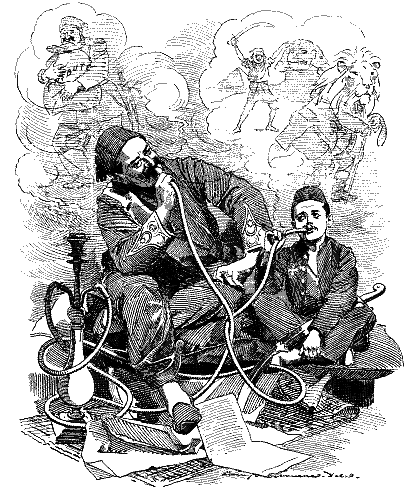
Sultan (amicably). Welcome, dear Abbas! Take a seat, and a pipe—take anything you have a mind to, and "make yourself at home," as the accursed Giaours say.
Khedive (squatting). Thanks, my dear—Suzerain! Yildiz Kiosk feels, indeed, very home-like. More than my own Cairo does—when Cromer's there. This Nichan-i-Imtiaz Order is really very becoming. Pity you and I, Abdul, have to take "orders" from anybody west of Alexandria!
Sultan (sotto voce). And why should we?
Khedive (sulkily). Well, the sons of burnt fathers have got the upper hand of the Faithful, somehow—confound them!
Sultan (reading). "Intelligence received here of late, from trustworthy quarters in Egypt, indicates that the Khedive's journey is to be made the point of departure for a grande action diplomatique against British influence in the Valley of the Nile." That's from the Times, my Abbas!
Khedive (moodily). Humph! Wish the Egyptian quarters were "trustworthy." Grande action diplomatique? Quite makes one's mouth water!
Sultan. Doesn't it? The same infernal—but influential—news-sheet says: "The young Khedive knows that not only would he meet with a personally kindly reception, but that the grievances he is known to be anxious to pour out would fall on ready ears." There, at least, the Giaour "rag" is right. Pour away, my Abbas! "Keep your eye on your father—or Suzerain—and he will pull you through."
[Winks and whiffs.
Khedive (whiffing and winking). Will he, though? And that Turkish Bodyguard?
Sultan (warmly). At your service at any moment, my dear Abbas!
Khedive (smoking furiously with closed eyes). Ah! if they would only let me alone, let me rule my subjects in my own Oriental way—as you do yours in Armenia, for example—then, indeed, I could have a good time, and plenty of treasure.
Sultan (significantly). Out of which my little formal trifle of Tribute might come easily and regularly—eh, Abbas?
Khedive. Quite so, Padishah! Bah! These brutal, blundering Britishers don't understand the Art of Government as adapted to Eastern Ideas.
Sultan (soothingly). Well, never mind, Abbas. We'll lay our heads together, anon, now you are here, and—who knows? Meanwhile, let's enjoy ourselves. Something like a "Turkish Occupation" this—eh? And how do you like this Turkish tobacco?
Khedive (blowing vigorously). Smokes easily, and makes a big cloud. In which I fancy I can see myself driving the British Lion out of the Nile Valley at the point of the bayonet.
Sultan (dreamily). And I picture myself comfortably replenishing my Treasury with that Tribute! Like music, ABBAS?
Khedive (uneasily). Ye-e-e-s. Why!
Sultan (promptly). Then I'll tip you something soothing.
[Sings.
I'll sing thee songs of Arabi, And tales of far Cash ne-ar! Strange yarns to move thee to a smile, Or melt thee to a te-ar! And dreams of delight shall hover bright, And smoke-born vi-i-sions rise Of artful "fake," which well may wake Wild wonder in thine eyes. I'll move thee to a smile With dreams of far Cash ne-e-e-e-ar!
[Left dreaming.
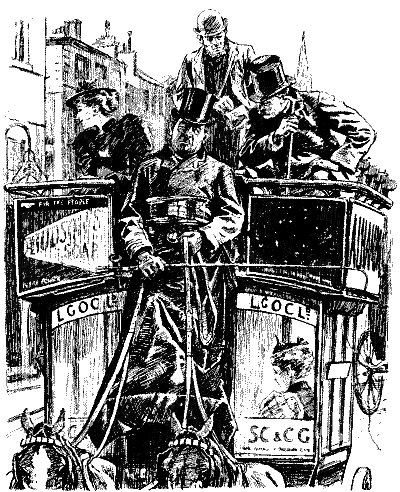
LACONIC.
Passenger. "Can you tell me what are the Times for these 'Busses to leave the Swiss Cottage?"
Driver. "Quarter after—'Arf after—Quarter to—and At!"
A VISION OF ROYALTY.
(Written after a surfeit of the Illustrated Papers.)
Ye Royalties of England, how beautiful ye are! The special artists claim you, they track you from afar. In uniforms and diamonds, with sceptre and with crown, In many a picture-paper those artists set you down. And thus the British public may gaze upon its Queen— They make her small, but dignified, of most majestic mien. She smiles—the artist marks her; she frowns—the artist quails, And soothes himself by drawing H.R.H. the Prince of Wales. He draws him at foundation stones, a trowel in his hand (The point of silver trowels I ne'er could understand); He draws him opening railways, or turning sods of grass, And he draws him as a Colonel, in helmet and cuirasse. We see him dressed for London, a-riding in the Row— I wonder if he ever finds his London pleasures slow; And we see him down at Sandringham, his country-home in Norfolk, Where the Royal pair are much beloved, especially by poor folk. And oft at public dinners, in Garter and in Star, We see his Royal Highness enjoying his cigar. I wish they wouldn't vary quite so much his Royal figure. For they sometimes make him leaner, and sometimes make him bigger. But, be that as it may, I feel that, while my life endures, I know by heart my Prince's face, my future King's contours. A stiff examination in the Prince of Wales I'd pass, And in all his princely attitudes they'd give me a first-class. The Duke of York, our Sailor Prince, I think I've got him pat; I've never seen him face to face, but what's the odds of that? In illustrated papers I have watched him every day Since he went and popped the question to the pretty Princess May. I've seen them plain or coloured in fifty different styles, Just like a pair of turtle-doves, all bills and coos and smiles. I never saw a turtle-dove that smiled upon its pet afore, But he who writes of bridal pairs is bound to use the metaphor. Oh, Princess May, oh, Princess May, in crayon or in oil you Are loveable and beautiful, they can't avail to spoil you. They did their worst, and did it well, those special-artist wretches, To make you like a stolid block in all their special sketches. So this, my meek petition, to those artists is addressed, Give Royalties of every sort a little welcome rest. I cannot bear my Royal ones—of loyalty I'm full— To look like wax and sawdust, with limbs of cotton-wool. And thus, when next you draw them (oh, may the time be long) To make them human beings will surely not be wrong. And if you'll take a hint from me you'll earn a nation's thanks, By drawing these prize princely ones a little less like blanks.
Lines in Pleasant Places.—Sala's Journal, full of interesting and entertaining matter, has lately been giving very sensible advice as to Palmistry, which is again in vogue. The Palmists appear to be doing so uncommonly well just now, that this year will be memorable, for them at least, as "the Palmy days" of chiromancy.
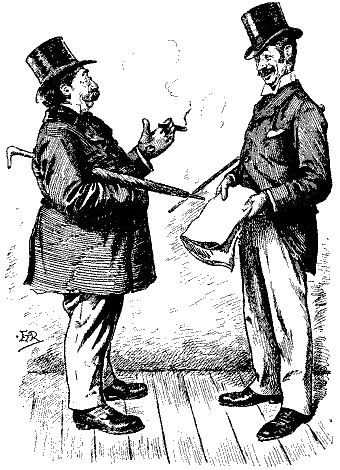
ENGLISH AS SHE IS "SCHPOGEN."
Herr Dumpling (a "Deacher of Englisch" who has made the most of his holiday during the Royal Marriage week). "Zertainly, I haf zeen ze Vedding-brozess, ze Gween, and ze gliddering Goaches, and ze Naidive Droobs; and in ze Evening neffer haf I zeen so peudiful Gas-works! Bot, ach Himmel, how vas I ofergrowded!"