QUEER ENGLISH.
Reading edition
We are delighted—everyone is delighted, and that is much the same thing—to know that Mrs. Bancroft is by this time on the high road to recovery from the effects of what might have been a serious accident. The "inimitable" was in a Hansom, when the horse suddenly fell. Had Mrs. Bancroft been only what is professionally known as "A Walking Lady," this could not have happened. The Daily Telegraph's account of it informed us that "Mr. Blakeley, now of the Criterion Theatre, and once a member of Mr. and Mrs. Bancroft's own company, who was happily passing immediately after the occurrence, was the means of having the lady taken to her private residence." Mr. Blakeley is always "happy" in any part he undertakes, nihil tetigit quod non ornavit, and no doubt he was "happily passing," perhaps gaily whistling, lightly stepping, merrily twirling a stick, and walking along "thinking of nothing at all," when he became aware of the danger to the popular ex-manageress, which at once changed his note from a tenner to an alto: in fact alto-gether altered it. [The above comment would have been impossible had the reporter stated that, "Happily for Mrs. Bancroft, Mr. Blakeley, &c., &c., was passing at the moment, and, &c., &c."]
"Ben Trovato!"—Yes, found at last; this Ben is Mr. Ben Davies, who sang five songs before the Queen, that is—to avoid all appearance of rudeness—in Her Gracious Majesty's presence, one day last week. He is now "Big Ben Trovato-re" in chief, and long may he remain so.
A Proper Name.—That peculiar but not uncommon ornithological species known as "Gaol-birds" ought to be kept in a Knave-iary.
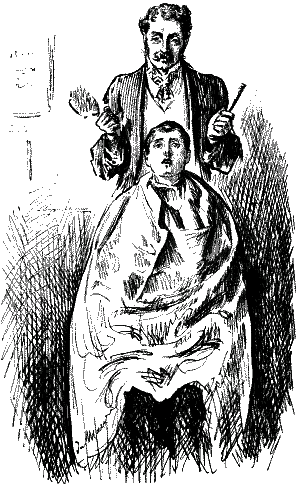
TOO CONSCIENTIOUS BY HALF.
"Is that enough, Sir?"
"Yes; that'll do very well. And now shave me, please."
"I ought to mention that Shaving is Threepence extra, Sir. Do you really think it's worth while?"
FROM PROFESSOR MUDDLE.
Dear Mr. Punch,—Your poet (in this week's issue) reminds me of my own unfortunate experience. Ever since I read that inspired work, Alice in Blunderland, I do not seem to be able to give a correct version of any of the poems I have long been accustomed to repeat or sing. After dinner the other night I was asked to sing, and gave a well-known song as follows:—
Think of me only with thy nose, No words need then be said; Or kiss me sweetly with thine ears, No lips are half so red. The thirst that in my body burns Demands both food and wine, So when I next shall call on thee You'll know I've come to dine. Thou sent'st me late a rose-bud fair, Not so much honouring me As hoping near my heart I'd wear It all for love of thee. But I returned it through the post— Forgive me, if you can— Since when I trow thou hast found out I'm not a marrying man.
De Trop.—The last item of the menu, as given in the World, of the Royal Wedding Breakfast, after the sweets, was named in plain English,—all the previous dishes being given in French,—"cold roast fowls." But how on earth after four courses and sweets, finishing with "Pâtisserie assortie," could anyone have the conscience—we put it in this way—to ask for and to eat any portion of "cold roast fowls"?
"This is a Goak."—The Weekly Register, recording the event of a Baronetcy being conferred on the present Lord Mayor, remarks, "With him we know the honour will be no barren one." Very good, W. R. The italics are ours, just to emphasize the pun.