Volume 104 — THE MAN FROM BLANKLEYS.
Reading edition
A Story in Scenes.
Scene XI.—The Drawing-room. Mrs. Gilwattle is still unable to express her feelings by more than a contemptuous glare.
Uncle Gabriel. My—ah—love, you didn't hear me. I was saying I've almost prevailed on his Lordship——
Mrs. Gilwattle (becoming articulate). His Lordship, indeed! If that's a Lord, I don't wonder you're such a Radical!
Uncle Gab. Why—why—what's come to you, Joanna? My Lord, I hope you'll excuse her—she's a little——
Mrs. Gil. Fiddlesticks! You've been made a fool of, Gabriel! Can't you see for yourself that he's neither the manners nor yet the appearance of a real nobleman—or anything but what he is?
Uncle Gab. (dropping Lord S.'s arm). Eh? If you're not a Lord, Sir, what else are you?
Lord Strath. (wavering between wrath and amusement). Afraid I can't enlighten you—I'm extremely curious to know myself.
Mrs. Tid. (distractedly). Oh, Aunt, it wasn't my fault, really! Montague would have him! And—and we sent round to say he wouldn't be required—we did indeed! Please, please don't tell anybody!
Mrs. Gil. (rigidly). It is my duty to let everyone here know how disgracefully we have been insulted to-night, Maria, and might have gone away in ignorance, but for that innocent child—who has done nothing, that I can see, to deserve being shaken like that! I'm not going to sit by in silence and see a man passed off as a Lord who is nothing more nor less than one of the assistants out of Blankley's shop, hired to come and fill a vacant seat! Yes, Gabriel, if you doubt my word, look at Maria—and now ask that young man to dine!
[Profound sensation among the company.
Uncle Gab. I—ah—withdraw the invitation, of course—it is cancelled, Sir, cancelled!
Feminine Murmur. I had a feeling, the moment he came in, as if—so thankful now I didn't commit myself by so much as—ah, my dear, it all comes from a desire to make a show!—&c., &c.
Uncle Gab. It's the bare-faced impudence of coming here on false pretences, that I can't get over. Come, Mr. Shopwalker, Counterjumper, or whatever you really are, what have you got to say for yourself?
Lord Strath. Say? Why——
[He struggles to control his countenance for a moment, until he is convulsed at last by irrepressible laughter.
All (except the Tidmarshes). He's laughing—positively laughing at Us! The brazenness of it!
Lord Strath. (regaining composure). I—I'm awfully sorry, but it struck me suddenly as so——After all, the joke is only against myself. (To himself.) Must try and get my unfortunate hostess out of this fix—not that she deserves it! (Aloud.) If you will kindly let me explain, I think I can——
Mr. Tid. (suddenly). Oh, hang explaining! It's all out now, and you'd better leave it there!
Lord Strath. I can't, indeed. I must make you all understand that this well-meaning lady with the highly-developed sense of duty has done our host and hostess a grave injustice, besides paying me a compliment I don't deserve. I'm sorry to say I can't claim to be half as useful a member of the community as any of the very obliging and attentive gentlemen in Mr. Blankley's employment. If I'm anything, I'm a—an Egyptologist, in an amateur sort of way, you know. A—in fact, I'm writing a book on Ancient Egypt.
The Others. A literary man! As if that made it any better!
Lord Strath. I merely mention it because it led me to write to Mr. Cartouche—whom I happened to hear of as a famous collector—and ask to be allowed to call and inspect his collection. Mr. Cartouche (who lives, I believe, at No. 92, next door) very kindly wrote, giving me leave, and inviting me to dine at the same time, and—I know it was unpardonably careless of me—but somehow I came here instead, and, Mr. and Mrs. Tidmarsh being both too—er—hospitable to undeceive me, I never found my mistake out till too late to put it right, without inconveniencing everybody. That's really all.
[Uneasy reaction in the company.
Uncle Gab. (pompously). Ha—hum—no doubt that puts a somewhat different complexion on the case, but it doesn't explain your conduct in calling yourself Lord Strathfoozleum, or whatever it was.
Lord Strath. I think you mean Strathsporran. I did call myself that, because it happens to be my name.
Mrs. Tid. (passionately). I don't believe it.... I can't. If it is, why did Miss Seaton call you "Mr. Claypole"?
Lord Strath. I beg your pardon—Claymore. Because, when we last met, I was Douglas Claymore, with no prospect whatever, as it seemed then, of being anything else.
Mrs. Tid. (faintly). Then he really is—Oh!
[She sinks on the couch, crushed.
Uncle Gab. Ha, well, my Lord, I'm glad this little misunderstanding is so satisfactorily cleared up, and if I may venture to hope for the honour of your company,—shall we say Friday wee——(Lord S. looks at him steadily.) Oh, if your Lordship has some better engagement, well and good. Makes no difference to me I assure you. Joanna, our carriage must be here by now, say good-bye and have done with it! Good-night, Maria, I'll see you don't expose me to this again!
Scene XII.—The guests have all taken leave with extremely frosty farewells; Mr. Tidmarsh is downstairs superintending their departure. Gwennie has been pardoned on Lord S.'s intercession, and dismissed, in much bewilderment, to bed. Mrs. Tidmarsh and Lord Strathsporran are alone.
Mrs. Tid. (hysterically). Oh, Lord Strathsporran, when I think how I——What can I ever say to you?
Lord Strath. Only, I hope, that you forgive my stupidity in blundering in here as I did, Mrs. Tidmarsh.
Mrs. Tid. It was a good deal your fault. If you had only said who you really were—if my husband had not been idiot enough to misunderstand—if Miss Seaton had been more straightforward, all this would never——!
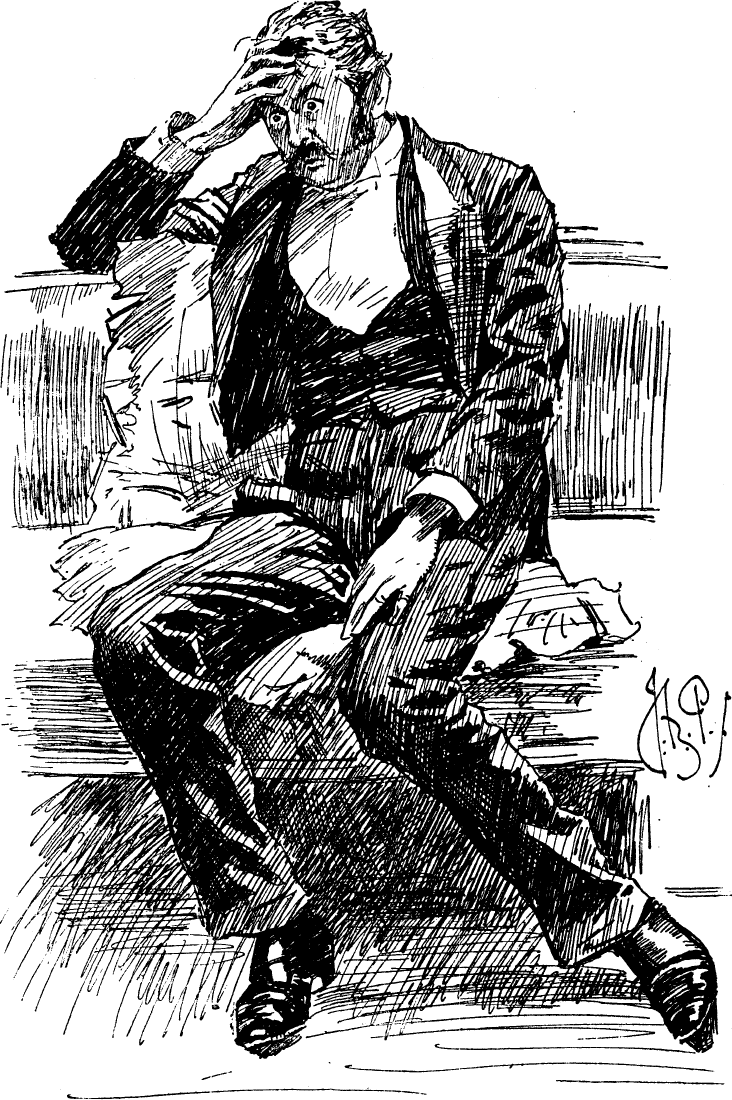
"Sitting down heavily on a Settee."
Lord Strath. We were all the victims of circumstances, weren't we? But I, at least, have no reason to regret it. And, if I may ask one last indulgence, will you—a—let me have an opportunity of saying good-bye to Miss Seaton?
Mrs. Tid. She, she doesn't deserve—Oh, I don't know what I'm saying. Of course, Lord Strathsporran, anything, anything I can do to——I will send her down to you, if you will only wait. She shall not keep you long!
Lord Strath. (alone, to himself). It's an ill wind, &c. I shall have Marjory all to myself, now! To think that—but for a lucky blunder—I should be spelling out scarabs and things on the wrong side of that wall at this moment, and never dreaming that Marjory was so——Ah, she's coming! (Miss Seaton enters, looking pale and disconsolate.) Marjory, you've no idea what you've missed! I must tell you—it's too good to lose. What do you think all these good people have been taking me for? You'll never guess! They actually believed I was hired from Blankley's! Give you my word they did!... Why don't you laugh, Marjory?
Miss Seaton (faintly). I—I am laughing. No, Douglas, I'm not. I can't; I haven't the conscience to. Oh, I never meant you to know—but I must tell you, whatever comes of it! I believed it too, at first. (Tragically.) I did, Douglas!
Lord Strath. Did you though, Marjory? Then, by Jove, I must have looked the character!
Miss Seaton (timidly). I knew you—you weren't very well off, Douglas, and so I fancied you might——Oh, I know it was hateful of me ever to think such a thing, but I did. And you can never really forgive me!
Lord Strath. Couldn't think of it! Shall I tell you something else, Marjory? I've a strong impression that you will not be an inmate of this happy English household much longer.
Miss Seaton. I'm sure I shan't, from Mrs. Tidmarsh's expression just now. But I don't care!
Lord Strath. Don't be reckless. How do you know there isn't a moral lion about? And where will you go next, Marjory?
Miss Seaton (with a shrug). I don't know. I suppose to anybody who wants a Governess, and doesn't mind taking her without a reference, if there is such a person!
Lord Strath. Well, oddly enough, I fancy I know somebody who has been trying for a long time to find a young person of just your age and appearance, and might be induced to waive a reference on a personal interview. (Miss Seaton looks incredulous.)... Marjory, don't you understand? If I hadn't been such a pauper, I'd have spoken long ago, when we were up in Scotland together, only it didn't seem fair then. I—I daresay I've no better chance now; but, at least, I've more right to speak than I had, and—and—will you have me, Marjory? (She turns away.) I—I won't worry you, dear, if you really can't care about me in that way; but—but if you only could, Marjory, even a little!
Miss Seaton. Douglas!...
Same Scene—somewhat later.
Lord Strath. Not yet, Marjory—I can't let you go just yet!... Must I, really? Before I've said half what I wanted!... Well—in one minute, then. And you're coming to my people as soon as you can get out of this, Marjory; and I shall see you every day, till—till we shall never be separated any——Confound it!—who's that? [Mr. Tidmarsh enters suddenly.
Mr. Tid. Oh—er—Lord Strathsporran, sorry to interrupt you, but—hem—my wife, who's feeling too unwell to come down again, desires me to say that, in her opinion, Miss Seaton has been here quite long enough. [Miss Seaton escapes by the back drawing-room.
Lord Strath. I entirely agree with Mrs. Tidmarsh; but I am happy to say that Miss Seaton will not remain here very much longer, as she has just done me the honour of consenting to be my wife. Good night, Sir, and many thanks for a most er—eventful evening.
[He goes out.
Mr. Tid. (making an effort to escort him downstairs, but giving it up, and sitting down heavily on a settee instead). She'll be Lady Strathsporran! And I shall have to break it to Maria—after she's just gone in and stuck a month's salary and immediate notice on her pincushion! Oh, lor—as if my poor wife hadn't trouble enough to bear as it was!
THE END.