THE FOX AND THE GUINEA-PIGS.
Reading edition
(A Financial Fable.)
["There are dozens of Companies now existing with the Duke of Puffball, Sir Bonus Bare-acres, Bart., Major Guinea Pig, M.P., and the like, figuring upon the Board of Directors. A short, but drastic Act, making all such figureheads directly responsible, would go far to prevent similar occurrences, and to abolish a delusive, if not a fraudulent system."—Herbert T. Reid's Letter to the Times.]
Smart Mr. Fox, whose brain no conscience troubles, Floated a Company—for blowing bubbles! "Bubbles?" the duller creatures cried in chorus, "Are you not coming nursery nonsense o'er us? What is the use of bubbles—save to boys?" "Hush!" cried 'cute Reynard. "Do not make a noise! Bubbles—if bright—are cunning's best decoys. Bubbles are only wind plus soap and water; But well-stirred suds, and well-blown flatulence, In this fool world, have influence immense, And draw unthinking dupes from every quarter. Eloquence is but Wind, yet flowery trope Is Humbug's favourite lure; And what is Diplomatic Skill but soap? Trust me! Success is sure! Bubbles are bright, bewitch the mob, float far, And cost the blower little. The watery sphere looks like a world, a star, And when it bursts, being exceeding brittle, Where it explodes (as at the rainbow's foot) There's hidden treasure—for the clever brute Who knows that gulls are the great wealth-bestowers, Bubbles mean solid bullion—for the blowers!" The shrewder animals applauded. Lupus Cried, "We are with you, so you do not dupe us!" Ursus and Taurus also, Bull and Bear, Were eager in the game to take a share. Said Vulpus to the assembled quadrupeds, "Company Boards, like ships, need figureheads, Wooden but ornamental! Eh? You twig? Sweet are the uses of—the Guinea Pig! Dull, but respectable and decorative, That tribe, to whom credulity is native. They'll sit around our Board in solemn row, And never, never 'want to know, you know,' Beyond convenient limits. Their proud presence Will fill our flock with faith; their acquiescence, So readily secured by liberal fees, Will make the mob accept our schemes with ease. Behold them! They will give us little trouble By wanting—well, to analyse the Bubble; So they get something for themselves more solid, They'll sit serene and stolid In titled sloth and coronetted slumber. I can secure them, friends, in any number; For Guinea Pigs are numerous and prolific And as decoys their influence is mirific. So whilst we work our Bubble-blowing rigs, Hurrah, for Guinea Pigs! They'll take our fees, assent to our suggestions, And ask no awkward questions."
Moral.
The rank's the guinea's stamp, says Scotland's Rob, But if you want to bubble, juggle, job, You'll find, with Vulpus, the Promoter big, Rank is the stamp of the true Guinea Pig!
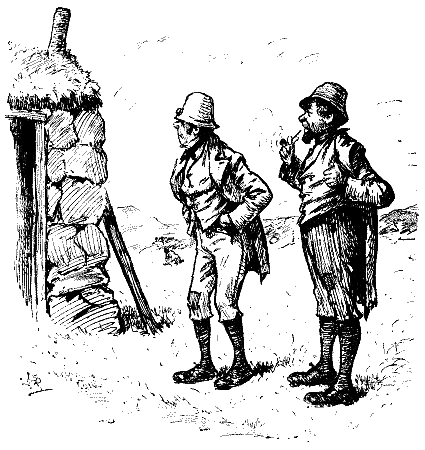
THE NEW CHIMNEY.
Mike. "Faith, Tim, ye haven't got ut Straight at all! It lanes over to the Roight!"
Tim. "Oh, ye're wrong. It's Plumb ex-hact! It's myself that Plumbed ut mosht careful. Indade, if ut has a fault, it lanes over an Inch or tew to the Left, when ye look at ut from Behoind!!"
THE POOR MAN AND HIS BEER.
[Mr. Chamberlain, at Birmingham, said, "We know that the Government propose to deprive the working classes of their beer." ("Shame!" and a Voice, "They don't!")
"Rob the poor Workman of his glass of beer!!!" And can that clap-trap, then, still raise a cheer? The British Workman has a thirsty throat, The British Workman also has a Vote, One will protect the other—if it cares to. But if he'd close, by vote, the shops such snares to His tipple-tempted and intemperate throttle He robs himself of access to the bottle,— If robbery it's called—'tis not another, (Who is a swell, with cellars) his poor brother Deprives of that long-hackneyed, much-mouthed "glass." The British Workman is not quite an ass, And where he wants to whet (with beer) his throat, Where are you like to get your two-thirds Vote? Whether there's wisdom in this vaunted Veto, Is quite another question sense must see to. And general justice judge. But those who cheer The stale old fudge about the Poor Man's Beer, Should learn it is a dodge of vested pelf, And, rich or poor, a man can't rob himself. It is the poor who suffer from temptation, And drink's detestable adulteration, That crying ill which no one dares to tackle! Whilst Witlers howl, and Water-zealots cackle. The poor are poisoned, not by honest drink, But lethal stuff that might scour out a sink. The Poor Man's Beer, quotha! Who'll keep it pure? Not rich monopolists, nor prigs demure, Those shriek for freedom, these for prohibition, "Vend the drugged stuff sans scrutiny or condition!" Cries Vested Interest. "Close, by law or Vote, The Witler's tavern and the Workman's throat!" Shouts the fanatic. Which, then, fad or pelf, Cares really, solely, for the Poor Man's self? Nay; the Monopolist fights for his money, The Monomaniac for his craze. How funny To hear one shout for freedom, t'other cheer The poisoner's cant about the Poor Man's Beer!
WHY is it evident that Mr. Arthur Balfour didn't know much of Ireland until last Monday week, April 3? Because 'twas then he went to Larne.
OUR BOOKING-OFFICE.
Statesmen, Historians, and such, may think that, between the years 1871 and 1876, "the Egyptian Question" turned upon the extravagance of Ismail Pasha, and the financial complications that followed thereupon. Readers of the Recollections of an Egyptian Princess (Blackwood) will know better. The real Egyptian Question of that epoch was, whether the English Governess of the Khedive's daughter should get her mistress's carriage at the very hour she wanted it; whether she should have the best rooms in any palace or hotel she might chance to be located in; and whether she should have her meals served at the time and in the fashion she had been accustomed to in the family mansion at Clapton or Camberwell. Many stirring passages in the book deal with these and cognate matters. None delights my Baronite more than one in which a driver named Hassan figures. Hassan, ordered for eight o'clock, sometimes came at nine. Occasionally at six. "He asked for 'backseesh,' which" Miss Chennells writes, "I did not consider myself bound to give, as he never did anything for me." On two occasions, her heart warming, she coyly pressed a florin into his hand, with dire results. "He was," she records, "much worse after it" (the florin, which he seems to have taken neat), "and would, when driving, stoop down, and look through the front window of the brougham, shouting 'Backseesh!'" However, Miss Chennells got even with Hassan. She followed her usual course when things went ill. She complained to her pupil, the Princess. Next morning, when the unsuspecting Hassan drove into the court-yard, "he was told by the Eunuchs to descend from the box, was conducted to an inner receptacle, and," Miss Chennells grimly adds, "then and there bastinadoed." Incidentally, in connection with the English Governess's struggle for supremacy in the City of the Pharaohs, we get pictures of life in the Harem, and glimpses of the lavish magnificence of the Khedieval Court, with its French embroidery on Eastern robes. It was with the object of describing these scenes, viewed from a rare vantage point, that the story was written. But not the least interesting character is that, unconsciously drawn, of the prim, practical, precise English Governess, pushing her way through the crowd of courtiers and Ethiopian slaves, peering through gold-rimmed eyeglasses into the recesses of the Harem, and glaring angrily at the hapless Eunuchs, who, going their morning rounds, visit her bedroom, regardless of the twine with which, before entering on her virgin slumbers, she had sedulously fastened the lockless door. Altogether a delightful book, says Passim Pasha, the accredited representative of the Baron De Book-worms.
Those who like "Just a tale by twilight, When the lights are low, And the glittering shadows Softly come and go," will do well to expend the comparatively small sum of one shilling, which, in certain ready-money quarters, is reduced to tenpence, or even ninepence, on Grim Tales, written by E. Nesbit, of which "The Ebony Frame" (which should have been called "The Speaking Likeness,") "The Mystery of the Semi-Detached," "Life-size, in Marble," and "A Mass for the Dead," are the best, the last-mentioned being the only one that ends, as all otherwise purposeless tales should end, happily. The Stories are grim enough, in all conscience, but they are told in a hearty sort of fashion, which, while relieving them of some of their weirdness, is calculated to impress the reader with an idea of the honesty and bona fides of the narrator. Thus far,
The Baron de Book-worms.
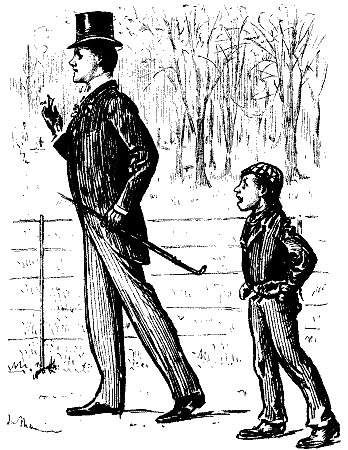
THE PENALTY OF FAME.
Small Boy (with shrill voice).
"'Fightin'—with—the Sev'nth—Royal Fusiliers—the Famous Fusiliers—the Fightin' Fusiliers,'" &c., &c.
Irritable War-Office Clerk. "Con-found the Seventh Royal Fusiliers! I'm sick of 'em! Blest if I don't pack 'em off to the Channel Islands!" [Does so.]
Mem. For the Next Epsom Meeting,—Why is the Winner of the Derby always like a Table d' hôte?—Because he's so much ahead.
QUESTIONS AND ANSWERS FOR A CRIMINAL COLLEGE.
(Suitable for Use at the Prison University, Elmira.)
Question. What is a crime?
Answer. A discovered breach of the law.
Q. And a virtue?
A. Its antithesis—the same thing unsuspected.
Q. What should be the chief occupation of a criminal?
A. A serious study of the law, with a view to its successful evasion.
Q. Is there a law for the rich and a law for the poor?
A. Certainly not; but a well-feed Q.C. is more than a match for a briefless Counsel whose professional sustenance is "soup."
Q. What is now generally considered to be the highest line of crime?
A. The malpractice that is frequently inseparable from holding of important positions on the Boards of bogus public Companies.
Q. What is necessary to secure a livelihood out of burglary?
A. A clear head, a knowledge of chemistry and kindred subjects, and a fair amount of capital.
Q. Why is ready money necessary?
A. Because the calling of a burglar nowadays is attended by various compulsory expenses. A successful burglar should be able to purchase skeleton-keys and "jemmies" of the most exquisite and delicate quality. Moreover, he should be able to entertain largely, and to keep a yacht.
Q. Is swindling ever known to be legal?
A. Scarcely; still it can often be practised with impunity on the Stock Exchange and the Turf.
Q. Is petty larceny lawful?
A. Only when practised on the belongings of your wife, and even in this case it is well to keep her in ignorance of the provisions of the Married Woman's Property Act.
Q. What are the advantages of a sojourn in the newly organised Elmira establishment?
A. An inmate is taught a trade, or even a profession.
Q. And now, in conclusion, considering that a breach of the law is necessary to secure admission to the University, what would you consider the most appropriate motto for the Institution?
A. "Honesty is not (at first) the best policy."
"Back us Up!"—It is stated that, on the new School Board for the Henley-in-Arden district, a Mr. H. Bacchus has been elected. May Bacchus (and the classic "fat venison") never be absent from this Board! Probably, nowadays, Bacchus is a strong supporter of the Temperance Movement, if not himself a Total Abstainer.