ESSENCE OF PARLIAMENT.
Reading edition
EXTRACTED FROM THE DIARY OF TOBY, M.P.
House of Commons, Thursday, April 6.—Met again after so-called Easter Holidays. Mr. G. early in his place, looking as blooming as the Spring flower in his buttonhole. "The Bright 'un from Brighton," was Marjoribanks's way of announcing the Chief, as he entered from behind Speaker's Chair. Spoke for hour-and-half on moving Second Reading of Home-Rule Bill. General impression is everything possible been already said on subject. This conviction so deeply impressed that Members will not come back to resume Debate. Benches only half full whilst Mr. G. delivering what will rank as historic speech. Situation accepted to extent that ten days or fortnight must be given up to Second-Reading Debate. Wouldn't be respectful, or even decent, to dispose of stage of such a measure in less time. Well known that this Sahara of observation will not influence single vote. If arrangements had been made with due notice to take division to-night, after Mr. G. had urged Second Reading of Bill, and Hicks-Beach had moved rejection, the majority would have been exactly the same as it will be a fortnight hence, when end is reached after multitudinous talk. Not by a vote more, nor a vote less, will Government majority be varied. Still, usual thing to talk for week or fortnight upon Bill of this kind. House will not fail in its duty to Queen and Country. A dolorous prospect, judging from to-night's experience. Mr. G. kept audience well together. Members increased as he spoke; but when St. Michael rose, audience dispersed like leaves in wintry weather.
"An excellent fellow Beach," said Campbell-Bannerman, "But in his House of Commons speech always gives one the idea that, through a blameless existence, he has been rolled upon by the melancholy ocean."
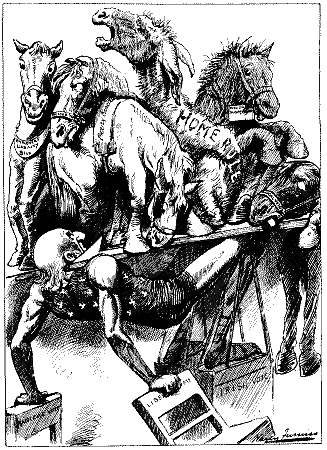
"THE POLITICAL SANDOW."
How Much More will he Bear?
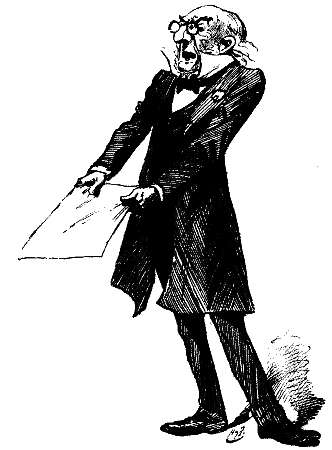
"THE UPPER G."
"When the fair land of Poland Was ploughed by the hoof Of the ruthless invader until The down-trodden serfs With small hope and no 'oof' Demanded a great Home-Rule Bill!"
Certainly his speech has depressing effect. Members, with one consent, go out to think over what he is probably going to say. Convenient arrangement for them, but does not add to hilarity of proceedings, or vary impression Campbell-Bannerman's figure of speech conveys.
After Beach, Birrell, with a new chapter of Obiter Dicta. Some of the smartest things addressed to the empty seat where Chamberlain should have been on view. But Joseph not yet come up out of Egypt. Had he been here, and House a little fuller, the new chapter would have gone off capitally. As things turned out, there was a fatal unreality in situation, which House quick to realise. Pretty to see Members, as Birrell struggled with his notes, involuntarily sniffing, as if they recognised familiar whiff of midnight lamp.
"Worst of these impromptus prepared beforehand," said St. John Brodrick, himself a master of spontaneous speech, "is, you never know in what circumstances they may have to be delivered."
Towards midnight, some refreshment in the incursion of Swift Macneill. Came up smiling; handing himself round, as it were, for inspection, as sample of kind of persecution of Protestants that would follow in Ulster on enactment of Home-Rule Bill. "I'm a Protestant, Mr. Speaker," he shouted, beaming on the Chair, "and I'm sent here by a majority of 2,500 Catholic peasants to represent an Ulster Constituency."
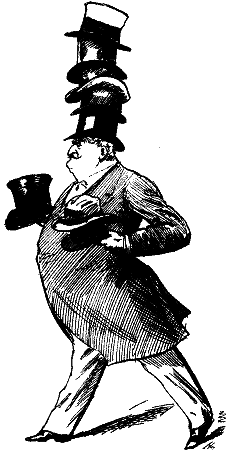
The Hattitude of Dr. Tanner, Thursday morning, April 6.
Swift Macneill's smile infectious. It illumined with something of saintly halo the depressed figure of Dr. Barton, who, again breaking his vow of silence, confessed that yesterday he had been enrolled as Member of an Organisation in Ulster sworn to resist Home-Rule. "I don't know, Mr. Speaker," he said, in hoarse whisper, "what that act may involve, and I don't care. It may lead to my spending the remainder of my days in penal servitude." Whereat the jaded House merrily laughed.
Business done.—Second Reading Home-Rule Bill moved.
Friday.—A dull night, my masters. Still harping on Home Rule. Second night's debate on Second Reading. Naturally supposed to be in heyday of vigour. But Benches empty; level of oratory third-rate; Stansfeld a hoary Triton among the Minnows; Ellis Ashmead Bartlett (Knight) gloomily views the scene. "Thought you were going to speak to-night?" I said, "Read the announcement in the papers." Never forget the haughty, withering glance of Ellis Ashmead.
"Sir," he said, "I talk only with my peers."
So suppose we shall have him one day next week, when Chamberlain, Grandolph, and Balfour take part in fray. Begins to look as if, for all practical purposes, might as well have deferred meeting of House till Monday.
"Mr. G. a great man," says Davitt. "Insisted upon us coming back on Thursday, to debate Home-Rule Bill. He can do most things; he can bring a horse to the water, but he can't make him debate."
Business done.—Eight hours' talk round Home-Rule Bill.
QUEER QUERIES.
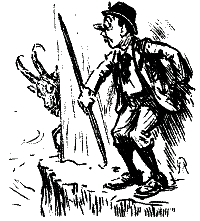
Influence of Music.—I recently noticed a paragraph in a Medical Journal advising persons suffering from Insomnia to try a musical box in their bed-rooms; and I therefore purchased a rather expensive one, which plays six tunes, with drum and trumpet accompaniment. Something seems to have gone wrong with the mechanism, as, after being fully wound up, it remains obstinately silent for an hour or so, at the end of which period it suddenly starts off at break-neck speed, and repeats one of the tunes backwards over and over again. Nothing that I can do will stop it. Could some musical expert kindly advise in this case? After a most agitated night, due to the vagaries of the instrument, I took it into bed with me, hoping to drown the noise; but the vibration of the drums under the bed-clothes was terrific! I then placed the machine in my bath, and covered it with water; but it continued to play with undiminished vigour. It is still playing. Some Museum, or a Government engaged in sub-marine experiments, might like to have it; or it might be suited for a Deaf and Dumb Asylum. It will be sold cheap.
St. Cecilian.
Sedantary!
["Several carriage-makers in London have, it is said, received orders of late for Sedan chairs."—Daily Paper.]
What wonder if our hansom-hiring Fair Should now adopt a coach distinctly rarer? As Cabby often treats them like a bear, Henceforth our ladies may prefer a bearer!
"The Silver Shell."—Mr. H. J. W. Dam's new Play (the initial letters, save the name—and as to the name, absit omen!) treats of Russian life. There is a "toff" in it, played by Mr. Kendal, whose name is Prince Karatoff, which reminds us of the Duke of Turniptop. Or, if he is an insouciant sort of person, he would more properly be titled, Prince Don't-Kar-a-toff. Unfortunate name, too, is Boris Ivanitch. Perhaps a Big Bore is Ivanitch; and as to the family title, Ivanitch—well, considered theatrically, it sounds unpleasantly like belonging to a scratch company. There's a bomb in it, which, we were informed, in a D. T. note, "appears as part of the furniture of a drawing-room." The entire furniture-covering is made, we are privately informed, of "bombazine," and the explosion may be expected to be terrific. For the sake of the clever Managers of the Court, not forgetting their H. J. W. Dam clever author, we trust The Silver Shell will be, for many months to come, an occasion for the public to silver shell out.
Transcriber's Note: Obvious punctuation errors have been repaired. The remaining corrections made are indicated by dotted lines under the corrections. Scroll the mouse over the word and the original text will appear.