SPORTING ANSWERS.—CANINE.
Reading edition
Spectator.—A very curious and interesting little story. We ourselves once had a dog who on returning home from a walk always chained himself up in the back-kitchen and bit the butler. He would then howl bitterly, slip his collar, and run to the nearest police station, where he gave himself into custody and insisted on cleaning out his own cell and appearing on the following morning before the Magistrate. This shows that dogs can reason. Our dog eventually died of being constantly quoted by Curates a Temperance Lectures. This was disappointing, as we had never grudged him either attention or butlers. One of our butlers had a cork leg,—but that is another story.
Sub Silentio.—(1) A dog's chief value is conversational. At afternoon teas such an animal is a wonderful resource after you have exhausted the picture-shows, the theatres, and all the scandals. You can lead off about his pedigree. "He's champion bred on both sides," always sounds well. A funny man is sure to say, "Champion bread-and-butter you mean. Ha! ha!" at the same time offering the animal some from the tea-table, to mark his point. This may be previously arranged, if you prefer it. Throw in a few stories about his wonderful intelligence in distinguishing the baker's boy from the mistress of the house, to the detriment of the former, and wind up by narrating how he once found his way home to Piccadilly from Pekin. All dogs do this in one way or another, so you will be quite safe. Then everybody else contributes his own special Spectatorial dog-story, and your tea will pass off without a dull or an accurate moment.
HOW NOT TO DO IT.
(Act from a Farce ready for Performance pending the settlement of the Labour Question.)
Scene—Interior of a Provided Work Office. Benevolent Organiser discovered looking over a list.
Ben. Org. Yes, I think this will do very well indeed. New pump, fresh road. Ought to keep them going comfortably through the rest of the winter. (Enter Unemployed.) Well, my good man, and what do you want?
Unemployed (in a whining tone). Me and my mates, Sir, are out of work. It's no fault of ours, and——
Ben. Org. Well, we will see what we can do.
Unem. Thankee kindly, Sir, I'm sure 'arf a sufferin, or even 'arf a dollar——
Ben. Org. (ignoring this suggestion). Now, let me see—what's your trade?
Unem. A watch-maker. So you see, as the Press says, you can't send me to mend roads, or build pumps.
Ben. Org. No, no. I have overlooked your class. But stay—I think I can forward you to a friend. Let me see, what time is it? (Produces watch, and lets it fall.) Dear me! It has stopped, as I live! (With vivacity.) My dear fellow, here is a chance for you. You shall mend it.
Unem. (freshening up). Only too pleased to take your watch.
[Possesses himself of the time-piece, and exit hurriedly.
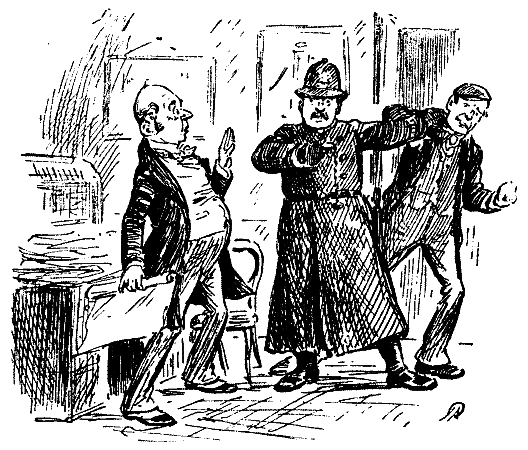
Enter Constable with Unemployed in custody.
Constable. This your watch, Sir?
Unem. (rapidly). Which was given to me by the kind gentleman to mend. But I gladly return it, as me and my mates have determined not to do any more work for fear that we should injure our brothers who are doing nothing. [Exit.
Constable. Lucky I kept my eye upon him, Sir. If I hadn't, you would never have seen him again—nor your watch either.
Ben. Org. Is there so much guile in the world?
Con. Yes, Sir, a pretty fine lot. But I can't stand palavering or those rowdies loafing around will pull the house about our ears. When the Unemployed are idle, the police have enough to do! Ponder over it, Sir; ponder over it! [Curtain, and Ben. Organiser left pondering.
A Vell Vorn Motto.—In his sound and sensible reply to a congratulatory address, H.E. Cardinal Vaughan suggested "Amare et servire" as the motto for the Christian capitalist. To the first verb the capitalist would, it is probable, make no objection; but as to the second, he would be inclined to move as an amendment, that, "for 'i' in servire should be substituted 'a'." At all events, Amare et servare is the narrower view taken on the broader of the two roads in life.
Author! Author!—Mr. J. L. Toole advertises that in consequence of "the Phenomenal Success" of Walker—London, it is to be kept going throughout the season. Excellent. But, for the sake of Mr. J. M. Barrie, its talented author, it is to be hoped that the conditions of the performance of his popular play are not "fee nominal." But for this J. L. T.—which initials stand for Jenerous Lavish Toole—will have already made ample provision.
WAYS AND MEANS.
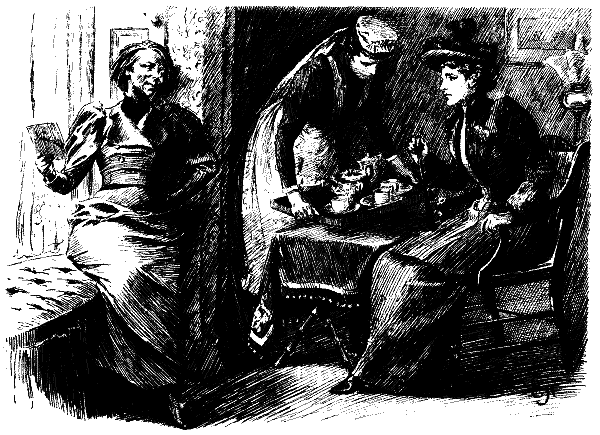
Kitty. "Well, Viola, I think it's a perfectly lovely Photograph! The worst of Vanbrandt is that he's so awfully Expensive. What did you Pay for these?"
Viola. "Oh, I didn't pay anything. They took me as a Type of English Beauty, and gave me half-a-dozen for myself."
Kitty. "What a splendid Idea! I think I'll be done on those Terms!"