THE WINTER ACADEMY OF 1995.
Reading edition
(An Elegant Extract from a Future Development.)
The Committee this year has wisely been recruited from the Master Bill Posters' Guild; the old-fashioned method of "hanging" is abandoned, and advertisements are now "stuck" on the walls by the New "B" Gum Process (for which Sir J. Millboard contributes a charming illustration No. 20,000). During a preliminary survey, we were astonished by the blatant excellence of the exhibition. "A Bicycle Made for Five," by Mr. Lowther R. Cade (No. 2006), is especially delicate and sudden; the tone is aluminium throughout, and although no children are represented as bodily on the machine, a Kineto-Phonograph inserted in the axle dexterously responds to a penny in the slot—when the youthful athletes are both seen and heard in the adjacent horse-pond. "Gregory the Grateful" (No. 612) fully sustains Dr. Utterson's reputation for historical advertisement; by pressing a spring the Pope actually swallows the powder, and seems to like it. It is quite equal to this Master's "Columbus in Wall Street" of last year. Mr. G. Morland's "Carter's Pill-gathering in the Old Kent Road" (No. 69) is too realistic for modern taste; the fine oaks in the background are absolutely hidden by placards; but Lord Boxall's "While there is Life there is Soap" (No. 15,000z) is truly impressionist; the life is full of soap, and the soap full of life. In "Glycerine" (unnumbered), by Miss Topsy Turvy (the Presidentess), we have a fine example of "The Newer Symbolism,"—a patent revolving motor displays its liquidity to equal advantage upside down.
Altogether the show is calculated to promote business—which is the true end of Art; it also opens out infinite possibilities for house-decoration.
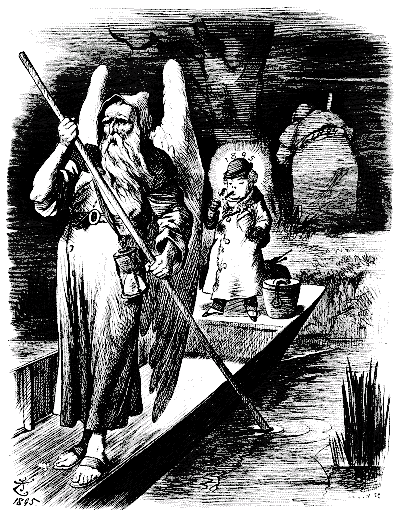
THE NEW PASSENGER.
AN "OLD MASTER'S" GROWL.
Burlington House, January 1, 1895.
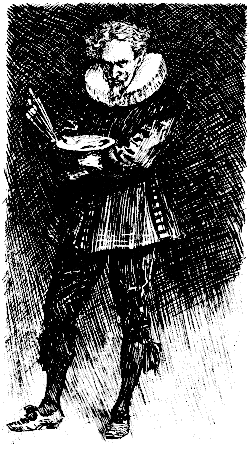
It's all very pretty to hang us up here, And pretend that you worship our genius and paint; You fancy it's "Cultchah" that rings in the year— But it ain't! You find us, you say, "a delight to the eye;" You exclaim that "such painting you never did see!" You "do" us—then scamper below with the cry— "Cup o' tea!" "Old Masters," indeed! It's "Young Students" with you— To their show in your thousands you flock in the spring; But of Me you exclaim, as you come in my view— "What a thing!" Just six months ago in these rooms you'd declare It was "exquisite Art" that you saw; you forgot That you'd said that of us. Bah! What do you care? Not a jot! Of course, there are some who are men of the day, Who belong to the band of the talented few; Right gladly we put forth our hand, as we say— "How de do?" For example, young Raphael—my excellent friend— And the later Italians and Germans as well, They consider Sir Frederic Leighton no end Of a swell. Then Reynolds declared, in the course of a chat, The "Cherry Ripe" picture of Millais to be As good as "Penelope Boothby." What's that? "So does he?" Van de Velde asserts he knows less of a wave, It's colour and drawing, than Moore at his best.— But when of your Coles and your Hunters you rave, I protest! Talk of Titian and Watts in a breath—which you may; Young Gilbert and Swan you may praise if you will; But the thought of the annual summer display Makes me ill! Yet that's what the mass of the people enjoyed. And the few who come here, both the great and the small, Mostly come to be seen. What—you think I'm annoyed? Not at all! We expect it.—I said just as much to Vandyck— There's but one in a hundred that comes who'll descry The beauty of Art. It's the sham I dislike. Well—good-bye!