THE CHRONICLES OF A RURAL PARISH.
Reading edition
VIII.—After the Poll.
I am overwhelmed with congratulations, from all classes, from all sections, from all ranks, and I am acclaimed on all hands as a worthy head man for a Mudford, if not yet a model, village. Not the least welcome have been the communications which have reached me from those who have made my acquaintance in these published Chronicles. The mayor of a borough whose charter dates well back into the beginning of the second half of the present century, wrote to say that he is emboldened by the fact that his wife's maiden name commenced with a W to write to tell me how rejoiced he is to hear of my success. A gentleman writes from "The Burning Plains of the Sahara" to say that he is always proud of the triumphs of a Timothy. (My daughter points out that this is clearly a forgery, since the Sahara mail isn't in till next week. But I can't go into that.) Then there is a very important letter from Birmingham, of which I will only say that Winkins, who has backed many a Bill, may yet live to indorse a Programme. I may here add that there has been an attempt in some quarters to decry these Chronicles as absurd and imaginary. My Birmingham correspondent describes them as "an important picture of things as they actually are." He is right. I am as serious as a Prime Minister.
My wife is back—which reminds me that I received a post-card, which his had the effect usually produced by a bomb. Here is what was on it:—
AFTER THE POLL.
After the poll is over, After the voting's done, Mudford will be much duller, No more election fun. But ONE man will be more happy, Not so disturbed in his soul (?), Winkins's wife is come back now— After the Poll!
Of course, I should have destroyed the card at once—but I was out when it came, and Maria read it first! What happened was a good instance of the monstrous way in which one man's sin is another man's punishment. In this case (1) it was my wife who had persisted in going away, and (2) it was an unknown post-cardist who had written the insulting doggerel. Yet I paid the entire penalty.
The great puzzle—who is the seventh councillor?—is still unsolved. All that has happened so far is that Mrs. Letham Havitt and Mrs. Arble March are no longer on speaking terms. It has leaked out that Mrs. March had more plumpers than Mrs. Havitt, whereupon ructions—as Jacky, who has just come home for the Christmas holidays says. I think he's quite right.
Our Parish Council meets next Monday—on the 7th. With the New Year we commence our reign of beneficent activity. I need hardly say that it is certain that I am to be Chairman. My position on the poll suggests it, common decency demands it, moreover I expect it. I refuse to believe that I shall be disappointed.
A GLAD NEW YEAR.
A Reflecting Roundel.
"A Glad New Year!" Why, bless my heart, how fast The time flies by! The year's no sooner here Than it is gone and numbered with the past— A Glad New Year! For some the sun shines bright, the sky is clear, No threatening clouds o'erhead exist to cast A single shadow. Yet, ah me, how drear The sad estate in which some lives are passed! The day when none are sad may not be near, But then—and not till then—there'll be at last A Glad New Year!
Up-to-date Version for mature Virgins and prematurely grizzled Working Men.—They whom the gods don't love, dye young!
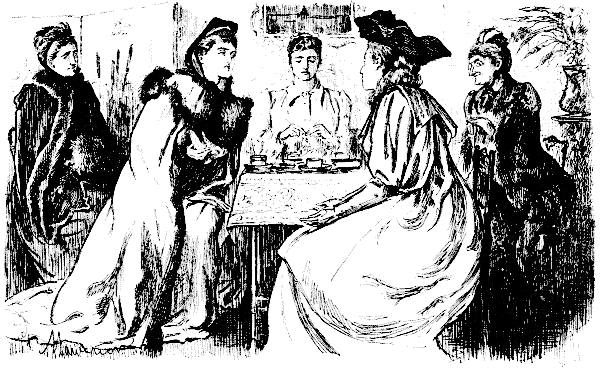
THE PROBLEM PLAY.
New Woman (with the hat). "No! My Principle is simply this—If there's a demand for these Plays, it must be supplied!"
Woman not New (with the bonnet). "Precisely! Just as with the Bull-fights in Spain!"
[Scores.
THE OLD FERRYMAN'S NEW FARE.
Air—"Twickenham Ferry."
O-hoi-ye-ho! Ho-ye-ho! Who's for the ferry? (The moon sails on high, and the snow's coming down,) A light gleams afar, and the church chimes are merry, Their message goes pealing o'er country and town. The ferryman's grey, and the ferryman's old; But the passenger's young, and the passenger's bold; And he's fresh as a pippin, and brown as a berry, He laughs at the night, and he heeds not the cold. O-hoi-ye-ho, Ho-ye-ho, Ho-ye-ho-Ho! O-hoi-ye-ho, Ho-ye-ho! "I'm for the ferry!" (The moon rides on high, and the snow's coming down,) "Sure it's late that it is, but I care not a penny; I'll brave the rough river and winter's grim frown." He'd his hands in his pockets, and oh! he looked brave As the toughtest old tar who e'er ventured the wave. With his cheeks like a rose, and his lips like a cherry, "Ah! sure, and you're welcome! Your presence all crave!" O-hoi-ye-ho, Ho-ye-ho, Ho-ye-ho-Ho! O-hoi-ye-ho, Ho! One flits slow from the ferry, (The moon rides on high, and the snow's coming down,) With shadowy form, and with footfall unsteady; You'd think 'twas a ghost at the dawn-signal flown. The ferryman turns on the phantom a glance, But the eyes of the youngster there glitter and dance, And with youth like a star in the stern of the wherry There is but one watchword for Time,—tis "Advance!" O-hoi-ye-ho, Ho-ye-ho, Ho-ye-ho-Ho! O-hoi-ye-ho, Ho-ye-ho! Old is that ferry, (The moon rides on high, and the snow's drifting down,) Still, older that steersman, though stalwart and steady, And many a journey and fare hath he known. For the Ferryman's Time, and his fares are the Years, And they greet him with smiles, and oft leave him in tears, And the youth who to-night takes his seat in that wherry, Knows not how 'tis freighted with hopes and with fears. O-hoi-ye-ho, Ho-ye-ho, Ho-ye-ho-Ho! O-hoi-ye-ho-Ho! 'Ninety-Five tries the ferry, (The moon rides on high, and the snow silvers down,) There's a smile on his lips, and his laughter is merry; Right little he bodeth of Fortune's dark frown. But the Ferryman's old, and the Ferryman knows That River of Years, with its joys and its woes; But we'll wish the young fare a snug seat in Time's wherry, And sun on his way, though he starts 'midst the snows. O-hoi-ye-ho, Ho-ye-ho, Ho-ye-ho-Ho!!