HOW TO WRITE AN EXTRA NUMBER.
Reading edition
(An Up-to-date fragment for Yuletide.)

The author was hard at work. He heeded not the snow that beat against the window, nor the wintry wind that whistled through the leafless trees. The fire burned brightly in the grate, and the shadows on the walls seemed to inspire him with seasonable tales. He wrote for dear life, as his copy was late, and he knew that the printers were clamouring for more and more from his facile pen. Every now and again he glanced at a volume of drawings (there were many sketches in the book on his desk), and, pausing for a moment, seemed to be lost in thought. Then he would resume his labours with fresh energy. Very rarely he would murmur to himself, and then his words would be few.
"Confusion!" he muttered on one such occasion; "how the Dickens (or should it be Thackeray?) am I to get in the Christmas waits?" He pondered for a moment, and then his eyes glistened with delight. "Eureka! I have it! They must appear in a dream. Yes, that will get over the difficulty, they must appear in a dream!"
And then he continued his writing. During the whole day he had been hard at work. His breakfast was scarcely touched. He waved away the servant girl who would have set before him his lunch. It was now close upon his customary dinner hour, but still he insisted upon isolation. Even the wife of his devotion did not dare to come near him. She knew that he would not speak to her, but only cast at her a glance. But such a glance! A terrible tirade compressed into a solitary look!
The short day waned and passed away. The evening quickly changed into night. There were cheery songs without, as it was Christmas Eve, when all men were thinking of wassail, and holly and mistletoe. Even the performers in the forthcoming pantomime were nearing the close of their last rehearsal, when they would go back to their homes to count the mince pies and glance for the last time at the cooking of the familiar plum pudding.
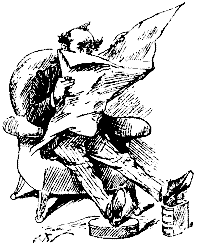
At length the writer was interrupted, and by his old familiar friend.
"I will not disturb you," said the caller, taking up a newspaper and commencing its perusal; "I know how busy you are, and will be silent as Cornhill on a Sunday."
The writer nodded and continued his work. His pen moved quicker and quicker until at length it stopped.
"Hurrah!" shouted the author. "At last my task is completed. I have brought in every cut and got through the necessary number of lines. Yes, my dear old comrade, I have done. The printer will be satisfied, and the publisher will cease to be alarmed. And now, my dear fellow, I can enjoy Christmas conscious of the fact that I have thoroughly earned a holiday."
"Ah!" observed the visitor glancing at the recently-written pages; "I see you have been writing something for Yuletide."
"Yuletide!" exclaimed the author. "Why, that was accomplished ages ago. No, my dear fellow, I have just finished a summer number timed to appear in August. I shan't think of touching the work of next year's Christmas until April!"
"YOU CAME TO TEA."
In spite of Fate invincible, Of lack of wit, and lack of gold, Of pictures that too cheaply sell, Or pictures never sold, Oh, yet, when I am old and grey, If old and grey I live to be, I shall recall one happy day, The day you came to tea! You came. Of course I am aware You did not, could not, come alone. You were between the millionaire And a stout chaperon. My work they called to criticise, But what they said I do not know, For gleams of laughter in your eyes That seemed to come and go. The hurrying moments how I rued! There flashed a scheme into my brain. With unexpected tea, I would My visitors detain. The ever-willing household slave Into my service I impressed; To her my tea, my gold I gave, She vowed to do the rest. That tea was strong, for all my hoard, Some half a pound, two shilling tea, Into the teapot had been poured— Only the milk—ah me! So pallid, comfortless a stream, Into your cup I saw it glide. For a true jug of country cream I felt I would have died! But with the cake I was content, Its richness no one could mistake, For my whole store the slave had spent On a superior cake. 'Twas all in layers, almonded, And crowned with white and rosy ice: "What a delightful cake!" you said; "But, please, a smaller slice!" I flushed and stammered. I suspect A pound I'd cut you unaware. On what I did could I reflect When you were sitting there? That revel, ah, how soon 'twas o'er! How swiftly came the moment when After my guests I shut the door, I mounted to my den. Then down I sat beside the wall, And, feeling doubtful and amazed, I strove your accent to recall As at your chair I gazed. I heard your soft laugh echo through The dingy room grown dear to me, Where now was silence; and I knew That you had been to tea!
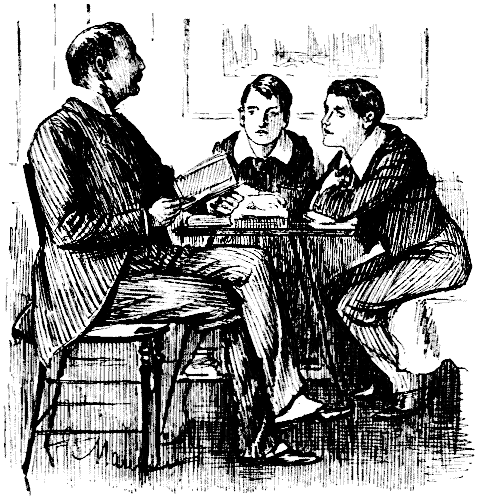
THE SHAKSPEARE LESSON.
Holiday Tutor (quoting)—
"'Letting I dare not wait upon I would, Like the poor cat in the adage.'
Now, George, what is an adage?"
George. "A place to keep Cats in!"