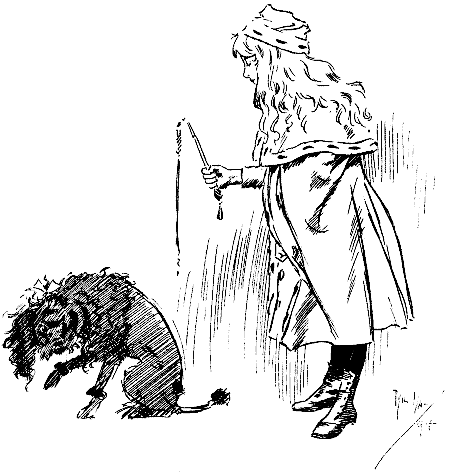
PROTEST FROM THE PLAYGROUND.
Reading edition
Dear Mr. Punch,—I know you sympathise with boys, and isn't it a jolly shame the masters set us such awfully hard questions in exams.? My Report has just come home, and my Pater has given me a fearful rowing, and all because it says "Wilkins Terts. (that's me) has done badly in Examinations, and does not take the trouble to use what intelligence he possesses." My Pater threatens not to take me to the Pantymime, and I hear it's awfully beefy this year! Well, we had a "History and General Knowledge" paper, and one of the questions was this beastly one, and of course I couldn't tackle it—"What, or where, are the following:—'Imperium in Imperio, The Korea, Bimetallism, The Grand Llama, Balance of Power, and One Man One Vote?'" I answered all right about the Korea, because I kicked young Smith under the table to give me a tip about it, and he said it was the book the Turks use in church; and I put that down, but all the other things floored me. Please will you say what Bimetallism is? Jones Junior said afterwards, in the playground, that it was a sort of lozenge, and Robinson Senior said he didn't know what it was, but he knew his Pater was a Bimetallist; and Jones said Robinson Senior's Pater must be a confectioner then; and so Robinson punched Jones's head; but what is it? And is it fair to ask us boys such questions? My Pater said at breakfast the School Board was fond of sending out sirkulers. Do you think they would send one to our Head-master, and ask him to stop such rot?
Your obedient young friend
Jacky.
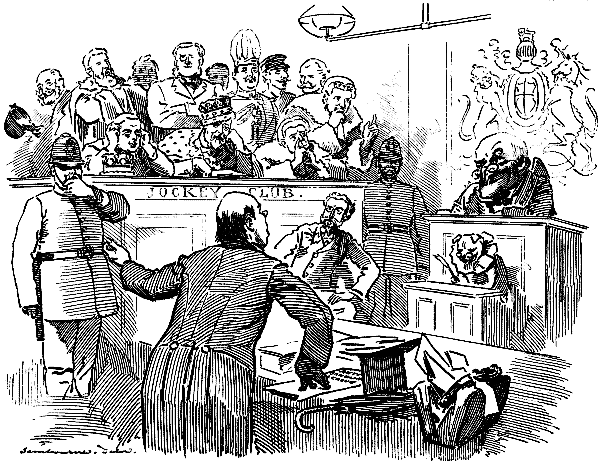
SPORT IN COURT.
["The Anti-Gambling League has decided to take proceedings against the Jockey Club.... In the view of the League every member of the Jockey Club is equally open to indictment."—Morning Post.]
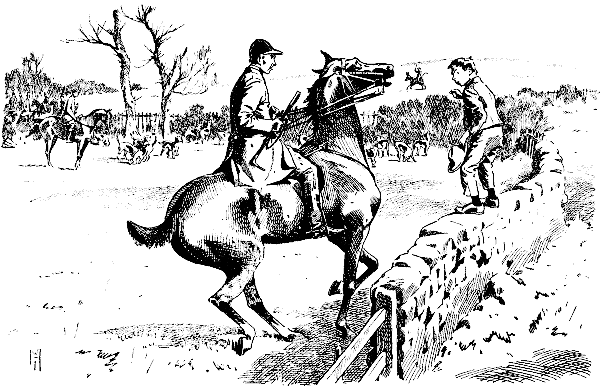
A VIEW HALLOO. (Hounds at fault.)
Whip (bustling up to Young Hodge, who has just begun to wave his cap and sing out lustily). "Now then, where is he?"
Young H. "Yonder, Sir! Acomin' across yonder!"
Whip. "Get out, why there ain't no Fox there, stoopid!"
Young H. "No, Sir; but there be our Billy on t' Jackass!"
SPORT IN COURT;
Or, The New Year Dream of the National Anti-Gambling Leaguer.
Oh! it must have been the grog, for I slumbered like a log, And I dreamed—such a dream! I was holding forth in court, And the prisoners in the dock,—how the Sporting League 'twould shock!— Were the Princes, and the Nobles, and the Leading Lights of Sport. A supreme, successful raid on the Jockey Club we'd made. No mere stuffy, sordid set, of poor betting-men this time, No cheap winner-spotting snobs, but a lot of topping nobs, And I had them on the hip, and I charged the lot with Crime! It was prime to see a Prince at my language flush and wince, And a Lord Chief Justice squirm, and a stern-faced Judge quite blench. But—I could not fail to mark the demeanour of the Clerk, Who looked on it as a lark!—and that Beak upon the bench— Ah! he had a mighty "beak," which I felt a wish to tweak— Had a wink in his left eye which seemed frivolous, if funny; And he didn't seem to suit us, for we wished a stern-faced Brutus; Nay, a ruthless Rhadamanthus were the big-wig for my money. Ah! it wanted resolution to conduct that prosecution, With a Prince and several Dooks, and an Earl, a County Squire, And a Mephistopheles, who sat lounging at his ease, Whom the culprits all called "Jimmy," and seemed hugely to admire; For although I ramped and raved, Beak and Prisoners behaved In a fashion which seemed scornful, and assuredly was light; And that Clerk—confound his mug, which looked strangely like a pug!— And the chap for the defence, with his eyes so brisk and bright, They seemed all upon the grin, or almost, which was a sin, And I'm sure I heard a Dook whisper in a Judge's ear, "Don't old Mulberry Nose look funny? I will bet you any money——!—" Well, I missed the wager's point; but oh, dear! oh dear!! oh dear!!! Think of betting—in a Court! And I thundered against Sport, Which meant Gambling, more or less, and red ruin, and disgrace. From the girls who, though they're loves, wager wickedly—in gloves, To the Plunger Peer who shames his ancient race—to win a Race. Ah! I think I "gave them beans." I'm uncertain what that means, But the Lord Chief Justice whispered I was doing so—to "Jim"— And the phrase I overhead, and although it sounds absurd, I felt it meant a compliment to me, compelled from him. So I said "Sport may intrigue and set up a rival League To our holy Anti-Gambling One; but Sport is a Foul Sink We have pledged ourselves to purge with a besom and a scourge——" But here that Punchian eye indulged in a prodigious wink, Such a spasm of sheer fun, that I felt the case was done; Court, Prisoners, Judge, assumed the guise of a colossal Joke! My head appeared to swim, the wild vision did dislimn, And with a shriek of bitter disappointment I—awoke!
"Anglo-Indian."—We are indisposed to go the full length of agreement with the learned Editors of the New English Dictionary in their study of the derivation of the objectionable word "damn." In the interesting extract you inclose they remark: "The conjecture that the word is the Hindi dām, dawm, an ancient copper coin, of which 1,600 went to a rupee (see Yule), is ingenious, but has no basis in fact." That may be so. It is, nevertheless, a curious coincidence that at the present time the steady declension of the money value of the rupee, combined with its immoveable rating in the salary list, produces in the Civil Service and the army in India a state of feeling subject to which at least 1,600 dams go to a rupee. We much fear that, under this provocation, our army in India is able to compete with regiments earlier enrolled, who, you will remember, "swore terribly in Flanders."
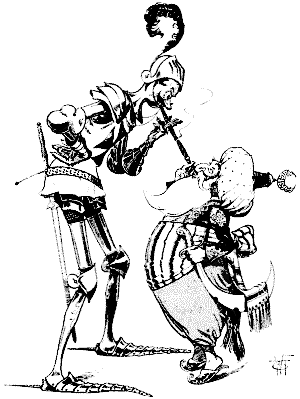
COMBINATION COSTUMES FOR COVENT GARDEN. "THE TWENTY-FIRST OF DECEMBER!"
"What nonsense you do talk. How do you make that out?"
"Why, any Fool could see that. The Shortest Dey and the Longest Knight, of course!"
NEW YEAR NOTIONS.
(By an Old Buffer.)
"There is nothing new under the sun," someone says; I wish that there wasn't, by Jingo! It seems to me everything's New in these days, And nothing is genuine old stingo. A New Poet turns up about once a week (According to log-rolling rumour); And there's the New Politics, all grab and sneak; And something dull dubbed the New Humour! The New Art; I'm certain it comes from Old Nick, It's so diabolic and dirty. Faith! some of their Novelties make me feel sick, And most of them make me feel "shirty." The New Year!—well, that is as old as the hills. The New Leaf—we annually turn it. Ah! if the New Newness would banish Old Ills. Not e'en an Old Fogey would spurn it. New Year, give us books that are healthy and gay, And Art that's not impish or queer, Sir! And if you'll but cart the New Woman away, You will be a Happy New Year, Sir!
THE MODERN THEATRE LAUGH.
Dear Mr. Punch,—I crave the hospitality of your columns under the following circumstances. The other night I went to a burlesque. Being a man of modest means, I contented myself with paying half-a-crown, for which sum I was able not only to sit with the plebs in the pit, but to see Society in the stalls.
Will it be believed, at the end of this so-called nineteenth century, that songs were sung and things were said which made those everywhere around me laugh? Sadder still, two-thirds of those I saw were women!—women, who are our mothers and sisters, when they are not our wives and sweethearts!
I haven't the least notion where the harm in all this comes in, but I'm confident there's some somewhere. In any event it's a serious sign of the times; which reminds me that I should have sent this to the Times, if I had not thought the recent Society-play correspondence sufficient for one season. I'm so afraid the dear old Thunderer will drop the telegraphic news and take to Telegraphic Correspondence.
In any case, I invite letters on "The Seriousness of Laughter."
Yours distressedly,
A Di-tri-syllabic Pittite.
[No letters on this subject will be inserted.—Ed.]
NEW YEAR.
"Ring out, wild bells." We hope that you, With '94 that's rung out, Will kindly ring out just a few Of all those things entitled "new" Which plagued us till quite mad we grew As mad as dog with tongue out. Those novelties! The newest kind— With turned up nose and weird, slee- -py eyes, that told of vacant mind, And monstrous chignon massed behind— Were those appalling things designed By Mr. Aubrey Beardsley. Yes, "things"; for nought of human shape, However strangely bizarre, Is there portrayed; there's not an ape, That feeds on cocoa-nut or grape, Between Morocco and the Cape, So hideous as these are. For goodness' sake, don't let us see New Art which courts disaster! We much prefer to Mr. B. Velasquez, Rembrandt, even P. P. Rubens or Vandyke, for we Like oldness in a master. And then "New Humour." Heavens, why It's but a pleasure killer! A cause of weary yawn and sigh, Which makes us almost long to fly To those old jokes collected by A certain Mr. Miller. In politics Newcastle, too, With programme was prophetic; And now Leeds leads, and shows who's who. The Grand Old Man—there's age for you!— Has found much better things to do, Not prosy but poetic. But all the things, so new in time, Are nothing to the woman, Who now is "new," and seeks to climb To heights which seem to her sublime; (Excuse the execrable rhyme) She is indeed a rum 'un. Of course we know that youth is sweet; Old women are not charming; But no old woman we could meet, With featless form and formless feet, This wild New Woman now could beat, She's perfectly alarming. Ring out, wild bells, wild belles like these New-fangled fancies screaming; Ring in the woman bound to please, A lady, always at her ease, Not manlike woman, by degrees More man that woman seeming. Old '94, who now has fled, Encouraged blatant boldness In things called "new," as we have said; New '95, now he is dead, Might bring some things which are instead Remarkable for oldness.
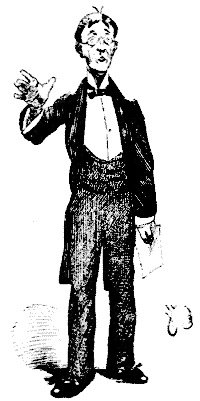
A VITAL QUESTION.
(Asked at a Penny Reading.)
"Who will stand on either hand, And keep the bridge with me?"
"SHOULD CHRISTMAS BE ABOLISHED?"
[A symposium on the above question appears in the December Number of The Idler.]
With what philosophy sublime The institutions are discussed, Which foolish men of olden time Were well content to take on trust! "Is life one great mistake?" we cry, "Our modern teachers deem it so;" "Man's place shall woman occupy?" And now this last—"Shall Christmas go?" They mock at any plea for mirth, With fine derision they allude To any wish for peace on earth As just a pulpit platitude; This Christmas-time, it seems, is fraught With fancies anything but clever; The lessons that Charles Dickens taught Are obsolete, and gone for ever! They tell us, in their stead, to praise The jokes on seasonable ills, The epigrams on quarter-days, The jeux d'esprit on mud and bills; But as for honest glee and cheer, Since every cause for joy's demolished, Why, Christmas, too, it's amply clear, Should be left out—in fact, "abolished." Well, let them talk; to please themselves By all means let them demonstrate That fairies, Santa Claus, and elves Are manifestly out-of-date. Well, let them talk; and find a joy In cynical philosophy, But every English girl and boy Will give their empty words the lie! Nor only these: In every land When Christmas brings, to brighten life, The sturdy grip of hand with hand, The softened heart, the ended strife,— Then air your pessimistic views, Then ask again, "Shall Christmas go?" And find your answer, if you choose, In one emphatic, hearty—"NO!"