Regular Meeting, November 16th, 1863.
Reading edition
Dr. Kellogg in the Chair.
Six members present.
Dr. Cooper read a letter from Mr. A. S. Taylor, now of Santa Barbara, complaining that his name had been omitted from the list of corresponding members, though he was elected several years since. It was resolved that his name be restored, having been omitted on account of his new address being unknown to the Secretary.
Mr. Bolander read the following article:
Enumeration of Shrubs and Trees growing in the vicinity of the mouth of San Francisco Bay.
BY HENRY N. BOLANDER.
The territory in question is divided naturally into three parts:
1. The northern part of the peninsula of San Francisco, with an undulating and hilly surface, consists of drifting sand, with a small per centage of humus mingled with it.
2. The Oakland Hills, running N. 54° W. mag., from the Bay of San Pablo to San Leandro, a distance of twenty-three miles, with the adjacent slopes and valleys. Heavy clayey soil predominates; but where shrubs and trees grow it is mostly a loose, light, and slightly sandy soil.
3. That part of Marin County between San Rafael, the head of Tomales Bay and Bolinas Bay, forming a triangle, with a hilly surface, the ridges running N. 54° W. mag. Soil a heavy clay, in the valleys and on bare hills; or a light, slightly sandy loam among shrubs and trees.
In all parts a metamorphic sand-stone underlies the soil.
Berberis (Mahonia) Aquifolium Pursh.
A low evergreen shrub, three to four feet high, not gregarious; in clay soil on the hill sides; rare.
Dendromecon rigidum Benth.
A shrub with slender upright branchlets, four to six feet high, rare; on white sand-stone, Oakland hills, third range eastward, not gregarious.
Rhus diversiloba Torr. and Gray. Poison Oak.
Everywhere, deciduous, exceedingly variable, three to eight feet high.
Negundo Aceroides Mœnch. Box-Elder.
A medium sized tree, twenty to thirty feet high; common among the Oakland hills, on banks of creeks.
Acer macrophyllum Pursh. Large-Leaved Maple.
Common on the banks of Walnut Creek, N.W. of Mount Diablo; fifty to seventy feet high, and two to five feet in diameter, in light sandy soil.
Æsculus Californica Nutt. Horse-Chestnut.
Mostly a shrub, seldom a medium sized tree, largest on the banks of creeks and moist hill sides; grows commonly in groups. Common.
Euonymus Occidentalis Nutt. Spindle-Tree.
A shrub seven to fifteen feet high, with slender upright branches; in swampy places, near the head of Tomales Bay; rare.
Frangula Californica Gray. California Buckthorn.
Very common, variable, four to ten feet high; evergreen, gregarious, in clayey soil.
Ceanothus thyrsiflorus Esch. California Lilac.
Very common, and variable in size, sometimes handsome trees; exceedingly gregarious, forming dense chaparral, on the northern and eastern slopes of hills and mountains; evergreen. Much cultivated on account of the profusion of its fragrant flowers, and the various shapes that may be given it by trimming.
Ceanothus rigidus Nutt.
Low, straggling, four to six feet high, less gregarious than the former; on the white sand-stone hills, east of Oakland.
Ceanothus ——.
A small shrub, three to four feet high, with very small glandular leaves; mostly single or in groups, on Mount Tamal Pais at 2,700 feet elevation.
Lupinus albifrons Benth. Silver-Leaved Lupine.
Very common in almost pure sandy soil, oblong in outline, two to six feet high; growing mostly single, evergreen.
Lupinus macrocarpus Hook. and Arn. Yellow Lupine.
Large, spreading, oval in outline, evergreen, with large fragrant flowers; gregarious in moist gravelly places along the shore of the bay, and in depressions, or banks of runs, where the soil partakes of a clayey nature.
Pickeringia montana Nutt.
Large, spreading, four to seven feet high; evergreen, and gregarious on the Oakland white sand-stone hills.
Cerasus Ilicifolia Nutt. California Cherry, or Plum.
A small tree, eight to fifteen feet high, with thick, shining, spinously serrate, evergreen leaves; fruit of a yellowish pink color, with a thin pulpy external portion. Hill sides on the peninsula of San Francisco, growing mostly in groups; rare.
Cerasus serotina Ehrh. Black Wild-Cherry.
A group of three or four small trees, eight to twelve feet high, near a road in the Oakland hills. Undoubtedly introduced from the Atlantic States.
Cerasus emarginata? Dougl.
A small shrub, three to four feet high, with very slender reddish and white dotted branchlets, and deciduous leaves; rare. Tamal Pais, 2,700 feet elevation.
Nuttallia Cerasiformis Torr. and Gray.
Oblong in outline, four to six feet high, deciduous; common on the northern slopes of hills, in clayey soil. Along the bay and Oakland hills.
Spiræa Opulifolia Linn. Nine-Bark.
Large, spreading, eight to fifteen feet high; common on the banks of creeks among the Oakland hills.
Spiraea Ariæfolia Smith.
Common on banks of creeks and northern slopes of hills, Oakland.
Cercocarpus parvifolius Nutt.
Rare, on the hills in Marin County. Its spirally-tailed seeds give the shrub an appearance as if in full blossom.
Adenostema fasciculata Hook. and Arn.
Oblong in outline, four to five feet high; very gregarious, forming extensive dense chaparral on the southern and western slopes of the Oakland bills; evergreen.
Rubus Nutkanus Lindl. Thimble-Berry. Rubus velutinus Hook. and Arn. Rubus macropetalus Dougl. Blackberry.
Northern slopes of hills, Oakland and Marin County.
Rosa blanda Ait. Wild Rose.
Very common on the banks of creeks, forming thickets. Oakland hills and Walnut Creek.
Rosa gymnocarpa Nutt.
Hill sides, Oakland. A small but beautiful species, rather rare.
Photinia Arbutifolia Lindl.
A handsome evergreen tree of medium size, in sandy soil. Common everywhere in the vicinity of water and springs.
Amelanchier Canadensis. Var. Alnifolia Torr. and Gray. Service-Berry.
Northern slopes, four to twelve feet high; in clayey soil, at Mission Dolores and Oakland hills.
Ribes divaricatum Dougl. Black Gooseberry. Ribes glutinosum Benth. Red Gooseberry. Ribes malvaceum Smith. Black Currant.
Banks of creeks and northern slopes.
Whipplea modesta Torr.
In loose, light soil, in the Redwoods; one to two feet high, rare.
Cornus pubescens Nutt. Soft-Leaved Dogwood.
Large, spreading, ten to fifteen feet high. Banks of creeks, Oakland hills.
Lonicera involucrata Banks. Twin-Berry.
Large, with slender upright branches, ten to fifteen feet high. Borders of creeks and swamps, Bay of San Francisco, Oakland, Marin County.
Lonicera Californica Torr. and Gray; et var. hispidula. Honeysuckle.
Slender, climbing; borders of streams. L. hispidula, on the out-croppings of white sand-stone, Oakland hills.
Symphoricarpus racemosus Michx. Snow-Berry.
Forming thickets in depressions on the Oakland hills, at 2,000 feet elevation, and along streams in the valleys. Clay soil—three to four feet high.
Sambucus glauca Nutt. Elder. Sambucus pubens Michx. Red-Berried Elder.
Dry hill sides and borders of wet places. S. glauca, often tree-like and twenty feet high. Oakland, Marin County.
Aplopappus Laricifolius Gray.
A low fastigiate-branched shrub, one to three feet high; very common in drift-sand on the peninsula of San Francisco.
Linosyris ——?
A beautiful little shrub, three to five feet high, with upright branches and long linear leaves, densely set. Branchlets and leaves covered by a resinous exudation. In glades on the northern slopes of Tamal Pais, 1,500 to 2,000 feet elevation.
Grindelia ——?
A low shrub, two to six feet high, bordering the channels in the salt marshes at Oakland and San Rafael.
Baccharis consanguinea D. C.
B. pilularis D. C. et B. glomeruliflora Hooker, seem to be identical. It is an exceedingly varying shrub; on sandy soil, low, creeping, with numerous fastigiate branchlets, the flowers mostly pistillate, and the heads less crowded; on clayey soil, especially on the banks of creeks, it is often fifteen feet high, quite tree-like, oblong in outline, the flowers mostly staminate, and the heads very much crowded. All forms are subject to excrescences, but especially those growing in a sandy soil. Evergreen.
Bahia Artemisiæfolia Less.
Ovate in outline, two to three feet high, evergreen; common on northern slopes, shores of the bay, and Oakland hills.
Artemisia filifolia Torr. Wormwood.
Large root-stocks with numerous slender branches, three to four feet high. Occupying almost invariably the southern slopes in common with Diplacus glutinosus. Both plants, on account of the leaden color of their leaves and branches, give the southern slopes that barren appearance, contrasting so strongly with the vegetation of the northern slopes.
Artemisia pachystachya D. C.
Sandy soil, three to four feet high. Peninsula of San Francisco.
Vaccinium ovatum Pursh. Evergreen Huckleberry.
A beautiful shrub, five to ten feet high, with slender upright branches; berries delicious. In light sandy soil, on the eastern slopes of Oakland hills.
Arbutus Menziesii Pursh. Madroña.
Evergreen, twenty to thirty feet high, on the northern and eastern slopes of the Oakland hills, but more common and generally larger and finer on the hill sides near San Rafael.
Arctostaphylos tomentosa Dougl. Mansañita.
Low, straggling, evergreen, and gregarious on the out-croppings of white sandstone in the Oakland hills.
Arctostaphylos pungens H. B. K. Mansañita.
Obovate in outline, ten to fifteen feet high; scattered.
Gaultheria Shallon Pursh. Maris. Sallal.
Low, creeping, evergreen, covering large tracts of land among the hills of Marin County. Berries eatable.
Azalea occidentalis Torr. and Gray.
On the banks of creeks in Marin County. Quite common; five to twelve feet high.
Diplacus glutinosus Nutt.
Southern and western slopes. Resinous, eight feet high; common.
Sphacele calycina Benth.
Mostly gregarious, five to eight feet high. Near the coast, Marin County; eastern slopes near San Mateo.
Eriodiction Californicum Benth.
Very glutinous, two to four feet high—evergreen. Dry hill sides, Tamal Pais.
Solanum umbelliferum Esch.
A slender evergreen shrub, two to four feet high on the bluffs of the bay.
Fraxinus Oregana Nutt. Oregon Ash.
On the banks of creeks, Marin County; twenty to thirty feet high.
Oreodaphne Californica Nées. Spice Bush, Mountain Laurel, Balm Of Heaven.
Often a large tree in moist localities, forty to fifty feet high, sometimes three to six feet in diameter; used for ship-building.
Dirca palustris Linn. Leatherwood.
Very common on the eastern slopes of the Oakland hills, where its flowers make it very conspicuous in spring; two to four feet high.
Croton (Hendecandra) procumbens Hook and Arn.
A very low shrub, common on the peninsula of San Francisco, in almost pure sandy soil.
Garrya elliptica Lindl.
Mostly a shrub with slender branches, but sometimes a small-sized tree; evergreen, gregarious, in sandy soil in this city, and on the eastern slope of the Oakland hills.
Platanus racemosa Nutt. Sycamore.
Banks of San Leandro Creek, Oakland hills.
Alnus viridis D. C.
A large tree on the banks of creeks, Oakland hills.
Myrica Californica Cham. and Schl. Wax Myrtle.
Mostly a medium sized tree, in moist localities and on the eastern slopes of Oakland hills.
Juglans rupestris Engelm. Var. major Torr. Walnut.
A beautiful large tree, forty to sixty feet high and two to four feet in diameter, with rather smooth bark and dense, graceful foliage; it may well vie with its Eastern congeners. Banks of Walnut Creek east of the Oakland hills.
Castanea chrysophylla Dougl. California Chinquapin.
A low, straggling evergreen and gregarious shrub, occurring only on the outcroppings of the white sandstone in the Oakland hills.
Quercus densiflora Hook and Arn.
Tamal Pais and Redwoods of Marin County.
Quercus agrifolia Nées. Live Oak.
A shrub as well as a large tree; everywhere in moderately moist situations.
Quercus tinctoria var. Californica Torr. Black Oak.
Hill sides, Marin County.
Quercus lobata Nées. White Oak.
Hill sides Marin County and banks of Walnut Creek.
Quercus acutidens? Torr. Scrub Oak.
Evergreen; forming dense chaparral on Tamal Pais.
Corylus rostrata Ait. Beaked Hazelnut.
Very common on the eastern slopes of the Oakland Hills. A shrub four to six feet high.
Salix (four species.) Willow.
Wet grounds everywhere, six to twenty feet high.
Populus tremuloides Michx. Aspen.
A medium sized tree on the banks of Walnut Creek.
Torreya Californica Torr. California Nutmeg Tree.
A large tree with long spreading branches, and rather smooth bark. Wood valuable; rare, on banks of Papermill Creek, Marin County.
Sequoia sempervirens Endl. Redwood.
A very large tree, forming small groves on the northern slopes of hills in Marin County, and on the eastern slopes of the Oakland hills.
Pinus insignis Dougl.
A small tree ten to fifteen feet high, on the outcroppings of white sandstone in the Oakland hills, third ridge eastward; rare.
Pinus contorta Dougl.
A medium sized tree, ovate in outline. Hills of Marin County; rare.
Abies Douglasii Lindl. Oregon Pine.
A very large tree, yielding excellent timber. Grows with S. sempervirens in small groves on the northern slopes of hills, Marin County.
Cupressus Mac-Nabiana? Murray. Cedar.
A spreading shrub, eight to twelve feet high, on Tamal Pais; rare.
Dr. Behr presented the following article:
On Californian Lepidoptera—No. III.
BY H. BEHR, M. D.
The following species of butterflies were mostly collected by the members of the State Geological Survey, among the higher regions of the Sierra Nevada; but some of them are from other portions of California.
Danais, Latr.
1. Danais Archippus, Cramer.
This species was found everywhere, both on the plains and at the highest elevations, up to the limits of Lepidopterous life, 10,500 feet above the level of the sea. The specimens caught in the Sierra were in a poor condition, and differed remarkably in habits from those found near San Francisco Bay. Like most Danaids, ours is rather a lazy and heavy butterfly, gifted it is true with great power of flight, which is shown not by swiftness, but by perseverance. It is however quite easily caught. But according to the statement of Mr. Hoffman, of the Geological Survey, this same Danais was on the mountain summits so restless and active that although very common, only two specimens could be obtained.
We consider these specimens as something like “enfans perdus,” of an otherwise respectable family, led away by an innate desire to strive against the current. Thus they struggle against the mountain breeze until finally they reach the bleak heights of the Sierra, where such tropical forms contrast strikingly with the alpine flora.
Argynnis, Fabr.
2. Argynnis montivaga, Behr, n. sp. [Argynnis, No. 4. Proc. Cal. Acad. II, 1862, p. 174.]
If, as I strongly suspect, this species is still undescribed, I propose for it the above name. It is not found near this bay, but seems to be widely spread through the Sierra from whence I have specimens collected at different localities. Those obtained by the Geological Survey are from an elevation of 10,500 feet.
3. Argynnis rupestris, Behr, n. sp. [No. 6 of former article.]
To the diagnosis formerly given I add the following character:
Margo anterior alarum anteriorum subtus quam disco pallidior.
The saturated coloration of the radical half of the hind wings, is not always equal in its extent beyond the middle macular fascia, so that the diagnosis of No. 9 is in some respects near enough to cause confusion, if it were not that in No. 9 the anterior margin of the forewings is always decidedly darker than the disk, furnishing a good diagnostic character. In general aspect they differ enough to be recognized at the first glance, but it is very difficult to describe the other differences.
The name I propose for No. 6, is derived from its inhabiting the steep rocky declivities characterizing the lower part of the Sierra. The specimens were collected by Prof. Brewer at a moderate elevation above the sea.
4. Argynnis monticola, Behr, n. sp. [No. 8 of the former article.]
This species was found in Yosemite Valley and some other localities, being apparently not rare.
5. Argynnis Antithore, Boisd.
One specimen only from Yosemite Valley.
Melitæa, Fabr.
It will be necessary to give a monograph of this genus before we go on with the enumeration of the mountain species.
We have in California eleven well-marked species, a number far exceeding those of the Atlantic Slope, and about equal to those of the whole of Europe. In the “Synopsis of North American Lepidoptera,” written for the Smithsonian Institution by John G. Morris, I find only two Californian species mentioned and described, viz.: M. Editha and M. Palla, the “M. Zerene” of the same work being without doubt an Argynnis. In a catalogue published by the same author in 1860, I find besides those just mentioned another, viz; M. Chalcedon.
Dr. Boisduval names several Melitæa in his letters to me, but gives no diagnosis.
Our Californian Melitæa belong to four types.
Type I. The first is that of M. Tharos, represented by four distinct species in California. This type is peculiar to the American Continent, occurring also in the Atlantic States, and in the tropics.
Type II. That of M. Athalia, represented by M. Palla, and several others. It is also abundantly represented in Europe, but seems to be wanting in the Atlantic States.
Type III. That of M. Phaeton, corresponding exactly to the European, M. Maturna, M. Artemis, etc., is represented in California by M. Editha, M. Chalcedon, and others.
Type IV. That of M. Leanira is numerous in the tropics of America but seems to be wanting everywhere else except in California.
Melitæa, Type I.
1. M. montana, Behr. Syn? M. Pyrrha, Doubleday.
Alae supra aurantiacae, nigro clathratae, inter secundam et tertiam fasciam nigram magis dilutae; posticae inter primam et secundam fasciam, serie punctorum nigrorum signatae, fascia prima ab angulo anteriori interrupta, et costam versus quintam tantum denuo cursum ad angulum posteriorem recipiente.
Alae anticae subtus aurantiacae, disco fere concolori, nec maculis pallidiouibus nec fasciis obscurioribus bene distinctis, apicem versus flavidae, maculls fasciisque fuscis, et prope angulum posteriorem macula nigra signatae. Alae posticae flavidae signaturis plus minus obscurioribus, in morem Argynnidum undulatis, serie punctorum brunneorum inter primam et secundam fasciam ut supra pertranseunte. Insuper inter costam quintam et sextam exstat lunula submarginalis pallidior, interdum candida pruinaque argentea induta, quam umbra amplectitur obscurior. Altera umbra a margine anteriori prope apicem extenditur.
This species is very variable as to the markings of the underside of the hind wings. Two specimens, which I received through the kindness of Mr. Lorquin, have scarcely any markings there. These were collected in the neighborhood of Los Angeles. The others, received from the gentlemen of the survey, were mostly collected at the headwaters of Tuolumne River, but some from Yosemite Valley.
2. M. collina, Behr, n. sp.
Alae omnes supra fulvae, nigro clathratae, posticae inter fasciam primam et secundam serie punctorum nigrorum instructae.
Alae anticae subtus fulvae apicem versus gilvescentes, ubique signaturis fuscis, marginemque versus aliquot maculis nigris obsitae.
Alae posticae subtus gilvae, hinc pruina argentea indutae, signaturis fuscis in morem Argynnidum undulatis, binis semper per umbram quandam connexis, hinc et illinc confluentibus, serie punctorum nigrorum halone amplexorum ut supra inter fasciam primam et secundam pertranseunte. Lunula submarginalis inter costam quintam et sextam major quam reliquae lunulae submarginales, et umbra brunnea amplexa.
This species is not rare in the vicinity of San Francisco, and the hills of Contra Costa, especially on the grassy valleys, along creeks, and on hillsides with a varied vegetation of herbaceous plants. There must be many generations of these annually, for the perfect insect is found from spring to autumn.
3. M. campestris, Behr, n. sp.
Alae supra nigrae fasciis macularibus ochraceis et aurantiacis alternantibus. Series punctorum nigrorum in alis posticis in fascia aurantiaca submarginali.
Alae anticae subtus aurantiacae apicem versus luteae. Macula disci et fascia intermedia infracta luteae, haec intus nigro marginata. Alae posticae subtus luteae, linea transversa undulata divisae; A radice usque ad lineam transversam brunneo signatae et prope mediam lineam transversam umbra obscura indutae; quae umbra extenditur usque ad seriem punctorum. Lunula inter quintam costam et sextam candida, aucta et umbra amplexa.
This species is very common in different localities, especially on marshy places, where Hemizonia abounds. Seems to be peculiar to the lower regions, and produces several annual generations.
4. M. pratensis, Behr, n. sp.
Alae supra nigrae fasciis macularibus fulvis instructae. Maculae fasciae submarginalis alarum posticarum singulae singula puncta nigra gerentes.
Alae anticae subtus ochraceae maculis pallidioribus hinc et illinc signatae. Marginem versus posticam extant aliquot maculae nigrae. Alae posticae subtus hepaticae lineis undulatis, maculis, umbris serieque punctorum cunctis aeque brunneis instructae. Lunula submarginalis vix pallidior et umbra amplectente tantum e reliqua ala discerni potest.
This species is found on grassy hillsides and is common enough in some localities near San Francisco. Several generations are found from spring to the beginning of the rainy season.
Before I had a sufficient series of these nearly allied species in my possession, I considered them local varieties of one single species. Afterwards I had an idea that two of them, M. collina and pratensis might be seasonal varieties or alternating generations, like for instance Arachnia Prorsa, whose vernal generation A. Levana was for a long time considered another species. But according to my observations continued through several years, these species are not confined to certain seasons, but are to be found throughout the dry season. If they were alternating generations of the same insect the different forms would be found only at certain seasons; but such is not the case.
M. montana is very variable but never approaches to the characters of the other three species. The rest are as constant as a species can be, and in a long series of duplicates from different localities I do not find anything like an intermediate form.
The four species of this type agree in the following points:
1. A row of dots between the first and second transverse lines of the hindwings, in the space that represents in these species the submarginal fascia. This row is clearly visible on both sides.
2. The marginal lunula between the fifth and sixth vein is perceptibly augmented on both sides, and on the other side is frequently of lighter color and always surrounded by a deeper shade.
The most positive characters distinguishing the species is found on the disc of the underside of forewings.
1. M. montana, has the disc uniform fulvous the markings of the upper-side shining through the coloration of the disc.
2. M. collina, has the disc orange color; markings very perceptible and towards the exterior margin bordered by a series of black spots.
3. M. campestris, has the disc with a yellow spot between the first and second primary costa, and is bordered towards the exterior margin by an angular row of yellow spots, which are themselves bordered at the inner side by deep black.
4. M. pratensis, has the disc ochre yellow with irregularly diluted spots and some black marks near the posterior margin.
There are plenty of other points of difference, as may be seen by comparing the diagnoses. But for recognition of any of the species it is sufficient to examine the disc. The other differences are difficult to describe, as all those who know by their own experience the difficulties of analyzing the complicated markings of the underside of the hindwings in this group will testify. As to the larval state of these insects nothing is known, and this want of facts regarding their metamorphosis, is the more to be lamented as the natural affinities of this type are by no means very clear or simple. It seems to constitute a kind of intermediate group between the true Melitæae and the Arctic type of Argynnides. The eyes are more prominent than in the typical species of Melitæa, and I find a similar conformation of the head in M. Tharos from the Atlantic States. At the same time the underside of the hindwings of all these species does not represent the well-defined alternate bands of the typical Melitæae, but the intricate undulations and undefined lights and shadows of the underside of the Arctic type of Argynnis. In fact M. montana approaches in this respect very closely to A. Aphirape.
Type II.
This type corresponds to the European type of M. Athalia, and even in the differential characters of the four species known to me there is a striking parallelism to those of four European species, so that each of them looks as if it was the transposition of a foreign species separated by a peculiarly Californian character, afterwards to be pointed out, from its European congener, and separated amongst themselves by the very same characters that separate the four European parallel species from each other. Their analogies are as follows:
California. Europe.
M. Palla, M. Dictynna,
M. Whitneyi, M. Athalia,
M. Gabbii, M. Parthenie,
M. Hoffmanni, M. Asteria.
The Californians differ from their European analogues in the orange color that fills the space between the margin and the marginal line on the underside. In the European species this space always has the same pale tint that forms the ground color.
Then the two waving lines that inclose the submarginal band on the underside of the hind wings, are not entirely filled by the orange or fulvous spots as in the European, but have an empty space between the first and second, and the second and third veins.
1. Melitæa Palla, Boisd.
Alae maris supra fulvae nigro clathratae, feminae nigrae nonnullis fasciis macularibus gilvis instructae.
Alae posticae subtus gilvae lineis nigris et maculis aurantiacis ordinariis instructae, necnon serie lunularum fasciae submarginalis fulvarum a vena tertia inchoantium usque ad ultimam decurrentium. Quaeque lunula continet ocellum.
I repeat the diagnosis for the purpose of adding a character that has been hitherto overlooked but is essential for separating this species from the following. It is the eye-spot contained in each of the orange-colored spots of the submarginal band. It is true that these spots are not in every specimen equally visible, and often require the help of the glass to make them visible, but still they are never wanting as in the following species.
M. Palla is the only one of this type found in the vicinity of San Francisco, where it is rather common. Nevertheless I have not yet succeeded in finding the caterpillar, but have heard from our celebrated entomologist, Mr. Lorquin, that he has raised this butterfly from a caterpillar found on a species of Plantago.
2. Melitæa Whitneyi, Behr, n. sp.
Alae maris supra rubricantes nigro clathratae feminae, fere eædem, colore tantum dilutiori hinc et illinc paululum alternantes.
Alae posticae subtus iis M. Pallae similes sed lunulae fasciae submarginalis ocellis omnino destitutae.
At the first look the difference between this species and M. Palla is striking enough, for the coloration of the upperside is quite different and the reticulate black marking runs in much thinner lines and is more regular than in M. Palla, where towards the margin the black markings unite more or less and cover the ground color. The striking alteration in the colors of the upper side in the series of M. Palla does not exist here and the female is sometimes quite like the male. Sometimes the ground color alternates transversely with a slightly diluted tint, and for the female this character would be sufficient. But both sexes differ in the constant absence of the eye-spots of the submarginal band.
I received this species from the headwaters of the Tuolumne River where it was collected during the stay of the State Geological Survey in the elevated and uninhabited regions. I take this opportunity of showing my respect for Prof. Whitney and the other members of that learned party, to all of whom I am under obligations for the kindness with which, under all kinds of hardships, they collected materials for a Fauna of our Californian Lepidoptera.
3. M. Gabbii, Behr, n. sp.
Alae maris supra ut in M. Palla, feminae fasciis transversis alternantibus luteis et fulvis totae nigro clathratae.
Alae inferiores ut in M. Palla, sed maculae radicales candidae pruinaque argentea renitentes ita ut fascia intermedia lunulaeque marginales. Fasciae, maculae, et margo aurantiacae ordinariae. Fasciae submarginalis spatium, quae non occupatur lunulis aurantiacis, sulphureum.
I received this species from the mountains near Los Angeles and have seen a series of specimens constantly showing the same characters. This description I made from a pair kindly communicated to me by Mr. Lorquin.
4. M. Hoffmanni, Behr, n. sp.
Alae et maris et feminae a radice usque ad medium nigrae hinc et illinc maculis luteis fulvisque obsitae, a media ala luteae marginem versus fulvescentes plus minus nigro clathratae.
Alae inferiores subtus ut in M. Palla, sed fascia submarginalis inter lineas undulatas nigras, non lunulis sed punctis omnino rotundis constituta.
This species is less rare than the two preceding. Nevertheless it has not yet been found near San Francisco and seems peculiar to the higher regions of California.
Melitæa, Type III.
Of this type, we know already as many Californian as European species, but except M. Phaeton, I do not know any Eastern representative of this type. The most robust and gaily colored species belong to this type and it is one of the most predominant of the diurnal types in California, not only from the number of its species but also of its individuals.
1. Melitæa Chalcedon, Doubleday.
This showy species is very common around the Bay of San Francisco. The caterpillar is somewhat of the coloration of that of Vanessa Antiopa, but short and thick like all the Melitæa caterpillars and beset with short fleshy thorns. The dorsal row of spines is brick red and so is the lateral stripe above the feet. All other parts, both of the body and spines, are black, which tint, being thickly sprinkled with white dots has a bluish luster like the same tint in the caterpillar of V. Antiopa.
Most commonly this caterpillar is found on Scrophularia, but I have found it also on Diplacus glutinosus and on a Lonicera, related to L. Caprifolium. The chrysalis is white with black and yellow dots. The butterfly is developed towards the end of April and is found until the end of June. There exists only one generation. The caterpillars grow very slowly through the summer. They are social and weave a kind of nest, in which they also hibernate. In spring their growth is quick enough, but they seem to be subject to much disease, and even in their natural state are frequently found half dried up. The butterfly also is often caught with crippled wings.
2. M. Cooperi, Behr, n. sp.
Alae supra ut M. Chalcedontis, subtus inferiores sulphureae fasciis et maculis ordinariis fuscis, maculis fasciae submarginalis fuscis concoloribus, neque ullo halone cicumdatae.
This species is very similar to M. Chalcedon, but the want of the yellowish halo around the lunulae of the brown band on the underside, is a very positive diagnostic character. The brown color of the bands also is always of the same somber hue as that of the underside of the forewings, and never of the fiery brick red that colors this fascia on the underside of M. Chalcedon, forming a perceptible contrast to the somber coloring of the underside of the forewings, which is the same in M. Chalcedon and M. Cooperi. With all these well-marked differences, the two species look so much alike, that it would have been a long time before M. Cooperi would have been recognized as a distinct species, if it had not been for the striking difference of its caterpillar, which was discovered by Mr. Lorquin near Clear Lake on a species of Scrophularia. This caterpillar is much more elongated than that of Chalcedon. It is nearly of the shape and coloration of that of the European M. Artemis, brimstone yellow, with a dorsal and a lateral black stripe. We were quite justified in expecting from such a caterpillar something strikingly different from the very common type of Chalcedon. But to our surprise our chrysalids gave us a series of crippled butterflies, which could scarcely be distinguished from M. Chalcedon. Since that time I have received a well-developed specimen through the kindness of Baron Koels, who caught it with several other insects on an excursion to Mount Tamal Pais.
It is pretty certain that M. Cooperi will be found in many other localities, as it is only its similarity to our most common vernal butterfly, the M. Chalcedon, that makes it escape our attention.
3. M. Quino, Behr, n. sp.
M. Chalcedonti similis sed antennae clava discolor, fusca nec concolor antennae reliquae aurantiacae.
Alae supra ut in M. Chalcedonte sed series macularum submarginalium in anticis rubra et marginalium in posticis flava rubro tincta. Series quarta in anticis bifida, fere tota rubra, tertia in posticis omnino rubra.
Alae inferiores subtus ut in M. Chalcedonte sed fascia flava prope radicem in maculas sex dissecta maculaque flava discalis puncto ejusdem coloris extus aucta.
Melitæa Quino may at once be distinguished by the entirely different and much gayer coloration of the upper side, which much more resembles that of M. Anicia than M. Chalcedon. To the latter species it comes the nearest in the peculiar shape of the wings, so characteristically different in the two sexes. In M. Anicia this difference exists but not to the same degree. The yellow part of the underside of the hindwings is much paler than in M. Chalcedon and M. Anicia. The yellow radical band is dissolved into six distinct but nearly connected maculae. In M. Chalcedon the band is not interrupted and only the sixth macula is separated, making part of the yellow coloration of the anal side of the wing. From M. Anicia it differs besides, in the underside of the forewings being nearly all of a reddish-brown color with scarcely any indication of the markings of the upperside, closely resembling M. Chalcedon. From both species M. Quino differs in the coloration of the club of the antenna.
This species I received from Dr. Cooper, formerly of the State Geological Survey, who collected several specimens near San Diego. I have called it Quino in remembrance of the California Pioneer, Padre Quino, the first European that ever succeeded in erecting a permanent settlement in California, and at the same time contributed very considerably by his learned writings to a more exact knowledge of these then scarcely discovered regions.
4. M. Anicia, Doubleday.
This species seems to be restricted to the eastern and more elevated part of the State. Most of my specimens are from Mariposa.
5. M. nubigena, Behr, n. sp.
M. Aniciae similis sed antennarum clava nigrescens, et subtus in alis posticis fasciae pallidae intermediae bipartitae pars exterior aurantiaca, ut fascia lunularum quae sequitur eam.
This species was caught in considerable numbers by Mr. Hoffman at the headwaters of the Tuolumne River and beyond, up to elevations of 11,500 feet. It evidently stands in the same relation to M. Anicia as in Europe M. Merope does to M. Artemis. I am not certain if M. nubigena is to be considered an alpine variety of M. Anicia or an independent species, nor as far as I know is the question yet decided as to the right to distinction of M. Merope, a long-known alpine insect of Europe. Nevertheless, considering the different coloration of the antenna club, I am very much inclined to think M. nubigena more than a mere alpine variety.
6. M. Editha, Boisd.
This species is found in different localities near San Francisco and Contra Costa. Nevertheless, it is much rarer than M. Chalcedon and of a more restless disposition. It makes its appearance before M. Chalcedon and is one of our first vernal butterflies. About the caterpillar I have not yet succeeded in ascertaining anything.
Melitæa, Type IV.
Of this type only one Californian species is yet known, but there may be perhaps some other species in the southern parts of the State, as the subtropical territory of New Mexico seems rather to abound in this type.
1. M. Leanira, Boisd. (In litteris.)
Antennae totae fulvae.
Alae supra nigrae, fasciis macularibus duabus et radicem versus maculis tribus quadrangularibus omnibus gilvescentibus instructae. Alae anticae prope marginem anticam, apicem versus et ad marginem externam mediam, e nigro rubescentes.
Alae anticae subtus rubrae iisdem maculis ut supra ornatae. Fascia macularis externa extus nigro marginata. Alae posticae subtus gilvescentes nigro venosae, et nigro marginatae, radicem versus nigro signatae; supra medium fascia nigra instructae, catenam moniliformem continente punctorum gilvorum.
Limbus ubique et supra et subtus nigro alboque variegatus.
M. Leanira is so distinct from all other Melitæae, that it is impossible to make any error in reference to its diagnosis. It is found in June and July in valleys of the Contra Costa hills, where I collected it myself. I received other specimens from Yosemite Valley. I have not succeeded in finding the caterpillar.
I have to add a few observations regarding the geographical distribution of the genus Melitæa in general and of its different types separately.
The genus Melitæa spreads from the Arctic zone to the tropic of Cancer and some mountain species even farther. Unlike the genus Argynnis in its geographical distribution Melitæa has no Antarctic species. It has its center of abundance in the temperate zone and decreases towards the tropics as well as the arctic zone. According to that peculiarity of the western slope of continents by which the temperate zone is more developed in extent and quality, than in the eastern slopes, the greatest number of species are found in Europe and on our coast. Eastern Asia has very few species, but the genus is better represented on the Atlantic side of this continent, where however, it appears in the aberrant forms of M. Tharos, M. Pyrrha, etc, whose real nature seems still doubtful and which are at least intermediate between Argynnis and Melitæa.
The genuine type is very uniform, and therefore the diagnosis of the Californian as well as the European species is enveloped in many difficulties, so that even in regard to many European species known and described for more than a century, the limits of the species are frequently more or less doubtful and nearly every Catalogue gives the series of closely allied species in a different form.
California possesses two types wanting to the European Fauna; Europe one type wanting to California. To us the type of M. Cinxia is wanting, to Europe that most characteristic form of M. Leanira, which is a very natural transition to the genus Synchloe. The other wanting to the old world is that of M. Pyrrha, an osculant form peculiar to the new world where it extends nearly as far as the equator.
As regards the development of the genus in size and brilliancy of color, the Californians have a decided advantage. The giants of the genus are all Californian and the coloration more bright and more distinct than the somber hues of their less-developed European allies.
Like the Argynnides the Melitæae are essentially local. There is no Amphigeic species, and even the Polar species (which in Argynnis are sometimes Amphigeic) are always different in this genus, never occurring both in Europe and America. In the same way the Atlantic and Pacific species seem always to differ.
These butterflies not having a very powerful flight are generally confined to circumscribed localities, in which they are generally plentiful and easily collected. Their caterpillars are frequently social like those of the Vanessæ, preferring the family of Scrophalarineous plants, (Scrophularia in California, Linaria and Veronica in Europe), but inclined more to polyphagy than the Argynnides, in their predilection for the Violarineae. Besides the Scrophalarineae the Melitæae live on Plantago, Lonicera, Scabiosa, and some even are found on shrubby trees of Salix, Populus, and Fagus.
Dr. Cooper presented a continuation of his descriptions of fishes:
On new Genera and Species of Californian Fishes—No. II.
BY J. G. COOPER, M. D.
Exocœtus, Artedi.
E. Californicus, Cooper, Californian Flying-Fish, State collection, species 1012. [Fig. 20.]
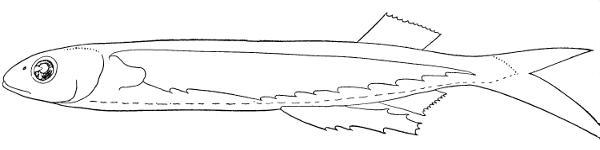
Fig. 20.
Specific characters.—Height of body one eighth of its length from tip of nose to fork of tail, length of head almost one fifth of the same (0·19). Width of forehead in front of eyes more than five eighths the length of head (0·69); diameter of eye less than one third of same length (0·30). Scale between eyes equilateral, and a little less than half of the width of head. No granulated area in front of orbit, and but a very narrow one behind it. Preoperculum rounded rectangular. Pectoral fin extending to halfway between end of dorsal and base of caudal, 0·60 of total length. Ventrals inserted nearer operculum than base of caudal, and extending to middle of anal. Dorsal commencing over 36th scale and extending to 48th.
D. 12, P. 14, V. 6, A. 10, C. 3-1-4-5-1-6. Scales 58-7/1.
Colors.—Steel-blue, fins smoky, below silvery, iris gilt.
General form much elongated, subcylindrical. Top of head perfectly flat, its width equal to its depth. Anterior half of body nearly as broad as high, compressed above. Posterior half compressed laterally, tapering to tail, the caudal peduncle three times as high as it is broad. A slight ridge along insertion of dorsal. Lateral line prominent, running close to insertion of ventrals. Proportions of fins to total length, as follows:
Length of dorsal 0·11
Height of ventrals 0·23
Length of anal 0·07
Length of caudal, upper lobe 0·15
Length of caudal, lower lobe 0·22
Height of pectoral 0·60
Length of specimen fifteen inches, the figure representing it half the natural size. One specimen obtained at Catalina Island.
Remarks.—In the preceding diagnosis I have followed the arrangement of specific characters adopted by Gill in his description of two new species of Exocœtus from the Pacific Coast of Central America. (Proc. Acad. Phil., June, 1863, p. 167.) By comparison it will be seen that our species is very distinct.
This large species of Flying-Fish is found in great numbers during the summer south of Point Conception, and some wander as far north as Santa Cruz at least. They can only be taken when they happen to alight on board of a vessel or in gill-nets, which I was not provided with during my late voyage among the islands. Their flight is rarely higher than ten feet above the water, but sometimes extends nearly a quarter of a mile.
Urolophus, Müller and Henle.
Urolophus Halleri, Cooper, State collection, species 522. [Fig. 21.]
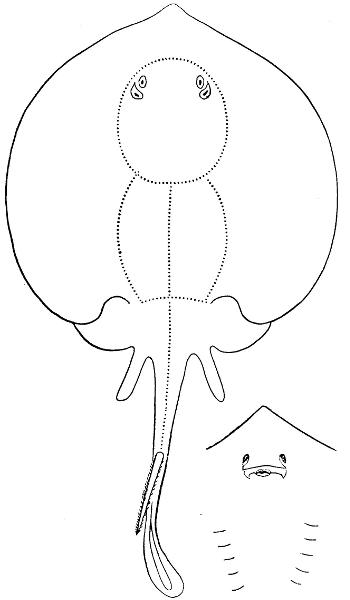
Fig. 21.
Specific characters.—Disk suborbicular, obtusely pointed in front, and with the pectoral fins rounded behind. Length anterior to anus a little greater than that of the tail behind it. Posterior outline of ventral fins projecting a little behind that of disk. Claspers as long as ventrals and projecting entirely behind them. Tail 0·47 of total length, gradually tapering from a cylindrical base to the spine, thence becoming flattened laterally expanding into a fin, which commences opposite the base of spine below, and ends opposite to its end above, broadest near its end, where its width is 0·10 the length of tail. Spiracles a little larger than orbits and farther apart, the distance between them equal to that from snout to orbits. Ventrals forming nearly equilateral triangles, their basal length one fifth that of head and body. Caudal spine arising at 0·48 of the length of tail, and not quite one third as long. Female more elongated than male but tail and spine shorter; the ventrals a fourth longer and more acute.
Colors.—Reddish speckled with yellow, below white. In some specimens the dark and light colors above are about equally distributed, the spots having a somewhat marbled arrangement. In others the light spots are very few and widely separated. Popular name “Round Stingray.” The figure is half the natural size. The dots show the principal outlines of the cartilaginous skeleton.
Remarks.—While this fish has the nearly orbicular outline of Urotrygon (mundus), Gill, from Panama (Proc. Phil. Acad., June, 1863, p. 173), it differs generically in having obtusely triangular teeth (equilateral), tail shorter than body, spine nearest to its base, smooth skin, etc.
It differs from Urolophus, as described by Richardson, in the upper velum of mouth being entire, and in having about twenty small tubercles on the surface of lower velum. These however can scarcely be considered generic differences.
Found abundantly in muddy creeks at San Pedro and San Diego, those from the former place being more uniform in color.
While I was at San Diego the little son of Major G. O. Haller, U. S. A. was wounded in the foot, probably by one of these fish, while wading along a muddy shore of the bay. The wound was very painful for some hours, though small. Another large rhomboidal species also abundant there but apparently still undescribed, inflicts very severe and dangerous wounds, of which I may have more to say hereafter.
This fish has great muscular power and can dart very rapidly through the water by lateral vibrations of its tail, at the same time quickly flapping the edge of its disk, to keep its level in the water and to regulate its direction.
It frequently buries itself slightly under the mud, and if disturbed obscures the water by stirring the mud, vanishing in the cloud thus raised to hide itself again. It will allow a boat to pass over its place of concealment, and may, if detected, be easily killed by a blow with the end of an oar. Many are also caught in the seines of the fishermen.
Their food consists of small mollusca, crustacea and such other animals, alive or dead, as they can obtain.