Regular Meeting, July 6th, 1863.
Reading edition
President in the Chair.
Twelve members present.
Professor George Thurber, of New York City, and F. W. Putnam, Esq., of Cambridge, Mass., were elected Corresponding Members.
Donations to the Library were received as follows:
Proceedings of the Academy of Natural Sciences of Philadelphia for October-December, 1862. Transactions of the Academy of Science of St. Louis, Vol. II, No. 1. Bulletin of the Museum of Comparative Zoology at Cambridge, Mass. Proceedings of the Boston Society of Natural History, Vol. IX, Signatures 11 and 12.
Dr. Kellogg read the following paper:
Description of Three New Plants.
BY A. KELLOGG, M.D.
Linum L.
L. trisepalum Kellogg. [Fig. 10.]
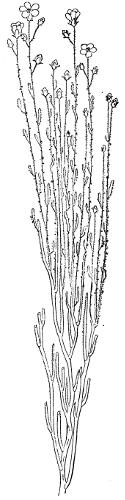
Fig. 10.
Stem suffruticose; base flexuous, smooth, cinnamon brown, numerously branched above; branches green, slender, erect, subsimple, stellate pubescent from minute scabrous elevations, and also simply short pubescent; plant sub-triangular throughout. Leaves erect, sub-appressed, small, linear, obtuse, slightly narrowed at the base into a very short petiole, alternate. Flowers small, yellow, in sub-terminal racemoid panicles; pedicels as long, or twice the length of the flowers; calyx bi-bracteate (appendaged?); bracts minute (about half the length of the sepals), linear, foliaceous (rudimentary sepals); proper sepals three, nerveless, ovate, acute (or sub-acute), imbricated margins glabrous, as long as the capsule. Petals obovate, sub-cuneate, scarcely twice the length of the sepals; stamens ten (yellow), shorter than the calyx; styles one, short; stigmas three, or united the entire length; capsule spheroid obtuse, sub-triangular, three-valved, each valve two-seeded, false dissepiment incomplete.
A small shrubby species, six inches to in height, found by Mr. Bolander on the White Hills back of Oakland.
P.S.—From the ripe fruit since obtained, the capsule is more ovate; separating invariably into three valves, only two to three ovules attaining to maturity; the seeds black, sub-compressed ovate, plano-convex or with two plain sides, the third convex, surface rough.
L. decurrens Kellogg. [Fig. 11.]
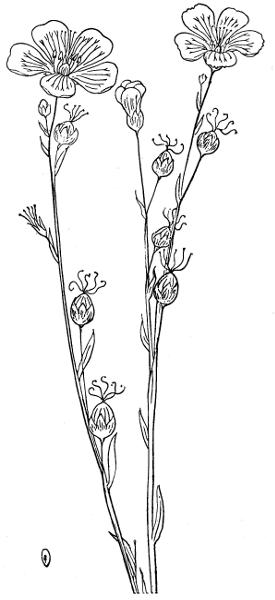
Fig. 11.
Stem annual, smooth, somewhat erect, sparingly branched, four to six inches of their summits racemed (the simple branches but slightly diverging from a vertical direction) much decurrent, from one to two feet in height. Leaves alternate, narrowly lanceolate, one-nerved, sharply acuminate (the lower-most leaves unknown). Flowers secund, large purplish blue, unilateral on long much decurrent pedicels, expansion of the pedicel above the articulation at the base of the calyx quadrangular; sepals five, ovate-oblong acute, margins scarious, seven-nerved, rather more than half the length of the capsule. Petals obovate, cuneate, claw short emarginate or crenate at the apex, marked by about five deeper blue veins. Styles five, free to the base, stigmas capitate. Stamens five, short; anthers oblong, white. Capsule ovate, very abruptly short pointed, completely ten-celled. Seeds oblong, hilum slightly narrowed.
Found by Mrs. Thayer on the head waters of Feather River.
Silene L.
S. Dorrii Kellogg. [Fig. 12.]
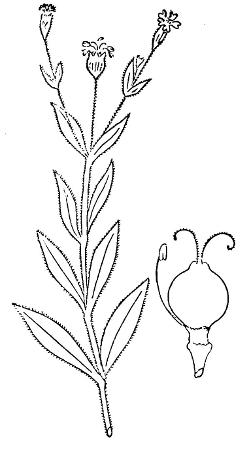
Fig. 12.
Stem simple or dichotomous above, minutely velvety glandular pubescent throughout, upper and cauline leaves lanceolate, acute or acuminate, sessile or sub-sessile, opposite, erect, slightly cilliate at base (radical leaves unknown). Flowers white, very small, sub-solitary on long peduncles; calyx tubular-campanulate, at length inflated, teeth short, acute (tipped with purple), tube ten-nerved; petals not crowned, minute border sub-two-lobed, lamina expanded, claws long and very slender; stamens ten, longer, at length shorter, filaments glabrous, anthers sagittate; styles two to three, separate, recoiled; stigmatose along the entire inner face. Ovary somewhat globose, apex slightly contracted; compressed seeds granular, stipe of the capsule very short.
A plant about three to five inches in height.
Collected by Mr. Herbert C. Dorr in Nevada Territory.
Dr. James Blake read a paper on the gradual elevation of the land in the environs of San Francisco.
On the Gradual Elevation of the Land in the Environs of San Francisco.
BY JAMES BLAKE, M.D., F.R.C.S.
The gradual elevation and depression of large portions of the earth’s surface has, within the last few years, been attracting considerable attention from geologists. It is a vast geological process of which we are the actual spectators, offering us the most imposing terrestrial phenomenon of which we can be cognizant, and at the same time affording us some tangible idea of the vast periods that have been required for bringing the surface of the earth to its present shape. It is the general opinion of geologists that the western shore of our continent is gradually rising. This has been proved to be the case as regards the southern portion of the continent; but the following facts, observed in the neighborhood of this city, afford undoubted evidence that at least this portion of the northern continent is being gradually elevated above the level of the ocean.
On the northern bank of Lobos Creek, a small stream running from Mountain Lake to the ocean, muscle shells and rolled pebbles are found at an elevation of from eighty to one hundred feet above the present level of the ocean, and probably at the distance of half a mile from the present beach. These shells and pebbles are exactly analogous to those now being deposited at the mouth of the creek, and were undoubtedly placed there when the spots at which they are found formed the beach of the ocean. The surface of the country is so much covered by drifting sands, that it is only in spots that these shore remains show themselves. The deposits first seen contain remains of shells considerably weathered—lower down the creek, shells and larger pebbles are seen; still lower down I found the same materials mixed with smaller pebbles, and at an elevation of about fifty feet small bands of black peat earth were found interstratified with the sand and gravel. These small bands of vegetable earth were evidently formed near the level of the ocean by the waves throwing up a barrier of sand which dammed up the waters of the creek, so as to form a pond in which a layer of vegetable matter was deposited. This process is going on at the present time, a dam having been thrown up by the heavy storms of the winter of 1861-1862.
Another evidence of the recent elevation of the country is seen near the western end of the Puerta Suelo, at a distance of about eight miles from the city. Here there is a depression in the hills, extending from the bay to the ocean, and forming a narrow neck to the peninsula on which San Francisco stands. Even at present, the distance from the waters of the bay to the ocean is not more than two or three miles at this point, and it is evident that at no very distant period this depression formed a channel of communication between them. Near the western end of this former channel, and at about a mile inland from the present sea beach, the skeleton of the head of a whale is found on the surface of the ground. The specimen measures about six feet across, and must have belonged to an animal fifty or sixty feet long. The bones, which are not at all mineralised, are in a good state of preservation. At the time they were carried there, there must have been eight or ten feet of water over the surface, and as the place is at present from ten to fifteen feet above the level of the ocean, a rise of twenty-five or thirty feet must have taken place at this spot since the animal was washed there.
Another locality at which evidence of the gradual elevation of the land can be obtained is found to the west of Black Point, where abundant remains of our present bay shells are found at a considerable elevation above the level of the sea; and, were not the surface of the country, particularly the lower levels, so completely covered in by the drifting sands, no doubt many analogous deposits could be found. To the south and west of the Mission, and in all the lower levels between there and the range of hills overlooking the Puerta Suelo, the surface is covered by these recent post tertiary deposits, through which the older rocks protrude in many places as isolated masses, the recent argillaceous sandstone being deposited in nearly horizontal strata around their base. These sandstones have given rise, by their decomposition, to the extensive surfaces of yellow sandy loam seen between the Mission and the Ocean House. I think the highest of these beds does not attain a greater elevation than one hundred feet above the present level of the ocean.
More recent evidence of the gradual elevation of the land is furnished by the holes made by the marine worms in the rocks on the shores of the bay, many of these holes being found at elevations which the highest tides do not at present reach.
On the age of these deposits it is useless at present to speculate. All that we know for certain is, that geologically speaking, they are recent; but whether it is five hundred, or five thousand, or fifty thousand years since the present site of Mountain Lake was on a level with the ocean, our present data do not enable us to form an opinion. All that the facts prove is that this portion of the continent is being gradually raised en masse.
From observations I have made on the main range of the Sierra, I am inclined to think that this process of gradual elevation is not confined to the land bordering the sea coast, but extends far into the interior. The undisturbed position of the post tertiary strata on the western slope of the Sierra, would indicate that the same process of gradual elevation must have been going on for hundreds of thousands of years, so that the original beach of the earlier post tertiary ocean is now at an elevation of four or five thousand feet above the present level of the sea. Should subsequent observations confirm the truth of this supposition, this country would afford a more striking example of the action of existing causes in modifying the surface of the earth, than is to be found in any other portion of the globe. It is desirable that some means should be taken to ascertain and record accurately the present relative level of the sea and land, as, after a few years, such a determination might furnish some very useful geological data. I have no doubt that it will be found that every shock of an earthquake is accompanied by an elevation of the land.
San Francisco, July 6th, 1863.