Part 1 — Regular Meeting, Nov. 21st, 1864.
Reading edition
President in the Chair.
Seven members present.
Rev. Horatio Stebbins was duly elected a resident member, Mr. Edward Bosqui a life member, and Mr. G. E. Wellington, of Nevada, a corresponding member, of the Academy.
Donations to the Cabinet: Specimens of Corals from the Hiton group of Islands, also a photograph of a Fungus [Agaricus], from the Society Islands, by Mr. Hubbard, on behalf of Mr. Andrew Garrett. Two specimens of Inoceramus, from Seattle, Puget Sound, by Mr. Hubbard.
Mr. Gabb presented the following papers:
Notes on some Fossils from the Gold Bearing Slates of Mariposa, with description of some new species.
BY WM. M. GABB.
Through the kindness of Miss Errington, of Bear Valley, Mariposa County, I have had the opportunity of examining a series of fossils, discovered by that lady on the Mariposa Estate. The shells appear to be of Jurassic age. The genera so far recognized, are Belemnites, Nucula or Leda, Lima, Pecten, and Pholadomya. The following are sufficiently perfect for description. Fuller descriptions and figures will be published hereafter in the Geological Report of the State.
Lima, Brug.
L. Erringtoni G. Shell very oblique, sides subparallel; beaks small; anterior end prominently rounded, sloping with a broad curve below to the base; posterior side nearly straight, continuing upwards in a long narrow ear; anterior ear obsolete (?).
Surface marked by strong concentric undulations, crossed on the upper and posterior portions by fine radiating lines.
Length, 2.25 inches; width, 1 inch.
The specimens are all very much compressed, and may be somewhat distorted in form, though the outlines are very nearly uniform in all of the specimens.
Pholadomya, Sow.
P. orbiculata G. Compressed, sub-circular; beaks rather prominent, nearly central; anterior end and base regularly rounded; posterior end slightly produced, more prominent below than above. Surface ornamented by concentric ribs, irregular in size, crossed by undulating, radiating lines on the anterior half of the shell. These lines become gradually obsolete and disappear on or about the middle of all of the specimens, although more perfect examples might show them continuing further.
Height, from a slightly distorted specimen, 1.1 inch; width, 1.3 inch.
Like the preceding species, all of the specimens have suffered considerably by compression; and had we perfect specimens, the shell would be found to be quite convex.
Belemnites.
B. Pacificus G. Long, slender, tapering very gradually and with a slight convexity to the tip. Section, sub-elliptical; alveolus deep and narrow.
A specimen 3 inches long, measures .35 in. in diameter in the middle. One cast has been found with a diameter of .9 inch at the broadest part.
I first discovered this species, as imperfect casts, in the slates near Spanish Flat, El Dorado County. Since then, numerous fragments and casts have been found at Mariposa, by Mr. C. R. King and Miss Errington.
Communication on the San Luis Obispo Quicksilver Fossils.
BY WM. M. GABB.
Mr. Attwood has recently presented to the collection of the State Geological Survey, a series of Fossils collected by himself, in the formation in which the San Luis Obispo cinnabar deposits occur.
Through the kindness of Prof. B. Silliman, Jr. I have had the opportunity of examining another small collection, made by that gentleman, at the same locality. I consider the result of sufficient interest to warrant a special communication on the subject.
The Fossils, though few in number of species, point unequivocally to the Miocene formation, the species being among the most familiar forms in the middle deposit of that formation in California.
They were: Dosinia ponderosa, Saxidomus aratus, Conus ravus = C. Californicus Reeve, Turritella Ocoyana Con., Natica, probably N. Recluziana, Pecten Pabloensis Con., Pallium Estrellanum Con., Carcharodon rectus Agas. a Balanus and one or two small shells too imperfect for determination.
Mr. Moore presented on behalf of Prof. Dana, the following paper:
On the Crystallization of Brushite.
BY JAMES D. DANA, L.L.D., PROFESSOR OF MINERALOGY IN YALE COLLEGE.
The specimens of the mineral Brushite, which I have had under crystallographic examination, were received from Mr. G. E. Moore, the discoverer of the species.
The crystals are slender prisms, not over a third of an inch in length. A common form (containing all the observed planes), is shown in the annexed figure. The prisms are monoclinic, and are often flattened, parallel to the clinodiagonal, as here represented.
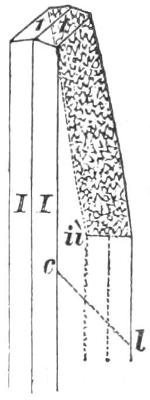
Fig. 26.
Cleavage is perfect, parallel of the clinodiagonal section, or the plane iì; also distinct parallel to the line cl, as apparent often in the cross fractures of the crystals, and by occasional striæ. This plane of cleavage may be taken as the basal plane O.
The planes I and l are brilliant, especially the former. The oblique plane situated on the back side in the figure, and which may be called r, is quite rough, owing to the oscillatory combination between two hemi-octahedral planes. In many of the crystals, only the right one of the two planes I is present, and also only the left one of the two planes l. The prisms frequently terminate above in an irregular edge, made by the meeting of the one, or two, planes I, and the rough plane r, and this edge is sometimes cut off, more or less deeply, by a single oblique plane, which is one of the planes l.
According to measurements with the reflective goniometer;
I:I = 142° 26’
I:iì = 108° 47’
l:iì = 101° 40’
I:l = 156° 20’ (approximately.)
The inclination of the I on l could not be accurately measured, on account of the minuteness of the planes in the crystals, in which both planes occur, and the want of perfection in the reflection. The angle obtained for l:iì would give, for l:l, 156° 40’.
By measurement with a goniometer attached to a compound microscope, the plane angle between the lines of cross cleavage, or cl, and the edge I:I (which equals the inclination of O on the orthodiagonal section, or a plane ii) was found to be 117-117½°; and that between edge I:I and edge l:l (which equals ii on li, both unobserved planes) 95°-95½°: whence O:li would equal approximately 147° 30’. The inclination of the rough plane r on the edge l:l is about 110°, but varies much.
The results of calculation, taking as data the above mentioned angles I:I and l:ii, along with the inclination of O to ii = 117° 15’, and that of the edge l:l (or lì) to ii = 95° 15’ are as follows:
C (= O : iì) = 117° 15’ and 62° 45’
a (vert. axis) : O (clinodiag.) : c = 0.5396 : 1 : 2.614
l : l = 156° 46’
-l : -l (unobserved planes) = 164° 22’
The species is related in form to Vivianite, in which
a : b : 2c = 1.0792 : 1 : 2.614.
The crystals of the two species are also alike in the perfect and pearly clinodiagonal cleavage.
On new Californian Marine Shells. No. II.
BY PHILIP P. CARPENTER, PH. D., OF WARRINGTON, ENGLAND.
Genus Collonia, Gray, 1852.
This genus was established (in English) by Dr. Gray, for Turbinate shells having an “operculum circular, with many gradually enlarged whirls, with a convex external rib and central pit.” The type (still appearing as such in the B. M. Col.) is a smooth fossil from Grignon, = Delphinula marginata, Lam., with a keeled and crenated umbilicus, like Phillippia. Another (African) shell is joined to the diagnosis, with the following brief description: “C. striata, Gray. Shell red, white marbled, striated.” It is quoted by Phillippi, Handb. Conch. p. 206, who assigns as a type T. sanguineus, Linn. For this species and its congeners, we now propose a subgenus Leptonyx, as they do not agree with the type. The genus was reconstituted by Messrs. Adams, Gen. i. 396 for shells with “imperforate axis and contracted aperture:” the description of the operculum being copied from Gray. The type is now “C. marginata, Nutt.” pl. 44, f. 2, the operculum of which is figured as with few whirls. The same description and figure are given in Chenu, Manuel i. 348, f. 2560. The error seems to have arisen thus. Mr. H. Adams (who acted for the ‘firm’ during his brother’s long absence in Japan,) probably took Gray’s C. marginata to be the ‘Turbo marginatus, Nutt.’ of Reeve, and from this species as type, described the genus to be imperforate, etc. Unfortunately, Dr. Gray did not observe the error, which had arisen from confounding two different shells called marginatus; and in his guide to Mollusca (in loco) he adopts the description of Messrs. Adams; so that Collonia, Gray, (hodie) = Collonia, Add., but not Collonia, Gray, (olim). Of the species arranged by Mr. H. Adams under Collonia, some may belong to the original genus: some are included under Cynisca, A. Ad.; and one (Turbo phasianella, C. B. Ad.) appears to be Eucosmia. They appear in the Br. Mus. Col. distributed between Gibbula and Photinula. The true Turbo marginatus of Nutt. is the ordinary black Californian Chlorostoma, like mœstus, and well named from its frilled margin near the suture. But the label having become affixed to the T. marginatus Rve. (which must stand as Reeve’s species and not Nuttall’s) the Californian shell was left without name, and was described by Mr. A. Adams as Chl. funebrale, under which name it must stand as Nuttal’s prior name was (unfortunately) in MS. only. The name Collonia marginata must stand for the original fossil of Lamarck. It is probable that Reeve’s shell belongs to another group; else it must, according to the usual custom of honoring error, be called C. Reevei. For the Californian species, which are imperforate and have a thin, smooth operculum, Mr. A. Adams and I propose to form a subgenus Leptonyx; a diagnosis of which will appear in the next paper, after the foreign species have been examined. The following are the Californian forms.
Leptonyx sanguineus, Linn.
H. t. parvâ, solidâ, rubrâ, anfr. V. subtumentibus, suturis plus minusve impressis; costulis spiralibus plus minusve rotundatis cinctâ, quarum iv.-viii. in spirâ monstrantur; aperturâ subcirculari; columellâ t. adolescente foveâ basali et dente ut in ‘Modulo’ munitâ; adultâ, callositate tenui labiali, foveam tegente, obscure bidentatâ; labio tenui, continuo; umbilico nullo.
Hab. Mediterranean, Phillippi, Hanley. Japan, A. Adams. Monterey, Jewett, Taylor, Cooper. Neeah Bay, W.T., Swan.
= Turbo sanguineus, Ln. Syst. Nat. Ed. 12, p. 1235:—Phil. Moll. Sic. in loco: Hanl. Ips. Lin. Conch, in loco.
= T. Belliæi, Michaud in Mus. Paris: teste Hanl.
Non “Turbo sanguineus, Linn.” Rve. Conch. Ic. sp. 55: = T. coccineus, Desh. = Globulus roseus, Chem. teste Rve. Nec (Gibbula) sanguinea, Risso.
Reeve says of his shell. “I am not quite sure that this is the T. sanguineus of Linnæus, but have every reason to believe it is.” That is, every reason except the one only convincing proof, which was so easy to a London naturalist, an inspection of the original type in the Linnæan Collection. A mere glance at this would have exposed his error. Reeve’s shell is whitish, with blood-red spots, and is probably a S. African species. Whether Linnæus described from Mediterranean or Japanese specimens, cannot be told from his rubbed shells; nor as yet have sufficiently perfect specimens been compared from the two oceans; but no character has been observed by which they can be separated. The great author obtained his Algerine and his Philippine shells from the Swedish consuls; and Japanese species may have been mixed with the latter. It is very rare in the Mediterranean; common in Japan; common also at Vancouver; but rare further south. It is, we believe, the only Californian shell described by the father of modern Natural History. The specimens vary very greatly in strength of sculpture. There is also a purple variety.
Leptonyx (sanguineus, var.) purpureum.
H. t. ‘H. sanguineo’ simili, sed purpureo fuscâ; lirulis spiralibus crebioribus, interstitiis parvis, labio obsoleto.
Hab. Sta. Cruz, Rowell. Monterey, Cooper. Neeah Bay, Swan.
Leptonyx bacula, Carp.
L. t. “L. sanguineo, jun.” simili; sed rufocinereâ, sculpturâ obsoletâ; anfr. iv. planatis, suturis vix distinctis, marginibus spiræ valde excurvatis; lirulis obsoletis latioribus, et circa basim striis crebris, vix sculptâ; apertura rotundatâ, declivi; columellâ vix callosâ.
Long. 0.08, long. spir. 0.06; lat. 0.14.
Hab. Catalina Is., dead on beach; Cooper, No. 1056.
This unpretending little shell resembles on the back one of the small Helicinæ. It differs from L. sanguineus in its small size, ashy color, flattened sutures, and nearly obsolete sculpture. A groove in the somewhat callous columella, continued slightly round the labrum, seems intended for the broad-margined operculum of the genus.