Annual Meeting, January 4th, 1864.
Reading edition
President in the Chair.
Fifteen members present.
E. Mathewson, Esq., of Martinez, was elected resident member.
The following is an abstract of the Annual Reports of the officers of the Society, for the past year (1863):
The Financial Report of the Trustees was received and accepted. During the year, $815.35 have been received from various sources, besides the balance on hand from 1862, of $141.22; $903.75 expended; and $52.82 remains in the hands of the Treasurer.
The Librarian (Prof. Whitney) reported verbally, that about fifty volumes have been added to the Library, mostly the publications of other Societies; that some sets of Journals have been rendered complete, by his own donations, and that the volumes of the “American Journal of Science” have been bound.
The Curator of Mineralogy (Mr. Moore) reports, that the collection is in nearly the same condition that it was at the commencement of the last year, that but few additions have been made, and that the work of cataloguing and classifying the specimens is in progress.
The Curator of Palæontology (Mr. Gabb) made no report.
The Curator of Botany (Dr. Kellogg) reports, that some additions have been made; that the collections are not in good condition for want of suitable cases, and recommends that new cases be procured, and that a suite of the specimens described by members of the Society be sent East, for comparison with specimens in those herbariums to which we have no access.
The Curator of Zoology (Dr. Cooper) made a verbal report, that he has been absent the most of the year, and that the collection has not materially changed since the last report, with the exception of an interesting collection of Birds deposited by Mr. Holder.
The Curator of Conchology (Dr. Trask) reported verbally, that about three hundred species of shells have been added to the collection during the year. Also, that he had received from Mr. Andrew Garrett, a collection of one hundred and fifteen species of Hawaiian Fishes, for the Museum.
The Curator of Entomology (Dr. Behr) reported verbally, that there have been no contributions, but that he will contribute from his own collection, and other persons have expressed their desire to do likewise, when the Society shall possess the means of accommodating and preserving the specimens.
The officers of the preceding year were reëlected, with the exception of Treasurer—S. Hubbard being elected in the place of Wm. Heffley, resigned.
The following resolution, prepared by Dr. Ayres, was unanimously adopted:
Resolved, That hereafter the Proceedings of the Academy be distributed gratuitously only to resident members and to such Societies and individuals as the Academy shall direct; and that the price of subscription to others be regulated by the Publishing Committee.
The Society authorized the publication of the following Constitutional amendments, adopted at the annual meeting, January 6th, 1862, the publication of which was accidentally omitted in the Proceedings of that year:
Amendment to Art. II, Sec. 4—That the Membership Fee, to be paid by an applicant for Resident membership, shall be two dollars, etc.—the remainder of the section remaining as before.
Amendment to Art. III, Sec. 2—This Association shall hold meetings on the First and Third Monday evenings of each month, for the investigation of Natural History, etc.—the remainder of the section remaining as before.
Dr. Ayres read extracts from letters containing inquiries in regard to the first volume of the Proceedings of the Society, which terminated abruptly, and was never finished. The supply has long been exhausted, and the republication has been frequently discussed; but as yet this is beyond the means of the Society.
Prof. Brewer communicated the following paper by Prof. Gray, giving the first installment of a series of descriptions of new plants from the botanical collections made by himself, while engaged in the State Geological Survey. These are a portion of the new species collected previous to 1863. The remainder will be described in future papers, along with those from the collection made after that time.
Descriptions of New Californian Plants—No. I.
BY PROF. ASA GRAY.
Streptanthus Nutt.
S. Breweri, n. sp. [§ Euclisia.]
Wholly glabrous and glaucous, annual, branched from near the base; cauline leaves (except the lowest) strongly cordate-clasping, with a closed sinus, entire or denticulate, the uppermost sagittate; flowers purple, on very short ascending pedicels, the lowest often leafy-bracted; the buds often a quarter of an inch long, obtuse, or barely acute; the sepals with scarious but blunt recurved tips; siliques narrowly linear, ascending or erect, straight or slightly incurved (1½-2½ inches long, less than a line wide,) compressed but torulose, the nerve of the valves obscure; seeds wholly marginless.
This most resembles S. tortuosus Kellogg (which is S. cordatus Torr., in Bot. Pacif. R. R. Whipple’s Rep. but evidently not of Nuttall), from which the above character indicates the differences.
There are three forms in the collection: 1. A dwarf state, in flower only, from Mt. Shasta, at an altitude of 8,000 feet. 2. A very glaucous form, with more numerous and rather smaller flowers, and with fruit, from the top of a dry mountain of the Mt. Diablo Range, near head of Arroyo del Puerto, at an altitude of 3,200 feet. 3. Another, in flower and fruit, with more naked and virgate branches, a foot or two in height, from San Carlos Mountain, near New Idria, 5,000 feet altitude. This is remarkable for having the calyx hoary-downy, but the plant is otherwise glabrous and glaucous.
S. hispidus, n. sp. (§ Euclisia.)
Very dwarf, (2-3 inches high, from an annual root,) hispid throughout, even to the siliques; leaves cuneate or obovate-oblong, coarsely toothed or incised, the cauline-sessile but hardly at all clasping; raceme short and loosely flowered; pedicels spreading or at length recurved in flower (which is red or red-violet) but the linear compressed siliques (1½ inch long, a line wide,) are erect; stigma almost sessile; immature seeds winged.
Mt. Diablo, dry places near summit.
This ranks next to S. heterophyllus.
Viola L.
V. ocellata, Torr. and Gray, var.
Glabrous, smaller; leaves somewhat thickish; peduncles elongated. Very curious and distinct. From Tamalpais.
Arenaria L.
A. brevifolia Nutt.? var. Californica.
Much branched or diffuse, cymosely many-flowered; petals and sepals somewhat narrower.
Leaves as in Nuttall’s plant, thickish, plane, mostly obtuse and spreading. Valves of the capsule entire. Filaments opposite and twice the length of the sepals, more dilated and glandular at the base. Seeds minute, minutely muricate, turgid. The fruit and seed are known only from Frémont’s specimens communicated to Dr. Torrey (No. 284 of Coll. 1846,) from California, a taller and less diffuse form than that now collected by Prof. Brewer, and more like Nuttall’s, from Tatnall County, Georgia. But my original specimen of the latter little-known plant is too incomplete to make certain the identity; and the two are widely sundered in geographical station. Still no adequate characters yet appear to distinguish specifically. Prof. Brewer collected his plant April 18th, in the valleys among high ridges in Sonoma, where it abounded.
Calandrinia H. B. & K.
C. Menziesii, Hook.
In various forms in southern California. Capsule slightly if at all exceeding the calyx; seeds rather turgid, shining; petals mostly much exceeding the calyx.
C. Menziesii, var. macrocarpa.
Stems and racemes at length more elongated and loosely-leaved; pedicels in fruit much spreading or recurved; capsule ovoid-fusiform, projecting beyond the calyx; seeds smaller, compressed and opaque.
Dry hills of the Santa Inez mountains, near Santa Barbara.
Perhaps a distinct species, but I want to see it confirmed by other specimens.
Linum L.
L. Breweri, n. sp.
Annual; glabrous; stem very small, not striate, with few flowers crowded at the apex; leaves filiform, smooth, alternate and opposite; stipules conspicuously glandular; pedicels shorter than the calyx; sepals oblong-ovate, acute, one-nerved, margin not scarious, glandular, less than half as long as the bright yellow, obovate-oblong petals; anthers elongated-oblong; sterile filaments almost wanting; styles three, distinct; stigma somewhat acutely pointed.
Dry hill sides of the Diablo Range, near Marsh’s Ranch, May 29th.
Plant barely two to three inches high, “but seen in the valley larger, with many flowers, not yet expanded.”
This, like L. Californicum, appears to be uniformly tri-carpellary; flowers about the size of those of that species, and the anthers elongated-oblong; but the leaves narrower; the stigmas not at all capitate or enlarged, but minute and acute; fruit not seen.
Trifolium, L.
T. bifidum, n. sp.
Somewhat villose or glabrous; stems from small (annual?) root, slender, spreading; stipules ovate-lanceolate, setaceously-acuminate, entire; leaflets linear-cuneate, lateral ones rarely dentate, bifid or incised at the apex with a mucronate point between the lobes; peduncles twice or three times as long as the leaves; heads naked, six to twelve flowered, or more; flowers pedicelled, at length reflexed; calyx five-parted, dentate, subulate-setaceous, somewhat hirsute, and nearly equal to the persistent, rose-colored scarious corolla.
Near Marsh’s Ranch, between Monte Diablo and the San Joaquin, among grass in a ravine near the water, May 29th.
Stems six to sixteen inches long. Heads and flowers about the size of those of the small form of T. gracilentum, to which species it is allied. Ovary two-ovulate, seeds single.
Astragalus L.
A. curtipes, n. sp. (§ Phaca, *Inflati.)
Minutely canescent, at length glabrate, a foot high; stipules connate, opposite the leaf; leaflets twelve to sixteen pairs narrowly oblong, retuse petiolulate, glabrous above; raceme in fruit short; calyx-teeth slender, subulate, slightly shorter than the campanulate tube; legume membranaceous, inflated, glabrate (1½ inches long,) semi-ovoid, (the ventral suture nearly straight, the dorsal very gibbous,) scarcely acute at either end, jointed to a rigid stipe, which does not exceed the tube of the calyx.
Dry hill sides, San Luis Obispo. Corolla not seen.
A. oxyphysus, n. sp. (§ Phaca, *Inflati.)
Tall, very softly canescen-villous; stipules small, scarious, distinct; leaflets 8-11 pairs, oblong; peduncles much surpassing the leaf; raceme elongated; bracts small and subulate; teeth of the silky calyx subulate, half the length of the cylindraceous tube; corolla white or greenish; legume obovate-acuminate, the base attenuate into a recurved stipe which somewhat exceeds the calyx.
Monte Diablo Range, near Arroyo Puerto, on dry hills.
A most distinct and striking new species.
A. Breweri, n. sp.
Allied to A. tener Gray, Rev. Astrag. (Phaca astragalina, var.? Hook. and Arn., and probably A. hypoglottis, var. strigosa, Kellogg,) but more branched from the annual root, and with broader leaflets, (4-5 pairs, oblong-obcordate); head 5-7 flowered, compact; immature legume globose-ovate, silky-canescent, not stipulate, erect, six-ovulate, one-celled, the dorsal suture slightly intruded.
Fields in Sonoma Valley, April. Common.
Dr. Ayres read letters from Mr. A. Garrett, and presented the following paper:
Descriptions of New Species of Fishes—No. II.
BY ANDREW GARRETT, OF HONOLULU, SANDWICH ISLANDS.
Cheilodactylus Lacep. 1803.
C. vittatus Garrett.
B. 6; D. 17-30; A. 3-8; V. 1-5; P. 8-6; C. 5, 1, 7, 6, 1, 4.
The height of the body is a trifle less than one-third of the total length. The upper profile rises in a convex line from the snout to the occipital region, whence it suddenly ascends in a nearly vertical curve, giving that portion of the fish a strongly gibbous appearance. The body rapidly tapers posteriorly, though preserving a slightly convex outline. The head enters nearly four and a half times in the entire length. The eyes are large, sub-circular in shape, even with the line of profile, and their greatest diameter is nearly one-third the length of the head. They are placed nearer the origin of the lateral line than the end of the snout. The small maxillary bone extends as far back as the anterior margin of the eye.
The dorsal fin takes its origin immediately above the posterior limb of the orbit and terminates within one diameter of the eye of the caudal fin. Its three anterior rays are very small, and the fourth, which is the tallest, is one-third as long as the base of the whole fin, or equal to two-thirds the height of the body. Posteriorly the spiny rays rapidly diminish in altitude so that the last one is shorter than the succeeding soft rays. The soft portion of the fin is comparatively low, gently convex along its upper edge, and is equally as long as the spiny part. The anal fin is small, being inserted just in advance of the middle of the soft portion of the dorsal. Its extreme margin is slightly concave and the rays rapidly diminish in length posteriorly. The ventrals when laid back reach as far as the anal fin. The second simple pectoral ray extends as far back as the vent. The caudal, which is deeply forked, has its lobes rounded off.
Color greyish-silvery, and ornamented with five oblique blackish-brown bands which are disposed as follows: one extends from the snout to the preopercular margin, the second starts from the eye and terminates on the pectoral base, the third, which passes over the occipital region, extends below the pectoral axilla; the fourth, which is much broader, starts from the origin of the dorsal fin, curves downward and backward, becoming wider in its descent, and passes beneath the abdomen; the fifth one commences on the upper anterior half of the spiny dorsal, extending along the back to near the termination of that fin. Three irregular, pale spots may be observed in the dorsal band, and three large blackish-brown spots on the caudal trunk. The opercular flap and snout tinged with orange-red. The interorbital space is marked with two transverse brownish-red bands. Irides yellowish-silvery. That portion of the dorsal fin anterior to the fifth band is white, the remainder, together with the anal and caudal, light-yellowish, the latter tipped with blackish-brown. The pectorals are orange-red, and the ventrals are deep blackish-brown.
Length, 7 inches.
Habitat, Sandwich Islands.
Remarks.—An extremely rare fish, of which the solitary specimen now before me is the only example that has come to my notice. It is the more interesting in a geographical point of view, as being the only species—as near as I can ascertain—recorded from the Polynesian Seas. Sir John Richardson, in his interesting “Notices of Australian Fish,” published in the “Proceedings of the Zoological Society of London,” describes, and gives a list of thirteen species. Nine of those occur in the Australian Seas, one from China and Japan, two from the Cape of Good Hope, and one from Tristan d’Acunha. In the number and arrangement of the fasciae, our fish closely resembles the C. gibbosus, Sol., (Chætodon) from Van Diemen’s Land. The latter species is less gibbous, the eyes smaller, the soft portion of the dorsal fin shorter, and the caudal forks are more pointed than in the C. vittatus.
Apogon Lacep. 1802.
A. maculiferus, Garrett.
B. 7; D. 7-1-9; A. 2-8 V. 1-5; P. 13; C. 4, 1, 8, 7, 1, 3.
The upper profile of the head is slightly concave; otherwise the general shape of the fish closely resembles the Apogon fraenatus, Val. The greatest depth of the body, taken at the commencement of the anterior dorsal fin, equals the length of the head, or two-sevenths of the entire length of the fish. The eye is large, sub-circular in shape, even with the upper line of profile, and its diameter nearly one-third as long as the head. The upper jaw is slightly the longest, and the hinder termination of the maxillary is on a line with the posterior border of the pupil. The margin of the preopercle is finely and regularly dentated, and its anterior crest or ridge exhibits but few irregular teeth. The lateral line may be traced over twenty-four scales.
The first and second dorsal fin are of equal length along their base, both being higher than long, and the altitude of the latter, which exceeds that of the former, is, as compared to the entire length of the fish, one to five. The anal fin is inserted a trifle more posterior than the fin above. The large ventrals, when laid back, cover the vent with their tips. The caudal is sub-bifurcate.
Color brilliant silvery, with an iridescent reflection in which carnation predominates. The upper two-thirds of the body is ornamented with longitudinal rows of small olivaceous spots, one on each scale, and those above the lateral line more or less coalescing, forming broken bands. The head, which is more or less tinged with diluted carmine-red, is marked by a diffuse olivaceous band, which extends from the end of the snout, passing through the eye and terminating on the opercle. Irides silvery white; cornea black. The membranes of all the fins are tinged with orange-yellow, and their rays are red.
Length, 5½ inches.
Habitat, Sandwich Islands.
Vernacular, “Upapalu.”
Remarks.—The longitudinal series of maculations will readily determine this species. Under the lens the spots assume the appearance of clusters of minute dots, some of which have blue central points.
Scorpæna Artedi, (L.)
S. parvipinnis, Garrett.
D. 13·10; A. 3-5; V. 1-5; P. 7-9; C. 5, 1, 6, 5, 1, 3.
In this species the upper and lower outlines are quite similar, being gently arched. The greatest depth of the body falls slightly short of one-third of the total length, and the greatest thickness at the base of the head, is a little more than two-thirds of the above mentioned depth. The head constitutes just one-third of the whole fish. The eye is large, circular, its diameter being nearly one-fourth of the length of the head. Four spines may be seen along the upper edge of the orbit, and the same number on each side of the occipital region and nape, the posterior one the larger. Two intraorbital spines, one on the nasal bone, and a longitudinal row of four along the supratympanic region. Two on the opercle, the lower one long and projecting posterior to the margin of that bone. A stout one may be observed on the humeral region, one on the infra-orbital, three on the margin of the preopercle, and a longitudinal row of irregularly disposed ones along the cheek. The lower jaw is slightly longer than the upper, and the tip of the maxillary extends as far back as the hinder border of the eye. Fine scales envelop the basal portions of all the fins except the ventrals, and cover all parts of the head except the jaws and the lower half of the maxillary bone. Minute filaments are observed on all parts of the fish, being more numerous on the upper anterior third of the body. The dorsal and anal fins are small, the former commencing above the origin of the latter line. The spiny portion of the dorsal is very low, gently arched, and constitutes nearly two-thirds of the fin. The soft portion of the anal fin is very narrow and rounded off.
The head and anterior half of the body is greyish, passing into light carnation beneath, and obscurely clouded with dusky. The posterior half of the body is dusky black, which fades into pink beneath, maculated with small darker spots. Caudal trunk, pink. Two large dusky black spots on the anterior dorsal region. Irides greenish-yellow. Fins pinky-red, the spiny dorsal mottled with dusky, and the other fins dotted with pinky-brown, and a bar of the same color on the caudal base.
Length, 4 inches.
Habitat, Sandwich Islands.
Remarks.—The scaly head, small dorsal and anal fin will readily distinguish this beautiful species.
Crenilabrus, Cuv.
C. modestus, Garrett.
B. 6; D. 12-10; A. 3-12; V. 1-5; P. 17; C. 2, 1, 6, 6, 1, 2.
The greatest depth, which occurs beneath the origin of the dorsal fin, is about one-fourth of the total length, and the greatest thickness is just half of the above mentioned depth. The head, which comprises a little more than one-fourth of the whole fish, presents a slight concave depression above the eyes. The preopercular serrations are very small. The eyes are sub-circular, their greatest diameter entering nearly six times in the length of the head, and twice in advance of their own orbit. The hinder tip of the maxillary reaches a vertical, passing through the center of the eye. Twelve longitudinal rows of scales may be enumerated between the lateral line and the vent, ten rows on the side of the caudal trunk, and the median longitudinal row on the body contains thirty scales. The lateral line, which passes over thirty-three scales, consists of slightly branched tubes.
The dorsal fin extends over a base equal to half the length of the fish, caudal fin excluded. Its soft portion falls slightly short of one-third of the whole fin. The anal fin, which is nearly half as long as the dorsal, has its hinder termination slightly more posterior. The acuminately pointed ventrals, when closely appressed to the abdomen nearly reach the anal fin. The large caudal has its posterior upper and lower angles considerably prolonged and pointed.
Color purplish-brown, passing into bluish grey beneath, and obsoletely lineated longitudinally with darker. A large oblong pale diffuse spot beneath the posterior end of the dorsal fin, which is directed obliquely downward and forward. Irides silvery, tinged with yellow. The dorsal fin is pale greyish, marked anteriorly with a large diffuse blue-black spot, its soft portion being tinged with reddish and margined above with yellow. The anal, ventrals and caudal are bluish-grey, the former posteriorly tinged with faded red and edged with yellow. Pectorals nearly colorless.
Length, 18 inches.
Habitat, Sandwich Islands.
Remarks.—We have obtained only two individuals of this large species, both of which were exposed for sale in the Honolulu fish-market. The colors, which are no doubt considerably changed, were taken from the dead fish.
Chironectes Cuv. 1817.
C. niger, Garrett.
D. 3-12; A. 6; V. 5; P. 10; C. 1, 7. 1.
The head constitutes about one-third of the total length, caudal excluded. The eyes are elliptically-oval, and inserted just once their greatest diameter distant from the margin of the upper jaw. The skin is covered with fine closely set prickly asperities, which gives it a velvety appearance. The general outline is ovate, and the greatest thickness equals one-sixth of the entire length. A range of conspicuous pores commences on the upper part of the gill covers, curving downward and upward to the symphysis of the lower jaw. Another row follows the margin of the upper jaw, passing over the snout, where it branches off posteriorly, curving over the eye and disappearing on the posterior portion of the body. Each pore is encircled with brush-like appendages, which gives them a tufted appearance. The dorsal fin extends over a base equal to one-third the length of the fish. Its upper margin is arched, and its height as compared to length is as one to two. The height and length of the anal fin are about equal.
Color deep black and obsoletely maculated with rather small roundish darker spots. On the basal portion of the dorsal and anal fins may be observed two large ocellations, with deep black pupils and paler areolae. Very minute opaque white points may also be seen scattered along the lower parts. Eyes blackish.
Length, 3½ inches.
Habitat, Sandwich Islands.
Remarks.—This species possesses the nasal tufted bristle and two horn-like processes that we observe in all the species inhabiting these seas. When handled it emits a most disagreeable odor.
Dr. J. G. Cooper presented the following paper:
On New Genera and Species of Californian Fishes—No. III.
BY J. G. COOPER, M. D.
Myxodes Cuvier, 1817.
M. elegans, Cooper, State Collection, No. 707. [Fig. 23.]
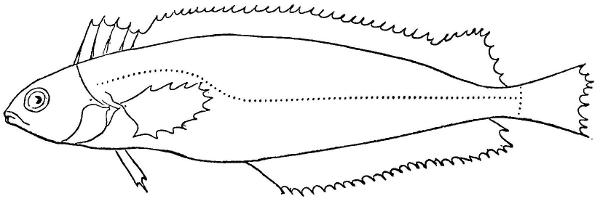
Fig. 23.
Specific characters.—Form elongated, high and narrow, the head wider than the thickest part of body. Length of snout equal to diameter of eye, lower jaw very slightly longest. Total length a little more than four and a half times that of head, which is equal to the greatest height of body. Head moderately arched, rounded above, the width between eyes a little less than the width of orbit. Orbit circular, contained four and a half times in length of head. Anterior lobe of dorsal commencing just behind head, triangular, one-twentieth of the length of fin, equal to the middle lobe in height; middle lobe gradually arched, its spines more slender than those of the first lobe; posterior lobe with soft rays only, about equal to the first, in size and form, extending nearly to the tail. Caudal fin quadrangular, its end obtusely truncate, nearly twice as long as wide. Anal commencing opposite seventeenth dorsal spine, nearly straight, its height one-fifth its length, and ending a little anterior to end of dorsal. Ventrals narrow, the middle ray longest. Pectorals arising opposite third dorsal spine, nearly as wide as long.
D. V-xxvii to xxx-8; C. 5-5; A. 26 to 28; V. 3; P. 11.
Scales in about 250 rows along middle of side, in 18/50-18/18 vertical rows along lateral line. Proportional measurements:
Length of largest specimen, 4 in. 100.
Length of head .20
Height of pectoral .15
Length of dorsal .72
Length of caudal .12
Length of anal .44
Height of ventral .09
Height of body .22
Width of body .08
Colors.—Exceedingly variable, but the general pattern, as preserved in alcohol, consists of a series of vertical bands, alternating with spots of various shapes and sizes, and often densely mottled with dark and light blotches distributed regularly, but not describable. The fins have alternating bands, and in all the specimens the membrane between the third and fourth dorsal spine is as clear as glass, as if intended to be seen through, but probably shines in the water as a sort of signal. When fresh the colors of those from San Diego were as follows: 1st, dark brown, a purple lateral stripe, sides with dark and light brown bars, having silvery blotches between them; below yellowish, top and sides of head blotched with yellow, a bright red ring with a green centre near pectorals, and another near caudal. Dorsal with alternating bars of olive and yellow; pectoral yellow at base, its rays reddish, barred with purple, ventrals and anal smoky.
Another was striped and cross-barred with brown, and mingled with this pattern were blotches of olive-brown, yellowish and purple, but no rings. Fins marked like the body, but paler.
It is possible that the rings observed in the first one, and not seen in any other, were caused by the growth of vegetable parasites, which are often found on fish of similar habits.
Remarks.—This is the first instance of a Myxodes being found on our coast north of the equator, though a nearly allied genus, the Heterostichus, has been long known. I was in some doubt whether to refer the fish to Myxodes on account of the meagre descriptions of the genus accessible, but having sent a copy of the outline to Mr. Gill, I have been confirmed in the correctness of the diagnosis. The following are some of the most important generic characters not shown in the outline of our species:
Branchiæ VI-VI, the apertures freely connected below. Teeth uniserial in each jaw, those of lower jaw largest, some of those along sides larger than the rest. No teeth on vomer. Scales minute, entire, cycloid, closely adherent—none on head or fins.
The two-lobed form of the spinous dorsal does not apparently exist in some of the species. Suspecting that some of the other characters will be found sufficient to distinguish it, I propose for it provisionally the name Gibbonsia, in honor of Dr. W. P. Gibbons, of Alameda County, whose descriptions of our viviparous fishes, published in 1854, by the Academy, have only of late been awarded the credit they deserve.
These beautiful little fish are found at low water in holes among rocks along our coast south of Point Conception, and at the adjoining islands. Their varied and elegant coloration would make them beautiful objects for a marine aquarium, but I had nothing suitable for the purpose, in which I could keep them alive long enough to study their habits.
I obtained three at Pt. Loma, San Diego, three at Catalina I., and two at Santa Barbara I., all manifestly of the same species, though differing individually in color, as above mentioned. They have no popular name.
Gillichtyhs, n. g.[8]
Generic characters.—Form moderately elongated, laterally compressed. Head depressed, broader than body, forming more than one-fourth of total length. Eyes small, situated far forward, and obliquely turned upward. Mouth moderate, its gape extending to the vertical of the posterior rim of orbit, but the angle of lower jaw half way to branchial aperture. Upper maxillaries extending back the same distance, thence prolonged by a cartilaginous expansion which reaches as far back as the opercular opening, and being there connected to an expansion of the skin of the lower jaw, forms a channel running back from the mouth and as long as the gape of the mouth itself. This channel is entirely free from the side of head, but only slightly movable forwards, so that it cannot serve to widen the mouth when opened.
Premaxillaries not protractile, movable at their symphysis, and only half as long as maxillaries, with which they are connected by a thin membrane, ending below orbit.
Villiform teeth on premaxillaries throughout, also on lower maxillaries to angle of mouth, and on pharyngeals; none on upper maxillaries, vomer or palate. A minute nasal aperture close behind maxillary and another opening just in front of anterior rim of orbit.
Preoperculum covered by the skin of the head.
Branchiæ four, all double, and free, opercular apertures small, as wide as base of pectorals, and separated by the whole width of the base of head.
Tongue broad and thick. Air-bladder small, liver very large and alimentary canal short.
Scales small, cycloid and thin, imbedded in the skin so as to be scarcely perceptible anterior to dorsal fin, or on back. None on ventral surface.
No lateral line perceptible. Dorsal fins two, situated far back, and rather large. Caudal small, obtusely rounded. Anal opposite to second dorsal. Ventrals united into a funnel-shaped disk opposite base of pectorals. Pectorals large and rounded. Fin rays all soft, dividing into three or four branches toward their ends. A small “papilla genitalis” in front of anal fin.
Whole fish covered with thick mucous secretion. Skin of head rather loose and soft, and perfectly smooth.
Gillichthys mirabilis Cooper, State Coll. No. 627. [Fig. 24.]
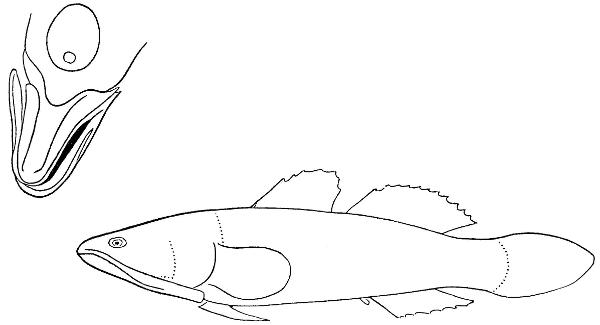
Fig. 24.
Specific characters. Scales along middle of side, about 90 in 27 rows.
D. 6-13; C. 13-13; A. 11; V. 6 + 6; P. 20.
Length of largest specimen obtained, 5¼ inches 100.
Distance from snout to orbit .06
Length of orbit .03
Snout to end of maxillary process .26
Snout to opercular aperture .27
Snout to first dorsal fin .36
Length of base of dorsal fin .15
Height of dorsal fin .10
From first to second dorsal .03
Length of base of second dorsal .19
Height of second dorsal .10
Length of caudal .16
Width of caudal .12
From caudal to second dorsal and anal .10
Length of base of anal .12
Height of anal .06
From ventral to anal .26
Height of ventral anteriorly .02
Height of ventral posteriorly .08
Height of pectoral .14
Width of base of pectoral .08
Lower jaw to ventrals .27
Width of head between orbits .02
Width of head at opercula .15
Height of head at opercula .16
Width of body at first dorsal .12
Height of body at first dorsal .18
Width of caudal at base .02
Height of caudal at base .09
Distance between ends of maxillary processes .58
Colors.—When alive mottled with light and dark olive, paler below, sides of head reddish. In alcohol black, pale below, and scales below middle of sides finely punctate each with 8-10 dots, only visible under a microscope.
Hab.—I found these remarkable fish only in San Diego Bay, and in but one station, which was among seaweed growing on small stones at the wharf of Newtown the military post, in November, 1861. They were left by the receding of the tide, and must have been out of the water from three to six hours daily, though kept moist by the seaweed. The four obtained were all females containing large masses of ova, and may have come to the spot in order to deposit them.
I could not obtain a glass vessel suitable for an aquarium, so as to keep them alive and observe their habits. The use of the strange maxillary processes or channels is obscure, nothing analogous being known in other fishes, the nearest approach to them being apparently the lengthened maxillaries of some Salmonidæ and Clupeidæ, fish of entirely different habits and affinities, this one being evidently one of the Gobidæ. The stomach contained small crabs, apparently swallowed whole.
Pteroplatea Müller and Henle, 1837.
P. marmorata, Cooper, State Collection, Species 674. [Fig. 25.]
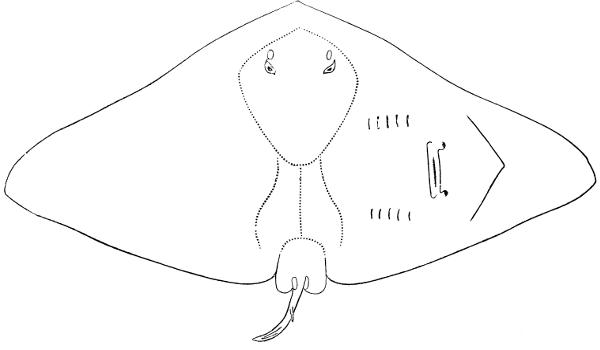
Fig. 25.
Specific characters.—Outline of disk rhomboidal, the anterior borders forming an obtuse angle in front, nearly straight in their course to the lateral angles, which are sub-acute; the posterior borders rounded.
Ventrals small, oblong, obtuse-angled, projecting a little behind the disk. Tail nearly twice the length of ventrals, slender and pointed, flattened laterally behind the spine, and bordered by a very narrow membrane, commencing opposite the end of the spine below, and ending a little farther back above.
Spine arising at a point one-third the length of the tail from its base, one-sixteenth of its length, and less than a fourth as wide as it is long.
Both surfaces are nearly flat.
Proportional measurements:
Total length of specimen, 9½ in. 100.
From median line to tip of pectoral .80
From anterior angle to eyes .13
From anterior angle to ventrals .70
Antero-posterior length of ventrals .10
Length of claspers .04
Length of tail beyond ventrals .25
Length of caudal spine .04
Distance between eyes .15
Colors.—Thickly marbled with blackish and grayish mottlings equal in size; ventrals and tail with a few scattered white spots; below, white. It is probable that the colors are variable, as in the allied Urolophus.
I was doubtful at first whether to consider this fish a Pteroplatea, as that genus is described by Richardson as having the mouth curved, and the dental plate extending to its corners, also the teeth lobed. These characters, however, may change with its growth, this being evidently a young specimen. Mr. Gill, of the Smithsonian Institution, Washington, D. C., to whom I sent a figure of it, agrees with me in referring it to this genus.
Compared with the P. Maclura (Lesueur), of the Atlantic coast, described and figured by Dekay in the Nat. History of New York, this species is less wide in proportion to its length, the difference being as 10 to 16. There is also some difference in the markings. The P. Maclura is said to attain the enormous width of 18 feet.
I found but one specimen of this fish at San Diego, where it was caught in a seine. I have also seen one, when the steamer was lying at anchor, at San Pedro, swimming near the surface of the water, apparently supporting itself by flapping its wing-like expansions, while it progressed slowly by lateral motions of its tail.
Note.—By an oversight of the printer, the proper references to the figures on page 110 were left out. The reader will however understand from the descriptions that the right hand figure is the Myxodes (Fig. 23), and the others the Gillichthys (Fig. 24).