Volume 2 — Wood-wind harmony.
Edward Agate translation
Before entering upon this section of the work I would remind the reader of the general principles laid down in the beginning of the chapter.
Harmonic texture, composed of plain chords or ornamental designs, simple or contrapuntal in character, must possess a resonance equally distributed throughout. This may be obtained by the following means:
1. Instruments forming chords must be used continuously in the same way during a given passage, that is to say they must be doubled or not throughout, except when one of the harmonic parts is to be made prominent:
To be avoided:
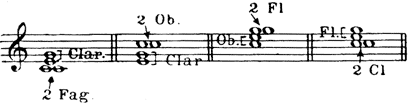
[Audio content is not currently supported on your device.
2. The normal order of register must be followed, except in the case of crossing or enclosure of parts, which will be discussed later on:
To be avoided:
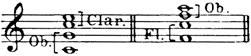
[Audio content is not currently supported on your device.
3. Corresponding or adjacent registers should be made to coincide except for certain colour effects:
To be avoided: The second flute will sound too weak and the oboes too piercing.
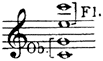
[Audio content is not currently supported on your device.
4. Concords (octaves, thirds and sixths) and not discords (fifths, fourths, seconds and sevenths), should be given to instruments of the same kind or colour, except when discords are to be emphasised. This rule should be specially observed in writing for the oboe with its penetrating quality of tone:
To be avoided:
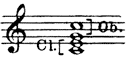
[Audio content is not currently supported on your device.
Four-part and three-part harmony.
Harmonic writing for the wood-wind may be considered from two points of view: a) instruments in pairs, 2 Fl., 2 Ob., 2 Cl., 2 Fag.; and b) instruments in three's, 3 Fl., 2 Ob., Eng. horn, 3 Cl., 2 Fag., C-fag.
A. In pairs. There are three ways of distribution: 1. Superposition or overlaying (strictly following the normal order of register), 2. Crossing, and 3. Enclosure of parts. The last two methods involve a certain disturbance of the natural order of register:
Overlaying. Crossing. Enclosure.
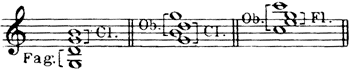
[Audio content is not currently supported on your device.
In choosing one of these three methods the following points must not be forgotten: a) the register of a particular isolated chord; the soft and weak register of an instrument should not be coupled with the powerful and piercing range of another:
Overlaying. Crossing. Enclosure.

Oboe too piercing. Low notes of the flute too weak. Bassoon too prominent.
[Audio content is not currently supported on your device.
b) In a succession of chords the general progression of parts must be considered; one tone quality should be devoted to the stationary and another to the moving parts:

[Audio content is not currently supported on your device.
When chords are in widely-divided four-part harmony notes may be allotted in pairs to two different tone qualities, adhering to the normal order of register:
Good: etc.
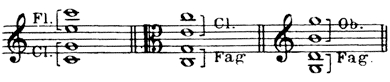
[Audio content is not currently supported on your device.
Any other distribution will result unquestionably in a grievous lack of relationship between registers:
To be avoided: etc.

[Audio content is not currently supported on your device.
If one tone quality is to be enclosed, it must be between two different timbres:
Good: etc.

[Audio content is not currently supported on your device.
It is possible to lend four distinct timbres to a chord in widely-divided four-part harmony, though such a chord will possess no uniformity in colour; but the higher the registers of the different instruments are placed, the less perceptible becomes the space which separates them:
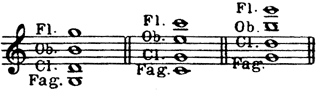
Fairly good Better Still better
[Audio content is not currently supported on your device.
The use of four different timbres in close four-part harmony is to be avoided, as the respective registers will not correspond:
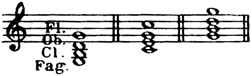
Bad Better Still slightly better
[Audio content is not currently supported on your device.
Note. In Mozart and Salieri, which is only scored for 1 Fl., 1 Ob., 1 Cl. and 1 Fag., wood-wind chords in four-part harmony are of necessity devoted to these four different timbres.
The same rules apply to writing in three-part harmony, which is the most customary form when it is a question of establishing a harmonic basis, the lowest register of which is entrusted to another group of instruments (strings arco or pizz., for example). Chords in three-part harmony are generally given to two instruments of one timbre and a third instrument of another, but never to three different timbres. Overlaying of parts is the best course to adopt:

[Audio content is not currently supported on your device.
The use of crossing and enclosure of parts (which in a way amount to the same thing) must depend on the manner of their progression:
Enclosure:

[Audio content is not currently supported on your device.
B. Wood-wind in three's. Here the distribution of chords in close three-part harmony is self-evident; any grouping of three instruments of the same timbre is sure to sound well:

[Audio content is not currently supported on your device.
also:
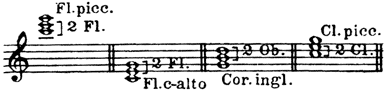
[Audio content is not currently supported on your device.
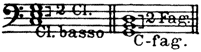
[Audio content is not currently supported on your device.
Overlaying of parts is the best method to follow in writing close four-part harmony; three instruments of the same timbre with a fourth instrument of another. Crossing and enclosure of parts may also be employed. Correspondence of timbres and the progression of remote parts must be kept in mind:

[Audio content is not currently supported on your device.
The method of using three instruments of the same timbre in widely-divided three-part harmony is inferior:

Not good Better Better Not good Better Better
[Audio content is not currently supported on your device.
But if the third instrument is of low register (Bass Fl., Eng. horn, Bass cl., or C-fag.), the resonance will be satisfactory:

[Audio content is not currently supported on your device.
In chords of four-part harmony, three instruments of the same timbre should be combined with a fourth instrument of another:

[Audio content is not currently supported on your device.
Harmony in several parts.
In writing chords of 5, 6, 7 and 8 part-harmony, whether they are independent, or constitute the harmonic basis, the student should follow the principles outlined in the previous chapter, dealing with the progression of wood-wind instruments in octaves. As the 5th, 6th, 7th and 8th notes are only duplications in octaves of lower notes of the real harmony (in 4 parts), instruments should be chosen which combine amongst themselves to give the best octaves. The process of crossing and enclosure of parts may also be used.
A. Wood-wind in pairs (close distribution):

[Audio content is not currently supported on your device.
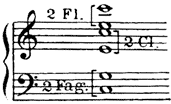
In widely-divided harmony chords in several parts are to be avoided as they will entail both close and extended writing:
[Audio content is not currently supported on your device.
Note. In the majority of cases this distribution is employed when the two upper harmonic parts have a special melodic duty to perform—this question is discussed above.
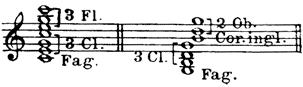
B. Wood-wind in three's:
[Audio content is not currently supported on your device.
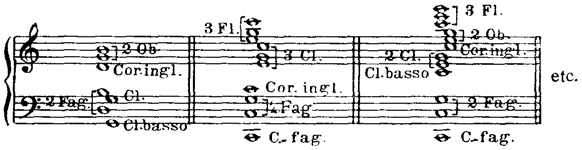
[Audio content is not currently supported on your device.
Overlaying of parts is the most satisfactory method in dealing with close three-part harmony. Crossing of parts is not so favourable, as octaves will be produced contrary to the natural order of register:
Here the arrangement is bad.
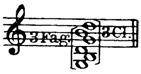

[Audio content is not currently supported on your device. [Audio content is not currently supported on your device.
Duplication of timbres.
A. If the wood-wind is in pairs it is a good plan to mix the doubled timbres as much as possible:

Excellent
[Audio content is not currently supported on your device.
also:

[Audio content is not currently supported on your device.
In chords of four-part harmony the classical method may be adopted:
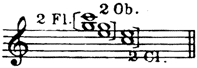
[Audio content is not currently supported on your device.
In this case, though the high C in the flute is fairly powerful, the resonance of the G and E in the oboes is softened by the duplication of the 2nd flute and 1st clarinet, while the C in the 2nd clarinets (not doubled) is feeble in comparison with the other notes. In any case the two extreme parts are the thinnest and weakest in tone, the intermediate parts the fullest and strongest.
B. Wood-wind in three's admit of perfectly balanced mixed timbres in chords of three-part harmony:

[Audio content is not currently supported on your device.
These timbres may even originate from three-fold duplication:
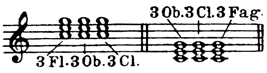
[Audio content is not currently supported on your device.
Remarks.
1. Modern orchestrators do not allow any void in the intermediate parts in writing close harmony; it was permitted to some extent by the classics:
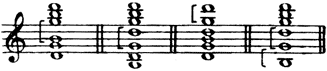
[Listen]
These empty spaces create a bad effect especially in forte passages. For this reason widely-divided harmony, which is fundamentally based on the extension of intervals, can be used but seldom and only in piano passages. Close writing is the more frequent form in all harmony devoted to the wood-wind, forte or piano.
2. As a general rule a chord of greatly extended range and in several parts is distributed according to the order of the natural scale, with wide intervals (octaves and sixths), in the bass part, lesser intervals (fifths and fourths) in the middle, and close intervals (3rds or 2nds) in the upper register:
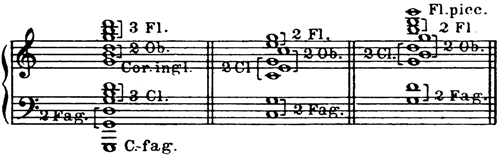
[Audio content is not currently supported on your device.
3. In many cases correct progression of parts demands that one of them should be temporarily doubled. In such cases the ear is reconciled to the brief overthrow of balance for the sake of a single part, and is thankful for the logical accuracy of the progression. The following example will illustrate my meaning:
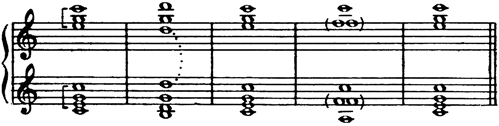
[Listen]
In the second bar of this example the D is doubled in unison on account of the proximity of the three upper parts to their corresponding parts an octave lower. In the fourth bar the F is doubled in unison in both groups.
4. The formation of the harmonic basis, which is essentially in four parts, does not by any means devolve upon the wood-wind alone. One of the parts is often devoted to the strings, arco or pizz. More frequently the bass part is treated separately, the chords of greater value in the three upper parts being allotted to the wood-wind. Then, if the upper part is assigned to a group of strings, there remains nothing for the wind except the sustained harmony in the two middle parts. In the first case the three-part harmony in the wood-wind should form an independent whole, receiving no assistance from the bass; in this manner intervals of open fourths and fifths will be obviated. In the second case it is desirable to provide the intermediate parts with a moderately full tone, choosing no other intervals except seconds, sevenths, thirds or sixths.
All that has been said with regard to the use of wood-wind in the formation of harmony, and the division of simple and mixed timbres applies with equal force to sustained chords, or harmonic progressions interchanging rapidly with staccato chords. In short chords, separated by rests of some importance, the arrangement and division of timbres is not so perceptible to the ear, and progression of parts attracts less attention. It would be useless, nay, impossible to examine the countless combinations of tone colour, all the varieties of duplication and distribution of chords. It has been my aim to denote the fundamental principles upon which to work, and to indicate the general rules to be followed. Once having mastered these, if the student devote a little time to the study of full scores, and listen to them on the orchestra, he will soon learn when certain methods should be used and when to adopt others. The pupil is advised, generally, to write for wood-wind in its normal order of distribution, to take heed that each particular chord is composed entirely either of duplicated or non-duplicated parts, (except in certain cases resulting from progression), to use the methods of crossing and enclosure of timbres with full knowledge of what he is doing, and finally to concentrate his attention on close part-writing.
Examples of wood-wind harmony:
a) Independent chords.
No. 105. The Christmas Night 148—Cl., 2 Fag.
No. 106."""beginning—Ob., Cl., Fag. (crossing of parts).
Snegourotchka 16—2 Cl., Fag.
"79, 5th bar.—2 Ob., 2 Fag. (cf. Ex. 136).
* No. 107. Snegourotchka 197—Picc., 2 Fl. (tremolando).
No. 108. "204—2 Fl., 2 Ob. (high register).
No. 109. Shéhérazade, beginning—Total wood-wind in different distribution.
* Russian Easter Fête A—3 Fl. tremolando (cf. Ex. 176).
* Tsar Saltan 45 Ob., 2 Fag.
No. 110. Tsar Saltan, before 115—mixed timbres.
No. 111.""115, and other similar passages—very sweet effect of wood-wind in three's.
""177—2 Ob., 2 Fag.
Sadko, Symphonic Tableau 9—Ob., 2 Cl., Fag.
* Sadko, Opera 4—Eng. horn, 2 Cl.
""before 5—Total wood-wind.
No. 112. Sadko 72—Chords in three-part harmony; simple and mixed timbres.
* No. 113. The Tsar's Bride 126 Full wind.
* No. 114. Legend of Kitesh, before 90—Enclosure of parts (Ob. I in the high register).
No. 115."""before 161—Wind and brass alternately.
No. 116."""167—Full wind except oboe, with chorus.
Legend of Kitesh 269—Fl., Cl., Fag.
* The Golden Cockerel 125—Various wind instruments, 4 part harmony (cf. Ex. 271).
"""218—Ob., Eng. horn, Fag., C-fag.; cf. also 254.
No. 117. The Golden Cockerel, before 236—Mixed timbre; 2 Fag. form the bass.
b) Harmonic basis (sometimes joined by the horns).
The May Night, Act III L—2 Fag., Eng. horn (cf. Ex. 18).
Antar 68—3 Flutes.
Snegourotchka 20—2 Cl., high register.
"before 50—2 Fl., Fag.
"187—2 Ob., 2 Fag.
"274—2 Cl., low register (cf. Ex. 9).
"283—Fl., Eng. horn, Cl., Fag. (cf. Ex. 26).
No. 118. Snegourotchka 292—Widely-divided harmony and doubling of parts in the wind.
No. 119."318-319—2 Flutes.
Shéhérazade, 2nd movement B—2 Cl., Fag. (sustained note in the horn) (cf. Ex. 1).
The Christmas Night 1—3 Cl.
Sadko 1—Cl., Bass Cl., Fag., C-fag.
No. 120. Sadko 49—Ob., Cl., Horn, Fag.
"99—2 Cl. (cf. Ex. 289, 290).
No. 121. Sadko 144—Cl., Fag.
No. 122."195-196—2 Cl., Bass Cl.
The Tsar's Bride 80—Cl., Fag.
"""166—harmonic parts in motion, Fl. and Cl. (cf. Ex. 22).
Servilia 59—Cl. (low. register), Fag.
* No. 123. Kashtcheï the Immortal 80—Ob., Fag. muted.
* No. 124. Legend of Kitesh. 52—Fl., Fag.
"""55—Fl., Ob. (cf. Ex. 197).
"""68—Eng. horn, Fag., C-fag. (cf. Ex. 199).
No. 124."""118—mixed timbre: 2 Ob., Eng. horn and 3 Cl.
"""136—harmonic parts in motion:
"""before 185—3 Fl. (low register) and 2 Cl.
"""223—Fl., Ob., Cl. (cf. Ex. 31).
* No. 125."""247—2 Cl., Bass Cl.
"""273—Eng. horn, 2 Cl. and Bass Cl., Fag.
* No. 126."""355—Eng. horn muted, Cl., 2 Fag.
* No. 127. The Golden Cockerel 3—Cl., Bass Cl., Fag., C-fag.
"""40-41 Bass Cl., Fag.; Fl., Cl.; Cl., Bass Cl.
* No. 128."""156—harmonic parts in motion: Fl. and Cl.