Volume 2 — Melody in the wood-wind.
Edward Agate translation
* The choice of instruments for characteristic and expressive melody is based on their distinctive qualities, discussed minutely in the foregoing chapter. To a large extent the question is left to the orchestrator's own personal taste. Only the best methods of using the wood-wind in unison or octaves, and distributing a melody in thirds, sixths and mixed intervals, from the standpoint of resonance and tone quality will be indicated in this section of the work. Examples of the use of solo wood-wind are to be found in any score; the following are typical instances:
Examples of solo wood-wind:
1. Piccolo: Serbian Fantasia C; No. 36. Tsar Saltan 216; Snegourotchka 54.
2. Flute: Antar 4; Servilia 80; Snegourotchka 79, 183; A Fairy Tale L; The Christmas Night 163; No. 37. Shéhérazade, 4th movement, before A (Fl. à 2 in the low register).
Flute (double tonguing): Pan Voyevoda 72; Shéhérazade, 4th movement, after V; No. 38. Ivan the Terrible, Act III, after 10.
3. Bass flute: No. 39. Legend of Kitesh 44.
4. Oboe: No. 40. Shéhérazade, 2nd movement A; The May Night, Act III Kk; No. 41. Snegourotchka 50; Snegourotchka 112, 239; The Tsar's Bride 108 (cf. Ex. 284), No. 42 and 43. The Golden Cockerel 57 and 97.
5. Eng. horn: Snegourotchka 97, 283 (cf. Ex. 26); No. 44. Spanish Capriccio E; No. 45. The Golden Cockerel 61.
6. Small Clarinet: No. 46. Mlada, Act II 33; Mlada, Act III 37.
7. Clarinet: Serbian Fantasia G; Spanish Capriccio A; Snegourotchka 90, 99, 224, 227, 231 (cf. Ex. 8); The May Night, Act I, before X; Shéhérazade, 3rd movement D; A Fairy Tale M; The Tsar's Bride 50, 203; The Golden Cockerel 97 (lowest register, cf. Ex. 43).
8. Bass clarinet: No. 47 and 48. Snegourotchka 243 and 246-247.
9. Bassoon: Antar 59; No. 49. Vera Scheloga 36; Shéhérazade, 2nd movement, beginning (cf. Ex. 40); No. 50. The Golden Cockerel 249; No. 51. Mlada, Act III, after 29; cf. also Ex. 78.
10. Double bassoon: Legend of Kitesh, before 84, 289; cf. also Ex. 10 (D. bassoon + D. bass solo).
The normal order of wood-wind instruments and that which produces the most natural resonance is the following: Flutes, Oboes, Clarinets, Bassoons (the order used in orchestral full scores). Departure from this natural order, e.g. placing bassoons above clarinets and oboes, or flutes below oboes and clarinets, and especially below the bassoons, creates a far-fetched, unnatural tone, useful, however, in certain cases to attain certain special effects. I do not advise the student to make too free a use of this proceeding.
Combination in unison.
The combination of two different wood-wind instruments in unison yields the following tone qualities:
a) Flute + Oboe. A quality fuller than that of the flute, sweeter than that of the oboe. Played softly, the flute will predominate in the low, the oboe in the upper register. Example: No. 52. Snegourotchka 113.
b) Flute + Clarinet. A quality fuller than that of the flute, duller than that of the clarinet. The flute will predominate in the lower, the clarinet in the higher register. Examples: No. 53. Legend of Kitesh 330; also 339 and 342.
c) Oboe + Clarinet. A fuller quality than that of either instrument heard separately. The dark, nasal tone of the oboe will prevail in the low register, the bright, "chest" quality of the clarinet in the high compass. Examples: Snegourotchka 19; No. 54. Snegourotchka 115. Cf. also Legend of Kitesh 68, 70, 84—2 Ob. + 3 Cl. (Ex. 199-201).
d) Flute + Oboe + Clarinet. Very full in quality. The flute predominates in the low register, the oboe in the middle, and the clarinet in the high compass. Examples: Mlada, Act I 1; * Sadko 58 (2 Fl. + 2 Ob. + Small Cl.).
e) Bassoon + Clarinet. Very full quality. The gloomy character of the clarinet prevails in the lower register, the sickly quality of the bassoon in the higher. Example: Mlada, Act II, after 49.
f) Bassoon + Oboe, and
g) Bassoon + Flute.
The combinations f and g, as well as Bassoon + Clarinet + Oboe, and Bassoon + Clarinet + Flute are very seldom found except in certain orchestral tutti, where they produce increased resonance without creating a fresh atmosphere. But in such combinations, the range of which is practically restricted to the limits of the third octave, the low notes of the flute will predominate in the lower third of this register, and the high notes of the bassoon in the middle third. The clarinet, weak in the middle compass will not stand out prominently in this particular combination.
h) Bassoon + Clarinet + Oboe + Flute. This combination is equally rare. The colour is rich, and difficult to define in words. The tone of each instrument will be separated from the others more or less in the manner detailed above. Examples: Russian Easter Fête, the beginning; No. 55. Snegourotchka 301; The May Night, Act III Qqq.
The process of combining two or more qualities of tone in unison, while endowing the music with greater resonance, sweetness and power, possesses the disadvantage of restricting the variety of colour and expression. Individual timbres lose their characteristics when associated with others. Hence such combinations should be handled with extreme care. Phrases or melodies demanding diversity of expression alone should be entrusted to solo instruments of simple timbres. The same applies to the coupling of two instruments of the same kind, such as 2 flutes, 2 oboes, 2 clarinets, 2 bassoons. The quality of tone will lose nothing of its individuality, and will gain in power, but its capacity for expression will be diminished accordingly. An instrument enjoys greater independence and freedom when used as a solo than when it is doubled. The use of doubling and mixed timbres is naturally more frequent in loud passages than in soft ones, also where expression and colour is broad rather than individual or intimate in character.
I cannot refrain from mentioning how greatly I dislike the method of duplicating all the wood-wind, in order to balance a group of strings, reinforced out of all reason, to suit the ever-growing dimensions of concert halls. I am convinced that, artistically speaking, a limit should be set to the size of both concert room and orchestra. The music performed at these super-concerts must be specially composed on a plan of its own—a subject which cannot be considered here.
Combination in octaves.
When the melody is entrusted to two wood-wind instruments in octaves, the usual arrangement producing natural resonance is:
8 [ Fl. Ob. Fl. Cl. Fl. Fag. Ob. Cl. Ob. Fag. Cl. Fag. ] 8
The combination of flute and bassoon in octaves is rare on account of the widely separated registers of the two instruments. Deviation from the natural order, such as placing the bassoon above the clarinet or oboe, the clarinet above the oboe or flute etc., creates an unnatural resonance occasioned by the confusion of registers, the instrument of lower compass playing in its high register and vice versa. The lack of proper relationship between the different tone qualities then becomes apparent.
Examples:
No. 56. Spanish Capriccio O—
Fl. Ob. ] 8.
No. 57. Snegourotchka 254—
Fl. Eng. horn ] 8.
* No. 58. Shéhérazade, 3rd movement E—
Fl. Cl. ] 8.
Sadko 195—
Fl. Eng. horn ] 8.
Pan Voyevoda 132—
Fl. Cl. ] 8.
Tsar Saltan 39—
Cl. Fag. ] 8.
No. 59. Vera Scheloga 30—
Cl. Fag. ] 8,
likewise any number of examples in the scores of various composers.
The use of two instruments of the same colour in octaves, e.g. 2 flutes, 2 clarinets or 2 bassoons etc., if not exactly to be avoided is certainly not to be recommended, as the instruments, playing in different registers will not correspond one with the other. Nevertheless this method may be safely employed when stringed instruments, arco or pizzicato double the two members of the wood-wind, and especially in the middle compass. The process is most satisfactory for repeated notes or sustained passages.
Examples:
The May Night, Act I T—
Cl. I Cl. II ] 8.
* Sadko, after 159—
Ob. I Ob. II ] 3, doubled by pizz. strings.
* Servilia, after 21—
Fag. I Fag. II ] 8 + pizz. strings.
Instruments of the same branch playing in octaves, e.g.
8 [ Fag. C-Fag. Cl. Cl. basso Ob. Eng. horn Small cl. Clar. Flute Alto Fl. Picc. Fl. ] 8
always produce a good effect.
Examples:
Snegourotchka 5—
Picc. Fl. ] 8 (cf. Ex. 15).
The Tsar's Bride 133—
Picc. Fl. ] 8.
Tsar Saltan 216—
Picc. Fl. ] 8 (cf. Ex. 36).
Sadko, after 59
Small cl. Cl. ] 8.
Legend of Kitesh 240—
Fag. C-Fag. ] 8 (cf. Ex. 21).
No 60. Mlada, Act III, before 44—
Ob. Eng. horn ] 8.
As in the strings, so in the wood-wind it is advisable to double in octaves any melody situated in the extremely high or low compass; an octave lower in the first case, an octave higher in the second. Thus the piccolo will be doubled by the flute, oboe or clarinet an octave lower; the double bassoon will be doubled by bassoon, clarinet or bass clarinet an octave higher.
8 [ Picc. Fl. Picc. Ob. Picc. Cl. ] 8
8 [ Fag. C-Fag. Bass cl. Fag. Cl. Fag. Cl. Bass cl. Fag. Fag. Fag. Bass cl. ] 8
Examples:
* Tsar Saltan 39—
Picc. Ob. ] 8.
* No. 61. Mlada, Act II, Lithuanian dance 32—
Picc. Small cl. ] 8.
Sadko 150—
Picc. Small cl. ] 8.
* Mixed qualities of tone may be employed in doubling in octaves, the above remarks still holding good.
Examples:
Pan Voyevoda 134—
Cl. + Ob. Cl. + Eng. horn ] 8 (cf. Ex. 7).
No. 62. Servilia 168—
2 Fl. + Ob. 2 Cl. + Eng. horn ] 8.
No. 63. The Tsar's Bride 120—
3 Fl. + Ob. 2 Cl. + Fag. + Eng. horn ] 8.
Mlada, Act III 41—
Fl. + Bass fl. Cl. + Bass cl. ] 8.
Doubling in two, three and four octaves.
In such cases the student should follow the above-mentioned rules, and should take care not to infringe the natural order:
In 3 octaves: Fl. Ob. Cl. Ob. Cl. Fag. Fl. Cl. Fag. Fl. Ob. Fag. ] 8 ] 8.
In 4 octaves: Fl. Ob. Cl. Fag. ] 8 ] 8 ] 8.
Mixed timbres may also be employed.
Examples:
No. 64. Spanish Capriccio P—melody in 4 octaves:
Picc. 2 Fl. 2 Ob. + Cl. Fag. ] 8 ] 8 ] 8.
The Tsar's Bride 141—melody in 3 octaves.
* Legend of Kitesh 212—
2 Cl. Bass cl. D. bassoon ] 8 ] 8.
* No. 65. Antar, (1st version) 3rd movement, the beginning—
Picc. + 2 Fl. 2 Ob. + 2 Cl. 2 Fag. ] 8 ] 8;
also C, melody in 4 octaves (piccolo in the upper octaves).
* Mlada, Act III, after 42—
Fl. Ob. Eng. horn ] 8 ] 8.
No. 66. Shéhérazade, 3rd movement G—
Picc. Cl. I Cl. II ] 8 ] 8.
Examples of melody doubled in five octaves are extremely rare; in such cases the strings participate in the process.
Melody in thirds and sixths.
Melodic progression in thirds and sixths demands either two instruments of the same colour (2 Fl., 2 Ob., 2 Cl., 2 Fag.), or instruments of different colours in the normal order of register:
Fl. Ob. Fl. Cl. Ob. Cl. Cl. Fag. Ob. Fag. ] 3 (6).
If this order is inverted, e.g.
Ob. Fl. Cl. Fl. Fag. Cl. ] 3 (6),
a strained and forced resonance is created. For progressions in thirds, the best method, from the standpoint of equality in tone is to use instruments of the same kind in pairs; for progressions in sixths instruments of different kinds are more suitable, but both courses are good and useful. They may also be employed for progressions in thirds and sixths, or thirds, fifths and sixths mixed, as for example:
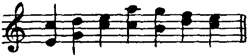
[Audio content is not currently supported on your device.
Examples:
Legend of Kitesh 24—different wind instruments in turn.
The May Night, Act III G—
Cl. Cl. ] 3.
Sadko 279-280—
Fl. Fl. ] 3 (6).
No. 67. Spanish Capriccio, before V—various wood-wind in thirds and sixths.
Servilia 228—
Fl. Fl. ] 3 and Cl. Cl. ] 3.
The Golden Cockerel 232—
2 Fl. 2 Ob. ] 6.
* Sadko 43—All wood-wind in turn, simple timbres.
When the doubled parts progress in thirds or sixths, the following method is advisable:
Fl. + Ob. Fl. + Ob. ] 3 (6) or Fl. + Cl. Fl. + Cl. ] 3 (6) etc., as well as:
Fl. + Ob. Fl. + Cl. ] 3 (6) or Ob. + Fl. Fl. + Cl. ] 3 (6) etc.
In the case of tripling the following arrangement may be adopted:
Fl. + Ob. + Cl. Fl. + Ob. + Cl. ] 3 (6) or Ob. + 2 Fl. Ob. + 2 Cl. ] 3 (6) etc.
Examples:
* No. 68. The Christmas Night 187—
Ob. + Cl. Ob. + Cl. ] 3.
* Legend of Kitesh 202-203 different mixed timbres.
Thirds and sixths together.

[Audio content is not currently supported on your device.
Apart from the obvious distribution:
Fl. Ob. Cl. or Ob. Cl. Fag.,
there are certain complicated methods which involve doubling:
Upperpart.Ob. + Fl.
Middle"Fl. + Cl.
Lower"Ob. + Cl.
The following is a complex instance somewhat vague in character:
No. 69. Legend of Kitesh 35—
Ob. Ob. + Cl. Cl. and Fl. Fl. + Ob. Ob.