Volume 2 — Melody in different groups of instruments combined together.
Edward Agate translation
A. Combination of wind and brass in unison.
The combination of a wood-wind and brass instrument produces a complex resonance in which the tone of the brass predominates. This resonance is naturally more powerful than that of each instrument taken separately, but slightly sweeter than the brass instrument alone. The tone of the wood-wind blends with that of the brass, softens and rarefies it, as in the process of combining two wood-wind instruments of different colour. Instances of such doubling are fairly numerous, especially in forte passages. The trumpet is the instrument most frequently doubled: Trumpet + Cl., Trumpet + Ob., Trumpet + Fl., as well as Trumpet + Cl. + Ob. + Fl.; the horn, less often: Horn + Cl., Horn + Fag. Trombones and Tuba may also be doubled: Trombone + Fag., Tuba + Fag. Combining the Eng. horn, bass clarinet and double bassoon with the brass, in corresponding registers, presents the same characteristics.
Examples:
Legend of Kitesh 56—Trombone + Eng. horn.
* Mlada, Act III, before 34—3 Trombones + Bass cl.
As a rule, the addition of a wind to a brass instrument yields a finer legato effect than when the latter instrument plays alone.
B. Combination of wind and brass in octaves.
Doubling the horns in octaves by clarinets, oboes or flutes often replaces the combination
1 Trumpet 1 Horn (or 2 Horns) ] 8.
This is done when it is a question of introducing a rich tone into the upper octave which the trumpet is not capable of imparting. If a single horn is used, the upper part is allotted to 2 clarinets, 2 oboes, or 2 flutes. But if there are two horns playing the lower octave in unison, three or four wind instruments will be necessary above, especially in forte passages:
8 [ 2 Ob. or 2 Cl. or 2 Fl. 1 Horn as well as 2 Ob. + 1 Cl. 1 Horn ] 8; 2 Fl. + 2 Cl. 2 Horns ] 8.
To double a trumpet in the upper octave three or four wind instruments are required, but in the top register two flutes will suffice.
Audio content is not currently supported on your device. Audio content is not currently supported on your device.
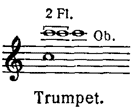
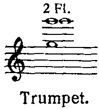
Wood-wind instruments should not be used to double a trombone in the octave above; trumpets are more suitable.
Examples of doubling in octaves:
* Snegourotchka 71—
Ob. + Cl. Horn ] 8.
* Legend of Tsar Saltan, before 180—
Ob. + Cl. Ob. + Cl. ] 6 ] 8.
Horn Horn ] 6
* Mention should also be made of mixed timbres (wood and brass) in progression in octaves.
Examples:
Mlada, Act III, beginning of Scene III—
Trombone + Bass cl. Tuba + C-fag. ] 8.
No. 78. Mlada, Act III after 25—
2 Cl. + 2 Horns + Trombone Bass cl. + 2 Horns + Trombone ] 8 (low register).
No. 79. Mlada, Act III, before 35—general unison.
When it is desired to distribute the melody over three or four octaves, it is difficult to achieve perfect balance of tone.
Examples:
* Shéhérazade, 4th movement, 15th bar after W—
Picc. 2 Fl. + 2 Ob. 2 Trumpets ] 8 ] 8.
* Legend of Tsar Saltan 228—
Picc. 2 Fl. + 2 Ob. Trumpet + Eng. horn ] 8 ] 8.
C. Combination of strings and wind.
In commencing this section of the work I consider it necessary to lay down the following fundamental rules which apply equally to melody, harmony, counterpoint and polyphonic writing.
All combinations of strings and wood-wind are good; a wind instrument progressing in unison with a stringed instrument increases the resonance of the latter and amplifies its tone, while the quality of the strings softens that of the wood-wind. In such combinations the strings will predominate provided that the two instruments are of equal power, e.g. when violins are coupled with an oboe, a bassoon with the 'cellos. If several wind instruments play in unison with one group of strings, the latter will be overpowered. As a rule all combinations refine the characteristics of each instrument taken separately, the wood-wind losing more than the strings.
Doubling in unison.
The best and most natural combinations are between instruments whose registers correspond the nearest:
Vns + Fl. (Bass fl., picc.), Vns + Ob., Vns + Cl. (small Cl.);
Violas + Ob. (Eng. horn), Violas + Cl., Violas + Fag.
'Cellos + Cl. (Bass cl.), 'Cellos + Fag.;
D. basses + Bass cl., D. basses + Fag.; D. basses + C-fag.
The object of these combinations is: a) to obtain a new timbre of definite colour; b) to strengthen the resonance of the strings; c) to soften the quality of the wood-wind.
Examples:
Snegourotchka 5—'Cellos + Violas + Eng. horn (cf. Ex. 15).
" 28—Violas + Ob. + Eng. horn.
" 116—Vns I + II + Ob. + Cl.
" 288—Vns I + II + 'Cellos + Eng. horn (cf. Ex. 17).
No. 80. The May Night, Act III Bb—Violas + Cl.
No. 81. Sadko 311—Vns + Ob.
No. 82. " 77—Violas + Eng. horn.
No. 83. " 123—Violas + Eng. horn.
Servilia 59—Vns G string + Fl.
Tsar Saltan 30—Vns I + II + 2 Cl.
No. 84. Tsar Saltan 30, 10th bar.—'Cellos + Violas + 3 Cl. + Fag.
Tsar Saltan 156-159—Vns detached + Fl. legato.
The Tsar's Bride 10 Violas + 'Cellos + Fag.
Antar, 4th movement 63—'Cellos + 2 Fag.
Shéhérazade, 3rd movement H—Violas + Ob. + Eng. horn.
Parts doubled in octaves.
Examples of strings in octaves doubled by wood-wind also in octaves are numerous, and do not require special description; they are used according to the rules already laid down. The following are examples of melody distributed over 1, 2, 3 and 4 octaves:
Examples:
No. 85. Ivan the Terrible, beginning of Overture—
Vns I + II + 2 Cl. Violas + 'Cellos + 2 Fag. ] 8.
No. 86. Sadko 3—
'Cellos + Bass cl. D. basses + C-fag. ] 8.
Sadko 166—
'Cellos + Fag. D. basses + C-fag. ] 8.
" 235—
Violas + 2 Cl. 'Cellos + D. basses + 2 Fag. ] 8.
The Tsar's Bride 14—
'Cellos + Fag. D. basses + Fag. ] 8.
" " " 81—
Vns I Vns II div. + Fl. + Ob. ] 8.
" " " 166—
Vns I + Fl. Vns II + Ob. ] 8 (cf. Ex. 22).
In three and four octaves:
Servilia 93—
Vns + 3 Fl. Violas + 2 Ob. 'Cellos + 2 Fag. ] 8 ] 8.
No. 87. Kashtcheï 105—
Vns I + Picc. Vns II + Fl. + Ob. Violas + 'Cellos + 2 Cl. + Eng. horn + Fag. ] 8 ] 8.
Shéhérazade, 3rd movement M—
Vns I + Fl. Vns II + Ob. 'Cellos + Engl. horn ] 8 ] 8.
Examples of melody in thirds and sixths:
Servilia 44—
Fl. + Ob. + Cl. + Vns Fl. + Ob. + Cl. + Vns div. ] 3.
No. 88. Servilia 111—Strings and wood-wind in thirds.
No. 89. " 125—same combination, in thirds and sixths.
Kashtcheï 90—The same.
It is necessary to pay more attention to cases where, of the two parts in octaves, only one is doubled. When this method is applied to a melody in the soprano register it is better to allow the wood-wind to progress in octaves, the lower part only being doubled by one of the string groups;
Picc. Fl. + Vns ] 8. Fl. Ob. (Cl.) + Vns ] 8.
Examples:
Tsar Saltan 102—
2 Fl. + Picc. Vns I + II + Ob. ] 8 (cf. Ex. 133).
* No. 90. Shéhérazade, 4th movement U—
2 Cl. 'Cellos + 2 Horns ] 8.
In the case of a melody in the low register demanding a sweet soft tone, the violoncellos and double basses should be made to progress in octaves, the former doubled by a bassoon, the latter not doubled at all:
'Cellos + Fag. D. basses ] 8.
Sometimes a composer is obliged to use this method on account of the very low register of the double bass, especially if a double bassoon is not included in his orchestral scheme.[14]
Example:
No. 91. Tsar Saltan 92—
Violas + Fag. 'Cellos + Fag. D. basses ] 8 ] 8.
D. Combination of strings and brass.
Owing to the dissimilarity between the quality of string and brass tone, the combination of these two groups in unison can never yield such a perfect blend as that produced by the union of strings and wood-wind. When a brass and a stringed instrument progress in unison, each can be heard separately, but the instruments in each group which can be combined with the greatest amount of success are those whose respective registers correspond the most nearly; Violin + Trumpet; Viola + Horn;
'Cellos D. basses + Trombones Tuba
(for heavy massive effects).
The combination of horns and 'cellos, frequently employed, produces a beautifully blended, soft quality of tone.
Examples:
Tsar Saltan 29—Vns I + II + Horn.
* No. 92. The Golden Cockerel 98—Violas con sord. + Horn.
E. Combination of the three groups.
The combination of members of the three groups in unison is more common, the presence of the wood-wind imparting a fuller and more evenly blended tone. The question as to which group will predominate in timbre depends upon the number of instruments employed. The most natural combinations, and those most generally in use are:
Vns + Ob. (Fr., Cl.) + Trumpet;
Violas (or 'Cellos) + Cl. (Eng. horn) + Horn;
'Cellos D. basses + 2 Fag. + 3 Trombones + Tuba.
Such groupings are used for preference in loud passages or for a heavy piano effect.
Examples:
No. 93-94. Snegourotchka 218 and 219—Vns I + II + Cl. + Horn and Vns I + II + Cl. + Trumpet.
Servilia 168—
Violas + Trombones 'Cellos + Trombone + Bass Cl. D. basses + Tuba + Fag. ] 8 ] 8 (cf. Ex. 62).
No. 95. Snegourotchka 325—
'Cellos + Violas + Fag. + Trombone D. basses + Fag. + Tuba ] 8.
Pan Voyevoda 224—Vns + Fag. + Horn + Vn. + Cl. + Trumpet. (Stopped notes in the brass.)
* Mlada, Act III, after 23—Violas + 2 Cl. + Bass trumpet.
* No. 96. Ivan the Terrible, Act III, before 66—
Bass Cl. + Horn D. basses + C-fag. + Tuba ] 8.
* Ivan the Terrible, Overture, 4th bar after 9—Violas + 'Cellos + Eng. horn + 2 Cl. + Bass Cl. + 2 Fag. + 4 Horns. (The melody simplified in the horns.)