Volume 2 — Melody in the brass.
Edward Agate translation
The natural scale, the only one which brass instruments had at their disposal prior to the invention of valves was:
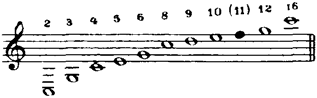
[Audio content is not currently supported on your device.
giving, in two part harmony:

[Audio content is not currently supported on your device.
With the help of rhythm, these component parts have given rise to a whole series of themes and phrases named fanfares, trumpet calls or flourishes, best adapted to the character of brass instruments.
In modern music, thanks to the introduction of valves, this scale is now possible in all keys for every chromatic brass instrument, without it being necessary to change the key, and the addition of a few notes foreign to the natural scale has enriched the possibilities of these flourishes and fanfares, and endowed them with greater variety of expression.
These phrases, either as solos, or in two or three parts, fall specially to the lot of the trumpets and horns, but they may also be given to the trombones. The full, clear, ringing notes of the middle and upper register of horns and trumpets are best suited to figures of this description.
Examples:
Servilia 20—Trumpets.
The Christmas Night 182—Horn, Trumpets.
Vera Scheloga, beginning of Overture, and after 45—Horn, Trumpets.
Ivan the Terrible, Act III 3—Cornet.
Snegourotchka 155—Trumpets.
No. 70. Legend of Kitesh 65 and elsewhere.—3 Trumpets, 4 Horns.
Pan Voyevoda 191—2 Trombones, Trumpet.
* The Golden Cockerel 20—2 Horns and
Trumpets Horns ] 8 (cf. further on).
After fanfare figures, those melodies best suited to the brass quality are those of an unmodulated diatonic character, rousing and triumphant in the major key, dark and gloomy in the minor.
Examples:
No. 71. Sadko 342—Trumpet.
Sadko, before 181—Trombones (cf. Ex. 27).
No. 72. Snegourotchka 71—Trumpet.
Russian Easter Fête M—Trombone.
Spanish Capriccio E—Alternative use in the horn of open and stopped notes (cf. Ex. 44).
Ivan the Terrible, Act II, before 17—Bass trumpet, and 3 Horns a little further on.
Mlada, Act II 33—Bass trumpet (cf. Ex. 46).
The genial and poetic tone of the horn in piano passages affords greater scope in the choice of melodies and phrases that may be entrusted to this instrument.
Examples:
The May Night, Overture 13.
The Christmas Night 1.
Snegourotchka 86.
Pan Voyevoda 37.
No. 73. Antar 40.
Melodies involving chromatic or enharmonic writing are much less suitable to the character of brass instruments. Nevertheless such melodies may sometimes be allotted to the brass, as in the music of Wagner, and the modern Italian realists, who, however, carry the proceeding to extremes. Vigourous phrases in the form of a fanfare, although introducing chromatic notes sound singularly beautiful on the brass.
Example:
No. 74. Shéhérazade, 2nd movement D.
As a general rule, brass instruments lack the capacity to express passion or geniality. Phrases charged with these sentiments become sickly and insipid when confided to the brass. Energetic power, free or restrained, simplicity and eloquence constitute the valuable qualities of this group.
Brass in unison, in octaves, thirds and sixths.
As, from its very nature, the brass is not called upon to realise a wide range of expression, kindred instruments of one group may be employed solo, as well as in unison. The combination of 3 trombones or 4 horns in unison is frequently met with, and produces extreme power and resonance of tone.
Examples:
Snegourotchka 5—4 Horns (cf. Ex. 15).
Snegourotchka 199—4 Horns and 2 Trumpets.
Sadko 175—1, 2, 3 Trumpets.
No. 75. Sadko 305[13]—3 Trombones.
No. 76. The May Night, beginning of Act III—1, 2, 3, 4 Horns.
Legend of Kitesh, end of Act I—4 Horns (cf. Ex. 70).
No. 77. Shéhérazade, 4th movement p. 204—3 Trombones.
Mlada; Lithuanian dance—6 Horns (cf. Ex. 61).
Owing to the resonant power of the entire group, the equality and even gradation of tone between the dark colour of the deep compass and the bright quality of the upper register, the use of brass instruments of the same kind in octaves, thirds or sixths invariably leads to satisfactory results. For the same reason the employment of brass instruments of different kinds, arranged according to normal order of register:
Trumpet 2 Horns Trumpet Trombone Trombone Tuba 2 Trombones Trombone + Tuba 2 Trumpets 2 Trombones 2 Horns Tuba
is likewise successful whether the instruments are doubled or not. Another possible method, though not so reliable, is to combine horns (above) with trombones, exclusively in octaves:
2 Horns 1 Trombone ] 8 or 4 Horns 2 Trombones ] 8.
Examples:
Sadko, before 120—
Trumpet Trumpet ] 8.
Sadko 5—
2 Trumpets 4 Horns ] 8.
Snegourotchka 222—
2 Trombones Trombone + Tuba ] 8.
Ivan the Terrible, Act III 10
1 Trombone + Trumpet 2 Trombones ] 8 (cf. Ex. 38).
The Golden Cockerel 125—
Trumpet Trombone ] 8.
Cf. also Snegourotchka 325-326—
Trombone Trombone ] 8 (Ex. 95).