Gleanings by an Old Florist.
Reading edition
SMILAX AND ITS USES.
Smilax, as now used by florists, is but a very recent affair. Although introduced first into Europe from the Cape of Good Hope as early as 1702, it remained for the florist of our time to find out its great adaptability for decoration and other uses in his art or calling. To Boston florists belong the credit of its first extensive culture and use, and for several years they may be said to have had the monopoly of its trade, and Boston smilax, along with Boston tea roses, which was pre-eminently the variety called the Bon Silene, was, for years, shipped to this and other cities. It is scarcely a decade of years ago, in this city, when a batch of one hundred strings could not be bought here, home-grown; now there would be no difficulty in getting thousands. Like everything else of like character, the first introducers reaped a golden harvest, so far as price is concerned, having often obtained a dollar a string; while now, the standard price, even in mid winter, is $2 per dozen, and often in quantity, it can be obtained at less. But where there was one string used then, there are now thousands. In olden times the florist was often put to his wits to find material to go around his made-up pieces and for relief as a green; now, everything green is smilax, and it must be confessed, that with the choice ferns, begonia leaves, and the like, that he used to have to prepare with, his work then was really often in better taste, so far as relief to flowers is concerned, with the old material than the new.
But for the purpose of festooning buildings, churches, and the like, smilax is by all odds the very thing wanted, and as much ahead of the old-time evergreen wreathing, that we had to use, as the methods now in use for obtaining cut flowers are ahead of the old. It is hard to say what the florist could do without smilax, so indispensable has it become. There are now probably twenty of the principal growers of this city that have at least one house in smilax, who will cut not less than three thousand strings in a winter, while of the balance of smaller fry enough to make up the total to 100,000 strings per year. In times of scarcity of material, it is cut not over three feet long; again, when the supply exceeds the demand, the buyer will often get it six to nine feet long, and at a lower price than he can buy the short—supply and demand ruling price, as a rule, between $1 and $3 per dozen.
The plant now under consideration is called, botanically, Myrsiphyllum asparagoides; by common usage it is called smilax, although not even a member of the true smilax family, some of which are natives of this country.
The plant seeds readily, hence every one who grows smilax may, by leaving two or three strings uncut, grow his own seed; it is then sure to be fresh—which is sometimes not the case when purchased. The seed is more likely to germinate if soaked twelve hours in warm water or milk before sowing.
A bed may be formed any time of the year, but the usual custom is to prepare it so as to be ready to cut, say, in the fall, for the first time. Take a pan or shallow box and sow the seed any time during the winter before March. When well up, so they can be handled, transplant into small pots, and from these shift into larger, say to three or four inch pots. Keep the shoots pinched back so as to form a stout, bushy plant. During winter they will require an artificial temperature of not less than 50 degrees. When summer comes they may be kept in the house or stand out of doors until the bed in which they are to grow is ready. This may be prepared any time most desirable, but if to cut first in the fall, so manage it that they may have two or three months to perfect their growth.
The common practice is to give the whole house to the use of the plant, but this may be varied at pleasure, growing either the center bunch, the front bunch, or both, as may be desirable.
The best soil is decayed sod from a pasture enriched with cow manure. It requires no benches to grow this plant; all that is necessary is to inclose the space designed by putting up boards one foot high to form a coping to hold the soil. Into this the plants are set evenly over the entire space, in rows nine inches to one foot apart. At the time of planting, a stake is driven into and even with the soil at each plant, being careful to have them in true lines both ways, and driven deep enough to be quite firm; on the top of this stake is driven a small nail or hook. Directly over each nail, in the rafter of the house, or a strip nailed to them for the purpose, is placed another nail, and between the two a cord similar to that used by druggists or the like—but green, if possible, in color, for obvious reasons—is stretched as taught as may be, so that when finished the whole house or space used is occupied by these naked strings, on which, as the growth proceeds, the plants entwine themselves. Some care will be required at first to get them started, after which they will usually push on themselves.
The most convenient height of the rafters above the soil is from four to ten feet, which will give long enough strings, and, what is important for quick growth, keep the plants when young not too far from the glass.
In planting, some make a difference of a month or two in the time, so that the crop may not come in all at once; but usually the plants will vary some in their growth, and hence, by cutting the largest first, the same result is obtained. If a heat of 55 degrees can be obtained as a minimum, and care is taken in keeping a moist, growing temperature, a crop can be taken off every three months at least. So as soon as ready to cut and a market can be obtained for the crop, strings should be strung again at once, leaving some of the smaller shoots when cutting for a starter of the next crop. Like everything else, heavy cropping requires heavy manuring, and hence a rich compost should be added to the soil at each cutting.
Some plant their beds fresh every year, others leave them longer. The root is perennial in character, and consists of fleshy tubers, not unlike asparagus, and may be divided for the new beds; but the general practice is to grow new plants. Always beware of buying old, dry roots, as they will sometimes refuse to grow, even if they look green and fresh. With many, in cutting, the practice is to cut clear through at the bottom, string and all, then by a deft movement of the hands the smilax is slipped from the string which, with the addition of a foot or two to tie again, is at once ready for the next, while others bring to market string and all, these being simply matters of practice or convenience.
Edgar Sanders.
Was Noah's voyage an arktic expedition?
OUR New Clubbing List FOR 1884. THE PRAIRIE FARMER IN CONNECTION WITH OTHER JOURNALS.
We offer more liberal terms than ever before to those who desire to take, in connection with The Prairie Farmer, either of the following weekly or monthly periodicals. In all cases the order for The Prairie Farmer and either of the following named journals must be sent together, accompanied by the money; but we do not require both papers to be sent to the same person or to the same post-office.
We send specimen copies only of The Prairie Farmer.
Our responsibility for other publications ceases on the receipt of the first number; when such journals are not received within a reasonable time, notify us, giving date of your order, also full name and address of subscriber.
WEEKLIES.
Price of the two.The two for
Harper's Weekly$6 00$4 60
Harper's Bazar6 004 60
Harper's Young People3 502 55
New York Tribune4 002 50
Toledo Blade4 002 20
Chicago Times3 252 50
Chicago Tribune3 502 50
Chicago Inter-Ocean3 152 50
Chicago Journal3 252 50
Peck's Sun3 753 00
Milwaukee Sentinel3 002 50
Western Farmer (Madison, Wis.)3 002 00
Burlington Hawkeye4 003 00
The Continent (Weekly Magazine)6 004 00
Detroit Free Press, with Supplement4 002 50
Detroit Free Press, State edition3 502 20
Louisville Courier-Journal3 753 00
St. Louis Globe-Democrat3 002 15
St. Louis Republican3 002 15
Scientific American5 204 15
Interior (Presbyterian)4 503 60
Standard (Baptist)4 703 60
Advance (Congregational)5 003 35
Alliance4 003 00
New York Independent5 004 00
Christian Union5 004 00
Boston Pilot (Catholic)4 503 50
American Bee Journal4 003 00
Florida Agriculturist4 002 75
Breeder's Gazette5 003 50
Witness (N.Y.)3 503 00
Methodist (N.Y.)4 003 50
Chicago News3 002 50
Globe (Boston)3 002 75
Youth's Companion3 753 00
Weekly Novelist5 004 25
Ledger (Chicago)3 002 90
MONTHLIES.
Harper's Monthly$6 00$4 50
Atlantic Monthly6 004 50
Appleton's Journal5 004 25
The Century6 004 50
North American Review7 005 50
Popular Science Monthly7 005 50
Lippincott's Magazine6 004 50
Godey's Lady's Book4 003 00
St. Nicholas5 003 50
Vick's Illustrated Magazine3 252 25
Am. Poultry Journal (Chicago)3 252 75
Gardener's Monthly4 003 00
Wide Awake4 503 00
Phrenological Journal4 003 00
American Agriculturist3 502 50
Poultry World3 252 75
Arthur's Home Magazine4 003 00
Andrews' Bazar3 002 40
Frank Leslie's Popular Monthly5 004 00
Frank Leslie's Sunday Magazine5 004 00
Frank Leslie's Ladies' Magazine4 504 00
Our Little Ones3 503 00
Peterson's Magazine4 003 30
Art Amateur6 005 00
Demorest's Magazine4 003 00
Dio Lewis' Monthly4 503 50
For clubbing price with any publication in the United States not included in the above list send us inquiry on postal card.
MISCELLANEOUS.
ONE CENT
invested in a postal card and addressed as below
WILL
give to the writer full information as to the best lands in the United States now for sale; how he can
BUY
them on the lowest and best terms, also the full text of the U.S. land laws and how to secure
320 ACRES
of Government Lands in Northwestern Minnesota and Northeastern Dakota.
ADDRESS:
JAMES B. POWER, Land and Emigration Commissioner, ST. PAUL, MINN.
CONSUMPTION.
I have a positive remedy for the above disease; by its use thousands of cases of the worst kind and of long standing have been cured. In deed, so strong is my faith in its efficacy, that I will send TWO BOTTLES FREE, together with a VALUABLE TREATISE on this disease, to any sufferer. Give Express & P.O. address. DR. T.A. SLOCUM, 181 Pearl St., N.Y.
NOW Is the time to Subscribe for The Prairie Farmer. Price only $2.00 per year. It is worth double the money.
PUBLISHERS' NOTICE.
THE PRAIRIE FARMER is printed and published by The Prairie Farmer Publishing Company, every Saturday, at No. 150 Monroe Street.
Subscription, $2.00 per year, in advance, postage prepaid.
Subscribers wishing their addresses changed should give their old as well as new addresses.
Advertising, 25 cents per line on inside pages; 30 cents per line on last page—agate measure; 14 lines to the inch. No less charge than $2.00.
All Communications, Remittances, etc., should be addressed to The Prairie Farmer Publishing Company, Chicago, Ill.

Entered at the Chicago Office as Second-Class Matter.
CHICAGO, JANUARY 19, 1884.
[Transcriber's Note: Original location of Table of Contents.]
WHEN SUBSCRIPTIONS EXPIRE.
We have several calls for an explanation of the figures following the name of subscribers as printed upon this paper each week. The first two figures indicate the volume, and the last figure or figures the number of the last paper of that volume for which the subscriber has paid: EXAMPLE: John Smith, 56—26. John has paid for THE PRAIRIE FARMER to the first of July of the present year, volume 56. Any subscriber can at once tell when his subscription expires by referring to volume and number as given on first page of the paper.
1841.1884.
The Prairie Farmer
PROSPECTUS FOR 1884.
SEE INDUCEMENTS OFFERED
SUBSCRIBE NOW.
For forty-three years The Prairie Farmer has stood at the front in agricultural journalism. It has kept pace with the progress and development of the country, holding its steady course through all these forty-three years, encouraging, counseling, and educating its thousands of readers. It has labored earnestly in the interest of all who are engaged in the rural industries of the country, and that it has labored successfully is abundantly shown by the prominence and prestige it has achieved, and the hold it has upon the agricultural classes.
Its managers are conscious from comparison with other journals of its class, and from the uniform testimony of its readers, that it is foremost among the farm and home papers of the country. It will not be permitted to lose this proud position; we shall spare no efforts to maintain its usefulness and make it indispensable to farmers, stock-raisers, feeders, dairymen, horticulturalists, gardeners, and all others engaged in rural pursuits. It will enter upon its forty-fourth year under auspices, in every point of view, more encouraging than ever before in its history. Its mission has always been, and will continue to be—
To discuss the most approved practices in all agricultural and horticultural pursuits.
To set forth the merits of the best breeds of domestic animals, and to elucidate the principles of correct breeding and management.
To further the work of agricultural and horticultural organization.
To advocate industrial education in the correct sense of the term.
To lead the van in the great contest of the people against monopolies and the unjust encroachments of capital.
To discuss the events and questions of the day without fear or favor.
To provide information concerning the public domain, Western soil, climate, water, railroads, schools, churches, and society.
To answer inquiries on all manner of subjects coming within its sphere.
To furnish the latest and most important industrial news at home and abroad.
To give full and reliable crop, weather, and market reports.
To present the family with pure, choice, and interesting literature.
To amuse and instruct the young folks.
To gather and condense the general news of the day.
To be, in brief, an indispensable and unexceptionable farm and home companion for the people of the whole country.
The style and form of the paper are now exactly what they should be. The paper used is of superior quality. The type is bold and clear. The illustrations are superb. The departments are varied and carefully arranged. The editorial force is large and capable. The list of contributors is greatly increased, and embraces a stronger array of talent than is employed on any similar paper in this country. We challenge comparison with any agricultural journal in the land.
The Prairie Farmer is designed for all sections of the country. In entering upon the campaign of 1884, we urge all patrons and friends to continue their good works in extending the circulation of our paper. On our part we promise to leave nothing undone that it is possible for faithful, earnest work—aided by money and every needed mechanical facility—to do to make the paper in every respect still better than it has ever been before.
SPECIAL NOTICE
To each Subscriber who will remit us $2.00 between now and February 1st, 1884, we will mail a copy of THE PRAIRIE FARMER for One Year, and one of our New Standard Time Commercial Maps of the United States and Canada—showing all the Counties, Railroads, and Principal Towns up to date. This comprehensive map embraces all the country from the Pacific Coast to Eastern New Brunswick, and as far north as the parallel of 52 deg., crossing Hudson's Bay. British Columbia; Manitoba, with its many new settlements; and the line of the Canadian Pacific Railway, completed and under construction, are accurately and distinctly delineated. It extends so far south as to Include Key West and more than half of the Republic of Mexico. It is eminently adapted for home, school, and office purposes. The retail price of the Map alone is $2.00. Size, 58 × 41 inches. Scale, about sixty miles to one inch.
READ THIS.
Another Special Offer.
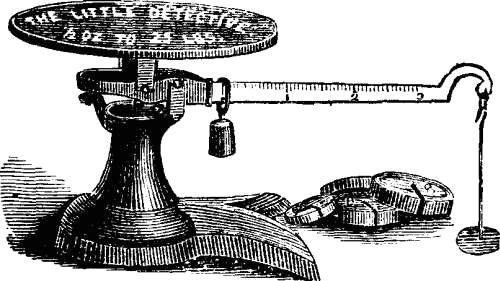
"The Little Detective."
Weighs 1-4 oz. to 25 lbs.
Every housekeeper ought to have this very useful scale. The weight of article bought or sold may readily be known. Required proportions in culinary operations are accurately ascertained. We have furnished hundreds of them to subscribers, and they give entire satisfaction. During January, 1884, to any person sending us THREE SUBSCRIBERS, at $2.00 each, we will give one of these scales, and to each of the three subscribers Ropp's Calculator, No. 1.
RENEW! RENEW!!
Remember that every yearly subscriber, either new or renewing, sending us $2, receives a splendid new map of the United States and Canada—58 × 41 inches—FREE. Or, if preferred, one of the books offered in another column. It is not necessary to wait until a subscription expires before renewing.
WE WANT AGENTS
in every locality. We offer very liberal terms and good pay. Send for sample copies and terms to agents.