Field and Furrow.
Reading edition
Mass. Ploughman: Farm accounts, even when kept in the most simple form, not only afford great satisfaction, but they do much to aid the farmer in his efforts to success. If at the end of the season he is able to strike the balance, and thus learn the cost of his principal crops, he is in a position to correctly judge what crops will promise the most profit another year.
The Farm Economist has this to say in regard to marketing corn. While it is contrary to general opinion, it is nevertheless true, as facts and figures are capable of proving: "Farmers in discussing their declining markets should remember that every bushel of corn sold in the form of whisky cuts off the sale of ten bushels in the form of meat. It might be well to consider this in discussing how the market for farm products can be improved." This same paper further remarks, "Where's the sense in a farmer growling because he is not represented in the government when he won't go to a convention and see that he is represented. Quit your growling and do your duty. One good vote in the primaries or in the convention is worth 1,757,362 growls afterward."
The Wisconsin Tobacco Reporter states that the new phase to the Sumatra question has brought out considerable discussion among dealers in the Edgerton market and that the prevailing impression appears to be that even if the recent decision be upheld, under the jugglery by which Sumatra is run into the country, prices for 1883 Wisconsin leaf will not be materially affected, as it can not entirely supplant its use and there will be a good demand for all our product. The editor adds: The scarecrow argument will doubtless be used by some buyers in bearing the market, but we are inclined to look upon it more as a bugaboo than many others, whatever the effect may be on future crops. We know of no good reason why 1883 Wisconsin should sell for lower prices than have ruled thus far this season and the report from Eastern markets seem to warrant this view.
A. B. Allen, in N. Y. Tribune: My cistern is about five feet in diameter and five feet deep. After cleaning it out in spring, I put about one bushel of sand in the bottom, and then let the rain-water come in. This keeps the water sweet and clear for a whole year. I have tried charcoal and various things for this purpose, but find pure clear sand best of all. It must not have other soil mixed with it, or any vegetable matter. The kind I use is white, and very like such as is found at the sea shore. Of course the roof end of the pipe should have wire gauze fastened over it so that no foul stuff can be carried down, and the eaves-troughs must be kept clean, the roof and chimneys also, and never be painted, or the latter even whitewashed. The sand is an excellent absorber of even the finest of foul stuff, and this is the reason, in addition to its own purity, of its keeping the water so free from generating the smell of ammonia.
Peoria Transcript: During some of the comparatively idle days of winter, the farmer may combine pleasure with profit by hitching up, taking his family, and driving to some one of his successful farm neighbors for a friendly visit. Such an act may be looked upon by the man-of-toil as a poor excuse to get out of doing a day's work, but we venture that he who tries the experiment once will be very apt to repeat it as often as time or opportunity will justify. In our neighborhood, and we presume the same condition of affairs exists in nearly every locality, there are farmers who have lived within a mile or two of each other for years, who hardly know their neighbors from a stranger when they meet upon the public highway or at town meeting, and as for going to the house, nothing short of death in the family or some event of great importance will ever bring them into the friendly relations which should exist between neighboring farmers.
A New Jersey correspondent of the Rural New Yorker writes: My clear water carp pond covers an area of about three-fourths of an acre, and is located about eighty feet below springs in the hillside, which furnish a never-failing supply of pure, clear water. The normal temperature of these springs, where they empty into the pond, varies but little according to season, but maintains an average of fifty degrees, Fah. Several times through the summer I found the water in the pond indicated an average of 80 degrees, Fah. The pond is so constructed that the water is constantly drawn from the bottom, thus keeping the surface at this high temperature. About one-half the pond is covered with mud to the depth of two feet or more—an essential in all carp ponds for hibernating. A limited supply of pure German carp fingerlings to place in the pond was sent me by Prof. S. F. Baird, United States Commissioner of Fish and Fisheries, Washington, D. C., and placed therein on April 6th last. No food was given besides that which grew in the pond. I saw them at rare intervals during the summer, and was agreeably surprised, when I drew the pond November 16th last past, to find that they had grown to be sixteen inches in length, and a pair weighed eight pounds.
The Monarch Lightning Sawing Machine.
On our 268th page appears the advertisement of the New Improved Monarch Lightning Sawing Machine, manufactured by the Monarch Mfg. Co., 163 Randolph. St., Chicago. The result of long experience in the manufacture of implements for cutting up wood is the superior and valuable machine which is advertised in our paper.
Such of our readers who live in a timbered district, and who need such a machine, should send for their large illustrated free catalogue. This company is the largest and most successful corporation in this city engaged in manufacturing one man power drag saws. The Monarch Lightning Sawing Machine has been sold all over the Western States, and always gives satisfaction. It is a first-class firm, thoroughly reliable, and their machine is of superior excellence.—Farm, Field and Fireside, January, 1884.
See their advertisement on another page of this issue.
FARM MACHINERY, Etc.
DEDERICK'S HAY PRESSES.
are sent any where on trial to operate against all other presses, the customer keeping the one that suits best.
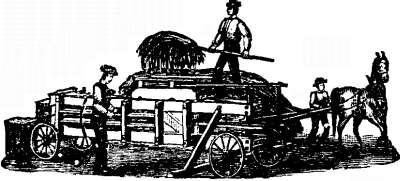
Order on trial, address for circular and location of Western and Southern Storehouses and Agents.
TAKE NOTICE.—As parties infringing our patents falsely claim premiums and superiority over Dederick's Reversible Perpetual Press. Now, therefore, I offer and guarantee as follows:
First. That baling Hay with One Horse, Dederick's Press will bale to the solidity required to load a grain car, twice as fast as the presses in question, and with greater ease to both horse and man at that.
Second. That Dederick's Press operated by One Horse will bale faster and more compact than the presses in question operated by Two Horses, and with greater ease to both man and beast.
Third. That there is not a single point or feature of the two presses wherein Dederick's is not the superior and most desirable.
Dederick Press will be sent any where on this guarantee, on trial at Dederick's risk and cost.
P. K. DEDERICK & CO., Albany, N. Y.
GREAT SAVING FOR FARMERS.
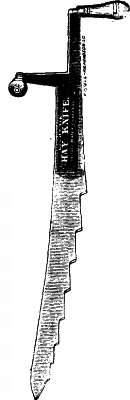
THE Lightning Hay Knife!
(Weymouth's Patent.)

Awarded "FIRST ORDER OF Merit" at Melbourne Exhibition, 1880.
Was awarded the first premium at the International Exhibition in Philadelphia, 1876, and accepted by the Judges as Superior to Any Other Knife in Use.
It is the BEST KNIFE in the world to cut fine feed from bale, to cut down mow or stack, to cut corn-stalks for feed, to cut peat, or for ditching in marshes, and has no equal for cutting ensilage from the silo. TRY IT.
IT WILL PAY YOU.
Manufactured only by HIRAM HOLT & CO., East Wilton, Me., U.S.A.
For sale by Hardware Merchants and the trade generally
THE CHICAGO DOUBLE HAY AND STRAW PRESS
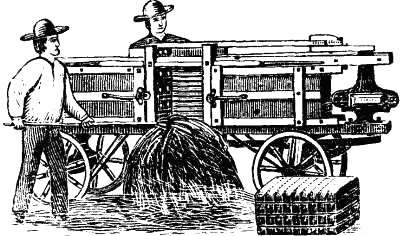
Guaranteed to load more Hay or Straw in a box car than any other, and bale at a less cost per ton. Send for circular and price list. Manufactured by the Chicago Hay Press Co., Nos. 3354 to 3358 State St., Chicago. Take cable car to factory. Mention this paper.
Sawing Made Easy
Monarch Lightning Sawing Machine!
Sent on 30 Days test Trial.
A Great Saving of Labor & Money.
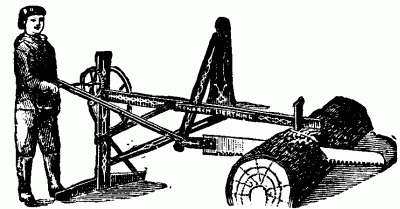
A boy 16 years old can saw logs FAST and EASY. Miles Murray, Portage, Mich. writes, "Am much pleased with the MONARCH LIGHTNING SAWING MACHINE. I sawed off a 30-inch log in 2 minutes." For sawing logs into suitable lengths for family stove-wood, and all sorts of log-cutting, it is peerless and unrivaled. Illustrated Catalogue, Free. AGENTS WANTED. Mention this paper. Address MONARCH MANUFACTURING CO., 163 N. Randolph St., Chicago, Ill.

CHICAGO SCALE CO.
2 TON WAGON SCALE, $40. 3 TON, $50.
4 Ton $60, Beam Box Included.
240 lb. FARMER'S SCALE, $5.
The "Little Detective," ¼ oz. to 25 lb. $3.
300 OTHER SIZES. Reduced PRICE LIST FREE.

FORGES, TOOLS, &c.
BEST FORGE MADE FOR LIGHT WORK, $10,
40 lb. Anvil and Kit of Tools. $10.
Farmers save time and money doing odd jobs.
Blowers, Anvils, Vices & Other Articles
AT LOWEST PRICES, WHOLESALE & RETAIL.
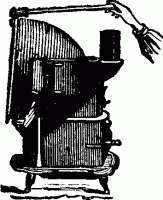
THE PROFIT FARM BOILER
is simple, perfect, and cheap; the BEST FEED COOKER; the only dumping boiler; empties its kettle in a minute. Over 5,000 in use; Cook your corn and potatoes, and save one-half the cost of pork Send for circular. D.R. SPERRY & CO., Batavia, Illinois.
CHAMPION BALING PRESSES.
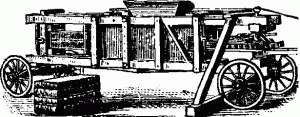
A Ton per Hour. Run by two men and one team. Loads 10 to 15 tons in car.
Send for descriptive circular with prices, to Gehrt & Co., 216, 218 and 220 Maine St., Quincy, Ill.
REMEMBER that $2.00 pays for The Prairie Farmer from this date to January 1, 1884; $2.00 pays for it from this date to January 1, 1885. For $2.00 you get it for one year and a copy of The Prairie Farmer County Map of the United States, free! This is the most liberal offer ever made by any first-class weekly agricultural paper in this country.