VEGETABLES.
Reading edition
To Preserve the Color of Vegetables.
The French cooks very generally use carbonate of ammonia to preserve the color of vegetables. What would lay on the point of a penknife is mixed in the water in which the vegetables (such as pease, spinach, string-beans, and asparagus) are boiled. The ammonia all evaporates in boiling, leaving no ill effects. They say also that it prevents the odor of boiling cabbage. It may be obtained at the drug-stores.
Potatoes Boiled.
Choose those of equal size. They look better when thinly peeled before they are boiled; but it is more economical to boil them before skinning, as careless cooks generally pare away half of the potato in the operation, and the best part of the potato is that which lies nearest the skin. Put them into an iron pot or saucepan in just enough well-salted cold water to cover them. Let them boil until they are nearly done; then pour off all but about half a cupful of the water in the bottom of the pot; return the potatoes to the fire, put on a close cover, and let them steam until quite done; then remove the lid, sprinkle salt over them, and let them remain a few moments on the fire to evaporate the water. Remove them carefully, and serve immediately. They should be dry and flaky.
If one has a cook too heedless to steam the potatoes properly, it should be remembered that potatoes should never be allowed to soak in the water a moment after they are done; the water should be immediately poured off, and the steam evaporated. It is important that potatoes should be done just at the moment of serving. It requires about thirty-five minutes to boil the medium-sized.
To Boil Potatoes (Captain Kater to Mrs. Acton).
Pare the potatoes; cover them with cold water; boil them gently until they are done. Pour off the water, and sprinkle salt over them; then with a spoon take each potato and lay it into a clean, warm cloth; twist this so as to press all the moisture from the vegetable, and render it quite round; turn it carefully into a dish placed before the fire; throw a cloth over; and when all are done, send them to the table immediately. Potatoes dressed in this way are mashed without the slightest trouble.
Mashed Potatoes.
Every one thinks she can make so simple a dish as that of mashed potatoes; but it is the excellence of art to produce good mashed as well as good boiled potatoes. In fact, I believe there is nothing so difficult in cookery as to properly boil a potato.
To mash them, then, first boil them properly. Put into a hot crock basin, which can be placed at the side of the fire, half a cupful or more of cream, a piece of butter the size of an egg, plenty of salt and pepper, and let them get hot. One of the secrets of good mashed potatoes is the mixing of the ingredients all hot. Now add six or seven potatoes the moment they are done, and mash them without stopping until they are as smooth as possible; then work them a very few moments with a fork, and serve them immediately. Do not rub egg over, and bake them; that ruins them. Much depends upon mashed potatoes being served at table hot, and freshly made. They are very nice prepared à la neige.
Potatoes à la Neige.
These are mashed potatoes made as in the preceding receipt, pressed through a colander into a dish in which they are to be served. The potatoes then resemble rice or vermicelli, and are very light and nice. They make a pretty dish, and must be served very hot. They make a favorite accompaniment to venison, and are often served around a rolled rib roast of beef.
To Bake Potatoes.
The potatoes must be of equal size. Put them into a hot oven and bake until tender. The excellence of baked potatoes depends upon their being served immediately when they are just baked enough. A moment underdone, and they are indigestible and worthless; a moment overdone, and they have begun to dry. It requires about an hour to bake a large potato. This is a favorite way of cooking potatoes for lunch or tea.
Potatoes in Cases.
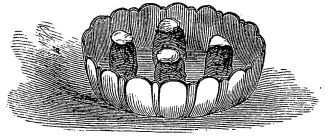
The following is an exceedingly nice way of serving baked potatoes. Bake potatoes of equal size, and when done, and still hot, cut off a small piece from each potato; scoop out carefully the inside, leaving the skin unbroken; mash the potato well, seasoning it with plenty of butter, pepper, and salt; return it with a spoon to the potato skin, allowing it to protrude about an inch above the skin. When enough skins are filled, use a fork or knife to make rough the potato which projects above the skin; put all into the oven a minute to color the tops. It is better, perhaps, to color them with a salamander. They will have the appearance of baked potatoes burst open.
Potatoes Baked with Beef.
Pare potatoes of equal size, and put them into the oven in the same pan in which the beef is baked. Every time the beef is basted, the potatoes should be basted also. Serve them around the beef.
Potatoes à la Parisienne.
Peel the potatoes, and with a vegetable-cutter (three-fourths of an inch in diameter) cut as many little balls as you can from each potato; throw these balls into boiling-hot lard, and fry (about five minutes) until done, when they must be skimmed out immediately. It is more convenient to fry them in a wire-basket (see page 53). Sprinkle salt over them as soon as done. It is a very good way of cooking potatoes as a garnish for beefsteak or game. The cuttings of the potatoes left after taking out the balls can be boiled and mashed. These potatoes must be served when done, or the crusts will lose their crispness.
Saratoga Potatoes.
It requires a little plane, or potato or cabbage cutter, to cut these potatoes. Two or three fine, large potatoes (ripe new ones are preferable) are selected and pared. They are cut, by rubbing them over the plane, into slices as thin or thinner than a wafer. These are placed for a few moments in ice, or very cold water, to become chilled. Boiling lard is now tested, to see if it is of the proper temperature. The slices must color quickly; but the fat must not be so hot as to give them a dark color.
Place a salt-box on the hearth; also a dish to receive the cooked potatoes at the side; a tin plate and perforated ladle should be at hand also. Now throw, separately, five or six slices of the cold potato into the hot lard; keep them separated by means of the ladle until they are of a delicate yellow color; skim them out into the tin plate; sprinkle over some salt, and push them on the dish. Now pour back any grease that is on the tin plate into the kettle, and fry five or six slices at a time until enough are cooked. Two potatoes fried will make a large dishful.
It is a convenient dish for a company dinner, as it may be made early in the day; and by being kept in a dry, warm place (for instance, a kitchen-closet), the potato-slices will be crisp and nice five or six hours afterward. They are eaten cold, and are a pretty garnish around game, or, in fact, any other kind of meat.
Fried Potatoes.
Fried potatoes must absolutely be served the moment they come from the fire. Nothing deteriorates more by getting cold or keeping than fried potatoes (with the exception of Saratoga fried potatoes, which are served cold). They may be sliced rather thin, and sautéd in a little hot butter, pepper, and salt. The French usually cut potatoes into little rhomboidal lengths, and throw them into boiling lard, or clarified grease (see page 44).
The fat should be quite hot, and the pieces of potato skimmed out the moment they receive a delicate color, and placed on a sieve by the side of the fire. Sprinkle over salt, and serve them in a hot dish.
Lyonnaise Potatoes.
Ingredients: Half a pound of cold boiled potatoes, two ounces of onion, a heaping tea-spoonful of minced parsley, butter the size of an egg.
Slice the cold boiled potatoes. Put the butter into a saucepan, and when hot throw in the onion (minced), which fry to a light color; add the sliced potatoes, which turn until they are thoroughly hot, and of light color also; then mix in the minced parsley, and serve immediately while they are quite hot. The potato-slices should be merely moistened with the butter dressing.
Potato Croquettes.
Add to four or five mashed potatoes (made according to receipt, see page 191) a little nutmeg, Cayenne pepper, and the beaten yolk of one egg. Beat the potatoes with a fork; roll them into little balls, which roll in egg and cracker-crumbs, and fry them in a wire-basket in boiling lard. For a change, a little minced parsley might be added.
At the New York Cooking-school the teacher passed the seasoned potatoes through a sieve, and then returned them to the fire, stirring them with a wooden spoon until they left the sides and bottom of the pan. He said this prevented them from cracking when frying.
Potato Roses.
Pare carefully with a thin penknife some peeled potatoes, round and round, until all of each potato is pared to the centre. Do not attempt to cut the slices too thin, or they will break. Place them in a wire-basket, and dip into boiling lard. These potatoes are a pretty garnish around a roast, and are supposed to resemble roses.
Potatoes for Breakfast.
Slice a generous pint of cold boiled potatoes. Put into the brightest of saucepans butter the size of a pigeon’s egg, and when it bubbles add an even tea-spoonful of flour (the sauce not to be thick), which cook a moment, and then pour in a cupful of milk (or, better, cream), salt, and pepper; stir with an egg-whisk until it boils, then mix in the potato-slices. When they are thoroughly hot they are ready to be served.
Potato Puff.
Stir two cupfuls of mashed potatoes, two table-spoonfuls of melted butter, and some salt to a fine, light, and creamy condition; then add two eggs well beaten separately, and six table-spoonfuls of cream; beat it all well and lightly together; pile it in rocky form on a dish; bake it in a quick oven until nicely colored. It will become quite light.
Shoo-fly Potatoes.
There is a machine which comes for the purpose of cutting shoo-fly potatoes; it costs two dollars and a half. The potatoes are cut into long strips like macaroni, excepting that the sides are square instead of round. They are thrown into boiling lard, sprinkled with salt as soon as done, and served as a vegetable alone, or as a garnish around meat.
Turnips.
The ruta-baga turnips are sweetest and best. Pare and cut them in pieces of equal size; put them into well-salted boiling water, and, when perfectly tender, drain them dry; let them remain a moment on the fire to evaporate the water, then mash them in a stew-pan, in which is hot butter, pepper and salt to taste. Stir them over the fire until they are thoroughly mixed, and keep them in the stew-pan until just before serving, as turnips should be served very hot.
Turnips in Sauce (French Cook).
Cut three good-sized turnips into slices, or parallelograms, as long as the turnip, and about half an inch thick. If they are not young and tender, they should be boiled until half done; but they should not be boiled at first if young. Put a piece of butter the size of an egg into a saucepan; when hot, put in the pieces of turnips, and fry them to a light-brown color. When done, add a heaping tea-spoonful of sugar; mix, and then pour in a tea-cupful of stock (boiling water would answer, but not so well); put this at the side of the fire to simmer until they are done, adding a little pepper and salt. Now put a little more butter, the size of a walnut, into a saucepan, adding a heaping tea-spoonful of flour; mix, and add a little lukewarm water. When smoothly mixed, add the sauce of the turnips; when both are well mixed, add the turnip slices; they are then ready to serve.
Parsnips Sautéd.
Parboil them; then, after cutting lengthwise, sauté them to a light-brown in a little hot butter or drippings.
Parsnip Fritters.
This is undoubtedly the best manner of cooking parsnips: Scrape, and, if large, cut them; put them into well-salted boiling water, and boil until tender; then mash them, adding to four or five parsnips a heaping tea-spoonful of flour, one or two eggs well beaten, pepper and salt to taste. Form the mixture into small cakes three-quarters of an inch thick and two and a half inches in diameter, and fry them on both sides to a delicate brown in a sauté pan, with a little hot butter. Serve hot.
Oyster-plant Fritters
are best made into little cakes, as described for parsnip fritters. They may, however, be made smaller, in order to imitate fried oysters.
Oyster-plants Stewed.
As you scrape them, throw them into a bowl of cold water, in which is mixed a table-spoonful of vinegar. When all are scraped, cut them either into half-inch lengths, or lengthwise into four pieces, which again cut into three-inch lengths; throw them into boiling water, in which are half a tea-spoonful of salt and one-third of a tea-spoonful of sugar to one quart of water. When done, drain, and mix them with white sauce, either drawn butter or a simple Bechamel.
Carrots.
The best mode of cooking carrots is to boil them with corned beef, and then serve them as a garnish around the meat. Carrots require a longer time to boil than almost any other vegetable. If large, boil them an hour and a half. It improves their appearance to cut them into shapes of balls or pears before boiling; or they may be cut into half-inch slices, and then shaped with the tin cutters (see page 55). These come in different sizes.
Beets.
If they are winter beets, soak them overnight; in any case, be very careful not to prick or cut the skin before boiling, as they will then lose their color; put them into boiling water, and boil until tender. If they are served hot, pour a little melted butter, pepper, and salt over them. They are often served cold, cut into slices, with some vinegar over them, or cut into little dice and mixed with other cold vegetables, for a winter salad.
Cauliflower, with White Sauce.
Trim off the outside leaves, and put the cauliflower into well-salted boiling water. Be careful to take it out as soon as tender, to prevent it dropping into pieces. Make, in a saucepan, a white sauce as follows: Put butter the size of an egg into the saucepan, and when it bubbles stir in a scant half tea-cupful of flour; stir well with an egg-whisk until cooked; then add two tea-cupfuls of thin cream, some pepper and salt. Stir it over the fire until perfectly smooth. Pour the sauce over the cauliflower, and serve. Many let the cauliflower simmer in the sauce a few moments before serving. The sauce Hollandaise is very fine for cauliflower.
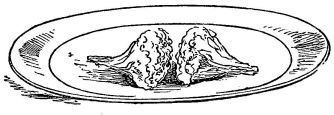
Cauliflower is delicious served as a garnish around fried spring chickens, or with fried sweet-breads, when the white sauce should be poured over both. In this case, it should be made by adding the cream, flour, and seasoning to the little grease (half a tea-spoonful) that is left after sautéing the chickens or sweet-breads. Time to cook, fifteen minutes, if small; twenty minutes, if large.
Cauliflowers, with Cheese.
Add plenty of grated cheese (say a cupful to a pint of sauce) to the usual white sauce made for cauliflowers. Heat the sauce well, to melt the cheese thoroughly, and pour it over the cauliflowers.
Cauliflower is valuable as a salad, with the Mayonnaise dressing, or, mixed with other cold vegetables, with the French dressing. See Salads.
Asparagus.
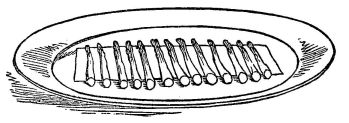
Tie the stalks in bundles, keeping the heads one way, and cut off the stalks, so that they may be of equal length. Put them into well-salted boiling water, and cook until they are tender (no longer). While boiling, prepare some thin slices of toast; arrange the asparagus, when well drained, neatly upon it, and pour over a white sauce, as for cauliflower. The sauce Hollandaise is especially nice for asparagus. Time to cook asparagus, about eighteen minutes.
Pease.
American mode: First boil the pods, which are sweet and full of flavor, in a little water; skim them out, and add the pease, which boil until tender; add then a little butter, cream, pepper, and salt. If they are served as a garnish, do not add the juice; but, if served alone, the juice is a savory addition. Time to cook, about half an hour.
The American canned pease should be rinsed before cooking, as the juice is generally thick. The pease are then thrown into a little boiling water seasoned with salt, and a little sugar; butter is added when done.
English mode: Throw the pease into boiling water, with some lettuce leaves and a sprig of mint in the bottom of the stew-pan. To each quart of pease allow two table-spoonfuls of butter and a lump of loaf-sugar; cover the stew-pan closely, and boil until they are tender—thoroughly done; then separate the pease from the other ingredients, sending them only to the table. This cooking of pease with mint (universally done in England) is a good way of utterly destroying the delicious natural flavor of the pea.
Spinach.
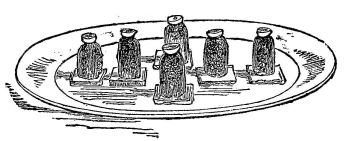
Having washed it thoroughly, put it into just enough salted boiling water to cover it. When it is tender, squeeze out all the water, and press it through a colander; then sauté it a few minutes, with a little butter, pepper, and salt. Serve with sliced, hard-boiled eggs on top; or, if it is used as a garnish for lamb, add a little lemon-juice and a spoonful of stock. Or, it is nice served as a course by itself, arranged on a platter as follows:
Put a circle of thin slices of buttered toast (one slice for each person at table) around the dish, and on each slice put a cupful of spinach, neatly smoothed in shape. Press the half of a hard-boiled egg into the top of each pile of spinach, leaving the cut part of the egg uppermost.
Tomatoes Stewed.
Pour boiling water over six or eight large tomatoes to remove the skin, and then cut them into a saucepan. When they begin to boil, pour away a little of the juice; add a small piece of butter, pepper, salt, and a very little sugar. Let them cook for about fifteen minutes, stirring in well the seasoning. Some add a few bread or cracker crumbs.
Tomatoes, With Mayonnaise Dressing (see Salads, p. 226).
Stuffed Tomatoes Baked.
Choose large tomatoes. Do not skin them, but scoop out a small place at the top, which fill with a stuffing. The simplest is made of bread-crumbs, minced onion, cayenne, and salt. First fry the onions in a little butter, add the bread-crumbs, moistened with a little water (or, better, stock) and seasoned with a very little Cayenne pepper and enough salt. Fry them a moment; then fill the cavities, allowing the stuffing to project half an inch above the tomato, and smooth it over the top. Bake.
A better stuffing is this: Chop very fine some cold cooked chicken, lamb, beef, or pork. Each of these may be used, or they may be mixed. However, a very little pork mixed with any kind of meat makes a pleasant seasoning. Now fry a little chopped onion in butter, and, when just colored, throw in the chopped meat, a few bread-crumbs, very little stock, and season the whole with salt, pepper, and some parsley. When hot, and well mixed, take it off the fire; add the yolk of a raw egg to bind it together. Fill the tomatoes with this preparation, sprinkle bread-crumbs over the tops, and bake. The tomatoes are a pretty garnish around any kind of meat. If served as a course alone, pour into the bottom of the dish a tomato-sauce flavored with a little sherry.
Onions.
There is no better manner of cooking onions than as follows: Put them into salted boiling water, with a little milk added, and boil them until tender (no longer). Then place them in a baking-pan with a little pepper, salt, and butter over the top of each, and a very little of the water in which they were boiled in the bottom of the pan. Brown them quickly in the oven, and serve very hot. They may be served alone in a vegetable-dish, or as a garnish around beef, calf’s heart, etc.
Onions, with Cream.
Boil the onions, putting them into boiling salted water, with a little milk added, until tender; drain, and put them into a stew-pan, with a white sauce made as directed for cauliflowers. Let them simmer a few moments. Serve with the sauce poured over.
String-beans.
String, and cut each bean crosswise into two or three pieces. Put them, with a little pork, into boiling water, and when boiled tender drain them. Put into a stew-pan a cupful of cream, a small piece of butter rubbed in an even tea-spoonful of flour, pepper, and salt. When hot, add the beans (say one pint), and stew them a few moments before serving.
String-beans in Salad (see Salads, page 226).
Lima Beans (London Cooking-teacher).
Put a pint of the shelled beans into boiling water slightly salted, adding two or three slices of onion. When tender, drain them. Put butter the size of an egg into a heated saucepan, and when it is hot add an even table-spoonful of minced onions, which cook well; then put in the beans; add enough water (or, better, stock) to keep them moist. Keep them at the side of the fire about a quarter of an hour, as it takes them some time to soak; just before taking them out, add a small handful of minced parsley. Do not cook them much after adding the parsley, as that spoils its color.
Lima Beans, with Cream.
Put a pint of the shelled beans into just enough boiling salted water to cover them, and boil them tender; then drain off the water; add a cupful of boiling milk (or, better, cream), a little piece of butter, pepper, and salt. Let the beans simmer a minute in the milk before serving.
Celery Fried.
Cut the celery into pieces three or four inches long; boil them tender in salted water; drain them. Make a batter in the proportion of two eggs to a cupful of rich milk; mix flour, or fine bread or cracker crumbs, enough to give it consistence; roll the pieces of celery in it, and fry them to a light-brown in hot lard. Serve very hot. Celery can also be cooked as asparagus, boiled tender, and served with a white sauce.
Egg-plant.
Cut the plant into slices less than half an inch thick, without paring off the skin; then sprinkle pepper and salt between the parts, and cover with a plate; let them remain an hour, then dip each slice separately first into beaten egg, then into fine bread or cracker crumbs. Sauté them to a light-brown in hot lard or butter.
Cabbage To Boil.
Cabbage is best boiled and served with corned beef; otherwise boil a small piece of pork with it. Always boil with it a piece of a red pepper. A little bunch of small red peppers, costing five cents, will last a long time for cooking cabbage, making pickles, etc.
Remove the outside damaged leaves, and cut the cabbage into halves (or, if very large, into quarters), so as to better cook the inside stalk; put it into the boiling water, with the corned beef or pork and the small red pepper. It will take the cabbage from half to three quarters of an hour to be well cooked. Drain the cabbage well, serving it with the meat in the centre of the dish.
Cabbage Stewed.
Shred two small cabbages coarser than for cold slaw; parboil them with a small piece of red pepper added to the boiling water; then pour off the water, and add three or four table-spoonfuls of vinegar, a small piece of butter, and a large-sized ladleful of stock from the stock-pot; cover the saucepan closely, and let the cabbage simmer gently for half an hour; season with a little red pepper, if it needs more, and salt.
To Boil Corn on the Cob.
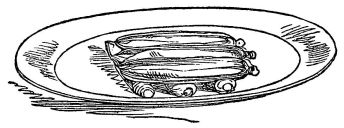
At the Saratoga Lake House there is a third specialty of good things. The first is the fried potato, the second is the fresh trout, the third is boiled corn, which is served as a course by itself. The corn is boiled in the husk. The latter imparts sweetness and flavor to the corn, besides keeping it moist and tender. The unhusked corn is put into salted boiling water, and when done, and well drained, some of the outside husks are removed, and the corn is served, with the remaining husks about it; or, the cobs may be broken from the husks just before sending them to table, which would save this trouble afterward.
Corn Mock Oysters.
Mix into a pint of grated green corn three table-spoonfuls of milk, one tea-cupful of flour, a piece of butter the size of a hickory-nut, one tea-spoonful of salt, half a tea-spoonful of pepper, and one egg. Drop it by dessert-spoonfuls into a little hot butter, and sauté it on both sides. It resembles, and has much the flavor of fried oysters. It is a good tea or lunch dish. Serve it hot, on a warm platter.
Corn Custard, to be served as a Vegetable.
Cut corn from the cob, mix it not too thin with milk, two or three beaten eggs, pepper and salt; bake half an hour. It is very nice.
Corn Pudding for Tea.
Ingredients: One dozen ears of sweet-corn, three eggs, one pint of milk, three table-spoonfuls of sugar, a small tea-spoonful of salt, a little butter, a little flour if the corn is quite young, with a little less milk; if the corn is older, omit it; grate half of the corn, and cut the other half. Bake.
Grated Corn Sautéd.
Mix grated corn with salt and pepper; sauté it in a little hot butter.
To Cook Cranberries.
Add one tea-cupful of water to a quart of cranberries, and put them over the fire. After cooking ten minutes, add two heaping cupfuls of sugar, and cook about ten minutes longer, stirring them often. Pour them into a bowl or mold, and when cold they can be removed as a jelly. The berries will seem very dry before the sugar is added, but if more water is used they will not form a jelly.
Artichokes.
Cut off the outside tough leaves, and trim the bottom; throw them into boiling salted water, with a few drops of vinegar. When quite done, drain, and serve with drawn butter, or, what is still better, a sauce Hollandaise.
Fried Apples for Breakfast.
Sour apples should be selected: Pippins, Northern Spies, etc. First fry some thin slices of pork, then the slices (without peeling them) of apples in the same hot fat.
A Rice Dish (Risotto à la Milanaise).
Put one ounce of butter (size of a pigeon’s egg) into a stew-pan, and when hot mix in a quarter of an onion (half an ounce), minced, and cook until it assumes a pale-yellow color; put in the washed rice (uncooked), and stir it over the fire until it has a yellow color also; then add a pint of stock. White stock is preferable, as it preserves the light color of the rice, yet any stock may be used. Boil slowly until the rice is tender (about half an hour), when the stock will be mostly absorbed. When about to serve, add one ounce of grated cheese, stirring for a few moments over the fire, without letting it boil; sprinkle a little grated cheese over the top.
This dish can be served alone as an entremêt or as a vegetable, with any kind of meat. A brown sauce may or may not be served around it.
Another Rice Dish.
Mix carefully (not to break the grains) in a pint of boiled rice (see page 288) a table-spoonful of either minced parsley or shives. Put a piece of butter size of a pigeon’s egg into a saucepan, and let it color a light-brown; mix the rice in the butter, and serve as a vegetable.
Mushrooms in Crust (Croûte aux Champignons).
For the crust, a little extra butter is added to the dough for rolls; it is made round, three inches in diameter, and two inches high, instead of an oval roll shape. When freshly baked, a slice is cut from the top of each one, the crumb is removed, and the shells are buttered and filled with mushrooms, cooked as for garnishing, and mixed with a Bechamel sauce. Finely minced parsley is sprinkled over the tops. They should be served quite hot. Fresh mushrooms are required for this dish.
Flaxseed for a Centre-piece.
Sew coarse flannel around a goblet with the stem broken off; put this shapely dome upon a saucer of water; wet the flannel, and sprinkle over as much flaxseed as will adhere to it. The flannel will absorb the water from the saucer, which should be often replenished. In about two weeks the flannel will be concealed in a beautiful verdure, which will vie with any table ornament.
CASSEROLES.
Casseroles are generally made of boiled rice, or of mashed boiled potatoes. When of rice, first cook thoroughly with milk, salt, and a little butter; or they may be cooked in broth, with a little ham added, which is afterward to be taken out. Mash fine.
When of potatoes, boil, season, and mash them well. Butter the casserole mold. First press the rice, or the potatoes, whichever used, into the figures of the mold; then fill it. In the centre bread may be substituted. Put the casserole aside to harden. When quite cold and firm, carefully unclasp and take off the mold; then, with a small, sharp knife and a spoon, scoop out the inside, leaving the casserole from a half to an inch thick. Just before serving, with a little paste-brush, dipped in the yolk of an egg, brush the whole surface. This may be omitted if preferred. Put in a very hot oven a few moments, to heat the rice or potato, and to color slightly the egg. Fill it with vegetables, such as cauliflower, Lima beans, string-beans, artichokes, pease, etc.; or with chicken fricasseed or fried, and served with a cream dressing, or with Bechamel sauce, or en blanquette; or with any kind of scollops, whether of game, poultry, sweet-breads, fish, or shell-fish.