Chapter XIV · SUBCUTANEOUS HYDROCARBON PROTHESES
Reading edition
Although the subcutaneous employment of oil and liquefied paraffin has been known for some years, particularly by Corning, who refers to his use of solidifying oils in surgery in an article published in 1891, no actual application for prothetic purposes was made until 1900, when Gersuny first advocated the method. In his published report he says that, “if vaselin, which at the temperature of the body has the consistency of ointment, be liquefied by heat and by the means of a Pravaz syringe is injected into dilatable tissue of the human body, there is produced, at the site where the injection is made, a tumefaction whose volume corresponds to the quantity of vaselin injected. The reaction which results from the procedure is insignificant and the mass appears to rest without change where injected.”
This subcutaneous method of vaselin injection he employed in the case of a young girl to correct a saddle or depressed nose. The operation was purely a cosmetic one, and was performed on May 8, 1900, with a very satisfactory result.
From the time of the appearance of Gersuny’s paper, “Ueber eine Subcutane Prothese,” a number of operators, such as Halban, von Frisch, Kapsammer, Delangre, Rohmer, Stein, and others, began to follow the method with gratifying results.
Pfannenstiel, shortly after, claimed that the injection of vaselin was not wholly without danger, and that pulmonary embolism had been observed by him subsequent to its use. Moszkowicz denied the possibilities of such danger, although at this date it is quite evident that there are many objections to the sole use of sterile vaselin for all subcutaneous cosmetic purposes where such protheses might be indicated.
Eckstein, on July 24, 1901, rehearses these objections and advocates the use of “Hart paraffin,” or paraffin with a melting point of 57-60° C. (140° F.). His method was taken up by Brœckært, Baratoux, Brindel, Watson Cheyne, Walker Downie, Leonard Hill, Lake, Scanes Spicer, Karewski, and other prominent surgeons abroad, and by Parker, Harmon Smith, Hamilton, Quinlan, Connell, and others in the United States.
Drs. Lynch and Heath were the first American physicians to place themselves on record in the employment of the method of Gersuny for the correction of nasal deformities.
Each of the operators employing the now so-called Gersuny method advanced their individual ideas and improvements in the art, and those of distinctive merit will be considered later by the author, who has employed both methods from the time of their incipiency.
The method of procedure in the injection of vaselin or paraffin is practically similar, except for the various ways in which the paraffin of different melting points is rendered liquid.
INDICATIONS
The indications for the protheses of either method are the same, except where the author advocates the use of either one or the other or a combination of the two from an experience with over five hundred personally conducted cases.
The advantages of the Gersuny method is that the operation is practically painless, causes no scar if properly performed, and corrects a deformity that could not be overcome otherwise in some cases, while in others it would entail not only difficult surgical interferences, but subsequently unsightly cicatrices that would render them more objectional than the very defects which were intended to be corrected.
This is particularly true in the cosmetic correction of depressions about the forehead resulting from direct violence or frontal sinus operations, for obliterating habit furrows, or frowns, between the eyebrows; also to restore the symmetry of the face in hollows of the cheek due to the removal of malignant growths, the maxillæ, or when caused by facial hemiatrophy or a congenital or long-acquired sinking in of the cheeks; while it may also be employed with excellent result to prevent post-operative adhesions about the face after mastoid operations and even to restore the form of the breast after operation for malignant disease and the raising of smallpox pits.
Numerous other uses may be mentioned, such as elevating an undue depression at the root of the nose, raising sunken furrows below the eyes, obliterating nasolabial folds, angular droops about the chin, rebuilding weak or pronounced oval or peaked chins, filling hollows about the neck and shoulders, and in fact anywhere about the body to restore the contour.
In correcting the deformities of the nose, whether congenital or acquired, this method has met an urgent and most useful demand, so much so that many rhinoplastic operations of extensive delicacy have been thrown aside for this simpler, rapid, and gratifying means of surgery.
Not only has it been employed to restore the nasal line in saddle noses, but also in many other deformities of that organ which do not require the removal of superabundant tissue.
According to the appended classification of nasal deformities, given by Roe, it will be seen that many faults of that organ may be overcome by the method.
Deformities of the nose { Bony Portion { Vertical { Concave.
{ Convex.
{ Lateral { Spatulated.
{ Defected.
{ Cartilaginous Portion { Tip { Excessive or Deficient Tissue.
{ Deviation from Median Line.
{ Wings { Collapsed.
{ Expanded.
From the above arrangement, and taking each division separately, the author enumerates the applicability of the subcutaneous prothesis, adding such as are not included in the above.
1. Vertical concavity. An overmarked depression at the site of the bony structure and about the root of the nose.
2. Lateral deficiency of form about the root of the nose extending downward as far as the inferior borders of the nasal bones.
3. Median anterior vertical concavity or saddle nose involving the middle third, otherwise the inferior and superior sections.
4. Deviations of the cartilaginous structure about the middle third of the nose, either unilateral or bilateral.
5. Deviation of the lobule.
6. Deficiency of the lobule.
7. Lobular cleft.
8. Subseptal cleft.
9. Collapsed alæ, unilateral or bilateral.
10. Retraction of subseptum.
In these ten subdivisions much can be done to bring about a normal appearance of the nose.
PRECAUTIONS
In selecting a case for subcutaneous injection the operator must well consider the methods to be employed, his successes with such methods, the importance and gravity of the operation, the condition of the patient, the extent of the deformity, the peculiarity of the patient and, particularly, the state of mind of the patient.
While at this date of the use of this method of beautifying parts of the human face we may feel certain of the happy outcome of an operation undertaken by the operator, he must not lose sight of the hypercritical person upon whom the work is to be done; even with an outcome gratifying in the extreme from a surgical standpoint, the patient will insist, and that in eighty per cent of all cases, to still further improve them in spite of the fact that a normal appearance has been attained, often leading the operator into doing what he should not do, and eventually undoing his own excellent efforts.
The author does not mean to imply this as a weakness on the part of the surgeon, but cannot impress too deeply upon him the unreasonable demands of a person insanely bent upon having the alabaster cheek ideal of the poets, the nose of a Venus, the chin of an Apollo, the neck of swanlike form, etc.
The patient believes it lies in the power of the cosmetic surgeon to do with their malformations as a sculptor would model in clay and will insist upon gaining their ideal beyond all reason.
Let the author warn the operator against the “beauty cranks,” especially of those who are just about to engage in great theatrical ventures, circus performances, or “acts,” and very desirable marriages. These are patients who are not only difficult to deal with, but the first to harm the hard-earned, well-deserved reputation of the surgeon and to drag him into courts for reimbursement for all kinds of damages, especially backed up by events, losses, and sufferings largely imaginable and untrue, and ofttimes entirely impossible.
In all cosmetic surgery this branch is the most dangerous from that point of view; therefore the operator should take his case well in hand, proceed with an unshakable determination and give the patient to understand his position, even to explaining what disappointments there might be and what dangers, if any, he might look forward to. The author believes it no unjust demand to have an agreement made with the one to be treated in which these matters are fully considered. Such an arrangement will save him much worry and will tend in the majority of cases to keep his patient satisfied.
On the other hand, the operator should not undertake to do an operation of a cosmetic nature unless he has a fundamental and practical experience of long standing in this branch of surgery, and is ready at all times to cope with such post-operative conditions as are likely to arise, which will be described later.
The author has on various occasions been asked to correct the most hideous malformations of parts of the face, particularly the nose, in which surgeons of high standing, both here and abroad, had injected paraffin in liquid form, usually under a general anesthetic, the most remarkable being that of a hospital orderly in the United States service, who had been subjected to not only one of such injections to correct a saddle nose under chloroform anesthesia, but to three distinctive operations, with the result of a permanent disfigurement, bettered only by a succession of excisions at different parts of the nose.
Apropos of such cases it may be timely to state that a general anesthetic for the performance of a prothetic injection operation is never justifiable and should be considered a lack of knowledge on the part of the operator, unless its use be advised by another surgeon in consultation.
The greatest mistake made with this so-called “filling method” has been a desire on the part of the patient or the operator, or both, to complete the work too quickly. Unscrupulous operators have restored a saddle nose or the contour of the cheeks in a few minutes, when it is an established fact that the work should be done slowly, giving time for the injections to accommodate themselves and to organize before others are attempted. This is not only true of fillings about the cheeks and shoulders, but also of injections about the nose and forehead.
Eschweiler particularly emphasizes the advocacy of oft-repeated injections, and the author recommends such rule without reserve or deviation.
THE ADVANTAGE OF THE METHOD
As has been said, the advantage of the Gersuny method over other procedures is that it can be undertaken practically without pain, that it is quick, bloodless, leaves no scar, and is harmless except under such conditions as will be referred to under a separate heading.
While the method entails only the pain of a pin prick a local anesthesia may be employed to overcome this, but never a general anesthetic. The ethyl-chloride spray, except at very small points of the skin, is not to be recommended because it freezes and consequently hardens the very tissue which should be flexible, the operation being undertaken the moment the needle is inserted and lasting only a few seconds. The hypodermic use of a two-per-cent solution of cocain, or better Eucain β, can be employed, but the author sees no advantage in it, as the hyperemic engorgement following its use obliterates, to a certain degree, the actual extent of the deformity.
It is desirable to obtain the best result to have the skin above the part as free as possible. When closely adherent it should be freed by the careful use of a delicate tenotome, inserted at the point where the injection is to be made, the same opening being used for the introduction of the needle of the syringe. If this opening has been made too large a fine suture of silk should be employed to bring the lips of the wound together before the injection is made; the needle point, being knife-edged, will not disturb the apposition and will tend to retain the filling if no undue pressure is used, as in the case of hyperinjection.
UNTOWARD RESULTS
Connell has tabulated the difficulties and dangers met with in this work as follows:
1. Toxic absorption.
2. Marked inflammatory reaction.
3. Loss of tissue, due to infection and abscess formation.
4. Pressure necrosis, caused by hyperinjection.
5. Sloughing of tissue as a result of the heat of paraffin.
6. Injection into very dense or inelastic structures, or where scar tissue is firmly attached to the underlying and adjacent parts.
7. Subinjection of too small an amount of paraffin with an insufficient correction of the deformity.
8. Hyperinjection with overcorrection of deformity.
9. Air embolism.
10. Paraffin embolism.
11. Primary diffusion or extension of paraffin (when first introduced) into adjacent normal structures.
12. Interference with muscular action of the nose.
13. Escape of paraffin after the withdrawal of the needle or primary elimination.
14. Solidification of the paraffin in the needle, which renders the injection difficult and causes injudicious expedition on the part of the operator.
15. Absorption or disintegration of the paraffin.
16. The difficulty of procuring paraffin at the proper melting point.
17. Hypersensitiveness of the skin over the injected area.
18. Redness of the skin over the injected area.
To those the author would add:
19. Secondary diffusion of the injected mass.
20. Hyperplasia of the connective tissue following the organization of the injected matter.
21. A yellow appearance and thickening of the skin after organization of the injected mass.
22. The breaking down of tissue and the resulting abscess due to the pressure of the injected mass upon the adjacent tissue after the injection has become organized.
Each of the above subdivisions may be advantageously considered individually, to wit:
1. Intoxication.—The danger of intoxication may truly be said to be more so due to the unclean or unsterilized matter injected than to the absorption following its employment, although Meyer has claimed untoward symptoms found in his experiments from absorption of injections of vaselin in the animal. Taddie and Delain, Stubenrath, Straume, Sobieranski, and Dunbar have corroborated this claim. They injected paraffin of various melting points in the lower animals and observed results therefrom, among which were loss of hair, a reduction of eighteen per cent in the body weight in two months and death.
Stein and Harmon Smith refute these conditions and remarked neither systemic nor local untoward results from such injections when paraffin of higher melting points were used.
Jukuff claims that no toxic symptoms resulting from the absorption of paraffin injected into tissues are shown, unless the amount be equal to ten per cent of the weight of the animal. To have this apply to the human as much as ten to fifteen pounds would have to be injected—an amount never required in operations of this nature.
While it cannot be denied that the injected mass becomes more or less absorbed in from two to three months and is replaced by connective tissue, it may be definitely stated that no toxic symptoms are caused directly thereby, except by the employment of an impure product.
2. Reaction.—The reaction following a properly made injection is of a mild inflammatory character. Considerable inflammation points to some fault in the technique or impurity of the injection. More or less edema of the site and its adjacent area may be noted, associated with slight or marked discoloration and pain of variable degree. The normal reaction following the injection is temporary and does not necessitate treatment or confinement of the patient, who can resume the duties of life fifteen hours after the operation.
3. Infection.—The cause of infection cannot be said to be due to anything but surgical uncleanliness, as it is with any surgical undertaking, and can be overcome by the same means.
The material injected should be thoroughly sterilized by boiling before using. Brœckært suggests combining an antiseptic with the paraffin and has used guiaform, a combination of formic aldehyde and guiacol in a proportion of five to ten per cent; yet this is of little value when we consider how readily these hydrocarbons can be rendered sterile at high temperatures.
4. Necrosis.—Death of tissue may follow an injection of paraffin when too much pressure has been applied, or when too much has been injected into the tissue, cutting off the blood supply, or when the injection has been made into the skin instead of beneath it. Again, constitutional disease, such as diabetes or Bright’s disease, may superinduce the breaking down of the tissue.
Hyperinjection should and can be avoided by the use of the proper instrument with which the required amount is graduated to a nicety. At no time should an injection be crowded into a dense tissue or where the skin is closely adherent, nor carried so far as to create a blanching of the skin. By carefully injecting the mass this danger should be overcome.
Dense or bound-down areas of skin should be loosened and freed, as has already been mentioned.
If care be exercised and small amounts be injected, in preference to overcoming the defect in one sitting, pressure effects are entirely overcome.
The circulation in the skin over the site of injection should be normal immediately after the operation has been performed, determined by observing the reaction in the color of the skin after delicate digital pressure.
5. Sloughing.—That sloughing of the skin should be occasioned by the high temperature of the paraffin injected is a condition entirely inexcusable. Paraffin of high melting points 58° to 65° C., or the so-called “Hart paraffin” employed by Wolff, liquefying at from 57° to 60° C., are to be used with caution. The author doubts whether the temperature of the paraffin at the time of injection, even in the latter method, is ever beyond 54° C. even if the thermometer registers 60° C. in the liquefying, hot-water bath.
By the time it has been drawn into the syringe, which has been heated by dipping into hot water, and the moment it is injected it has lost several degrees in heat.
It would not be permissible to inject a molten mass of a temperature so high as to scar or burn the tissues, and the best results of most operators have been obtained with such of the paraffin group that become liquefied at a temperature of not over 45° C. (112° F.).
The claim of Eckstein, that paraffins of low melting points are more likely to be absorbed, has not been substantiated in actual practice, since we now know that any and all of these injections, irrespective of their melting points, are absorbed in time, giving place to connective tissue, and that rarely, if ever, is there a true and complete encapsulation or encystment of the mass thus introduced. Even the hard paraffins are split up in time into minute pearllike particles which are displaced by the growth of tissue arising from the presence of the foreign substance. This is true even in those cases in which the author has introduced by surgical means solid paraffin plates in the cold state.
6. Sloughing Due to Pressure.—When an injection is forced into a dense or firmly bound-down tissue, as into the body of a thickened cicatrix, or about the point of the nose or the subseptum of the nose without first dissecting off the skin above the subcutaneous layers, an acute anemia is at once marked, followed by inflammation and gangrene.
By injecting sterile water into the area thus loosened with the knife a good idea of the thoroughness of the dissection and the possibility of building up the part to be corrected is obtained, yet in these cases the author has always found more or less difficulty in keeping the injected mass in place for the reason that the divided surfaces tend to unite at their peripheral borders, crowding the mass upward or to one side or diffusing it in such a way that the result has been anything but satisfactory.
To overcome this it is advisable to inject a smaller quantity than necessary to entirely correct the defect, to mold it out flat and to allow it to organize before more is introduced.
7. Subinjection.—Insufficient injection leading to an undercorrection of the defect is a far more desirable condition than hyperinjection, and is easily corrected by a repetition of the treatment, even to a third sitting, until the desired result is obtained. Following this rule will give far better results, as has been said, than to be compelled to remove a part of the filling and some of the connective tissue which has resulted therefrom.
8. Hyperinjection.—The injection of too much vaselin or paraffin is one of the most common faults found with operators. In the first instance a tumefaction of the site results which with the production of the tissue which takes the place of part of the filling makes the result very unsatisfactory and requires one or more cutting operations to reduce it. A peculiar fact with these hyperplastic growths is that even though they may be reduced with the knife to a normal size they seem to redevelop again and again, giving both surgeon and patient great concern.
This, in the opinion of the author, is due to the binding down of the marginal borders, which, in the event of partial extirpation, are not injured sufficiently to displace them and that they unite again in their former position. To overcome this it is found best to excise the entire filling much beyond the margins and to apply pressure over the area until perfect union has taken place.
This is best accomplished with a disk of aluminium, bent to conform to the shape of the part operated, lined with sterilized lint and fixed over the site by strips of Z. O. plaster.
While the hyperinjection of vaselin is not as objectionable as that of paraffin, because of the more ready accommodation and absorption of the mass, it nevertheless leads to diffusion of the material, owing to its softer consistency and consequent greater facility in seeking fine avenues of escape, paraffin having the advantage of cooling upon itself en masse, leaving little to escape into undesirable channels after it has once been molded and set.
Vasserman cites a case in which gangrene of the bridge of the nose resulted after an injection of 2.05 c.c. of vaselin.
However, when these faults occur they are errors of technique, and should be avoided, as has been mentioned heretofore.
The removal of such hyperinjected masses by the aid of paraffin solvents, such as benzine, ether, chloroform, or xycol, applied to the skin above the filling, has proved a failure, nor will heat used externally in the same manner remedy evil.
What is left to the operator is to open the skin and, with a small, sharp spoon curette, remove the mass early, before it has become organized, or to excise the new connective tissue and the broken-down filling, as mentioned.
When, however, the tumefaction resulting from such hyperinjection is not extensive, as is often found about the chin and at the root of the nose, the secondary deformity can be materially, if not entirely, remedied by electrolysis. A needle or brooch of certain hardness is to be employed, connected with the negative pole of a continuous current apparatus. From twelve to twenty milliampères are required. The process is similar to that used with the destruction of hair, nævi, or moles on the face. The needle should puncture the entire tumor or penetrate its maximum diameter and be charged with the current for two or three minutes. Several of such punctures should be made at each sitting, the latter being repeated as often as is deemed necessary by the operator. The reaction which follows this procedure is of little moment, and these sittings can be undertaken every three or four days.
While this method is liable to leave little punctuate scars at the sites where the needle is introduced, it is nevertheless more satisfactory than the linear scar made with the knife, to the use of which the patient may, on the other hand, object, not to speak of the difficulty and unsatisfactory results usually obtained therewith.
9. Air Embolism.—The fault of introducing air under the skin with the syringe at the time of injection can only be the result of flagrant negligence. Every physician should know enough to hold the syringe in an erect or vertical position, and to expel the air above the solution in his syringe, as is done with any hypodermic injection.
Air embolisms are also occasioned by a careless filling of the syringe with the hydrocarbon in a cold state, as the material is now generally used, and while the dangers of such emboli are very much exaggerated they should not be permitted, when by the pouring in of the liquefied material the syringe can be filled evenly.
Practically there is no harm done by the injection of air under the skin, yet it elevates the skin at the site of the defect and hinders the surgeon in accomplishing the best results.
These emboli cause a bulging up of the skin for the time being and may occasion more or less pain to the patient, which passes away in ten or twelve hours, leaving the parts as injected except for such reactionary symptoms or edema, already referred to.
10. Paraffin Embolism.—The creation of an embolism is invariably due to an injection of the foreign substance directly into a blood vessel. This condition is one of the most objectionable, if not the most dangerous, factor associated with the subcutaneous injection of any foreign matter, be it a liquid substance, as, for instance, an oil; many cases have been placed on record where they have been observed after the introduction of even paraffin of high melting points, when introduced under the skin in hot liquid state. Consequently the use of vaselin liquefied by the aid of heat is especially liable to give rise to such condition.
Pfannenstiel cites a case wherein he injected paraffin in which the patient was at once attacked with violent coughing, and for three days exhibited symptoms of grave nature, such as pain in side, intense dyspnea, acceleration of the pulse, hyperthermia, cyanosis of the face, hemoptysis, violent cephalalgia, and vomiting—all indications of pulmonary and cerebral embolism. The injection in this case was one of 30 c.c. of paraffin, with a melting point of 45° C. The symptoms as mentioned continued for about one week, gradually subsiding, and followed by recovery.
Kapsammer has also noticed such symptoms. Leiser, after injecting vaselin to correct a saddle nose, noted an immediate collapse of the patient, which was obviated only by the hypodermic use of ether and the resort to artificial respiration. When the patient returned to consciousness, he was found to be entirely blind in the right eye, the eye before the operation having been known to show only a pronounced astigmatism.
Kofman cites the loss of a patient from the injection of 10 c.c. of paraffin for vaginal prolapsis. Moskowicz observed two cases of pulmonary embolism treated in the same manner, stating that an alarming dyspnea continued for several hours.
Especially have cases in which the injections of paraffin were made submucously for the correction of atrophic coryza shown embolic tendencies. This is especially true when paraffins of high melting points have been employed, as in the case of Pfannenstiel, in which instance the condition of the mass permitted of freer absorption or the high temperature caused a coagulation of the blood in the veins, leading to thrombosis and embolism, and when the amount of such an injection is so large as to prevent cooling and hardening in the normal space of time added to the quantity and associated at the same time with consequent pressure, predisposing to absorption or dissemination, especially if the injection be made into the parenchymatous instead of the subcutaneous tissue.
Comstock, in his experience on animals, states that “in all cases in which paraffin was used at 102° F. the animals died within two weeks’ time, hence the specimens at that temperature are limited (death being by thrombosis). In all other cases with the higher melting point, 110° F., no unpleasant results were experienced.”
Hurd and Holden have observed a patient who had previously undergone two injections of paraffin for the correction of a depression in the upper part of the nose. A third injection was advised and made under the same conditions as the first, except that no cocain anesthesia was employed, the paraffin being at same temperature as before.
The moment the injection was made complete blindness in the right eye resulted, while a small ecchymotic spot appeared at the site of the needle insertion in the skin. Half an hour later an examination of the eye showed the right pupil dilated and inactive light stimulus, the patient being unable to distinguish light from darkness. Ophthalmoscopically the lower branch of the central retinal artery and its subdivisions were found to be empty and in a state of collapse, evidenced by their pale appearance. The upper branch of the same vessel was found to be poorly filled.
The authors endeavored to remove the embolism to a collateral branch of the artery by the use of amyl nitrate, digitalis, and pressure on the globe of the eye, with no effect. Some hours later edema of the retina appeared, followed by permanent loss of sight. The same authors have observed several cases of pulmonary embolism result from the injection of paraffin.
It is also a fact that injections of the nature being considered, while not causing immediate embolism, may do so as a result of phlebitis, caused by a direct injection into the vein or over or upon it in such a way as to cause irritation.
Mintz reports a third case of amaurosis following a paraffin injection. The latter was made to correct a saddle deformity caused by syphilis. Three minutes after the injection the patient complained of pain in the left eye, which was followed by total blindness, vomiting, and a pulse of 48. Several days later there appeared symptoms of venous congestion in the orbit, paralysis of the ocular muscles, corneal cloudiness, and exophthalmos, a small gangrenous spot appeared at the site of the injection.
Brœckært observed a case of facial phlebitis, followed by pulmonary infarction. Brindel cites a case in which he observed a hard line of considerable extent and painful to the touch, extending from the inner angle of the eye to the angle of the eye, where it deviated toward the root of the nose and terminated at the origin of the eyebrow.
De Cazeneuve made an injection, and on the following day noted that the right cheek had increased considerably in size with an elevation of temperature in the part. Two days after, under the right eye and to the right of the nose, the whole cheek was red, hot, and much distended, giving the skin a glazed appearance. Palpation was extremely painful. A hard line could be made out, extending from the inner angle of the eye outward and downward under the lower eyelid and terminating in the center of the edematous cheek. The phlebitis in this case resulted without the development of an embolism.
After a careful study of the causes of such embolisms we come to the conclusion:
1. That the injected mass should not be heated above a certain melting point.
2. That hyperinjection should at all times be avoided, particularly with paraffins of high melting points.
3. That the injection should be made subcutaneously not into parenchymatous tissues, and
4. That a puncture of a vein or the introduction of the injected mass into a vein should be avoided.
In the consideration of the first two causes the author advocates using injections of low melting points only at all times; in fact, from his experience with over two thousand subcutaneous injections, he relies entirely upon such paraffins or hydrocarbon mixtures as are semisolid at 70° F., appearing as a white cylindrical thread from the needle of the syringe as pressure is applied.
With such a preparation and a careful introduction of the needle, as described later, and with the injection of an amount much less than that needed to correct the deformity and proper digital compression on the blood vessels and about the site of the injection embolism is practically impossible.
The avoidance in the third instance is self-evident, and it is to the fourth fault and cause that we must pay particular attention.
Stein says that all that is necessary to avoid puncturing a vein is to first introduce the needle alone under the skin and to attach the syringe only when it is found no flow of blood results from the puncture thus made.
Freeman and the author add to this by advocating the use of a somewhat blunt-pointed needle instead of the extremely sharply pointed knife-edged needles usually furnished with syringes intended for this purpose.
11. Primary Diffusion or Extension of Paraffin.—The spreading of paraffin into normal tissues about the site to be corrected by prothetic injection is a fault due principally to a careless use of the syringe. The employments of an improper syringe in which the amount to be injected cannot be graduated or controlled will be considered later—the result with such being hyperinjection. In this event, when the anterior line of the nose is to be restored, the mass is liable to find its way into the loose areolar tissue of the infra-orbital region; in correcting a nasolabial furrow the mass is pushed upward or is forced into the tissue of the cheek above it, aggravating the trouble; in obliterating a frown it travels upward toward the margin of the scalp, giving a median prominence to the forehead that is found to be very difficult to correct; in injections about the mouth the mass moves down upon the chin or accumulates at the angle of the jaw; in correcting the creases beneath the chin it seeks the sides of the neck, even traveling to the superior border of the clavicle at its sternal third. Many other forms of such diffusions can be mentioned directly due to primary diffusion the result of hyperinjection.
Enough has been said of the danger of hyperinjection, yet even with a proper amount of the injected mass this distention may be observed. To avoid this the operator, or his assistant, should compress the margins of the site of the injection with his fingers firmly applied, as, for instance, in the injection of the root of the nose pressure should be made at both inner canthi and over the tissue just above the root of the nose and beneath the finger tips.
Downie advocates the use of celloidin in the correction of a saddle nose as follows: He paints a band of celloidin or collodion down each side of the nose, limited by the line of junction with the cheeks, and another band across the root of the nose. These painted on bands he allows to dry and contract for fifteen minutes before undertaking the injection.
The contraction of these bands prevents to a certain extent the spreading or extension of the liquid paraffin into the cellular tissue about the eyes, yet experienced digital pressure is at all times to be preferred.
If a liquid paraffin or hydrocarbon mixture or vaselin is used, the immediate use of ice cloths applied to the part as digital pressure is removed, is advisable to aid in the rapid hardening or setting of the injected mass before the tension of the tissues over and about it might influence it. With semisolid injection this is not necessary, except in the subsequent treatment, as will be considered later, because the mass, unless of too soft a consistency, as, for instance, vaselin, will practically remain as injected and molded.
Vaselin when injected into tissue where there is tension would naturally be forced out of position and shape, and should not be used except in combination with a paraffin of a melting power high enough to give the proper consistency to the former.
12. Interference with Muscular Action of the Wings of the Nose.—That nasal respiration may be encroached upon as a result of injecting paraffin about the nose has been observed by Alter. He points out that during nasal inspiration there is a tendency for the alæ to contract upon themselves or to move inward, decreasing the lumen of the orifice, and that in the normal state this movement is counteracted by the action of dilator muscles of the alæ—that is, the dilator naris anterioris, the pyramidalis nasi, and the levator labii superioris alæque nasi—and that this muscular action is interfered with owing to the pressure of the paraffin upon these delicate structures, and resulting in more or less permanent collapse or indrawing of the alæ during inspiration. He observed considerable interference with inspiration in a case cited in which an injection of paraffin had been made.
To avoid undue pressure upon the structures referred to, it is advised to have an assistant place a thumb into each nostril and the index fingers without and above the alæ in such way that the tips of the fingers may be enabled to exert the necessary pressure over the injected mass into these structures, and to maintain this pressure until the mass has been properly molded and set. Connell advises inserting the little fingers into the nostril to prevent an encroachment on the lumen of the nasal canal.
The above applies particularly to those cases where injections are made into the anterior lower or lateral third of the nose, as, for instance, in overcoming slight depressions in the anterior line, immediately above the lobule or in a low unilateral deviation of the nose.
13. Escape of Paraffin after Withdrawal of Needle.—When the injected mass employed is of a semisolid consistency, as heretofore advised, it is hardly possible for the mass to be forced out through the opening of the skin made by the introduction and withdrawal of the needle, unless there be an unwarrantable immobility of the skin above the site to be injected. The latter should be corrected before injection.
The mass after having been molded in the shape desired may be further hardened and set by the application of ice cloths or spraying with ether before the needle is withdrawn from the skin, yet this is hardly necessary, and the author advises against the practice for the reason that pressure of the needle prevents proper and free molding of the mass and renders the tissue liable to further injury by scraping its point to and fro subcutaneously, adding to the extent of the wound and the dangers of infection and repair.
The skin immediately around the needle hole, after withdrawal of the needle, may be gently smoothed out with the dull rounded metal handle end of the bistoury to free the interdermal canal of any foreign matter.
The skin about the needle hole is then gently washed with a fifty-per-cent solution of hydrogen peroxid, dried with a sterile cotton sponge and the opening sealed with a drop of collodion. Subsequent treatment of the parts will be considered later.
14. Solidification of Paraffin in Needle.—This occurs only when paraffins of high melting points are employed in liquid form in the syringe, and is due to the rapid cooling of the paraffin in the small metallic cannulæ, or needle, wherein it sets more readily, since the volume contained therein is very small, often not more than two or three drops.
This cooling establishes a pluglike formation in the distal end of the needle, which prevents a proper use of the syringe, often breakage, and when suddenly liberated by an extra pressure on the piston rod causes a rapid discharge of the contents of the syringe to an extent not desired with the result of hyperinjection.
This fault was one of the most annoying in the early days of such injections when syringes of ordinary pattern, such as the Pravaz, or those built like the ordinary hypodermic, were used. It was not unusual to have the paraffin cool in the needle so quickly between the latter in the flame of an alcohol lamp that the syringe became unmanageable and broke in the hands of the operator. Since that time new and more useful syringes have been introduced by various operators which overcome this difficulty, yet with them, too, come the employment of semisolid paraffins or mixtures thereof. Yet, as some authors insist upon using paraffins of high melting points, it may be well to rehearse their methods of overcoming this annoying intraneedle solidification.
Eckstein surrounds the syringe and needle shaft, except the tip of the needle, with a rubber tubing, as shown in Fig. 284, to act as an insulator, and thus, for a time at least, keep the preparation liquid. Before filling the syringe he heats it by several immersions in and internal washings of hot sterile water. To prevent the paraffin from setting in the exposed tip of the needle he draws into the filled syringe a few drops of hot water, which are injected into the tissues, causing no objection to the method.
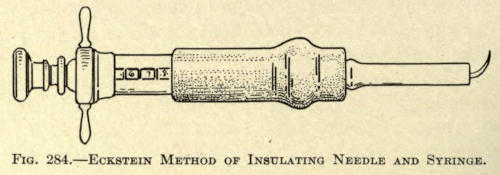
Fig. 284.—Eckstein Method of Insulating Needle and Syringe.
Paget and Harmon Smith warm the needle in hot sterilized or even boiling water. Previous to this Smith cools the contents of the syringe drawn into it at a temperature of 120° F. by immersing the latter in a bath of sterilized water at a temperature of 80° F.
From the above it will be noted that Smith advocates using the injections in semisolid state being ejected in a thin, cylindrical thread. A syringe of special construction, as referred to later, is, of course, required for such work.
Quinlan has invented a so-called paraffin heater, as shown in Fig. 285, in which the paraffin is kept in solution by the syringe being surrounded by a continuous flow of hot water. A plain and very objectionable syringe is shown in the illustration, and while the preparation in the syringe is thus kept in a liquid state the solidification in the needle is not overcome.
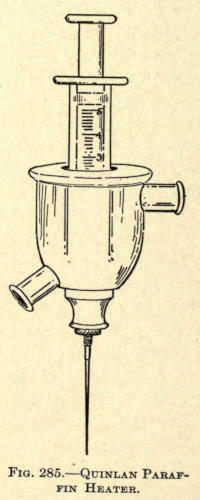
Fig. 285.—Quinlan Paraffin Heater.
Downie winds fine platinum wire about the needle through which he passes the current from a storage battery to keep the needle hot, yet such an arrangement is obviously difficult of manipulation, and when paraffins of high melting points are employed it is quite likely that a plug is formed in the exposed point of the needle.
Karewski has introduced a syringe having a jacket through which hot water is allowed to circulate, while similar instruments have been originated by Pflugh and De Cazeneuve. None of these overcome the difficulty in question.
Viollet went even further by inventing a syringe surrounded with a coil of resistance wire, heated by an electrical current, and Delangre, Ewald, and Moszkowicz use special thermophorm sleeves over the syringe proper; all, however, offering the same objection in the exposure of a part of the needle in which temperature of the liquid must necessarily be lowered, or be low enough to cause plugging, the very fault for which all these modifications have incidentally been urged, as the greater amount of paraffin in the syringe itself is as a rule large enough to retain sufficient heat to permit of its ejection, if the injection is made as expeditiously as possible.
The objection of the setting of the paraffin in the barrel of the syringe has never hampered any operator, the difficulty in these instances having been entirely due to the obstruction offered its ejection by the threadlike plug obstructing the metal cannula before it; the barrel, being glass, retains its temperature more readily than the thin metal needle, hence the difficulty.
That all prothetic preparation of the nature in hand should be placed in the barrel of the instrument in liquid form is essential, in that the syringe is thus filled to its required height evenly, and devoid of air spaces, yet in the light of the best and most successful results the mass should be allowed to cool and be ejected in semisolid state from a specially constructed instrument, to be described later.
With such method it is impossible to have an occlusion of the needle at any time, and the objection of sudden outbursts of unknown and undesirable quantities of the mass is entirely overcome.
15. Absorption or Disintegration of the Paraffin.—The question of the ultimate disposition of paraffin, injected subcutaneously for any purpose, has been an extensive one in which many operators have taken part.
Gersuny at first claimed an encapsulation for the injected mass of vaselin, which he states was not taken up by the lymphatics, but remained in situ as an inert, nonirritating body. Shortly after it was shown that the encapsulated mass soon became ramified by newly formed, fine bands of connective tissue, which developed more and more in the part until the entire mass had become displaced by this tissue with an eventual consistency of cartilage.
Eckstein claims that at first a capsule of new connective tissue incloses the injected mass (Hart paraffin) a few days after the latter is injected, which can be easily stripped away from the encapsulated matter several weeks or months after, showing a smooth inner wall, the encysting capsule showing a decided lack of blood vessels, proving histologically its relation to the structure of cicatricial formation.
In this Eckstein is undoubtedly mistaken. He objects to the ultimate replacement with connective tissue for the vaselin process of Gersuny, when in reality we have begun to realize that such result will follow any hydrocarbon subcutaneous injection unless the latter be made in small quantity into parts of the body which are in constant motion.
The latter is shown with injections of paraffin made into or about the nasolabial fold. The tumor is so small as to be hardly felt by the palpating finger, but soon takes on larger proportions, evidencing an encapsulation of some extent or less independent of the encysted mass. That this is true can be ascertained by incising these little hard tumors when the contents can be readily pressed out or evacuated, the mass appearing practically as injected months before.
The same result is shown by Harmon Smith, who made an injection of paraffin (110° F.) into the peritoneal cavity of a rabbit which was killed twenty-two days later. On examination no sign of inflammation of the peritoneum was found—a fact that seems to prove the nontoxic effect of paraffin—nor were there evidences of the formation of adhesions. The mass had become rounded, had traveled about the abdominal cavity, and was found lodged between the liver and the diaphragm.
Comstock, with his experiences of injections of paraffins at high melting points, found that the harder paraffins do not become encysted, but become a part of the new tissue, which belief is corroborated by Downie, who introduced paraffin into a carcinomatous breast. Upon subsequent amputation and microscopic examination there was shown an intimate connection between the ramified site of the injection and the surrounding tissue. The same results have been noted by Jukuff.
Smith found that, in trying to remove an injected mass of paraffin several months after introduction, the greater part of the mass had become so thoroughly imbedded in the meshes of the newly formed connective tissue that it was practically impossible to remove it without including a considerable portion of the connective tissue as well.
Stein claims also that the paraffin is absorbed, little by little, as it is replaced by the new connective tissue, no matter what the melting point of the introduced paraffin might have been. The mass grows smaller to a degree, according to the amount injected; finally, at the end of a month or more, the entire mass is replaced by a tissue perceptibly analogous to cartilage.
Freeman, like Eckstein, claims that encystment of the paraffin occurs soon after the injection, much like that following a bullet or other foreign body in the tissues, but, unlike the latter author, that a limited amount of the connective tissue also penetrates the mass, which is speedily converted into a solid cartilagelike body.
Wendel believes entirely in the encystment theory, while Hertel, in specimens removed twelve to fifteen months after injection of paraffin with a melting point of 100° F., found a wall of round cells under various states of inflammation surrounding the masses with fibers of connective tissue traversing the latter. In the various histological findings he argues that the greater the tissue surface exposed to the injected foreign body the greater the irritation, and the larger the smooth paraffin mass the less the reaction; in other words, small masses of the injected mass cause a higher rate of tissue formation, while the larger masses have a tendency to encystment merely. He also believes that the harder paraffins require a greater length of time to become absorbed, and that during such time of resorption new connective-tissue growth is established, continuing to the time of its complete disappearance.
Comstock, after thorough and extensive investigation with the injection of paraffins of various melting points made at varying times after the injection of such procedures, concludes definitely that, “In paraffin we have a substance that will fill in spaces of lost tissue, and not remain entirely a capsulated foreign body, but become a bridgework, and, in fact, a part of the new tissue.”
Wenzel, after an unsuccessful attempt to overcome a laparocele by the injection of paraffin, a year later performed a radical operation of the parts. The excised tissue at the site of the injection showed deposits of the broken-up mass of paraffin, each being enveloped by a capsule of connective tissue without any signs of ramifying bands, and hence decided against the belief of the resultant tissue formation.
Eschweiler, the latest authority on the above question, after examining microscopically a portion of paraffin-injected tissue that had been carried “in situ” on the bridge of the nose for about one year, concurs absolutely with the connective-tissue replacement belief.
From the foregoing it may be definitely accepted that while there may be an encapsulation or encystment of the injected mass, be it what it may so long as it belongs to the paraffin group, there is always a ramification of the mass by the formation of the strands of new connective tissue which eventually in a month or more, according to the amount of the mass, develops to a size corresponding to the latter or even beyond the size of the latter, as will be mentioned later, and that in all cases the paraffin is ultimately and almost, if not completely, crowded out of the area occupied by the injection, and that its disappearance is accountable to absorption.
This absorption, following such an injection, is productive of no harm to the human economy, and the new tissue caused to be formed by such injection truly enhances the cosmetic and surgical value of the method inasmuch as an encapsulated mass of paraffin is liable to displacement, spreading, and irregularities, should it be subjected at any time to external violence.
Such violence, again, would lead to the irritation and inflammation of such cyst wall, causing an undue crowding upon the parts injected and possible gangrene of that part of the wall upon which such pressure was brought to bear, leading to unsightly attachment and ultimate contraction of the skin where bound down by the inflammation, or even evacuation by the absorption of gangrenous material and resultant abscess.
That this absorption or disintegration of paraffin is of no consequence may be proven by all the early cases in which such injections were used. Gersuny’s first case, having been done May, 1899, shows no diminution of the prothetic site at the end of two years. The same may be said of the hundreds of cases done by other operators.
The greater question in the mind of the author is what will be the ultimate behavior of this new connective tissue.
That the development of this new connective tissue is gradual has been mentioned, some authors claiming a complete replacement of the mass at the end of a month, others from two or three months. Morton says that four months’ time is required before the mass is, more or less, completely removed and replaced by organized tissue. The author believes, however, that the length of time necessary for this replacement not only varies, proportionately with the amount of paraffin injected, but that it differs in each case, and markedly with some patients in which the growth or developments of the new tissue did not cease for months and even a year after such injection. This corresponds truly to a hyperplasia, and will be considered later.
Time alone will show the ultimate behavior of this new tissue, and while it is reasonable to argue that this newly organized tissue could cause no untoward results, it must be determined whether this tissue will not undergo atrophy and contract, or become susceptible to other changes in time. It is a new tissue practically, and as yet we know nothing of its idiosyncrasies, although its histological nature is determined.
We do not know that irritations, such as surgical interference, will cause it to take on new growth, as evidenced by the attempts of extirpation of unaccountable overcorrections obtained with injections made early in the time of the employment of the Gersuny method, in which the parts practically grew back to their former size or became even larger. This may be accounted for by the fact that most, if not all, of the connective tissue was not removed or points to an active nucleus or several such centers which were not destroyed.
That the growth is not limited by the size of the mass injected is the author’s belief; in other words, the replacement of the new tissue is not proportionate to the injection, but that other forces, such as adjacent tissue pressure and presence and outer influences, as, for instance, the daily massage of the parts with the hands, have much to do with the final amount of tissue caused to be developed by the initial stimulus of the injection. Nothing further or definite, however, has been written on this supposition.
16. The Difficulty of Procuring Paraffin with the Proper Melting Point.—This should not prove an objection to the method, since operators can procure pure and sterilized paraffins of the various melting points from any reliable chemical house.
What the operator should determine first of all is the kind of paraffin he intends to use for subcutaneous injection.
The selection of paraffin of a certain melting point should be influenced by what he has read on the subject, as given by authorities of wide experience.
A few cases do not suffice from which to draw conclusions; it is only from a great number of similar operations that a definite form or preparation of paraffin can be decided on.
From the following authorities is shown a variance in the melting points of the preparations used, but by a glance it may be noted that the first division of men, from numbers 1 to 10 inclusive, use paraffins of melting points very near to each other; the latter group, from 11 to 13 inclusive, employ those of the higher melting points.
The former group may, therefore, be said to utilize the paraffins of lower melting points.
Group I
1. Gersuny 36-40° C. 97-104° F.
2. Moskowicz 36-40° C. 97-104° F.
3. Parker 102° F.
4. Freeman 40° C. 104° F.
5. A. E. Comstock 107° F.
6. Walker Downie 104-108° F.
7. A. W. Morton 109° F.
8. Harmon Smith 110° F.
9. Stephen Paget 108-115° F.
10. Pfannenstiel 115° F.
Group II
11. Brœckært 56° C. 133° F.
12. Eckstein 56-58° C. 133-136° F.
13. Karewski 57-60° C. 134-140° F.
From a glance of the first group the variance of the temperature of melting points is not a great one, practically lying between 102° and 115° approximately. When we consider the actual difference in the employing practicability and the effect upon the tissue there is practically little, if any, difference. The only difference between these authorities is that some employ their preparation in liquefied form, through the application of heat, while the others employ it in the cold or semisolid form. The choice of such method, from what has already been said, should unreservedly be the employment of a paraffin in the cold or semisolid form at a mean temperature of about 110° F.
This choice would fall upon any one of the paraffins used by the authorities given in Group I.
The objections to the “Hart paraffins” of melting points given in Group II have been sufficiently shown in preceding paragraphs, although a few pointed objections from the various surgeons may not be out of place here to offset the claims and advocacies of those employing the preparation in liquid form at higher temperatures than 110° F.
Paget says: “I am absolutely sure now that Eckstein’s paraffin is without any real advantage. It is very difficult to handle; it sets very rapidly; it causes a great deal of swelling and some inflammation, and may even produce some discoloration of the skin, and it yields no better results than does Pfannenstiel’s paraffin, which melts at 110° F.”
Again he says: “The best paraffin is that which has a melting point somewhere between 108° and 115° F. When the paraffin has to stand heavy and immediate pressure, the higher melting point is preferable.”
He had up to the date of the latter extract operated upon forty-three cases of deformed noses and “in no case was there embolism, sloughing of the skin, or wandering of paraffin.”
Paget, however, employs the paraffin in liquefied form, and allows cold water to trickle over the nose while the injection is molded into form. Of this later.
Comstock says, “Paraffin must be used where it will be at all time above the body temperature,” and further that, “in selecting the melting temperature for surgical uses, it should be that from 106° to 107° F., the best for use in subcutaneous injections, for the reason that it gives a substance firm enough to hold very well its form, especially when confined by the surrounding tissue, and at the same time with a melting point out of the reach of the system at all times.”
From this we are given to understand that he uses his preparation in cold form entirely when injecting, but of the melting point mentioned.
The author can see no advantage in using any paraffins of low temperature melting points in liquid form. Here is the very factor of causing embolism reintroduced. Surely a liquid of any kind injected into a blood vessel will give cause for trouble, even if the temperature of the setting of such a paraffin be high or low. The employment of the paraffins of a melting point above 120° F. in cold form is difficult, if not impossible, even with the latest pattern of screw syringe which is quite true, but there is no need of using such paraffin nor any liquefied paraffin, since any such preparation of about the melting point of 110° F. will serve every purpose overcoming all the objections of the advocates of those using any other.
If a vessel be injected and filled with any paraffin preparation there is danger of phlebitis and thrombosis; the only possible way to overcome it is not to puncture the vessel.
While a preparation injected cold can be more easily governed from without by digital pressure or guidance, what can be said for a hot seething preparation introduced under great pressure?
Furthermore, when paraffin is injected in liquid form, especially when so rendered by a temperature necessarily even higher than the actual melting point, there is danger of searing the entire site intended for injection—a condition inducive to no good and a burning of the skin where the necessary superheated needle enters it, causing a punctate scar, more or less painful during the time required to heal the wound.
With the later knowledge that small amounts should be injected, and that such injections should be repeated, it being known that such method facilitates the production of new connective tissue, may we not draw the conclusion that the result obtained by the injection depends not upon the injection per se, but the resultant of that injection—namely, tissue production, and that this tissue production is the outcome of a stimulus in the form of that injection?
There has not appeared an authority who has claimed otherwise for injections of paraffin hot or cold, while it is true that the use of liquefied paraffins at high temperatures have caused all sorts of untoward results, while those of lower melting points in similar form have not escaped objections.
The author has used the cold-injection method in over three hundred nose cases without a single case of sloughing, embolism, or death, and in no case was there secondary diffusion or hyperinjection. The only fault has been the desire on the part of the patient to be finished too quickly, which usually leads to a result not as satisfactory as when the injections are made sufficiently far enough apart to allow the formation of organized tissue at the site of injection.
Gersuny’s preparation of paraffin, particularly useful for the cold-injection method, is made as follows: A certain amount of cold paraffin, melting at about 120° F., and white cosmolin or vaselin, melting at about 100° F., are mixed by being heated to liquefaction. The bulb of a clinical thermometer is then coated with the cooled mixture of paraffin, which is then placed into a hot-water bath, the temperature of which is gradually raised until the paraffin melts and floats upon the surface of the water. The water is then allowed to cool and its temperature noted just as the oil-like liquid paraffin begins to look opaque, which marks the melting-temperature point of the mixture.
Should this be found to be too high more vaselin is added, or vice versa, until the desired quantity of both is known.
This method of preparation is, however, a tedious and awkward one, and can be readily improved upon by mixing certain known quantities of the one with the other after the first experiment.
The author recommends the following formula for the preparation of a mixed paraffin, which he has found serviceable and satisfactory for use with cold-process injections and employed by him for the last four years.
℞ Paraffin (plate, sterile) ʒij;
Vaselin alba (sterile) ℥ij.
The two are placed into a porcelain receptacle and melted in a hot-water bath to the boiling point, then thoroughly mixed by stirring with a glass rod and poured into test tubes of appropriate size and allowed to cool. Each tube is sealed properly with a close-fitting rubber cork, which may be coated with a liquid paraffin without, including the neck of the tube, and put away for later use.
Since 1905 the author has used an electrothermic heating device in which the paraffin mixture is prepared. The apparatus is made up of a metal pot set into a resistance coil, and is shown in Fig. 286.
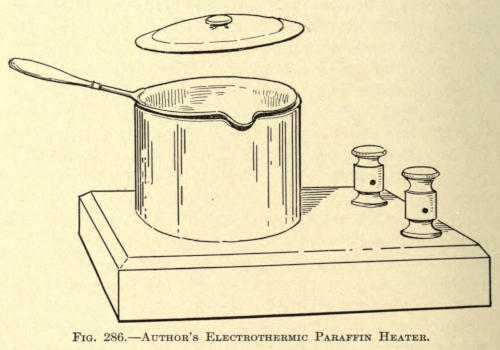
Fig. 286.—Author’s Electrothermic Paraffin Heater.
This instrument overcomes the complications of the water bath and burning or browning of the paraffin mixture, so commonly found with ordinary methods, the temperature of the resistance coil within the heating chamber being controlled by a small rheostat at will.
Before using, the contents of each test tube thus prepared are reheated to sterilization and poured into the barrel of the syringe to two thirds of its length, the piston introduced and screwed down into position; the syringe being placed to one side until its contents have been cooled, or the entire instrument is immersed in sterilized water at about 70° F. until the paraffin mixture has set or becomes uniform in consistency, which takes about five minutes.
Upon screwing down the piston the mass will be found to issue from the needle as a white, cylindrical thread, and is ready for use in this form.
Harmon Smith has had such a paraffin prepared which has a melting point of 110° F. This can be purchased in the market in sterile sealed tubes ready for use. The contents of these tubes should, however, be resterilized at the time of employment.
The same author prepares this paraffin of 110° F. melting point by mixing sufficient petroleum jelly (evidently white vaselin) with the commercial paraffin melting at about 120° F. to bring the melting point down to 110° F. He claims that making such a mixture is a difficult matter, since a plate of paraffin will have various melting points, one corner melting at 120° and the opposite as high as 140° F. He advises having the mixture accurately prepared in large quantities and dispensing it in test tubes of one-half ounce capacity, as now found on the market. The mixture is poured in hot liquid form into these test tubes, which are then sealed with wax and placed on a sand bath, whose temperature is raised to 300° F. to insure sterilization.
The latter author has devised a neat paraffin heater, shown in Fig. 287.
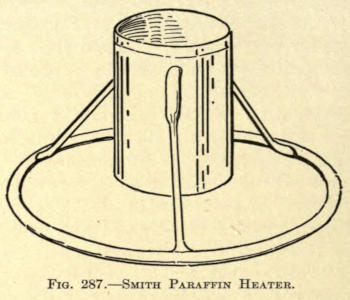
Fig. 287.—Smith Paraffin Heater.
Of this he says: “To insure still further the sterilization of the paraffin, I have devised a tin (nickle-plated) receptacle supported on an attached tripod, which raises the bottom an inch from any plane surface on which it is placed, and is closed with a detachable lid. This arrangement prevents the paraffin from burning or browning. Into this I pour the paraffin from the test tube, after melting, and place this receptacle into a sterilizer, or any ordinary boiler—surround it almost entirely with water and then boil. After I have boiled it for a few minutes I remove the receptacle and permit it to cool until the paraffin therein is about 120° F. I then draw it up into the syringe, which has been sterilized in the same boiler with the paraffin. When sufficient is withdrawn, I evacuate the air bubbles from the syringe by pressing the piston upward and run my set screw into place. Some two or three minutes are now allowed for the paraffin to assume equal consistency throughout and to cool down to a semisolid state. When the paraffin reaches this consistency it may be kept many hours ready for use, at the temperature of the room, if only the precaution to warm the needle is taken each time before attempting the injection.”
17. Hypersensitiveness of the Skin.—A permanent hypersensitiveness of the skin over the site of a subcutaneous paraffin injection has never been definitely shown. While it is true there is some pain and feeling of stress and fullness over and about such area, immediately after the operation, this has subsided in about twenty-four hours in the average case, except in those where a very hot liquid paraffin and of large amount has been injected, when several days are required to overcome these symptoms.
Smith claims a numbness over the site of the injected area which soon passes away, but this is perhaps more a feeling of fullness rather than one of anesthesia.
The author has observed, however, in several cases a period of extreme discomfort, fullness and cephalalgia in cases of subcutaneous injections about the root of the nose. Peculiarly these attacks appear only after the filling has become organized; that is, after the connective tissue has displaced the paraffin. The secondary tumor in such cases appears to be slightly larger superiorly than the original size at the time of injection.
The irregularity of these attacks, with edema of the forehead and slight puffing of the upper eyelids, points to a disturbance of the circulation and is undoubtedly due to pressure on the angular vessels, and the venous arch across the root of the nose. The symptoms usually appear in the early morning and moderate toward night, reappearing again the next morning or not again until the next attack, which may be expected at any time.
This condition of affairs is an unfortunate one, since we cannot look to the avoidance of the trouble nor foresee it at the time of operation. In one case the symptoms did not develop until nearly two years after the injection was made and became so troublesome that the only relief had was by opening the skin of the nose laterally and excising as much as seemed necessary of the newly formed connective tissue with a fine pair of curved scissors. None of the injected matter was discovered except two fine scalelike disks of glistening paraffin of a diameter of one sixteenth inch. These were evidently all that remained of the injected mass, and were undoubtedly held in the innermost meshes of the new tissue. Immediate relief followed the operation, but no appreciable difference in the size of the tumor could be noticed.
Cold applications or ice cloths relieve the temporary pain following an injection of paraffin, but in most cases this is rarely necessary except in extremely nervous and expectant patients.
On the whole the author believes the secondary neuroses and circulatory difficulties are now practically overcome by the more conservative use of the matter to be injected, coupled with a repetition of the injection of smaller amounts at each sitting and not repeating the same until the first has become organized.
18. Redness of the Skin.—Redness of the skin following an injection of the nature under consideration was one of the early objections made by various operators.
That redness, more or less permanent, has been found in many cases in which these injections were made is true, but such redness was found particularly when the injections were those of liquid paraffin of high melting points and in which the operator was overzealous in bringing about an absolute correction of a deformity, with the result that when the paraffin had been molded and set, it was generally pinched or shaped up or outward, thus causing a great deal of pressure upon the circulatory vessels of the skin.
The redness in such cases did not appear until several days after the operation, becoming worse gradually instead of better even in spite of the efforts to reduce it by external applications. Not unusually, in the permanent cases, distended capillaries can be seen in the skin resembling the condition in acne rosacea chronica, especially when the injection had been made to correct a saddle nose.
Smith says: “Redness is present in a good many cases. I have seen a case in which the redness lasted over a year, but it gradually disappeared. There seems to be a tendency on the part of nature to take care of a foreign body, and I think the reënforcement of connective tissue that grows into this mass requires an increased blood supply, and later, when the blood supply is no longer necessary, the redness will disappear.”
The latter is true where the hyperemia is either acute or subacute, but in chronic cases where the capillaries have become distended and show plainly there is little to be hoped through the effort of nature.
Eckstein, the advocate of “Hart-paraffin” method of high melting point, states that a redness of the parts develops a few days after the injection that disappears after a time, but that this redness is more marked and of longer duration when the injections are made intracutaneous instead of subcutaneous.
These injections should be made subcutaneous in all cases, and there is no excuse for deviating from this method.
With the use of semisolid and cold paraffin mixtures, as heretofore advocated, redness rarely if ever follows the injection unless undue pressure has been made, in which case necrosis is more liable to follow unless the adjacent tissue will gradually allow the mass to become relieved by a change in form and position.
Such subsequent hyperemias are not now as common as when the injections were at first attempted, and the author may say freely that they never occur when the proper method and material is used.
Paget says: “In a few cases—but only in a few—some reddening of the skin has followed the injection, and in a few this has been very slow to fade.
“The few referred to are of a record of twenty-two nasal cases, but no data is given whether the operator used paraffin of high or low melting points. F. Connell found that redness in that case continued for a year, diminishing very little in that time. It appeared on the second time after the operation for a correction of a saddle nose, and remained stationary for about one month. Twenty drops of paraffin were injected. It very gradually increased, so gradually, in fact, that there is still a distinct reddened area over the bridge of the nose. On pressure this redness will disappear, but returns immediately after the removal of the pressure. A few dilated and tortuous capillaries course their way over the area. The condition is still present fourteen months after the injection.
“There has been practically no change or decrease in the redness during the last six or seven months, it is not as marked as it was during the first few months, but still requires the profuse application of face powder in order to prevent her nose from being conspicuously red.”
The above case has been cited because it is typical of such condition, and while the amount as stated was quite small, one is almost nonplussed for an explanation of the result, yet it undoubtedly must have been due to a close attachment of the skin to the underlying structures, necessitating pressure, which is known to cause it.
However, it is possible to have such redness develop weeks or months after the injections are made. In such cases it is not due to the primary pressure of the injection, but to that of the newly developed tissue which has taken its place, but which is slightly overdeveloped for the same unaccountable reason already referred to.
Almost every surgeon who has used this method of restoring the contour of parts of the face has observed redness, more or less permanent, follow the method used, but in most cases liquid paraffin of high melting points had been forced into the tissues at great pressure.
In one case, that of a southern operator, the entire tip of the nose had become injected by primary diffusion or direct filling.
It became inflamed immediately after, and some weeks later, when the swelling had subsided, the lobule was found to be very hard, tense, and extremely red. Two years after the author saw this case, and the tip of the nose still appeared like a red cherry with numerous capillaries showing over its area, while the rest of the nose, although much broadened by secondary displacement of the paraffin, was natural in color.
This proves that as the pressure was relieved by absorption and displacement, the tissue took on a normal appearance, whereas in the lobule of the nose, where there was no relief from the pressure, nature could do nothing to relieve the inevitable result.
In cases where the redness is suspected it may not be too late, a day or two after the injection, to remold the mass into such form as to relieve the acute tension.
If the redness develops early, cold applications of an antiseptic nature or ice cloths can be used to advantage. Antiphlogistin or other similar preparations applied externally give good results.
Later ichthyol, twenty-five-per-cent solution, may be applied; acetate of alumen in saturated solution seems to do well. Some operators apply hydrogen peroxid, but it gives only temporary benefit. When the capillaries have become distended and the redness is practically chronic the vessels should be destroyed with a fine electric needle, using about 20 milliampères—direct current.
Sometimes when the redness is acute and seems to persist depletion of the part does some good. This is done by nicking the skin here and there with a fine bistoury and allowing the part to bleed freely. Care should be taken not to puncture the skin too deeply, so as not to allow the injected mass to escape.
In some cases it is allowable to open the filled cavity early and remove enough of the filling to overcome the difficulty, injecting later, after the filling has become organized, to make up the deficiency.
When the redness is secondary—that is, when it develops after the connective tissue has replaced the paraffin—it is best to open up the part and excise enough of the tissue to overcome the pressure.
In a case where the author injected for a deep furrow in the forehead with a cold semisolid paraffin mixture, a secondary redness developed three months after the injection had been made, no redness having been noticed in the meantime. There was more or less swelling for two or three weeks, undoubtedly due to pressure phlebitis, which eventually subsided.
The redness in this case was only reduced by an excision of the tissue causing the trouble. The result was satisfactory.
19. Secondary Diffusion of the Injected Mass.—This is a condition that no operator can foretell, although it might be caused by a primary diffusion due to hyperinjection of so small an extent that it escaped the surgeon’s attention at the time.
Again, a site injected may at the time of operation present all the indications of a satisfactory result—that is, the tissues at the place of operation and its immediate vicinity appear perfectly loose and elastic; the injection being made easily and the contour of the defect being remedied either partially or entirely as the operator may desire; there being no mechanical anemia post-operatio, and no decided effort on the part of the tissues to cause primary elimination after the withdrawal of the needle; yet it is possible that, by such an injection, sufficient pressure may be caused upon some of the blood vessels within the limitations of the injection as to cause a decided reaction a few hours after the operation, as evidenced by a swelling, too great for the disturbance occasioned, and associated with all the signs of a fairly active inflammation.
It is possible that such a reaction may cause a displacement or diffusion, post-primary, of the mass injected, especially if the mass be merely vaselin or a mixture of vaselin and paraffin at a melting point too low for the purpose. Nevertheless, it is practically impossible to foresee such result and the operator can only use the same care as with any or all such injections.
It is possible, when the reaction is too marked, to mitigate, to a great extent, this diffusion of the injected mass, by using such methods as reduce the inflammatory symptoms.
As a rule, these cases exhibit considerable ecchymosis after this active reaction has subsided, lasting from one to two weeks.
Secondary diffusion, as the author uses the term, signifies an extension of the injected mass beyond the intended area. This may occur in two or three weeks or be proportionate to the activity of the production of fibrous connective tissue that is supplanting the mass.
Leonard Hill has reported a case in which he injected vaselin to correct a saddle nose for æsthetic or cosmetic reasons. The result was very satisfactory to both operator and patient, and continued so for nearly twelve months, when secondary diffusion of the mass began to be noticeable. Eventually the diffusion became so great in the upper eyelids as to close both eyes completely.
The worst case of such secondary diffusion the author has ever heard of or seen came to his attention early this year. The patient had been subjected to a subcutaneous injection of oils for the cosmetic correction of an abnormal deepening of the inner clavicular notch. The injected mixture, as far as the author could learn, was made up of sweet almond, peanut, and olive oils with two others that had been forgotten. Her physician had made two injections several days apart with a satisfactory result. The reaction was trifling and the parts returned to the normal in two weeks.
Five months later the part injected became tender to the touch and began to enlarge daily. With the increase in size a gradual inflammation involved the whole lower region of the anterior region about the root of the neck. Various applications were made to the part to reduce the inflammation, but at the end of ten days a region of skin that had indicated the pointing of an abscess burst, allowing the escape of about eight ounces of pus. Under the most careful surgical attention this discharge continued for about three months, until under the influence of gauze packing the wound was made to heal from the bottom, leaving an ugly irregular scar at the site of the opening. With the healing of this fistular wound, however, the size of the tumor did not diminish whatever, but continued to grow until, at the present time, one and one half years after the injections had been made, the size of this peculiar hyperplastic growth of ovate form measures nearly five inches across its horizontal diameter and three and one half inches through the vertical. It is closely adherent to the overlying thickened skin, which has undergone a yellow pigmentary change to be considered in the next text subdivision. The tumor is hard, painless, and freely movable beyond the limitation of its skin attachment and rests upon the sternal thirds of the clavicles, extending upward and forward with evidences of traction on the whole anterior skin of the neck. Laryngoscopy discloses nothing abnormal. The deformity is hideous, and necessitates a mode of dress to conceal it. The patient has not as yet been operated on for the extirpation of the growth, owing to her present physical condition, the result of melancholia.
Scanes-Spicer injected some vaselin to correct a saddle nose with satisfactory immediate result, but after several days the upper lids became slightly edematous, and soon after a small hard lump, the size of a grain of shot, was felt in the left upper lid.
Harmon Smith observed a secondary diffusion in two cases in which the abnormality in one occurred on the side of the nose and in the other at the inner canthus following the course of the angular vein.
While in the foregoing cases the difficulty may have been overcome by using the cold, semisolid paraffin mixture and reducing the amount injected, it is questionable if the diffusion could thus have been entirely overcome.
The author points to the fact that undoubtedly this fault is observed more when the tissues at the side of the nose, or about the alæ, are injected, and that the cause here is one of an unequal pressure of the parts—the skin more or less bound down above and the ungiving cartilage below.
In such cases great care should be exercised in the amount injected, and if, after introducing the needle, the tissue be found to be unduly adherent and inelastic, to withdraw the needle and with a fine tenotome divide or dissect up the skin before the mass is injected. At no time would an operator be justified to inject more than ten drops of the mass, at a single operation, into the parts referred to.
As already mentioned, there is not only danger of diffusion of the mass in such region of the nose, including the lobule and the subseptum, but there is a special danger of gangrene from pressure where the tissues are less supportative than where muscular tissue or greater mobility of the skin is found.
After the immediate attempts to reduce a reactive inflammation, nothing can be done to overcome secondary diffusion except excision of the amount not wanted. This should not be undertaken until at least three months after the time of injection.
The mass of connective tissue must be entirely excised as thoroughly as possible, and slightly beyond the border of the abnormal elevation. A sharp curette is practically of no use for this purpose, and only wounds the skin, and by reason of retentive shreds of tissue may cause infective inflammation.
The opening into the skin should be made with a fine bistoury, the skin be dissected off from the elevated connective tissue, and the latter extirpated by dipping cuts of a fine small, sharp-pointed, half-rounded scissors. The operation can be done neatly and painlessly under eucain anesthesia.
The wound may be sutured with fine silk or be allowed to unite of its own accord.
It is advisable to supply a small pressure dressing, made of a circular gauze pad, over the site to assure of the best union between the dissected or undersurface of the skin and the floor of the wound.
Dry dressings are to be preferred, since moisture would tend to soften the skin and permit it to crawl, which would not improve the ultimate result.
20. Hyperplasia of the Connective Tissue following the Organization of the Injected Matter.—The overproduction of connective tissue replacing the injected mass is rarely observed, yet a few cases have been noted.
Sebileau has reported a true case of diffuse fibromatosis following an injection of paraffin. This not only included the site of the injection, but extended to the surrounding or adjacent tissue, making the secondary defect much more disfiguring than the first.
The author has observed in one case of hyperplasia following the correction of a saddle nose, that the area injected presented no unusual appearance for six months, when the nose at its middle third began to enlarge slowly until it resembled a marked Roman shape, the enlargement extending laterally and as far down as the nasogenian furrows at the end of nine months.
The injection used was a cold, semisolid paraffin mixture, and only sufficient to barely correct the defect was injected, the skin being thoroughly flexible at the time of operation.
No reason can, therefore, be given for this unusual result, except, perhaps, a peculiar idiosyncrasy of the tissues, that may be compared, somewhat, with the external tissue changes in hypertrophic or keloidal scars, especially noted in the wounds of negroes—a condition for which we have, as yet, found no attributable cause.
While we cannot definitely prevent such a result, following an injection of a hydrocarbon, we may at least be sure that hyperinjection is not the cause.
The hyperplasia as exhibited in these cases is one of true fibromatosis. The microscopical examination may show the retention of paraffin in small, round, pearllike masses lying in cells of varying size, but with specimens of such tissue removed after a number of years’ standing does not show the paraffin in situ.
In a specimen taken from a chin five years after the injection of paraffin the Lederle Laboratory makes the following report accompanied by microphotographs of sections taken from the fibromatous area as shown in Figs. 288a and 288b:
“Anatomic Diagnosis.—The specimen consists of several pale, tough masses of tissue removed from the chin covered on the outside by normal skin.
“Histologic Diagnosis.—The various layers of the epidermis—i. e., the strata corneum, lucidum, and granulosum—are unthickened and practically normal. In the corium the papillary and reticular layers are apparently normal, showing no thickening nor round-cell infiltration.
“The glandular elements in this area and the hair follicles appear normal.
“Toward the deeper layers and the subcutaneous connective tissues appear isolated areas of round-cell infiltration separated by masses of fibrous connective tissue, much of which is of new formation, as indicated by the nucleated character of the elongated cells. There are areas of diffuse round-cell infiltration.
“In this portion of the corium there is also to be found a large number of vacuolated areas varying very greatly in size, and which are surrounded by membranous fibrous-tissue elements, much of which is likewise of new formation, as indicated by the character of its cells.
“These vacuoles doubtless represent the areas containing the masses of paraffin which have been split up by the new formation of fibrous tissue. Between the vacuolated areas can be seen actual infiltration by true fat cells.
“In many spots the fibrous-tissue formation has proceeded to the point of thick bands containing but few nucleated cells. Fig. 288a, which is a photomicrograph of this portion of the section, shows these changes.
“In one of the foci of round-cell infiltration which have been surrounded and invaded by bands of new fibrous tissue there are numerous giant cells of the so-called ‘foreign-body’ type. This is shown in Fig. 288b.
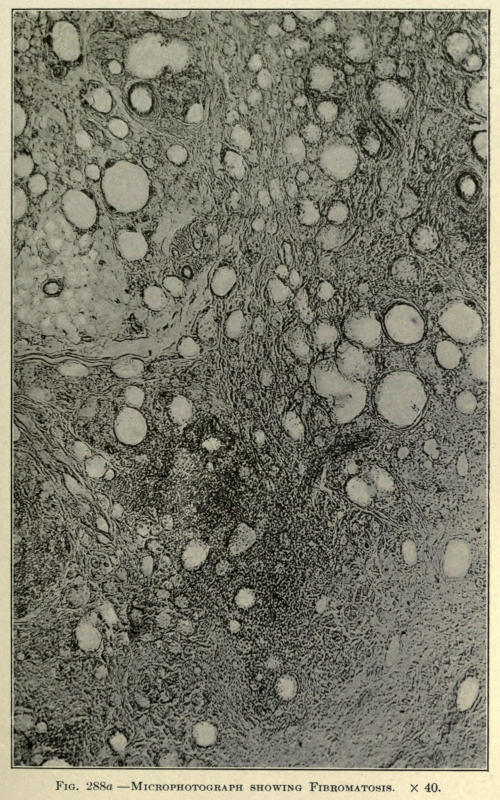
Fig. 288a.—Microphotograph showing Fibromatosis. × 40.
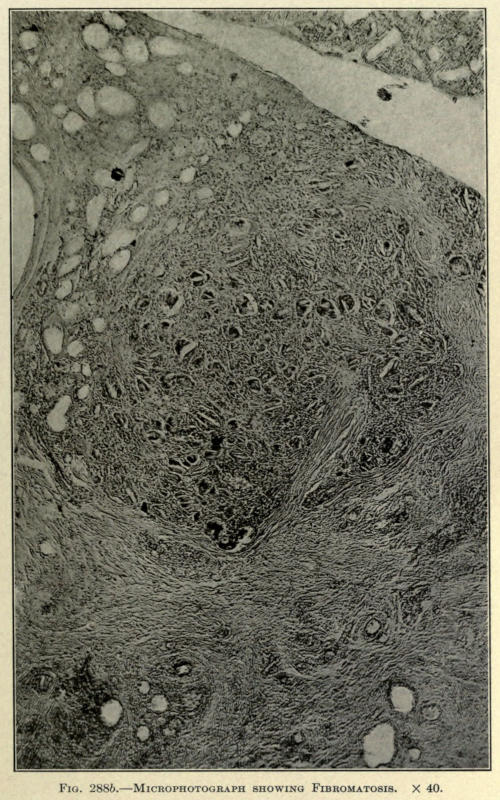
Fig. 288b.—Microphotograph showing Fibromatosis. × 40.
“Summary.—Histological Diagnosis.—Diffuse fibromatories with fatty infiltration and giant-cell formation in a vacuolated area produced by paraffin injection.”
Once the hyperplasia is established the surgeon must simply wait until he believes the activity of the abnormal growth has subsided and then remove the superabundant tissue with the knife.
With another case, in which the patient was operated on by another surgeon, the author was called upon to remove the growth. A part of the coarse, yellowish pale and cartilagelike tissue was excised, sufficient to restore the parts to a normal contour. After an uneventful recovery the patient went away, greatly pleased, only to return in six months, presenting a similar condition as before the extirpation.
A second operation was done, this time more extensively, the entire yellowish connective tissue being removed by the aid of a long median incision on the anterior aspect of the nose.
The wound healed readily and showed very little scar, and the patient was discharged. One year after the last operation the nose was still normal in appearance and the growth had not reappeared.
From this it is deemed absolutely necessary to remove practically all of the newly formed tissue to warrant a nonrecurrence of the fibromatosis.
21. A Yellow Appearance and Thickening of the Skin after Organization of the Injected Mass Has Taken Place.—This condition of the skin is evidenced some time after the injected mass has become organized, beginning about the sixth month after the time of injection. It has been especially noticed with the hard paraffin fillings of the nose, but also with other injections, even of the lowest melting points, about the sternoclavicular regions of the neck.
The skin becomes at first streaked with a superficial and irregularly defined patch of red, the forerunning indication of the size of the ultimate pathological change. The red color subsides slowly, leaving the area pale, which thereafter gradually thickens, taking on the appearance of a light yellow stain in the skin.
Practically opposite to the condition in xanthalasma, where the yellow area is slightly elevated and occurs in the loose tissue of the eyelids.
The cause seems to be a degenerative change in the skin dependent on pressure upon its underlying tissues. Evidently the pressure of an overproduction of the connective tissue which has sprung up to replace the injected mass.
Seemingly the cause is due to an injection being made too close to the derma where the latter is bound down to the subcutaneous tissue, or a desire on the part of the surgeon to prevent an injection into the deeper areolar tissue, especially when the injection is made in the vicinity of the larger blood vessels, for fear of causing embolisms or phlebitis.
Excluding the use of hard paraffin for such injection, the operator should be sufficiently experienced to use these injections properly and without fear, and at all times avoid injecting into the skin instead of subcutaneously.
Making the puncture first and observing if blood flows freely or trickles from the detached needle will assure the operator into what tissues he has thrust his needle.
Should active bleeding follow the puncture, he should withdraw the needle and wait to inject the site at a later sitting, using the same precaution; at no time should he be in doubt as to the absolute placing of the injected mass.
When the injections are done about the lower neck or shoulders great care must be exercised to avoid the blood vessels, and small quantities be only injected to prevent reactions that may cause phlebitis of these vessels; furthermore, the injected mass must be carefully molded to prevent the formation of uneven elevations or lumps. Without doubt an injection into one of the blood vessels of the neck would mean certain death.
Kofman lost a patient by pulmonary embolism twenty-four hours after an injection of 10 c.c. of paraffin. How many punctures he made to inject this amount is not stated, but certain it must be that he introduced part of the mass directly into some blood vessel.
The author advises, when injecting about the neck, to use a stout, dull-pointed needle introduced under local ethyl chloride anesthesia and to elevate the tissue with the needle as the injection is made. In this way the operator can observe the behavior or placing of the injected mass, at the same time stretching the skin to permit of the injection without encroaching upon the blood vessels. The mass is immediately molded after each injection. The further question of the practical method of making these injections will be fully considered later.
If, however, the pigmentation under consideration has taken place, electrolysis with a fine needle may be resorted to, with the object of whitening the discoloration by producing scar tissue, in the form of punctations, in the discolored area.
While the numerous white spots so caused are objectionable, they are better borne by patients than the pigmented appearance. A thorough needling of the spot in this way eventually brings about an improvement, and if, for æsthetic reasons, the patient objects to the unsightliness of the result thus obtained, the white area may be carefully tattooed with an appropriate color to match the rest of the skin of the face or neck.
If the pigmented area is not too large, it can be excised with the knife and the healthy skin be brought together with a fine silk suture, thus leaving a thin linear scar which can be dealt with as the punctate scar area, if desired; the electrolysis being a painful procedure at all times, since sufficient milliampères must be used to cause scar-tissue formation, which is between 20 to 30 milliampères in such cases.
22. The Breaking Down of Tissue and Resultant Abscess Due to the Pressure of the Injected Mass upon the Adjacent Tissue after the Injection Has Become Organized.—The above result is particularly noticeable when the injections have been made into the cheek or the breast. It is understood that the suppurative changes under consideration herein are not attributable to imperfect sterilization of the injected matter, although it is possible, and perhaps is the cause in fifty per cent of the suppurative elimination of the infected mass from the cheek, that a nucleus of infection is carried into the tissues and is held in suspense for a time, because of its imbedment in a neutral media that does not readily permit of bacteriological propagation, but eventually this nucleus must come in contact with tissue which it can affect, and only then may its infection be taken up.
The author believes that such secondary affections are accountable to pressure effects upon the blood vessels or glandular structure, as in the case of breast injections, the new connective tissue causing a lack of nourishment in the part or gland, and a resultant breaking down of the tissue, directly influenced in some instances by external violence.
Tuffier reports the elimination of paraffin injected into the breast several weeks after the injection. If this elimination had been caused by primary infection an acute reaction would have taken place at least within forty-eight hours, ending in abscess shortly after.