Chapter XIV · SUBCUTANEOUS HYDROCARBON PROTHESES (continued 2)
Reading edition
A case which came to the author’s attention was that of a lady who had been operated upon for the correction of a saddle nose three months before. The result had been satisfactory. The day previous to consulting the author she had injured her nose in an automobile accident. The nose was much swollen, very painful, and red over the entire upper and middle third. The use of external cold did not relieve the condition much, and on the fourth day the skin broke open at one point, allowing pieces of the paraffin to escape. Immediate relief followed, the wound healed with a marked sinking of the middle third of the nose. After three weeks the nose was again injected with no further untoward symptoms, the result being satisfactory for two years past.
In this case undoubtedly the exciting cause was directly due to violence, which may be the forerunner in many of such cases, but there is a number of such eliminations directly due to a breaking down of the tissue from internal pressure alone.
There is no way to overcome this difficulty, except to await the definite formation of the abscess and then to puncture the skin directly over the soft fluctuating area and to drain the cavity.
Once relieved, the condition quickly subsides, leaving a certain amount of loss of contour, which can, however, be corrected several weeks after by a secondary injection.
When the abscess occurs in the cheek it is not advisable to open interiorly, but to make the puncture through the skin, on account of the danger of infection from the buccal cavity and of the imperfect evacuation thus attained.
A trocar and cannula of proper size will be found to be the most suitable, the parts being gently manipulated to evacuate the contents of the abscess.
Aspiration can also be resorted to, but for the breast a small linear incision, made under local anesthesia at the most dependent point, best answers the purpose.
A small gauze strip drain may be employed for a few days to insure of perfect drainage in the latter case, the wound being brought together eventually by a delicate cosmetic operation if desirable.
THE PROPER INSTRUMENTS FOR THE SUBCUTANEOUS INJECTION OF HYDROCARBON PROTHESES
Although Gersuny advocated the use of a Pravaz syringe for injecting the liquefied vaselin mixture for prothetic purposes, it was soon found that such an instrument was practically useless, especially when the parts to be injected offered more or less resistance to the introduction of the foreign matter.
Other operators, following the advice of Eckstein, who advised the employment of “Hart paraffin” of high melting point liquefied by heat, raised the objection that the metal needle became so easily obstructed by the rapid setting of the paraffin in its distal end that the great force necessary to eject the contents of the syringe usually resulted in a breakage of the glass barrel in the hands of the operator, or, as in some types of the syringe, a separation of needle and syringe at the point where the former was slipped upon the ground point of the latter, with the annoyance of the paraffin squirting over the faces of both patient and operator.
Eckstein tells us how to overcome the first difficulty with this same style of syringe as used by him. He covers the syringe with a rubber insulating sleeve and draws several drops of hot, sterilized water into the needle to overcome the plugging up of the latter; an illustration of his syringe has been shown on page 232. Mention has also been made of the various methods used to overcome this difficulty by other operators.
It was presently found that such an instrument was not only impractical, but also a detriment to procuring desirable results, the paraffin solution shooting out suddenly, in some instances causing hyperinjection, and at other times emerging so slowly that it required unusual force on the part of the operator—a painful procedure for delicate hands, inasmuch as the fingers only can be applied to operate the instrument.
With the object of overcoming this uncertainty of the amount of the injection and the unnecessary exertion to inject any given quantity, as well as to establish enough vice à tergo to keep the needle free from plugging up with cooling paraffin, various operators devised instruments, all having practically similar points of mechanical merit and usefulness. The required necessities being to invent a syringe which would have a known capacity, a piston under control of the operator at all times, and metallic needles of proper lumen, to prevent the solidification of the liquid paraffin, screwed to the syringe to prevent loosening.
With the object of overcoming these difficulties the author devised a syringe which was made for him by Tiemann & Co., early in 1902. He begs to introduce the same here, as a type similar to which most operators have built their special instrument.
The syringe at that time consisted of a glass barrel, of a size to hold 6 c.c. of liquefied paraffin. At either end of the barrel tube were placed metal ends, the distal one containing a cap with a screw thread to receive the needle, the upper cap being threaded to receive a check nut through its center and on its outer surface, on opposite sides to each other, two metallic rings to accommodate the thumb and forefinger. The center of the check nut was double threaded to receive the piston rod, the piston or plunger being held in place by two, upper and lower, washer nuts, the lower being threaded to receive a small rod passing through the bored-out center of the piston rod, and which ended in a check nut, in the handle, threaded upon the outer or manual end of the piston rod, in such a way that the fiber or asbestos piston washer could be tightened and loosened at will.
The syringe permitted of being used as an ordinary syringe by unscrewing the cap check nut or be made into a screw drop syringe by screwing the same nut into place. By turning the handle end of the piston rod the contents of the syringe were forced out smoothly and evenly in any quantity desired.
With the later employment of the cold, semisolid preparation of vaselin and paraffin, as heretofore considered, it was found necessary to reënforce this syringe, so that the greater pressure necessary to eliminate the wormlike thread of hydrocarbon would not force off the lower cap or break the barrel of the syringe at its needle end.
This was done for the author by the Kny-Scheerer Company, December 6, 1902, when metallic strips were added to opposite sides of the glass barrel connecting the lower with the upper cap.
The instrument as then made is shown in Fig. 289.
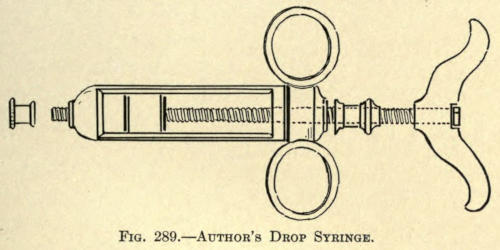
Fig. 289.—Author’s Drop Syringe.
At the same time the same firm made the author a syringe entirely of metal, similar in construction, except that the barrel was made larger in diameter and shorter in proportion to bring the instrument near to the seat of operation. The regulating washer rod was not needed, since in this instrument no washers were required, the piston head being made of solid metal throughout and the rod being soldered to the plunger, thus overcoming any objectionable fault in sterilization.
This type of syringe was found to be most suitable for the cold, semisolid injections, and is of the type now universally used except for the slight modifications of the various operators. It is illustrated in Fig. 290.
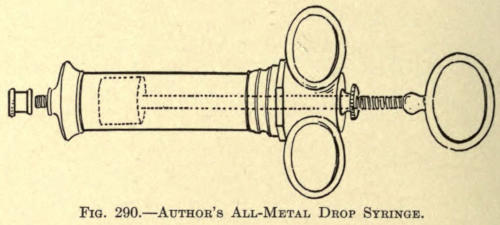
Fig. 290.—Author’s All-Metal Drop Syringe.
Since there were no objections to making the barrel large enough to permit of injections, such as are required for restoring the contour of the cheek and the neck and shoulder, it was made to contain 10 c.c. working capacity, overcoming the necessity of constant refilling, when comparatively large injections had to be made—a fact worth remembering from a practical standpoint, although two or three of these syringes, specially prepared for each patient, might be found desirable by some operators. Yet the simplicity and ready facility with which this instrument can be used and refilled renders it useful and sufficient for performing operations of this nature to any judicious extent.
Syringes holding small quantities of the paraffin mixture are found to be a nuisance.
The following operators employ syringes of the capacity given:
Brœckært 3 c.c. 50 mm.
Eckstein 5 c.c. 80 mm.
Freeman 5.6 c.c. 90 mm.
Downie 10 c.c. 150 mm.
The instrument employed by Brœckært, holding less than one dram, would be of little use except to correct very slight deformities about the brow or nose, or dressing up or completing the contour of parts previously filled by larger injections.
Another syringe similar in type to the author’s, but of a capacity of 5.6 c.c., was introduced by Harmon Smith.
The principles of the syringe are alike, but the style of handles, two flat metal bars at opposite sides, offers no objection when comparatively hard mixtures of paraffin and vaselin are used.
While operating the syringe the narrow blades are brought in contact with the soft flexor sides of the thumb and forefinger, indenting the flesh deeply, and with the least unexpected move on the part of the patient permitting it to slip out of the grasp of the surgeon. Its incapacity for large injections also offers some objection, but for correcting smaller defects it is both practical and compact. It is illustrated in Fig. 291.
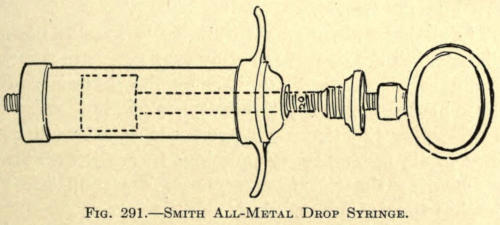
Fig. 291.—Smith All-Metal Drop Syringe.
It is obvious that with the screw drop type of syringe the cold semisolid paraffin mixture contained in its barrel is always under the full command of the operator, nor can there be a plugging of the needle, since the great force that can be exerted with a turn of the piston handle would free it, even if the mixture were of a comparatively high melting point, although the force to be applied would naturally increase in proportion to the hardness of the mass within the syringe.
The turning of the screw piston forces out the contents of the syringe in the form of a white thread of a diameter equal to the diameter of the lumen of the needle.
To facilitate this ejection, the needles should be of ample diameter, not over one inch long and having knife-edged points. Longer needles are not necessary, and only add to the force required to turn the screw handle.
Curved needles, used by some operators, are never needed, and the author does not see how they could be applied at any time in preference to the straight.
As much of the paraffin mixture can be forced out of the syringe as may be desired by screwing the piston down into the barrel.
The piston rod may be graduated in five- or ten-drop divisions, but the operator rarely ever refers to the scale. He judges the amount required by the elevation of the tissues brought about by the presence of the paraffin thus forced under the tissue. Experience soon teaches him the amounts necessary or judicious in each case, always remembering that it is better to do a second and later injection than to hyperinject.
The entire instrument being of metal permits it to be sterilized as readily and in the same manner as any other metallic instrument.
It is understood that the syringe must be taken apart for sterilization at all times.
Lubrication, to facilitate operation, is never required, since the nature of the mixture used in the syringe answers this purpose in every way.
Owing to the greater amount of metal in the solid piston itself, the latter is very likely to expand under dry heat sterilization or boiling, so much so that for a moment it cannot be introduced within the barrel. This can be quickly overcome by dipping it into cold sterile water or absolute alcohol, which brings about its contraction.
After using, the syringe should be emptied entirely, unscrewed and sterilized, and placed in the metal case furnished for it. A screw cap is furnished to take the place of the needle when not in use.
The method of filling and using the syringe will be considered later.
PREPARATION OF THE SITE OF OPERATION
The same surgical precautions should be observed when a paraffin injection is to be undertaken, as with a minor surgical operation.
It is hardly found necessary to prepare the site of operation the day before, nor need the patient be detained for such time for the purpose of making him ready.
With careful observance of ordinary surgical technique, both as to surgeon and patient, all of this class of operations can be performed in any physician’s office, providing that both instruments and the mass to be injected have been rendered sterile.
Especial care should be given to the operator’s hands, for with these he not only handles the instruments, but must also mold the mass injected, thus frequently coming in contact with the needle opening or openings made in the skin.
When injections are to be made in the cheeks of the patient, the mouth should be prepared by cleansing the teeth thoroughly and washing out the buccal cavity with warm boric acid or hydrogen peroxid solution, or any of the preparations of the Listerine composition.
This rinsing should be continued every few minutes for at least ten minutes before the operation is undertaken.
This is necessary, as the surgeon must introduce his finger into the mouth and behind the cheek to mold out the mass injected subcutaneously, and infection could easily be introduced by his fingers during this procedure.
Externally a generous field of the operation is scrubbed with a brush dipped into green soap and water.
The skin is then thoroughly washed with gauze sponges steeped in absolute alcohol, followed with spongings with a 1-5,000 solution of bichlorid of mercury. The whole surface is then wiped off with a sponge dipped in ether and covered for the time being with a pad of sterilized gauze until the operator is ready to proceed with the operation.
PREPARATION OF THE INSTRUMENTS FOR OPERATION
The manner of preparing the necessary mixture of paraffin has been described on page 244. After such preparation, the mixture, still hot, may be poured into test tubes, which are sealed and put away for further use, each tube holding just enough to fill the syringe two thirds full.
When a syringe is to be filled, one of the tubes is opened and the contents are again boiled over a spirit flame, or simply liquefied and poured into one of the types of heaters already described for the same purpose of resterilization.
From the test tubes or the heater, the boiling mixture may be drawn up into the sterilized syringe to the required amount or it may be poured into the opened piston screw cap end.
In the latter event the ready cooling of the mixture as it enters the needle will permit it to be retained in the barrel, or the needle may be immersed in sterile water as the paraffin is poured into the syringe, yet even if a few drops escape from the needle in the former method, no harm is done, as such loss amounts to nothing and helps to eventually fill the syringe evenly and free of air.
If the mixture is drawn up into the barrel to the required height, more or less air enters, which must be removed by turning the syringe, needle up, and screwing up the piston rod until either the liquid or cylindrical thread of the cooled mixture appears.
If the mixture is poured into the syringe the piston is slowly pressed into the barrel, thus allowing the air to escape along its sides if the mixture is set, or if warm the syringe is turned up and the piston screwed into place. As this is done the few drops of cooled paraffin will be forced from the needle before the air is exhausted. The screw is turned until the paraffin emerges evenly from the needle.
The syringe must now be laid aside, or placed in sterile water of the temperature of the room, to allow the liquid within to set evenly and become uniform in consistency.
The operator will follow what method he pleases in filling his syringe, but at no time should he fill it with the cooled product with a spatula, or other such means, as he is sure to fill it unevenly in this way, incorporating a number of air spaces. The air issues from time to time during an operation with sudden sputtering outbursts, that not only tend to annoy the patient, but also to frighten him—the shock being unusual and unexpected, while the air thus forced into the subcutaneous tissues puffs out the parts and interferes with a perception of the proper amount to be injected and adds to the danger of air embolisms.
Slipshod methods are inexcusable, and should not be tolerated. The best results possible should be given the patient, and only from the best results obtained with the best care can the most reliable data be attained, all helping to fix the reliability, efficacy, and exactitude of this branch of cosmetic surgery.
THE PRACTICAL TECHNIQUE
The field of operation and the instruments having been properly prepared, as described, the modus operandi must next be considered.
Since the various parts of the face to be injected demand specific procedure, they will be considered somewhat individually hereafter, whereas the general technique, applicable in as far as the method of injection is concerned and applying similarly in all cases, may tersely be first taken up.
Various and noted surgeons point out that these subcutaneous injections should be made under general anesthesia, i. e., ether, while others consider the hypodermic use of cocaine or Eucain β solution in one to four per cent necessary to accomplish good results.
The author considers the method in the first case objectionable both as to patient and operator, entailing much discomfort to the one operated on and demanding an unnecessary waste of time for the etherizing and recovery. Likewise is the employment of a local anesthetic not indicated or demanded, since the operation to be undertaken necessitates only the pain associated with the prick of the needle through the skin.
The objection to etherization is obvious, while the hypodermic employment of any local anesthetic, by the very fact of its presence of volume and its physiological action upon the tissue, tends to interfere with the proper injection of the parts by reason of temporary swelling of the parts, not caused by the later injections of the prothetic mass.
If in nervous irritable patients an anesthetic is required to allay fear it is best to use the ethyl-chlorid spray upon the skin sufficiently to overcome the sharp sting of the needle insertion. For this purpose the ether spray is used only to the point of blanching the skin, and no longer.
This mode of procedure is especially useful when a number of injections are to be made, as in the rounding out of a cheek or of the shoulders, in which the contour cannot be restored from one point of injection, as will hereinafter be described.
The patient, being now in readiness, the skin over the area is lifted or pinched up with the fingers of the left hand of the operator as a guide to its mobility and to steady the part.
The point of the needle is now forced through the skin and into the subcutaneous tissue at a point along the periphery of the deformity and pushed a little beyond the center of the cavity to be filled.
The elevation of the skin is in the meantime partly kept up with the needle itself, while the syringe is grasped with the freed hand, the thumb and forefinger of the right hand being placed upon the handle of the screw or piston rod, which they must rotate to force the semisolid mass from the instrument.
Before beginning the injection an assistant is instructed to press with his fingers the tissue about the margin of the defect to prevent the filling from becoming misplaced or being forced into undesirable channels, especially if the skin over the defect is found to be thick and inelastic.
The screw handle is now rotated evenly and slowly, discharging the mass to be injected, which will soon be evidenced by the rise of the skin over the depression to be corrected.
Only sufficient of the mass must be injected to fairly correct, never to overcorrect, the defect.
Experience alone will assure the surgeon when this point has been attained, since he cannot immediately judge the necessary amount injected, as it will appear as a round or irregular lump under the skin, until it has been molded or worked out into shape.
Owing to the pressure exerted upon the contents of the syringe, which will continue to emerge from the needle for a time, the needle is left in place for a few seconds before withdrawal, so that the needle canal through the skin will not become filled with the semisolid mixture.
Such blocking up of the opening causes a cystic development or enlargement about the opening in the skin by this backing up or exuding, ofttimes crowding itself in between the layers of the skin and necessitating later removal with the knife. If not this fault it tends to keep the wound open unnecessarily after the operation, preventing healing and permitting the escape of a certain amount of the injected mass, if a mixture of low melting point has been utilized.
The needle, having been allowed to remain as advised, is now withdrawn. The tip of one finger is placed over the opening in the skin and held there gently, but firmly, while the mass is molded into the shape required or desired with the fingers of the right hand.
If it now appears that the injection is insufficient the needle may again be introduced through the same opening and more is injected, remembering, however, that if the correction is quite normal no more should be added for several days, or until the injected mass has become organized, which should take place in about three weeks.
If it is found that the skin over the defect is inflexible and bound down, it will be found advisable to sever or dissect subcutaneously the adhesions that bind it down with the use of a fine tenotome or a spear-headed paracentesis knife.
This may be done two or three days before the parts are injected to assure the surgeon of an absolute cleanliness of the wound.
Mayo advocates the injection of a saline solution into subcutaneous wounds thus made as a guide to the extent of dissection and to further loosen the tissues.
When the parts, thus loosened, show little tendency to bleed, the author advocates immediate injection, as the waiting for several days permits the throwing out of new connective-tissue cells that interfere to a certain extent with the proper injection of the part.
It is with such wounds that secondary elimination is most likely to take place, especially if “Hart paraffin” or paraffin of a high melting point has been employed.
This is undoubtedly due to the healing down and contraction of the margins of the wound, which seems to progress more and more, encroaching eventually upon the hard mass and ending in inflammation of the overlying skin and ultimate elimination. With injections of softer consistency this is less frequent and, in fact, may be entirely overcome by limiting the amount of the injection at the first sitting, relying upon a full correction for later operations, when the periphery of the wound has become more or less influenced by the presence of the neutral mass between the wounded surfaces.
The subcutaneous dissection referred to must, of course, be done under local anesthesia, preferably the Schleich mixture or a one-per-cent solution of Eucain β.
The injection of the paraffin, or hydrocarbon mixture, in semisolid form, having been made and properly molded into shape, is set or fixed by spraying the part with ether or by the application of sterile ice cloths. When liquid paraffin has been injected it will be noted that the paraffin in setting contracts upon itself considerably, leaving less of a correction than anticipated.
The needle opening in the skin is next washed off with a twenty-five-per-cent solution of hydrogen peroxid and closed over with a drop of collodion.
The patient may then be discharged for the time being, with the instruction to apply ice cloths to the part for at least twelve hours to reduce, as far as possible, the reactive resultant inflammation.
On the third day the collodion patch may be removed and replaced with isinglass adhesive plaster applied with an antiseptic solution. The latter is allowed to remain on the skin until it falls off.
SPECIFIC CLASSIFICATION FOR THE EMPLOYMENT AND INDICATION OF HYDROCARBON PROTHESES ABOUT THE FACE
Reference has been made heretofore to the general indications for which subcutaneous injections of paraffin or its compounds may be employed. With the object of systematizing such indications and to further bring out the practicability and judicious use of the method under consideration the author submits the following tabulated arrangement, with the hope that it may lead to a more concise and better knowledge of the possibilities within the reach of the plastic or cosmetic surgeon.
The face will be considered in such grand divisions as are easily and readily understood, the defects of each part being shown under its distinctive regional heading.
Deformities About the Forehead
Transverse Depressions { Punctate.
{ Linear.
Deficient or Receding Forehead:
(Exhibition of Undue Superciliary Ridges.)
Unilateral Deficiency { Surgical (Frontal Sinus).
{ Traumatic.
Interciliary Furrow { Single.
{ Multiple.
Temporal Muscular Deficiency { Unilateral.
{ Bilateral.
Deformities of the Nose
Anterior Nasal Deficiency { Superior Third.
{ Middle ”
{ Inferior ”
{ Superior Half.
{ Inferior ”
{ Total.
Lateral Insufficiency { Unilateral.
{ Bilateral.
Lobular Insufficiency.
Interlobular Deficiency.
Alar Deficiency { Unilateral.
{ Bilateral.
Subseptal Deficiency { Partial.
{ Complete.
Deformities About the Mouth
Labial Deficiency { Upper Lip { Unilateral.
{ Median.
{ Bilateral.
{ Lower Lip { Unilateral.
{ Median.
{ Bilateral.
Nasolabial Furrow { Unilateral.
{ Bilateral.
Oral Angular Furrow { Unilateral.
{ Bilateral.
Deformities About the Cheeks
Deficiency of Cheek { Total { Unilateral.
{ Bilateral.
{ Partial { Unilateral.
{ Bilateral.
Deformities About the Orbit
Deficiency of Lid Contour { Upper Lid { Unilateral.
{ Bilateral.
{ Lower Lid { Unilateral.
{ Bilateral.
Furrow About Canthus { Unilateral.
{ Bilateral.
Deficiency of Ocular Stump { Unilateral.
{ Bilateral.
Deformities About the Chin
Anterior Mental Deficiency { Partial.
{ Total.
Lateral Mental or Angular Deficiency { Unilateral.
{ Bilateral.
Deformities About the Ear
Pro-auricular Deficiency { Unilateral.
{ Bilateral.
Post-auricular Deficiency { Unilateral.
{ Bilateral.
SPECIFIC CLASSIFICATION FOR THE EMPLOYMENT AND INDICATION OF HYDROCARBON PROTHESES ABOUT THE SHOULDERS, ETC.
Supraclavicular Deficiency { Unilateral.
{ Bilateral.
Infraclavicular Deficiency { Unilateral.
{ Bilateral.
Interclavicular (Notch) Deficiency.
Supra-acromion Deficiency { Unilateral.
{ Bilateral.
Infra-acromion { Unilateral.
{ Bilateral.
Supramammary Deficiency { Unilateral.
{ Bilateral.
Mammary Deficiency { Partial { Unilateral.
{ Bilateral.
{ Total { Unilateral.
{ Bilateral.
Supraspinous Deficiency { Unilateral.
{ Bilateral.
Infraspinous Deficiency { Unilateral.
{ Bilateral.
Interscapular Deficiency.
SPECIFIC TECHNIQUE FOR THE CORRECTION OF REGIONAL DEFORMITIES ABOUT THE FACE
Transverse Depressions
Punctate Form.—Such deficiencies are either of sharply defined depressions in a part of the frontal bone due to congenital malformation or of traumatic origin.
In the first instance they are usually unilateral or median and rarely ever bilateral. In those of the second class the deformity may be median, but is more often found to be unilateral.
Linear depressions of the forehead are usually found to be congenital, although traumatism in the form of direct violence may be the cause, as, for instance, the kick from a horse or a severe blow or fall.
The acquired linear form of lack of contour is found in people of middle life given to undue use or corrugation of the forehead, as in frowning.
The correction of this class of deformities may be accomplished by carefully raising the depressed area by repeated injections of small quantities, always avoiding the frontal and supra-orbital vessels.
At no time should such a deformity be corrected in one sitting, unless when the defect is a congenital one of small moment.
The reaction following these injections, owing to the close attachment of the integument to the bone, is usually found to be more severe than where the skin is more loosely attached.
In traumatic cases the scar attachments should be freely liberated, under eucain anesthesia, by the aid of a fine probe-pointed tenotome, before the cold paraffin mixture is introduced.
In such event only one opening should be made and just enough of the mixture be injected to raise the skin to its normal contour, if this be possible. Generally, later injections are required, and these may be made without further dissection. They should not be undertaken until the incised wound made with the tenotome has healed thoroughly, otherwise the pressure of the injection is liable to burst through the delicately healed wound, and thus delay if not endanger the success of the first operation.
When the reaction following such injections be severe, associated with considerable edema, cold pack or ice cloths should be applied or resort may be had to hot applications of antiphlogistin. The patient should be kept on his feet during the day and sleep with the head high at night. The bowels should be kept open, and general tonics be given if indicated. The patient usually returns to the normal, except for a little tenderness about the forehead, in three or four days under the treatment outlined.
Deficient or Receding Forehead
In this condition there is usually a transverse lack of contour across the forehead above the superciliary ridges, giving the patient a degenerate appearance. The defect is congenital and is to be corrected, as described in the foregoing division, although the injections may be at either outer or temporal end of the forehead, gradually being brought nearer to the median line until the contour of the whole forehead has been raised by subsequent injections.
Unilateral Deficiency
This defect may be traumatic—the result of direct violence, but is more commonly due to a frontal sinus operation.
In both events it will be found necessary to detach the cicatrices that bind the skin down to the injured bone, before a prothetic injection may be undertaken.
In some cases where the cause of the deformity has been moderate and the scar is linear and of long standing the injection may be undertaken without subcutaneous dissection.
Several injections are necessary, as the tissue about such parts is usually much thickened, apart from the firmness added by the scar tissue.
A short stout needle should be employed, the puncture being preferably made under ethyl-chlorid anesthesia, as the pressure necessary to raise the tissue causes considerable pain.
To further facilitate the injection the operator should raise the skin with the needle introduced subcutaneously.
Only one injection of small amount (10 to 15 drops) should be done at a sitting. The injected mass, unless too easily introduced, and thus forming a tumefaction, need not be molded out, since the pressure of the skin overlying it will accomplish it more satisfactorily, while the pressure required in molding tends only to press out more or less of the mass, thus lessening the benefit of the operation.
A second sitting must be undertaken in not less than one week, or even later, if a subcutaneous dissection has been done.
The secondary treatment should be followed as heretofore described. The reaction, for even a small injection in these cases, is usually considerable.
Interciliary Furrow
This deformity is usually spoken of as a frown. It may be said to be congenital, when it appears in early life, but is commonly acquired through the habit of frowning.
The furrow may be a simple linear one or made up of a number of furrows. The author has been called upon to correct one made up of six distinct furrows.
The furrows or creases radiate upward and outward, conelike from a point beginning at the root of the nose.
In the correction of this common deformity the operator is tempted to overdo the fault by hyperinjection. A single furrow is readily corrected by a few drops of the injection, which should be neatly smoothed out. A little of the mass at this part of the face seems to accomplish considerable; in fact, the part seems overcorrected for some time after a judicious and carefully done operation, which is undoubtedly due to the active reaction that follows such cosmetic procedure, owing to the close proximity of the frontal veins and those of the venous arch at the root of the nose, which undergo more or less phlebitis of a mild type, the resultant edema depending upon the pressure caused by the mass on these vessels. The intimate relation and anastomoses of the latter is clearly shown in the carefully prepared dissection represented in the frontispiece.
In injecting, the needle should be introduced at a point directly at the root of the furrow or furrows—that is, at the junction of the forehead with the nose.
A needle one inch long should be used, taking care not to puncture any of the veins which are found to be very differently placed in various patients. If blood flows from the needle puncture, no injection should be made at that point, but another be chosen which does not give such result, preferably at a later sitting.
The needle should be introduced well upward under the skin so that its point corresponds to the point of greatest depression.
The injection should be made slowly and continued until a tumor, judged to be sufficient to overcome the major deformity when molded out has been formed.
This knowledge can only be gained by experience, and the operator must be cautioned to underinject rather than cause undue prominence of that part of the face.
If, however, his judgment has not been accurate enough, the operator can immediately thereafter squeeze out enough of the filling to give him the desired correction.
If more than a single furrow is to be corrected, he may inject the two center ones, leaving the outer for later operation.
In multiple furrows the injections must be made in conelike form, to give a normal contour to the forehead. The apex of such cone corresponding to a point at the root of the nose, and the base to an arc with its greatest convexity near the median hair line of the scalp, depending upon the length of the furrows.
The injections in such cases should be made at least three days apart, two being made at each sitting, after the central or two inner depressions have been raised by the first operations. These later injections should be made to relieve the furrows lying next to the median, gradually working out to each slant side of the cone until the contour of the middle forehead has been made normal.
Never superimpose an injection about the median line until the major defect in general has been overcome, and only then when the first injections have become settled and organized, as such untimely disturbance is liable to set up considerable reaction, with enough induration and resultant new connective-tissue formation to cause a decided lumpy or protuberant appearance of the part.
The mixtures of low melting points should be preferred to the harder variety in frown corrections. They lend themselves to better molding, and seem to undergo organization with less pathological change than those of the latter class.
When the injections must be made over the inner third or half of the eyebrows, as is often the case, they should be made well above the hair line and molded out in an upward direction, to avoid the dropping down of the mass into the upper lids or to prevent the resultant displacing connective tissue from involving them.
If the upper lids do become involved, as shown by fullness, hardness, and partial ptosis, the connective tissue causing the same must be carefully cut out from the lid by a transverse semicircular incision made in the upper lid along the line of its backward fold or hinge. If need be, an elliptical strip of the skin of the lid may be removed at the same time to give better scope to the extirpation under consideration.
The author has recently corrected two such cases where a surgeon had hyperinjected the entire forehead with a combination of oils at one or two sittings. The resultant involvement and later discoloration of the lids at the end of a year’s time might have been expected.
Such wounds, when neatly sutured with No. 1 twisted silk, leave surprisingly little scars; in fact, the cicatrices are rarely ever detected a few days after healing has been established.
The treatment post-injectio for all furrow protheses should be as already laid down.
Apart from general surgical cleanliness and an antiseptic powder, the blepharoplastic operation mentioned required no special attention. The sutures may be removed in forty-eight hours.
Temporal Muscular Deficiency
Unilateral and Bilateral
This facial defect while possibly unilateral, as in hemiatrophy, is generally met with in the bilateral form due to either hereditary causes or a lack of nourishment of the parts, the latter usually involving the greater part of the face. Chronic diseases and the cachexia dependent upon disease may be the origin, in which the deformity is rarely ever overcome entirely by internal treatment and massage of the parts; if anything, massage tends to elongate the skin about the temples, causing a worse disfigurement in the form of numerous fine furrows.
The correction of the defect under consideration may be readily overcome by repeated and careful injections of a hydrocarbon of low melting point.
The author prefers the use of sterilized vaselin injected in its cold state. The use of paraffin of high melting points or its compounds is not advisable, and if employed leaves the temples uneven or lumpy, due to the unequal organization or new tissue formation caused thereby, at the same time causing sagging of the skin of the adjacent parts, particularly the upper eyelids, owing to the added weight of the new tissue growth occasioned by such preparations.
Contrary to general expectation, this part of the face is readily injected and corrected.
The skin should be pinched up with the thumb and forefinger of the left hand and the needle introduced with the right hand in such way as to exclude the puncturing of blood vessels.
To assure the operator against such difficulty the needle may be withdrawn after insertion, and if blood does not trickle from the wound it may be reintroduced without pain to the patient and the injection begun.
It is not advisable to correct the defect at one sitting. One third or one half of the depressed area may be overcome by one injection. The resultant tumefaction must then be thoroughly molded out, until little seems to have been accomplished by the injection.
The operator trusts in these particular cases more to the development of new connective tissue than in any other part of the face, except perhaps in the correction of an interciliary furrow. It is surprising how much is attained by the most conservative injections in and about the temples.
The molding of the injected mass must be done in a superio-posterior direction to avoid forcing it into the upper eyelids, resulting in the same overdevelopment previously referred to.
Both temples should be injected as advised at one sitting. The use of the ethyl-chlorid spray makes the operation less fearful to the patient.
Subsequent injections should not be done earlier than three weeks or until any discoloration of the skin of the parts has disappeared. The latter is not an unusual occurrence, and is undoubtedly due to the pressure of the injected mass upon the numerous blood vessels found there.
The post-operative treatment should be followed as heretofore advocated.
Deformities of the Nose
The use of hydrocarbon protheses for the correction of nasal deformities has revolutionized, to a great extent, the rhinoplasty of many centuries. Through their employment many unsatisfactory cutting operations have been entirely displaced, and it is quite right to hold that the introduction of other subcutaneous protheses and like apparatuses of amber, celluloid, caoutchouc, silver, gold, aluminium, ivory, or other nature have been supplanted by this method of operation, when these were needed to correct a partial deformity of the nose.
When a total rhinoplasty has to be undertaken the paraffin group of protheses of course cannot be resorted to, owing to a lack of the necessary retentive walls of tissue, except perhaps in such cases where the so-called double flap, or French method, is employed, and there only after the parts have become thoroughly organized.
A somewhat complete tabulation of nasal defects has been given heretofore which gives an excellent idea of the extensive use these hydrocarbon injections may be put to.
Such nasal deformities as are amenable to this method of correction may be due to either congenital causes, lack of development, direct violence, ulcerative changes following catarrh, syphilis, and tubercular disease. In some cases, however, the defects are purely of a cosmetic nature, and not considered as abnormalities except by the critical eye of the patient. This is true particularly with lobular and supra-alar deficiencies, as well as a slight lack of contour about the anterior line.
In some instances the defect may be an acquired one, as in the lateral deviation known as handkerchief bend.
A specific and somewhat elaborate classification has been given to the more important and distinctive deformities of the nose, principally to facilitate the proper citation and recording of cases.
It may be readily understood that each one of these classifications may be further subdivided, but such subdivision can be only of the degree or extent of the deformity, and must be left to the individual operator and his thoroughness of observation and nicety of recording.
The author prefers making a plaster cast of the entire nose which is to be corrected, and a second cast after the operation has been completed, or at the time of his discharge. A record sheet, or a direct photograph, can be made before and after operation for the same purpose, which is not so desirable, however, because it has been found quite impossible to procure the desired accurate pictures of a nasal deformity, the photographer not being given to bringing out imperfections as the surgeon wishes them, even under the most explicit instructions, unless the surgeon accompanies the patient to the studio to supervise the posing. This requires a waste of valuable time; not to speak of the expense of making pictures of a pathological nature. The better way would be to have an apparatus in the operating room. The surgeon can then pose his patient against a screen background in the position and to the size of picture he may desire. Plate cameras and time exposures are best for this purpose. For recording and half-tone reproduction silver prints are found best.
For all deformities of the anterior nasal line a hydrocarbon compound of the higher melting points should be used. This should be injected in the cold form. The mixture given on page 39, with perhaps an added half dram or dram of paraffin, has been found excellent, the addition of paraffin being made to assure a suitable fineness of contour and width. The softer mixtures are more liable to cause a lack of contour and a consequent widening of the part injected, even after molding, because of the contractility of the skin overlying the injected mass, which tends to flatten it out, giving the nose a less artistic and delicate appearance.
Furthermore, a soft mixture will be found to be inefficient in overcoming the tension of the skin in most cases, especially those about the middle third of the nose.
In some cases of lateral deformity, and where otherwise mentioned, it is advisable to use only a mixture of the lower melting points, as in the case in the correction of interciliary furrows and temporal muscular deficiency.
Superior Third Deficiency.—The degree of depression about the superior third or root of the nose varies considerably. The most extensive form may be commonly found in the negro nose, where there is almost an absence of a rise in that part of the nasal bones. Such noses are also found in the Chinese and Japanese. The condition ofttimes may be associated with epicanthus.
Epicanthus, formerly corrected by an elliptical excision done anteriorly, can be entirely overcome by the subcutaneous injection method, thus not only avoiding the resultant linear cicatrix, but building up the depressed nose to its normal contour.
The skin overlying most of the defects of the superior third is usually found to be loose, hence injection is readily accomplished.
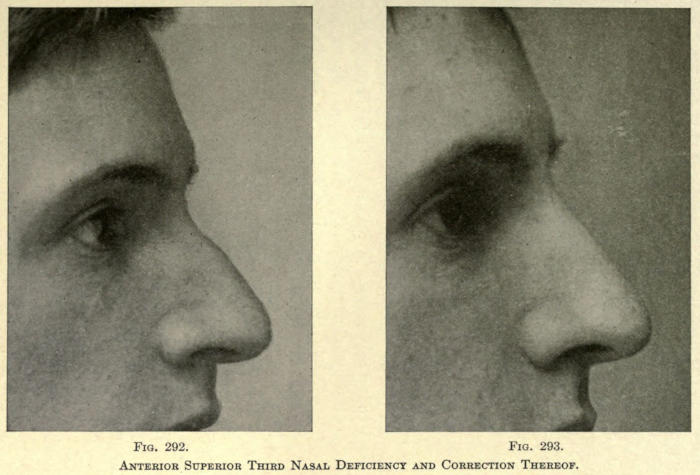
Fig. 292. Fig. 293.
Anterior Superior Third Nasal Deficiency and Correction Thereof.
The needle should be introduced laterally and anterior to the angular vessels to prevent their occlusion and injection. The point of selection is made at about the middle of the deformity. The needle is introduced until its point lies in the center of the depression, or at the median line from the anterior view.
The mass is injected slowly as the skin of the nose is pinched up between the forefinger and thumb of an assistant.
The part is injected until a tumefaction, equal in body to the extent of the deformity, is attained.
The needle is allowed to remain in place for a moment, to permit of a stoppage of the threadlike mass, usually following the pressure applied to the piston, after the operator has stopped turning the screw. This will prevent the mass from following into the channel made by the needle, or the backing up of the mass, as it were. Should this occur the paraffin mixture should be squeezed from the skin opening to prevent the formation of an intercutaneous encystment.
Immediately the needle is withdrawn the operator places a finger tip over the opening and proceeds with the thumb and forefinger of the right hand to mold the mass into the desired shape.
The post-operative treatment should be as previously given, and is the same with all injections about the nose, so that it will not be referred to again under this heading.
While a fairly large defect can be corrected at one sitting, it is advisable to rather reinject one or two weeks later to secure the exact shape.
It is to be impressed upon the operator that there is always a slight broadening of this part of the nose following the development of the connective tissue which takes the place of the injected mass, hence the injection should not be overcrowded nor the parts overcorrected.
The mass should be molded out as narrow as possible and be pinched between the fingers by the patient two or three times a day after the reaction has subsided, which is usually about the third day. This procedure will keep the mass from being flattened during the time tissue replacement takes place.
Middle Third Deficiency.—This defect is commonly seen in football players and pugilists as the result of a breaking of the inferior extremities of the nasal bones and the displacement of the articulating cartilages, although the defect is often seen as a result of an injury to the nose early in life, causing a lack of development in the superior or articulating extremities of the cartilages. Nondevelopment from catarrh, syphilis, and intranasal disease are other causes. This type of deformity is generally designated as the saddle nose.
In the latter cases the skin is usually bound down to the cartilaginous structure by cicatricial bands, and needs to be liberated. This is accomplished subcutaneously with a fine tenotome introduced laterally.
To assure the operator of a thorough dissection he may inject the site with sterile water through the opening made with the knife, squeezing it out before injecting the nose.
If the skin has had to be freed by surgical means the mass injected should be sufficient to overcome the defect almost entirely, to prevent the reformation of the bands of connective tissue which have been severed. Their re-establishment would mean an unequal development of the new connective tissue springing up from the injected mass, thus defeating the object of the operation.
If no dissection has been done the defect should be corrected about two thirds and added to by a subsequent injection.
The mass in either case should be well molded out, especially at both sides, to keep the nose as narrow as possible. There will be more or less widening ultimately following the organization of the mass.
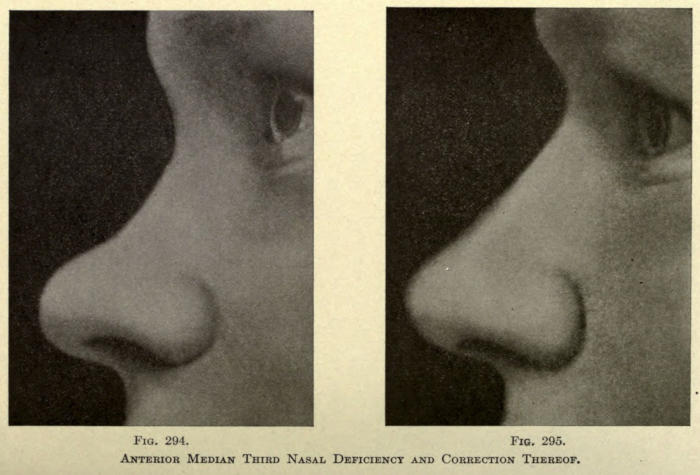
Fig. 294. Fig. 295.
Anterior Median Third Nasal Deficiency and Correction Thereof.
It is not uncommon to find a dividing wall of subcutaneous tissue about the articulation of the nasal bones and cartilages, as evidenced by a rising up or down of the injected mass above or below this line. If this be found, rather than break down this wall with the injection, it is deemed advisable to inject each chamber separately and mold the two masses after injection, as in the ordinary type of cases.
Inferior Third Deficiency.—This deformity of the nose is due purely to a lack of development or a luxation of the cartilage of the septum and the upper lateral cartilages. The point or lobule of the nose is usually tilted upward and the subseptum curved upward at its middle third.
The cause of this deformity is usually due to direct violence at some time in life, with improper replacement at the time of injury. Syphilis and intranasal catarrh, lupus and ulcerative diseases, are also causes.
The skin overlying the defect may or may not be closely adherent, but is in most cases rather thickened and inelastic. It is therefore necessary, in most cases, to loosen the skin by subcutaneous dissection, done as already described before the injection is made.
To rebuild such a nasal defect without dissection, except in such instances where the skin is quite elastic, is not to be advised, since the injected mass would be flattened, more or less, antero-posteriorly, giving the nose a broad and ugly appearance after the connective-tissue formation has been attained.
It is with cases of this kind that paraffin injections introduced in the liquid form and of high melting points are usually expelled in a week or ten days, or even later, subsequent to a breaking down of the surrounding tissues and the resultant abscess.
The best preparation to employ is the form of paraffin mixture advocated in the preceding operation used in its cold state and injected slowly, after the integument has been rendered mobile enough to permit the desirable correction.
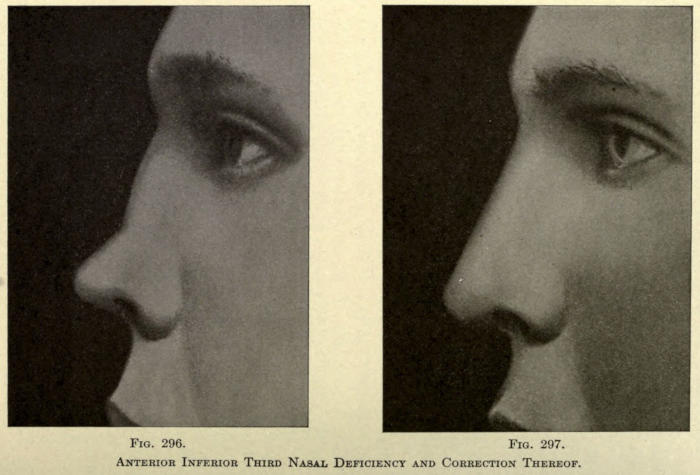
Fig. 296. Fig. 297.
Anterior Inferior Third Nasal Deficiency and Correction Thereof.
The defect should not be corrected in one sitting, for the very reason that some widening of the nose may take place, owing to the contractility of the skin, post-operatio.
The mass injected should correct the major part of the defect and be molded out carefully, especially from both sides of the nose, and the patient be instructed to pinch the nose laterally several times a day after the reactive inflammation has subsided with the object of keeping the nose as narrow as possible.
After the mass has been thoroughly replaced with connective tissue and the anterior line is found to be too depressed, a fine line of the mass about the thickness of the needle may be injected over it in a vertical direction, the point of a fairly large needle being introduced just above the anterior aspect of the lobule and thrust upward to the superior border of the now existing deformity, and be slowly withdrawn as the mass is injected.
This will leave a rounded cylindrical-like mass along the anterior nasal line, which must not be molded at all, except to soften or shade off the superior and inferior extremities.
The author advocates making two such injections, at the same sitting, when the deformity has persisted. These injections are made parallel to each other with a distance of about one eighth inch between them.
The subseptal deficiency will also have to be corrected. This will be referred to later under its separate division.
The reaction in cases of this type is usually more severe than those just mentioned. There may be considerable swelling and discoloration, but by following the methods of treatment laid down heretofore the symptoms usually subside in two or three days.
Superior Half Deficiency.—In this type of deformity there is found a nondevelopment of the bridge of the nose, while the greater part of the cartilage of the septum and the lower lateral cartilages seem to be quite normal in contour. The nose has a dished appearance, with an undue prominence of the nasal base or lower half.
Various causes may be given to this condition, but heredity is responsible in a great majority of the cases.
The deformity in the type under consideration rarely takes in an accurate half of the nose, there being an involvement more or less of the lower anterior half, yet it is sufficiently distinctive to give it specific classification.
For the correction of the defect in such cases the injection is made laterally, the same mass being employed as in the preceding cases.
In this type of case the mass injected should quite correct the defect and be molded with great care to a desired contour, keeping in mind always the condition and elasticity of the skin overlying it.
An inflexible skin should be rendered mobile by digital massage, practiced for a few days prior to operation, or in tense conditions be loosened by subcutaneous dissection.
The great fault in injecting so large a quantity as is necessary in these cases is to make the nose too wide from the very beginning, which, added to the widening following the replacement by new tissue, makes the shape of the nose unsatisfactory.
For this reason it will be found of some benefit to apply an anterior nasal splint of aluminium, covered interiorly with a fold of white flannel or gauze and pressed into such shape that when applied to the nose it will keep the latter pinched up laterally to the desired width. This splint will hardly ever be borne by a patient and causes great discomfort until after the post-operative reaction has subsided. It may then be bandaged or held in place by strips of Z. O. Adhesive plaster for an hour or two in the day and during the entire night.
After the first few days’ wearing the patient soon becomes accustomed to the splint. It should be worn as mentioned for about three weeks, when the patient may be permitted to pinch the nose laterally with his fingers two or three times a week or more.
The secondary injection may be made in the ordinary way or as advocated by the author in the manner described in correcting defects of the inferior third of the nose.
Inferior Half Deficiency.—In this type of deformity the greater point of nondevelopment or deficiency is found at the upper extremity of the cartilage of the septum, below its articulation with the inferior border of the nasal bones, and involving to a greater extent the area over the upper lateral cartilages.
This deformity, due to whatever cause, rarely affects the base or inferior part of the nose, owing undoubtedly to the greater protection and stability offered by the lower lateral and sesamoid cartilages and the dense cellular tissue making up the alæ. Except in such cases where violence of an extreme nature has been exerted in early life, or where ulcerative disease has broken down most of the cartilage of the septum, the point of the nose is usually normal in size and shape. In the latter cases there is an upper tilt of the lobule and a shortening of the columna upon itself with a convexity in an upward direction.
The cause of this type of deformity is usually a direct blow upon the point of the nose, syphilitic ulceration internally, catarrh, or other ulcerative disease.
When due to violence the point of the nose may or may not present a normal appearance, there may be a normal base tilted upward (retroussé or snout nose) or a dropping forward and downward (hook or beak nose).
The shape of the nasal base depends much upon the time of life the injury was received—that is, before or long after puberty, also upon the extent of injury inflicted and where applied.
From injuries received early in life we may look to a lack of development in the cartilage of the septum alone, or associated with deficiency in one or both lateral cartilages.
The deformity is usually symmetrical, but where the nasal bones have been injured as well, particularly where one bone is injured more than its fellow, there is a possibility of the disfigurement being unilateral. This is rarely the case except when due to punctured wounds; generally in such cases the anterior nasal line assumes a twisted form.
Some operators have included noses of undue lobular prominence (à la Cyrano de Bergerac) under this type of deformity, and while it is to be admitted such a nose might be built up by subcutaneous prothesis the result is anything but harmonious or normal. Such a nose should be reduced by cutting operations instead of being added to. The seeming depression above the lobule is only comparative to the overdeveloped form of the lobule. The face values of every patient should be studied, and the surgeon should never attempt to break up the harmony of facial form by simplifying an operation and rendering the patient’s appearance even more ridiculous than before his attempt to correct a fault.
The correction of the deficiencies of the lower half of the nose is associated with difficulties in various directions. Either the skin over the defect is too dense to render injection an easy matter, or the nose is so broadened horizontally from the original injury that the injection, no matter how artistically done, leaves the nose bulky and ugly in appearance.
When the nasal processes of the superior maxillary bones have not been widened unduly by an injury and the skin is dense, simple subcutaneous dissection before injection will overcome the difficulty easily enough.
In that case the needle is inserted laterally in a line with the maximum depth of the depression and the point shoved up to the median line anteriorly.
Enough of the cold mixture of paraffin and vaselin, as heretofore advised, is injected to reduce the deformity nearly to the normal.
The mass is molded to give the nose as near a normal contour as possible, always keeping in mind the later broadening of the nose when the new connective tissue has taken the place of the injected mass. A later injection made, as advised heretofore, will restore the anterior line to better form.
If the nasal processes of the superior maxillary bones have been thrown outward considerably a surgical operation is necessary to reduce them.
No injection should be made until the wounds from such operation are thoroughly healed and contracted.
In all cases of this type the skin will be found to be rather dense and likely to be tied down by past inflammations to the anterior aspects of the lower lateral cartilages at their juncture with the upper lateral cartilages. If the adhesions are not too dense the harder form of the cold mixture should be used. This will not only permit of raising the skin more readily than with a softer kind of mixture, but will be more likely to retain its form under the contractile pressure brought to bear down upon it.
When the skin is closely adherent it should be loosened subcutaneously, as already advised. The injection may be done at the same sitting, and be of greater quantity than in the cases where this had not been done, for the reasons mentioned.
Pressure splints and manual compression should be employed as in the preceding deformity.
The reaction following the first injection is likely to be severe. Cold applications, as previously referred to, are indicated, and should be continued for at least two days.
Care should be taken not to inject into the lateral vessels, which usually lie on a line with the juncture between the lateral and lower lateral cartilages. If this should happen, the point of the nose at once assumes a bluish hue, and there is more or less pain felt at once, with considerable swelling a few hours after the injection. Later, every symptom of gangrene of the lobule is liable to be noticed, yet with faithful attention to furthering the circulation of the parts by either cold or hot applications, the active inflammatory symptoms usually subside in ten to fourteen days, leaving the patient with a whole nose, more or less colored at the lobule, according to the state of the circulation and the exposure of the parts to the various temperatures. This may be overcome in time, yet it may persist for years, depending entirely upon the ability of the anastomosing vessels to overcome the artificial thrombus or occlusion offered by the mass injected.
That a reaction quite similar in character, but of milder degree, is likely to be seen when one of these vessels has not been injected, can be readily understood when we consider that a hard and somewhat ungiving mass is made to overlie the vessels themselves. The symptoms just described in such case are apt to be noted much later, even several hours after the injection, because the swelling has then begun to add its pressure to that of the mass in obstructing the flow of blood to the lobule. Such condition may be termed pressure occlusion in contradistinction to thrombotic obstruction.
These symptoms usually subside in a day or two, or with the swelling caused by the reaction.
If the symptoms appear at once after the injection, it is best to force out as much of the injected mass as is possible through the needle hole through which it has been introduced.
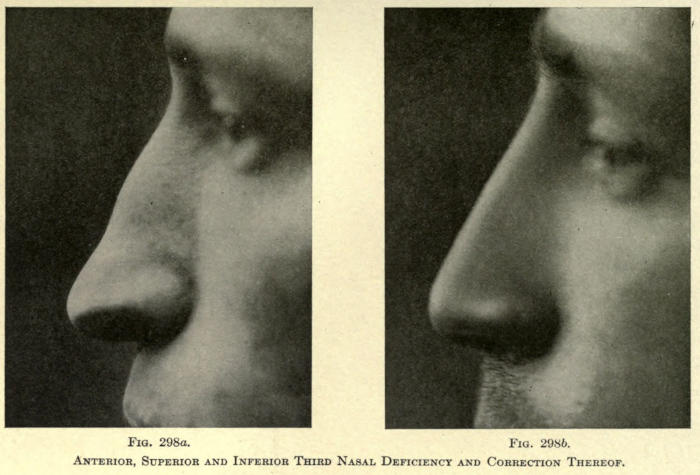
Fig. 298a. Fig. 298b.
Anterior, Superior and Inferior Third Nasal Deficiency and Correction Thereof.
The author was called to attend a case several hours after the operator had injected a nose. The acute symptoms pointed to a direct occlusion of the vessels, yet the surgeon who had performed the operation assured me he had not injected until he found that blood did not flow from the needle after its insertion. To relieve the patient of immediate fright and some pain, a dull pointed needle of larger caliber than the one used in operation was pushed through the needle wound previously made, taking the place of a cannula, and a greater part of the injected mass was squeezed out. Ice cloth applications were followed through the night and the nose recovered in three days without showing the discoloration of the skin usually observed following such cases. The nose was never injected again, on account of the dread of the patient, but peculiarly the anterior line showed almost a normal contour after four weeks had elapsed. This only goes to prove that very much less of the mass to be injected is required than is commonly supposed by operators.
Total Anterior Deficiency.—In this condition there is a scooped-out or general curved-in appearance of the entire anterior nasal line. The lobule of the nose is usually normal in size.
This defect should be corrected by two injections of the paraffin compound previously referred to. The points of injection should be lateral and anterior to the angular vessel on the side of the nose preferred by the operator—one about the center or major curvature and the other about the inferior third.
Care should be taken to mold the injected mass as narrow as possible, or as much as the skin will permit. If the latter is bound down it should be mobilized by subcutaneous dissection or levation. A subsequent injection should not be undertaken until the entire mass has become settled or fairly organized, which is about the end of three weeks.
The mass should be injected well up to the root of the nose to give it the appearance of the normal bridge. If this is found impossible owing to a dividing skin attachment, a third needle puncture should be made at a point on a level with the internal canthus.
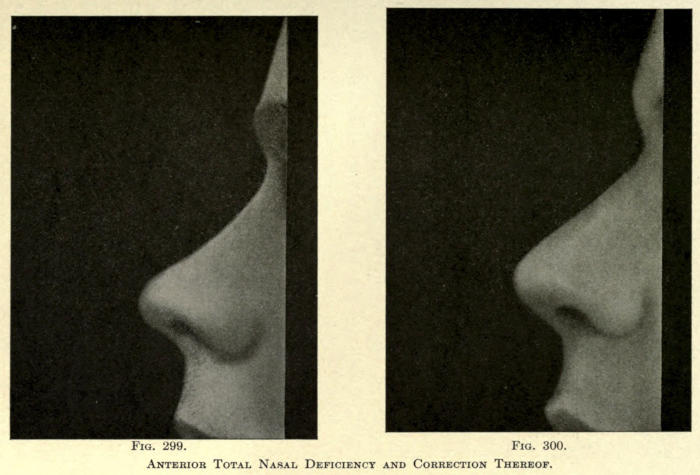
Fig. 299. Fig. 300.
Anterior Total Nasal Deficiency and Correction Thereof.
Care must be exercised to keep the mass from creeping into the loose tissue about the internal canthi by having an assistant press the sides of the nose at that point with the thumb and forefinger.
This undesirable condition is much more liable to occur when a hot liquid paraffin is employed, since the operator can observe quite accurately the extent and direction taken by the mass injected when the cold product is used.
Some authorities have injected noses of this type from the point of the nose, but it will be found that the position of the puncture at this point allows a considerable portion of the mass to work out during molding and also to permit of the readier oozing out of the mass during the pressure exerted by what reactive inflammation follows the operation. This is accounted for by the fact that the needle creates a tubelike canal in the tightly bound down tissue overlying the lower lateral cartilages, whereas in the lateral punctures the short canal is easily displaced by the swelling, thus causing its obliteration and preventing the free oozing.
On the other hand, it will be found to be more difficult to inject from the point of the nose alone and that a very long needle has to be used which must be withdrawn as the parts above the point are filled. Furthermore, it will be found necessary to thrust the point of the needle in different directions to overcome vertical attachments of the skin which are more readily lifted up than thrust aside by the mass, hence necessitating a greater amount of injury to the tissues, not to speak of the possibility of injecting transverse blood vessels higher up in the nose of which the operator would not be aware at the time; showing only in the resultant phlebitis and unexpected reactive symptoms, associated with a discoloration more or less lasting according to the extent of obliteration of the vessels.
The post-operative treatment should be as heretofore advised.
Lateral Insufficiency (Unilateral and Bilateral).—Depressions about the sides of the nose are usually due to hereditary causes, when they are likely to be bilateral, yet intranasal ulcerations may cause a falling-in, as it were, of either one or both nasal walls, involving in such instances the entire side or part of it. In the partial cases the depression may be in any of the division of thirds used by the author—that is, it may lie laterally over the region of the nasal bone and such of the nasal process of the superior maxillary bone as goes to make up that part of the nose, or in the middle third below the bone structure and above the superior limitation of the lower lateral cartilages, or within the lower third over the inferior border of the cellular tissue making up the nasal rim.
Traumatism may be found to be the cause of such depressions, especially in the middle third, after fracture or luxation of the nose. In such cases the defect is usually unilateral or at the seat of the former injury, a convexity usually being exhibited on the opposite side.
Since the skin is rather firmly adherent at the sides of the nose, except in the major part of the superior third, it will be found best to raise the skin of such defect into normal contour by a series of very small injections instead of following the method heretofore advised in connection with tense or adherent areas of skin, for the reason that such dissection would render the skin too mobile over an area usually beyond the defect itself and inviting the surgeon to an annoying hyperinjection which renders the part more unsightly than prior to the operation. This is true in most cases unless the depression is of traumatic origin and beyond the size of deformity usually corrected.
The author advocates the employment of a hypodermic needle attached to the syringe in place of the regular needle and that the injection be of sterile white vaselin without additions of any kind.
Such injections may be made very readily, one or more at the first sitting, being introduced below the deepest part of the defect. It is surprising how much four or five drops of such an injection will accomplish. Furthermore, it is to be remembered that the injections about the side of the nose are readily replaced by new connective tissue, equal to, if not commonly greater in amount, than the mass injected, such growth being completed in about two months after the time of injection. This may be explained by a more or less active perichondritis when the injection is made over the cartilage, the inflammation, thus set up, being of longer duration than where the skin and bone or areolar tissue are involved. Any subsequent injection should not be undertaken until at the end of two weeks or more for the reasons above stated.
The injected mass at all times should be introduced under normal pressure, never to the extent of rendering the skin above it white in color. The mass should also be molded out with the tip of the finger or the rounded, dull handle end of a scalpel. If necessary, the small finger may be introduced into the nostril to facilitate this molding. Should the reactive inflammation be severe such remedial agents as have been referred to should be used to reduce it.
Phlebitis following injections at the side of the nose is due entirely to the injection of a blood vessel and must be avoided. When a fine needle is used there is less likelihood of free bleeding from an injured vessel, therefore a thorough knowledge of the usual position of the vessels about the sides of the nose is absolutely essential. Bleeding of greater extent than that which would follow the thrust of the needle through the skin should put the surgeon on his guard. Experience is the better teacher and conservatism in these ofttimes delicate, subcutaneous operations will save the surgeon much annoyance and eventually the need of having the patient submit to a cutting operation to reduce an overcorrected area.
Should a hyperplasia of connective tissue result from such an operation, a small linear incision, under four per cent eucain anesthesia, should be made directly over the greatest prominence, through which the offending mass can be removed by the aid of a small hooked knife or a fine pair of curved scissors.
The mass should be removed beyond the plane of the skin; in fact, it should be rather removed in conelike form, apex inward, and the peripheral attachment completely obliterated, in order to obtain the desired result, as it is not unusual to have the prominence reappear after imperfect extirpation and improper dissection.
Moist pressure dressings may be applied over the small wound thus made, for several days, or until the inflammation following the operation has subsided. Suturing such a wound is hardly necessary, but if the incision be over one fourth of an inch long, two fine silk sutures, deeply placed, may be utilized, their tension adding to the compression needed to bring the mobilized skin into position in reference to the base of the wound.
The author has used contractile collodion in place of compress dressings with very good result. This should be renewed within forty-eight hours.
After eight or ten days silk isinglass adhesive plaster is applied over the wound until it falls off.
Lobular Insufficiency.—This defect of the nose is usually of hereditary origin, although it may be occasioned by the retraction of the inferior half of the organ in tubercular or syphilitic ulceration in which the lobule falls inward and upward by the loss of the retaining cartilages.
Owing to the close adhesion of the skin to the lower lateral cartilages and the cellular tissue about the rim of the alæ it is found difficult to restore the contour or elongate the organ at that site by subcutaneous injection.
Even after thorough mobilization of the integument the subsequent injected mass is liable to be thrown off by an overactive inflammatory reaction, due undoubtedly to the adhesions formed between the divided surfaces from the periphery inward which has a tendency to crowd the injected mass forward and downward before a new connective tissue has had time to be formed, causing a breaking down of the skin at some point overlying the mass and allowing it to escape.
The author has attempted to replace the injection by small solid paraffin plates introduced through a small lateral incision made for the subcutaneous dissection, and while the wound healed readily enough and the nose appeared normal, the plates were in every case thrown off by a later inflammatory process before the end of the third week.
The author then attempted to replace the solid plates with granular paraffin, gently packing the latter into the wound until the desired elevation had been obtained with the idea that such mass would accommodate itself much better under the pressure caused by reactive inflammation, but even this procedure proved unsuccessful.
The best results are obtained with sterilized white vaselin injections when there is considerable mobility of the skin. A single needle opening should be made, preferably about the center of the side of the lobule, or slightly anterior to this point, carrying the point of the needle forward to the anterior median line and a little above the actual point of the nose.
The injection should be made slowly, closely watching the size of the elevation caused by the mass and the state of the circulation about the entire lobule.
Usually ten drops of the mass suffice to give the desired result. The mass may be molded out if found desirable, but if the skin appears normal after the operation and the tumefaction thus made does not make the nose look grotesque, it may be allowed to remain as injected, depending upon the subsequent reactive pressure to force it into shape. In this way a greater part of the mass is retained at the wanted site and is not crowded to the sides of the lobule by the customary post-operative molding.
Even with this method great care must be exercised in not injecting too much at each sitting. A failure is sure to result in hyperinjection about the lobule. When it be remembered that only a very small quantity of the mass will make a decided difference, the surgeon and patient should be satisfied with the slightest gain.
If, however, the mass be retained and further elongation of the lobule is desired, a subsequent injection can be undertaken, but not until a full month after the primary operation.
Here, as with lateral nasal injections, there seems to be an overproduction of new connective tissue following such an injection; a decided factor in eventually pleasing the patient.
It is needless to say that the operator must avoid injecting one of the blood vessels of the lobule, as this will cause considerable inflammation from which the lobule does not recover readily, owing to the dense tissue the surgeon has to deal with, leaving the tip of the nose discolored and bluish for some time after the operation.
If the injected mass causes an immediate venous stasis of the lobule, hot applications should be applied at once, or as soon as the operator discovers that the proper massage and pressure to remove the offending mass does not improve the circulation.
The author advocates the judicious use of antiphlogistin, faithfully applied hot every six hours and continued until the acute inflammatory symptoms subside, when the surgeon may resort to ice cloths or cold pack until the danger of pressure and resultant gangrene have subsided.
Despite the very grave symptoms associated with such inflammation, the operator may assure the patient against permanent disfigurement, although the three or four weeks’ duration of treatment, usually required in such cases, is an ordeal the cosmetic surgeon and the patient are not liable to forget.
If the injected mass causing this state of affairs has been of liquid paraffin, the better method to pursue is to make several small incisions into the site of the injections and remove the little masses of solid paraffin as far as possible with the view of relieving the pressure or encroachment, at the same time alleviating the pain and stasis by the resultant depletion. Moist, hot applications should follow this procedure. The small wounds made in the skin will heal without suture, leaving hardly any perceptible scar.
The author, however, advises against any mixture or liquid paraffin injections about the lobule, never having seen a satisfactory result when either had been employed.
The post-operative treatment in uncomplicated cases may be of aristol and adhesive isinglass plaster or collodion.
Interlobular Deficiency.—This condition is hereditary in the great majority of cases. The defect, while quite disfiguring, giving the appearance of a cleft nasal point, is easily corrected by the subcutaneous injection method.
Paraffins of high melting points should, however, never be employed for this purpose for diverse reasons: first, the hardening of the mass after cooling causes too much pressure upon the small blood vessels at the point of the nose and results in more or less permanent discoloration of the tip; second, by reason of the pressure of a hard mass, at the end of the nose, considerable inflammation results which usually terminates in the evacuation of the entire mass and consequent cicatrization; third, by virtue of the greater irritating qualities of paraffin a greater amount of new connective tissue than necessary is thrown out, causing a general and hyperplastic rounding of the entire tip of the nose that requires surgical interference to overcome. In the illustration shown the patient’s nose was injected along the entire anterior line and the lobule with paraffin liquefied under heat. A marked post-operative inflammation resulted, with permanent redness of the entire organ and several decisive capillaries showing about the sides and tip of the nose. This was followed in about six weeks by a progressive hyperplasia which left the nose about three times its natural size, and the lobule a hard, ball-like knob of high red color. Several cosmetic operations were required to make the nose appear anywhere near normal, while the electrolytic needling process was resorted to for a number of sittings to destroy the acute redness and the individual vessels showing.
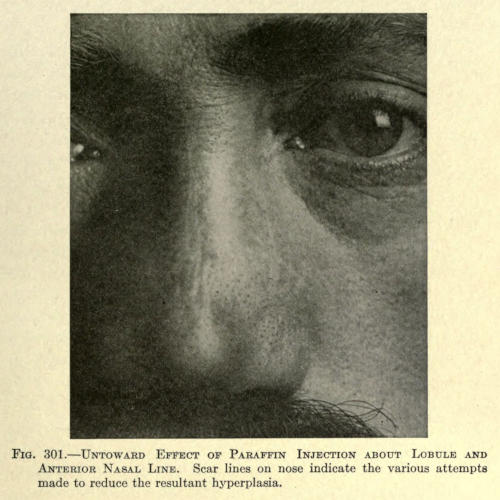
Fig. 301.—Untoward Effect of Paraffin Injection about Lobule and Anterior Nasal Line. Scar lines on nose indicate the various attempts made to reduce the resultant hyperplasia.
While a great many workers with paraffin deny any beneficial results from the employment of sterile white vaselin for subcutaneous injections, the author claims that in this particular class of deformity it is almost exclusively required.
The vaselin in cold state should be injected directly under the skin overlying the deepest point of the cleft and be slowly continued until the lobule assumes its normal contour. The puncture may be made below the point of the nose.
One such injection usually suffices to correct the fault. The reactive symptoms are not severe if proper technic has been applied, and cold compresses usually relieve it within twenty-four hours.
Should the skin be adherent about the anterior aspect of the lower lateral cartilages, it can be forced away with a small, dull, round-pointed knife resembling an eye spud, the opening for which need not necessarily be greater than that made for the needle. The latter is inserted through the same opening, which must be closed over in this event with a drop of contractile collodion into which aristol is introduced with the pulverflator, which not only embodies an antiseptic, but at the same time hastens its hardening.
Alar Deficiency (Unilateral and Bilateral).—The contraction about the nasal rims may be due to hereditary causes or the result of intranasal disease. The defect is usually bilateral, involving the entire alæ or only their lower half or third.
The fault should be corrected by several injections made along the rim of the nasal wing, using a fine needle, preferably of the hypodermic size. Vaselin only should be used and two or three drops, according to the extent of the deformity, be injected into the cellular tissue at the point of each needle insertion.
Three of such punctures may be made along the rim, one beyond the other in each wing. According to the defect the injection may be carried higher or lower above the margin of the rim by shoving the needle upward and toward the inferior border of the lower lateral cartilage.
The reaction in these cases is very little, rarely necessitating other than an antiseptic powder-plaster dressing. Subsequent injections should be made if the first do not give the desired contour; but never until the surgeon is satisfied that the resultant new connective tissue thrown out has reached its ultimate growth.
The harder paraffins, especially those injected in the liquefied state, are not to be tolerated for the reasons given with the preceding method of correction.
Subseptal Deficiency (Partial and Complete).—It is not uncommon to find a marked concavity of the subseptum in noses that have sunken in by reason of intranasal disease or traumatism.
This concavity, when partial, is usually most marked near the lobule, but in the complete variety the upward curve may be greatest near its juncture with the lip.
Owing to the usual adhesions formed during the inflammatory period causing the deformity the correction of this defect is quite difficult. As a rule, the skin of the entire subseptum needs to be dissected away from the underlying structure before it will permit of correction by the injection method.
This dissection is advocated and can be readily done from one of the nostrils at a point just beyond the union of skin and mucous membrane.
The dissection under such method can be made more thoroughly than when done exteriorly, for the reason that the entire field is laid open to a free use of the scalpel, leaving no visible cicatrix externally. The dissection may be followed by the immediate injection of the mixture of paraffin and vaselin, as already referred to, used cold, or the area is injected with normal salt solution until the intranasal wound has healed, which usually takes place in about five days. The mucous membrane in such instance may be neatly but not too tightly sutured with No. 1 silk. If the operator deems it advisable he may inject the salt solution again on the third day to prevent the formation of such adhesions as may interfere with the ultimate hydrocarbon injection. This is rarely found necessary.
If the post-operative inflammation prove mild, then the adhesions will not be as tenacious, in which case the surgeon may wait until even the seventh or eighth day before injecting the paraffin compound, to be sure of not forcing the intranasal wound apart under the pressure of the mass injected.
Never should so large a quantity of the mass be injected as to cause blanching of the narrow strip of skin. This is sure to result in gangrene of some, if not all, of the skin of the subseptum—a result much to be regretted, since subsequent correction of the deformity increased by the contraction of the dermal cicatrix is rendered well-nigh impossible by reason of this very tissue.
Hard paraffin injected in its molten state is never borne in this part of the human economy. It is usually thrown off after a few days of very painful and highly inflammatory symptoms, undoubtedly explained by the fact that the circulation of the subseptum is principally dependent upon the delicate branches of the two small septal arteries of the superior coronary and a hard, ungiving mass would readily cause their obliteration.
Deformities about the Mouth
Labial Deficiency (Upper and Lower Lip).—There are a number of causes creating deficiencies about the labial orifice. The same causes apply naturally to both lips, whether the defect be unilateral, bilateral, or median. Some of these deformities are more often met with than others, as, for instance, a median deficiency of the upper lip following cicatricial contraction due to a harelip operation done early in life; in elderly patients a partial paralysis is found to affect one half the upper and sometimes a part of the lower lip, giving to the mouth a drooped and grinning appearance.
Other causes are dental defects, abnormalities of the alveolar processes, traumatism, and disease.
In those conditions where loss of tissue is responsible for the defect, as in the extirpation of neoplasms, ulcerative disease, etc., it is quite likely that cheiloplasty is required to rebuild the parts, but in many of these cases splendid results may be obtained by the judicious use of hydrocarbon protheses to overcome the usual post-operative oral distortion. It is understood that such injections should not be undertaken until the wounds are thoroughly healed and the cicatricial union fully contracted. This is true also in harelip operations undertaken later in life.
The correction of labial defects coming under this method is not at all difficult, but artistic skill and judgment are as necessary as the surgical technic.
The lips are plentifully supplied with blood vessels, and therefore greater care in injecting a foreign mass into their structure is necessary; furthermore, the lips cannot be placed at rest for any long period of time, so that the mass injected can never be expected to be kept in place if of a consistency hard enough to permit the contraction of the orbicularis muscle to move it about.
From the very fact of this practically constant movement of a part it is self-evident such hard mass could not be retained or held in position for any length of time, unless the mass is small enough not to be affected by the movement, and under such condition the correction of a defect as desired by the patient would require perhaps months to accomplish, owing to the very fact that only droplike masses may be deposited under the skin in perhaps a half dozen places with the necessity of a long period of rest until the injections have been replaced by the new tissue before the next operation could be undertaken.
It is absolutely absurd to think of injecting a lip with hard paraffin liquefied by heat and expect to obtain a satisfactory result. While it is true the mass is moldable immediately after its introduction, so that a desired shape may be obtained, it does not overcome the fact, however, that the mass must harden, as it will, and that, while a part of it is broken away, as it were, from the mass proper, there is a nuclear contraction as the hardening takes place, thus overcoming partly the molded form; furthermore, the movement of the parts here tends to displace the mass. Unequal muscular contraction breaks up not only the form but also the mass itself, during all of which time it is made to act as an irritant by virtue of the movement of the uneven edges of the paraffin upon the adjacent tissue.
Furthermore, the presence of paraffin and the resultant mass of new and hard connective tissue, so well recognized by all experienced surgeons, is not desirable in the lip structure; it makes the lip appear bulky and hard and anything but natural.
It is in these very cases that the injections of cold sterile white vaselin is indicated. After injection the mass may be evenly and satisfactorily molded out, the mass being soft and readily pressed into shape in the various cells of areolar tissue without leaving hard and uneven lumps.
The movement of the lip is not then a source of danger in displacing the mass, since the acute swelling of the lip tissue prevents its free movement for several days, which gives the injected mass an opportunity to establish itself and find its proper place.
Another advantage in using this preparation subcutaneously is that it is less irritating than hard paraffin, permits freer movement, and creates a better production of new connective tissue.
While a part of the mass may be absorbed during the replacement period the lip retains its normal consistency, and if the desired contour has not been attained a subsequent injection may be made in three weeks’ time without interfering in any way with the former result.
The only precaution, aside from avoiding the injection of blood vessels, is to keep the injection from the prolabium or vermilion border. The latter tissue is very prone to fatty degeneration or to yellowish discolorations when such a foreign mass has been introduced into or near its structure.
There is no objection in injecting the lip, upper or lower, in several places, as the cellular network about the mouth is sufficiently dense to prevent the escape of the vaselin injected from the adjacent opening if the distance is not less than a half inch between the punctures.
The injections may be made from above downward in the upper lip and, vice versa, in the lower. They should be begun at the outer angle working toward the median line.
The reaction following such an injection is usually more severe than in any other tissue of the face, owing to the great number of fine blood vessels, but the swelling is readily controlled in two or three days by cold applications.
Aristol collodion dressings over each wound suffice to close the punctures.
In the median variety of defect, where a cicatricial band separates the lip into halves, it may be found necessary to do a subcutaneous dissection before a suitable injection can be done, but in cases of long standing the dividing wall is exceedingly thin and the threadlike adhesions below are quite easily broken up by the force of the injection. The later product of new connective tissue will tend to further improve the contour.
Nasolabial Furrows (Unilateral and Bilateral).—This condition in the bilateral form is exceedingly common in adults beyond middle age. It is also found in those individuals suffering from inanition, due to whatever cause. The unilateral form is found principally in patients suffering from semifacial paralysis in which the tissue lacking the proper neurotic supply droops or sags down, causing a deep furrow to appear from the attachment of the alæ to the angle of the mouth, associated more or less by a flattening of the cheek contour of that side of the face.
The method of correction advocated by the author varies entirely from the technic advanced by other surgeons.
The usual method has been to introduce the needle of the syringe at the outer or lower extremity of the furrow and from one of such punctures to inject the whole line of depression.
While this seems right theoretically the method does not give the desired result. Owing to the free movement of the upper lip the mass, at first neatly restoring the contour, is crowded upward into the inferior malar region and very often downward toward the angle of the mouth, where it settles in a hard lump which is not only obnoxious to the sight but interferes with the proper use of the parts concerned in mastication and vocalization. Invariably the operator is called upon to remove the disfigurement.
It can be readily understood that hard paraffin itself, in such case, would prove more objectionable than a softer mass which, upon early discovery, could be molded or massaged into better position, while nothing less than excision would prove efficacious with paraffin.
As with the lip, then, the author advocates the use of either the cold mixture of paraffin, as heretofore described, or the cold white vaselin according to the operator’s opinion in overcoming the extent of the fault. For all ordinary cases white vaselin alone is necessary.
The technic of injection as used by the author is as follows: In the ordinary case when the furrow is not too pronounced one sitting only is required. Two needle punctures are made above the upper line of the defect, the first being made about one half inch from the wing of the nose and the other about one inch outward and downward.
The needle is pushed downward under the skin until its opening corresponds to the median line or deepest part of the furrow. Enough cold white vaselin is injected to bring the depressed area slightly above the plane of the skin of the upper lip. The second puncture is made perpendicular to the first and the injection made in the same manner.
With the tip of the indicis over the first needle opening the mass is molded out evenly by a gentle rocking or rubbing movement. The same is done with the second mass.
It will be found, then, that the two masses are made to meet at about the center of the furrow, leaving a slight wall of tissue between them. This wall has the virtue of preventing the falling down of the upper mass, at the same time dividing the quantity of the injected mass into two, and lessening the weight.
If the condition is bilateral both sides are operated on at the same sitting. If subsequent injections are needed they are done three weeks later, the punctures being made between the former first and second punctures and the second and outer border of the furrow. In this way the entire site is filled with a series of injections.
If the surgeon desires he may increase the number of these needle punctures at the first sitting, making them nearer together in that event.
It will be found necessary in some cases to inject the cold mixture of vaselin and paraffin into the furrow directly below the wing of the nose, since the integument at that point requires a mass somewhat harder than vaselin to force and hold it up.
The rest of the furrow must, however, be injected with vaselin alone, for the reasons already given in parts that are movable.
The reaction is rarely very marked and subsides in about three days.
Gentle massage may be permitted above the site of injection to keep the mass from crawling into the cheek. This is done by gently stroking the skin from below upward toward the nose on a line an inch above the original depression.
The dressings are the same as before mentioned, although collodion painted over the needle openings is most serviceable after having sponged off the sites with absorbent cotton dipped into absolute alcohol to remove the vaselin that may have exuded from the openings during the molding-out process.
Oral-Angular Furrow.—These furrows occur at the corners of the mouth, running downward upon the anterior chin. Small as these defects appear, they are found difficult of obliteration, for the reason that the tissues are more or less under constant movement during the waking hours. Repeated injections, each of small quantity, are necessary. Hard paraffin is contra-indicated.
The injections are made from above the defect downward at right angles to the defect.