Chapter XIV · SUBCUTANEOUS HYDROCARBON PROTHESES (continued 3)
Reading edition
It will be found difficult to keep the mass from being expelled on account of the movement, there being more or less oozing from the puncture, but if the openings can be controlled for at least twenty-four hours this danger may be overcome to a great extent.
Ethyl chlorid may be sprayed over the part immediately the needle is withdrawn to set the mass and followed with a drop of collodion. The patient is advised to keep the mouth as immovable as possible for the rest of the day.
The reaction is never severe, and is easily controlled by cold applications. If, after one week, there is shown a tendency to sagging of the mass, it should be gently massaged upward with the finger several times during the day for at least two weeks; this will keep it in place, and allow nature to replace it with new connective tissue when desired.
Deformities about the Cheeks
Deficiency of Cheek (Total and Partial).—A total lack of proper contour of the cheek, generally termed flattening, may be due to hereditary causes, but is generally dependent upon a cachexia due to a general disease, or fatty degeneration of the muscular structure of the cheeks, as found in those beyond middle age.
A partial deficiency of the cheek or cheeks is usually hereditary, but may be dependent upon digestive disorders or other causes of malnutrition.
This class of deformity is found more often in women than men. It is usually bilateral.
Unilateral cheek deficiency, whether partial or total, may be congenital, but is often the result of a local paralysis causing hemiatrophy. Traumatisms early in life or during birth and amputation of the inferior maxillary are other causes.
This class of deformity is quite readily corrected by subcutaneous injection; in fact, it is the only known method of merit, superseding the former resort to partial correction by massage or artificial and temporary correction by the wearing of plumpers in the buccal cavity.
The method of procedure is the same in all cases, the number of injections and quantity varying, of course, with the extent of the defect.
As with the rebuilding of the contour of the lips so with the cheeks, which must of necessity be mobile and flexible, the injection of hard paraffin is out of the question. The author has observed a number of such cases, and is free to say that in each case the result was not only abnormal in appearance, but a source of great annoyance to the patient.
What is worse is that the paraffin once injected can never be removed except in places where an actual encystment has taken place, in which case the hard mass may be removed through a small incision made directly over the mass and introducing a grooved director into the opening then by the rotation, or to-and-fro movement of which, combined with digital pressure, the cyst is evacuated. Once the mass is replaced by a network of connective tissue it could not be removed except by an extensive dissection and extirpation, which leaves behind it cicatrices far worse than the appearance of the parts before operation.
The author injects cold sterile white vaselin below the skin here and there about the cheek at the sites of deepest deficiency.
These injections may be made under ethyl-chlorid anesthesia.
Each injection is carried to the extent of causing a lump below the skin, the quantity being judged from a thorough experience with similar cases.
After the injections have all been done, the thumb of the right hand is passed into the mouth against the buccal mucous membrane of the left cheek and the index finger over it externally or on the skin surface. For the right cheek the index finger instead of the thumb is placed in the mouth. The mass or lumps are now gently pressed into the desired shape and thickness by the aid of these two fingers. A few drops of the mass may be forced out of the needle holes under this procedure, but this is of no consequence when it is considered that from one to two ounces may have been injected into each cheek.
This gliding form of massage should be continued until the entire cheek presents an even and rounded-out appearance.
It will be found, in the majority of cases, that the integument of the cheeks about the region of the inferior border of the zygomatic process is rather firmly adherent, and that a subsequent injection will be necessary to elevate the cheek at that point.
Injections over the malar bone are prone to cause severe reaction, leaving a puffed appearance just below the eyelids. This may be more or less permanent and is very undesirable. It should be avoided by injecting very small quantities at that site. It is always safer to add a little subsequently.
The reaction, generally, is not severe, and is readily controlled by cold applications, yet the author has experienced considerable swelling and tenderness in two cases of total cheek deficiency corrections which lasted for several weeks after the operation, giving excellent result eventually, however. Such symptoms are dependent upon circulatory interference, but resolution should take place without untoward results with judicious treatment, unless the operator has been negligent by injecting one or more blood vessels, in which case the resultant thrombosis may cause breaking down of the subcutaneous tissue, abscess, evacuation of the mass, and possibly death in part of the integument. The precautions referred to in avoiding any such possibility have been fully given heretofore.
Never should the operator hyperinject the cheeks, even if the patient insists upon looking like a puffed ball. He should be satisfied with a normal contour, and truthfully assure the patient such hyperinjected contour could not be retained owing to the weight and dropping down of the mass before nature could properly replace it by organized tissue.
Subsequent injections may be made about three weeks after the first sitting.
With nervous and hypercritical patients the surgeon may elect to give the patient a number of sittings, injecting only small quantities at two or three places each time. This in the majority of cases will give better results than when an entire cheek is injected, for the reason that the larger mass is likely to be displaced by the unconscious act of the patient in sleeping on one or both of the rebuilt cheeks or the willful massage to improve the handiwork of the surgeon in their own belief.
Massage of the cheeks after the replacement period is not to be tolerated. It tends to create hyperplasia by circulatory stimulation.
It is not unusual to have the patient tell you that for weeks after the replacement period the cheeks are swollen considerably in the morning upon arising, going down gradually during the day.
This is due to the spongy or loose character of the new tissue caused to be formed by the foreign mass, which gradually takes on a harder and more compact form.
The post-operative dressing will be either adhesive isinglass plaster or collodion. With the former, moist applications during the stage of reaction are not permissible.
Deformities about the Orbit
Deficiency of Lid Contour (Upper and Lower Lids—Unilateral and Bilateral).—The lack of contour in the eyelids is not as frequently met with as redundancy of their integumentary structure; there are cases, however, where the eyes seem to lie deep in their sockets, owing to a sinking in or a collapse of the surrounding lids.
This condition is often found to be hereditary, in other cases it is the result of malnutrition, a peculiar lack of adipose tissue about the orbit for no known reason, or fatty degeneration in past middle life.
The fault is usually bilateral. In rare instances trauma about the orbital borders may result in lack of nutrition. Such cases are usually unilateral, and the upper lid is affected in the majority of cases.
The correction of these defects is found to be rather difficult, owing to the thickness of the tissue under consideration.
The use of hard paraffin plays havoc with eyelid tissue, rendering it hard, immobile, and causing a hyperplasia of the new connective tissue formed thereby, as well as the peculiar yellowish pigmentary spots of irregular form resembling on casual inspection xanthalasma. This discoloration has been fully described earlier in the work.
The author has had occasion to remove these hard irregular masses investing the lower lid in several cases where paraffin had been injected, also two cases in which the pigmentary discoloration involved both upper and lower lids associated with the same hard fibrous masses. Excision under local anesthesia and silk suture was the method of correction employed.
From an experience of twenty-two cases the author believes these conditions most amenable for correction by the injection of sterile oils in preference to any other substance. Even white vaselin does not here seem to answer the purpose, owing to its stimulating property of causing the resultant growth of connective tissue.
While vaselin injected in the lids causes less of this new tissue to be formed, such tissue is never of the consistency required. This is especially true of the upper lids.
The oil injected, sterilized sperm oil being employed by the writer, is prone to absorption of more or less degree, but the result is gratifying, and lasts from six months to one year, leaving no untoward effect.
If the absorption has been sufficient to leave the parts as before the operation, a subsequent injection of the same character may be undertaken six months from the time of the first or even later, as the patient may choose.
The tissue of the eyelid is prone to swell immediately the oil is injected, and this swelling is entirely out of proportion to the quantity introduced. This edema, due to a retardation by pressure of the blood supply, is very misleading, the operator believing the parts overinjected. A screw-drop syringe is therefore absolutely required.
A fine hypodermic needle is used, and after a few drops of the foreign matter have been injected, the lid should be massaged gently with the tip of the indicis, employing the circular movement.
The injection should be made at the outer end of the lid about one fourth inch above or below the canthus for upper or lower lid respectively.
The needle, slightly dulled, should be long enough to reach the full length of the part to be injected. Its course can be readily seen under the thin, overlying skin.
As the injection progresses slowly and evenly the needle is withdrawn.
A second puncture or injection should not be made at one sitting; if the parts are underinjected the operation is repeated as soon as the swelling of the lid has subsided, which is about the end of the fourth or fifth day.
The reaction, apart from the edema, is very little, although there may be more or less discoloration of the parts, as the result of the obstruction offered the blood vessels.
This is always an alarming symptom to the patient, but passes away completely in the usual manner in several days.
The post-operative dressings may be collodion or silk protective.
Cold or hot applications, as may be best borne by the patient, can be used; they tend to reduce the puffing and lessen the ecchymosis. The patient should be instructed to lie with the head higher than usual for the first two nights to retard the edema.
Furrow about Canthus (Unilateral and Bilateral).—This condition is commonly called “Crow’s Feet,” and is, in the majority of cases, due to advancing age, but is acquired by habitually contracting the eyelids, as in laughing or grimacing. It is particularly noticeable in persons employed in the drama.
The defect is usually bilateral, but may exist at one side only in rare cases.
The correction is easily accomplished by this method of subcutaneous injection, although a reduction of the furrow alone does not suffice, leaving a lump or elevation at the site. The author shades off the injection, as it were, making the site somewhat conelike, the apex being at the canthus and the base outward toward the hair line of the temporal region.
Sterile oil should be injected near the canthus, where the overlying integument is delicate. One such injection, covering an area of the diameter of half to three fourths of an inch, should be made, and thus backed up or built outward with two or three injections of the white vaselin, as described under temporal muscular deficiency.
The hypodermic needle should be used near the canthus, and the regular one over or about the temple.
The reaction near the canthus is similar to that with lid injections. The same post-operative treatment as with the lids should be employed.
Deficiency of the Ocular Stump.—It frequently happens that by reason of extensive inflammatory disease and adjacent adhesions of the eye, a greater part of the globe must be excised than in the usual case, whether the operation be an ordinary excision, the Mules’s evisceration or the Frost modification of the latter.
In such event the granular button or the stump made of Tenon’s capsule is too small to permit of the placing and retention of the artificial eye. In other instances the stump is so contracted that while the artificial eye is retained it must of necessity be allowed to rest deep in the socket, destroying the entire contour of the orbit. Again in the enucleation operation so little of Tenon’s capsule engages the artificial eye that movement is entirely destroyed, particularly when the Mules’s glass globe has not been introduced.
Excellent results may be obtained in some of these cases, others are not amenable to the injection method because of a lack of sufficient stump to inject, and the danger of injecting through the posterior wall of the capsule, the mass in part escaping into the orbital apex, where it is liable to impinge sufficiently upon the remains of the optic nerve to cause sympathetic inflammation of the normal eye. A condition at once not easily corrected, proving dangerous to the sight of the healthy eye, and possibly producing a fatal termination.
It is with the use of paraffin, liquefied by heat and injected in this state, that such fatal cases as have been placed on record have been operated. The liquid mass under pressure forced into a soft pultaceous mass cannot be easily controlled, if at all, and accidents here are of more serious import than in any other part of the human anatomy, apart from the direct injection of a facial artery of sufficient size to produce an alarming embolism and death.
The author cannot speak too forcibly against such irrational procedure. Other surgeons are beginning to realize the danger of the use of hard paraffin injections near the eye.
The proper and safe method of improving the stump is to introduce into it, under local eucain or cocain anesthesia, small masses of the mixture of vaselin and paraffin in cold state. These injections into the stump and mucous membrane should be done several weeks apart, always keeping a respectful distance from the remains of the optic nerve.
The injections should be begun as near to the surface as possible without breaking down the tissue by necrosis, keeping in mind that one or two of such successfully introduced masses will do much toward supporting the artificial eye.
If necessary the mucous membrane back of the palpebral rim can be injected in like manner to give firmer hold to the eye and at the same time give support to the usually depressed and atrophied lids.
Wet dressings are applied to allay the reactive inflammation, which should be proportionate in severity to the amount of the mass injected.
In three cases operated upon by the author excellent results were attained, and no untoward results had been experienced two years after injection.
Deformities about the Chin
Anterior and Lateral Deficiencies.—An anterior lack of contour of the chin is generally regarded as of the receding type. With this is usually found a bilateral lack of form, especially in men. With a generally well-formed face such a chin gives it a weak and ofttimes a degenerate appearance. In women a deficient chin is not as noticeable, because of the smallness of the face in general and the predomination of the oval type.
The lack of prominence about the chin may be anterior only, the broadness being sufficient, due to a lack of development of the mental process, or it may be deficient laterally with a pronounced mental prominence, giving it a sharp, protruding, or pointed appearance, or the lack of form is combined, as is commonly the case.
Such chins may be made to appear normal, and even ideal, by the subcutaneous injection method. The type of chin most favored by American men is the square angular, now so plentifully seen in pen-and-ink illustrations.
The tissue of the chin lends itself readily to the building-up process. Almost any form may be attained by the judicious employment of the method under consideration.
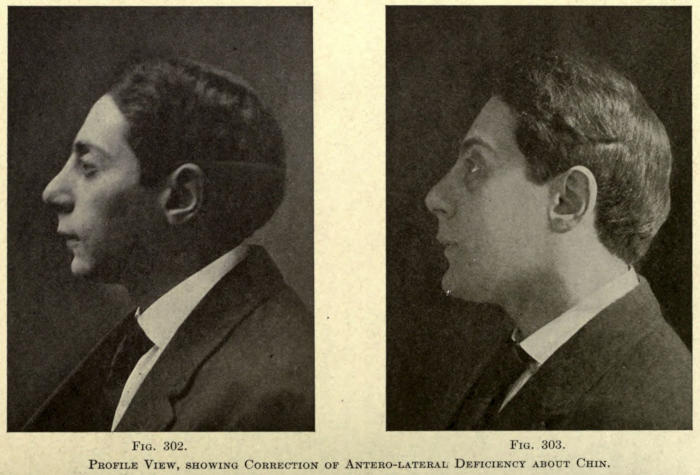
Fig. 302. Fig. 303.
Profile View, showing Correction of Antero-lateral Deficiency about Chin.
While it is true excellent results may be obtained with hard paraffin, used in liquefied form, it can often be shown, however, that the paraffin injected under pressure will run down in narrow, pencil-like streams underneath the chin and skin of the anterior aspect of the neck, where they may be felt afterward as hard oval cysts or of elongated form. This is not possible when the cold mixture of vaselin and paraffin is used, since the position of the mass can be easily followed with the eye or felt with the fingers.
The injections should be made from either angle at the first sitting. Enough of the mass should be introduced to leave a ridgelike formation across the anterior chin, varying in thickness according to the shape of the chin previous to operation and the form desired.
It is not well in chins of very deficient type to attempt to make the anterior contour as it should be in the first sitting. Too much pressure would be required, and unless the skin was freely movable considerable reactive inflammation would result, with possible necrosis of the skin in part and consequent expulsion of the injected mass.
The anterior line of such chins should be rebuilt in several sittings, always waiting for the parts to become normal in appearance and sensitiveness.
This method helps to stretch the skin, allowing of further injections and the introductions of a greater quantity than could be introduced at one time only.
The author advocates making two or three sittings of the anterior restoration of contour and two for each angle.
The angles of the chin are injected at a point about midway between the mental process and beginning of external oblique line. The mass is injected as near the inferior ridge as possible, and somewhat above the attachment of the platysma myoides muscle.
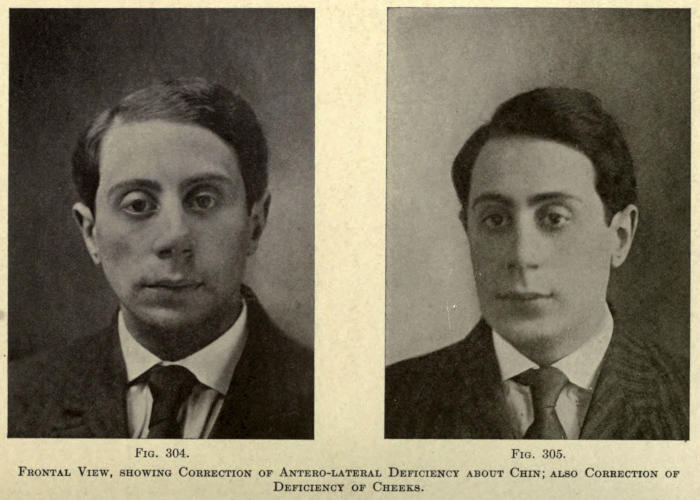
Fig. 304. Fig. 305.
Frontal View, showing Correction of Antero-lateral Deficiency about Chin; also Correction of Deficiency of Cheeks.
Only one needle insertion is made at each angle, and the mass is injected until a round elevated tumor is attained, which is pinched or squeezed with the fingers into the desired angular form, one finger being placed over the needle opening to avoid squeezing the mass out.
It can be readily seen that with this puttylike mass much better results than with the comparatively soft vaselin could be obtained while with the liquefied paraffin the operator would be at a loss to know just what had been accomplished until the mass had become fairly solidified, and then often finding the semisolid mass, which required rapid molding to give the desired shape before it would become hard and unmanageable, in a different position and much more distributed than he had expected.
For the latter reason repeated small injections have been advised, but the author believes oft-repeated injections of paraffin in a small area are prone to set up considerable disturbance, and that the resultant tissue replacement is interfered with. Furthermore, the injected mass would eventually be in grape-bunch like form, and in that condition not as manageable or inducive to the establishment of contour angulation, such as is required in the chin. The final appearance of chins thus rebuilt is heavy and rounded, lacking the concavity above the inferior prominence along the anterior line as well as the angulation laterally.
With the cold mixture advised a considerable mass may be injected at one sitting, which is easily molded into form and which retains that form unless the reactive inflammation is severe. This should not follow unless actual hyperinjection has been done or an unclean product has set up an infective cellulitis.
When the chin is uncommonly peaked, or small, it may be found necessary to inject both sides of the chin beyond the angle and in an upward direction slightly below and following the external oblique line.
Such deficiency may be found decidedly unilateral as a result of lack of development of one half of the lower maxillary bone, a resection of either maxilla for whatever cause, imperfect union following fracture or disease of the bone early in life.
In such cases the lateral deficiency must be first restored, using the same method, before the chin proper can be built up. Ofttimes the lower cheek of the affected side must also be injected. This should be done after the site overlying the former body of the maxilla of the affected side has been rebuilt. The cheek should then be built out above this hard linear mass by the injection of cold white vaselin, as heretofore referred to.
The following illustrations show a chin deficient anteriorly and laterally before and the result after correction.
The post-operative treatment should be collodion dressing, followed by cold antiseptic applications for at least two days. The latter ameliorates the inflammation and helps to retain the molded shape of the mass. Subsequent sittings may be made one a week or ten days apart.
Deformities about the Ear
Pro-auricular Deficiency (Unilateral and Bilateral).—A deep furrow in front of the ear may be found unilateral in hemiatrophy of the face, but the condition is usually a bilateral one, due to malnutrition or the fatty degeneration of past middle age. In the latter case the depression is accompanied by a redundancy and wrinkling of the skin.
Owing to the close proximity of the large temporal vessels a hard mass should never be injected subcutaneously for the relief of this condition. Even the mixture of vaselin and paraffin has caused considerable reaction when injected to overlie these vessels.
The author advises the injection of white sterile vaselin or sperm oil for this form of correction. It should be carefully injected, since the vessels lie close to the skin with the anterior auricular crossing transversely about the center of the furrow.
Every precaution should be taken, one injection only being made from below upward at each sitting if more than one is necessary, and then only after the needle has been unscrewed from the syringe to make sure vessel bleeding does not follow the puncture.
The reaction is usually severe, with considerable edema and ecchymosis.
The resultant tissue formation likewise is active, and hyperplasia at this site is not uncommon, especially if the mixture or hard paraffin has been employed.
A cellulitis following such an injection is exceedingly troublesome, the injected mass being thrown off usually at the base of the furrow, which is followed by a low type of inflammation with a protracted oozing of serous exudate. Should such a case come under the care of the surgeon, thorough cleansing of the affected site under scrupulous antisepsis should be done at once, and wet antiseptic dressings be applied daily until the wound is entirely healed.
A plastic skin operation must be done in most of these cases to overcome the ragged cicatrix formed upon healing of the wound. This should never be undertaken until the wound has been healed for several weeks at least.
After the injection of the parts cold antiseptic dressings should be applied at once, and kept up until every sign of reactive inflammation has subsided. At no time should the subsequent injection be undertaken before a month has elapsed from the time of the former operation.
Post-auricular Deficiency.—This defect is invariably unilateral, and then the result of a mastoid operation.
The skin about the depressed site will be found to be more or less firmly adherent, necessitating subcutaneous dissection before an injection for correction can be undertaken.
In this case the cold mixture of vaselin and paraffin is indicated, since the softer products will hardly suffice to elevate the tense skin. If the former surgical operation has been done some time previous to the required injection the parts may at one or two sittings be restored to a fairly normal contour, depending entirely upon the amount of ungiving scar tissue at the site. If the parts are tender and not reduced to normal, the injections should be made frequently, about ten days apart, injecting a small mass across and through the subcutaneous scar attachment at each sitting.
The reactions following such injections help to tease the scar away from the bony tissue, but should not be sufficient to cause extensive inflammation.
The same mode of post-operative treatment as has been given with pro-auricular corrections should be followed.
SPECIFIC TECHNIQUE FOR THE CORRECTION OF DEFORMITIES ABOUT THE SHOULDERS
Deficiencies about the base of the neck and the shoulders are very commonly found in women. These defects are usually bilateral, except in rare cases. The much-desired contour is readily restored by the subcutaneous-injection method, and since the technic for one part is the same as for the whole there is no need to dilate specifically upon the treatment of each part.
The author advocates the injection of cold sterile white vaselin only, for the restoration of the contour about the neck, anterior and posterior shoulder, and the mammæ, except in the unilateral correction of a flattening of the breast following amputation for the removal of neoplasms, when the mixture of white vaselin and paraffin should be used, owing to the tenseness of the skin following the excision of a large part of the integument covering the diseased gland.
In the restoration of the contour about the neck and shoulders it is well for the surgeon to familiarize himself thoroughly with the superficial veins of the parts, since the vessels here are larger, and the introduction of foreign matter into them is liable to lead to serious and even fatal results.
The injections should never be made until the operator has assured himself of the fact that a vessel has not been entered into, and then only should a small quantity of the mass—i. e., about two or three drams—be injected at one point.
The easiest mode of introducing the needle is to pinch up the skin between the fingers of one hand, introducing the needle into the fold thus raised. As the mass is injected the skin should be raised by aid of the needle, so as to allow all the immediate room possible for its reception.
The mass injected is at once molded down flat with the thumb or forefinger.
A number of such injections may be made at both sides at the one sitting. The ethyl-chlorid spray may be employed to render the parts less painful. At no time should the entire shoulders be filled at one sitting, for fear that the reaction may be severe or that for any unforeseen cause infection results which would in such instance be indeed difficult of treatment, eventually leaving the parts scarred and unsightly.
Nor should the mass be injected intracutaneously, a fault sometimes observed about the base line of the neck anteriorly and laterally where the operator has been timid in avoiding the exterior and anterior jugular veins. Such injections invariably result in abscess, or when not extensive enough to cause necrosis the skin assumes a more or less permanent red or yellow discoloration over the site so injected.
The treatment for the partial or total removal of such spots has been referred to.
In the average case of contour restoration of the shoulders about eight sittings are required, two sittings being given each week, and as many injections made as is deemed necessary or advisable at each.
All the precautions of technic heretofore given should be employed. The reaction following such injections is never severe, and little or no treatment is necessary.
The needle openings are covered with aristol collodion or the isinglass adhesive plaster.
At the end of six months or more after the injected matter has been quite thoroughly replaced with new connective tissue it is often found necessary to inject small quantities here and there about the shoulders, owing to the contraction of the new tissue and its ultimate fixed disposition about the parts more than to the absorption of the mass injected.
Furthermore, a certain amount of edema or swelling follows the injection of any foreign matter under the skin which is not, in cases of this kind, so readily absorbed, giving during that period of time a more pronounced contour or fullness, which, passing away in the natural course of events, does not imply the absorption of the matter injected—a statement so often made by those not in favor of using paraffins of low melting points for subcutaneous protheses.
Such result, however extensive, as it might be in some cases for the lack of proper injection or in the case with oil injections is at all times correctable, while the hyperplastic knobs, so often following the injection of paraffins of high melting points about the shoulder, can only be removed by surgical means, which leave the parts more unsightly than before anything had been done for the patient.