BOOK XI.
Reading edition
Practical Inferences from the foregoing Survey.

Having in the preceding Books carried my Survey as far as I care at present to engage my self, all that remaineth, is to draw some Inferences from the foregoing Scene of the great Creator’s Works, and so conclude this Part of my intended Work.

CHAP. I.
That God’s Works are Great and Excellent.
The first Inference I shall make, shall be by way of Confirmation of the Text, That the Works of the Lord are great[a]. And this is necessary to be observed, not against the Atheist only, but all other careless, incurious Observers of God’s Works. Many of our useful Labours, and some of our best modern Books shall be condemned with only this Note of Reproach, That they are about trivial Matters[b], when in Truth they are ingenious and noble Discoveries of the Works of GOD. And how often will many own the World in general to be a Manifestation of the Infinite Creator, but look upon the several Parts thereof as only Toys and Trifles, scarce deserving their Regard? But in the foregoing (I may call it) transient View I have given of this lower, and most slighted Part of the Creation, I have, I hope, abundantly made out, that all the Works of the Lord, from the most regarded, admired, and praised, to the meanest and most slighted, are great and glorious Works, incomparably contrived, and as admirably made, fitted up, and placed in the World. So far then are any of the Works of the LORD, (even those esteemed the meanest) from deserving to be disregarded, or contemned by us[c], that on the contrary they deserve (as shall be shewn in the next Chapter) to be sought out, enquired after, and curiously and diligently pryed into by us; as I have shewed the Word in the Text implies.
FOOTNOTES:
CHAP. II.
That God’s Works ought to be enquir’d into, and that such Enquiries are commendable.
The Creator doubtless did not bestow so much Curiosity, and exquisite Workmanship and Skill upon his Creatures, to be looked upon with a careless, incurious Eye, especially to have them slighted or contemned; but to be admired by the rational Part of the World, to magnify his own Power, Wisdom and Goodness throughout all the World, and the Ages thereof. And therefore we may look upon it as a great Error, not to answer those Ends of the infinite Creator, but rather to oppose and affront them. On the contrary, my Text commends GOD’s Works, not only for being great, but also approves of those curious and ingenious Enquirers, that seek them out, or pry into them. And the more we pry into, and discover of them, the greater and more glorious we find them to be, the more worthy of, and the more expressly to proclaim their great Creator.
Commendable then are the Researches, which many amongst us have, of late Years, made into the Works of Nature, more than hath been done in some Ages before. And therefore when we are asked, Cui Bono? To what Purpose such Enquiries, such Pains, such Expense? The Answer is easy, It is to answer the Ends for which GOD bestowed so much Art, Wisdom and Power about them, as well as given us Senses to view and survey them; and an Understanding and Curiosity to search into them: It is to follow and trace him, when and whither he leads us, that we may see and admire his Handy-work our selves, and set it forth to others, that they may see, admire and praise it also. I shall then conclude this Inference with what Elihu recommends, Job xxxvi. 24, 25. Remember that thou magnify his Work, which Men behold. Every Man may see it, Men may behold it afar off.
CHAP. III.
That God’s Works are manifest to all: Whence the Unreasonableness of Infidelity.
The concluding Words of the preceding Chapter suggests a third Inference, that the Works of GOD are so visible to all the World, and withal such manifest Indications of the Being, and Attributes of the infinite Creator, that they plainly argue the Vileness and Perversness of the Atheist, and leave him inexcusable. For it is a sign a Man is a wilful, perverse Atheist, that will impute so glorious a Work, as the Creation is, to any Thing, yea, a mere Nothing (as Chance is) rather than to GOD[a]. ’Tis a sign the Man is wilfully blind, that he is under the Power of the Devil, under the Government of Prejudice, Lust, and Passion, not right Reason, that will not discern what every one can see, what every Man may behold afar off, even the Existence and Attributes of the CREATOR from his Works. For as there is no Speech or Language where their Voice is not heard, their Line is gone out through all the Earth, and their Words to the End of the World: So all, even the barbarous Nations, that never heard of GOD, have from these his Works inferred the Existence of a Deity, and paid their Homages to some Deity, although they have been under great Mistakes in their Notions and Conclusions about him. But however, this shews how naturally and universally all Mankind agree, in deducing their Belief of a God from the Contemplation of his Works, or as even Epicurus himself, in Tully[b] saith, from a Notion that Nature it self hath imprinted upon the Minds of Men. For, saith he, what Nation is there, or what kind of Men, that without any Teaching or Instructions, have not a kind of Anticipation, or preconceived Notion of a Deity?
An Atheist therefore (if ever there was any such) may justly be esteemed a Monster among rational Beings; a Thing hard to be met with in the whole Tribe of Mankind; an Opposer of all the World[c]; a Rebel against human Nature and Reason, as well as against his GOD.
But above all, monstrous is this, or would be, in such as have heard of GOD, who have had the Benefit of the clear Gospel-Revelation. And still more monstrous this would be, in one born and baptized in the Christian Church, that hath studied Nature, and pried farther than others into God’s Works. For such an one (if it be possible for such to be) to deny the Existence, or any of the Attributes of GOD, would be a great Argument of the infinite Inconvenience of those Sins of Intemperance, Lust, and Riot, that have made the Man abandon his Reason, his Senses, yea, I had almost said his very human Nature[d], to engage him thus to deny the Being of GOD.
So also it is much the same monstrous Infidelity, at least betrays the same atheistical Mind, to deny GOD’s Providence, Care and Government of the World, or (which is a Spawn of the same Epicurean Principles) to deny Final Causes[e] in God’s Works of Creation; or with the Profane in Psal. lxxiii. 11. to say, How doth God know? And is there Knowledge in the most High? For as the witty and eloquent Salvian saith[f], They that affirm nothing is seen by GOD, will, in all Probability, take away the Substance, as well as Sight of God.——But what so great Madness, saith he, as that when a Man doth not deny GOD to be the Creator of all Things, he should deny him to be the Governour of them? Or when he confesseth him to be the Maker, he should say, GOD neglecteth what he hath so made?
FOOTNOTES:
CHAP. IV.
That God’s Works ought to excite us to Fear and Obedience to God.
Since the Works of the Creation are all of them so many Demonstrations of the infinite Wisdom and Power of God, they may serve to us as so many Arguments exciting us to the constant Fear of God, and to a steady, hearty Obedience to all his Laws. And thus we may make these Works as serviceable to our spiritual Interest, as they all are to our Life, and temporal Interest. For if whenever we see them, we would consider that these are the Works of our infinite Lord and Master, to whom we are to be accountable for all our Thoughts, Words and Works, and that in these we may see his infinite Power and Wisdom; this would check us in Sinning, and excite us to serve and please him who is above all Controul, and who hath our Life and whole Happiness in his Power. After this manner GOD himself argues with his own foolish People, and without Understanding, who had Eyes, and saw not, and had Ears, and heard not, Jer. v. 21, 22. Fear ye not me? saith the Lord: will ye not tremble at my Presence, which have placed the Sand for the Bound of the Sea, by a perpetual Decree, that it cannot pass it; and though the Waves thereof toss themselves, yet can they not prevail; though they roar, yet can they not pass over it?
This was an Argument that the most ignorant, stupid Wretches could not but apprehend; that a Being that had so vast and unruly an Element, as the Sea, absolutely at his Command, ought to be feared and obeyed; and that he ought to be considered as the Sovereign Lord of the World, on whom the World’s Prosperity and Happiness did wholly depend; v. 24. Neither say they in their Heart, let us now fear the Lord our God, that giveth Rain, both the former and the latter in his Season: He reserveth unto us the appointed Weeks of the Harvest.
CHAP. V.
That God’s Works ought to excite us to Thankfulness.
As the Demonstrations which GOD hath given of his infinite Power and Wisdom should excite us to Fear and Obedience; so I shall shew in this Chapter, that the Demonstrations which he hath given of his infinite Goodness in his Works, may excite us to due Thankfulness and Praise. It appears throughout the foregoing Survey, what Kindness GOD hath shewn to his Creatures in providing every Thing conducing to their Life, Prosperity, and Happiness[a]; how they are all contrived and made in the best Manner, placed in the fittest Places of the World for their Habitation and Comfort; accoutered in the best Manner, and accommodated with every, even all the minutest Things that may minister to their Health, Happiness, Office, Occasions, and Business in the World.
Upon which Account, Thankfulness and Praise is so reasonable, so just a Debt to the Creator, that the Psalmist calleth upon all the Creatures to praise God, in Psalm cxlviii. Praise him all his Angels, Praise him all his Hosts; Sun, Moon, Stars of Light, Heavens of Heavens, and Waters above the Heavens. The Reason given for which is, ℣. 5, 6. For he commanded, and they were created; he hath also established them for ever and ever; he hath made a Decree which they shall not pass. And not these Celestials alone, but the Creatures of the Earth and Waters too, even the Meteors, Fire and Hail, Snow and Vapours, stormy Winds fulfilling his Word. Yea, the very Mountains and Hills, Trees, Beasts, and all Cattle, creeping Things, and flying Fowl. But in a particular manner, all the Ranks and Orders, all the Ages and Sexes of Mankind are charged with this Duty; Let them praise the Name of the Lord, for his Name alone is excellent; his Glory is above the Earth and Heavens, ℣. 13.
And great Reason there is we should be excited to true and unfeigned Thankfulness and Praise[b] to this our great Benefactor, if we reflect upon what hath been shewn in the preceding Survey, that the Creator hath done for Man alone, without any regard to the rest of the Creatures, which some have held were made for the Sake of Man. Let us but reflect upon the Excellence and Immortality of our Soul; the incomparable Contrivance, and curious Structure of our Body; and the Care and Caution taken for the Security and Happiness of our State, and we shall find, that among the whole Race of Beings, Man hath especial Reason to magnify the Creator’s Goodness, and with suitable ardent Affections to be thankful unto him.
FOOTNOTES:
CHAP. VI.
That we ought to pay God all due Homage and Worship, particularly that of the Lord’s Day.
For a Conclusion of these Lectures, the last Thing I shall infer, from the foregoing Demonstration of the Being and Attributes of GOD, shall be, that we ought to pay GOD all that Homage and Worship which his Right of Creation and Dominion entitle him unto, and his great Mercies call for from us. And forasmuch as the Creator appointed, from the very Creation, one Day in seven to his Service, it will not therefore be improper to say something upon that Subject: And if I insist somewhat particularly and largely thereon, the Congruity thereof to the Design of these Lectures, and the foregoing Demonstration, together with the too great Inadvertency about, and Neglect of this ancient, universal, and most reasonable and necessary Duty, will, I hope, plead my Excuse. But that I may say no more than is necessary on this Point, I shall confine my self to two things, the Time God hath taken, and the Business then to be performed.
I. The Time is one Day in seven, and one of the ancientest Appointments it is which GOD gave to the World. For as soon as GOD had finished his six Days Works of Creation, it is said, Gen. ii. 2, 3. he rested on the seventh Day from all his Work which he had made. And GOD blessed the seventh day, and sanctified it, because that in it he had rested from all his Work. This Sanctification[a], and blessing the Seventh Day, was setting it apart, as a Day of Distinction from the rest of the Week-Days, and appropriating it to holy Uses and Purposes, namely, the Commemoration of that great Work of the Creation, and paying Homage and Worship to that infinite Being, who was the Effector of it.
This Day, thus consecrated from the Beginning, for the Celebration of the τοῦ κόσμου γενέσιον the World’s Birth-Day, as Philo calls it, was probably in some measure forgotten in the following wicked Ages, which God complains of, Gen. vi. 5. and so after the Flood likewise. But after the Return out of Ægypt, when GOD settled the Jewish Polity, he was pleased to renew this Day, and to establish it for a perpetual standing Law. And accordingly it was observed down to our blessed SAVIOUR’s Time, countenanced, and strictly observed by our great LORD and Master himself, and his Apostles and Disciples in, and after his Time; and although for good Reasons the Day was changed by them, yet a seventh Day hath been constantly observed in all Ages of Christianity, down to our present Time.
Thus we have a Day appointed by GOD himself, and observed throughout all Ages, except some few perhaps, which deserve not to be brought into Example.
And a wise Designation of Time this is, well becoming the divine Care and Precaution; serving for the recruiting our Bodies, and dispatching our Affairs, and at the same Time to keep up a Spiritual Temper of Mind. For by allowing six Days to labour, the Poor hath Time to earn his Bread, the Man of Business Time to dispatch his Affairs, and every Man Time for the Work of his respective Calling. But had there been more, or all our Time allotted to Labour and Business, and none to rest and recruit, our Bodies and Spirits would have been too much fatigued and wasted, and our Minds have been too long engaged about worldly Matters, so as to have forgotten divine Things. But the infinitely wise Ruler of the World, having taken the seventh Part of our Time to his own Service, hath prevented these Inconveniencies; hath given a Relaxation to our selves; and Ease and Refreshment to our wearied Beasts, to poor fatigued Slaves, and such as are under the Bondage of avaritious, cruel Masters. And this is one Reason Moses gives of the Reservation and Rest on the Seventh Day, Deut. v. 13, 14, 15. Six Days shalt thou labour, and do all thy Work; but the Seventh is the Sabbath of the LORD thy GOD; in it thou shalt not do any Work, thou, nor thy Children, Servants, Cattel, or Stranger, that thy Man Servant and Maid Servant may rest as well as thou. And remember, that thou wast a Servant, &c. therefore the Lord thy God commanded thee to keep the Sabbath Day. That carnal, greedy People, so bent upon Gain, without such a Precept, would have scarce favoured their own Bodies, much less have had Mercy upon their poor Bonds-men and Beasts, but by this wise Provision, this great Burden was taken off. But on the other hand, as a longer Liberty would too much have robbed the Master’s Time, and bred Idleness, so by this wise Provision, of only one Day of Rest, to six of Labour, that inconvenience was also prevented.
Thus the wise Governour of the World, hath taken Care for the Dispatch of Business. But then as too long Engagement about worldly Matters, would take off Mens Minds from God and divine Matters, so by this Reservation of every Seventh Day, that great Inconvenience is prevented also; all being then bound to worship their great Lord and Master, to pay their Homages, and Acknowledgments to their infinitely kind Benefactor; and in a word, to exercise themselves in divine, religious Business, and so keep up that spiritual Temper of Mind, that a perpetual, or too long Application to the World would destroy.
This, as it was a good Reason for the Order of a Sabbath to the Jews; so is as good it Reason for our Saviour’s Continuance of the like Time in the Christian Church.
And a Law this is, becoming the infinitely wise Creator and Conservator of the World, a Law, not only of great Use to the perpetuating the Remembrance of those greatest of God’s Mercies then commemorated, but also exactly adapted to the Life, Occasions, and State of Man; of Man living in this, and a-kin to another World: A Law well calculated to the Dispatch of our Affairs, without hurting our Bodies or Minds. And since the Law is so wise and good, we have great Reason then to practise carefully the Duties incumbent upon us; which will fall under the Consideration of the
II. Thing I proposed, the Business of the Day, which God hath reserved to himself. And there are two Things enjoyned in the Commandment, a Cessation from Labour and worldly Business, and that we remember to keep the Day holy.
1. There must be a Cessation from worldly Business, or a Rest from Labour, as the Word Sabbath[b] signifies. Six Days thou shalt do all thy Work, but the Seventh is the Sabbath of the Lord thy GOD (not thy Day but his) in which neither thou, nor any belonging to thee, shall do any Work. In which Injunction it is observable, how express and particular this Commandment is, more than others, in ordering all Sorts of Persons to cease from Work.
2. We must remember to keep the Day holy. Which Remembrance is another Thing also in this, more than in the other Commandments, and implies,
1st, That there is great Danger of our forgetting, neglecting, or being hindred from keeping the Day holy, either by the Infirmity and Carnality of our own Nature, or from the Avocations of the World.
2ly, That the keeping it holy, is a Duty of more than ordinary Consequence and Necessity. And of greatest Consequence this is,
First, To perpetuate the Remembrance of those grand Works of GOD commemorated on that Day; in the first Ages of the World, the Creation; in the middle Ages, the Creation and Delivery from Ægypt; and under Christianity, the Creation and Redemption by Christ. Which Mercies, without such frequent Occasions, would be ready to be forgotten, or disregarded, in so long a Tract of Time, as the World hath already stood, and may, by God’s Mercy still stand.
Secondly, To keep up a spiritual Temper of Mind, by those frequent weekly Exercises of Religion, as hath been already mention’d.
Thirdly, To procure GOD’s Blessing upon the Labours and Business of our six Days, which we can never expect should be prosperous, if we are negligent of GOD’s Time. For how can we expect GOD’s Blessing upon a Week so ill begun, with a Neglect, or Abuse of GOD’s first Day? And therefore if we become unprosperous in the World; if Losses, Troubles or Dangers befall us, let us reflect how we have spent the Lord’s Day; whether we have not wholly neglected it, or abused it in Riot, or made it a Day for taking Journeys, for more private Business, and less scandalous Labour, as the Custom of too many is.
Thus having shewn what Reason there is to remember to keep holy the Day dedicated to GOD, I shall consider how we are to keep it holy, and so conclude. Now the Way to keep it holy, is not by bare resting from Work; for that, as a Father saith, is Sabbatum Boum & Asinorum, a Sabbath of Beasts: But holy Acts are the proper Business for a holy Day, celebrated by rational Beings. Among all which, the grand, principal, and most universally practis’d, is the Publick Worship of GOD, the assembling at the publick Place of his Worship, to pay (with our Fellow-Creatures) our Homages, Thanks, and Praises to the infinite Creator and Redeemer of the World. This as it is the most reasonable Service, and proper Business for this Day, so is what hath been the Practice of all Ages. It was as early as Cain and Abel’s Days, Gen. iv. 3. what was practis’d by religious Persons in the following Ages, till the giving of the Law; and at the giving of that, God was pleas’d to order Places, and his particular Worship, as well as the seventh Day. The Tabernacle and Temple were appointed by God’s express Command; besides which, there were Synagogues all over the Nation; so that in our Saviour’s Time, every great Town or Village had one, or more in it, and Jerusalem 460, or more[c].
The Worship of these Places, our blessed SAVIOUR was a constant and diligent frequenter of. ’Tis said, He went about all the Cities and Villages, Teaching in their Synagogues, and Preaching, and Healing, &c. Mat. ix. 35. And St. Luke reporteth it as his constant Custom or Practice, Luke iv. 16. And as his Custom was, he went into the Synagogue on the Sabbath-Day.
Having thus mention’d the Practice of CHRIST, it is not necessary I should say much of the Practice of his Apostles, and the following purer Ages of Christianity, who, in short, as their Duty was, diligently follow’d their great Master’s Example. They did not think it enough to read and pray, and praise God at Home, but made Conscience of appearing in the publick Assemblies, from which nothing but Sickness and absolute Necessity did detain them; and if Sick, or in Prison, or under Banishment, nothing troubled them more, than that they could not come to Church, and joyn their Devotions to the common Services. If Persecution at any Time forc’d them to keep a little Close; yet no sooner was there the least Mitigation, but they presently return’d to their open Duty, and publickly met all together. No trivial Pretences, no light Excuses were then admitted for any ones Absence from the Congregation, but according to the Merit of the Cause, severe Censures were pass’d upon them, &c. to express it in the Words of one of our best Antiquaries[d].
The publick Worship of GOD then, is not a Matter of Indifference, which Men have in their own Power to do, or omit as they please; neither is it enough to read, pray, or praise God at Home, (unless some inevitable Necessity hindereth;) because the appearing in GOD’s Home, on his Day, is an Act of Homage and Fealty, due to the CREATOR, a Right of Sovereignty we pay him. And the with-holding those Rights and Dues from GOD, is a kind of rejecting GOD, a disowning his Sovereignty, and a withdrawing our Obedience and Service. And this was the very Reason why the Profanation of the Sabbath was punish’d with Death among the Jews, the Sabbath being a Sign, or Badge of the GOD they own’d and worshipp’d.[e] Thus Exod. xxii. 13. My Sabbaths ye shall keep; for it is a SIGN between me and you, throughout your Generations; that ye may know that I am the LORD, that doth sanctify you; or as the Original may be render’d, a Sign to acknowledge, that I Jehovah am your Sanctifier, or your God: For as our learned Mede observes, to be the Sanctifier of a People, and to be their God, is all one. So likewise very expressly in Ezek. xx. 20. Hallow my Sabbaths, and they shall be a Sign between me and you, that ye may know that I am the LORD your GOD; or rather as before, to acknowledge that I JEHOVAH am your GOD.
The Sabbath being thus a Sign, a Mark, or Badge, to acknowledge God to be their God, it follows, that a Neglect or Contempt of that Day, redounded to GOD; to slight that, was slighting God; to profane that, was to affront God; for the Punishment of which, What more equitable Penalty than Death? And although under Christianity, the Punishment is not made Capital, yet have we no less Reason for the strict Observance of this holy Day, than the Jews, but rather greater Reasons. For the GOD we worship, is the same: If after six Days Labour, he was, by the Seventh, own’d to be GOD, the Creator; no less is he by our Christian Lord’s Day: If by the Celebration of the Sabbath, the Remembrance of their Deliverance from the Ægyptian Bondage was kept up, and GOD acknowledged to be the Effecter thereof; we Christians have a greater Deliverance, we own our Deliverance from Sin and Satan, wrought by a greater Redeemer than Moses, even the blessed JESUS, whose Resurrection, and the Completion of our Redemption thereby, was perform’d on the Christian Lord’s-Day.
And now to sum up, and conclude these Inferences, and so put an End to this Part of my Survey: Since it appears, that the Works of the LORD are so great, so wisely contriv’d, so accurately made, as to deserve to be enquired into; since they are also so manifest Demonstrations of the Creator’s Being and Attributes, that all the World is sensible thereof, to the great Reproach of Atheism: What remaineth? But that we fear and obey so great and tremendous a Being; that we be truly thankful for, and magnify and praise his infinite Mercy, manifested to us in his Works. And forasmuch as he hath appointed a Day on Purpose, from the Beginning, for these Services, that we may weekly meet together, commemorate and celebrate the great Work of Creation, that we may pay our Acts of Devotion, Worship, Homage and Fealty to him; and since this is a wise and excellent Distribution of our Time, What should we do, but conscientiously and faithfully pay GOD these his Rights and Dues? And as carefully and diligently manage GOD’s Time and Discharge his Business then, as we do our own upon our six Days; particularly that with the pious Psalmist, We love the Habitation of God’s House, and the Place where his Honour dwelleth; and therefore take up his good Resolution in Psal. v. 7. with which I shall conclude; But as for me, I will come into thine House in the Multitude of thy Mercy, and in thy Fear will I worship towards thy holy Temple.
Now to the same infinite GOD, the omnipotent Creator and Preserver of the World, the most gracious Redeemer, Sanctifier, and Inspirer of Mankind, be all Honour, Praise and Thanks, now and ever. Amen.

FOOTNOTES:
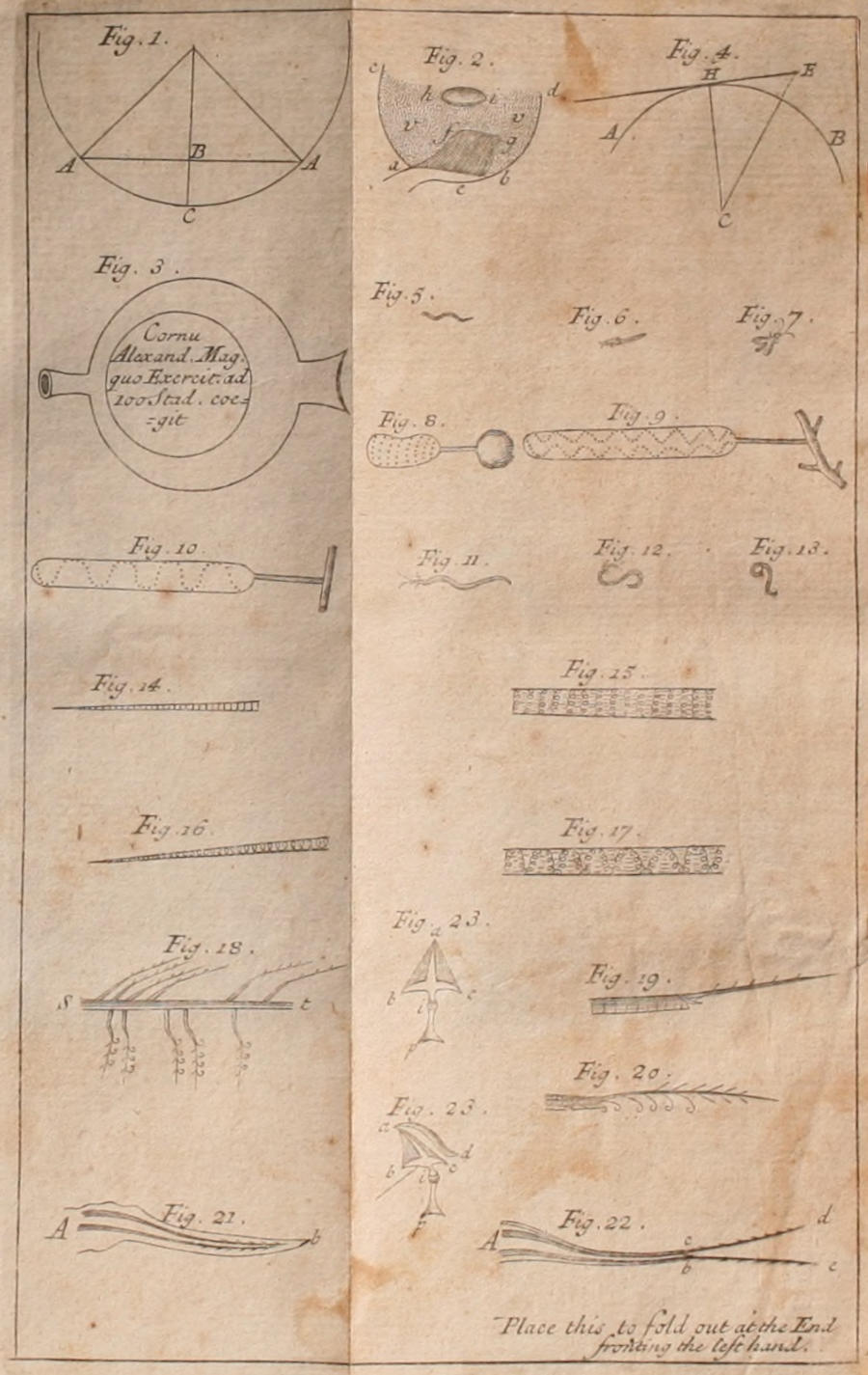
Place this to fold out at the End fronting the left hand.