THE BONES
Reading edition
By reason of the care with which the bones were collected from the Minisink cemetery, those of the different adult skeletons were kept apart as found and are thus perfectly identifiable as to individuals. Excluding those of adolescents and children, there are present the bones of 32 adult skeletons, and in the majority of cases these are almost complete. Of these 32 individuals, 17 were male and 15 female, thus affording a fair series for comparison.
The bones in general are practically normal and almost free from important anomalies. They indicate people of medium to somewhat above medium stature, and of good though not excessive muscular development. In their morphological features they approximate in many respects the bones of whites, yet differ in numerous interesting particulars.
Although a number of the subjects represented by the skeletal remains were old people, there is an absence of light bones or of other evidences of senility. The proportion of such bones in modern whites is in fact much larger than among any of the Indians, either prehistoric or modern, a fact of considerable physiological importance.
Humerus
GENERAL OBSERVATIONS
There are present 46 adult humeri, mostly perfect and almost all paired. The principal measurements of these are given in the following table:
XXXIX. MUNSEE: HUMERI
MALES
Right
Number of adult humeri Length, maximum Diameters at middle[48] Index of shaft (b × 100) a
Major (a) Minor (b)
Average: cm. cm. cm.
Paired (13) 32.5 2.24 1.65 73.6
Total present (14) 32.5 2.25 1.65 73.4
Minimum:
Total present (14) 31.1 1.9 1.5 65.2
Maximum:
Total present (14) 34.4 2.6 1.85 81.6
Left
Average: cm. cm. cm.
Paired (13) 32.6 2.2 1.64 74.6
Total present (13) 32.6 2.2 1.64 74.6
Minimum:
Total present (13) 31. 1.85 1.4 65.2
Maximum:
Total present (13) 34.7 2.55 1.95 81.4
FEMALES
Right
Number of adult humeri Length, maximum Diameters at middle[49] Index of shaft (b × 100) a
Major (a) Minor (b)
Average: cm. cm. cm.
Paired (12) 30.6 2.09 1.43 68.4
Total present (15) 30.7 2.08 1.41 67.7
Minimum:
Total present (15) 28.5 1.9 1.2 61.9
Maximum:
Total present (15) 32.3 2.3 1.7 77.3
Left
Average: cm. cm. cm.
Paired (12) 30.2 2.01 1.4 69.8
Total present ((12) 30.2 2.01 1.4 69.8
Minimum:
Total present (12) 28.5 1.75 1.25 63.6
Maximum:
Total present (12) 31.9 2.2 1.7 77.3
The averages are in no way exceptional. Reference to the writer’s report on the Indian skeletal remains from Arkansas and Louisiana[50] will show that the humeri of that collection had practically the same dimensions.
The relation of the average of paired female humeri to that of paired male humeri is as 94.2 to 100, which is somewhat higher than existed among the Arkansas and Louisiana Indians (91.34 for 86 humeri), among Indians in general (91.2 for 602 humeri), and also among whites (91.8 for 2,700 humeri), but is lower than in the American negro (94.6 for 164 humeri). As no error in the sexual identification entered into the present series, the disparity here shown is difficult to explain, except perhaps by the result of some peculiar local occupational differences in the two sexes or a local hereditary multiplication of an individual peculiarity.
The right and left humeri are of practically the same length in the males, while in the females the average of the left bones is slightly inferior to that of the right, as is usual in most Indian tribes and also among the white and other races. The equal length of the arm bones in the males indicates probably a lack of specialized occupation.
The dimensions of the shaft of the humerus at the middle and their percental relation or index are interesting in several respects, as shown by the following data:
XL. COMPARISON IN DIMENSIONS OF MUNSEE WITH OTHER RACIAL HUMERI
MALES
Whites American negroes Munsee Other Indians
Number of humeri (both sides) (1,930) (112) (26) (348)
Length, cm. 32.53 32.7 32.55 31.67
Mean diameter of shaft at middle, cm. 2.02 2.09 1.93 1.91
Index of shaft 83 84.1 74.1 73.1
FEMALES
Number of humeri (both sides) (770) (52) (24) (254)
Length, cm. 29.8 30.9 30.4 28.9
Mean diameter of shaft at middle, cm. 1.83 1.89 1.78 1.69
Index of shaft 79.3 79.2 69.1 70.3
In the first place it will be seen that although the Munsee arm bones are practically of the same average length as those of the miscellaneous American whites, their strength in both sexes, and especially in the males, is greater in the whites. It will further be noted that the disproportion is especially pronounced in the thickness of the bone, the humerus of whites, both male and female, being the stouter, as a result of which the shaft index is decidedly higher in the whites than in the Indians—the Munsee humerus, in other words, is more platybrachic. Much the same distinction exists between the Munsee humeri and those of the American negro; while on the other hand it will be noted that in this respect there is close harmony between the Munsee and other Indians.
Referring again to the table on page 53, and contrasting the bones of the two sides, it will be observed that the left humerus in both sexes is on the average weaker, though the difference is quite small; also that the shaft index in both sexes is larger on the left side. Exactly the same conditions have been observed by the writer on the several series of arm bones of whites and negroes, and also on other Indians, as are presented in preceding tables, which fact shows that we are dealing with no accidental phenomena. The difference in the index between the two sides is due exclusively to the relatively greater breadth (i. e., the antero-posterior diameter) of the right bone, the thickness of the humerus being very nearly the same on the two sides of the body.
BUREAU OF AMERICAN ETHNOLOGY BULLETIN 62 PLATE 23
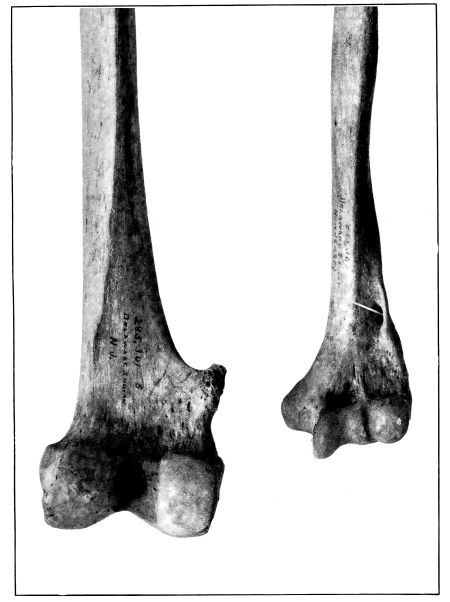
SUPRACONDYLOID PROCESS IN A FEMUR, AND A SPURIOUS SUPRACONDYLOID FORAMEN IN A HUMERUS OF THE MUNSEE
DETAILED OBSERVATIONS
Shape of the shaft.—A number of years ago the writer[51] called attention to the fact that in transverse sections at the middle the long-bones show each a considerable variety in the shape of the shaft, and that these varieties can be reduced for each bone to several distinct types of both functional and racial significance. As to the humeri, the most frequent shapes are the p. c., plano-convex or infantile form; type 1, or ordinary prismatic; type 2, lateral prismatic; and type 4, in which the anterior border is broadened out to a distinct fourth surface.
Among the Munsee the occurrence of shapes was as follows:
XLI. MUNSEE HUMERI: SHAPE OF SHAFT
Type MALES FEMALES
Right Left Right Left
Specimens Per cent Specimens Per cent Specimens Per cent Specimens Per cent
pc—plano-convex 3 21 2 15 2 13.3 3 23
1—ordinary prismatic or near 6 43 6 46 9 60 5 39
2—lateral prismatic 1 7 2 15 — — —
4—quadrilateral 2 14 — — 2 13.3 3 23
Various intermediate 2 14 3 23 2 13.3 2 15
The most frequent shape is the ordinary prismatic; the next in frequency is the plano-convex; the lateral prismatic is the least common. The significance of these conditions must be left for future consideration, when our data, especially on the American Indians, are more extensive.
Perforation of the septum.—The septum between the olecranon and coronoid fossæ in Indians often shows a smaller or a larger perforation. The frequency of this developmental anomaly or condition differs from tribe to tribe, and it differs also between the sexes, being as a rule more common in females. In the Munsee male humeri only six instances of such perforation exist, three in right and three in left bones, the total amounting to 22 per cent of the bones. In only one instance is the opening large; in three it is medium; in one small, and in one of pin-point size. In the 29 female humeri which could be examined for this feature the conditions are quite different, the perforation being present in no fewer than 17 cases, or nearly 59 per cent of the bones. Eight of the 17 are right (47 per cent), nine left (53 per cent). As to size of the perforation, one is pin-point, eight small, and eight medium; none is large.
Supracondyloid process.—This process, which in a more or less rudimentary form, and especially in the form of a ridge, is not rare in whites, is very uncommon in the Indians, though even in this race in the majority of humeri some roughness, or even a slight ridge, can be detected in its position. Among the Munsee humeri no specimen shows more than a trace of the anomaly.
The rarity of this process in the Indian is of additional interest from the fact that it seems to be shared by other branches of the yellow-brown race, and also by the blacks; moreover, the process appears to be absent, or nearly so, in the humeri of all known apes. The problem as to why a feature of this nature, which appears clearly to be reversive, should be more common in modern whites than in the more primitive races and even in the anthropoid apes and the lower primates, offers a fruitful field for investigation.
Radius
The total number of radii in condition to be measured is 41, 19 male and 22 female. Taking the paired bones in the males, we find that their length is equal on the two sides, as was very nearly the case with the humeri; in the females the right radius averages slightly longer than the left, again as in the arm bones of this sex. The arms as a whole were therefore of very nearly the same length on the two sides in the males, but the right was generally slightly longer than the left in the females, a condition which in all probability was connected with the relatively greater use of the right hand and arm in the latter sex.
The percental relation between the length of the radius and that of the humerus approximates 79 on both sides in the males and 78 in the females. Indians of other localities show much the same condition, the index approximating in the males 78 on both sides and in the females 77 on both sides. In whites the same index is only 73.6 in the males and 72.8 in the females; while the American negro gave to the writer 77.4 for the male and 76.8 for the female sex. This means that the forearm in the Munsee and in Indians generally is relatively long; it is decidedly longer in relation to the humerus than in the whites, and so far as the Munsee are concerned it is even slightly longer than in the average American negro; and in all the groups it is to a slight extent relatively longer in the males than in the females.
In strength, curvature, and other features the Munsee radii show nothing exceptional. In fact, this bone is of secondary importance in the anthropology of modern races except in its relative proportions.
XLII. MUNSEE: RADIUS
LEGEND:
A = Radio-humeral index (R × 100)/H
MALES
Number of bones Right Left
Length, maximum Number of cases (A) Number of bones Length, maximum Number of cases (A)
Average: cm. cm.
Paired (9) 25.7 (8) 78.8 (9) 25.7 (8) 78.8
Total present (11) 25.65 (10) 78.9 (9) 25.7 (8) 78.8
Minimum, total present (11) 24.6 (10) 74.9 (9) 24.6 (8) 76.1
Maximum, total present (11) 26.6 (10) 82.5 (9) 26.4 (8) 82.1
FEMALES
Average:
Paired (10) 23.7 (10) 77.5 (10) 23.45 (10) 78
Total present (11) 23.66 (10) 77.5 (12) 23.54 (11) 78
Minimum, total present (11) 22 (10) 74.8 (12) 21.6 (11) 74.7
Maximum, total present (11) 24.7 (10) 80.1 (12) 24.6 (11) 80.1
Ulna
Like the radius, the Munsee ulna shows nothing specially noteworthy as regards its form. The curvature is moderate, as a rule, and so is the strength of the bone. The dimensions are presented in table XLIII.
As with the other two long-bones of the upper limb, the length of the ulna is practically the same on the two sides in the males, and slightly shorter on the left than on the right in the females.
XLIII. MUNSEE: ULNA
MALES FEMALES
Right Left
Number of bones Length, maximum Number of bones Length, maximum Number of bones Length, maximum Number of cases Length, maximum
Average: cm. cm. cm. cm.
Paired 6 27.6 6 27.5 10 25.5 10 25.2
Total present 8 27.5 9 27.7 11 25.45 11 25.3
Minimum 8 26.6 9 26.1 11 23.7 11 23.4
Maximum 8 28.6 9 29.3 11 26.5 11 26.5
Femur
GENERAL OBSERVATIONS
The total number of adult femora in condition for measurement is 60—33 males, 27 females.
The bones, as a rule, are normally developed and with one exception free from anomalies. The exception is the left femur of male subject no. 285,301, which shows a large spinous process on the mesial border of the bone above the internal condyle (proc. supracondyloideus femoris), as exhibited in plate 23. The linea aspera, while mostly well developed, is in no case exceptionally high. The curvature and torsion show nothing exceptional.
MEASUREMENTS
As this is the most important of the long-bones, a number of measurements besides the length were taken, as indicated below.
The mean bicondylar length of the Munsee femora, taking both sides together, is 45.5 cm. in the males and 42 cm. in the females. Judging from observations on whites and on other Indians, these lengths correspond to the average stature of approximately 167 cm. in the male and 156 cm. in the female Munsee. These figures are very close to those obtained by the help of the well-known Manouvrier and Rochet tables, and may therefore be safely accepted. They show that the Munsee were somewhat above the medium, but not really tall in stature.
XLIV. MUNSEE: FEMORA
LEGEND:
A = Number of bones
B = Length bicondylar
C = Length maximum
D = Number of cases
E = Humero-Femoral Index (H × 100)/F
F = Number of cases
G = Diameter antero-posterior at middle[52] (a)
H = Diameter lateral at middle[53] (b)
I = Index of shaft (b × 100/a)
J = Number of cases
K = Maximum (c)
L = Minimum (d)
M = Platymeric index (d × 100)/c
N = Diameters at upper flattening
MALES
Right
N
A B C D E F G H I J K L M
Average: cm. cm. cm. cm. cm. cm.
Paired 12 45.2 45.8 8 71.8 16 2.92 2.55 87.1 15 3.23 2.37 73.3
Total present 14 45.26 45.8 11 72.1 17 2.91 2.53 87.1 17 3.22 2.35 73.1
Minimum 14 43.4 43.8 11 69.6 17 2.5 2.24 73.5 17 2.9 2 64.6
Maximum 14 48.1 48.7 11 76.3 17 3.3 2.95 100 17 3.75 2.7 90
Left
Average:
Paired 12 45.4 45.9 8 71.7 16 2.9 2.6 89.9 15 3.33 2.38 71.6
Total present 15 45.82 46.3 9 71.3 — — — — — — — —
Minimum 15 43.7 44 9 67.7 16 2.5 2.25 75 15 2.9 2.1 59.5
Maximum 15 49.2 50 9 75.7 16 3.3 2.9 107.7 15 3.7 2.7 93.7
BUREAU OF AMERICAN ETHNOLOGY BULLETIN 62 PLATE 24
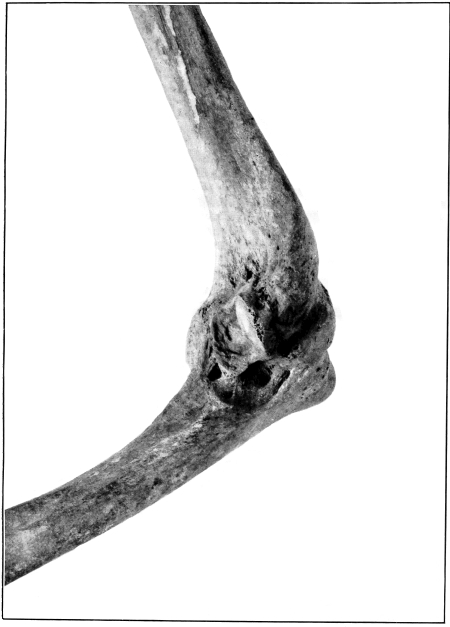
FUSION OF HUMERUS AND ULNA; MALE MUNSEE SKELETON, NO. 285,303, U.S.N.M
LEGEND:
A = Number of bones
B = Length bicondylar
C = Length maximum
D = Number of cases
E = Humero-Femoral Index (H × 100)/F
F = Number of cases
G = Diameter antero-posterior at middle[54] (a)
H = Diameter lateral at middle[55] (b)
I = Index of shaft (b × 100)/a
J = Number of cases
K = Maximum (c)
L = Minimum (d)
M = Platymeric index (d × 100)/c
N = Diameters at upper flattening
FEMALES
Right
N
A B C D E F G H I J K L M
Average: cm. cm. cm. cm. cm. cm.
Paired 13 42.1 42.65 10 72.6 13 2.58 2.35 91.2 12 2.88 2.17 75.5
Total present 14 — — 12 72.7 14 2.56 2.37 91.6 14 2.89 2.14 74
Minimum 14 39.4 40 12 70.6 14 2.3 2 82.1 14 2.5 1.85 56.9
Maximum 14 44.7 45.1 12 74.4 14 2.95 2.6 106.2 14 3.25 2.45 84.5
Left
Average:
Paired 13 41.9 42.6 10 71.65 13 2.48 2.38 93.1 12 3.03 2.17 71.7
Total present — — — — — — — — — — — — —
Minimum 13 39.6 40 10 69.4 13 2.25 2 83.3 12 2.6 1.8 56.1
Maximum 13 44.5 45.4 10 73.2 13 3 2.65 113 12 3.35 2.45 87.7
The two lengths of the femur, the bicondylar and the maximum, differ somewhat as a rule in favor of the latter. The difference is due and proportional to the inclination of the axis of the shaft and the development of the internal condyle, and ranges in different individuals from 0.5 mm. to 15 mm. In whites in all the groups studied it is moderate, not reaching 4 mm. in the average. In the American negro (who often has some white blood), the disproportion between the two lengths is slightly higher than in the whites, but additional observations are needed. Among Indians, however, the difference is perceptibly higher than among the whites, and is especially pronounced among the Munsee, where it reaches the average of nearly 5 mm. in the males (taking the mean of the two sides) and 6 mm. in the females. As the Munsee bones are perfectly normal, the explanation of this peculiarity must be sought either in an unusual breadth of the pelvis or in a somewhat greater length of the neck of the femur, and may be connected with some functional characteristic of these people, such as possibly a more than usual prevalence of the habit of squatting.
XLV. MUNSEE AND OTHER FEMORA: RELATIONS BETWEEN THE BICONDYLAR AND MAXIMUM LENGTH OF THE BONES
Munsee Other Indians United States whites Italians American negro
M. F. M. F. M. F. M. F. M. F.
Number of paired bones 12 12 55 22 100 50 31 8 12 8
Average excess of the maximum
over the bicondylar length:
Right, cm. 5.35 5.6 4 3.8 3.05 3.78 3 2.6 4 3.2
Left, cm. 4.2 6.45 4.2 3.2 2.55 3.8 2.58 2.1 3.25 3.5
The difference between the maximum and bicondylar length of the femur in some racial groups averages greater in the females than in the males, while in others the condition is reversed. Among the Munsee the females show the greater difference (6 mm. to slightly less than 5 mm. in the males); but this peculiarity is not shared by other Indian groups. A condition similar to that of the Munsee exists in this respect among the United States whites, where the difference between the two lengths averages 3.8 mm. in the females and only 2.8 mm. in the males; while among the Italians, and to a less extent the negroes, the disproportion is greater in the males (Italians: m. 2.8, f. 2.35 mm; negroes: m. 3.6, f. 3.35 mm.). The excess of the difference in males in these groups was unexpected, the usual impression being that the axis of the female femur is generally more oblique than that of the male; and the more oblique the axis, the greater should be the difference between the bicondylar and maximum length of the bone.
As to the two sides of the body, in the majority of the groups whose femora were studied, greater average differences were found between the two lengths of the bone on the right than on the left; in a few groups, however, such as the Munsee, the United States whites, and the United States negro females, the condition was reversed.
These interesting conditions and exceptions make it probable that an extended special study of the relations of the two femoral lengths would be well repaid by the results.
The relation in bicondylar length of the Munsee female to the male femora is as 92.7 to 100, and practically the same result was obtained in other Indians (92.65 to 100). In United States whites the proportion is as 93 to 100; in American negroes, as 93.1 to 100. These are striking similarities in people so far apart racially.
HUMERO-FEMORAL INDEX
The percental relation in length of the femur to the humerus in the Munsee, the humero-femoral index
maximum length of humerus × 100 ,
bicondylar length of femur
approximates in both sexes 72, which is very near the average in human races generally. The similarity of this important relation in different racial groups, as may be seen from the measurements by the writer in the next table, is quite remarkable.
As a rule the humero-femoral index is in both sexes slightly higher on the right than on the left side, and the Munsee form no exception in this particular. As to sex, while in all branches of the whites, as well as in the United States negroes, the male index on both sides is slightly higher, in the Munsee, as well as in other Indians, the index in the male is slightly lower than that in the female. These features are all connected, of course, with the peculiarities of the length of the Indian humerus as well as the femur, outlined in other chapters.
XLVI. HUMERO-FEMORAL INDEX IN THE MUNSEE AND IN OTHER RACIAL GROUPS
Male Female
Subjects Right Left Subjects Right Left
Munsee 8 71.8 71.7 10 72.6 71.7
Other Indians 100 72.3 71.6 61 72.7 71.8
United States whites 200 72.2 71.7 63 71.8 70.9
Irish 22 72.6 71.9 35 71.7 70.6
Germans 86 72.8 72 21 72.4 71.3
Italians 39 72.5 72.3 11 72.6 72
Other whites 53 73.9 73 15 72.9 71.3
United States negroes 25 71.7 71.5 13 70.3 70.2
THE SHAFT
The measurements taken at the middle of the shaft in the Munsee femora indicate generally a moderate development. The mean diameter is smaller in both sexes than it is in ordinary American whites and negroes[56] of the same stature. The same condition, though in a somewhat lesser degree, was observable in the Arkansas and Louisiana Indian femora, and there are reasons to believe that it is common to other Indian tribes, if not general in the race. The whites and negroes used here for comparison are of course those of the working classes, or such as find their way into dissecting rooms.
As to the strength of the femur on the two sides of the body, the difference in the Munsee, as well as in other Indians and racial groups, is very small. However, in the males a slightly higher average mean diameter is seen in the left femur, while in the females the condition is reversed. Curiously the same slight excess in strength of the left femur in the male and of the right in the female is exhibited also by the United States whites, while in the United States negroes, in both sexes, the bones of the two sides are exactly equal, as is shown in the following table:
XLVII. STRENGTH OF THE FEMUR ON THE TWO SIDES OF THE BODY
MEAN DIAMETER AT THE MIDDLE OF THE SHAFT
Munsee United States whites United States negroes
Male: cm. cm. cm.
Right 2.73 2.89 2.91
Left 2.75 2.91 2.91
Female:
Right 2.46 2.74 2.60
Left 2.43 2.64 2.60
Taking the antero-posterior and lateral diameters at the middle of the shaft separately, we find several more interesting points. The antero-posterior diameter in the Munsee (and the same is true of the United States whites and United States negroes, as will be seen by the following table) is practically equivalent in the right and left femora in the males; but except in the whites it is perceptibly smaller on the left side in the females of all groups. On the other hand, the lateral diameter, excepting in the probably too small male negro series, is invariably larger on the left than on the right side in both males and females. Thus it may be said that the left femur is almost invariably slightly broader on the average than the right, and this especially in the females of probably all racial groups.
These interesting conditions are most clearly shown by the shaft index
diameter lateral × 100
diameter antero-posterior
which in both sexes and in all the racial subdivisions is higher on the left side.
The index in the Munsee femora is noteworthy in another respect: It is decidedly smaller in both sexes of this group than it is in the American negro and especially in the United States whites. Judging from data on other Indians in the writer’s possession, it seems very probable that the characteristic shown by the Munsee in this regard is common to Indians in general. As may be seen by reference to the figures in the following table, the low shaft index in the Munsee is due entirely to smaller breadth; the Munsee femur is relatively narrower than that of both whites and negroes.
XLVIII. COMPARISON OF THE PROPORTIONS AND INDEX OF THE SHAFT OF THE FEMUR AT MIDDLE, IN MUNSEE, WHITES, AND NEGROES. PAIRED BONES
MALES
Right Left
Diameter antero- posterior Diameter lateral Index Diameter antero- posterior Diameter lateral Index
Munsee: cm. cm. cm. cm.
Specimens (16) (16) (16) (16) (16) (16)
Average 2.92 2.55 87.1 2.90 2.61 89.9
United States whites:
Specimens (66) (66) (66) (66) (66) (66)
Average 2.95 2.84 96.3 2.95 2.87 97.4
United States negroes:
Specimens (6) (6) (6) (6) (6) (6)
Average 3.06 2.77 90.5 3.06 2.77 90.5
FEMALES
Munsee:
Specimens (13) (13) (13) (13) (13) (13)
Average 2.58 2.35 91.2 2.48 2.38 93.1
United States whites:
Specimens (28) (28) (28) (28) (28) (28)
Average 2.64 2.58 97.7 2.65 2.63 99.5
United States negroes:
Specimens (7) (7) (7) (7) (7) (7)
Average 2.68 2.53 94.4 2.63 2.58 98.1
PLATYMERY
Another anthropologically important region of the femur is the subtrochanteric flattening, which, as well known, has been studied in whites and in other races by Manouvrier and other observers.[57] The flattening in question is situated below the minor trochanter, reaching its maximum at approximately 3 cm. below that point. It yields itself to two measurements, the maximum and the minimum diameter, and the percental relation of the latter to the former constitutes the platymeric index. This index is generally quite high in whites, in whom the flattening is but moderate.
The next table shows the conditions found in this respect with regard to the Munsee, the United States whites, and the United States negroes.
XLIX. COMPARISON OF THE PROPORTIONS AND INDEX OF THE SHAFT OF THE FEMUR AT THE SUBTROCHANTERIC FLATTENING, IN THE MUNSEE, WHITES, AND NEGROES. PAIRED BONES
MALES
Right Left
Diameter maximum Diameter minimum Index Diameter maximum Diameter minimum Index
Munsee: cm. cm. cm. cm.
Specimens (15) (15) (15) (15) (15) (15)
Average 3.23 2.37 73.3 3.38 2.38 71.6
United States whites:
Specimens (66) (66) (66) (66) (66) (66)
Average 3.25 2.69 82.8 3.24 2.73 84.1
United States negroes:
Specimens (6) (6) (6) (6) (6) (6)
Average 3.07 2.68 87.3 3.17 2.73 86.3
FEMALES
Munsee:
Specimens (12) (12) (12) (12) (12) (12)
Average 2.88 2.17 75.5 3.03 2.17 71.7
United States whites:
Specimens (28) (28) (28) (28) (28) (28)
Average 2.94 2.39 81.1 3.0 2.39 79.6
United States negroes:
Specimens (7) (7) (7) (7) (7) (7)
Average 3.02 2.42 80.1 2.97 2.44 82
It will be observed, in the first place, that at the middle of the shaft the mean of the two diameters at the upper flattening in the Munsee is smaller in both sexes and on both sides than that in either the whites or the negroes, thus indicating that the bone is more slender.
The most striking points brought out by the data are, however, those relating to the degree of the flattening in the subtrochanteric region in the different racial groups. The Munsee femora are decidedly flatter than those of the whites, which in turn are slightly flatter than those of the negro. As a result the platymeric index in the Munsee is considerably below that in both the other races.
Taking the two diameters separately it will be observed that the diameter maximum or breadth is frequently larger in the left than in the right femur. This is true in both sexes among the Munsee and in the white females and negro males. In the white males the measurement is equal on the two sides, and in the negro females it is slightly larger on the right than on the left. In all probability the tendency of the left femur to be slightly broader than the right at the subtrochanteric flattening is quite universal.
The lateral diameter or thickness is also slightly larger in the left femur in nearly all the racial and sex groups, but the excess is less than with the breadth. It is thus evident that the left femur at this point is in general slightly stronger than the right. But, as already indicated, the mean excess in breadth is mostly greater than that in thickness, the result of which in most of the groups is a slightly lower platymeric index on the left side.
As to sexes, the platymeric index in the Munsee is slightly higher on both sides in the females than in the males. This is exceptional for Indians, the condition being usually the reverse. In the United States whites and United States negroes, and in Indian tribes other than the Munsee examined by the writer, the male femur as a rule gives a somewhat higher average index on both sides than the female, indicating that the flattening in the male is of lesser degree.
As to the sides, in the majority of the groups, and particularly in the Munsee, the right platymeric index is slightly higher than the left. In the Arkansas and Louisiana Indians it was very nearly equal on the two sides in both sexes. In the series of United States white males used here for comparison, and in the United States negro females, the right index is higher. Evidently, while the preponderant tendency is for the right platymeric index to be slightly higher than the left, there are not infrequent exceptions, but the differences are not of much importance.
To summarize, it may be stated that at the subtrochanteric flattening the Munsee femur shows a decidedly greater compression than the femora of the United States whites, and especially those of United States negroes; it shows a slightly greater relative flatness in the male than in the female, which is exceptional; and in the majority of cases it is relatively slightly flatter on the left than on the right side of the body.
These details may seem rather involved, and perhaps in some instances of no great consequence. But when at some time we shall be able to examine scores of records where we have now but few, and each series of records extending to hundreds instead of to only tens of specimens, the above points will assume a definite morphological importance, demonstrating on the one side the presence of astonishingly uniform and persistent laws relating even to secondary characteristics of bones, and, on the other, to clear, conspicuous, racial sexual and other group differences.
SPECIAL CHARACTERISTICS OF THE FEMORA
As to special descriptive characteristics of the Munsee femora, special attention was paid to the linea aspera, the shape of the shaft at middle, and the presence and development of the third trochanter.
Linea aspera.—The linea aspera was found to be generally well developed, but seldom high and in no case excessively rough, indicating well but not exceptionally developed musculature.
Shape of the shaft.—As to the shape of the shaft at middle, in a fourth of the males and in nearly half the females this was found to be more or less prismatic, and in 9 per cent of the males and 7.5 per cent of the females, plano-convex; the remainder of the bones showing, with one exception, intermediary or not well-defined shapes. None of the femora present the cylindrical (juvenile) type, or type 4 (anterior surface divided in two by a long vertical ridge), and in but one bone is the shape clearly elliptical. Among the whites the last named (elliptical) form is much more common, while the plano-convex type is less frequent than in the Indians.[58]
Third trochanter.—Respecting the third trochanter, this presents itself as a more or less marked ridge, or an oblong tuberosity, or a round tuberosity; and in any of these forms it may be slight, medium, or pronounced. In some instances there will be found a depression, instead of an elevation, in the bone at or near this locality. These different forms have no separate morphological significance. They all serve for or are due to the attachment of the gluteus maximus muscle, and merge into each other by transitional stages. In the Munsee, conditions in regard to the third trochanter were as follows:
L. MUNSEE AND WHITE FEMORA: THIRD TROCHANTER OR GLUTEAL TUBEROSITY
Subjects Third trochanter absent Ridge
Moderate Pronounced
Munsee: Per cent Per cent Per cent
Male (17) 30 40 —
Female (14) 32 36 —
Whites:
Male (200) 43 32 4.5
Female (120) 45 31 5
Oblong tuberosity Round tuberosity
Moderate Pronounced Moderate Pronounced
Munsee: Per cent Per cent Per cent Per cent
Male 26 — 6 —
Female 22 3.5 3.5 3.5
Whites:
Male 9 5 3.5 3
Female 12.5 1.7 5 —
It is here seen that the third trochanter is strictly absent in less than a third of the male as well as of the female bones of the Munsee; a small to pronounced oblong tuberosity exists in 26 per cent of the males, and practically the same proportion (25.5 per cent) of the females, while a rounded tuberosity is found in 6 per cent of the males and in 7 per cent of the females. Among the previously reported Arkansas and Louisiana Indian femora, the frequency of the third trochanter in most of its forms was somewhat greater. Among the ordinary American whites, it will be observed from the above figures, there is in both sexes a more frequent complete absence of the third trochanter in any form than in the Munsee; there is less frequency of the moderate ridge and moderate oblong tuberosity; and a greater frequency of pronounced grades of both ridge and oblong tuberosity, while the occurrence of round tuberosity is about even in the two groups. Subtrochanteric fossa in place of or beside a prominence was observed in Munsee adults in five cases—four males and one female. In adolescents it was more frequent.
Tibia
The results of the several measurements obtained on the Munsee tibiæ are shown below.
The mean length of the bone, taking the two sides together, is 38.5 cm. in the males and 35.3 cm. in the females. The length of the female bone stands to that of the male as 91.7 to 100, which is lower than was obtained on the tibiæ from Louisiana, where the proportion was 93.7, or than that prevailing among whites, where it is even slightly higher (94.6 in miscellaneous New York whites). The Munsee female tibiæ are therefore relatively somewhat short, paralleling to some extent what was found with reference to the radius. Lesser differences of the same nature is found in probably all larger racial groups. Why the feature should be more pronounced in the Munsee than in other Indians is difficult of explanation; but, as will be seen later, this is not the only peculiarity of the female Munsee tibiæ.
LI. MUNSEE: TIBIÆ
LEGEND:
A = Length[59]
B = Diameter[60] antero-posterior at middle (a)
C = Diameter[61] lateral at middle (b)
D = Index of shaft at middle (b×100/a)
E = Tibio-femoral index (T×100/F)
MALES
Right
Number of bones (A) Number of cases (B) (C) (D) Number of cases (E)
Average: cm. cm. cm.
Paired (11) 38.3 (14) 3.28 2.14 65.4 (19) 84.4
Total present (12) 38.5 (14) 3.28 2.14 65.4 (10) 84.6
Minimum (12) 36 (14) 3.05 1.95 56.3 (10) 81.1
Maximum (12) 40.5 (14) 3.55 2.4 69.7 (10) 86.9
Left
Average:
Paired (11) 38.6 (14) 3.25 2.16 66.6 (9) 84.5
Total present (12) 38.8 (15) 3.23 2.16 67.1 (11) 84.9
Minimum (12) 36.7 (15) 2.8 1.95 54.9 (11) 79.4
Maximum (12) 40.9 (15) 3.55 2.4 80.4 (11) 90.0
FEMALES
Right
Average: cm. cm. cm.
Paired (13) 35.3 (13) 2.6 1.98 76.1 (12) 83.7
Total present (14) 35.3 (13) 2.6 1.98 76.1 (12) 83.7
Minimum (13) 32.4 (13) 2.25 1.65 70.2 (12) 81.4
Maximum (13) 37.1 (13) 2.85 2.3 86.7 (12) 87.7
Left
Average:
Paired (13) 35.2 (13) 2.6 1.93 74.5 (12) 83.7
Total present (14) 35.2 (14) 2.64 1.96 74.6 (12) 83.7
Minimum (14) 32.4 (14) 2.25 1.5 58.8 (12) 81.5
Maximum (14) 36.7 (14) 2.8 2.35 82.2 (12) 86.1
As to the two sides, the Munsee left tibia averages somewhat longer in the males than the right, which on the whole in slight measure is also the condition among the whites, but to which individual and even group exceptions are not infrequent. In the Munsee females, on the other hand, the average length of the left tibia is slightly less (by 1 mm.) than that of the right.
The percental relation of the length of the tibia with the bicondylar length of the femur, or the tibio-femoral index, averages in whites approximately 82 in the males and slightly less in the females. In the Munsee it is somewhat more elevated in both sexes. As in the whites and other racial groups, a moderate excess of the male over the female index is present on both sides, indicating the slightly greater relative shortness of the female leg bones aforementioned. Judging from the available data on the tibio-femoral index among other Indians,[62] that in the Munsee comes very near to the average of the race.
The strength of the Munsee tibia (and the same is probably true of many other Indian tribes) is surprising, being nearer that of the whites than is the case with either the humerus or the femur. The antero-posterior diameter of the Indian tibia is, in fact, in almost all the Indian groups somewhat greater than in the whites. The index of the shaft is invariably and quite perceptibly lower in the Indians than in the whites, excepting the Munsee females, in whom, curiously enough, the index is relatively quite high, exceeding both that of the other Indians available for comparison and of the whites. No satisfactory explanation of this and other exceptional features of the Munsee tibia can be given. The condition can scarcely be regarded as accidental, for on examining the individual shaft indexes it is observed that in but one of the female bones is the index below 60, giving thus a pronounced platycnemy; in five it is between 60 and 70; in ten between 70 and 80, and in no fewer than eleven it rises to 80 or over. Among the twenty-nine male Munsee tibiæ there is but one that gives a shaft index of slightly above 80.
LII. MEAN DIMENSIONS OF THE TIBIA (THE TWO SIDES BEING TAKEN TOGETHER) IN THE MUNSEE AND OTHER INDIANS, AND IN WHITES
LEGEND:
A = Mean diameter antero-posterior at middle[63] (a)
B = Mean diameter lateral at middle[64] (b)
C = Module[65]
D = Index of shaft at middle (b × 100)/a
E = Tibio-femoral index (T × 100)/F
Length (A) (B) (C) (D) (E)
Males: cm. cm. cm. cm.
Munsee 38.45 3.27 2.15 2.71 66 84.45
Arkansas 38.4 3.35 2.18 2.76 65.15 82.35
Louisiana 37.1 3.3 2.2 2.75 68.47 84.25
Whites (miscellaneous) 36.5 3.14 2.22 2.68 71.1 82
Females:
Munsee 35.25 2.6 1.96 2.28 75.3 83.7
Arkansas 33.15 2.8 1.98 2.39 69.25 82.35
Louisiana 34.75 2.9 1.88 2.39 64.2 83.9
Whites (miscellaneous) 34.56 2.65 1.96 2.3 71.9 81.6
The Munsee tibiæ, barring a few moderate inflammatory lesions referred to in another section, are normal throughout and free from anomalies. The inclination of the head is in no case especially marked.
As to the shape of the shaft at middle, conditions were found as follows:
LIII. MUNSEE TIBIÆ: SHAPE OF SHAFT AT MIDDLE[66]
1 2 3 4 5 6 I
Per cent Per cent Per cent Per cent Per cent Per cent Per cent
Males 11 13.5 7 24 3.5 — 40
Females 44 11 — 15 3.5 — 26
It is interesting to note that in the female Munsee tibia, type 1 is decidedly frequent and much more common than in the males; type 3, which is usually associated with considerably developed leg muscles, is absent in the females; type 4 is relatively frequent in both sexes; type 6 is wholly absent.
In the next table are shown for comparison the proportions of the different types found by the author in different racial groups. For the purpose of elucidating these data, both sexes are taken together. It is seen that well-differentiated type 1 is most common in the Indians; that type 2 is relatively scarce in the negro; type 3, most common in the white (laboring class), was not met with in a pronounced form in the negro; type 4 is decidedly more common in the Indian than in the other two races; and type 6, absent in the Indians and rare in the whites, is fairly frequent in the negro. These differences show that the shape of the shaft of the tibia, as that of the femur, humerus, and other bones, has a considerable racial significance, which, as our data are increased, will doubtless become accentuated.
LIV. COMPARISON OF MUNSEE AND OTHER INDIAN WITH WHITE AND NEGRO TIBIÆ WITH REFERENCE TO SHAPE OF SHAFT AT MIDDLE[67]
Types 1 2 3 4 5 6 I
Per cent Per cent Per cent Per cent Per cent Per cent Per cent
Munsee (all—56) 27 12 3.5 20 3.5 — 34
Arkansas and Louisiana — — — — — — —
Miscellaneous whites (1975) 18 15 9 5 5 2 45
United States negroes (55) 20 9 — 7 7 11 45
Fibula
While of secondary importance, the fibula often presents interesting features which make it worthy of closer attention than it usually receives. One of these features concerns its length on the two sides of the body, which, in some Indians at least, is more uniform than that of its companion bone, the tibia. It was found so by the writer in the skeletal collections from Arkansas and Louisiana mounds, and the feature appears again in the Munsee. The slight differences presented by the Munsee fibulæ in this particular harmonize with those of the tibiæ.
The percental relation of the female to the male fibula averages 93.5 (the male bone = 100), while in the tibia it was only as 91.7 to 100.[68] This anomaly is due to the unexplained relative shortness of the female Munsee tibiæ.
As to the shape of the shaft, which in the fibula differs more than in any other bone, the prevalent tendency, as in the Arkansas and Louisiana specimens, is toward type 2, or the lateral prismatic; a good many of the bones, however, show also a more or less marked fluting of one or two of the surfaces. The details are given in the following table:
LV. MUNSEE FIBULA: LENGTH
Males Females
Right Left Right Left
Number of bones Length, maximum Number of bones Length, maximum Number of bones Length, maximum Number of bones Length, maximum
Average: cm. cm. cm. cm.
Paired (5) 36.9 (5) 37 (4) 34.9 (4) 34.8
All (6) 37.1 (6) 37.1 (9) 34.7 (7) 34.7
Minima (6) 35.3 (6) 35.8 (9) 32 (7) 31.8
Maxima (6) 39 (6) 38.8 (9) 36.8 (7) 36.9
LVI. MUNSEE AND OTHER INDIAN FIBULÆ— SHAPE OF SHAFT AT MIDDLE[69]
Types Males
1 2 and 2a 3 5 6 4
P.ct. P.ct. P.ct. P.ct. P.ct. P.ct.
Munsee 4 48 4 15 11 18
Arkansas and Louisiana 27 40 9 9 3 12
Females
P.ct. P.ct. P.ct. P.ct. P.ct. P.ct.
Munsee 5 32 18 5 14 27
Arkansas and Louisiana 17 42 4 4 17 17
Clavicle
The Munsee clavicle, in paired bones and in average, measures 15.3 cm. in length on the right and 15.25 cm. on the left in the males, and 13.7 cm. on the right with 13.9 cm. on the left in the females. This gives the ratio of 90.4 (female) to 100 (male), which is lower than that in any of the long-bones and indicates a relative shortness of the clavicle in the Munsee females.
The right clavicle is very slightly longer than the left in the male, but is perceptibly shorter than the left in the female skeletons. One pair of the male and a pair of the female bones show pronounced curves; otherwise there is nothing special. The strength of the bones is moderate to medium; none is massive.
LVII. MUNSEE CLAVICLE: LENGTH
Males Females
Right Left Right Left
Number of bones Length, maximum Number of bones Length, maximum Number of bones Length, maximum Number of bones Length, maximum
Average: cm. cm. cm. cm.
Paired (8) 15.35 (8) 15.3 (9) 13.7 (9) 13.9
All (9) 15.4 (10) 15.3 (11) 13.8 — —
Minima (9) 14.4 (10) 14.2 (11) 12.7 (9) 12.9
Maxima (9) 16.5 (10) 16.3 (11) 14.9 (9) 15.6
Sternum
The total number of sterna present is 14, 8 males and 6 females. In 13 of these specimens the manubrium is completely detached, which in general is the most usual condition, while in the 14th there is partial attachment. Much the same condition was found by the writer in the Indian sterna from Arkansas and Louisiana.
The measurements of the sternum, given in the next table, are found to be moderate throughout. Unfortunately there are few available measurements of the sternum in other races for comparison.
LVIII. MUNSEE STERNUM: DIMENSIONS
Males
Number of bones Total length (less xiphoid and episternals)[70] (a) Greatest breadth of body (b) Sternal Index (b×100) a Maximum thickness of body
Average: cm. cm. cm.
Paired (6) 15.7 3.7 23.8 1.2
All — 15.7 3.7 23.8 1.2
Minima All 14.6 3.4 21.1 1
Maxima All 17.5 4.2 25.8 1.3
Females
Average:
Paired (6) 13.8 3.5 25.7 0.9
Average All 13.8 3.5 25.7 0.9
Minima All 12.8 2.8 21.5 0.8
Maxima All 16.2 3.9 30.5 1
As to the rib facets, two of the 11 sterna in which the notches can be counted show seven on each side; in female skeleton no. 285,307, with normal number of ribs, there are seven notches on the right and but six on the left; in female no. 285,311, with 24 regular ribs and a right cervical, there are six facets on the right and seven on the left, and all the facets on the right side are situated perceptibly higher than those on the opposite side of the bone; in four instances there are six facets on each side; in two (male no. 285,301 and female no. 285,330, the former with the normal number of ribs and the latter uncertain) the sternum shows six facets on the right and but five on the left side; finally, in female no. 285,310, with 24 ribs, we find but five sternal facets on each side—this subject, however, was not fully adult. These details show that there are considerable irregularities in the sternal facets among the Munsee, even in the presence of the normal number of ribs.
The antero-posterior curvature of the Munsee sternum ranges from slight to moderate. The xiphoid appendix is attached to the body of the sternum in only one instance—a male. In one male (no. 285,314) the left clavicular facet is considerably larger than the right.
Three of the male and one female sterna show on one or both sides attached episternal tubercles. In three of the cases the anomaly is unilateral—twice left and once right—while in one of the males it is bilateral, but the tubercle is more pronounced on the left.
The breadth-length index of the sternum shows considerable individual variation in both sexes, but on the average it is higher in the females, the bone in this sex being relatively shorter.
Scapula
GENERAL FEATURES
This is one of the most interesting bones of the body, and although it has been reported on by a number of observers, it presents a variety of features that deserve further study. It is a bone which in all particulars shows great individual variation, but on close scrutiny it is found that these variations differ more or less from group to group and are therefore of anthropological importance, and that they are subject to certain laws which evidently are universal to human kind.
In collections derived from graves, such as those of the Munsee, the scapulæ, on account of their frailness, are often damaged, so that relatively few specimens are available for examination. There are nevertheless in the Munsee collection five male and nine female bones in fair condition, and their study gives some satisfactory results. To contrast these results properly the writer presents in the following table data not only of the Munsee, but also those on several other Indian groups as well as on the whites and the United States negroes.
LIX. MUNSEE SCAPULÆ: COMPARISON
LEGEND:
A = Infra-spinous height
B = Breadth
C = Scapular index
D = Infra-spinous index
Specimens Total height (A) (B) (C) (D)
MALES cm. cm. cm.
Munsee (4) 15.2 11.2 10.6 69.5 94.2
Southern Utah cliff-dwellers (18) 15.1 11.6 10.15 67.4 87.7
Pima and Pueblo (5) 15.5 12 11.05 71 93
Various Mexican Indians (9) 15.8 12 10.4 65.5 86.6
Indians, Peru (55) 15.83 12 10.17 64.2 84.8
Indians, Peru (Livon) †† (17) 15.1 11.3 10 63.8 85.6
United States whites
(various nationalities) (70) 16.4 12.25 10.7 65.3 87.3
Whites (Livon) †† (73) 16.8 12.4 10.6 63 85.5
United States negroes (46) 16.25 11.6 10.9 66.8 92.1
FEMALES
Munsee (9) 13.9 10.4 9.9 70.7 95.3
Southern Utah cliff-dwellers (10) 13.7 10.25 9.7 70.6 94.2
Pima and Pueblo (5) 13.8 10.25 9.95 72 97
Various Mexican Indians (12) 13.75 10.25 9.75 70.7 94.9
Mexican Indians[71] (Livon) †† (2) 13.17 10.16 10.17 77.2 100
Indians, Peru (39) 13.78 10.47 9.17 66.5 87.5
Indians, Peru (Livon) †† (6) 13.5 10 9 67 88.4
United States whites
(various nationalities) (44) 14.4 10.9 9.6 66.7 88.4
Whites (Livon) †† [72](51) (13.5) (10.25) (9.1) 67.5 88.8
United States negroes (18) 14.2 10.2 9.25 65 90.7
†† M. Livon, De l’omoplate, etc., Thèse, Paris, 1879, pp. 41-42.
The above data show that the Indian scapula is on the whole somewhat smaller than that of either the whites or the American negroes, except in the females, where the bone, while shorter, is slightly broader than that in the other two races. The Munsee scapulæ compare fairly well with those of other Indian tribes, the apparent differences being doubtless due in a measure to the small number of specimens.
The scapular index in the Munsee is high, indicating that the shortness of the bone is both absolute and relative. The different Indian tribes offer considerable variation in this respect, but, as will be noted, except in the Peruvians, the index in all is above that of the whites and in the majority of cases even above that of the negroes. These high scapular indexes in the Indian approximate those of the anthropoid apes, but it remains to be determined if the phenomenon in the two genera is homologous.
In the female Munsee the scapular index is perceptibly higher than in the males, and this characteristic, owing to a relatively greater breadth of this bone in the females, is common to all the other given groups, excepting the negro.
The infraspinous index is also high in the Munsee as compared with other Indians, the whites, and even the negroes. This is particularly the case in the males, in whom the infraspinous height is exceptionally low.
The female index again exceeds that of the males in the Munsee and in all other Indian groups, as well as in the whites, owing to the relatively greater breadth of the female scapula. The negroes show here once more an exception to the rule, and it would be interesting to trace how far this peculiarity may be prevalent in that race.
High indexes, such as those of the Indians, have been reported by Livon, Broca, Ranke, and others,[73] among some of the African negroes, the Melanesians, the Malays, the Guanches, and the Egyptians.
DESCRIPTIVE FEATURES
The principal points for visual observation to which attention has been given in this instance were (a) the shape of the scapula as a whole, with the development of the teres major region; (b) the form of the superior border of the bone; and (c) the development of the notch in the superior border.
Type of body.—The scapula as a whole may be more or less neatly triangular or wedge-shaped, which form will be designated as type 1. Again, it may be more acutely wedge-shaped, with both its axillary and vertebral border markedly concave, a type which the author classes as 3.[74] It may be quadrilateral, type 4, with the axillary border augmented by a shorter but well-marked inferior border, due to a development of a process or angle by the influence of the teres major muscle. It may be pentagonal, when the preceding type is augmented by a distinct angle in the axillary border at or above the spine, which divides it into two well-marked borders—type 5. Finally, we may have a shape resembling that in many lower mammals and characterized by marked convexity of the axillary border, which will be referred to as type 6.
Among the 19 Munsee scapulæ, a large majority show types 4 and 5, the few remaining specimens approaching type 1. There is no instance of the relatively rare type 3, nor of type 6, which is quite common in other Indians, particularly the males. The following table gives several series of records for comparison, including that of United States whites. Analysis of the data shows some marked sexual as well as racial differences, the full value of which can not, however, be determined in the absence of more ample records. It is very plain, however, that type 1, or a close approach to it, and types 3 and 5 are, on the whole, more common in the females than in the males; while type 6 is decidedly more frequent in the males. Type 3 is relatively frequent in the whites, type 5 relatively scarce. In all probability the Indians differ considerably among themselves with respect to the shape of the scapulæ, as shown by the Munsee and Peruvian males, though the two series of specimens are very unequal in numbers. Minor differences in records of this nature can not be given any weight, for naturally the matter of classification of the different shapes is less perfect than that of accurate measurements.
LX. THE FORM OF THE SCAPULA: MUNSEE AND COMPARATIVE
MALES
People Specimens Indefinite Type 1 or near 1 Type 3 Type 4[75]
Per ct. Per ct. Per ct. Per ct.
Munsee (8) — 12 — 38
Peruvian Indians (57) 10.5 21 3.5 5
United States whites
(miscellaneous) (168) 4.8 28 9.5 9.5
United States negroes (40) — 22.5 5 17.5
FEMALES
Munsee (11) — 27 — 27
Peruvian Indians (38) — 29 5 5
United States whites
(miscellaneous) (118) 1.7 32.2 13.6 15.2
United States negroes (16) — — 25 19
MALES
People Type 5 near 5 Type 6 near 6
Per ct. Per ct. Per ct. Per ct.
Munsee 50 — — —
Peruvian Indians 5 — 37 17.5
United States whites
(miscellaneous) 17.9 7.7 14.3 8.3
United States negroes 32 2.5 15 5
FEMALES
Munsee 27 18 — —
Peruvian Indians 39 11 8 3
United States whites
(miscellaneous) 16.1 8.5 8.5 4.2
United States negroes 37.5 6 — 12.5
Superior border.—The form of the superior border of the scapula can be divided for purposes of description into (1) horizontal or slightly rising and forming a right or nearly right angle with a vertical line passing upward from the base of the coracoid; (2) moderately rising or oblique and straight or but slightly curved, forming with the coracoid vertical an angle of between 85 and 55°; (3) markedly oblique, forming with the coracoid vertical an angle of less than 55°; (4) angular or deep saddle-shaped, which is of special importance anthropologically; and (5) markedly concave or semilunar (see pl. 25). In rare instances a form (6) occurs, in which the border is low and moderately convex, and another (7) in which it is markedly concavo-convex; and, finally, there occurs now and then an indeterminate form (I), which can not be classified.
BUREAU OF AMERICAN ETHNOLOGY BULLETIN 62 PLATE 25
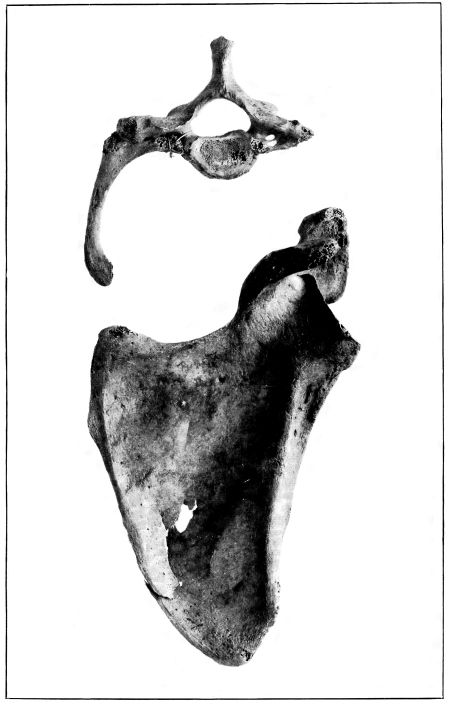
a THE SEVENTH CERVICAL VERTEBRA OF FEMALE MUNSEE SKELETON NO. 285,311, U.S.N.M., WITH A CERVICAL RIB
b SCAPULA OF FEMALE MUNSEE SKELETON NO. 285,328, U.S.N.M., SHOWING SEMILUNAR SHAPE OF THE SUPERIOR BORDER
LXI. FORM OF THE SUPERIOR BORDER OF THE SCAPULA IN THE MUNSEE AND IN OTHER RACIAL GROUPS
Group Specimens Types[76]
1 2 3 4 and near 4 5 and near 5 6 7
% % % % % % %
Munsee (16) — — 31.2 25 43.8 — —
Northwest Coast Indians (82) 6.7 27.5 35.4 25.6 4.9 — —
Southern Utah cliff-dwellers (53) 16.9 54.7 20.7 7.6 — — —
Mexican Indians (41) 37.8 39.1 15.8 4.8 2.4 — —
Peruvian Indians (95) — 37.9 15.8 17.9 26.3 — [77]
United States whites
(miscellaneous) (1,032) 15 48.5 11 8.2 16.7 0.3 0.5
The data obtained in this particular on the Munsee and other Indian groups, as well as on a large series of whites, are given in the next table. It is very evident that racial and tribal differences of some importance exist in the shape of the border. Among the whites its most common form is type 2, or moderate to medium oblique, pronounced obliquity being infrequent; types 4 and 5 occur but rarely. In the Munsee there is a curious but doubtless local prevalence of the semilunar type 5, the next most frequent form being that of pronounced obliquity; and one-fourth of the cases show the saddle form or an approach to it. Among other Indians the conditions differ. The cliff-dwellers of southern Utah come, on the whole, near to the whites; among the Mexican Indians low borders prevail, while among the Northwest Coast tribes we find the opposite condition—high borders, with a relative frequency of the angular or saddle-shaped type (4 or near 4). It is an interesting fact that the last named form (4) is frequent and often highly developed in the Eskimo.
The question occurs as to how the form of the superior border differs in the two sexes and on the two sides, and the next table throws some light on these problems. It will be observed that among the Indians the differences between the males and the females are not striking, though there is a tendency toward greater obliquity of the border in the males. Among the whites, types 1 and 4 are more common in the females than in the males; type 2 occurs about the same number of times in the two sexes, while types 3 and 5 are more frequent in the males.
LXII. FORM OF THE SUPERIOR BORDER IN MUNSEE AND OTHER INDIAN SCAPULÆ ACCORDING TO SEX AND SIDE
Sex and side Specimens Types
1 2 3 4 2-4 3-4 5
% % % % % % %
Males (both sides) (84) 11.9 34.5 33.3 5.9 3.6 3.6 71
Females (both sides) (110) 20 35.5 21.8 5.5 4.5 7.3 5.5
Right (both sexes) (104) 18.3 33.6 22.1 8.7 5.8 6.7 4.8
Left (both sexes) (90) 14.4 37.8 31.1 2.2 2.2 4.5 7.8
As to the two sides, we find that a slightly lesser tendency to marked obliquity of the border exists in the left than in the right scapula; while the bone of the right side shows greater frequency of the angular or deep saddle-shaped (type 4 or near 4).
Scapular notch.—The notch in the scapular border, at the base of the coracoid, which, as is well known, transmits the suprascapular nerve, may be absent, shallow, medium deep, or converted into a complete foramen. Among the 21 scapulæ of the Munsee and 431 of whites, the conditions in this respect, with reference to sex and side, are as follows:
LXIII. SCAPULAR NOTCH IN THE MUNSEE AND IN WHITES
Sex Specimens Form 1 (absent) Form 2 (shallow) Form 3 (medium) Form 4 (deep) Form 5 (complete foramen)
Munsee: % % % % %
Male (9) — 22 — 67 11
Female (12) 8 66 — 16 —
Peruvian Indians:
Male (57) 3.5 15.8 70.2 10.5 —
Female (37) 5.4 24.3 67.6 2.7 —
Whites:
Male (267) 0.7 15.4 57.3 22.8 3.7
Female (164) 3.7 15.2 64 16 1.2
Side
Munsee:
Right side (11) — 40 — 50 20
Left side (10) 10 60 — 30 —
Peruvian Indians:
Right side (50) 4 22 68 6 —
Left side (44) 4.5 15.9 70.5 9.1 —
Whites:
Right side (215) 2.3 14 62.3 18.6 2.8
Left side (216) 1.4 17.6 56.5 21.8 2.8
It is plain that while among the whites the medium form of the notch very largely predominates, among the Munsee this form is absent, though this is doubtless accidental to some extent at least, owing to the relatively small number of specimens. The complete foramen is much more frequent in the Munsee than in the whites.
As to the sexes, in both the Munsee and the whites there is observable a predominance of the deeper forms and the complete foramen among the males, and of the shallower forms and the complete absence of the notch in the females.
As to sides, no characteristic differences in the notch appear.
Ribs
Owing to careful collection, a large majority of the ribs from the Munsee cemetery were preserved and are with their respective skeletons, thus facilitating their study. Furthermore, we possess nearly all the bones of the spines, which show the rib facets.
The ribs present are marked throughout by medium and normal development. Fractures are very rare, there being only two (in one subject) among the 166 ribs of the males, and but one in 196 ribs of the females.[78] This speaks well for the peaceful life of the community.
The number of ribs is normal (24) in every one of the adult males; among the females, however, there are two interesting anomalies—namely: In female no. 285,311 there are 25 ribs, the additional one being well developed, 6.5 cm. long, right cervical; this rib approaches in form the ordinary first rib, while both the latter are unusually long, being about one-third longer than any of the other female first ribs in the series. The spinal formula in this case, curiously enough, is only 7-12-4, the fifth lumbar being attached to the sacrum. The second anomaly is present in female skeleton no. 285,321, with the spinal formula of 7-11-5, and consists of the absence of the last pair of ribs. The congenitally absent dorsal vertebra is the twelfth.
The first rib generally repays special examination, particularly as to its shape. This shows three main types—(1) the curved; (2) the mono-angular or pistol-shaped, with a nearly straight neck and straight body; and (3) the biangular, in which, besides the angle between the neck and the body, there is another distinct angle in the body itself, so that the rib appears as if it consisted of three segments. The relative frequency of these forms the author has reason to believe will be found to differ in the race and sex, but as a rule it is the same on both sides. In the Munsee the shapes found were as follows:
LXIV. MUNSEE: SHAPE OF RIBS
Subjects Type 1 or near 1 Type 2 or near 2 Type 3 or near 3
Per cent Per cent Per cent
Males (10) 70 20 10
Females (12) 75 25 —
The biangular form, which is fairly frequent in whites, is nearly absent in the Munsee, the one pair in the males presenting merely an approach to the form.
Spine
The entire number of vertebræ of 21 skeletons has been preserved, thus affording an excellent opportunity for studying the numerical relations of the bones, as well as other particulars.
The bones are entirely normal, with the exception of the frequent slightly to moderately developed marginal exostoses (which, unless premature or excessive, the author regards more and more as the usual manifestations of age rather than of disease), and one case of advanced spondylitis deformans, resulting in fusion of the lower half of the spine and the sacrum. The bones show moderate to medium development and are free from gross anomalies.
As to numbers, the cervical vertebræ show but one exception to the normal—namely, in male skeleton no. 285,326, in which only six vertebræ are present in this region. The locus of the (congenitally) missing one is between the third and the sixth, its exact identity being difficult to determine. In one of the females (no. 285,311) the seventh cervical, as already mentioned, gives attachment on the right to a well developed cervical rib (pl. 25, a).
The vertebræ of the dorsal region are also normal in number in all cases but one, which has been mentioned in connection with the ribs; it is no. 285,321, female, and presents a congenital absence of the twelfth vertebra.
The numbers of the lumbar vertebræ show frequent variation. In two of the ten males and two of the eleven females there are but four lumbars, while in one female there are six. In detail we find the following abnormalities:
In male skeleton no. 285,316, the fifth lumbar shows a transitional, sacral form, though not attached to the sacrum, and it also presents a detachment of the posterior part of its neural arch.
In male no. 285,326, one of the lumbar vertebræ between the second and fifth is absent congenitally.
In female no. 285,310, one of the lumbar vertebræ is missing congenitally; the last lumbar in this case is in form like the fifth; the upper segment of the sacrum is somewhat lumbar-like, but the bone possesses only five segments and a normal curvature.
In female no. 285,311, with four lumbar vertebræ, the fifth, somewhat modified, is attached to the sacrum (pl. 27).
In female no. 285,326, where we have six lumbar vertebræ, the last, like the lowest lumbar in male no. 285,316, shows a separation of the posterior portion of the neural arch.
In male no. 285,308, the twelfth dorsal and the first lumbar show complete and evidently early non-pathological fusion.
BUREAU OF AMERICAN ETHNOLOGY BULLETIN 62 PLATE 26
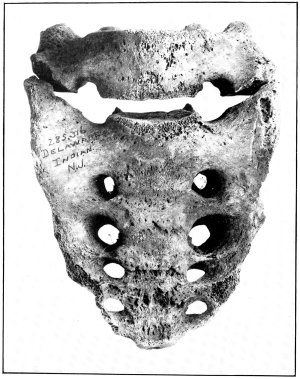
a MALE MUNSEE SACRUM SHOWING BILATERAL ARTICULATION WITH AN EXTRA SEGMENT INTRODUCED BETWEEN THE LAST LUMBAR AND THE SACRUM
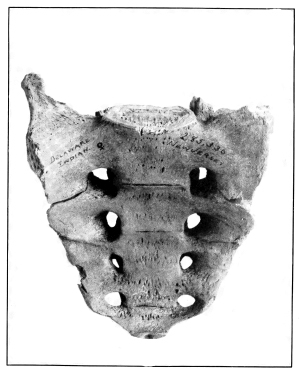
b FEMALE MUNSEE SACRUM SHOWING BILATERAL ARTICULATION WITH EXTRA SEGMENT
Sacrum
GENERAL OBSERVATIONS AND MEASUREMENTS
The total number of serviceable specimens of sacra is 17, only 13 of which, however (six males and seven females), are five-segment bones and sufficiently well preserved to afford the necessary measurements. The results show that, as usual, the male sacrum, while in breadth nearly equal to that of the female, is perceptibly higher, in consequence of which the sacral index, or percental relation of breadth to height, is lower in the males.
A comparison of the Munsee sacra with those of other Indians and United States whites shows marked agreement both in size and in the relative proportions of the bone in the males, but less in the females. As will be seen by the next table, the Munsee female sacrum is somewhat lower than that of any of the other series.[79]
LXV. MUNSEE SACRUM: DIMENSIONS
LEGEND:
A = Number of specimens
B = Height[80]
C = Breadth, maximum
D = Index (B×100/H)
Males Females
(A) (B) (C) (D) (A) (B) (C) (D)
cm. cm. cm. cm.
Average (6) 10.7 11.6 108.2 (7) 9.9 11.7 118.5
Average (including damaged specimens) All — — — (11) — 11.5
Minimum (including damaged specimens) All 9.9 11.3 102.6 (11) 8.9 11 104.7
Maximum (including damaged specimens) All 11.5 12.0 114.1 (11) 10.7 12.8 126.0
Emmons, who a few years ago, with the writer’s assistance, conducted an examination of 217 Indian female pelves,[81] obtained as a total average of his specimens (which however include also sacra of more than five segments), for the height 10 cm., breadth 11.5 cm., and index 115.8—figures which stand in close accord with the above. In the Negro race and in the Australians the sacrum, as is well known, is relatively narrower; and in much larger degree this is also the case in the anthropoid apes. The relatively broad and short sacrum of the whites and the Indians may therefore be regarded as a feature of an advanced evolutionary character.
LXVI. SACRUM: COMPARATIVE DATA
LEGEND:
A = Number of specimens[82]
People Males Females
(A) Height Breadth Index (A) Height Breadth Index
cm. cm. cm. cm.
Munsee (6) 10.7 11.6 108.2 (7) 9.9 11.7 118.5
Arkansas and Louisiana mounds (18) 10.95 12.2 111.6 (22) 10.2 11.96 117.2
Southern Utah cliff-dwellers (22) 10.8 11.55 106.9 (10) 10.1 11.33 112.2
Southwest and Mexico (15) 10.7 11.36 106.2 (18) 10.4 11.5 110.6
United States whites
SEGMENTS
Among the eight male Munsee sacra in which determination of the number of segments is feasible, six show five and two show six vertebræ, while among the 12 female bones there are 10 with five and two with six segments. We have thus four six-segmented sacra in 20, or 20 per cent. Emmons, in 217 female Indian pelves, found six segments in 19.8 per cent of the cases.
Among additional specimens examined by the writer, in 53 sacra of the southern Utah cliff-dwellers, five vertebræ were present in 37, or 70 per cent; six in 15, or 28 per cent; and seven in one, or 2 per cent. Of 42 sacra of Southwestern and Mexican Indians, 31, or 74 per cent, showed five; 10, or 24 per cent, six; and one, or 2 per cent, seven segments. As to whites, among 503 sacra of miscellaneous Americans of both sexes, five segments were present in only 66.4 per cent of the bones; six segments in 31 per cent; seven segments in 2 per cent, and eight in 0.4 per cent, while the whole coccyx was attached, non-pathologically, in one instance. The frequency of more than five vertebræ in the sacrum is therefore slightly to decidedly less in probably all the tribes of Indians than in the United States whites.
CURVATURE
The curvature of the sacrum in the Munsee can be described in 18 of the 20 specimens as medium, while in two (one male and one female) it is submedium. This agrees closely with the author’s observations on this feature in other Indians. In the United States whites the proportion of regular and medium forms is smaller, while not infrequently there exists in the sacrum of whites a pronounced curvature, which is very rare in the Indian. Among 115 Indian sacra from Arkansas, Louisiana, the Southwest, and Mexico, the writer found moderate or medium curvature in 75, or 65 per cent; submedium to slight in 24, or 21 per cent; and pronounced (though never excessively) in 16, or 14 per cent. Among the 217 specimens examined by Emmons, moderate or medium curvature was present in 148, or a little more than 67 per cent; submedium in 52, or 24 per cent; and pronounced in 18, or 8 per cent.
BUREAU OF AMERICAN ETHNOLOGY BULLETIN 62 PLATE 27
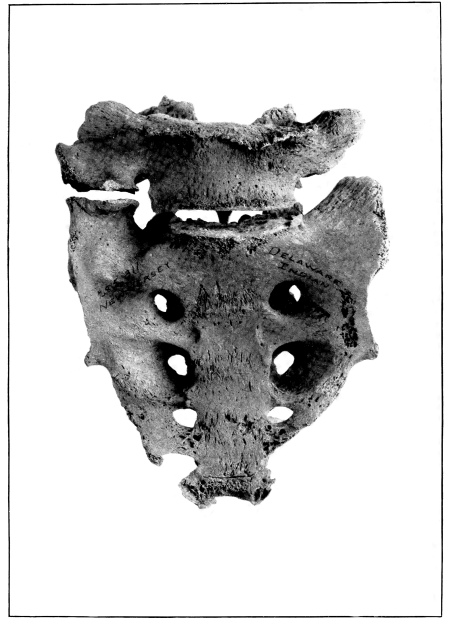
FEMALE MUNSEE SACRUM SHOWING UNILATERAL ARTICULATION WITH THE LAST FIFTH LUMBAR
The curve of the sacrum begins in the Munsee (and the same is true of other Indians) in a majority of cases with the first or upper-most segment, but in numerous instances with the second vertebra. More in detail, among the 20 Munsee sacra, in 13, or 65 per cent, the curve began with the first; in six, or 30 per cent, with the second; and in one, or 5 per cent of the cases, with the third vertebra. Among 113 sacra of both sexes from Arkansas, Louisiana, the Southwest, and Mexico, examined by the writer, the curve began in 52, or 46 per cent of the cases, with the first; in 42, or 37 per cent, with the second; in 14, or 12 per cent, with the third; and in five, or 4 per cent, with the fourth vertebra. In the female series studied by Emmons, the curve began in 41.5 per cent of the cases with the first; in 27 per cent with the second; in 22.5 per cent with the third; in 7.4 per cent with the fourth; and in 1.8 per cent with the fifth segment. Among whites, in 224 sacra of five segments examined by the writer, the curve began with the first vertebra in 87 per cent; with the second in 5.4 per cent; and with the third in 7.6 per cent of the cases. It is therefore evident that the anterior curve of the sacrum begins more frequently higher up in the whites than in the Indians. This peculiarity is probably connected with a somewhat greater curvature, even on the average, in the sacrum of whites.
Ossa Innominata and Pelvis
THE OSSA INNOMINATA
The total number of adult innominate bones of the Munsee, available for examination and measurement, is 37, and in general the bones are remarkable for their regular development, with complete freedom from pathological conditions and from the more important anomalies. They are also of medium dimensions and weight throughout.
The measurements of the bones show that in the paired specimens, in both sexes, they are of nearly the same dimensions on the two sides. The male bones exceed those of the female in both height and breadth, and especially in the former, but relatively to its height the female innominate is broader than that of the male, as a result of which the innominate height-breadth index is higher in the females.
LXVII. MUNSEE: INNOMINATE BONES
MALES
Right
Number of bones Height maximum (ischioiliac) (a) Number of bones Breadth maximum (of ilium) (b) Number of cases Innominate index (b × 100) a
Average: cm. cm.
Pairs (5) 21.2 (5) 15.6 (5) 73
All (7) 21.2 (6) 15.6 (6) 73.8
Minimum (7) 20.8 (6) 15.1 (6) 70.7
Maximum (7) 22.2 (6) 16.2 (6) 75.1
FEMALES
Average:
Pairs (11) 20.1 (5) 14.95 (5) 75.6
All (11) 20.1 (8) 15.2 (8) 75.9
Minimum (all) (11) 18.5 (8) 13.6 (8) 72
Maximum (all) (11) 20.7 (8) 16 (8) 78.9
MALES
Left
Number of bones Height maximum (ischioiliac) (a) Number of bones Breadth maximum (of ilium) (b) Number of cases Innominate index (b × 100) a
Average: cm. cm.
Pairs (5) 21.2 (5) 15.6 (5) 73.2
All (6) 21.3 (5) 15.6 — —
Minimum (6) 20.8 (5) 15.2 — 70.7
Maximum (6) 21.8 (5) 16 — 74.5
FEMALES
Average:
Pairs (11) 20.1 (5) 14.9 (5) 75.1
All (13) 20 (10) 14.75 (10) 74.5
Minimum (all) (13) 18.5 (10) 13.5 (10) 69.5
Maximum (all) (13) 20.8 (10) 15.8 (10) 78
Comparative data on the innominate bones are given in the next table. The Arkansas and Louisiana specimens, as well as those of other Indians, agree closely with those of the Munsee. The innominate of the whites, on the other hand, is both higher and especially broader, hence it shows a higher index in both sexes. Emmons, from his 217 Indian female pelves, obtained as an average height of the innominate 19.3 cm., and as the breadth 14.5 cm., with a mean index of 74.8. These results agree closely with those of the writer and strengthen the evidence that the innominate bones in the Indians average somewhat smaller in both dimensions, and are also somewhat narrower relatively than those in the whites.
LXVIII. COMPARISON OF THE MUNSEE OSSA INNOMINATA WITH THOSE OF OTHER INDIANS AND OF WHITES
MALES
Right
Group Specimens (pairs) Height maximum (ischioiliac) Breadth maximum Innominate index
cm. cm.
Munsee (16) 21.3 15.6 73.4
Arkansas and Louisiana (13) 21.2 15.4 72.7
Southern Utah cliff-dwellers (20) 20.5 15.0 73.2
Southwest and Mexico (12) 20.7 15.2 73.7
United States whites (32) 22.03 16.43 74.6
Left
Group Height maximum (ischioiliac) Breadth maximum Innominate index
cm. cm.
Munsee 21.2 15.6 73.2
Arkansas and Louisiana 21.3 15.35 72.1
Southern Utah cliff-dwellers 20.5 15 73.3
Southwest and Mexico 20.7 15.2 73.5
United States whites 22.1 16.47 74.45
LXVIII. COMPARISON OF THE MUNSEE OSSA INNOMINATA WITH THOSE OF OTHER INDIANS AND OF WHITES—Continued
FEMALES
Right
Group Specimens (pairs) Height maximum (ischioiliac) Breadth maximum Innominate index
cm. cm.
Munsee (11) 20.1 14.95 75.6
Arkansas and Louisiana (8) 19.8 15 75.7
Southern Utah cliff-dwellers (7) 19 14.3 75.4
Southwest and Mexico (12) 19.1 14.6 76.6
United States whites (20) 20.2 15.73 77.9
Left
Group Height maximum (ischioiliac) Breadth maximum Innominate index
cm. cm.
Munsee 20.1 14.9 75.1
Arkansas and Louisiana 19.95 15.1 76.1
Southern Utah cliff-dwellers 19.1 14.2 74.6
Southwest and Mexico 19.2 14.75 76.8
United States whites 20.1 15.7 78.1
THE PELVIS AS A WHOLE
The Munsee pelves available for measurement comprise those of six males and ten females. They are free from all deformation, and present the usual sexual characteristics with regard to massiveness, the flare of the ilia, the subpubic angle, and the width of the great sciatic notch.
The articulated pelves, with a slight space left for the pubic cartilage, gave measurements shown in the table below. The male pelvis, it is seen, is somewhat larger than the female in both of its mean external dimensions, and is also somewhat higher relatively, as a result of which it shows a higher height-breadth index.
LXIX. MUNSEE: PELVIS AS A WHOLE
LEGEND:
A = Pelvic index[85]
B = Diameter[86] antero-posterior (b)
MALE
Number Mean height of ossa innominata Breadth maximum of pelvis (A) Superior Strait
Breadth maximum (a) (B) Brim index (b×100) a
cm. cm. cm. cm.
Average (6) 21.2 26.7 78.9 12.1 10.6 87.8
Minimum (6) 20.8 24.4 76.6 11.6 9.6 78.7
Maximum (6) 21.5 28.2 85.9 12.8 11.2 98.3
FEMALE
Average (10) 19.95 25.9 77.0 13.0 11.0 84.5
Minimum (10) 18.5 24.1 73.3 12.3 9.4 70.7
Maximum (10) 20.7 27.8 80.4 13.8 12.5 94.4
The pelvic cavity at the superior strait or brim is more spacious, both antero-posteriorly and laterally, in the Munsee female than in the male, and it is also somewhat broader relatively to its depth, as a result of which it gives a somewhat lower depth-breadth index.
On comparison with the pelves of the mound-building Indians of the Arkansas and Louisiana mounds, those of the Southwest and Mexico, and those of United States whites, it is seen that the Munsee pelvis, as a whole, is of moderate dimensions, especially in its breadth, which is slightly smaller than that in any of the other groups in the males and in most of the females. Because of this fact, the height-breadth index of the pelvis in the Munsee is relatively high—higher than that of any of the other Indians. It is exceeded in this respect only by the pelvis of the white males.
An even more marked peculiarity of the Munsee pelvis applies to its inlet or brim. As will be seen by a glance at the figures, this is relatively narrow and deep in both sexes; the lateral diameter, with a single minor exception, is the lowest, and the diameter antero-posterior the highest of all the groups. As a result of this condition, the brim index of the Munsee in both males and females is exceptionally high.
LXX. COMPARISON OF THE MUNSEE PELVIS WITH THAT OF OTHER INDIANS AND OF WHITES
LEGEND:
A = Mean height of ossa innominata
B = Greatest breadth of pelvis (between outer lips of crests)[87]
C = Diameter lateral maximum of brim
D = Diameter antero-posterior maximum of brim
MALES
Group Specimens (pairs) (A) (B) Pelvic index (C) (D) Brim index
cm. cm. cm. cm.
Munsee (6) 21.2 26.7 78.9 12.1 10.6 87.8
Arkansas and Louisiana (23) 21.55 28.1 76.7 13 10.4 79.8
Southern Utah cliff-dwellers (23) 20.6 26.85 76.7 12.4 10 80.6
Southwest and Mexico (15) 20.6 27 76.2 12.3 9.7 78.7
United States whites (32) 22.06 27.1 81.4 12.7 9.64 75.9
FEMALES
Munsee (10) 19.95 25.9 77.0 13 11 84.5
Arkansas and Louisiana (12) 19.7 26.8 73.5 13.33 10.74 81.4
Southern Utah cliff-dwellers (7) 19.05 25.4 74.5 13.1 10.1 77.4
Southwest and Mexico (12) 19.15 25.7 74.4 12.9 10.75 83.1
United States whites (20) 20.16 27.05 74.5 13.35 10.73 80.4
The brim index in general shows unexpected irregularity from group to group and between the two sexes. In the Munsee and the southern Utah cliff-dwellers it is higher in the males; in the other Indians and in the whites it is higher in the females; and the range of its groupal as well as individual variation is considerable. As all the specimens were measured by the author with the same instruments, by the same method, and with equal care, the differences can not be attributed to error, hence the only reasonable conclusion is that even under normal conditions (for these series contain no deformed or pathological pelves) the absolute as well as the relative dimensions of the superior strait are capable of not a little fluctuation, attributable, it seems, in some measure at least, to an early unequal development of the soft parts both within and without the pelvic cavity.
In order to satisfy himself further on this point, the writer extracted a number of the larger series of pelvic measurements from Emmons’s data, and from the next table it will be seen that, although they relate to females only, the groupal variation is also marked. Yet these differences among the Indians rarely if ever fall below what may be considered normal limits, or such a limit as would in the female still permit of safe childbirth under other normal conditions. They are therefore what may be called infunctional or transfunctional fluctuations.
LXXI. FEMALE INDIAN PELVIS: SUPERIOR STRAIT[88]
Group Specimens Diameter antero- posterior Diameter lateral Index
cm. cm.
Northwest coast (31) 12.99 10.7 82.39
California (16) 13.2 10.56 80
Sioux (12) 13.03 10.98 84.26
Tennessee (6) 13.32 10.93 82.01
Kentucky (8) 13.09 10.66 81.42
New Mexico (10) 13.26 10.43 78.65
Arizona (57) 12.87 9.52 74.01
Mexico (15) 12.71 10.93 85.55
Peru (13) 12.71 10.12 79.58
Short and Other Bones
PATELLA
The patella, the largest of the sesamoid bones, offers three dimensions for measurements, namely, the maximum height, the maximum breadth, and the maximum thickness; and the mean of these diameters, the patellar module, is a convenient unit for comparing the size of the bone.
The 30 patellæ present in the Munsee collection give proportions which are tabulated below. The male bone is perceptibly larger in all dimensions than the female. There are but small differences as to side, and they are probably due in a measure, if not entirely, to the small number of specimens. The mean diameter or module is practically the same on both sides in both the male and the female. The breadth-height index averages slightly over 100 and offers nothing definitely distinctive either as to sex or to side. It varies in males from 91.7 to 107.4, in the females from 93.8 to 107.9.
LXXII. MUNSEE: PATELLÆ
MALES
Right
No. Height, maximum No. Breadth, maximum No. Thickness, maximum No. Breadth- height index
Average: cm. cm. cm.
Pairs (4) 4.5 (4) 4.6 (4) 2.11 (4) 102.8
All (6) 4.41 (6) 4.57 (6) 2.06 (6) 103.6
Minimum (all) (6) 4.2 (6) 4.4 (6) 1.95 (6) 97.8
Maximum (all) (6) 4.6 (6) 4.8 (6) 2.3 (6) 105.9
Left
Average:
Pairs (4) 4.6 (4) 4.55 (4) 2.1 (4) 98.9
All (10) 4.36 (11) 4.38 (12) 2.04 (10) 100.5
Minimum (all) (10) 4 (11) 3.9 (12) 1.85 (10) 91.7
Maximum (all) (10) 4.8 (11) 4.7 (12) 2.25 (10) 107.4
FEMALES
Right
No. Height, maximum No. Breadth, maximum No. Thickness, maximum No. Breadth- height index
Average: cm. cm. cm.
Pairs (5) 3.93 (5) 4.02 (8) 1.73 (5) 102.3
All (9) 3.93 (9) 3.97 (11) 1.75 (9) 100.4
Minimum (all) (9) 3.7 (9) 3.7 (11) 1.5 (9) 93.8
Maximum (all) (9) 4.1 (9) 4.3 (11) 1.9 (9) 107.9
Left
Average:
Pairs (5) 3.93 (5) 4.05 (8) 1.76 (5) 103.1
All (5) 3.95 (5) 4.05 (8) 1.76 (5) 103.1
Minimum (all) (5) 3.8 (5) 3.85 (8) 1.5 (5) 96.2
Maximum (all) (5) 4.05 (5) 4.1 (8) 1.95 (5) 107.9
Module (mean diameter)—
Males: right, 3.74; left, 3.75;
Females: right, 3.23; left, 3.25.
A comparison of the Munsee patella with that of whites shows that the latter is slightly larger in both sexes and on both sides; its relative proportions, however, are very much the same, except that the bone in white males on both sides appears to be relatively slightly higher than in the females, which, while also true of the Munsee on the right side, does not hold true for the left.
LXXIII. PATELLÆ: MUNSEE AND WHITES
MALES
Group Specimens (pairs) Right
Height Breadth Thickness Breadth- height index
cm. cm. cm.
Munsee (8) 4.5 4.6 2.11 102.8
United States whites [89](200) 4.56 4.64 2.15 101.7
Left
cm. cm. cm.
Munsee (8) 4.6 4.55 2.1 98.9
United States whites (200) 4.52 4.66 2.17 103.2
Module (mean diameter)—Males: Munsee, right, 3.74; left, 3.75;
Whites, right, 3.78; left, 3.78.
FEMALES
Group Specimens (pairs) Right
Height Breadth Thickness Breadth- height index
cm. cm. cm.
Munsee (10) 3.93 4.02 1.73 102.3
United States whites [90](100) 4.02 4.03 1.9 100.2
Left
cm. cm. cm.
Munsee (10) 3.93 4.05 1.76 103.1
United States whites (100) 3.97 4.08 2.9 102.7
Module—Females: Munsee, right, 3.23; left, 3.25;
Whites, right, 3.32; left, 3.32.
The Munsee patella, while in general slightly smaller than that of the whites, will be seen from the comparative data in the accompanying table to average somewhat larger than that of other Indians available for comparison. The larger size in all dimensions of the white man’s patella than that of the Indian is doubtless due to the greater muscularity of the white subjects from which the bones were derived and who belonged almost exclusively to the laboring classes.
Of the 30 Munsee patellæ, 15 show a moderate to well developed semilunar notch in the lateral border of the bone, for the vastus lateralis (pl. 28, b). The patellæ of female skeleton no. 285,311 are decidedly oblique, especially that on the left side; and the patellæ of female no. 285,321 show each an exceptionally long apex.
LXXIV. THE MODULE OR MEAN DIAMETER OF THE PATELLA IN THE MUNSEE AND OTHER GROUPS
Group Male Female
Right Left Right Left
cm. cm. cm. cm.
Munsee 3.74 3.75 3.23 3.25
Arkansas and Louisiana 3.54 3.50 3.17 3.17
Southern Utah cliff-dwellers 3.61 3.58 3 3
Southwest and Mexico 3.49 3.49 — —
United States whites 3.78 3.78 3.32 3.32
BONES OF THE HAND
While the total number of bones of the hands in the Munsee material aggregate nearly 700, there are very few complete sets. It is nevertheless possible to ascertain that in general the hand of the Munsee was of moderate to medium development, and remarkedly normal in conformation. Among the females, some of the bones are quite small. The only anomaly worthy of mention is the presence of rudimentary hamuli on both unciforms in one of the male subjects (no. 285,308).
The proportional length of the hand can be judged from the measurements of the first metacarpal, and from the relation of this length to that of the humerus on the same side. The following table gives these dimensions. It is seen that the length of the first metacarpal in the male exceeds somewhat that of the female, and also that the length of the right bone exceeds slightly that of the left. The metacarpo-humeral index is somewhat higher on the right in the males, indicating a somewhat greater length of the hand on the right side in that sex. In the females the small number of specimens makes the result in this respect uncertain.
LXXV. MUNSEE: FIRST METACARPAL
MALES
Right
Number of specimens Length, maximum [91] Metacarpo- humeral index (mc × 100) H
Average: cm.
Pairs (5) 4.6 14.5
Total present (8) 4.7 14.5
Minimum (total present) (8) 4.2 12.9
Maximum (total present) (8) 5.1 16.2
Left
Average: cm.
Pairs (5) 4.5 14.1
Total present (5) 4.5 14.1
Minimum (total present) (5) 4.25 12.9
Maximum (total present) (5) 4.8 15
FEMALES
Right
Number of specimens Length, maximum [92] Metacarpo- humeral index (mc × 100) H
Average: cm.
Pairs (5) 4.3 14
Total present (8) 4.4 14.3
Minimum (total present) (8) 3.9 13.2
Maximum (total present) (8) 4.8 15.3
Left
Average: cm.
Pairs (5) 4.3 14.3
Total present (7) 4.2 13.9
Minimum (total present) (7) 3.75 12.8
Maximum (total present) (7) 4.8 15.8
A comparison of the first metacarpal in the Munsee and in the United States whites shows that this bone in the Munsee on both sides (and in both sexes) is somewhat shorter, indicating a smaller hand. This is also apparent in the metacarpo-humeral index, which on both sides in the whites is higher than in the Munsee. The absolute and relative smallness of the Indian hand, particularly in the males and on the right side, is doubtless due to its lesser use.
BUREAU OF AMERICAN ETHNOLOGY BULLETIN 62 PLATE 28
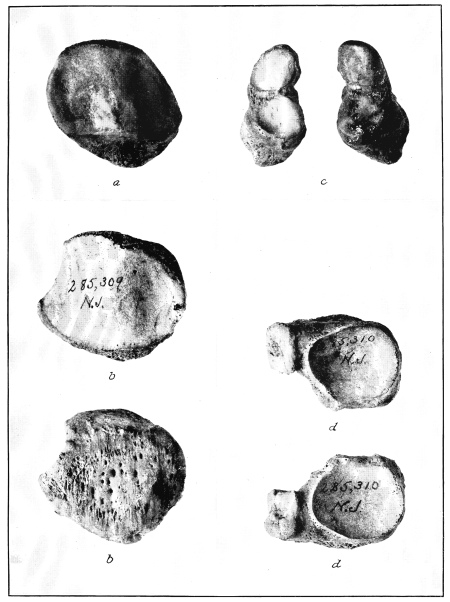
a PATELLA OF FEMALE MUNSEE SKELETON NO. 285,311, U.S.N.M., SHOWING MARKED OBLIQUITY
b PATELLÆ OF FEMALE MUNSEE SKELETON NO. 285,309, U.S.N.M., SHOWING PRONOUNCED VASTUS NOTCH
c INTERNAL CUNEIFORM OF MALE MUNSEE SKELETON NO. 285,301, U.S.N.M., SHOWING EACH A DOUBLE METATARSAL FACET
d PAIR OF FEMALE MUNSEE SCAPHOIDS SHOWING UNUSUAL BROAD TALUS FACET AND PECULIAR TUBEROSITY
LXXVI. FIRST METACARPAL IN MUNSEE AND IN WHITES
Both sexes Specimens Length, maximum Metacarpo- humeral index
cm.
Munsee (16) 4.55 14.4
United States whites (94) 4.69 14.9
Munsee (12) 4.35 14.0
United States whites (65) 4.43 14.3
BONES OF THE FEET
Owing to their larger size and greater differentiation, a number of the bones of the feet, particularly of the tarsus, yield material for measurement and special observation, and have received rather extended attention by anatomists and anthropologists,[93] but as yet there is no perfect uniformity in the methods of measurement or of description. The writer’s object in selecting his measurements and points for description was to employ only those that appear to be the most sensible and significant, the most readily standardized, and involving no details, save in cases that may be of special importance.
First Metatarsal
As the first metacarpal serves in a measure as an index of the size of the hand, so the first metatarsal gives an indication of that of the foot. The proportional length of the foot can further be judged from the percental relation of the first metatarsal to the femur. The relation between the size of the feet and that of the hands is expressed by the pollex-hallux index, or percental relation between the first metacarpal and the first metatarsal.
There are in all 36 first metatarsals among the Munsee bones, the measurements and relations of which are given in the above table. It will be seen that the length of the bone is, on the average, greater in the males than in the females, but it does not differ perceptibly on the two sides of the body in either sex.
The hallux-femur index is practically equal on the two sides (differing only in centesimals), and is larger in the males than in the females, showing that the foot of the Munsee male was not only somewhat larger than that of the female, but was also larger in that sex in relation to the length of the femur and the stature. This relative excess of the foot is more marked than was that of the hand, and in all probability is a result of greater functional activity, the male Indians being excessive walkers and runners.
A comparison of the first metatarsal in the Munsee and in the United States whites shows that in the latter, in both sexes, the bone is longer, indicating, on the average, a longer foot. The difference is especially marked on the left side and is probably both racial and functional.
As a result of the greater length of the bone in the United States whites, whose average stature is very nearly that of the Munsee, we find that their hallux-femur index is decidedly higher than that of the Munsee, especially on the left side. The white man’s foot is therefore not only longer absolutely, but also relatively as compared with the femur and, indirectly, the stature.
The foot of the whites is also somewhat longer relatively to the hand, than that of the Munsee, and especially on the left side, which gives us a lower pollex-hallux index for the whites.
LXXVII. MUNSEE: FIRST METATARSAL
MALES
Right
Number of specimens Length, maximum Number of cases Pollex- hallux index[94] Number of cases Metatarso- femoral[95]
Average: cm.
Pairs (6) 6.5 (4) 70.4 (5) 14.7
Total present (11) 6.5 (8) 72.4 (9) 14.5
Minimum (total present) (11) 6.1 (8) 65.1 (9) 13.8
Maximum (total present) (11) 6.8 (8) 76.6 (9) 15.1
Left
Average:
Pairs (6) 6.5 (4) 69.2 (5) 14.7
Total present (8) 6.48 (4) 69.2 (7) 14.2
Minimum (total present) (8) 6.3 (4) 65.4 (7) 12.9
Maximum (total present) (8) 6.8 (4) 71.1 (7) 15.2
FEMALES
Right
Average: cm.
Pairs (7) 6.0 (4) 73.2 (6) 14.2
Total present (8) 5.97 (7) 72.2 (7) 14.1
Minimum (total present) (8) 5.5 (7) 70.9 (7) 13.5
Maximum (total present) (8) 6.45 (7) 75.4 (7) 15.1
Left
Average:
Pairs (7) 6.0 (4) 73.9 (6) 14.2
Total present (9) 5.91 (6) 72.4 (7) 14.1
Minimum (total present) (9) 5.45 (6) 67 (7) 13.5
Maximum (total present) (9) 6.4 (6) 77.4 (7) 15.2
LXXVIII. THE FIRST METATARSAL IN THE MUNSEE AND IN UNITED STATES WHITES
Both sexes Right
Specimens Length, maximum Hallux- femur index Pollex- hallux index
cm.
Munsee (19) 6.3 14.3 72.3
United States whites[96] (51) 6.6 15.3 71.1
Left
cm.
Munsee (17) 6.2 14.15 71.1
United States whites (33) 6.7 15.5 66.1
Os Calcis
Being the largest bone of the tarsus, and the most important functionally, the os calcis, or calcaneus, seems to deserve closer attention by anthropologists than it usually receives.
The bone presents three different and fairly easily ascertainable dimensions: (1) the greatest length of the whole bone; (2) the minimum breadth or thickness of the body; and (3) the height of the body at its greatest constriction. It further offers several interesting points for visual observation.
The total number of calcanei in the Munsee material is 51, which gives a fair male and female series. The following table shows the measurements on 40 of those that are paired and hence most suitable for comparison.
LXXIX. MUNSEE BONES: OS CALCIS
MALES
Specimens (pairs) Length, maximum Breadth, minimum of body[97] Height of body[98] Breadth- length index Breadth- height index
cm. cm. cm.
Average 10 8.1 2.74 4.07 33.9 67.4
10 8.05 2.72 4.07 33.87 66.9
Minimum 10 7.7 2.5 3.7 30.1 61.6
10 7.5 2.45 3.8 28.1 62.2
Maximum 10 8.5 3 4.5 37.7 72.5
10 8.5 3 4.5 37.3 73.7
FEMALES
Average 10 7.35 2.4 3.6 32.9 66.9
12 7.3 2.38 3.6 33.1 66.4
Minimum 10 6.7 2 3.2 28.2 60.6
12 6.7 1.95 3.3 28.7 59
Maximum 10 7.7 2.65 3.8 34.7 71.6
12 7.8 2.65 3.9 34.3 70.4
It will be observed that, as is usual with other parts of the skeleton, the male bone is somewhat larger than the female; also that the right os calcis averages very slightly larger than the left in length and breadth, but is equal in both sexes to that of the left side in height. Reducing the three average measurements to a mean diameter, or module, we obtain for the males on the right, 4.97 cm.; on the left, 4.95 cm.; for the females, right, 4.45 cm.; left, 4.43 cm. showing that the difference in the mass of the bones on the two sides is very small.