THE BONES (continued 2)
Reading edition
The three measurements of the os calcis give rise to two indexes: one expressing the percental relation between its breadth and length, the other showing a similar relation between its breadth and height. The breadth-length index is somewhat higher in the males than in the females, but in the paired bones does not differ very appreciably on the two sides. Taking all the bones, as in the next table, we see that the index in the males predominates slightly over that in the females, which, judging from the constancy of the condition in the several series of specimens used for comparison, is probably also the true condition in the Munsee. It indicates a tendency in the males toward not only absolutely but also relatively slightly thicker calcaneus.
The breadth-height index, like the breadth-length proportion, is also slightly higher on both sides in the males than in the females, and in both sexes on the right than on the left side. As the height is the same on the two sides, this shows exactly the slightly greater relative thickness of the bone in the males than in the females, and on the right than on the left side. The phenomenon is doubtless connected with difference of stress to which the bone is subjected in the two sexes and on the two sides of the body.
The comparative data given in the following table show that, as with many other bones of the body, the os calcis in the Munsee and in other Indians in both sexes, and especially in the males, is smaller in all dimensions than it is in the whites. The relative proportions of the bone are quite alike in the different racial groups of males, but differ in an interesting way in the females, in which, among the whites, the bones show lower indexes than in the other groups. The white female os calcis is longer and higher, but equal in slenderness to that of the Indian.
LXXX. OS CALCIS: COMPARISON
MALES
Group Number of specimens Length, maximum Breadth, minimum of body Height, minimum of body Module Breadth- length index Breadth- height index
cm. cm. cm. cm.
Munsee (29) 8.07 2.77 4.04 4.76 34.1 67.9
Arkansas and Louisiana (34 8 2.75 3.97 4.91 34.5 69.3
Southern Utah cliff-dwellers (50) 7.72 2.81 4.05 4.86 36.4 69.4
Southwest and Mexico (16) 7.85 2.67 4.01 4.84 34 66.5
United States whites (55) 8.33 2.85 4.20 5.13 34.1 67.7
FEMALES
Munsee (22) 7.3 2.4 3.6 4.43 32.6 66.2
Arkansas and Louisiana (12) 7.3 2.45 3.5 4.42 33.7 70.3
Southern Utah cliff-dwellers (30) 6.92 2.43 3.56 4.30 35.1 68.3
Southwest and Mexico (13) 7.1 2.4 3.43 4.31 33.8 70.1
United States whites (30) 7.87 2.43 3.81 4.71 30.9 63.7
Articular Facets for Astragalus
As to visual observations on the os calcis, the greatest interest attaches probably to the number and conformation of the articular facets for the astragalus. These facets may be two in number, anterior and posterior. But the anterior facet may be divided into two by a ridge; or it may be replaced by two facets, anterior and median, completely separated by a narrow to moderately broad groove or space; or, finally, in place of the single oblong anterior facet there may be a small to rudimentary anterior and a medium sized median facet, separated by a broad and deep notch.
The percental distribution of these facets among the Munsee, the Arkansas and Louisiana mound Indians, and the United States whites, is given below. There is a remarkable similarity in the frequency of occurrence of the two main forms (two and three facets) in all three groups among the males, but the females show slight irregularity.
LXXXI. OS CALCIS: MUNSEE AND COMPARATIVE: ARTICULAR FACETS FOR ASTRAGALUS
Group MALES FEMALES
Specimens Two facets Three facets Specimens Two facets Three facets
Per cent Per cent Per cent Per cent
Munsee (31) 26 74 19 48 52
Arkansas and Louisiana (39) 26 74 33 37 63
United States whites (55) 25.5 74.5 30 40 60
The agreement above set forth might lead us to suppose that practically no racial differences are connected with the facets, at least between the whites and some of the Indians; but this assumption is not borne out by a detailed study of these characters. The next table shows the more detailed observations on the number and character of these facets in the Munsee and in whites, and also with reference to sex and side. Here we notice, in the first place, that the frequency of two facets only is much higher in both groups in the females than in the males, while three facets are correspondingly more frequent in the males. But we observe further that the condition of three facets in which the anterior and median are separated by a wide notch is very much more frequent among the whites than among the Indians.
As to sides, differences between the right and left are irregular; if we combine the two series of Munsee and whites they almost disappear.
LXXXII. OS CALCIS IN THE MUNSEE AND IN UNITED STATES WHITES: ARTICULAR FACETS FOR ASTRAGALUS
Specimens Two facets Three facets, but the two anterior separated only by a ridge Three facets, completely disconnected Three facets, disconnected with a wide notch between the anterior two
Males: % % % %
Munsee (31) 25.8 19.4 35.5 19.4
United States whites (55) 25.5 7.3 29.1 38.2
Females:
Munsee (29) 48.3 10.3 41.4 —
United States whites (30) 40 16.7 20 23.3
Right:
Munsee (31) 42 6.5 42 9.7
United States whites (51) 29.4 15.7 21.6 33.3
Left:
Munsee (29) 31 24 34.5 10.3
United States whites (34) 32.4 2.9 32.4 32.4
An additional point of some interest in connection with the calcaneus is the development of the peroneal spine. Among the Munsee this was found frequently to be very moderate and never pronounced; among the whites, cases with a much more marked development of the spine are met with occasionally, especially among the males.
Astragalus
Next to the calcaneus, the most interesting bone of the tarsus is the astragalus. The bone exhibits wide and characteristic variations among the higher mammals and may well be expected to show some groupal differences in man. It yields itself to three measurements, the maximum length, breadth, and height, from which in turn we obtain the module or mean diameter, useful in comparing the size of the bone, and the breadth-length and breadth-height indexes, which show its shape.
BUREAU OF AMERICAN ETHNOLOGY BULLETIN 62 PLATE 29
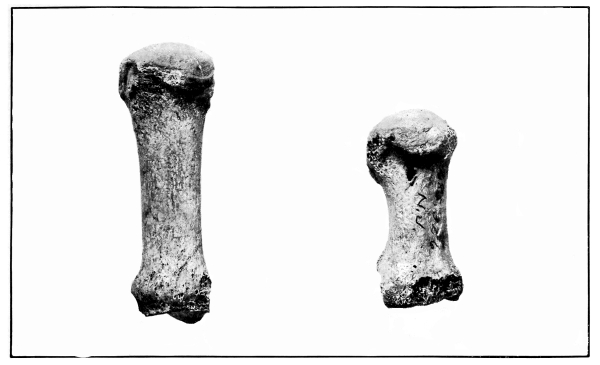
a THE RIGHT AND LEFT FIRST METATARSAL OF MUNSEE SKELETON NO. 285,326, U.S.N.M., SHOWING DISPROPORTION IN SIZE; ALSO A CANAL IN THE SMALLER BONE, POSSIBLY THE VESTIGE OF AN EARLY FRACTURE
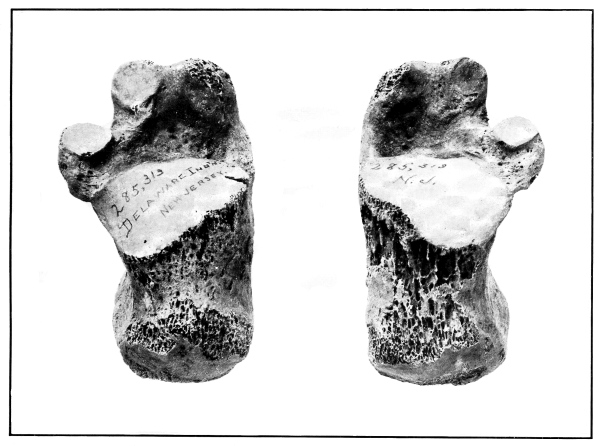
b THE CALCANEI OF MALE MUNSEE SKELETON NO. 285,313, U.S.N.M., SHOWING WIDE SEPARATION OF THE TWO FACETS FOR THE ASTRAGALUS
There are 60 astragali in the Munsee material, and the measurements of 52 paired bones are given below. They show the bone in the male to be absolutely larger in every dimension than in the female. As to the side, there is practically no difference among the males, but among the females the average measurements of the left astragalus are all slightly higher than those of the right bone. The module is practically identical on the two sides in the males, and slightly higher on the left in the females. As to the relative proportions, there is great similarity between the two sexes, as well as on the two sides of the body.
LXXXIII. MUNSEE: ASTRAGALUS
MALES
Right
Specimens (pairs) Length, maximum[99] Breadth, maximum[100] Height, maximum[101] Module Breadth- length index Height- length index
cm. cm. cm. cm.
Average (12) 5.7 4.27 3.27 4.4 74.9 57.4
Minimum — 5.3 4.1 3.05 4.41 70.7 54.7
Maximum — 6.2 4.6 3.5 4.41 83.3 62.5
Left
Length, maximum Breadth, maximum Height, maximum Module (mean diameter) Breadth- length index Height- length index
cm. cm. cm. cm.
Average 5.7 4.28 3.25 4.41 75.1 57.1
Minimum 5.3 4.05 3.05 — 72.3 53.8
Maximum 6.3 4.7 3.5 — 79.2 60.7
FEMALES
Right
Specimens (pairs) Length, maximum[102] Breadth, maximum[103] Height, maximum[104] Module Breadth- length index Height- length index
cm. cm. cm. cm.
Average (14) 5.19 3.9 3 4.02 75 57.8
Minimum — 4.7 3.5 2.7 4.02 70.5 54.4
Maximum — 5.7 4.1 3.3 4.02 83.7 62.3
Left
Length, maximum Breadth, maximum Height, maximum Module (mean diameter) Breadth- length index Height- length index
cm. cm. cm. cm.
Average 5.22 3.93 3.03 4.06 75.2 58
Minimum 4.8 3.6 2.7 — 69.9 52.8
Maximum 5.7 4.15 3.4 — 83.7 61.5
The results presented in this table would not be wholly satisfactory without the possibility of comparing them with similar observations, obtained by the same methods, on the bones of the whites. Such comparative data, furnished in the next table, show a number of points of considerable interest. In the first place, as with the calcaneus and other parts of the skeleton, the Munsee bones are seen throughout to be of more moderate dimensions than the bones of the whites. The module in the latter is very perceptibly higher.
There are, however, also notable differences in the relative proportions of the bones in the two races. Among the whites in both sexes the astragalus is relatively longer and also higher than it is among the Indians, as a result of which both of the indices of the bone in the whites are lower. The differences in this respect are too large and regular to be accidental.
LXXXIV. ASTRAGALUS IN THE MUNSEE AND IN UNITED STATES WHITES
MALES
Group Specimens Length, maximum Breadth, maximum Height, maximum Module Breadth- length index Height- length index
cm. cm. cm. cm.
Munsee (24) 5.7 4.28 3.26 4.42 75.0 57.2
United States whites (50) 6.29 4.48 3.32 4.7 71.2 52.8
FEMALES
Munsee (28) 5.2 3.91 3 4.04 75.1 57.9
United States whites (33) 5.75 4.02 3.11 4.29 69.8 54
In the examination of the os calcis, special attention was directed to its facets, especially the middle and anterior, for the astragalus. Inspection of the corresponding facets on the astragalus shows that these do not harmonize fully with those of the os calcis. They are less differentiated and more frequently connected or fused. Thus we have among 60 Munsee astragali, 28, or approximately 47 per cent which show only one facet corresponding to the anterior and middle facets of the calcaneus, without any dividing line; 29, or 48 per cent, with one facet divided more or less completely by a ridge; and only three specimens, or 5 per cent, in which there are two distinct facets, though in but one of these are they separated by a moderate space. In the astragalus of the whites the proportions of these different forms are by no means the same as in the Munsee. Thus among 82 bones there are but 24, or 29 per cent, with one facet not divided by any ridge; 35, or 43 per cent, with one facet divided by a ridge; and no fewer than 23, or 28 per cent, of those in which there are two distinct facets, in 19 of which they are completely separated by a narrow to moderate space. The frequency of two facets well separated is therefore much greater among the whites than among the Munsee, which is another interesting distinction in the astragalus of these two groups and possibly of the two races which they represent. This is the more remarkable as no corresponding difference has been found in the facets on the os calcis.
Scaphoid
There are three additional bones of the tarsus which deserve somewhat detailed scrutiny, namely, the scaphoid or navicular, the cuboid, and the internal cuneiform. Although irregular in shape, each one of these bones yields to three measurements, which differ in the two sexes as well as racially, and each presents a number of points for observation.
The measurements taken by the writer on the scaphoid as well as on the other tarsal bones are, it may be repeated, the most practicable ones, and relate as closely as possible to the three principal dimensions of the specimens. In the case of the scaphoid they are the greatest breadth, height, and stoutness.
The results of the measurements of the scaphoid in the Munsee appear in the next table. The bone in the male is very perceptibly larger than that in the female, and that of the right foot is in both sexes and in all dimensions somewhat larger than that of the left. These conditions are shown nicely by the module or mean diameter of the bone.
The three measurements give rise to two indexes, which indicate the relative proportions of the scaphoid. The height-breadth index is somewhat larger on both sides in the females than in the males, which, as will readily be seen by reference to the actual dimensions, is due to the relatively greater breadth of the Munsee scaphoid in the males. No special difference is observable on the two sides of the body in the males, but in the females the right bone is relatively higher than the left.
The stoutness-breadth index offers no special differences either on the two sides or in the two sexes.
LXXXV. MUNSEE: SCAPHOID
LEGEND:
A = Breadth,[105] maximum
B = Height,[106] maximum
C = Stoutness,[107] maximum
D = Stoutness-breadth index
E = Breadth
F = Height
G = Stoutness
MALES
Right
Number of specimens, (A) (B) (C) Module (mean diameter) Height- breadth index (D)
cm. cm. cm. cm.
Average (6) 4.20 2.11 2.61 2.98 50.2 62.3
Minimum — 3.9 1.9 2.5 2.66 48.4 62.2
Maximum — 4.55 2.2 2.85 3.2 55.4 64.1
Left
Average (6) 4.05 2.04 2.55 2.88 50.4 63
Minimum — 3.65 1.7 2.45 2.6 46.6 60.5
Maximum — 4.5 2.25 2.75 3.16 53.7 67.1
FEMALES
Right
Number of specimens, (A) (B) (C) Module (mean diameter) Height- breadth index (D)
cm. cm. cm. cm.
Average (6) 3.75 1.96 2.35 2.69 52.2 62.7
Minimum — 3.5 1.75 2.25 2.53 48.1 60
Maximum — 4.05 2.15 2.5 2.85 56.1 66.7
Left
Average (6) 3.72 1.89 2.31 2.64 50.8 62.2
Minimum — 3.4 1.7 2.15 2.43 45.7 50.8
Maximum — 4.05 2.05 2.45 2.97 55.4 68
A comparison of the measurements of the Munsee scaphoid with those obtained on the United States whites shows a number of interesting conditions. The bone in the whites is again in both sexes and in all dimensions somewhat larger than in the Indian, The height-breadth index is identical in the females of the two races, but is more elevated, owing to a relatively greater height of the bone, in the white than in the Munsee males. The stoutness-breadth index is decidedly higher in both sexes in the whites, though more particularly so in the males. It may therefore be stated that the scaphoid in the United States whites is, in both sexes, not only absolutely but also relatively stouter, and in the males also relatively somewhat higher, than that in the Munsee Indians.
LXXXVI. SCAPHOID IN MUNSEE AND IN UNITED STATES WHITES
MALES
Number of Specimens Breadth, maximum Height, maximum Stoutness Module Height- breadth index Stoutness- breadth index
cm. cm. cm. cm.
Munsee (19) 4.13 2.08 2.59 2.93 50.4 62.8
United States whites (52) 4.33 2.23 2.96 3.17 51.5 68.5
FEMALES
Munsee (19) 3.75 1.94 2.35 2.68 51.7 62.7
United States whites (36) 3.94 2.03 2.54 2.54 51.6 64.3
An inspection of the Munsee scaphoid shows a number of interesting particulars. A facet for the cuboid is present in only 23.5 per cent of the cases (15 per cent males and 30 per cent females); among the United States whites its frequency is nearly twice as great, or 39 per cent (40 per cent males and 37 per cent females), and Manners Smith reported an even higher proportion in England.[108]
The facet for the talus differs quite markedly as to shape in the Munsee and the whites. In the whites, and particularly in the females, it is predominantly more or less pyriform, and only seldom quadrilateral or nearly so; while in the Munsee conditions are reversed and a more or less quadrilateral facet is present in a large majority of the cases, especially in the males, while the pyriform type is scarce.
The tuberosity of the scaphoid differs also somewhat in the two races. In general, it may be more or less pointed, or decidedly blunt, or squarish; the first two forms are common among the whites, while the squarish or angular, rare in the whites, is not infrequent in the Indians. (See pl. 28, d.)
The processus plantaris is found generally to be quite pronounced in the Munsee, more frequently so than in the United States whites; and occasionally there exists in the Indian scaphoid an additional tuberosity, separated from the regular one by a groove continuous with that situated between the processus plantaris and the tuberosity.
Cuboid
The cuboid bone, though so irregular, can be fairly conveniently measured as to its maximum length, breadth, and thickness. The method of taking the dimensions is explained in the next table.
There are 19 pairs of cuboids in the Munsee material—9 male and 10 female. Their measurements show the usual predominance of the male bone over the female on both sides and in all dimensions; as to sides, however, the differences are very small, the mean diameter being, in fact, equal on the right and left in both sexes.
LXXXVII. MUNSEE: CUBOID
LEGEND:
A = Length, maximum[109]
B = Breadth, maximum[110]
C = Thickness, maximum[111]
MALES
Right
Number of Specimens (pairs) (A) (B) (C) Module (mean diameter) Breadth- length index Thickness- length index
cm. cm. cm. cm.
Average (9) 3.77 2.85 2.5 3.04 75.7 66.5
Minimum — 3.55 2.7 2.3 2.88 70 62
Maximum — 4 3.15 2.65 3.18 79.7 69.4
Left
Average (9) 3.74 2.85 2.53 3.04 76.2 67.7
Minimum — 3.55 2.75 2.3 2.86 71.8 62.8
Maximum — 3.95 3 2.65 3.13 80 74.3
FEMALES
Right
Average (10) 3.54 2.66 2.26 2.82 75.1 64
Minimum — 3.25 2.3 2.1 2.58 67.6 59.5
Maximum — 3.85 2.95 2.4 3.03 81.5 67.7
Left
Average (10) 3.55 2.65 2.26 2.82 74.4 63.6
Minimum — 3.25 2.35 2.1 2.65 67.1 59.7
Maximum — 4.8 2.95 2.5 3.03 81.5 71.4
As in the case of the scaphoid, the three measurements of the cuboid give rise to two indexes which express the relative proportion of the bone. Both of these indexes, as seen by the table, are higher in the males than in the females, especially on the left side, showing that the male bone is relatively broader as well as thicker.
The indexes also show slight differences on the two sides, but these are not parallel in the two sexes; in the males both are slightly higher on the right side, while in the females the condition is reversed owing to the fact that while in the males the length of the bone is slightly less on the left, in the females it is slightly greater on that side than on the right.
The Munsee cuboid contrasted with that of the United States whites is, as in all the other bones of the tarsus, slightly smaller in every dimension, and it differs also from the latter to a moderate degree in its relative proportions; but these differences, as seen in the following table, are somewhat irregular and can not be regarded as established before a larger series of specimens is examined.
LXXXVIII. THE CUBOID IN MUNSEE AND IN UNITED STATES WHITES
MALES
Number of Specimens Length Breadth, Thickness Module Breadth- length index Thickness- length index
cm. cm. cm. cm.
Munsee (22) 3.75 2.85 2.52 3.04 75.1 67.1
United States whites (48) 3.96 3.02 2.59 3.19 76.3 65.5
FEMALES
Munsee (24) 3.51 2.63 2.26 2.80 75 64.3
United States whites (36) 3.62 2.67 2.37 2.89 73.7 65.5
As to points for observation, some interest attaches to the cuneiform and talus facets. In the United States whites the facet for the external cuneiform is single in 70 per cent of the cases, divided by a well-marked ridge in 23 per cent, and double, though mostly connected, in 7 per cent of the specimens. In the Munsee, in 45 bones, a single facet is present in 42, or 93 per cent; and one with a ridge in three, or approximately 7 per cent, while two facets occur in no instance.
In the United States whites a facet for the talus was found by the writer in four specimens out of the 82 examined, or approximately 5 per cent. Among 44 cuboids of the Munsee it occurred in only one instance (2.3 per cent), and in this case it was small.
The anterior or metatarsal facet of the cuboid is on the average flatter in the whites than in the Munsee, especially from side to side and in the bones of the males.
Internal Cuneiform
The internal cuneiform is the largest of the cuneiforms and yields two measurements—the greatest height and smallest breadth—which with their indexes are suitable for comparison. There are 45 of these bones in the Munsee material.
The results of the measurements, given in the next table, show the bone in the males to be as usual somewhat larger than in the females. With respect to the sides, the left bone is as high as and very slightly broader than the right in the males (in paired bones); but in the females the left internal cuneiform is very slightly lower and more perceptibly narrower than the right.
The breadth-height index on both sides is higher in the females, which shows that in this sex the bone is not only absolutely but also relatively lower than in the males.
LXXXIX. MUNSEE: INTERNAL CUNEIFORM
MALES
Right
Average: cm. cm.
Pairs (8) 3.2 2.27 70.8
All (9) 3.17 2.24 70.7
Minimum (all) (9) 2.9 2.05 66.7
Maximum (all) (9) 3.35 2.4 77.4
Left
Average:
Pairs (8) 3.2 2.29 71.6
All (12) 3.17 2.3 72.7
Minimum (all) (12) 3 2.15 65.2
Maximum (all) (12) 3.35 2.55 79.7
FEMALES
Right
Average: (11) 2.86 2.11 73.8
2.86 2.11 73.8
Minimum (11) 2.6 1.95 68.9
Maximum (11) 3.05 2.4 80
Left
Average: (11) 2.84 2.06 72.6
(13) 2.86 2.08 73
Minimum (13) 2.6 1.9 70
Maximum (13) 3 2.3 78.6
A comparison of the internal cuneiform in the Munsee and in the United States whites shows the bone in both sexes of the latter to be greater in height as well as in breadth. But, as indicated by the indexes, this bone in the whites is in general also relatively higher than in the Indians, as the result of which we have a lower index in the whites in both sexes. This reveals another interesting difference in the osteology of the two groups, which may prove to be of definite racial significance.
The relatively greater narrowness of the internal cuneiform in the female than in the male is equally well pronounced in the whites and in the Munsee, and is probably a universal characteristic.
XC. THE INTERNAL CUNEIFORM IN THE MUNSEE AND IN UNITED STATES WHITES
MALES
Specimens Height Breadth, Breadth- height index
cm. cm.
Munsee (21) 3.17 2.28 71.8
United States whites (50) 3.48 2.43 69.9
FEMALES
Munsee (24) 2.86 2.10 73.4
United States whites (37) 3.16 2.24 71.1
In descriptive features the internal cuneiform of the Munsee offers only minor differences from that of the whites. There seems to be present in the Indians, however, a somewhat greater tendency toward the occurrence of a double anterior or metatarsal facet. Two distinct facets are present in five of the 45 Munsee bones (11 per cent), as against only one in the 87 bones of the whites (1.1 per cent). On the other hand, an approach to two facets (hour-glass shape, or a division of the one facet by a ridge) occurs in the Munsee in a little more than 13 per cent of the specimens, and in the whites in a little more than 10 per cent.
External and Middle Cuneiform
The external and middle cuneiform bones in the Munsee resemble closely those of the whites, but average slightly smaller in size.
Among 35 external cuneiforms, 10, or approximately 30 per cent, show absence of the facet for the fourth metatarsal, and one an absence of both facets for the second metatarsal.
As to the middle cuneiform, the central ligamentous depression on its medial surface, and especially the canal running downward from this, are characteristic features of the Indian bone and are more pronounced in both sexes than is the average in whites.