THE CRANIA
Reading edition
General Observations: Differences in Type
Although the remains comprise seventeen adult males and the same number of females, some of the skulls are so defective that measurements and notes of value could be made only on those of ten males and thirteen females.
In examining and arranging these specimens, the first realization of importance is that, while the majority clearly belong to one type, there are a few that must be classed apart. The main type, as will be noted later and more plainly from the measurements, is that characterized by dolichocephaly to mesocephaly, and agrees with that prevalent among other Lenape as well as other Eastern tribes. The additional type is brachycephalic. Among the twenty-five skulls of adults there are four of the brachycephalic type, all females. A few additional examples existed evidently among the children; and several of the remaining skulls may be transitional as a result of admixture. The brachycephaly is so marked that it can not be due to normal individual variation within the series, and if we exclude this possibility the only remaining conclusion is that the broad-heads could not have been Lenape, except by adoption. The individuals represented by these skulls might have come from western Pennsylvania, where brachycephaly seems to have prevailed at least in some districts; or from farther southwestward, from a region to which points the intentional deformation among the “Munsee” crania. These possibly represent the Shawnee, who came from that section and who, according to growing indications, while speaking Algonquian were of a different type physically.
The admixture of this type existed evidently also among other branches of the Lenape, and to a more limited extent among various other tribes of the Atlantic states. The writer called attention to this mixture in 1902,[15] and will return to the subject in the second part of this memoir, which deals with Eastern skulls in general.
Chief Descriptive Features
The skulls are of good size, but otherwise are characterized by moderate development. There is no massiveness, no heavy supraorbital arches or crests, no heavy jaws. It is plain that they did not belong to a tribe of great huntsmen or warriors.
The frontal region, though prevalently somewhat low in the females, in a large majority of the cases is well arched; the zygomæ are not excessively broad, the malar bones not heavy. The nose is rather short, the face only mildly prognathic. The dental arches, as in the majority of Indians, are very regular, and the same applies to the medium sized teeth. The vault of the skull from above is either ovoid (58 per cent) or elliptical (42 per cent), while the outline of the norma posterior approaches more or less the pentagonal.
In addition there may be mentioned an unusual scarcity of Wormian bones and an equal sparsity of marked anomalies. These and other features are treated in detail in another part of this paper. (See pp. 35, 47.)
Measurements
The measurements[16] offer many points of interest, although, so far as the vault is concerned, they are considerably interfered with by artificial deformation in some of the specimens. As in certain former reports by the writer, they will be dealt with in order according to their significance.
FORM OF THE VAULT
The measurements relating to the form of the vault comprise the maximum length and breadth, and the basion-bregma height, with the resultant percentage-relations or indexes. The details are given in the accompanying table. Although the number of undeformed specimens in good condition is small, it will be seen (a) that there is an absence of extremes in the several dimensions, (b) that the crania range in type from dolichocephalic to mesocephalic, and (c) that they show good height. As a result of the latter, both the height-length and the height-breadth indices are high, though corresponding well with those of many other Indian tribes and those of numerous other branches of the yellow-brown race. Comparisons will be found in the second part of this report, which deals with the Eastern Indians in general.
BUREAU OF AMERICAN ETHNOLOGY BULLETIN 62 PLATE 5
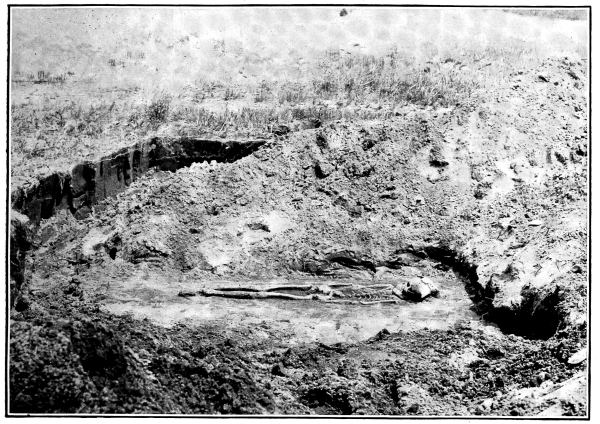
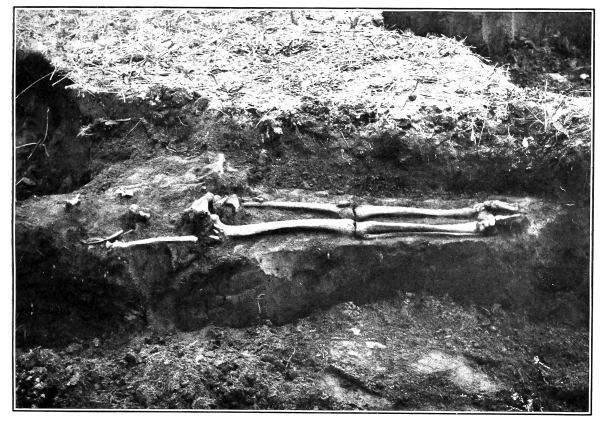
TWO BURIALS IN EXTENDED POSITION
The lower burial is of special interest as showing how much of a skeleton may be decayed or scattered without disturbance of the remainder
I. MUNSEE CRANIA: MEASUREMENTS RELATING TO THE FORM OF THE VAULT[17]
LEGEND:
A = Length, maximum
B = Breadth, maximum
C = Height(basion-bregma)
D = Cephalic index (b × 100)/x
E = Height-length index (z × 100)/x
F = Height-breadth index (z × 100)/y
MALES
Cat.No., U.S.N.M. Deformation (A) (B) (C) (D) (E) (F)
(x) (y) (z)
cm. cm. cm.
285,303 Slight asymmetry) 18.9 13.3 14.2 70.4 75.1 106.8
285,308 19.8 14.6 13.8 73.7 69.7 94.5
285,306 18.7 14 14 74.9 74.9 100.0
285,313 18.8 4.4 13.7 76.6 72.9 95.1
285,326 Slight occipital flattening (17.7) (13.7) (14.4) — — —
285,301 Moderate occipital flattening (17.8) (15.1) (14.6) — — —
285,305 do. (17.0) (14.6) (13.7 — — —
(4) (4) (4) (4) (4) (4)
Averages of undeformed 19.05 14.1 13.9 73.9 73.1 98.9
FEMALES
285,309 18.2 13.3 13.1 73.1 72 98.5
285,327 17.6 13.1 12.4 74.4 70.5 94.7
285,307 Trace of fronto-occipita
flattening[18] 16.9 13 12.9 76.9 76.3 99.2
285,320 17.4 13.4 13 77 74.7 97
285,347 18 14 13 77.8 72.2 92.9
285,302 Moderate occipital flattening (16.0) (41.1) (13.2) — — —
285,304 do. (16.6) (14.3) (14.2) — — —
285,310 do. (16.9) (14.4) (14.2) — — —
285,321 Marked occipital with slight
frontal flattening (16.4) (14.5) (14.2) — — —
(5) (5) (5) (5) (5) (5)
Averages undeformed 17.6 13.4 12.9 75.8 73.1 96.4
Attention may be called to the lower value of the average cephalic index and the higher value of the average height-breadth index in the males than in the females. These conditions, due to the relatively greater length and also to the relatively greater height of the male skull, are not exceptional and will later be found to be quite general among Eastern Indians.
The identical value of the average height-length index in the two sexes is of no special significance and is probably incidental.
In the deformed skulls we see the usual effect of the flattening by the lessening of the length and a compensatory increase in both breadth and height.
SIZE OF THE SKULL
The principal determinations relating to the size of the vault are the cranial module or mean diameter, the capacity, the circumference, and the antero-posterior arc, all of which are given in the next table, where also is shown the thickness of the skull, which is of importance as a corrective to the external dimensions.
II. MUNSEE CRANIA: MEASUREMENTS RELATING TO THE SIZE OF THE VAULT[19]
MALES
Number Capacity[20] Cranial Module (L+B+H) ——— 3 Circumference maximum (above supraorbital ridges) Nasion- opisthion arc Thickness of left parietal (1 cm. above and along squamous suture)
c.c. cm. cm. cm. min.
285,326 1,470 15.27 49.3 36.2 4
285,306 1,505 15.57 51.5 36.6 4.5
285,303 1,515 15.47 51.7 38.3 5.5
285,301 1,515 15.83 51 36.9 6.5
285,305 1,530 15.10 49.4 35.2 5.0
285,313 1,550 15.63 51.3 37.1 5.5
285,308 1,720 16.07 55 39.5 4
(7) (7) (7) (7) (7)
Averages 1,544 15.56 51.3 37.1 5
FEMALES
285,327 1,225 14.37 48.5 34.9 3.5
285,307 1,240 14.27 47.6 33.9 3.5
285,347 1,265 15.0 50.2 35.1 5.5
285,320 1,280 14.60 48.2 35.0 4.0
285,304 1,275 15.03 48.7 33.3 5.0
285,302 1,295 14.43 47.9 33.8 4.0
285,309 1,300 14.87 50.1 36.3 4.0
285,321 1,310 15.03 48.7 34.0 5.0
285,310 1,375 15.17 49.3 35.0 5.0
(9) (9) (9) (9) (9)
Averages 1,285 14.75 48.8 34.6 4.4
It will be noted that the measurements of the Munsee skulls, particularly those of the males, show fair capacity as well as external size of the vault, and also that only a few of the crania are thick-walled. An interesting feature is the unusual superiority of the measurements of the males over those of the females. This in a measure is due to the occurrence among the males of one skull of extraordinary size (1,720 c. c.); but even if we exclude this, the difference between the two sexes is somewhat greater than among other Indians. In the following table are given a few comparative data on this point.
BUREAU OF AMERICAN ETHNOLOGY BULLETIN 62 PLATE 6
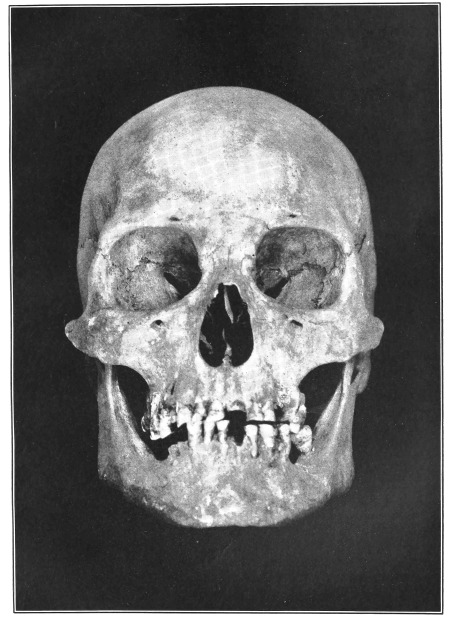
MALE MUNSEE SKULL, NO. 285,303, U.S.N.M. (FRONT VIEW)
III. RELATION OF AVERAGES OF MEASUREMENTS RELATING TO SIZE OF VAULT IN MALES AND FEMALES
(Males = 100)
Group Number of specimens Capacity Module Circum- ference Nasion- opisthion arc Thickness
Males Females
Arkansas[21] 19 14 86.5 96 96 96.5 92.5
Louisiana[22] 22 7 89.5 96 97 98 88
Munsee (excepting no. 285,308) 6 9 85.0 95.5 96 94.5 88
These data are of interest in a number of additional particulars. In the first place, it is seen that, barring capacity, a striking similarity exists in the relation of female to male measurements in the different groups of Indians. There are reasons to believe that such resemblances are not confined to these tribes alone or even to Indians generally, but extend, with a limited range of variation, to all races.
Another remarkable fact is that the external measurements of the skull, especially the mean diameter or module, and the circumference show practically identical percental relations in the two sexes, averaging each about 96 for the female to 100 for the male; while in capacity the difference is decidedly greater (less than 90 to 100) in favor of the male, notwithstanding the fact that the thickness of the female skulls averages smaller. In other words, a female skull only nine-tenths as thick as that of a male and which gives external measurements that compare with those of the male cranium in a ratio of 96 to 100, will stand in respect to its internal capacity toward the male skull as only 88 or 89 to 100. The cause of this must be attributed to the unequal build, in the two sexes, of those parts of the skull which are not reached by the ordinary external measurements, and the narrower and especially the lower frontal region in the female plays probably a large part in this connection.
RELATION OF SIZE OF SKULL TO STATURE
The size of the head, as is well known, increases with stature. This increase is not uniform, but progresses in a diminishing ratio. The fact holds true in all races, though the exact values of the ratio with the different racial elements have not as yet been determined definitely. In the case of skeletal remains, in which it is not possible to learn the exact stature, the most suitable manner of obtaining light on the subject is to compare the length of the femur with the cranial capacity, by which means we ascertain the number of cubic centimeters of the capacity that correspond to each centimeter of the length of the femur. The following data give the results of such a comparison among the Munsee and on Indian skeletal remains from Arkansas and Louisiana.[23]
IV. MUNSEE CRANIA: RELATION OF SKULL CAPACITY TO STATURE[24]
MALES
Number Bicondylar length of right femur Skull capacity Femoro-cranial index (= c.c. of skull capacity per 1.0 cm. of femoral length)
cm. c. c.
285,305 43.4 1,530 35.3
285,301 44.2 1,515 34.3
285,308 45.1 1,720 38.1
285,303 45.1 1,515 33.6
285,313 45.3 1,550 34.2
285,326 46.6 1,470 31.5
285,306 48.1 1,505 31.3
(7) (7) (7)
Averages (45.4) (1,544) (34.0)
Exclusive of 285,308 45.4 1,514 33.3
FEMALES
285,302 39.4 1,295 32.8
285,327 40.2 1,225 30.4
285,320 42 1,280 30.5
285,309 42.3 1,300 30.7
285,310 43 1,375 32.0
285,321 43.5 1,310 30.1
285,304 43.8 1,275 29.1
285,307 44.7 1,240 27.7
(8) (8) (8)
Averages 42.4 1,288 30.4
Comparative Data MALES
Arkansas (5) 45.1 1,446 32.1
Louisiana (7) 44.4 1,434 32.3
FEMALES
Louisiana (5) 41.7 1,330 31.9
BUREAU OF AMERICAN ETHNOLOGY BULLETIN 62 PLATE 7
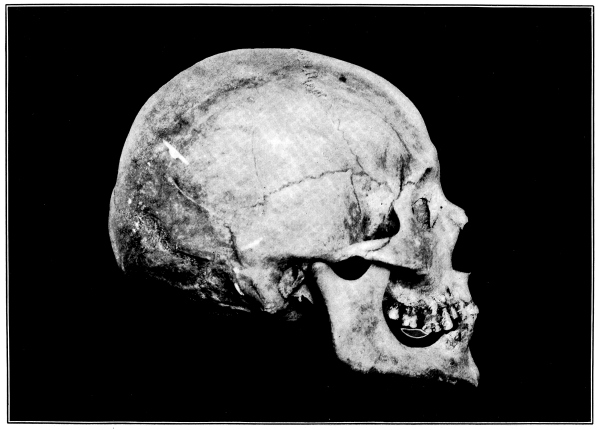
MALE MUNSEE SKULL, NO. 285,303, U.S.N.M. (SIDE VIEW)
The results presented in the table show considerable individual variation in the femoro-cranial index, by reason of which there is some irregularity of alignment of the cases. This is especially true in regard to the capacity, which in this small series shows little regularity or evidence of conformity with the aforementioned general rule of increase of the size of the head with stature. The tallest of the eight females had one of the smallest heads, and the man with the largest brain was not even of average height. However, there is no doubt that if the series of skulls was considerably larger, the usual progression, showing gradual increase in the size of the brain with the height of the body, would be apparent.
The femoro-cranial index progresses much more regularly than the capacity, and shows another well-known fact, also common to all human races, namely, that while the absolute size of the brain enlarges in proportion to the stature, its relative dimensions with reference to stature diminish as the latter increases; so that while the tall man or woman may be expected to have an absolutely larger brain than the average of his group, relatively to his stature he will have less brain matter than the short individuals of the same group.
The averages in the preceding table are interesting in another particular—i. e., the difference in the value of the femoro-cranial index in the two sexes. Both the former records of the Louisiana crania and those of the Munsee now presented show these indexes to be perceptibly lower in the females than in the males. The superiority in this respect among the male crania is seen not only in the averages, but practically throughout the records, seven of the eight indexes in the females being below the minimum of the indexes in the males. It seems evident that among the Indians the brain substance in the females is not only absolutely smaller than in the males, but is also somewhat smaller for each centimeter of stature, so that men of the same height as the women would still show an advantage in this particular. This advantage is not necessarily connected with mentality, but may be due to the greater muscularity of the males.
As to the value of the femoro-cranial index in different tribes, we can as yet say nothing positive. The indications are that if differences exist, they are not of a very pronounced character.
SIZE AND SHAPE OF THE FACE
The measurements chosen, as in the writer’s work previously cited, are only the most essential. They include the total and upper length of face, and the three breadth measurements—the smallest breadth of the forehead, the greatest facial breadth in the plane of the zygomatic arches, and the breadth at the angles of the lower jaw. As to the total facial length (chin-nasion), wherever the teeth were worn due allowance for the wear was made on the basis of measurements on well-preserved teeth of the same sex and in the same group.
The results, presented in the next table, show that among the Munsee the face was of only fair height and that its other dimensions were rather subdued for Indians.
V. MUNSEE CRANIA: MEASUREMENTS RELATING TO SIZE AND SHAPE OF THE FACE[25]
LEGEND:
A = Total length of face (chin-nasion)[26]
B = Upper length (prosthion-nasion)
C = Breadth of face (diam. bizyg. max.)
D = Facial index total (x × 100)/z
E = Facial index upper (y × 100)/z
F = Cephalic index of the skull (for comparison)
G = Diameter frontal minimum
H = Diameter bigonial
S.D. = Slightly Defeormed
DEF. = Deformed
MALES
Number (A) (B) (C) (D) (E) (F) (G) (H)
(x) (y) (z)
cm. cm. cm. cm. cm.
285,303 11.8 6.8 13.7 86.1 49.6 70.4 9.3 11
285,306 12.2 7.0 13.9 87.8 50.4 74.9 9.5 11.9
285,326 12.1 6.9 13.6 89.0 50.7 S.D. 8.7 10.6
285,313 12.0 7.2 14.0 85.7 51.4 76.6 9.0 9.5
285,308 12.6 7.4 14.2 88.7 52.2 73.7 10.1 11.1
285,305 12.1 7.2 13.6 89.0 52.9 DEF. 9.6 9.5
285,301 12.3 7.6 14.2 86.6 53.5 DEF. 9.5 9.3
(7) (7) (7) (7) (7) (7) (7)
Averages 12.15 7.15 13.9 87.6 51.5 — 9.4 10.4
FEMALES
285,310 11.9 7.0 13.6 87.5 51.5 DEF. 9.8 10.3
285,327 11.2 6.6 12.4 90.3 53.2 74.4 8.4 8.7
285,302 11.9 7.0 12.8 93.0 54.7 DEF. 9.3 9.8
285,307 (?) 6.8 12.4 — 54.8 76.9 8.5 —
285,304 11.8 7.3 12.9 91.5 56.5 DEF. 9.4 9.6
(4) (5) (5) (4) (5)
Averages 11.7 6.9 12.8 90.5 54.1 — 9.1 9.6
The bizygomatic breadth, though not really small, is below the average in many other tribes of Indians, while the frontal breadth and that of the lower jaw are also somewhat below the medium. These results bear out the statement made under “General Observations” (p. 20) relative to the moderate proportions of the face of the Munsee. Comparative data given in the second part of this report indicate that in some of these respects, especially in the height of the face, the Munsee were somewhat exceptional among the Eastern tribes.
The facial indexes indicate mild chamœprosopy to mild leptoprosopy. Both the total and the upper indexes are perceptibly higher in the females, which on analysis of the measurements is seen to be due to the relatively greater narrowness of the face in the female, which, in turn, is doubtless connected with a relatively smaller development of the temporal muscles, the main muscles of mastication. The same condition was noticeable in the crania from Arkansas and Louisiana previously reported by the writer, and is probably quite general among Indians. Some of the foreheads and some of the lower jaws among the Munsee, as will be seen from the details, were relatively quite narrow.
BUREAU OF AMERICAN ETHNOLOGY BULLETIN 62 PLATE 8
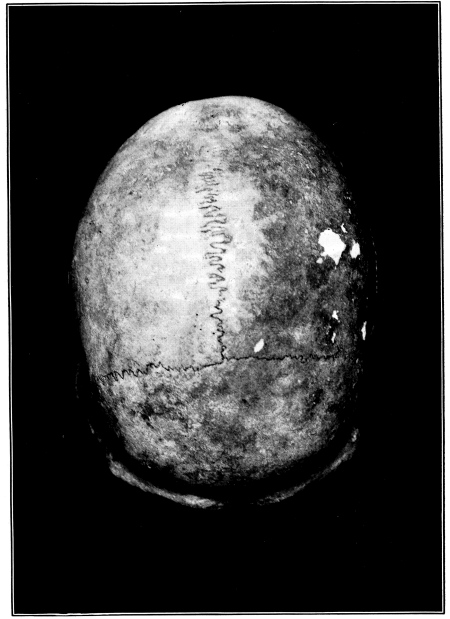
MALE MUNSEE SKULL, NO. 285,303, U.S.N.M. (VIEW FROM ABOVE), SHOWING TYPICAL FEATURES
ORBITS. NOSE
With respect to the orbits, the writer follows his invariable custom of making measurements on both sides and recording the mean, which, in turn, gives rise to a mean index. This procedure is necessary in view of the fact that in only a minority of cases are the two orbits of equal dimensions and that sometimes they differ considerably.[27]
Among the series of Lenape crania which the writer reported on in 1902,[28] there were several specimens in which the orbits were unusually low. At that time it seemed as if this feature might be almost characteristic of these Indians; but evidently such is not the case, for low orbits are quite rare among the Munsee. As will be seen from the following figures, in only one instance (male, no. 285,313) are the orbits decidedly low and broad, giving the microseme[29] index of 78.1. Of the remaining cases four males and two females (43 per cent) are mesoseme, while two of the males and five of the females (50 per cent) are megaseme. The extensive fluctuation of the orbital index in both sexes of the Munsee tribe is very striking, but much the same variation was observed in the Arkansas and Louisiana crania previously mentioned, and is present among the Eastern tribes in general.
MALES
Orbits Nose
Number Mean height Mean breadth Mean Index (b×100) a Number Height Breadth Index (B×100) H
(a) (b)
cm. cm. cm. cm.
285,313 3.2 4.1 78.1 285,303 5.0 2.2 44.0
285,308 3.4 3.95 86.1 285,326 5.0 2.35 47.0
285,303 3.4 3.9 87.2 285,301 5.45 2.6 47.7
285,305 3.6 4.05 87.2 285,305 5.0 2.5 50.0
285,306 3.35 3.75 89.3 285,308 5.3 2.8 52.8
285,326 3.3 3.6 91.7 285,306 5.0 2.9 58
285,301 3.6 3.9 92.9 285,313 5.15 3.0 58.3
(7) (7) (7) — (7) (7) (7)
Averages 3.4 3.9 87.5 — 5.1 2.6 51.1
FEMALES
285,321 3.3 3.8 86.8 285,304 5.3 2.5 47.7
285,310 3.4 3.85 88.3 285,302 4.9 2.4 49
285,307 3.5 3.85 90.3 285,347 5.0 2.5 50
285,309 3.3 3.65 90.4 285,309 4.9 2.6 53.1
285,327 3.4 3.6 94.4 285,310 5.0 2.7 54
285,304 3.5 3.7 94.6 285,327 4.8 2.6 54.2
285,302 3.55 3.65 97.9 285,320 4.9 2.7 55.1
— — — 285,307 4.8 2.7 56.3
— — — 285,321 5.2 3 57.7
(7) (7) (7) — (9) (9) (9)
Averages 3.4 3.72 91.7 — 5.0 2.65 52.9
The average orbital index in the female Munsee is higher than that in the males, as is generally the case, a fact directly due to the heavier development of the supraorbital region in the males.
The nose in many of the individual Munsee, in conformity with the rest of the upper face, was rather short, but occasionally it was quite broad. The indexes, according to Broca’s classification, give four instances (25 per cent; 3 m., 1 f.) of leptorhinic, four cases (25 per cent; 2 m., 2 f.) of mesorhinic, and eight cases (50 per cent; 3 m., 5 f.) of moderately platyrhinic nasal aperture, the averages falling both in mesorhiny. The usual accompaniments of platyrhiny in the negro nose, however, are invariably absent, the inferior borders of the aperture being moderately sharp and the bridge showing generally a fair development.
PROGNATHISM
Measurements relating to prognathism include three basal diameters, namely, from basion to prosthion, the subnasal point and nasion; and the subnasal (alveolar) height, with the heights from prosthion and the subnasal point to nasion. These lines connected give us, in skulls in which the facial parts are well preserved, the angle of the face as a whole and also the alveolar angle, which it is important to measure separately.
BUREAU OF AMERICAN ETHNOLOGY BULLETIN 62 PLATE 9
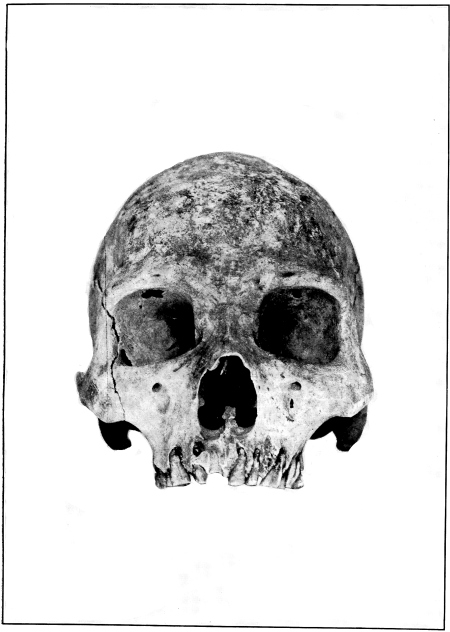
MALE SKULL, NO. 99-6669, A.M.N.H., FROM MANHATTAN ISLAND (FRONT VIEW)
VII. MUNSEE CRANIA: PROGNATHISM, FACIAL AND ALVEOLAR[32]
LEGEND:
A = Basion-prosthion line
B = Basion subnasal point[33]
C = Basion-nasion
D = Prosthion-nasion height
E = Prosthion subnasal point height
F = Facial angle (angle between a and d)
G = Alveolar angle (angle between a and e)
MALES
Number (A) (B) (C) (D) (E) (F) (G)
(a) (b) (c) (d) (e)
cm. cm. cm. cm. cm. ° °
285,306 10.5 9.7 10.4 7 2.1 70 62
285,308 10.2 9.2 10.3 7.4 2.2 70 58
285,301 10 8.8 10.4 7.6 2.3 72 54
285,305 9.4 8.6 10.0 7.2 2.2 74 64
285,326 9.9 8.9 10.3 6.9 2.0 74 56
285,303 9.5 8.7 10.2 6.8 1.9 77 61
(6) (6) (6) (6) (6) (6) (6)
Averages 9.9 9.0 10.3 7.15 2.1 73 59
FEMALES
285,307 10.4 9.2 10.1 6.8 2.1 69 52
285,327 9.4 8.4 9.7 6.6 1.9 74 55
285,302 9.0 8.0 9.6 7.0 2.2 74 58
285,304 10 9.0 10.5 7.3 2.1 74 58
285,310 9.4 8.4 10.2 7 2.1 76 58
(5) (5) (5) (5) (5) (5) (5)
Averages 9.6 8.6 10 6.9 2.1 74 57
An extended and meritorious report on the naso-alveolo-basilar angle such as here described was published in 1909 and 1910 by Dr. P. Rivet,[34] who commenced its determination independently by the same method as that of the present writer and almost simultaneously with him; but no comparisons are as yet available in regard to the alveolar angle. It appears from Rivet’s data that among modern white adults the average of the facial angle, as herein defined, ranges in round numbers from 70.5° to 73°;[35] among the negroes, the mean of Rivet’s series gives 68.5°; among several groups of American Indians it was 68° to 71.5°. Rivet calculated his indexes mathematically and with the help of an “abaque,” while the writer obtained his results by the direct (graphic) method, which, for small series of calculations and used with precision, seems to him preferable, although the results are probably quite comparable. By this method the writer obtained on the Arkansas and Louisiana crania, previously reported, averages ranging for the facial index from 70° to 74° for the males, and 68° to 70° for the females; while the alveolar angle gave the average of 55° to 60° in the males, and 51° to 53° in the females. The Munsee crania give the rather high average of 73° for the males and 74° for the females, with respect to the facial angle, and 59° in the males with 57° in the females for the alveolar angle. These figures indicate that both the facial and the alveolar protrusion in the Munsee was exceedingly moderate for a group of Indians, although in a measure the height of the indexes is due to the shortness of the face.
PALATE
It was possible to obtain satisfactory measurements of the palate (or, more strictly speaking, the upper alveolar arch) in 13 instances, which, in view of the usually frequent defects of the arch, is a good proportion of the cases. The measurements and indexes follow Turner’s method, which is quite satisfactory.[36] The greatest length recorded by Turner in 20 European male and 8 European female skulls was 6 cm., the smallest 4.7 cm.; the greatest breadth 6.9 cm., the smallest 5.6 cm. The same measurements among the Munsee range, if we take both sexes together, from 5.1 cm. to 6 cm. for length and 5.9 cm. to 7.2 cm. for breadth, showing both dimensions, though more especially the breadth, to be slightly superior in these Indians to what they are in whites. The palatal or “uranic” index averaged, in Turner’s whites, 116.2 in the males and 115.6 in the females; in the Munsee the averages are 120.7 for the former and 120.5 for the latter sex, showing the palate in these Indians to be more “brachy-uranic,” or relatively broader. The sexual differences in both Turner’s and the present series are so small as to be practically negligible. In the different groups of Arkansas and Louisiana crania, reported in 1909 by the writer, the average palatal index ranged from 116 to 122 in the males and from 115 to 122 in the females—conditions very similar to those shown in the present observations.
It may here be pointed out that the whole subject of the dimensions of the palate or alveolar arch in the different races, and especially in the different types of skull, needs investigation. As it is, the variety in the dimensions and shape of these structures, and especially their correlation with the rest of the face and skull, are only imperfectly understood.
BUREAU OF AMERICAN ETHNOLOGY BULLETIN 62 PLATE 10
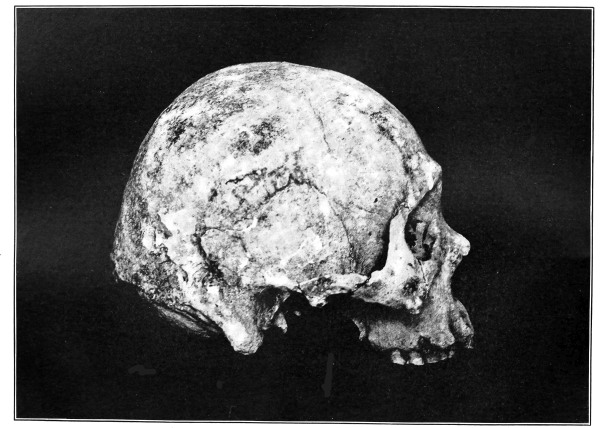
MALE SKULL, NO. 99-6669, A.M.N.H., FROM MANHATTAN ISLAND (SIDE VIEW)
LEGEND:
A = Index (B × 100)/L
B = Height at symphysis[39]
C = Thickness at 2d left molar[40]
D = Diameter bigonial
E = Minimum breadth of ramus
F = Angle (mean)[41]
G = Mean diameter (L + B)/2
MALES
Number Length Breadth (A) Number (B) (C) (D) (E) (F)
cm. cm. cm. cm. cm. cm. °
285,316 5.8 6.7 115.5 285,316 3.4 1.5 — 3.7 —
285,301 5.8 6.9 119 285,303 3.6 ([42]) 11 3 120
285,306 5.7 6.8 119.3 285,305 3.6 1.3 9.5 3.5 117
285,315 6 7.2 120 285,313 3.6 1.4 9.5 3.6 116
285,326 5.5 6.6 120 285,301 3.7 1.3 9.3 3.6 116
285,305 5.3 6.4 120.8 285,306 3.8 1.3 9.5 3.5 117
285,308 5.7 7.0 122.8 285,326 3.8 1.3 10.6 3.2 116
285,303 5.1 6.6 129.4 285,308 3.9 1.6 11.1 3.4 121
— — — — 285,315 3.9 1.8 10.9 4.0 121
(8) (8) (8) (9) (8) (8) (9) (8)
Averages 5.6 6.8 120.7 — 3.7 1.5 10.5 3.5 118
FEMALES
285,327 5.1 5.9 115.7 285,324 3.2 1.5 9.6 3.3 128
285,307 5.6 6.6 117.9 285,307 3.2 1.2 8.7 — 127
285,304 5.2 6.2 119.2 285,310 3.4 1.6 10.3 3.5 131
285,302 5.2 6.4 123.1 285,321 3.5 1.65 — 3.5 —
285,310 5.2 6.6 126.9 285,347 3.5 1.6 — 3.4 128
— — — — 285,302 3.7 1.5 9.8 2.8 140
— — — — 285,320 — — — 3.1 123
— — — — 285,309 — — — — 130
(5) (5) (5) (6) (6) (4) (6) (7)
Averages 5.25 6.35 120.5 — 3.4 1.5 9.6 3.2 130
MALES
Foramen magnum
Number (G)
cm.
285,301 3.3
285,305 3.3
285,303 3.5
285,306 3.5
285,308 3.6
285,326 3.6
285,313 3.8
— —
— —
(7)
— 3.5
FEMALES
285,309 3.1
285,327 3.1
285,304 3.2
285,310 3.2
285,302 3.3
285,320 3.3
285,347 3.3
285,307 3.4
(8)
— 3.2
FORAMEN MAGNUM
In respect to the foramen magnum, there is so much irregularity and so little special significance in the ratio between the two main diameters, length and breadth, that the writer prefers to use the mean measurement,
(l + br),
2
which stands in some relation to stature and probably to muscular development, and which may have more than passing interest in the study of racial and other groups. The average in the Munsee is, as usual, perceptibly higher in the males than in the females. It is almost identical in both sexes with that of the Indian skeletal remains from the Louisiana mounds (Munsee, 7 males, 3.5; 8 females, 3.2: Louisiana, 10 males, 3.45; 14 females, 3.18 cm.), which were nearly alike in stature, but it is slightly superior to that of the Indians from Arkansas, who were also of practically the same height (Arkansas, 22 males, 3.3; 16 females, 3.14 cm.).
LOWER JAW
The measurements of the lower jaw show only moderate dimensions throughout. The angle (mean of the two sides, which usually differ somewhat in this respect) averages decidedly higher in the females (130°), which is not always the case in American crania. Thus among the Arkansas and Louisiana mound crania it averaged 118.5° in the males, or practically the same as in the Munsee; while it was only 122° in the females, or eight points lower than in the Munsee of the same sex.
Detailed Observations on the Crania
In visual examination of a series of crania or other bones of more than passing importance, general impressions are not sufficiently accurate or reliable; consequently, the writer habitually makes detailed notes of the principal features of each specimen in accordance with a definite though simple scheme. Such notes can be tabulated and analyzed almost as readily as measurements.
In choosing the points for observation, the only rule that can be formulated is to include everything of consequence, and to cover the whole specimen, which is not so easily accomplished as at first might seem. Some of the points touched upon in such a procedure will, of course, be of much less weight than others, but they serve to complete the picture and will doubtless be of some interest and value in future comparisons; while purely individual characteristics that might be included by some authors may be passed entirely.
The results of the detailed examination of the Munsee crania are as follow:
THE VAULT: FOREHEAD
The conditions found in respect to the frontal region will be clearly seen from the accompanying table. As general among Indians, this region in the Munsee skulls shows high development only in exceptional cases. In the males there is frequently more or less of a slope; in the females, where slope is rare, low foreheads prevail.
BUREAU OF AMERICAN ETHNOLOGY BULLETIN 62 PLATE 11
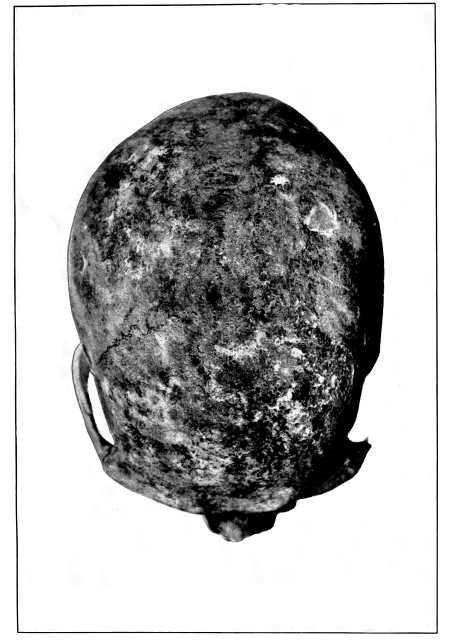
MALE SKULL, NO. 99-6669, A.M.N.H., FROM MANHATTAN ISLAND (VIEW FROM ABOVE), SHOWING LONG OVOID OUTLINE
IX. MUNSEE CRANIA: FRONTAL REGION
9 males 11 females
Cases Per cent Cases Per cent
Exceptionally good development — — 1 9
Medium 5 56 4 36
Low 1 11 5 45
Slight to moderately sloping 3 33 1 9
SAGITTAL REGION
The vault of the skull among Indians is frequently more or less arched or keeled, indicating strong development of the temporal muscles. This characteristic is of course much more frequent and pronounced in the males than in the females. The Munsee, it will be seen, show no exception in this respect. The elevation of the sagittal region is present in nearly all the males, although it is seldom pronounced. Among the females nearly half are without sagittal elevation, while in the remainder this feature is only slightly developed.
X. MUNSEE CRANIA: SAGITTAL REGION
9 males 12 females
Cases Per cent Cases Per cent
Oval or nearly so 1 11 5 42
Slightly elevated or keeled 4 44 5 42
Moderately keeled 2 22 1 8
Markedly keeled 2 22 1 8
TEMPORO-PARIETAL REGION
The temporo-parietal region differs in convexity with the type of the skull, being usually quite flat in pronounced dilochocephaly and decidedly convex in marked brachycephaly. Besides this, it is also subject to individual and groupal variations. In the series at hand, in two-thirds of both the male and the female skulls the region is of about medium convexity. Among the remainder of the specimens it is rather interesting to note that while in a third of the cases in the males the region is flat and in no case bulging, these conditions are practically reversed in the females. The temporo-parietal region of the brain tended evidently to a greater relative development in the females of this series than in the males.
XI. MUNSEE CRANIA: TEMPORO-PARIETAL REGION
9 males 12 females
Cases Per cent Cases Per cent
Bulging — — 3 25
Medium convexity 6 67 8 67
Rather flat 3 33 1 8
OCCIPUT
When we eliminate all the cases that show any trace of artificial flattening of the back of the skull, there remain only a few specimens for observation. Among these, three-fourths show medium convexity of the occiput, while in one-fourth the region is protruding. There is no difference in this respect in the two sexes. The external occipital protuberance and the occipital ridges do not show especially strong development in any case, and barring a single instance of the occurrence of an Inca bone, which will be spoken of in another connection, there are no anomalies of this region to be recorded.
XII. MUNSEE CRANIA: OCCIPUT (IN THE UNDEFORMED)
4 males 4 females
Cases Per cent Cases Per cent
Medium prominence 3 75 3 75
Protruding 1 25 1 25
Slightly asymmetric 1 (25) 1 (25)
SUTURES: SERRATION
The serration of the cranial sutures is of interest for the reason that in the skulls of whites and in superior skulls generally the knitting is often, though not invariably, quite complex, while in the majority of the skulls among the retarded races it is more or less simple and may occasionally be nearly absent. For the sake of simplicity in recording the nature of the sutures the writer refers to the serration as “medium,” or about as it averages in whites; “submedium,” which is self-explanatory; and “poor,” or such as approaches a simple wavy line. Among the Indians the sutures range mostly from submedium to more simple, and the Munsee skulls form no exception. As seen from the actual data not one case reaches the standard of medium complexity in all the sutures, while in a large proportion of the specimens the serration of most, if not all, is decidedly inferior. No special difference exists in this respect between the skulls of different sizes.
BUREAU OF AMERICAN ETHNOLOGY BULLETIN 62 PLATE 12
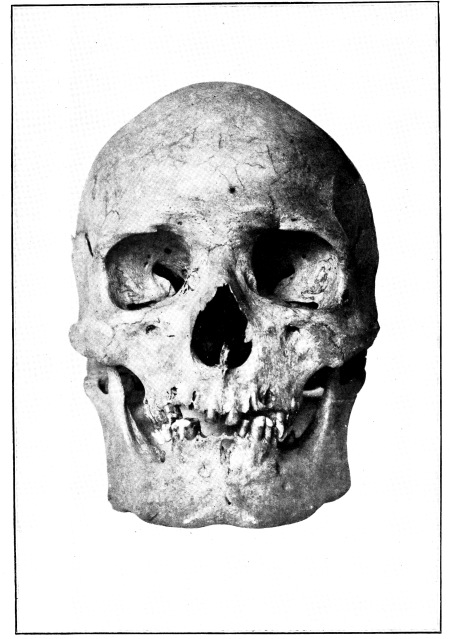
MALE MUNSEE SKULL, NO. 285,308, U.S.N.M. (FRONT VIEW)
XIII. MUNSEE CRANIA: SERRATION OF SUTURES
7 males 11 females
Cases Per cent Cases Per cent
Medium (about as average in whites) — — — —
All sutures of the vault submedium 2 29 5 45
All poor 2 29 5 45
Coronal and lambdoid submedium, sagittal medium 2 29 1 9
Coronal quite simple, sagittal and lambdoid nearly medium 1 14 — —
OCCLUSION OF SUTURES
In none of the specimens at hand can be detected any premature occlusion, though in this respect it is impossible to be certain as to the temporo-occipital articulations. Unfortunately, there is no possibility of giving the exact relation of age to the occlusion in any of the sutures; all that it is possible to determine is their relative involvement. The order among the males is S-C-TO-L;[43] that in the females, TO-S-C-L. It is plain that occlusions in the coronal and temporo-occipital sutures are almost as early and frequent as those in the sagittal, while those in the lambdoid are decidedly later. As to locality, the coronal suture occludes first below the temporal ridges; in the sagittal the commencement is most frequent, as usual, about obelion; in the lambdoid it is irregular; while in the temporo-occipitals in the Munsee it advances generally from the anterior or basal extremity of these sutures backward and upward.
XIV. MUNSEE CRANIA: OCCLUSION OF SUTURES (EXTERNALLY, ALL GRADES)
9 males 12 females
Cases Per cent of skulls Cases Per cent of skulls
Coronal 6 67 4 33
Sagittal 7 78 4 33
Lambdoid 2 22 2 17
Temporo-occipital 5 56 5 42
WORMIAN BONES
The frequency of Wormian bones in any given series of skulls, while a factor of no great importance, is always of some interest. It is certain that in this respect there is a wide difference even in different groups of the same people, such as the Indians. Among the Munsee, as already mentioned, we find a remarkable scarcity of these ossicles, especially in the males. Not only are the Wormian bones scarce in this series, but they are also invariably small. This scarcity may in all probability be regarded as a sign of the absence of all disturbances, developmental as well as pathological.
XV. MUNSEE CRANIA: WORMIAN BONES; BREGMA AND “INCA” BONES
LEGEND:
A = Temporo-occipital
B = Temporo-parietal (squamo-mastoid angle).
Total number present 8 males 12 females According to sutures 8 males 12 females
Cases Per cent Cases Per cent Cases Per cent Cases Per cent
None 3 38 4 33 Coronal 1 12 — —
One 3 38 1 8 Sagittal — — — —
Two 1 12 1 8 Lambdoid 4 50 6 50
More than two — — 5 42 (A) — — 6 50
Inca bone — — 1 8 (B) 2 25 2 17
Bregma (fontanel) bone. 1 12 — — — — — — —
BREGMA AND INCA BONES
Among the 20 crania in which conditions with respect to these facts could be ascertained, there was found one bregma or fontanel bone (3 × 3.1 cm.), and one of the so-called Inca[44] bones (diameter, 8.3 × 3.5 cm.). There is nothing especially noteworthy in these occurrences, both of which, particularly the Inca bone, are of the nature of developmental anomalies.
Pterions.—Among the 19 Munsee skulls in which the pterions could be determined there was no case of temporo-frontal contact. In all instances the pterion was of the H type, predominantly narrow in the males and predominantly medium to broad in the females.
XVI. MUNSEE CRANIA: PTERIONS
7 males 12 females
Cases Per cent Cases Per cent
Temporo-frontal contact) — — — —
H type, narrow 4 57 1 8
H type, medium 3 43 6 50
H type, broad — — 5 42
PARIETAL FORAMINA
These are represented quite poorly. In almost half the skulls there are no parietal foramina at all, while in most of the remainder they range from very minute to medium size, of which latter there is a single instance, and in only one case are there two canals of medium size. The exact significance of this showing is not clearly understood. When present these canals transmit, as is well known, a small arteriole and an emissary vein which connects the venous systems within and without the wall of the skull.
BUREAU OF AMERICAN ETHNOLOGY BULLETIN 62 PLATE 13
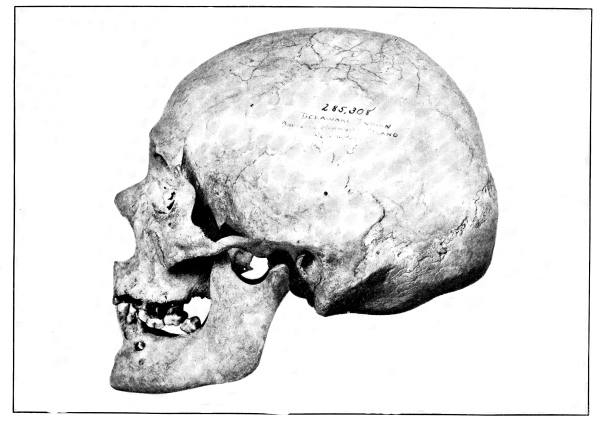
MALE MUNSEE SKULL, NO. 285,308, U.S.N.M. (SIDE VIEW)
XVII. MUNSEE CRANIA: PARIETAL FORAMINA
9 males 12 females
Cases Per cent Cases Per cent
None 3 33 6 50
1 or 2 minute 3 33 1 8
1 medium 2 22 4 33
2 medium 1 11 — —
1 medium on right,
2 minute on left — — 1 8
RETROMASTOID FORAMINA
The retromastoid (“mastoid”) foramina are most often two in number—a larger and a smaller—one of which transmits a vein from the transverse sinus within to the cutaneous occipital vein on the outside of the skull wall, and the other a smaller branch of the occipital artery. Like the parietal foramina, they show considerable individual and groupal variation in both number and size. It is not uncommon in some Indian crania to find one of these canals to be of very appreciable diameter (up to 4 mm.). While in the Munsee skulls they appear almost generally two on each side, they are in no instance above moderate size, and in several cases are quite minute. Thus in these specimens the retromastoid foramina stand in harmonious rather than compensatory relation with the small or even absent parietal foramina.
XVIII. MUNSEE CRANIA: RETROMASTOID FORAMINA
8 males 12 females
Cases Per cent Cases Per cent
2, moderate size, each side 7 88 5 42
2, small to minute, each side 1 12 4 33
1, moderate size, each side — — 1 8
2, small to minute, each side 1 12 4 33
2, medium, right side; 2 small, left side — — 1 8
MASTOIDS
The mastoid processes are mainly of importance as sexual characteristics. Their value in this respect, however, differs considerably from racial group to group, and even within a single stem of people, such as the Indians. On the whole, however, it may be said that in the Indian female the mastoid is somewhat more developed than it is in the average white woman. Occasionally it is considerably more developed, reaching the subaverage or even the average dimensions of that of the males in the same tribe. The grade of development of the process is of course related to the strength and activity of the sternocleido-mastoid muscle, to which it gives attachment. Among the Munsee the size of the mastoids on the whole is only moderate; yet even in this series they rise in one of the female skulls to male-like proportions.
XIX. MUNSEE CRANIA: MASTOIDS
10 males 12 females
Cases Per cent Cases Per cent
Large (masculine) 1 10 — —
Medium (masculine) 6 60 1 8
Submedium (feminine) 3 30 11 92
In one of the females (no. 285,309) the apex of the left mastoid is bifid. Well developed cases of this anomaly are rare; there are only three or four other Indian crania in the large collections of the United States National Museum in which it is well represented. In another female specimen (no. 285,304) the right mastoid shows a peculiar, marked indentation in the middle of its dorsal surface, with a groove extending therefrom upward and backward and downward and backward.
SUPRAORBITAL RIDGES
These ridges, as is well known, are sexual characteristics in the main; phylogenetically they are the remains of the pronounced supraorbital arches of man’s anthropoid ancestors and of early man. Like the mastoids they show also considerable individual variation in each sex among the Indians, owing to which they occasionally fail to afford aid in the determination of the sex of the specimen. As a rule they are limited in Indians to the median half to two-thirds of the supraorbital space. In the Munsee skulls at hand they are markedly developed in only one of the males; in two of the male skulls they are small, feminine like, while in two of the female skulls they are so developed as to approximate the supraorbital ridges of the average male.
BUREAU OF AMERICAN ETHNOLOGY BULLETIN 62 PLATE 14
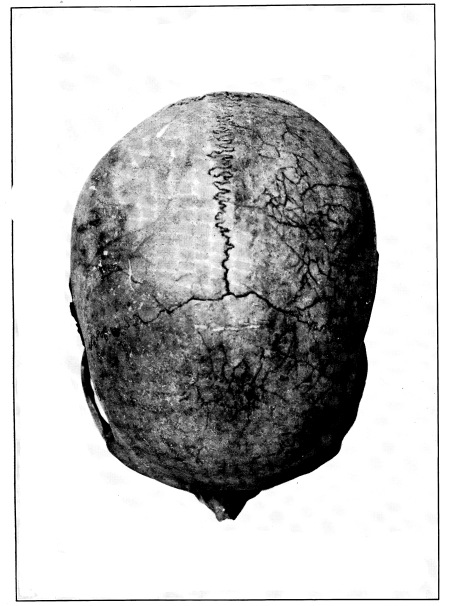
MALE MUNSEE SKULL, NO. 285,308, U.S.N.M. (VIEW FROM ABOVE)
XX. MUNSEE CRANIA: SUPRAORBITAL RIDGES
8 males 12 females
Cases Per cent Cases Per cent
Pronounced (masculine) 1 12 — —
Medium (masculine) 5 63 2 17
Small (feminine) 2 25 8 67
Very small — — 2 17
NASION DEPRESSION
The depression at the ridge of the nose is generally well marked in male Indian crania, but is mostly shallow in the female specimens. The depression is never narrow, like a deep line, as in some of the negroes; and in the females it is usually quite wide from above downward. The skulls of the series under consideration show nothing very exceptional in this respect.
XXI. MUNSEE CRANIA: NASION DEPRESSION
7 males 12 females
Cases Per cent Cases Per cent
Pronounced 1 14 — —
Medium 5 71 2 17
Shallow 1 14 5 42
None or scarcely any — — 5 42
NASAL BRIDGE
The development of the nasal bridge differs among the Indians more or less from tribe to tribe, hence it would be erroneous to assume that all Indians, or even a majority in some of the tribes, had high noses. On the other hand, the nasal bridge is never flat and short as in the negro. In the females, as among the whites, the bridge is generally lower than in the males. The observations on the Munsee, among 17 cases in which the bridge is preserved, show 10 of medium height and 7 submedium to low.
XXII. MUNSEE CRANIA: NASAL BRIDGE
7 males 10 females
Cases Per cent Cases Per cent
Medium height 6 86 4 40
Submedium height 1 14 2 20
Low — — 4 40
NASAL BONES
The chief feature of the nasal bones to which the student usually directs attention is their breadth. There is on this continent a frequency of especially narrow nasals among the Eskimo. Among the Indians, narrow nasal bones occur only exceptionally; more commonly they are rather broad, though the breadth is not excessive. In the present series we find them fairly broad in all the males and in two of the females; narrow (not excessively) in only two of the females.
XXIII. MUNSEE CRANIA: NASAL BONES
7 males 12 females
Cases Per cent Cases Per cent
Broad 7 100 2 17
Medium — — 8 67
Narrow — — 2 17
NASAL APERTURE
The features of chief interest with respect to the nasal aperture are the fullness or sharpness of the inferior borders, the presence or absence of subnasal fossæ or simian gutters, and pronounced asymmetry. Among the 19 Munsee skulls in which these features can be studied, there are only one instance of moderate grooves and three cases of moderate asymmetry. The lower borders are fairly sharp, more so than the average in many other Indians.
XXIV. MUNSEE CRANIA: LOWER BORDERS OF NASAL APERTURE
7 males 12 females
Cases Per cent Cases Per cent
Normal, fairly sharp 4 57 11 92
Dull — — — —
Asymmetric 2 29 1 8
Simian grooves 1 14 — —
NASAL SPINE
On the whole the nasal spine reaches its most pronounced development, especially in height, in the modern whites. It is rudimentary or absent in the anthropoid apes, and seldom reaches marked development in the yellow-brown and black races. Among Indians it ranges from rudimentary or very low to fairly well developed. In the Munsee, as shown by the accompanying figures, it was mostly very low to submedium.
BUREAU OF AMERICAN ETHNOLOGY BULLETIN 62 PLATE 15
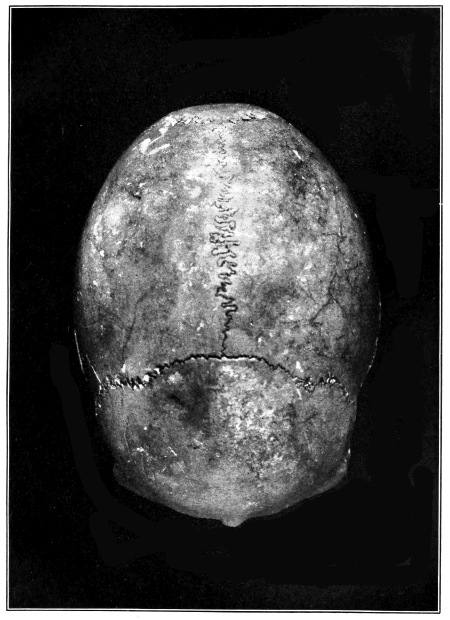
UNDEFORMED TYPICAL FEMALE MUNSEE SKULL, NO. 285,309, U.S.N.M. (VIEW FROM ABOVE)
BUREAU OF AMERICAN ETHNOLOGY BULLETIN 62 PLATE 16
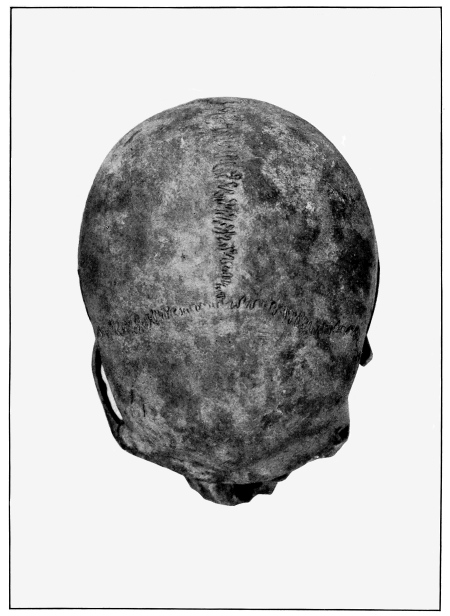
MALE MUNSEE SKULL, NO. 285,306, U.S.N.M., SHOWING FINE OVOID OUTLINE
BUREAU OF AMERICAN ETHNOLOGY BULLETIN 62 PLATE 17
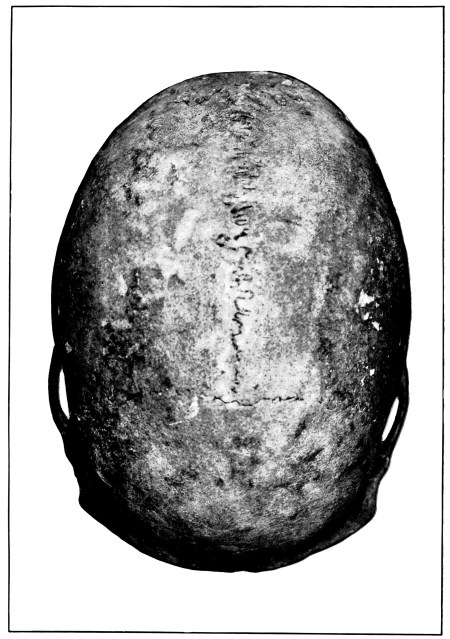
LARGE MALE SKULL, NO. 2010-4423, A.M.N.H., FROM MANHATTAN ISLAND, SHOWING FINE ELLIPTICAL OUTLINE
XXV. MUNSEE CRANIA: NASAL SPINE
7 males 11 females
Cases Per cent Cases Per cent
About as average in whites 1 14 3 27
Submedium 4 57 6 55
Very low 2 29 2 18
ORBITS
In the majority of skulls under consideration, the orbits offer nothing special morphologically; in a number of instances, however, there is an exceptional conformation, the details of which are shown in the table which follows. The data accentuate the fact, already shown by the measurements, of the considerable range of fluctuation in these features, which, however, seems in this case to have little if any anthropological significance, although it may be due in part to admixture with other people.
XXVI. MUNSEE CRANIA: ORBITS
7 males 12 females
Cases Per cent Cases Per cent
No special features 3 43 8 67
Lateral axis of each nearly horizontal 1 14 — —
Lateral axis of each decidedly oblique 1 14 — —
Strikingly large — — 1 8
Strikingly small 1 14 — —
Exceptionally high — — 2 17
Exceptionally low 1 14 — —
Right lower and more oblique than left — — 1 8
SUBORBITAL FOSSÆ
These depressions in the upper maxillæ, which, strictly speaking, have only indirect relation to the canine teeth and do not deserve the old name of “canine fossæ,” are generally less well marked or hollowed out in the Indian than in whites, although there is considerable individual variation. In the Munsee, in more than half the skulls, they are shallow to very shallow.
XXVII. MUNSEE CRANIA: SUBORBITAL (CANINE) FOSSÆ
7 males 12 females
Cases Per cent Cases Per cent
Deeply hollowed — — — —
Medium 3 43 6 50
Shallow 3 43 6 50
Only a trace of depression 1 14 — —
These fossæ are of evolutionary significance. In the anthropoid apes they are either entirely wanting or very nearly so, the region being in fact often moderately convex; and the same is true, so far as the evidence is available, of early man to the latter part of the Neanderthal period.
MALAR BONES. ZYGOMÆ
The malars among the Munsee are of moderate development throughout, and none of the bones shows any complete or even appreciable partial division or other anomaly. The zygomatic processes are rather submedium in strength as compared with those of other Indians, particularly in the males.
In one of the male skulls (no. 285,313) the right zygoma is represented only by a pointed but otherwise unaltered base, the rest of the bone, up to the malar suture, being absent. In all probability this condition is the result of an old fracture, after which the larger part of the zygoma was lost or remained separated.
XXVIII. MUNSEE CRANIA: THE MALARS; ZYGOMÆ
MALARS 9 males 12 females ZYGOMÆ 7 males 11 females
Cases Per cent Cases Per cent Cases Per cent Cases Per cent
Heavy or protruding. — — — — Very broad — — — —
Medium development. 9 100 10 91 Medium 3 43 10 91
Submedium 4 57 1 9
(for the sex and race).
Submedium development. — — 1 9
UPPER ALVEOLAR ARCH
The main feature for observation of the upper dental arch is its slant or prognathism, and conditions in this respect have already been shown in the main by the measurements. The inspection confirms the fact that in three of the female skulls the arch must be described as markedly slanting. In two cases, in both of which the vault of the skull is artificially deformed, the arch is asymmetric; in one of these, however, the asymmetry is evidently due to early loss of some of the teeth. In no case is there any special massiveness of the arch.
XXIX. MUNSEE CRANIA: UPPER ALVEOLAR ARCH
8 males 11 females
Cases Per cent Cases Per cent
Medium slant 8 100 8 73
Marked slant — — 3 27
Asymmetric 1 (12) 1 (9)
BUREAU OF AMERICAN ETHNOLOGY BULLETIN 62 PLATE 18
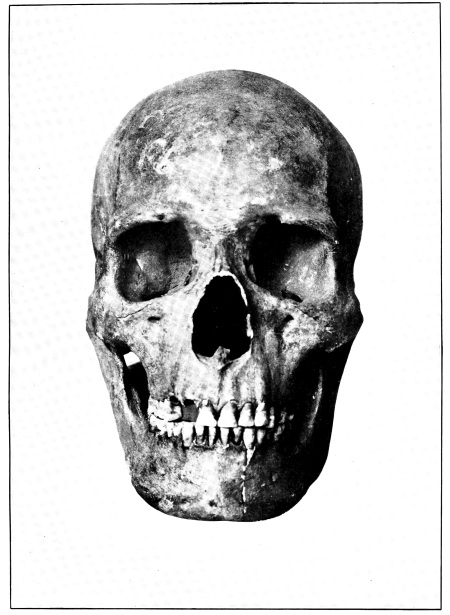
ADULT MALE SKULL FROM MANHATTAN ISLAND, NO. 99-6667, A.M.N.H., SHOWING AN EXCEPTIONALLY HIGH AND NARROW FACE
LOWER JAW
In 17 of the 20 Munsee skulls in which the lower jaw is present, the latter is of ordinary (Indian) dimensions and form; in one male and in one female it shows strong development. In a single instance only is the chin square; in the others it is moderately rounded. The prominence of the chin in all cases may be described as approximately medium.
XXX. MUNSEE CRANIA: LOWER JAW
9 males 11 females
Cases Per cent Cases Per cent
Ordinary Indian form and moderate development 7 78 10 91
Square chin 1 11 — —
Jaw very strong 1 11 1 9
PALATE
The shape of the palate is determined by that of the upper dental arch. Of the skulls at hand, in 11 of the 22 cases the outlines of both the arch and the palate are elliptic, in 7 ovoid, and in 4 parabolic. The tendency toward the parabolic form is more marked in the females than in the males. The height of the palate shows nothing exceptional, and there is no torus worthy of notice.
XXXI. MUNSEE CRANIA: PALATE
10 males 12 females
Cases Per cent Cases Per cent
Ovoid 3 30 4 33
Elliptic 6 60 5 42
Parabolic 1 10 3 25
Torus — — — —
BASE OF THE SKULL
Glenoid fossæ.—In general the glenoid fossæ of the Indian skulls resemble those among the whites, but there is considerable individual variation, particularly in spaciousness of the hollows. Among the 22 Munsee crania, in 14 the fossæ are of ordinary form and of about medium dimensions; in one they are narrow antero-posteriorly, in 4 wide; in 1 case their axis is decidedly oblique, and in 2 the fossæ differ in depth on the two sides. The wide fossæ are more frequent in the females.
XXXII. MUNSEE CRANIA: GLENOID FOSSÆ
10 males 12 females
Cases Per cent Cases Per cent
Ordinary form and dimensions 8 80 6 50
Narrow (antero-posteriorly) 1 10 — —
Wide (antero-posteriorly) 1 10 3 25
Decidedly oblique (laterally) — — 1 8
Left shallow, right medium — — 2 17
Floor of auditory meatus.—Among the Indians, and particularly in the young, there are frequently found more or less pronounced defects or dehiscences (Hyrtl) in the floor of the auditory meatus. The frequency of these defects differs from locality to locality and probably from tribe to tribe. They are rather scarce in the Munsee, two-thirds of the crania showing no defect whatever, while of the remainder in only one instance was the perforation large. There seems to be a predominance of this condition in the females.
XXXIII. MUNSEE CRANIA: DEFECTS IN FLOOR OF AUDITORY MEATUS
10 males 12 females
Cases Per cent Cases Per cent
None 8 80 8 67
Slight, each side 1 10 2 17
Moderate, each side 1 10 1 8
Large, each side — — 1 8
Styloid processes.—Among the Indians the styloid processes seldom reach good development, although there is some difference in this respect among the tribes. In a great majority of Indian crania the styloid processes are more or less diminutive, and not seldom they are quite rudimentary or even absent, in the latter case usually only small bases being discernible. In the Munsee only four of the twenty-two skulls show styloids which approach the medium or average in whites; in seven the processes are decidedly submedium; and in eleven they are rudimentary.
XXXIV. MUNSEE CRANIA: STYLOID PROCESSES
10 males 12 females
Cases Per cent Cases Per cent
Medium (about average in whites) 2 20 2 17
Submedium 5 50 2 17
Rudimentary 3 30 8 67
BUREAU OF AMERICAN ETHNOLOGY BULLETIN 62 PLATE 19
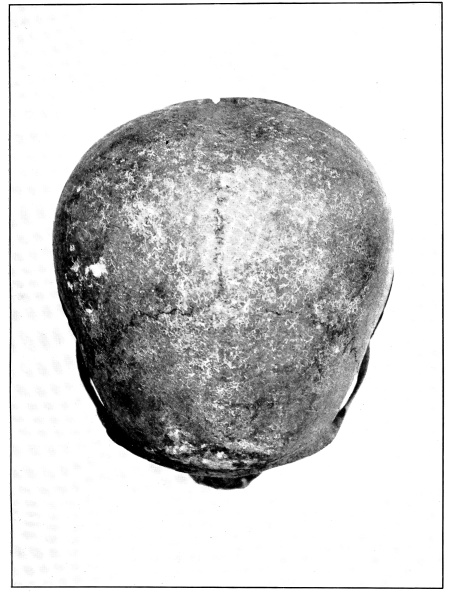
BRACHYCEPHALIC EXTRANEOUS FEMALE SKULL, NO. 285,311, U.S.N.M. (VIEW FROM ABOVE), FOUND WITH THE MUNSEE INDIANS
BUREAU OF AMERICAN ETHNOLOGY BULLETIN 62 PLATE 20
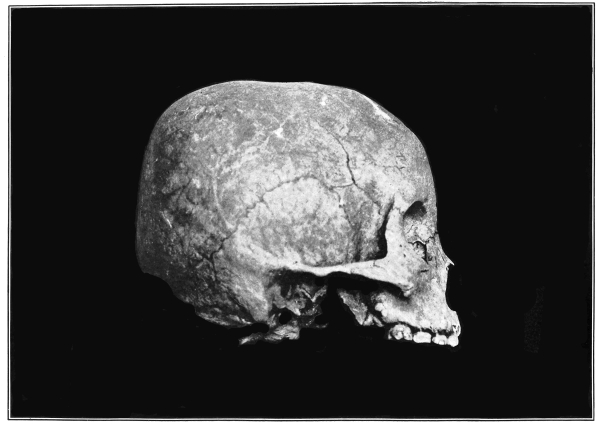
SKULL OF MUNSEE CHILD OF ABOUT SIX YEARS OF AGE, NO. 285,329, U.S.N.M., SHOWING FRONTO-OCCIPITAL COMPRESSION
Middle lacerated foramina. Posterior lacerated foramina.—As repeatedly pointed out by the writer on former occasions, the middle lacerated foramina are structures of some importance. They are very small in the anthropoid apes, generally small in negro skulls, submedium to medium in the yellow-brown races and in less developed whites, and reach their maximum spaciousness in civilized modern white men. These differences are connected with the increase in the size of the brain. A growing brain not accompanied with a proportionate or equally rapid increase in the bony structures of the base of the skull (which seems to be most frequently the case) will cause a spreading and bulging of the basal parts, one result of which will be the increased size of the middle lacerated foramina. In the Munsee, in only two of the nineteen skulls in which the basal region is sufficiently well preserved for examination, the foramina about equal in size the average in whites; in nearly half of the remaining skulls they are submedium, and in slightly more than half they are small.
XXXV. MUNSEE CRANIA: MIDDLE LACERATED FORAMINA; POSTERIOR LACERATED FORAMINA
7 males 12 females 7 males 12 females
Cases Per cent Cases Per cent Cases Per cent Cases Per cent
Medium (about as average in whites) Of equal size 1 14 1 8
Submedium 5 71 3 25 Right larger 5 71 8 67
Small 1 14 8 67 Left larger 1 14 3 25
The posterior lacerated or jugular foramina are of interest chiefly because of their frequent and often marked inequality in size, which signifies inequality in the size of the lateral sinuses and especially of the internal jugular veins. The right foramen is frequently larger than the left, a phenomenon which has been associated with the prevailing right-handedness in man. In the nineteen Munsee skulls in which the foramina could be examined, they are of about equal size in only two instances; the right is larger in thirteen, or in two-thirds of the cases, while the left is the larger in only four instances. As the proportion of left-handed persons among the Indians averages only about three per cent, it is evident that in some instances the relation between a larger jugular canal and habitual greater use of the arm of the same side would not maintain; besides, we know the motor centers for the right arm and hand to be on the left side of the brain. Possibly greater blood pressure on the right side in right-handed persons, due directly and mechanically to the greater muscular activity on that side, would be a more satisfactory explanation.
Depressions of the petrous portions.—In examining the petrous parts in the usual way, with the skull turned base upward, it is observed that in modern men of all races, in the majority of cases, these parts are more or less depressed below the niveau of the surrounding parts. In reality, of course, the surrounding parts have been pressed outward by the developing brain, while the prismatic and resistant petrous parts remained behind. The grade of depression of the petrous parts stands generally in close correlation with the size of the middle lacerated foramina and is of parallel significance.[45] Among the anthropoid apes even a slight depression of the petrous portions is very rare, and most frequently, especially in the orang, these portions rise slightly above the surrounding structures. In the African negro, and occasionally in individual skulls of other inferior races, they are level with the surrounding parts. In better developed negro skulls, as in the majority of those of other primitive peoples, they are slightly to moderately depressed. In white men, and in superior skulls in general, the depression is frequently pronounced, especially, it seems, in the brachycephals. The Indian stands in a practically intermediate position between superior whites and the negroes, and the Munsee are no exception. In two of the skulls the depression is well marked; in three males and seven females it is less than the average in whites; and in two males and five females it is only slight. The females, it will be noted, make a poorer showing in this respect than the males.
XXXVI. MUNSEE CRANIA: DEPRESSION OF PETROUS PORTIONS
7 males 12 females
Cases Per cent Cases Per cent
Medium (about as average in whites) 2 29 — —
Submedium 3 43 2 58
None or almost none 2 29 5 42
Pterygo-basal foramina. Posterior condylic foramina.—Interesting features of the base of the skull, to which Gruber and (in this country) Harrison Allen have called attention, are the foramina found occasionally at the base (or proximal part) of the external pterygoid plates. These foramina are seldom complete. They may be single, double, or even triple. They are formed by a process or by processes of bone which proceed upward and backward, and in some cases more or less outward, from the border of the external pterygoid plate. According to the insertion of these processes, the foramina to which they give rise can be divided into two classes, namely, the more frequent pterygo-spinous and the rarer pterygo-sphenoidal.
Their significance is not yet so clearly understood as is desirable. They are of some anthropological interest and occur quite frequently among Indians, especially in certain localities. Among the Munsee they were rather scarce, particularly in the females.
XXXVII. MUNSEE CRANIA: PTERYGO-BASAL FORAMINA; POSTERIOR CONDYLIC FORAMINA
7 males 12 females 5 males 12 females
Cases Per cent Cases Per cent Cases Per cent Cases Per cent
None or only a trace 3 43 11 92 Two, normal 3 60 12 100
Pterygo-spinous complete on left, Left absent 1 20 — —
four-fifths on right 1 14 — —
Pterygo-spinous incomplete, Right, diminutive 1 20 — —
both sides 1 14 1 8
Incomplete pterygo-sphenoidal, left side 1 14 — —
Complete pterygo-sphenoidal on left (absent on right) 1 14 — —
Posterior condylic foramina.—These are canals which transmit the posterior condylic vein and are of interest only because of their more or less frequent absence from one or both sides in different racial groups. In the Munsee they are exceptionally normal, as will be seen from the preceding figures.
MISCELLANEOUS ANOMALIES
In addition to the peculiarities shown in the preceding paragraphs, the Munsee skulls present a number of anomalous conditions which deserve to be mentioned.
In male skull no. 285,306 the right occipital condyle is flat, the left being normal; there was no injury or arthritis.
In male skull no. 285,326 there is an accessory facet posteriorly to the left condyle.
In female skull no. 285,311 there are two moderate precondylar tubercles.
In male skull no. 285,313 and female skull no. 285,312 there is a moderate medio-basilar (“pharyngeal”) fossa.
In female skull no. 285,320 the carotid canals in the petrous parts are usually large, measuring 7 mm. in major diameter.
In female skull no. 285,311 a canal, 6 by 4.5 mm., is present just posteriorly to the right angular process, in the frontal bone and the spheno-frontal suture.
Finally, there is a series of anomalies relating to the spinous and oval foramina. They are as follows:
Male skull no. 285,303: The median wall of the left foramina spinosum and ovale is deficient.
Female skull no. 285,310: Median wall of right spinous foramen deficient.
Female skull no. 285,347: Median wall of left spinous foramen deficient.
Female skull no. 285,320: Median wall of each spinous foramen deficient.
Female skull no. 285,323: Right foramina spinosum and ovale connected, and the median wall of both deficient.
Female skull no. 285,311: The left foramen ovale is unusually large, 8.5 by 4.5 mm., while the right is enormous, 10 by 8 mm. (pl. 21).
The Teeth
Dentition.—Of the 22 skulls of Munsee adults at hand it is possible to ascertain the state of dentition in 14. In 11 of these cases there were 32 teeth in each, while in three there were 31. The congenital deficiency consisted in one case of the third left upper molar; in the second, the third left upper molar is completely absent, while the right corresponding tooth is rudimentary; and in the third there is a congenital absence of the left lower lateral incisor, while on the right side we find the very rare condition of a complete fusion of the lower lateral incisor and the canine (pl. 22).
Loss and decay.—Teeth lost through caries and the presence of decay are common in this series, more so than in other Indian groups. Among the males, 13 per cent of all the teeth were lost in life, while 12 per cent of those still present show more or less decay; among the females 21 per cent were lost in life and 16 per cent of those present show caries—this notwithstanding the fact that the average age of the female skulls was less than that of the males. The teeth lost or affected were mostly the molars, especially those in the lower jaw.
Wear.—In every instance the remaining teeth show more or less pronounced effects of wear. Where the wear is advanced, it is generally also irregular. The detailed notes show that the wear is slight in eight, moderate in five, and advanced in nine of the 22 specimens.
Size, quality, shovel-shaped incisors.—In size the Munsee teeth in all cases are medium. Where not decayed or worn off they show invariably regular and normal development. The upper incisors present in every case the cingulum which gives their lingual surface a more or less pronounced shovel-shaped character, common to and characteristic of all Indians, with rare individual exceptions.
BUREAU OF AMERICAN ETHNOLOGY BULLETIN 62 PLATE 21
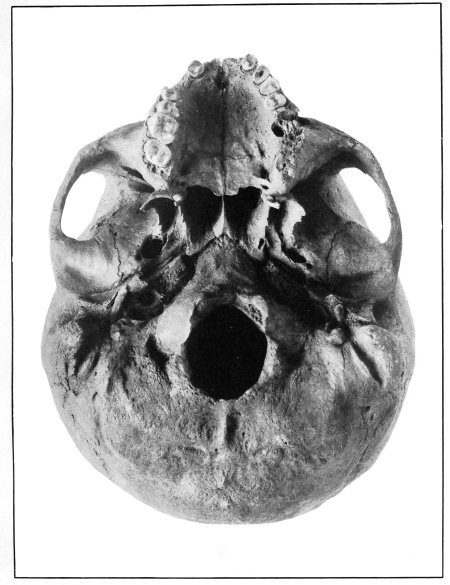
BASE OF FEMALE SKULL NO. 285,311, U.S.N.M. (BRACHYCEPHALIC EXTRANEOUS), FOUND AMONG THE MUNSEE BURIALS, SHOWING EXCESSIVE SIZE OF THE FORAMINA OVALE, ESPECIALLY ON THE RIGHT SIDE
BUREAU OF AMERICAN ETHNOLOGY BULLETIN 62 PLATE 22
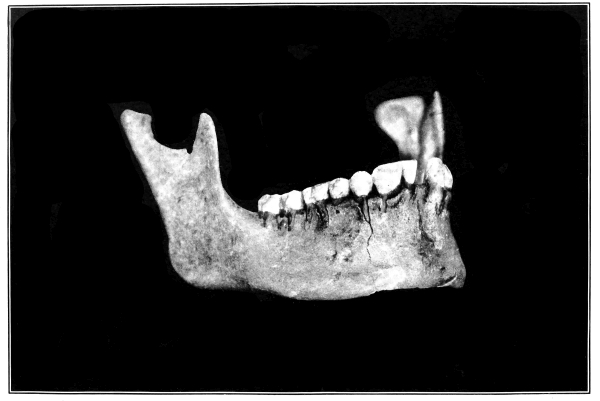
LOWER JAW OF FEMALE MUNSEE SKULL NO. 285,307, U.S.N.M., SHOWING COMPLETE FUSION OF THE RIGHT LOWER LATERAL INCISOR AND CANINE
Anomalies.—The anomalies of the teeth are always of considerable interest, being mainly either reversive or degenerative (progressively) in character. The skulls observed indicate the following conditions:
Male no. 285,301: A small supernumerary tooth between and on the labial side of the left lower second and third molars. The lateral upper incisors in this skull are somewhat abnormal lingually, their surface appearing as if rolled together from side to side, so that the tooth is cylindrical in form and its shovel-like hollow has become almost a cavity.
In male no. 285,303: The third right upper molar is diminutive.
In male no. 285,305: The third lower right molar is impacted, its vertical axis tending forward and upward.
In male no. 285,326: The third right upper molar is diminutive.
In female no. 285,305 is present the aforementioned fusion of the right lower lateral incisor and canine. The resultant tooth appears like a broad stout incisor (pl. 22).
In female no. 285,310: The crown of the right lower third molar is unusually large (13.5 mm. long by 12 mm. broad) and looks like that of a fused double tooth, but both first and second molars are present. The opposite tooth is also larger than ordinary, but the upper corresponding teeth are normal.
Finally, in no. 285,311 the third right upper molar is rudimentary.
Cuspids.—Many of the molars present were so worn that a determination of their cuspid formulæ was impossible. The better preserved teeth showed the interesting conditions detailed in the following table:
XXXVIII. MUNSEE CRANIA: MOLARS; CUSPIDARY FORMULÆ
Upper Molars
MALES
First molar Second molar Third molar
Cusps Number of teeth examined Per cent Cusps Number of teeth examined Per cent Cusps Number of teeth examined Per cent
4 15 100 4 4 30 3 2/2 1 11
[46]3 1/2 7 54 2 2/2 3 33
3 1 8 2 1/2 1 11
2 3/2 1 8 [47]Pursed 4 44
FEMALES
4 14 100 3 1/2 13 100 3 2 15
2 3/2 1 8
2 2/2 1 8
Pursed 9 69
Lower Molars
MALES
5 4 100 5 1 33 5 2 50
4 1/2 1 33 4 2/2 1 25
4 1 33 4 1 25
FEMALES
5 1 100 4 1/2 2 67 4 4 67
4 1 33 Pursed 2 33
It will be observed that the 29 first upper molars have all four regular cusps, while all the first lower molars have five. The second upper molars vary in the males, but show all three ordinary and one small cusp (the posterior lingual) in the females. The wisdom teeth fluctuate considerably in both sexes, both as to size and to form.
Summary of Measurements and Observations on the Crania
A summary of the results of the examination and measurements of the Munsee skulls includes the following points of interest:
A number of the specimens show traces of intentional fronto-occipital deformation, which is completely absent among other Indian tribes of the northeastern and Middle Atlantic States; and several of the skulls are of distinctly extraneous type. Both of these conditions point to admixture, which in all probability came from the southwestward and may have been due to Shawnee influence during the last few decades of the occupancy by the Munsee of the upper Delaware.
The crania that can be safely accepted as belonging to the Munsee themselves, and which are not deformed, are characterized by moderate dolichocephaly to mesocephaly and a high vault. They are not thick-walled and show fair capacity.
The face is of moderate dimensions and lacks prognathism. The facial index ranges from mild chamœprosopy to mild leptoprosopy.
The orbits are very variable, but the majority are mesoseme.
The nose is rather short, but fairly broad; the average index is mesorhinic.
The palate is of only moderate length, but fairly broad; its index in both sexes is brachy-uranic.
The lower jaw is of moderate dimensions throughout.
The teeth are medium in size.
Descriptive features.—The forehead is chiefly of medium development in the males, in the females frequently somewhat low.
The sagittal region shows more or less arching, in no case extreme; the temporo-parietal region and the occiput present mostly medium forms.
Serration of cranial sutures is submedium to very submedium. Wormian and other intercalated bones are scarce. The order of occlusion of sutures among the males was S-C-TO-L; among the females TO-S-C-L (see page 35).
The pterions are all of the H type, with tendency to narrow in males, medium to broad in females.
Parietal foramina are few in number and small, retromastoid foramina moderate to small.
The mastoid processes and the supraorbital ridges present ordinary development and variation; no excess.
The nasion depression is well marked in the males, mostly shallow in the females; nasal bridge is medium to submedium, nasal bones of fair breadth; lower borders of the nasal aperture are mostly fairly sharp, and with one exception there are no simian grooves or subnasal fossæ; nasal spine ranges from very low to submedium.
The orbits show exceptional variation in form, as they do in measurements; suborbital (canine) fossæ are shallow to medium; malar bones are of but moderate development, without anomalies; zygomæ average somewhat submedium as compared with those of other Indians.
The upper alveolar arch is mostly of very moderate slant and free from abnormalities. The lower jaw is of ordinary form, without anomalies. The palate in half the cases is elliptic, in two-thirds of the remainder ovoid, and in one-third parabolic; it is in no case exceptionally low or very high, and there is no torus.
Base.—The glenoid fossæ in a majority of the crania show usual form and medium dimensions, but tend to wideness in a number of the females; dehiscences in the floor of the auditory meatus are, for Indians, scarce.
The styloid processes reach medium development in but few instances, and they are frequently rudimentary.
The middle lacerated foramina are mostly submedium to small; depression of petrous portions prevalently submedium to slight. The posterior lacerated or jugular foramina are, as usual, in a majority of the cases larger on the right side. Pterygo-basal foramina are scarce.
Anomalies observed on the skulls pertain mostly to the basal structures, particularly the condyles and the sphenoidal foramina.
Teeth.—Dentition was remarkably regular, but decay and loss of teeth in life were relatively more frequent than in other Indians; upper incisors, especially the middle, are shovel-shaped lingually, as usual in Indians. More or less wear of the teeth in the adults is present in every instance. Dental anomalies, while few in number, comprise a case of special interest: a perfect fusion of canine and incisor.