Rev. H.C. Adams (continued 6)
Reading edition
“You forget the women,” said the corporal with a smirk.
“No, I don’t forget them, Andrewes,” answered Bostock angrily. “But you had better do so—forget Miss Vander Heyden, at all events. You will remember that she is to become my wife as soon as we can reach Doomberg, where the missionary has promised to marry us. You had better all keep that in your heads, or you may chance to find an ounce of lead there.”
“Well, you needn’t be so cranky about it, John Bostock,” said Sullivan. “Will Andrewes and the others have been your pals ever since we came into the country, nigh upon a twelvemonth ago, and Jem Gott and I was your pals long before. And we’ve never done nothing but please you, and we ain’t going to now.”
“Well, that’s as it should be, Sullivan. We need have no more words about that. And now dinner’s ready, I see, so we had better fall to at that.”
Meanwhile Vander Heyden and his two friends had no sooner completed their meal than they hastened to the waggon, and summoned Matamo and Haxo to assist in repairing the damage sustained. Their first step was to renew the canvas covering, which had been torn down. Then they nailed thick boards all round the lower part of the waggon, and constructed a kind of citadel in the middle, consisting of four strong boxes, about three feet high, inside which two persons might take refuge.
“I wish you would not think so much of me,” urged Annchen, from whom it had been impossible to conceal the approaching danger. “My life is of no more value than any one of yours. And you are neglecting, I am sure, your own safely. Henryk, will you not listen to me? Mr Rivers, will not you?” She blushed deeply as she spoke.
“Say no more, Annchen,” returned her brother sternly, though with evident tenderness of feeling. “We shall all do our best for ourselves as well as for you. And there is every hope that Margetts will return before these scoundrels even begin their attack. It cannot be more than a two hours’ ride to Heidelberg. I could myself do it in little more than one; but then, unfortunately, I was only on terms of distant civility with Lieutenant Evetts.”
“It will take Margetts at least two hours,” observed Hardy; “and then there may be difficulty in finding Mr Evetts and in getting his men together. It was three o’clock when Margetts rode off. If he is back by ten, it is as early as can reasonably be hoped.”
“Ten will be time enough,” remarked Rivers. “They will wait for the moon to set, or they would be an easy mark for our bullets.”
“And the moon does not set till eleven,” said Vander Heyden. “Besides, even if they do make their attack, it remains to be seen whether we cannot keep them off. It can hardly be worse than it was at Rorke’s Drift, when we three stood side by side together. But I think we have now been as long at work in the waggon as it is safe for us to be. We might awaken suspicion if it was thought that we were fortifying it. We must get out, and not return to it until after the moon has set. Annchen, I shall wish you good-bye now. You must be in your place of shelter when we return.”
He folded her in a warm embrace, and then leaped from the waggon, forgetting that George still remained, or unwilling perhaps to witness his adieux.
George took her hand and looked earnestly into her face. “This may be the last time we shall meet,” he said. “I know I can never have my wish, but I should like you to know how fondly I love you.”
The tears rose in her eyes and streamed down her face. “I do know it,” she murmured,—“I do know it, George; I prize and I return it.”
Their lips met for a moment, as if by a mutual impulse, and then Rivers leaped down and joined his companions, who had taken their places by the fire.
The night came on clear and bright, as is the night of those regions,—the moon, a dazzling globe of crystal; the stars studding the sky with brilliant specks of light. The three friends affected to converse carelessly together, intermingling their talk with bursts of merriment. But every ear was in reality strained to catch the distant tramp of horses’ feet—the more keenly because the hour had now indeed come when Margetts’ return was not only possible, but might be reasonably looked for. Anxiously they watched the moon as it sank slowly down the heaven, disappearing at last behind the distant mountain range, and comparative darkness succeeded, which under the shadow of the cliffs rendered objects even at a little distance scarcely distinguishable. Then they rose, and somewhat noisily bade the Hottentots good-night, desiring them to keep a careful watch. Moving off to their own waggon, they crept stealthily behind and round under its cover to the other which was reserved for Annchen and her attendant, and got inside, joining Matamo and Haxo, who were anxiously expecting them. They had lighted a lantern, whose light just showed the interior of the waggon.
“Hark! what was that?” exclaimed Hardy, as a sound resembling that of the discharge of a gun was heard at some distance. “Can that be Margetts’ signal?”
“It is most unlikely that he would discharge his gun,” said Rivers. “It would have the effect of putting these ruffians on their guard. He knows that we have no need to be warned.”
“True,” said Hardy; “but if he is coming at all it ought to be soon. It is nearly half-past eleven. These fellows will make their attack almost immediately now. Ha! listen! Yes, I hear them coming!”
Even as he spoke, a hand was laid on the shutter by which the back of the cart was closed, and attempt made to pull it open.
Vander Heyden put his head out. “What are you doing here?” he asked. “This is my sister’s sleeping-place.”
“I know that, Mr Vander Heyden, and I know you, and you too know me. I am Langley Cargill, of the Nassau Regiment—your equal by birth and station. I design your sister no harm, but to make her my wife. Give her up to me, and I will ensure her safety and the most honourable treatment.”
“I would as soon give her into the hands of Satan!” cried Vander Heyden fiercely. “You and your ruffians will do wisely to move off at once, or we will fire on you without mercy.”
“Then take the consequences of your own folly. Fire into the waggon, boys!” he shouted; “we’ll soon make an end of this.”
A dozen guns were discharged, and the leaden hail came rattling between the ribs of the tilt above them. It did not produce much effect, as all those within had thrown themselves on the floor, where the solid sides of the waggon, strengthened by the recent defences, prevented the bullets from penetrating. The next moment the fire was returned with more effect. Two of the pretended soldiers were shot dead on the spot, Bostock and one of his men were severely wounded.
“Rush up and smash the shutters in before they can load again?” shouted Bostock, regardless of his wound. He caught up a heavy piece of timber, which shattered the stout boards at a blow, and was about to mount to the attack, followed by his comrades, when a volley of musketry was suddenly poured in, which stretched two or three more of the banditti on the ground, and a voice was heard calling them to surrender, or no quarter would be shown.
Vander Heyden and his companions leaped from the waggon to shake hands with Margetts and Evetts, who, with a couple of dozen of his men, had now completely surrounded the robbers, nearly all of whom indeed were either killed or wounded. But the danger was not entirely at an end, as they had supposed. Bostock had been pierced by a second bullet, and it was plain that he had received his death-wound. But his fierce spirit still bore him up. He heard Evetts’ challenge with a scornful laugh.
“Surrender?” he cried. “Not I, at all events. I believe I am done for this time, but there is still some fight left in me. Henryk Vander Heyden, I told you I should one day return your fire; there is time to do so yet.”
He raised himself with difficulty, and, levelling his revolver, fired at his antagonist, who was only a few feet from him. With fell satisfaction he noted that the shot had taken effect. Then he fell back and expired without a groan.
Chapter Nineteen.
“Are you much hurt?” cried Rivers, rushing up to Vander Heyden and raising him, while Hardy supported him on the other side.
“I don’t know, I hardly felt it,” he answered. “I don’t think it struck the ribs.”
“We must get his coat off and stop the bleeding,” said Hardy. “If you will hold him, I will unfasten the coat. Bring the lantern closer.”
“Leave him to me, sir,” said a voice behind. “I know something of surgery, as a man has need to do who lives in this country.”
Both Rivers and Hardy turned round in great surprise. The speaker was Mr Prestcott.
“Ah, you wonder to see me here! I had no intention of leaving home when we parted, but I was summoned to Heidelberg two days afterwards, and was on my way to Mr Evetts when Mr Margetts met me. We must cut the coat away. If the wound is where I suspect, it would give him great pain to take it off his shoulders. Ah, I thought so,” he continued when the sleeve had been cut away and the shoulder had been laid bare. “You have had a narrow escape, sir. The bullet struck the cartridge-belt which was hanging round your neck, and glanced off, passing out through the fleshy part under the arm-pit, just missing the rib. But it is a nasty wound too. You will have to lie quite quiet for some time, and be careful that the bleeding does not burst out again. There must be some proper person to nurse him.”
“His sister, Miss Vander Heyden, is here, sir,” said Rivers. “She is in the waggon yonder. She does not know anything about this yet.”
“You had better go and warn her,” said Mr Prestcott; “then we will carry him to the waggon.”
His instructions were obeyed. Annchen was of course terribly distressed, but repressed her emotion, and instantly set about the necessary preparations. The boxes were removed from the waggon, and as soft a bed as possible made upon the floor of dried grass and reeds, over which several rugs were laid. The waggon fortunately stood in a sheltered place under two large trees, whither it had been moved to render it as secure from attack as possible. Annchen and Rose undertook the nursing; and Mr Prestcott engaged to send over the necessary medicines from Heidelberg.
“He must be kept as quiet as possible, remember. I suppose there are enough here,” glancing round as he spoke at the Hottentot servants, as well as at Matamo and Haxo, “to secure him against disturbance or attack.”
“There will be no further fear of attack,” said George, to whom this remark appeared to be addressed. “This wretched Bostock is dead, and all the rest of the gang have either been killed or are prisoners. Stay, though,” he added; “I see Gott is prisoner, and Van Ryk was hanged at Rorke’s Drift; but I am afraid Sullivan has escaped.”
“It will be a pity if he has,” remarked Lieutenant Evetts. “I hear at Heidelberg that the whole gang has been for months past the pest of the neighbourhood.”
“Sullivan has not escaped,” said Margetts; “I can account for him. He had been set to watch for me as I returned to the camp, and pick me off, I suppose; but he fell into his own trap.”
“Ha, that must have been the shot, then, that we heard,” said Rivers. “What made you so long in returning, Redgy? We were getting alarmed.”
“Well, I missed the track,” said Margetts, “and had ridden past Heidelberg. By good luck I met Mr Prestcott, who was riding in to see Mr Evetts, and he took me with him. It was after all no loss of time, I believe, for he knew where to find Evetts, which I did not. And during our ride to Heidelberg, he told me something, George, which you will be interested to hear. But first I will tell you about Sullivan. Evetts got his men together, and Mr Prestcott volunteered to come with us, wanting to identify some of the gang, who had more than once stolen his property. When we got within a mile or two Evetts scattered his men, and told them to move up with as little noise as possible. One of them in this manner got past Sullivan without being seen by him. He chanced to look back, and saw Sullivan just levelling his gun at me, and he anticipated the shot by sending a bullet through the back of his skull. He was lying dead by the roadside when I passed, and I recognised him as Sullivan, notwithstanding his disguise.”
“Talking of his disguise,” observed Rivers, “I wonder where they got the soldiers’ uniforms from. I know there are fellows among them who are clever enough at staining Europeans so as to look like natives; but how did they come by the uniforms?”
“That is a question easily enough answered,” remarked Lieutenant Evetts, who had now joined the party. “The Zulus stripped soldiers enough at Isandhlwana to fit out a regiment or two, and for months afterwards they were to be had for anything the Zulus could get for them. But I must say the get-up, on the whole, was not bad.”
“No,” assented Hardy; “and the fellows who wore the uniforms had all, I fancy, been really in the army at one time or another. Certainly the corporal had.”
“Yes,” said Rivers. “When I first spoke with the man I thought I knew his face, and probably I had seen him in the ranks. That was one of the circumstances that for a long time prevented me from entertaining any suspicion.”
“By-the-bye, George,” said Margetts, “I have forgotten to ask you how you discovered Bostock. I thought, as I told you, there was something strange about the party, but did not suspect Bostock was among them, and his disguise was so perfect that I can hardly believe he is the fellow lying dead yonder. There was no time to ask you when you sent me off to Heidelberg; but I should like to ask you how you recognised him.”
“It was your remark and his limp that first made me suspect him,” said George. “He has always limped since he received the wound on board the Zulu Queen. I happened to know he had received another wound a few months since—a bullet-wound on the wrist. I went and stood close at hand while the pretended corporal was putting the handcuffs again on the prisoners’ wrists; and there was the scar of the wound plain enough. I saw Bostock glance suspiciously at me, as he saw I was scrutinising his wrist, and I had some trouble to keep myself from showing that I had discovered him. But you were saying, Redgy, that Mr Prestcott had told you something which I should be interested to hear. May I ask what it was?”
“Well, Mr Rivers,” said Prestcott, “it was simply that I am well acquainted with your mother. In the course of my business I make frequent journeys to Zeerust, and know old Ludwig Mansen and his family quite well. I was there not many weeks ago. It is odd that his name did not come up in the course of our conversation about Zeerust. I did not particularly notice yours, or it would certainly have done so. You wrote to her some time ago, did you not?”
“Yes,” said George, “eight or nine months ago; but I have never received any reply to my letter.”
“Ah, I supposed so. The man to whom you gave it was several months in getting to Umtongo, which was the name of Mansen’s farm. Then she could get no messenger to carry her reply for several weeks, and it must have reached Rorke’s Drift somewhere about the beginning of June. But it appeared you had left the Natal Volunteers, and it was thought you were going to join some other corps; but that was not known for certain. She is in a terrible state of alarm now, that you have been killed at Ginghilovo, or Ulundi, or one of the smaller battles.”
“Well, her anxiety will soon be relieved now,” observed Margetts.
“I trust so. But in that case Mr Rivers must not wait to accompany Mr Vander Heyden to Zeerust Mr Vander Heyden cannot be moved for three weeks, and then he must travel very slowly. I do not suppose he can get to his destination under a month, at the very earliest.”
“Of course I shall not wait for that,” said Rivers. “I shall ride across country, if I can find a guide. I suppose it will not occupy very long, Mr Prestcott?”
“No, sir. Your horse, if that is your horse yonder, would take you there in four days—probably in three, but certainly in four.”
“And as for a guide,” interposed Hardy, “you will not find a better in all the Transvaal than Matamo. He knows the whole of this country as well as I know the paths about my own farm. I am sorry that I myself cannot remain here; I have another engagement to fulfil at Newcastle. But I will undertake to return before Mr Vander Heyden can reach Zeerust. Meanwhile Mr Margetts will stay here and look after the party.”
“Must that be so?” asked George. “I should have liked Redgy to accompany me.”
“It must be, I am afraid,” said Hardy. “I am sorry that my engagement must be kept.”
“I am sorry too,” said Margetts; “but of course we cannot leave Vander Heyden here alone. When shall you set out, George?”
“To-morrow, if Matamo is prepared,” was the answer. “But we must lie down now and take some rest. The dawn must be close at hand.”
“I shall return with my party and the prisoners at once,” said Lieutenant Evetts; “and I suppose you also, Mr Prestcott, will accompany me.”
“Yes,” said Mr Prestcott. “The medicines and lint ought to be sent out at once.”
They parted, and our travellers, lying down, took some hours’ repose. Then George summoned Matamo, and inquired of him whether he knew the way to Umtongo, and would undertake to guide him thither.
“The way to Umtongo,” repeated Matamo. “I know it quite well. I have been there two, three times. I could ride it in the dark.”
“That’s all right, then,” said George.
“Yes, sir; we can get there in three days,—Koodoo’s Vley one day, Malapo’s Kloof two days, Umtongo three days. But they will be long days.”
“Then had we not better start at once?”
“Yes, sir, or we shall not reach Koodoo’s Vley to-night. I will go and get everything ready.”
In two hours they set off, the Bechuana appearing to be in high spirits. The track he pursued led through a country wilder than any George had yet seen. It ran for some miles along the banks of a small but most picturesque stream, the banks of which were clothed with trees of every variety. The mimosa predominated, but it was intermingled with date-trees and Kaffir plums and huge cacti, with their swordlike leaves, and acacias already coming into flower. Overhead hoopoes and parrots kept up a never-ending chorus, while countless tribes of monkeys and squirrels leaped and chattered among the branches. Occasionally there sprang up, with the whirring noise so familiar to the sportsman, a covey of red-brown partridges. Notwithstanding that they were well supplied with provisions, George’s instinct could not forego the opportunity. He let fly right and left with both barrels. Two partridges dropped dead just in front of them, while others flew off wounded. Matamo dismounted and secured them, and they proved a most appetising addition to their supper when they halted a few hours after.
“How far are we from Koodoo’s Vley?” said Rivers, as he leaned back against the sloping bank, after having made a delicious meal.
“Koodoo’s Vley? About three hours’ ride. Give the horses a long rest, and we shall get there before the moon goes down.”
George relapsed into thought. The excitement of the last few hours had left no time for reflection, but now the recollection of what had passed between himself and Annchen came vividly back. He had long felt assured that, notwithstanding the distance at which he had always been kept from her, she was not indifferent to him, but now he had had a distinct assurance to that effect from her lips. For a moment the doubt crossed him whether, in the few hurried words he spoke to her before the attack, he had not in some measure broken his promise to Vander Heyden. There had been little time for reflection, and his had been dictated by a sudden impulse. But no. He felt sure it had not been so. His promise to Vander Heyden had been that he would not ask her to be his wife, and he had not asked her. Doubtless she would expect him to follow up his declaration by a formal offer, but it must rest with her brother whether that must be made. On the whole, he had good hope, when he recalled the particulars of Vander Heyden’s interview with him, that he would withdraw his opposition. At all events, there was no need to be down-hearted about it, and perhaps the less his thoughts rested upon it the better.
He turned to Matamo, who was sitting on the other side of the fire, sorely disturbed, apparently, at the long silence to which George’s reverie had consigned him. He responded at once to George’s advances, who inquired of him whether he had known Mr Prestcott before he met him a few days previously.
“Do I know Mr Prestcott? Yes, sir, I have known him a long time. Very good Baas, is Mr Prestcott. He tells pretty stories.”
“More pretty than true, hey, Matamo?” suggested George. “Did you hear his story about the lion and the powder-flask?”
“Yes, sir; I have heard that more than once. It gets nicer every time it is told. Mr Hardy, too, he tells a nice story about the cobra in the tree, but not so nice as my story about the big boa.”
“Your story—an adventure of your own, like the leap off the hippopotamus’s head, eh? Let us hear it by all means, Matamo.”
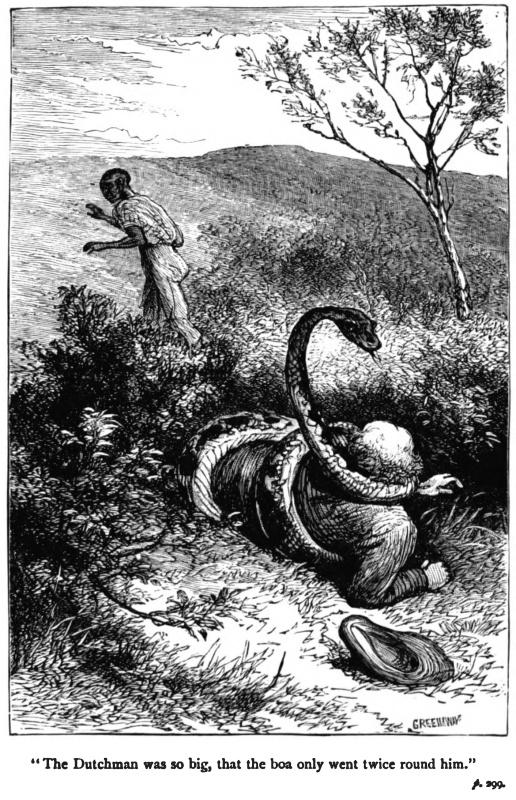
“Yes, sir. It happened a great many years ago. I had been sent on an errand to the Kasal Mountains. A fat old Dutchman seized me, and would not believe my story, but made a slave of me. If I said a word, he tied me up to the cart-wheel and flogged me with the jambok. One day he sent me after an ox that had strayed. He was always afraid that I should run away, and if I was any time out, came to meet me with the jambok ready in his hand. I couldn’t find the ox anywhere, but I thought I saw something moving in a thick bush, and I fancied it might be the stray beast. I forced my way inside, and trod on what I thought was the end of a log. But it was a great boa, not a log. The boa put up its head and was going to spring; but I ran like a springbok, and the boa after me. I never went so fast in my life, but the boa went faster. Just on the edge of the wood, I saw the fat Dutchman coming with the whip. When the Dutchman saw the boa, he too turned and ran. But I ran faster than the Dutchman anyhow. The boa thought he was better eating than a lean Bechuana boy, and he caught him round the waist and twisted himself all about him. The Dutchman was so big that the boa only went twice round him. He bellowed for help so loud that every one could hear him, so there was no need for me to tell them.”
“What did you do then, Matamo?”
“I ran away as fast as I could, and went home to Mr Baylen.”
“I suppose the Dutchman was killed, wasn’t he?”
“Yes, sir. The big snake ground him up like corn in a mill,—jambok and all,” added Matamo significantly.
“Well, you must tell that story to Mr Prestcott and Mr Hardy. I don’t think either of them could beat it.”
“Ah, but I had another escape, from a rhinoceros, closer than that,” said the Bechuana, evidently much gratified at George’s approval.
“Closer than that!” said George. “It must have been a near one, then, indeed. Let us hear it, by all means.”
“It was in the rocky country above Standerton,” said Matamo. “I was hunting, and had to climb some steep crags two or three hundred feet high, and in some places as steep as a wall. I got to the top, and sat down to rest under a small tree that grew close to the edge of the precipice. Presently I got up and went on to the wood, where there were plenty of elands and antelopes. All of a moment a big female rhinoceros broke out and ran at me. I put up my gun and hit her just in the right place, and she dropped. I was going to load again, when I saw close behind her the male rhinoceros, and he made a rush at me. There was no time to load. I threw my gun away, and ran for it as hard as I could. But the precipice was right in front, and no room to turn to the right or the left. The rhinoceros is very swift of foot. He was close behind me as I approached the edge. I thought we should both go over together, but just at the last moment I seized the bole of the tree and swung myself round. The rhinoceros couldn’t catch hold of the tree, and couldn’t stop himself. Over he went in a moment, and I heard him strike the ground three hundred feet down. I went below and took a look at him. He was smashed to atoms.”
“That was a close shave too,” said George. “But come, Matamo, it is time we were off again. The horses must be fully rested.”
They remounted, and proceeded for several hours. But for some reason they did not make good progress. The horse ridden by the Bechuana appeared to be completely tired out, and could with difficulty be urged to an easy trot. The moon had set while they were still fully three miles from Koodoo’s Vley, and Matamo declared it would not be safe to proceed further that night.
He off-saddled his horse with more care than usual, and, instead of knee-haltering and turning him out to graze as usual, secured him by a headstall under the shelter of some trees, and brought him some grass and water. But the animal, though it drank thirstily, seemed unable to eat, and presently lay down, too much exhausted, apparently, by its day’s journey to stand.
“Bad job this, Mr Rivers,” said Matamo, after carefully noting the horse’s condition.
“What do you think is the matter with him?” inquired Rivers.
“The horse-sickness, sir. I’ve been afraid of it for an hour or two, but there is no doubt of it now. It is less common at this time of the year, but it happens sometimes.”
“Can’t anything be done?” asked George. “I know this horse-sickness is a strange malady, which no one seems to understand. But is there really no cure for it?”
“None that I have ever heard of,” was the answer. “Yes, he’s getting worse. He’ll die; nothing can cure him.”
“Has he been bitten by the tsetse, do you think?” asked George.
“The tsetse? no, sir. The tsetse is not found here; there is no mistake about it, where it is found. I know it well, and its buzz too. It is certain to kill any horse it attacks, or ox either.”
“Doesn’t it hurt a man, then?” inquired George.
“It never bites a man, or a donkey, or a mule. But what this poor brute has is the horse-sickness, and nobody knows either the cause or the cure of that.”
An hour or two afterwards Matamo’s predictions were verified. As the darkness came on, the poor brute’s malady got worse. Its flanks heaved; it drew its breath with ever-increasing difficulty; its tongue lolled from the jaws, which were tightly clenched on it. Then violent convulsions came on, and it expired.
“What is to be done now, Matamo? Can you go on with me on foot?” asked George. “We could ride alternately, you know; of course we should not go nearly as fast, but we should get there in time.”
“I am very sorry, Mr Rivers, but I can’t go. Mr Baylen wants me back. I must have returned to Horner’s Kraal the very day after the party reached Lichtenberg.”
George remembered that Mr Baylen, while they were at Colenso, had told him that the time of the year when he could never spare Matamo was the spring. At the time when he made George the offer of the Bechuana’s services, there had been no idea of the journey to Zeerust being delayed so long. He felt, therefore, that he ought not to urge Matamo to remain longer with him. But, on the other hand, if he returned to Heidelberg with Matamo, and obtained another guide, at least a week would be lost. Knowing his mother’s anxiety and distress, he was most unwilling to protract them. Besides, he could remain only a certain time at Umtongo, and he would not cut that any shorter, if he could help it.
“Do you think I could find my way by myself, Matamo, if you gave me full directions?” he asked.
“I am not able to say that, sir. I will tell you the way as well as I can. But if you go on to Koodoo’s Vley, you will find the Kaffirs’ kraal, which is close to it, and they will show you the way to Mansen’s farm, if you pay them money. The Kaffirs will go anywhere for money, and they know the place well.”
With this George was obliged to be contented, and, having obtained the most minute directions as regarded the road to Koodoo’s Vley, which lay only two miles off, he said goodbye to the Bechuana on the following morning and rode off alone. There was no difficulty in finding his way, Matamo’s directions having been very clear, and the landmarks easy to find. He proceeded, however, cautiously, and in about two hours reached the Vley, which he clearly enough recognised, as well as the Kaffir kraal, standing, as Matamo had described it, on the banks of a small stream and in an open glade surrounded by a wood. But, to his great disappointment, it was wrecked and deserted. Either there had been a quarrel with some hostile tribe, or a Dutch commando had been sent against it. But, whichever may have been the case, all its inhabitants were gone. George searched all round, but could nowhere find one single Kaffir.
He was now greatly troubled. Relying on Matamo’s assurance of meeting with a guide, he had not even taken any instructions from him as to the way to his mother’s house. He only knew in a general way that it lay to the north-west. He would at once have ridden back and endeavoured to overtake Matamo, but he reflected that the Bechuana, being now on foot, would probably take a shorter way to Heidelberg, which he had been unable to follow while on horseback. There was only, in fact, the alternative of going on, in what he knew must be at least the right direction, or return to the town. After a long debate, he determined on the former course. He took out his pocket compass, and turned his horse’s head directly to the north-west.
He rode on for seven or eight hours, and presently the aspect of the country changed. An open stretch of veldt succeeded to the mingled forest and scrub and jungle through which he had been passing. The grass grew up to his horse’s hocks, and in some places up to its shoulder. Suddenly there came a rush through the grass, and a hartebeest, closely pursued by a pack of wild dogs, rushed by him George had not hitherto come much into contact with these creatures, which, however, are to be found in large numbers in these regions. They are curious animals, more resembling hyenas than dogs, though the specially distinctive mark of the hyena, the drooping off at the hind-quarters, is not to be found in them. But in the stripe, and the bushy tail, and the peculiar-shaped ear, they closely resemble the hyena. They are not so cowardly as the last-named creatures, and are in consequence more dangerous to encounter.
The hartebeest was evidently almost exhausted. It was not likely that it could run another mile; and George, who had omitted to take any provision with him, expecting to get his dinner at the Kaffir kraal, resolved to follow and rescue the carcase from the wild dogs, whom a shot from his rifle would probably disperse, or, at all events, keep at a distance, while he cut off the meat he required. He spurred his horse accordingly, and started in pursuit. But the ground was soft, and for some time he gained but little on his quarry. The hartebeest held on with more vigour than he had expected, and at last, when he had got within distance, a sudden stumble of his horse caused him altogether to miss his mark. He was obliged to stop and reload, and the ground thus lost was difficult to regain. It was not until after a full hour’s pursuit that he saw the hartebeest, unable to go any further, at last turn round in despair and face his enemies. Rivers had now sufficient time to take aim at the leader of the pack with his first barrel, and the hartebeest with the second. Both shots were successful. The hartebeest dropped instantly, with a ball through its heart, and the dog rushed off with a yell of pain, falling dead before it had gone a hundred yards. But the rest of the troop did not take to flight, as George had expected. Probably the pursuit of the prey had been stimulated by hunger, which now rendered them insensible to danger. After a moment’s hesitation they rushed on the carcase, while one or two, bolder than the rest, sprang on his horse, from which he had alighted to drive off the dogs with his hunting-knife. Terrified at the attack, the steed broke loose from George’s hold, galloping off at full speed, and pursued by the greater part of the pack. George shouted and endeavoured to follow, but became instantly aware of the hopelessness of the attempt. The horse was already a hundred yards off, galloping at the utmost of its speed, in the hope of distancing its pursuers. The darkness, too, was rapidly coming on. It would plainly be impossible for him to recover his horse that night, as it would presently be too dark to discern any objects at a distance. He must provide himself as well as he was able with food and shelter for the night. Hastily reloading, he first rid himself of the two or three dogs that were busily engaged in mangling the body of the hartebeest. Next with his hunting-knife he cut down a quantity of bushes, part of which he piled up as a shelter against the wind, which began to blow with some sharpness as the dusk came on. The rest of the wood he set alight by the help of the matches in his belt, and presently succeeded in kindling a tolerable fire. Then he cut off some meat from the carcase of the hartebeest, of which there was a good deal left, notwithstanding the ravages of the dogs. By these means, and by obtaining water from a clear rivulet, which he found flowing at a little distance, he contrived to satisfy his hunger and thirst. He sat down in the shelter which he had provided for himself, and looked up at the sky above him. It was a delicious night. The constellations of the Southern Hemisphere are not in themselves as beautiful, as those with which we of the northern regions are familiar. But their liquid brilliancy, seen against the background of the deepest blue, renders the general aspect of the heavens far more lovely and imposing. The sense also of entire loneliness came upon him with profound solemnity. He was here far—he knew not how far—from all human help and sympathy. Whatever good or evil fortune might befall him was his concern and his only. The utter helplessness of man so situated impressed him painfully. We seldom realise the full meaning of passages of Holy Writ until some striking circumstance of our lives bring them home to us, and George felt for the first time how profound a meaning was contained in these words: “It is not good for man to be alone.”
Chapter Twenty.
George awoke chilled and cramped with the night air, and was preparing leisurely to get up and commence the search after his missing steed, when his eye lit on an object a few feet of him, which caused him instantly to leap to his feet. A snake, which had probably been attracted to the spot during the night by the warmth of his fire, was just raising its head, as if preparing to dart upon him, spitting venom at the same time from its open jaws. His rapid backward spring just enabled him to avoid its fangs. But some of the poison had been spurted on to his face, and he instantly felt a sharp sting of pain. His first act was to crush the head of the reptile with his heel, and then to sever its neck with his knife. It was of a dark brown, almost a black colour, and six or seven feet long. George had never seen one of the kind before, but recognised it from the descriptions that had been given him as the picakholu, the most venomous, it was said, of any known serpent, and called by the natives the “spitting snake.” George noticed that the fangs were still distilling poison in a considerable quantity, notwithstanding that the neck had been completely severed. He felt a good deal of pain in the places where the poison had fallen, and especially in the white of the left eye. He hurried to the spring, which was fortunately only at a short distance, and, kneeling down, plunged his head again and again into the water, hoping in that manner to get rid of the painful smart. This gave him some slight relief, and he hoped that, as no poison could have mixed with his blood, the pain would gradually wear itself out.
The first thing, of course, was to find his horse. He had hoped that if it had succeeded in shaking off the wild dogs, it would return to the spring to drink. But though he did not doubt that it would soon outstrip them, they having been evidently completely exhausted by the long previous chase, there might be water nearer to the point at which the animal found itself after its escape, and in that case of course it would make for it. Taking up his gun, he began following the track of the animal’s hoofs, which were clear enough to be traced in the soft grass of the veldt. After an hour’s search, the grass was exchanged for a long arid stretch of sand, diversified by scrub and stone. Here the hoofs of the horse and the lighter prints of the dogs’ feet were still more plainly to be distinguished. The sand became looser and looser as he advanced. It was evident that the horse must have grown rapidly more exhausted, as its feet plunged almost to the fetlock at every step. At last he came upon the carcase of the animal itself, which had evidently been torn down by the pack and devoured. There had plainly been a furious struggle, one or two of the dogs having been killed by the dying efforts of the horse.
Rivers was now seriously alarmed. He must retrace his steps as well as he was able to the spring, and seek again to relieve the burning pains in his face, which under the scorching heat of the sun stung him more sharply than even at first. Then he must make his way on foot, keeping as before to the north-west, and hope to fall in with some traveller, or reach the shelter of some friendly habitation. He was well aware that, if all these chances failed him, his life on earth would soon be ended. He began his return across the sandy waste, and, after several hours of painful exertion, succeeded in reaching the spring, by the side of which he sank down completely exhausted. Long and copious draughts somewhat restored him; and as the cool of the evening came on, he got up and resumed his journey, making another meal before he started on what remained of his morning’s repast. He walked on for a mile or two, leaning on his gun, and hardly sensible of the objects round him. At last he got to a part of the wood where the trees seemed to have been cut away, and a broader path, almost approaching to a road, cut out. He staggered for some distance along this track, and then his senses completely deserted him, and he dropped to the ground, his gun going off as he fell, though happily without injury to himself.
When he opened his eyes again, he looked around him with great surprise. He was lying on a comfortable bed, in a tolerable-sized room; which, though different in many respects from any chamber he had hitherto occupied, was nevertheless evidently of European construction. There was a sash window, looking out, so far as George could distinguish, upon a garden. The walls were of plank, planed and fitted together with some neatness; the floor of mud, beaten hard and smeared with cow-dung. There were no tables or chairs, no chests of drawers, or washing apparatus, but there was a bench and one or two solid chests. The bed itself was tolerably clean, and there were sheets, but of coarse material. By his side, on a shelf, were a tea-cup and spoon and several bottles.
With some difficulty he recalled the incidents which had taken place previously to his fainting fit,—the poison spirted on his face by the snake, his search after his horse, and his subsequent journey through the wood. But all seemed dim and confused, and as if it had taken place a long while ago. He lay thinking for a long time, or rather in a state of half consciousness, in which dream and reality were blended together. Then he closed his eyes and again fell asleep, waking up a second time, also to his confused fancy after a long period of inaction. He found himself lying on the same bed and in the same room, but this time he was not alone. There was an old man sitting by his bedside and watching him apparently with some curiosity. He was a Dutchman,—that was plain from his physiognomy alike and his dress,—and probably a man of some substance. His clothes were of the usual material, but of a good quality, and had not been much worn. His features were rather harsh, but not repulsive, and his demeanour quiet and self-possessed. He noticed the change in George’s appearance, and proceeded to express his satisfaction in English, which was not quite idiomatic, but nevertheless was intelligible.
“The Englishman is better; is he able to talk?”
“Thank you, I feel much better,” said George. “Will you please to tell me where I am, and how I came here?”
“I heard your gun, and found you in a swoon. This is my house; it is called Malopo’s Kloof.”
“I am very thankful,” said George. “How long have I been ill?”
“It is more than five weeks since I found you—five weeks last Monday.”
“Five weeks!” repeated George, becoming dimly conscious of strange, wild scenes, among which he seemed to have passed an immeasurable period of time,—gallops over interminable plains, struggles with armed assassins, writhings of wounded snakes, and the like phantasmagoria of a sick fancy, succeeding and intermingling with one another. “Five weeks! Have I had a fever?”
“A marsh fever, and a very bad one. I thought several times the Englishman would die,” said the old man.
“And who has been my doctor?” inquired Rivers, only able to recall two figures that were not quite shadowy and unreal,—the figure of the man before him, and another younger than he. “Who have been my doctor and my nurse?”
“You have had no doctor: there is none in these parts. Rudolf and I nursed you,” was the answer. “We put on cool bandages and gave you cool drinks—nothing else.”
“And I have to thank you for my life then!” exclaimed George, feebly stretching out his hand, and becoming aware for the first time how thin and wasted it had become.
“We could not let the Englishman die,” said the old man simply. “But you must be quiet—you are not strong enough to talk.” Putting a glass containing some mixture which tasted deliciously cool and refreshing to his lips, the Dutchman now withdrew, and Rivers was soon once more buried in slumber.
He woke again after a long interval, feeling stronger, and so went on for a week or two more, gaining strength continually, until at last he was permitted to get up and sit for an hour in the garden, which was now in the prime of its beauty and luxuriance. Mynheer Kransberg—that he presently discovered to be his host’s name—had been one of the earliest settlers in the Transvaal, long before the country bore that name, and when it was only inhabited by the native tribes. He had been quite a young man, though possessed of good means, when the Dutch first broke out into resistance to the English rule. Aware of the hopelessness of rebellion, and unwilling to take part against his countrymen, he had withdrawn with a considerable following of his own dependants into the then unknown regions lying to the north of the Orange river. Here he had purchased land of one of the native chiefs, built his house, and enclosed his farm, and here he had lived ever since, through all the numerous changes which the country had undergone, paying as little heed to them as if he had belonged to another planet. He had never married, or felt any inclination to do so. He had ridden about his fields, and reared his cattle and sent them to market, and brewed his Dutch beer, year after year, with a placid contentment which is rarely witnessed, even in a Dutchman. If he was indolent he was at all events extremely good-tempered, and his oldest servants scarcely ever remembered to have seen him ruffled.
He had lived alone until within the last few years, never seeming to experience the want of a companion. But about two years since his solitude had been broken in upon by the arrival of his nephew, Rudolf Kransberg, a tall, gawky youth of two-and-twenty, who came to claim his help and protection. His father, a merchant in Graham’s Town, had died insolvent, and his son, calling to mind for the first for a great many years his uncle in the Transvaal, had made a journey hither, in the hope of gaining a kind reception. In that he had not been disappointed. The old man heard of his arrival, and of the misfortunes which had befallen his brother, without exhibiting the smallest emotion, but at the same time he gave the young man shelter and maintenance, allowed him, in fact, to live in his house, treating him in all respects as though he had been his own son. Rudolf, who in many respects resembled his relative, accepted the situation with equal complaisance, and they had now lived together two years in perfect contentment, not a word having been exchanged between them as to the older man’s disposal of his property or the younger one’s prospects in life, till within the last few weeks, when Rudolf had consulted his uncle on the subject of a marriage which he was anxious to contract.
The two were sitting in the garden in a Dutch summer-house which old Kransberg had run up with his own hands some forty years before. It was generally thought that the old man liked the society of his nephew, and especially during the smoking of the evening pipe, though he never expressed any feeling to that effect, or, indeed, to any effect whatsoever, unless compelled by absolute necessity. He was therefore somewhat surprised when one evening Rudolf took his pipe from his lips, and after rolling out a long puff of smoke, addressed his uncle.
“My uncle, there is something I would ask you. May I speak?”
The old man similarly removed his pipe, emitting a corresponding puff, and then answered briefly, “Ya.”
“My uncle, I am four-and-twenty.”
He paused, but his uncle not considering this to require a verbal acknowledgment, only nodded.
“My uncle, it is time I was married.”
This apparently was regarded as calling for a reply. The pipe accordingly was again removed, and Mynheer inquired “Whom?”
“Thyrza Rivers.”
Another long silence followed this communication, after which the old man remarked, “Englishwoman.”
“True,” assented the nephew, roused by his feelings to unusual prolixity of speech; “but she has always been bred up in our ways. And her father-in-law is a good man.”
Old Kransberg again gave an affirmative nod. “Go over and ask her,” he said.
Rudolf nodded in his turn, and so the conversation ended.
It was on the day following this that Mynheer Kransberg, as he was proceeding after supper to smoke his usual pipe in the summer-house, was startled by the discharge of a gun at a short distance. As the reader has heard, the country had been for some time infested by bands of ruffians, who committed great depredations in the neighbourhood. The old man’s first idea was to summon his servants and send them out to see after the marauder, but, casting his eyes along the road, he saw the figure of a man lying prostrate, having apparently been shot. Straightway he summoned two of his Hottentots and desired them to bring the wounded man or his body, as the case might be, into the house. It was soon discovered that there was no wound, but the stranger had a dangerous attack of fever of some kind, and was in imminent danger of his life. Without more words he had him consigned to the bed in his guest-chamber, where he and his nephew nursed him with all possible kindness, until he had recovered his consciousness, as the reader has heard, and appeared to be in a fair way of recovery. George soon made acquaintance with both uncle and nephew. No great effort, indeed, was necessary to form such an acquaintance. All that was required was to sit still and smoke, exchanging, it might be, two words in the course of every hour. During all this time Rudolf’s courtship had been held in abeyance. As it was necessary for him to stop at home and assist his uncle in nursing, it was not possible he could be spared to ride over twenty miles to Umtongo. If the swain had been a Frenchman or an Italian, or even an Englishman, it might have been argued that his attachment to the lady was not a very ardent one. But that would have been to mistake the case. Rudolf was very sincere in his devotion, and was anxious that his visit should not be delayed any longer, and he had ordained in his own mind that he would set forth on his errand the following day, when he was greatly startled by a question which his guest put to him.
George had been sitting, as the reader has heard, in his host’s garden, enjoying the scent of the delicious flowers, when he saw Rudolf Kransberg advancing towards him. The young Dutchman bestowed a nod upon him, his usual greeting, and then, sitting down on the bench beside him, lighted his pipe and began to smoke. Presently George inquired whether Rudolf could tell him of a farmhouse in that neighbourhood called Umtongo, the residence of a farmer named Ludwig Mansen.
Rudolf was so startled that he actually dropped his pipe. He stooped, however, to pick it up again, before he repeated the words, “Umtongo! Ludwig Mansen!”
“Yes,” said George, supposing that his companion did not understand him. “I was on my way to his house when I was taken ill. The farm must lie at no very great distance. Perhaps you may be able to tell me where it is.”
“You going there!” ejaculated Rudolf with more animation.
“Yes, I was going there, and I want to go there now.”
“It will not be fit for you to go for a long time yet,” returned the Dutchman, relapsing into silence, from which he could only be roused to make monosyllabic replies. A minute or two afterwards, indeed, chancing to see his uncle in the distance, he got up and went to join him.
George was perplexed, but the demeanour of his hosts had puzzled him from the first. He saw, however, that they meant kindly by him, and supposed that Rudolf was simply afraid that he might bring on a relapse by venturing on a long ride in his present weak condition. He knew, indeed, he was not fit to make the attempt yet. Impatient, therefore, as he was to rejoin his mother and sister, he resolved to remain quiet for a few days more. He was more ready to do this, because he felt his strength returning to him every day, and it was evident from Rudolf’s manner that his stepfather’s house lay at no great distance.
He was a good deal surprised when, on the following evening, Rudolf Kransberg, who had been absent all day, returned to Malopo’s Kloof, but with a companion. He was sitting alone in the arbour, the time for old Kransberg’s pipe having not yet arrived, when a well-known figure suddenly presented itself, and the voice of Redgy Margetts greeted him.
“Hooray, old fellow! this is glorious indeed! Why, here have we been scouring the country for you for weeks past, and your mother and Thyrza—your mother and your sister,” added Redgy, correcting himself, “have put off going into mourning for you day after day, only because they couldn’t bear to think you were dead. And here have you been alive all the time, only twenty miles from us. Old Kransberg, they say, never holds any intercourse with his neighbours, and it must be so, or he must have heard of the hue and cry that has been raised. Matamo had gone back to Horner’s Kraal, and we only heard from some people in Heidelberg of his having parted company with you somewhere near Koodoo’s Vley. We searched the whole country, Hardy and Haxo and I, and some of Ludwig Mansen’s men, and we found at last the skeleton of your horse; we knew it by your saddle. And by the spring, where it was quite clear you had camped for the night, there were the remains of one of the most venomous snakes in the country. We were afraid you had been bitten by it, and had staggered somewhere into the bush and died. There would have been small chance for you, they said, if it had bitten you. But it doesn’t matter, happily, what we thought, only I should like to know if you are able to tell me the true history of the matter.”
“You shall hear presently,” said George. “But first of all I want to know about my mother. Is she looking well?”
“Well, I never saw her before, you know,” said Redgy, “and of course she has been in great distress about you; but as regards looks, I’m sure she’s an extremely handsome woman, and she will soon now be at her best again. You should have seen what a difference there was in her when we found out all about you from young Kransberg.”
“Young Kransberg,” repeated George. “I supposed he guessed the truth, then, from what I told him yesterday, and rode over to tell you about me.”
“Hem! no,” said Margetts shortly; “that wasn’t the object of his visit. He didn’t know that you were in any way connected with Mrs Mansen—didn’t know what your name was indeed. He only mentioned quite casually at dinner that a young Englishman had been found close to his uncle’s house, nearly two months ago, who had been seized with a bad attack of marsh fever. We all caught at it at once, and felt almost sure, from his description, that the person of whom he had been speaking must be you. But Mrs Mansen couldn’t bear to be kept in suspense a moment, and I offered to ride over here the moment dinner was over; and Rudolf Kransberg,” added Redgy with something of a chuckle, “was obliged to accompany me.”
“Well!” said Rivers. “But there’s plenty more I want to know. I haven’t seen my sister since she was quite a child. She must be grown up now.”
“Yes, she is grown up,” assented Redgy shortly. “And she promised to be pretty?”
“That’s a matter of opinion,” said Redgy with evident embarrassment. “Some people, I believe, do think her so.”
“But you don’t, eh?” said George, glancing at him in some surprise. “But never mind that, I shall soon be able to judge for myself. There are other things I want to know about. What has become of—of the Vander Heydens?”
“Oh, they are all right,” said Margetts. “Vander Heyden recovered rapidly, and got home in three weeks after the time you left us. Their place is only a few miles from Umtongo. They have been continually over there to see your mother and sister. Miss Vander Heyden and Miss Rivers have struck up a very close friendship, and I must do Vander Heyden the justice to say that nobody has been more active in the search after you than he was.”
“He’s a good fellow,” said George, “though he is a Dutchman, and hates the English, and is as proud as Lucifer into the bargain. Well, and Hardy—what of him?”
“Hardy is at Pieter’s Dorf—that’s the name of Vander Heyden’s place. He has designed a capital house, which they have already begun building. It will go on all the faster now that the search for you is happily over. Well now, it’s my turn, George, to ask questions. Do you think you are strong enough to be moved? Mr Mansen proposes to send over his light bullock waggon for you. Of course you couldn’t sit in the saddle for twenty miles, and won’t be fit to do so for some time yet. But you might be able to bear the motion of the waggon. You look quite as strong as Vander Heyden did, and you haven’t so far to go.”
“I should think I certainly might,” said George. “I don’t know whether it is in consequence of seeing you and hearing your good news, but I feel ever so much better than I did this morning.”
“Very good,” said Margetts. “Then I will ride back at once and tell them to send the waggon. It will take one day to come here, then you can go back the next. That will be the day after to-morrow, you know.”
“Very good. I must of course consult my kind host. But I don’t fancy he will make any difficulty. We shall have to arrange, also, what I am to pay him for my lodging and nursing. I must have been a considerable expense, as well as trouble to him.”
Margetts took his leave, and George went in quest of Mynheer Kransberg, whom he found in his usual seat in his summer-house. He listened in silence to George’s proposed arrangements, as well as to his thanks for the great kindness shown him. But when his guest inquired how much money was due for the lodging and attendance he had received. Mynheer Kransberg answered quietly,—
“There is nothing due. This is not an inn.”
“I am aware of that,” returned Rivers, colouring a little, for he had entertained the idea that all Dutchmen were eager to make any profit in their power, and had spoken accordingly. “But I must have occasioned some considerable outlay, and besides have given your servants and yourself and nephew, a great deal of trouble,” he pursued.
“We do not, any of us, grudge it,” said the old man in the same tone as before. “We do not want money for doing a simple act of Christian charity. You have rendered me your thanks—that is enough.”
“I do indeed render them most heartily,” said Rivers, “and I shall never lose the recollection of your generous kindness.”
During the journey in Farmer Mansen’s ox-waggon, which occupied nearly the whole of the day, he had time to reconsider the opinion which he had formed respecting the Boers, and which had been very much the same that is entertained by Englishmen generally. There is undoubtedly a strong prejudice felt against them. They are believed to be selfish, cold-blooded, and cowardly,—harshly oppressive to the helpless, but descending to falsehood and trickery in their dealings with those whom they dare not openly defy. A good deal of disgust also is felt at the strictness of their religious profession, which is thought to be inconsistent with their harsh and worldly conduct.
That there is some truth in these censures is not to be denied. They have been for many generations slaveholders, and no nation ever yet escaped the degradation which that most odious of all customs entails. Slaveholders become inevitably selfish, unjust, and brutal, and incline to become cowardly also. It is the coward only that oppresses the weak, and they who habitually oppress the weak cannot but become cowards. But the Boers have virtues to which justice has not been done. They are kind-hearted and generous to all except the blacks. No nation exceeds them in industry, in simplicity of life, and in the practice of domestic virtues. The profound respect rendered to parents, the faithful affection subsisting between husband and wife, the anxious care bestowed on their children, the loyal attachment and devotion to their country, might put to shame many who are their severest censors. And their religious profession is sincere enough, however blinded their eyes may have become as regards some obvious Christian duties.
Prayer is offered in almost every Dutch household morning and evening to Almighty God. The Sunday is given up to the strictest religious observances; the periodical communions are punctually and reverently attended. If the curse of slavery could be torn out by the roots, and the natives recognised by them as of equal value with themselves in the sight of Heaven, there would be few worthier races to be found on the face of the earth than they.
Chapter Twenty One.
“Here is a letter for you, George,” said Mrs Mansen, as the former entered the parlour at Umtongo, about three months after his arrival at his mother’s house. “It looks like Mr Rogers’ handwriting. But I believe Mr Rogers is still in England.”
“It is from him, though,” said George when he had finished reading the letter. “He has returned to Dykeman’s Hollow—has been there about a fortnight, he says.”
“What has made him come back so much sooner than he had intended? He wrote us word that his business in England was prospering, but he would be obliged, he thought, to remain another twelvemonth.”
“Ah, but there is, it appears, a total change of things in England. Another Government has come in, and is likely to reverse altogether the policy of the old one. He says, too, that a lot of people have taken up Cetewayo’s cause, and declare that he is a very ill-used man, that he never hurt or wronged anybody, and if we had left him alone, he would have left us.”
“Do they?” said Mrs Mansen. “I wish some of them had been Cetewayo’s neighbours, as we were.”
“Well, the upshot is, that Mr Rogers thought it was of no use for him to stay any longer in England, so he has come back. And now he wants me to go back to Dykeman’s Hollow, and take up my old work as schoolmaster and teacher.”
“Well, I hoped you were going to settle here,” said Mrs Mansen. “There is as much need for your services here as there could be at Dykeman’s Hollow. And my husband would be willing, as you know, to give you a part of this farm to look after,—quite as large as you could manage,—and to build you a house to live in, or rather, I should say, enlarge the small house at Droopsdorf. Two more rooms would make it a comfortable house.”
“He and you are very kind, mother. But, you see, I engaged myself to Mr Rogers, and I ought to keep to my engagement.”
“Yes, but that was a year and a half ago, and things have happened since then which make all the difference. Mr Rogers didn’t know that we had removed from Spielman’s Vley, and that you, by engaging yourself to him, would be, not half an hour’s ride from us, but a good week’s journey at least, and you didn’t know it, and couldn’t guess it, either.”
“No doubt that is true, mother; and I must allow that if I had known that there would be all the width of the Transvaal between you and me, I shouldn’t have made the agreement. But, you see, I did make it.”
“Yes, but I don’t think Mr Rogers could refuse to cancel it. It would be very unhandsome of him if he did. Then again, I don’t suppose he has heard of your long illness. He thinks you have been living with us nearly six months, as Mr Margetts has; whereas for three months, or for two at all events, you didn’t come here at all, and for a good month more you were quite an invalid. I haven’t had more than two real months of you yet, my dear boy, and after so long a separation,—I may say after what seemed like a recovery of you from the grave—I can’t afford to part with you. Isn’t that reason, Thyrza?”
“Yes,” answered Thyrza. “I think Mr Rogers would at least give you a longer holiday, if he didn’t consent to your staying here altogether. I know father thinks so too.”
“I am sure I don’t want to leave you,” said George, looking affectionately at his mother and sister. “I have never been made so happy by anything as by finding you.”
Mrs Mansen and her daughter were indeed two relatives of whom any one might be proud. The mother was a little past middle age, but was still strikingly handsome, and though her dress differed in some particulars from that of an English lady, she would have passed muster, both as regards appearance and manners, in good English society. Her daughter nearly resembled her in height and feature; and if the reader could have seen her, he would not have been surprised that even the ponderous Rudolf Kransberg should have been captivated by her charms. She was a lively girl in her nineteenth year, and, as yet, fancy-free. It had never occurred to her that Mynheer Rudolf had viewed her with any sentiment of admiration; and we are afraid that, if the idea had entered her head, it would have had no other effect than that of affording her unmixed amusement.
“And it isn’t father only,” pursued Thyrza, “who wants you to remain at Umtongo. There’s another person—”
“Redgy Margetts, I suppose,” interrupted George. “I have no doubt he likes his quarters well enough—”
“Mr Margetts!” broke in Thyrza hastily, and with a little accession of colour; “I wasn’t thinking about him. I don’t suppose he knows his mind on that subject or any other. No, it is a different person altogether—”
“My dear Thyrza,” interposed Mrs Mansen, “there is your father out in the garden, beckoning. He wants you, I am pretty sure. Go out and speak to him.”
Thyrza departed, and Mrs Mansen, after a pause of a minute or two, addressed her son in a tone of some embarrassment.
“I am sorry you said that about Mr Margetts,” she said—“sorry for two reasons. In the first place, I fancy—if indeed it is only fancy—that he is attracted by Thyrza.”
“Redgy is as easily attracted by a handsome girl as a bee is by a honeysuckle,” said George; “but his attachment does not generally last much longer.”
“I hope you may be right,” returned his mother; “but I own I think otherwise. I grant Thyrza either does not see, or does not much care for, his preference. But how long that might continue, I do not know.”
“Well, mother, even if it were so, what objection is there to Redgy Margetts? He is a gentleman by birth, well educated, and a capital fellow every way. Thyrza might do much worse.”
“No doubt. But he is, I understand, in no position to marry. He is a younger son, with no fortune, only a precarious allowance, and his family would probably be opposed to such a marriage.”
“That is true,” assented George; “but then Redgy is too honourable a fellow to engage Thyrza’s affections, if he did not see his way to marrying her.”
“Very likely. He would not intentionally make her fond of him. But he might do so, nevertheless. No, George, it is certainly better that he should leave Umtongo; and my idea is that he should go and take your place at Dykeman’s Hollow.”
“We had both better go,” said George. “There is a reason—”
“Yes, I think I understand it,” interrupted Mrs Mansen. “And I was going to say I was sorry you introduced Mr Margetts’ name, because it led to Thyrza’s remark. You would not like her to speak to you on the subject. But may not I do so?”
George again coloured and walked once or twice across the room. Then he spoke.
“I do not affect to misunderstand you, mother. I know to whom Thyrza meant to refer. But—”
“But hear me for a moment, George. I can understand your unwillingness to address Miss Vander Heyden, knowing, as you do, her brother’s rooted dislike to the English. But you do not know all that I know. When the brother and sister reached their home, several months ago, we were just beginning to be seriously anxious about you. Rumours reached us, first, that you had been one of a party attacked near Heidelberg, and secondly, that you had left your friends on the day after the attack, and had set out for Umtongo. What had become of you during the last month? Of course we were anxious and alarmed, and the alarm soon spread. Miss Vander Heyden herself came over here to inquire. Her distress had completely broken down all the barriers of reserve. She did not, indeed, tell us of her attachment to you, but it was impossible for us not to see it. After another month of continual inquiry, we were all convinced that you must have perished in the bush. Then Annchen spoke to me—she could not, in fact, keep it to herself. Considering you as no longer belonging to this world, she told me of the vows of affection which had been interchanged between you.”
“They never ought to have been,” said George. “I was to blame. But I should be still more culpable if I allowed myself to be influenced by what you have told me. It cannot be, and that is all I have to say.
“Yet,” he resumed a few minutes afterwards, “I am not sorry that we have had this conversation, painful as it has been. You know now my main reason for wishing to return to Dykeman’s Hollow. It has been very nice being with you and Thyrza. But Umtongo is too near Pieter’s Dorf for me to fix my residence there. Perhaps, by and by, when she has married and gone away—”
“There is but little chance of her marrying any one, unless it is yourself, George,” interposed Mrs Mansen.
“That may be so—I cannot say. But as our wishes can never be fulfilled, it is unwise—indeed, it would be cruel in me, were I to reside where my continual presence must needs be continually thrust upon her.”
“Only one word more, George. Is your scruple founded on your want of money? Do you know that Umtongo is my property, not my husband’s, and that it will of course one day come to you? I have already said that we would provide you with a house and an income at once. But the future also would be provided for. Mr Vander Heyden could not allege—”
“My scruples, as you term them, have no connection with money. You must urge me no more. I must go, and at once. I shall speak to Margetts without delay,” he continued. “He, too, will be sorry to leave Umtongo. But I shall be much surprised if he does not fall in with my suggestion at once.”
Meanwhile Thyrza, who had joined her stepfather in the garden, was having an interview with him which altogether took her by surprise. Old Ludwig Mansen—he was always called old Ludwig, though he wanted a year or two of fifty—was a man very generally respected and beloved. To the shrewdness of the Dutchman and his placid temper, he added a generosity and unselfishness which are not so common with that people. He was particularly fond of his stepdaughter, and was just now greatly pleased at a piece of information imparted to him a few days before, which he considered to be the best possible thing for her, and of which he was now going to apprise her.
On the previous Monday he had ridden into Zeerust, to attend a meeting convened for the purpose of protesting against the annexation of the Transvaal, which had taken place several years previously, but which had become every year more odious in the eyes of the Boers. At Zeerust, to his great surprise, he had met old Kransberg, who also had ridden in from Malopo’s Kloof. Mansen knew that his neighbour cared no more about the annexation than he did himself. Influenced probably by his English connections, he did not regard the rule of Queen Victoria with any aversion, and knew that, although the English might administer the law with little regard to Boer prejudices, they would at least administer it justly. As for old Kransberg, he had seen too many changes of government to care much who governed the country, so long as they maintained law and order. This was so well known to Ludwig, that he could hardly believe his eyes, when, on turning from a bridle path into the road near Zeerust, he fell in with Kransberg leisurely riding along in the same direction.
Zeerust is one of the loveliest spots in the whole of the Transvaal. It lies in a valley nearly surrounded by hills, which rise to a considerable height on the north, east, and south, while towards the west the level plain extends into the far distance, beyond the range of human vision. It differs from many other valleys of the same country in being supplied abundantly with water throughout the entire year. The vegetation is in consequence always of the freshest green, and every kind of tropical fruit and grain is cultivated, and yields a rich return.
The town, into which the neighbours rode, is not large, but consists of solid, substantial houses, with the great Dutch Presbyterian meeting-house towering in its centre. In the market place adjoining, the horses and waggons of the Boers from the neighbourhood were grouped together, while their owners were flocking in to take part in the meeting. Mansen and Kransberg did not join them. At the request of the latter they betook themselves to the principal inn, where, with much solemnity, but no unnecessary expenditure of words, he made his communication to his neighbour. His nephew Rudolf, it appeared, had arrived at the conclusion that a marriage between himself and Ludwig’s stepdaughter would be a desirable arrangement, if it could be arrived at, and he desired permission to pay formal addresses to her if agreeable to her parents. Old Ludwig replied, with equal gravity, that he would inform his wife of the proposal, and answer to it should be sent in due season. The two Gerontes then adjourned to the Town Hall, and listened with imperturbable stolidity to the speeches delivered.
Ludwig rode home, as has been intimated, much pleased with what he had heard; but he did not proceed, immediately on his arrival at Umtongo, to pass on the news, as an English parent would probably have done. He took an opportunity, a day or two afterwards, when there was nothing of importance to attend to, of communicating it to his wife. A debate was held, at which it was agreed that a message should be sent to Malopo’s Kloof, inviting young Rudolf Kransberg to pay a visit at Umtongo on the following Monday, and that, shortly before his arrival, Thyrza should be apprised of his visit and its purport.
Mrs Mansen therefore had had a twofold object in sending her out of the room: first, to stop her malapropos remarks about Annchen Vander Heyden, and secondly, that she might be informed respecting Rudolf’s visit. Thyrza herself, however, did not anticipate any more important communication than that possibly her stepfather had purchased a new dress for her in Zeerust. She was a good deal surprised when he inquired of her what might be her exact age.
“Nineteen last December, father,” she answered.
“Nineteen,” he repeated gravely; “it is an early age at which to marry.”
“I daresay it would be,” she answered, somewhat startled; “but then, I am not going to marry.”
“You do not know that,” he observed gravely. “An offer of marriage has been made for you—in most respects a suitable one.”
“An offer of marriage to me!” repeated Thyrza in astonishment.
“I did not say to you, but for you,” he replied; “the offer will not be made to you just yet.”
“And who is to make it?” inquired the damsel hastily.
“You know my neighbour, Mynheer Kransberg of Malopo’s Kloof?”
“Yes, but I suppose he doesn’t want to marry me?” cried Thyrza.
“Why, no, my daughter,” returned Ludwig with a broad smile; “he is somewhat past the age of matrimony. Nay, it is his nephew Rudolf.”
“Rudolf Kransberg!” again exclaimed Thyrza; “he wishes to marry me!”
“Even so,” rejoined Ludwig. “Does the idea surprise you?”
“I should as soon have expected the wooden soldier outside your summer-house to make love to me!”
“Nay, Thyrza,” said Mansen in a displeased tone, “this does not become you. He is a worthy youth, and deserves due consideration.”
“Well, but I may tell him, as soon as he comes—I suppose he is coming?”
“He comes to-day,” answered Ludwig.
“Well, then, I may tell him I can’t marry him, and there will be an end of it.”
“By no means; matters cannot be settled so hastily. Do you remember that he came over here about three months ago?”
“Oh yes, when we found out that George was at his uncle’s house. I remember that quite well.”
“Well, it appears that he came over with credentials from his uncle then, intending to address you. But Mr Margetts, not suspecting his purpose, insisted on riding back with him at once. If he had known the object of his visit, Mr Margetts would not have so taken him away.”
Not feeling quite so sure of that, Thyrza remained silent for a minute or two, and then rejoined—
“But if he has put off any renewal of his visit for more than three months, he cannot be very much in earnest about this.”
“You do not understand our ways. We do not do things in a hurry. No, Thyrza, you must receive him with all consideration, and must not, at all events, reject him before he makes his offer.”
“And how long will it be before he makes it?”
“I cannot say; probably some months. He will come over occasionally, at intervals, and then you will receive him in the proper manner.”
“And what is the proper manner?” inquired Thyrza, who was growing more and more discomposed at every fresh detail.
“Why, when he arrives, you will of course shake hands with him, and then he will probably say no more to you till after supper. Then he will remain in the parlour; and then you will wait till we are gone to bed, and then go to him—”
“Gracious, father, you are not serious!”
“Perfectly so, Thyrza. The room will be dark, but you will take a piece of candle with you, which you will light; and the interview between you will last until the candle has burned out. Then you will retire to bed, and he will ride home. That is the usual custom.”
“And who is to provide the piece of candle?”
“You must do that. But stop a moment, Thyrza. The candle must be sufficiently long to allow of a proper interview. I have heard of young women taking not more than half an inch of candle—”
“I shouldn’t have taken a quarter of an inch—” muttered under her breath—“if it had rested with me.”
“I must insist that a proper-sized candle is used—not less than three inches long. Your mother will provide it, and place it on your table. And here is the young man coming,” he added; “I hear his horse’s steps outside.”
Thyrza fled to her room, resolved, at all events, not to encounter her swain before supper-time. Meeting George and Redgy an hour or two afterwards, she confided to them her troubles, and implored them at all events to keep her unwelcome suitor engaged until she was obliged to meet him at supper.
“See him while a bit of candle is burning!” exclaimed Margetts, to whom the custom seemed as outré as it had to Thyrza. “Why don’t you take a bit of candle as thin as a crown-piece? You’d soon have done with him then.”
“Ah, I thought of that,” said Thyrza; “but they won’t allow it. My mother has looked up a piece of candle long enough for an hour and a halfs interview and laid it on my dressing-table. I must take that with me; and however I am to endure an hour and a half of it I cannot think.”
“Well, you must make the best of it,” said Redgy. “George, I think you had better take her out for a walk till supper-time. I’ll go in and entertain the enamoured gentleman, if he requires entertainment.”
On entering the parlour, however, it did not appear that the soupirant for Thyrza’s favour either expected or desired any entertainment. He had duly arrived, looking very stiff and solemn in his new leather and buckram suit, and, after shaking hands with everybody all round, had seated himself in the corner, where he had remained ever since without speaking a word to any one. So he continued the entire afternoon and evening, until the supper-hour arrived, and he took his place at the table with the others, but carefully keeping the whole length and breadth of the table between himself and the object of his affection. Not a syllable did he utter during the meal; and Thyrza had come to believe that he had changed his mind and did not intend to address her, when suddenly, a few minutes before the party broke up for the night, he moved across the room and whispered in her ear, though loud enough for every one to hear, “I say, we’ll sit up to-night!”
The dispersion of the party delivered Thyrza from the necessity of replying, and presently every one had retired to his chamber, excepting Rudolf Kransberg, who remained in the parlour, which was now pitch dark, and George and Redgy, who lingered in the passage.
“I say, George,” said Margetts, “shouldn’t you like to see the courtship?”
“Well,” answered Rivers with a smile, “I must say I should. But of course that is impossible.”
“No, it is not,” rejoined the other. “Look here: the big dresser runs right through the wall, and there is a cupboard behind that communicates with it, through the cracks in the door you can see everything that passes.”
“Wouldn’t Thyrza dislike it?” suggested George.
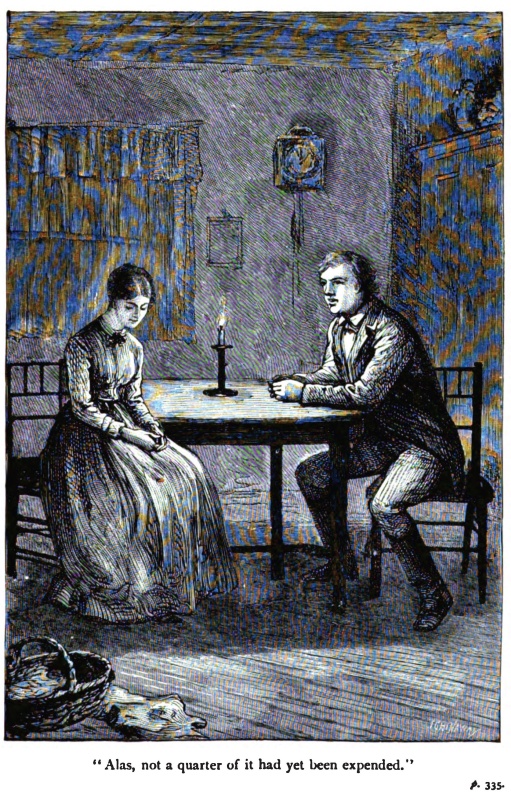
“No. I’ll be bound she would be as much amused as we are. It isn’t as though she cared a straw for him.”
“Well, that is not unlikely,” rejoined Rivers. “Come along then. I must own I am curious to see it.”
“Creep in here,” said Margetts, opening a door in the wall, “and mind you don’t make any noise. There are some holes in the dresser through which we shall be able to see.”
Almost as he spoke, the door of the parlour opened, and Thyrza was seen standing on the threshold, with the bit of candle in one hand and a match-box in the other. She proceeded to light the former, and placed it in an empty candlestick on the table, and then seated herself—not, as her swain had probably hoped, on the large heavy, wooden-legged sofa which ran along one side of the table, but in the large arm-chair, usually occupied by her mother.
Rudolf, though somewhat disappointed at the position thus taken up, glanced, nevertheless, with approbation at the bit of candle provided, which, in his view of the matter, intimated that the lady was not disposed to abridge the length of the interview. He seated himself in a chair, as near as he could contrive to his inamorata, and looked admiringly at her.
“I say,” he said, after a silence of some ten minutes or so,—“I say, I think you are very nice. I admire you greatly.”
“You are very obliging,” said Thyrza demurely.
There was another pause, after which Rudolf spoke again.
“I say, I mean to come over here very often to see you.”
“Indeed?” replied Thyrza with a glance at the candle. Alas! not a quarter of it had yet been expended.
“You don’t dislike me, do you, Miss Rivers?” inquired her suitor, after a third and still longer interval.
“I don’t know why I should,” was the answer.
Deriving some confidence, apparently, from this extremely guarded expression of opinion, Rudolf made a further venture.
“I should like to give you a kiss,” he said.
Not meeting with any response, and proceeding perhaps on that most delusive of all proverbs, that silence gives consent, he rose from his place and leaned over her chair, out of which she started with very evident alarm. Believing this to be only feigned reluctance, he pressed forward to urge his entreaty, when suddenly there came a loud explosion. The candle flew all to pieces out of the socket, scattering the tallow in all directions, and the room was left in complete darkness. George and Margetts could hear Thyrza making her escape through the door, while the unlucky lover, wiping the grease from his clothes, made his way to the stable, and rode off as fast as his horse could carry him.
“Redgy, you villain!” exclaimed George, after they had retreated to their room and given vent to their laughter,—“Redgy, you villain, that was your doing!”
“It was the plug of gunpowder, not I,” pleaded Redgy. “Mrs Rivers oughtn’t to have left the candle all that time on Thyrza’s dressing-table.”
“Did Thyrza know anything of the trick?” asked George.
“On my honour, she did not.”
“Well, it is a good job we are going to-morrow, or there might be a serious row about this.”
Chapter Twenty Two.
It was a Sunday evening late in December, about nine months after the departure of George Rivers and his friend from Umtongo. George, who wore a suit of clerical black, had just returned from a long ride to Spielman’s Vley, where he had passed the day. He was now a deacon, having been ordained by the Bishop of Praetoria a month or two previously. The weather was delicious, but very warm, and George was glad to sit down by his friend’s side in a charming little summer-house which they had built under the shade of a tall eucalyptus planted by Mr Rogers when he first came to the Transvaal, forty years before.
“Well, George, what sort of a congregation had you?” inquired Margetts; “and how did you get on with your sermon?”
“I had a very good congregation,” was the reply. “The farmer who bought Spielman’s Vley of my stepfather is an Englishman, an emigrant from a Berkshire village. He and his wife and grown-up children were all there, and so were nearly all the farm-servants whom he had brought with him. He told me very earnestly how it delighted him to hear the Church service. It was like a voice from Old England, he said, and he couldn’t tell me how glad they all were that a clergyman would come over from Umvalosa every alternate Sunday now, instead of once a month.”
“And I daresay, when he was in Berkshire, he didn’t think much of the Church service,” suggested Margetts.
“No, he often didn’t go, he told me, and cared very little for it when he did. And it was the same with his labourers. They seldom miss the service here. Well, it is to be hoped that they will not come to neglect it again, now it is once more within their reach.”
“But how about the ‘natives’ service’?” asked Redgy. “Could you get on with that?”
“I am afraid I made a good many blunders,” said Rivers, “especially in the sermon. However, nothing but practice will set that right.”
“You think an interpreter doesn’t answer?”
“No, I am pretty sure it doesn’t. You know what Lambert told us about his interpreter, when he first went to preach to the Kaffirs in the Knysna.”
“No, I didn’t hear the story.”
“Lambert said he was puzzled how to address them, when it occurred to him that ‘Children of the Forest’ was a title that would be sure to take their fancy, and he accordingly began his discourse to them in that way. He thought he had done it rather well, until one of his friends, who had heard him, and who was a good Kaffir scholar, told him that the interpreter had rendered his ‘Children of the Forest’ as ‘Little men of big sticks.’ That story determined me never, anyhow, to employ an interpreter.”
Redgy laughed. “I think you are right,” he said, “and your Kaffir certainly improves. By-the-bye, did you see Hardy? His house is only seven or eight miles off from Spielman’s Vley, and I am told he always goes over when there is service there.”
“I believe he does, but he was not there to-day. Mr Bacon told me he had gone to Durban—went about a week ago.”
“Indeed. Do you know what took him there?”
“I fancy he was sent for to make some report of the state of things in this neighbourhood. You know he now holds an official position of some importance.”
“Yes, which you might have had if you had liked it, George. He has the credit of having given them warning at Rorke’s Drift in time to prepare themselves for the defence of the place. But it was you who brought them that information.”
“I did not want the post, Redgy; and, if I had, Hardy was the person really entitled to it. I did not know the way from Isandhlwana to Rorke’s Drift, and could not have found it. And to say the truth, I should not have thought of the garrison at Rorke’s Drift, if he had not reminded me of it. No, he fully deserved his appointment, and I am heartily glad he got it. But I believe, when he gets to Durban, he will warn the Government that the Transvaal is not merely in a condition of discontent and disloyalty, but on the verge of an armed outbreak.”
“Do you think it goes so far as that, George? An armed outbreak means a war with England, remember. What possible hope can they have in succeeding in that?”
“No reasonable hope, of course. The hundredth part of England’s power would be enough to crush them. I don’t suppose the Boers could bring 5000 men into the field, and England could easily send five times that number, or twenty times that number, if she chose. The Boers have but little discipline or material of war, or knowledge of strategy. England is a first-rate power in all those respects. It would be as absolute madness for the Transvaal to go to war with England, as it would be for a terrier dog to provoke a lion to fight with it. But, however great the madness, it does not follow that they will not do it.”
“What can induce them?”
“Their profound ignorance of the relative strength of the two countries. I was talking with a Boer of some intelligence, who, I found, really believed that Holland was one of the Great Powers in Europe—the equal, if not the superior of England. He knew nothing of history, apparently, since the times of Van Trompe and Admiral Blake. He fancied Isandhlwana had only been redeemed by a desperate and exhausting effort, which would make it impossible for us to engage in any other war for a generation to come. The accidental circumstance that a quantity of newly-coined money had been sent out here to pay the troops was enough to convince him that England was bankrupt, and driven to expend its last guinea. People who know no more than that of the true state of things may perpetrate any act of folly.”