Rev. H.C. Adams (continued 5)
Reading edition
Annchen took her supper with the rest of the party, but soon afterwards retired to her waggon; and the four Europeans, sitting round the largest fire, for the night was unusually cold, began to converse together.
“This is near the place where that disaster occurred—Intombe—isn’t it?” asked Margetts, knocking the ashes out of his pipe.
“Yes,” answered Hardy; “the spot where the massacre took place is down on the bank of the river, only a little way from this. One would have thought that Isandhlwana would have been enough to teach even our countrymen common prudence. But I suppose nothing ever will.”
“It looks like it, certainly,” said George. “But it does not often happen that three such instances of carelessness, followed by such terrible results, follow in the course of one single campaign, as Isandhlwana, Intombe, and the death of the Prince Imperial.”
“That last was rather cowardice than carelessness, wasn’t it?” asked Margetts.
“I don’t think so,” said George. “The Prince Imperial was an entirely raw and inexperienced officer. The country was known to be in a most dangerous state, full of armed Zulus, who are among the most stealthy and cunning of all enemies; and he was allowed to go out in command of a party with no one competent to advise him. They tried to make out that he was not in command of the party, but nothing could be plainer than that he was; and that it was his total ignorance of the Zulus and the Zulu country that caused the disaster.”
“The troopers might have stopped to help him,” suggested Margetts.
“They were told to mount and ride,” said George, “and they did what they were told. How can you blame them for obeying their officer’s orders? Don’t you think so, Hardy?”
“Most certainly,” assented Hardy. “It does not appear that any of them, except his own French attendant, knew that the Prince was in any more danger than the rest of the party, until it was too late to do anything for him. The attempt to make out that that unfortunate Lieutenant Carey had the command of the party and was answerable for the loss of the Prince, was one of the most dishonest things I ever remember. The person really to blame was the officer who sent out the party under the Prince Imperial’s charge. But I suppose it was necessary to have a scapegoat, and this poor young Carey was the most convenient person to select.”
“What will become of Cetewayo?” suggested Vander Heyden. “Will they send him to Robben Island, along with Langalabalele and a lot of others?”
“Most likely,” said Hardy; “and there he will enjoy himself along with his wives, and grow fat, and die an old man most likely.”
“Yes, if a party in England don’t take him up,” said Rivers. “I am told there are persons in England who are raising a great clamour and making out that he has been shamefully used.”
“I wish they could be made to come out and live under his rule in Zululand,” suggested Hardy. “What is that?” he exclaimed a moment afterwards, starting up. “There is something in the bush there, creeping near us. Take your rifles. We must see to this.” He caught up a long burning stick from the fire and threw it down among a number of dry canes and reeds which lay at a short distance. A bright flame sprang up and showed some dark figures moving off into the scrub at a little distance; but the shadows fell so confusedly that it was difficult to make out whether they were men or animals. A minute afterwards Matamo passed them on horseback, cantering off in the direction of the scrub.
“That’s all right,” said Vander Heyden; “he’s sure to truck them, if any one can. We may sit down again. I suppose you couldn’t see what they were, Hardy?”
“It was something crawling on four legs,” said Hardy, “and I caught a momentary glimpse of a spotted skin, but whether it was the kaross of a Zulu, or a real tiger, I can’t say.”
“The tigers are very bold,” said Vander Heyden, “in this country. I suppose they are not such formidable beasts as the tigers of Bengal, though.”
“No, indeed,” said Hardy. “If you had ever come into contact with them, you would know the difference.”
“Did you ever kill a tiger in Bengal?” asked Margetts.
“Why, no, Mr Margetts, but one very near killed me.”
“Did he? Tell us about it,” said Redgy.
“Well, it was very soon after I went to India, when I was quite a young man. There was a letter of importance to be taken to the officer in command at Meerut; there was no one at hand who could take it, and they were obliged to entrust it to me. I was to travel by what they call dak,—travelling all night in a palanquin on men’s shoulders, and resting during the hot hours of the day. We were travelling in the wildest part of the country, when one of the bearers put his head in between the curtains. ‘Would massa like to see a tiger?’ he said.
“I had been dozing, but I started up. ‘No,’ I said; ‘there are few things I should like to see less.’
“‘Massa see one if he like it. Very big tiger yonder!’
“I looked out, and there, sure enough, about two hundred yards ahead of us there was a big tiger, trotting along in advance; I could see his striped skin clearly in the moonlight.
“‘Won’t you stop?’ I inquired of the bearers.
“‘No good stop!’ was the comforting reply; ‘tiger see us before we see him. If he mean to eat us, he eat us; if he don’t, he leave us alone.’
“I looked carefully to the loading of my gun, and lay back in the litter, watching our fellow-traveller, who jogged on, apparently entirely regardless of us. Presently he turned into the jungle and disappeared.
“‘Well!’ I said, ‘to be sure you are not going to pass the spot where he very likely is laying wait for us?’
“‘If he mean to have us, he have us,’ was the only answer I got.
“I had a strong presentiment that he did mean to have us, and I was half inclined to get out of the litter and leave them to make the experiment in their own persons. But at this moment there was a ringing noise heard in the distance, and a troop of native horsemen, who had been sent on some errand, came riding up. I informed the officer in command of our predicament, and he gave us an escort of his men to the nearest station. We heard afterwards that the tiger in question had been for many weeks past the terror of the neighbourhood, having killed great numbers of men. I was exceedingly glad to hear, when I returned that way a week or two afterwards, that he had been tracked out and shot.”
“I know they are formidable beasts,” said Vander Heyden. “I saw some of them when I was in England, and also at the Cape. The so-called tiger of this country is an awkward beast to come into contact with, though. But I consider the buffalo, if he is wounded, a much more dangerous animal.”
“I agree with you,” said Hardy. “A full-grown buffalo is pretty nearly a match for a lion, and a herd of them can put a lion to flight at any time.”
“Yes, I have seen that myself,” said Vander Heyden. “I remember once, when I was out hunting in the country near the Crocodile river, I came upon a lion who had just seized a buffalo calf, which had strayed, I suppose, for none of the herd were in sight. He was carrying it off to his lair probably. I fired, and my bullet struck one of his legs. It was a bad shot, and only inflicted a flesh wound. The lion turned, and I suppose would have rushed upon me. But at that moment a trampling was heard, and a troop of buffalo came in sight, headed probably by the mother. The lion left the calf and galloped off as fast as he could to the jungle, which lay a mile or so off. He would have got clear of them, I have no doubt, if it hadn’t been for the wound I had given him. But that crippled him so much, that the herd presently overtook and charged him. He turned and sprang upon one of them. But they had him down in a minute, and gored him to death with their horns, without his being able to make any resistance.”
The sound of horses’ feet was now heard, and Matamo came up. “Well, Matamo,” cried Redgy, “what was it then? was it a tiger, or a hyena, or a wild dog, or what?”
“I am not sure,” said Matamo, “but I think it was a bush thief?”
“A bush thief?” repeated Hardy; “do you mean a native or a white man?”
“A white thief, Mr Hardy,” answered the Bechuana,—“the same who attacked us before.”
“What! on the banks of the Blood river, you mean—before Isandhlwana, eh?” said George.
“Yes, Mr Rivers,—the man you rode after and did not catch.”
“What makes you suppose that? Colonel Wood is believed to have cleared the country of the gang by whom we were attacked,” observed Margetts.
“The colonel did not drive him off,” said Matamo. “I remember him quite well; I saw him in Luneberg the day before we left. He was looking at the waggons and asking questions. He thought I did not know him, but I did.”
“Then you think he is dogging us?” suggested Rivers.
“He is certainly after us, and means us harm,” rejoined the Bechuana. “I saw him long way off to-day. I knew his horse.”
“Horse! was he on horseback when you saw him just now—that is, if you did see him?”
“He was creeping through the bush on his hands and knees when I first saw him,” was the answer. “When I first got on my horse and rode after him, I saw him a long way off, on the edge of the wood, he and one or two more. They got on their horses and rode off before I could come up.”
“Well, they won’t come back to-night, anyhow,” observed Rivers; “and to-morrow we must devise some means of circumventing them.”
No more was said, and presently the party turned in to their sleeping-places for the night.
Rivers tapped Vander Heyden on the shoulder, and the two moved off a short distance out of hearing.
“What do you think of this, Mr Vander Heyden?” inquired George when they were out of hearing distance.
“I am afraid Matamo is right,” answered the Dutchman. “I know more of this man Cargill, or, as he chooses to call himself, Bostock, than I have cared to say. He was once in the Dutch service, and was received in society as a gentleman. At the Hague he fell in with my sister, to whom he offered very marked attentions—indeed, once made her an offer of marriage.”
“But she repelled him?” said George.
“Yes, so decidedly that he had no pretext for intruding further on her. But he would not desist, and my sister appealed to me for protection. I called at his quarters, and the result was a quarrel and a challenge, which I accepted. But the same night, at the burgomaster’s ball, he was so insolent in his demeanour to Annchen, that I insisted on his leaving the ballroom. A fracas with the police ensued, and he was lodged in prison, from which he made his escape. I never heard what had become of him until I saw him on board the Zulu Queen. But he had sent a notice to me, while in prison, that the defiance which had been exchanged between us still held good, if I dared to meet him. I answered that I stood prepared to do so when and where he might demand it. I could not then foresee that he would fall to his present level. He reminded me of my words when we met that day near the Blood river. I daresay you wondered that I should condescend to a duel with such a fellow. But my word had been given, though at that time I did not like to tell you all.”
“I see,” said George; “but you are not bound to meet him again.”
“No, nor have I any intention of doing so. Indeed, I told him so. But you heard what he said,—‘he would find his opportunity of returning my fire,’ or some such words. He is quite ruffian enough to shoot at me without further warning.”
“If I thought that,” exclaimed George, “I declare I would fire upon him without ceremony! What, do you think he was creeping up through the reeds with that intention when Matamo saw him?”
“I cannot say. But if it was really he that Matamo saw, I don’t think it unlikely.”
“Well, we must be on our guard of course. It is a pity we haven’t a good dog with us. We must see if we can’t get one at one of the houses we pass. There is nothing for it but to go to sleep now. I think we are safe for to-night.”
The night passed as had been anticipated, without further disturbance. In the morning the route was resumed, the place appointed for that evening’s halt being Elandsberg. They were able to proceed with greater speed than on the previous day, the long, level plain being rarely interrupted by watercourses. The only drawback was that the veldt, though to all appearance level and firm, was in many places undermined by the burrows of the ant-bears which abound in this district, and which the long grass renders invisible. The horses were continually plunging into these fetlock deep, and sometimes almost to the knee. The greatest care was necessary to prevent a dangerous accident. This formation of ground lasted through the whole of the morning’s ride, so that Vander Heyden had no opportunity of resuming the conversation with George which he had held on the previous evening. But when the mid-day halt had been made, the Dutchman, who had been seated near him under the shade of a large oomehahma, asked him to take a turn with him into the wood, while the drivers were engaged in inspanning the cattle.
“Mr Rivers,” he said, “I think I ought to tell you what I have heard from my sister about this man Cargill, of whom we were speaking last night. I suppose she had overheard something from the Hottentots, which induced her to suppose that he had been seen in the neighbourhood. But it certainly is necessary that some steps should be taken to prevent the mischief which may otherwise not improbably follow. You will perhaps think it strange that I should speak to you, of all men, about her. I know the light in which you regard her. You have never, indeed, made any secret of it.” He paused and hesitated, looking at George in an embarrassed manner.
Rivers bowed rather distantly. “You are right, Mr Vander Heyden,” he said; “I have said and done nothing secretly. But I am aware of your feeling on the subject. You must allow me to say that you have made no secret of your feeling either.”
“That is true, Mr Rivers, and is one reason why I wish to speak to you now. I will not deny that when we first met, on board the Zulu Queen, my feeling was one of simple dislike to your countrymen. That may be an unreasonable prejudice; but if you knew my family history, you would not wonder at it. But the events which ensued on board the ship, and afterwards during the campaign in Zululand, have, permit me to say, completely altered my feeling. I have learned your true character, and honour and esteem you.”
George again bowed, and put out his hand, which the other took frankly. “I, too, Mr Vander Heyden, have had prejudices to get over,” he said, “and may say with truth that I have surmounted them.”
“I am glad that you can say so,” resumed Henryk. “To proceed—I would now willingly accept you as a suitor for my sister’s hand, and, to be perfectly frank, do not much doubt that she would receive you favourably, but for a circumstance which is perhaps to be regretted, but cannot be set aside. My father entertained a still stronger resentment against the English than ever I have felt. The idea of being connected with them in any manner was odious to him. Above all, the notion that either I should ever marry an Englishwoman, or an Englishman become the husband of Annchen, was one against which he was determined to guard by every means in his power. She is seven or eight years younger than I am, and was indeed not more than twelve years old at the time of his death. He thought her too young to be spoken to on the subject. But he put a clause into his will, by which she forfeited her whole inheritance if she married an Englishman, and he also laid his solemn commands on me never to allow such a marriage. I gave him my promise, and nothing can ever release me from it.”
He again paused. But George only once more bowed, and Henryk went on. “I have never told Annchen of my interview with my father, which took place only a few days before his death; nor is she aware of the clause in his will of which I have told you. When I perceived your attentions to her, I warned her against entertaining any reciprocal feelings, but only on the ground that I could never consent to such an union. I did not wish to bring in my father’s name, if I could help it. Nor shall I do so, unless it becomes absolutely necessary. May I not hope, Mr Rivers, that you, seeing what the consequences of a marriage with her would be, will prevent the occurrence of this necessity by abstaining from any further persistence in your suit?”
George was silent for a minute or two, and then replied, “You have spoken frankly, Mr Vander Heyden, and in a manner that does you honour. I do not fear poverty myself, but I ought not to reduce her to it, unless at her own expressed wish. We should not, in England, think it right for a parent to exercise so extreme an authority over a daughter as a prohibition to marry a person of any particular nation, be he who or what he might, would amount to. But under the circumstances of the case, I am willing to respect your joint wishes, and will not, unless with your permission, ask Annchen to be my wife.”
“I thank you, Mr Rivers. You will observe that my father’s command was not addressed to her, forbidding her to marry an Englishman, but to me, requiring me to forbid it. If I could think it right to set my father’s injunction aside, she doubtless would feel no scruple. But that, I fear, can never be the case.”
There was a further pause, and then Vander Heyden again spoke. “Having told you this, I have no hesitation in asking your help in the present condition of things. This man Cargill, or Bostock, or whatever he may choose to call himself, does not pursue us in this manner only because he bears me a deadly hate. He has an equally deadly passion for Annchen. I had no idea till last night of the length to which he had gone. Even on board the ship, he had the insolence to speak to her. On the day when we left the Cape he contrived to find her alone, and warn her that there would probably be mutiny and danger to the captain and officers and passengers, but she might trust to him to preserve her from all harm.”
“Why did not Miss Vander Heyden warn you?” exclaimed Rivers, greatly startled.
“He timed it well. It was only just before the ship struck. Moritz and I were asleep in our cabin, and the captain was asleep in his also. He knew that there would be no possibility of warning us. Again, as I learn, while she was at the Swedish pastor’s house, just after our encounter on the banks of the Blood river, she received a letter which he contrived to have handed to her, telling her of his unaltered affection, and that he was still resolved she should be his. I learn that he was seen in Luneberg making inquiries as to the route we were to pursue, accompanied by some of the mutineers and one or two other notorious ruffians. There is, I am afraid, no doubt that some attempt will be made to carry her off during this journey to Zeerust.”
“It sounds like it, I fear,” said Rivers. “Well, Mr Vander Heyden, you may command my services to the utmost in averting so dreadful a calamity.”
“I thank you; I knew I might reckon on your generous help. I think, if we can reach Standerton in safety, as with great exertion may be done to-morrow, we may engage more men to accompany us. Our party may be made so numerous, that Cargill will not venture on any violence. We are at present ten in number, but two or three of them cannot be relied on. If we could engage five or six stout fellows, and arm them well with rifles and revolvers, they would not dare to attack us. I propose to have a watch kept throughout the night, as well as two or three men riding always in advance, and they may follow in our rear by day.”
“I think you could not do more wisely,” said George; “and until we reach Standerton we will undertake the duty ourselves. Margetts and I will keep one watch, you and Hardy another, and Matamo and Haxo the third. And the same with the parties in advance and in the rear.”
“I thank you heartily,” said Vander Heyden. “I will speak to Mr Hardy and the two servants, if you will do so to Mr Margetts.”
Chapter Sixteen.
The dawn was only just beginning to dapple the skies, when the voice of Henryk Vander Heyden was heard rousing his Hottentots and superintending the inspanning of the oxen and the saddling of the horses. The sun was hardly above the horizon before the party had set out, Vander Heyden and Hardy riding two or three hundred yards in advance with their guns and revolvers loaded, keeping a keen lookout as they advanced, and two of the Hottentot servants following in the same manner in the rear. In this manner they advanced for three hours or so, through a country resembling in character that which they had passed yesterday, with the difference that the ground was harder and drier, so that the progress of the waggons was less interrupted. About nine o’clock they halted for the first meal of the day on the edge of a dense mass of shrubs and underwood, through which nothing but the woodman’s axe or a herd of elephants could have forced their way. Here occurred an incident which was remembered by one of the party, at all events, long afterwards. Redgy Margetts had alighted, and was about to take his place at the breakfast table, if the rough boards taken from the cart, on which the viands were spread, could be so designated, when he saw what he took to be the end of a long green plantain among the stems of the cacti. They are very delicious eating; and, thinking to add to the attractions of the meal, he took hold of one end to draw it out. To his surprise and alarm, he felt it move and writhe in his grasp, and the next moment a hideous green head made its appearance from the bushes, and would have sprung on him, if Matamo, who was calling out to Margetts to warn him, had not dexterously flung the large knife which he was holding in his hand, wounding the snake in the neck and disconcerting its aim. It missed Redgy’s face, at which it had darted, and fell on the ground close to him, and Haxo, who had caught up an axe, struck its head off.
“A lucky escape, Mr Margetts,” said Matamo. “A big mamba, that; he is seven or eight feet long. I never saw a bigger.”
“The brute?” exclaimed Redgy. “I took him for a big cucumber, or something of that kind. Is he poisonous, Matamo?”
“Yes, Mr Redgy, very poisonous. A man, if he was bit by him, would die in an hour, perhaps in less. I’ve known one die in three-quarters of an hour.”
“You must be careful, Mr Margetts,” said Annchen, who had witnessed what had passed with a shudder of horror. “I have been learning a good deal about the African snakes. They are the worst things in the country. We newcomers cannot be too careful.”
“You are right, miss,” said Matamo. “Some of them look like sticks or green stalks or stems of trees lying on the ground. Strangers sometimes don’t find out that they are snakes, till they are bitten.”
“But, as a rule, they won’t harm you unless you provoke them,” said Vander Heyden. “They have the cobra in India as well as here. In which country do you think it is the most venomous, Hardy?”
“It is bad enough anywhere,” answered Hardy; “but I think it is worst in India. Its venom is very rapid in its action there. I remember Captain Winter’s Hindoo cook being bitten by one. She used to keep her money in a hen’s nest near the kitchen door. One night she heard a noise in the nest, and thought some one was stealing her money. She crept down in the dark and put her hand into the nest to feel if the money was safe. The noise had been caused by a cobra which had crept in to eat the chickens. It bit her, and she was dead in less than half an hour.”
“Yes, no doubt it was in a state of great irritation, and the bite unusually venomous,” observed Vander Heyden; “but I consider both the puff-adder and the cerastes to be quite as dangerous as the cobra, and the mamba yonder is almost as bad as any. But with proper care there is not much danger. If they do bite you, as a rule, the only thing to be done is to cut or burn the flesh out.”
The meal was now eaten, and the waggons were soon once more in motion, the same precautions being observed during the remainder of the day. No enemies, however, were sighted, or, indeed, any living creatures at all, except some koodoos, which Haxo and George pursued and were fortunate enough to overtake, killing one and bringing the prime parts home for supper.
About five o’clock they reached Elandsberg; which had never been more than a tolerable-sized village, and had been sacked and burned by the Zulus some months before in one of their incursions. It was now deserted; and it was fortunate that the koodoo had been killed, or the party might have had but a slender supper to partake of. But as it was, they soon made themselves comfortable. All the cottages had been wrecked, and the furniture broken to pieces or carried off; but the walls of some were still standing, and one of the largest—a farmhouse apparently—had suffered less than the others. The roof, of corrugated iron, over two of the rooms was still almost whole, and even the windows of one, the principal bedroom, had escaped. This room was got ready for Annchen and her Hottentot. Her bed and box were brought in, and a rug spread on the floor for the servant. In the other room, which had been the kitchen, the men of the party took up their quarters. A fire was lighted on the hearth, at which the koodoo’s flesh was roasted; a half shattered table was rescued from the débris outside and propped up with boxes, and the party presently sat down to an appetising supper. Two of the servants were left to keep guard outside, their places being taken by others at midnight. Then the rest of the company wrapped themselves in their rugs and lay down round the fire.
The night was undisturbed, and the route resumed with the first glimmer of daylight, Vander Heyden being particularly anxious to reach Standerton that night; where, he believed, his anxieties would be at an end. It was a most delicious day, and everything went smoothly until after the halt for the mid-day meal. Then it was arranged that Margetts and Haxo should form the advanced guard, while Matamo and Hardy followed in the rear.
Redgy rode on, thoroughly enjoying the delicious afternoon. The sky was beautifully blue, and for a long time not flecked by a single cloud.
“How lovely the afternoon is!” he exclaimed half to himself, as they paced leisurely along. “I wish our halting-place was farther off. I shall be quite sorry when this comes to an end.”
“It is quite far enough off, sir,” replied Haxo, to whom this remark appeared to be addressed. “It is about half a mile on, and I wish it wasn’t a quarter.”
“Why do you wish that, Haxo?” asked Redgy, turning in surprise to his companion, whose presence he had almost forgotten.
“Because the river is between us and Dolly’s Kop, sir,” answered Haxo; “and I am not sure whether the waggon will get across.”
“Get across! Why not? I suppose it is like the other rivers we have passed to-day,—so I understand at least. We have had no difficulty about crossing them.”
“Just so, Mr Margetts. The rivers about here are nearly all sand, with just a little water. But after an hour’s rain they look different.”
“Rain! Yes, but we’ve had no rain.”
“We are going to have it, though, and that pretty soon. Do you see those clouds?” He pointed as he spoke to a thick bank of black vapour which was creeping over the sky. “See, they’re hurrying on the oxen as fast as they can. They may get across, but I don’t think it.”
They turned round and rode up to the waggon, where, indeed, the giraffe-hide whips were in full requisition, and the waggons proceeded at a pace which would soon have brought them up to the river-side had it continued. But they were presently obliged to moderate their pace, and before long it became difficult to proceed. The sky grew so dark as almost to obscure the track—indeed, but for the lightning, which repeatedly burst forth with a vividness which illuminated the whole scene, they would not have been able to distinguish their way at all. Then there came a cold, biting rush of wind, and suddenly the rain burst forth in torrents, which soon drenched every one to the skin, while the animals became almost unmanageable. It was well they had experienced drivers, or some serious disaster must have ensued.
At length, after a fierce struggle with the elements, the banks of the river were reached. But it became evident at a glance that all hope of crossing it must for a long time to come be abandoned. The narrow streamlet had risen to a roaring torrent, not only filling its sandy bed, but expanding into wide lagoons on either side, and filling up hollows which in some places were fifteen or twenty feet deep. Fortunately for the belated wanderers, the ground at the point which they had reached was high and rocky; and they were glad to avail themselves of Matamo’s local knowledge, who ordered the oxen to be turned aside from the track, and presently drew the waggons into a cavern, running far enough back into the rock to afford a shelter from both wind and rain. The horses were now stabled in an adjoining cavern, and the oxen turned out to find what food they could. The condition of the party was in some degree improved. But they were sufficiently miserable nevertheless. The deluge of rain had not only soaked the men to the skin, but had forced its way into the waggons, and Annchen and her maid, and the beds and wraps and every other article inside, except the solid chests, were as completely drenched as though they had been plunged into the river. Some wood, with which the floor of the cave had been strewn, was heaped together and a fire lighted, but it would evidently be hours before anything like warmth or comfort could be restored. Our travellers were greatly relieved when they saw a horseman, wearing a heavily flapped hat and leggings and boots of untanned leather, together with a thick cloak wrapped round his person, suddenly draw up at the mouth of the cave and ask in intelligible English who they were, and whether they required any help.
“We are mostly English travellers,” replied George. “We have been caught in the storm, and are almost wet to the skin. The lady who is with us, in particular, may suffer from the effects of the exposure. We should be thankful to you to show us any place where we can obtain warmth and food and shelter.”
“English!” repeated the stranger; “my countrymen. I do not often come across them in these regions, and shall be pleased to offer them such hospitality as I can. You have horses, I think; you had better mount and ride with me. My house lies at the distance of about a mile from here, though the wood lies between it and us.”
All complied without hesitation; even Vander Heyden, though unwilling to be indebted for any services to an Englishman, felt that, for his sister’s sake, it would be impossible for him to refuse. The servants were left behind under Matamo’s and Haxo’s charge, there being plenty of food for their wants, as well as accommodation quite as good as they were used to.
The party rode off, following a path evidently well known to their conductor, though indistinguishable by them. The rain had now entirely ceased, though the sky was still clouded. After a quarter of an hour’s ride they reached the house; which stood, as well as they could discern, on the edge of a wide, deep hollow, which the floods had converted for the time into an inland lake. There was light enough to distinguish clearly the outlines of the building. It was externally like the houses of the Dutch; but the internal arrangements were different. The kitchen was at one end, and there was a sitting-room adjoining it, and two or three separate bedrooms at the other end. The furniture, too, was different, the articles being less massive and solid than is usually the case with the Boers. There was even a bookcase in the parlour, containing it might be thirty or forty books, articles rarely to be seen in the houses of the Dutch.
Annchen was immediately shown to one of the spare bedrooms, and some clothes brought her by one of the Hottentot women, while her own were taken out to be dried. The males of the party were similarly accommodated, and in an hour’s time all the travellers were assembled round the stranger’s board, with the exception of Vander Heyden, who, having seen his sister made comfortable, took a courteous farewell of his host, and expressed his intention of returning to the cavern, not considering it safe, he said, to leave the waggons and cattle entirely in charge of the natives.
“You may be right, sir,” said the Englishman. “Natives, unless you have had long experience of them, cannot safely be left in charge of valuable property. More particularly is that the case at the present time.”
“Indeed!” said Vander Heyden, delaying his departure as he heard his host’s words. “To what do you more particularly refer?”
“The whole country has been for a long time past overrun with ruffians and outlaws of every description,” was the answer. “Zulus and Kaffirs, whom the recent war has driven out of their own country; Hottentots, who will not work, and live by pillage and pilfering; rogues from the diamond fields, who have been expelled for their knavish tricks, as well as convicts, who have broken loose from their confinement, have for years past formed a sort of banditti, against which one has perpetually to be on one’s guard. After the annexation, our Government almost entirely put them down; but the events of the last half-year have renewed the mischief almost as bad as ever. I have no doubt, however, that now that the struggle has come to an end, quiet and security of life and property will be reestablished. But you need not be afraid, I think, for your waggons. You do not seem to be aware that a bridge over the river has been recently made, and there is a good road from it all the way to Standerton. I shall be pleased to show it to you to-morrow. It is one of the boons for which we have to thank the English Government.”
Vander Heyden made no reply, but once more bowed and took his leave.
Rivers and Hardy looked at one another and smiled.
“What a pity it is that he dislikes the English so!” said the latter. “He really is a fine fellow—brave and generous and honest, and full of kindness to every one, except an Englishman.”
“We ought to feel it all the more a compliment that he is so civil to us. I suppose there must have been some very great wrong done to his father by our countrymen,” said George.
“To his grandfather first, and then to his father,” said Hardy. “His grandfather was one of those who rebelled when they found that the country had been permanently handed over to the English after the fall of Napoleon. He was taken prisoner with arms in his hands, and was hanged like any highwayman. His son migrated to Natal, and was again driven out by the English, when they annexed the colony. Proceedings were taken against him which were extremely harsh, and he died, as I have heard, of a broken heart. His son, our friend Henryk, got together all he could of his father’s property, and withdrew into the Transvaal; where he bought a farm, but left it in charge of an agent, while he himself served in the Dutch army for several years. The annexation of the country by the English, three or four years ago, was the last drop in the cup of his indignation. He had returned to the Transvaal, having become wealthy again, partly by his deputy’s successful farming, partly through money left him by his uncle, Van Courtlandt. He went again to Europe, to try if he could not procure the repeal of the Act of Annexation. He has come back now, bitterly disappointed at his failure. It is no wonder, I must say, that he cannot endure the English.”
The host now informed them that supper was ready, and they took their places at the table. After the meal Annchen withdrew for the night, and the rest of the party, gathering round the hearth, for the rain and wind had made the air chilly, smoked their pipes and drank their host’s Schiedam at their ease.
“If you would excuse my curiosity, sir,” said Hardy after a while, “I should like to know what brought you into these parts. You are, I think you said, an Englishman. But—”
“But I don’t look as though I had lived in England,—that is what you mean, I think? Well, I’ll tell you my history. It illustrates what we were talking of at dinner,—as to what is the truth respecting the treatment of the natives by the Boers. My father and mother were English. They came out to the Cape Colony somewhere about 1830, and they settled on a farm in Namaqualand. It didn’t pay. Their cattle were continually driven off by the bushmen, and their fruit plundered and their guns and hoes and the like stolen by the Hottentots. Nothing they could do would prevent it. The native servants were often as not in league with the thieves. Every now and then they would run off and take anything of value with them.”
“As for the cattle-stealing,” remarked George, “that is an old story. A man must be a good deal wiser than I am who can say how it is to be prevented. But I wonder, I must say, if you treated the Hottentots well, as I have no doubt you did, that they didn’t stay with you.”
“Perhaps they might,” said Prestcott, which they afterwards found to be their host’s name,—“perhaps they might, if they had been left to themselves. But there were always a lot of Hottentots going loose about the country; and they threatened our servants with their vengeance if they didn’t give them food and drink. They didn’t dare refuse, and then they expected to be severely punished, and ran off. Anyhow, they couldn’t keep any servants, and their property was continually pillaged. They must have left the country if they had lived. But one day my father was speared by a party of bushmen, whom he had caught driving off a bull. My mother, who had seen the transaction, ran screaming out, and they speared her too. They then entered and pillaged the house. I was a child of eight years old, and they no doubt would have killed me along with my parents, if it hadn’t occurred to them that old Potgieter, a Boer farmer a few miles off, would give them something handsome for me. They took me to him, and he did buy me.”
“You don’t mean that he bought you of them, knowing how they had come by you?” exclaimed Redgy, horror-stricken.
“No, sir. They were too clever to tell him that, and he was too clever to ask. They merely said they had found me, and they believed my father and mother were dead.”
“And they had excellent reasons for believing so,” remarked Redgy.
“True, sir. Well, old Herman Potgieter took pity on me, as he was pleased to express it. He took me over to the field-cornet’s house, and apprenticed me, after their fashion, to himself, until I should be one-and-twenty years old.”
“Ay, I have heard of that before I left England,” remarked Margetts. “But I thought the age was five-and-twenty, and it was further remarked that it was astonishing how long these apprentices are in reaching their five-and-twentieth year.”
“Just so, sir. The natives seldom know how old they are; indeed, they are seldom able to keep any account of time; and they are obliged to prove that they are five-and-twenty before they can claim their freedom. I have known a native kept in service until he was nearly forty. But though I was not nine years old before I was taken before the field-cornet, I knew something of their ways, having heard my father talk about it. I produced a Prayer-Book he had given me on my eighth birthday, insisting upon it that in a little more than twelve years’ time I should be free. I suppose when they found out I was really an English boy, on my father’s side at all events, they were a little frightened, and thought it best to be cautious.”
“I have no doubt of it,” assented Hardy. “I suppose you took good care of your Prayer-Book?”
“Old Potgieter contrived to get hold of that,” said Prestcott; “but I was not to be beaten. The house where my father had lived stood only a few miles off, or rather had once stood, for no one had lived there since it had been wrecked by the Hottentots, and it was a mere ruin. But I knew my father had buried a box under the stone paving in one corner of the room, and that it contained among other articles my baptismal certificate. One day, when I wanted but a few weeks of becoming one-and-twenty, I took a pick-axe with me, went over to my old home, and dug up the box. There was my baptismal certificate, sure enough, and a good bit of money besides, as well as shares in an English company at Cape Town. I put these back into the box, which I buried again, but I took the certificate with me, and on my twenty-first birthday went over to the field-cornet’s again. Old Potgieter thought he had destroyed the evidence of my age, and was dumb-foundered when he saw the signatures to the papers, and durst say no more.
“I repossessed myself of my money and shares, and sold the latter at Cape Town, where they fetched a good price. Then I bought this land here and built this house, where I have lived ever since. I married, but never had any children. A few years ago my wife died, and I have never cared to marry again.”
“What became of old Potgieter, the old wretch?” inquired Redgy.
“Poor old Potgieter!” said Prestcott. “He wasn’t unkind to me after all; and when I heard how barbarously he had been murdered, I was as hot as any one to punish his slayers.”
“How was he murdered?” inquired Hardy.
“He was making a journey somewhere, I forget where. It was only for trading purposes, but I suppose the Kaffir chief, near whose kraal he halted for the night, thought otherwise. And it can’t be denied that there was some reason for his thinking so. Old Potgieter had been on a great many commandos, and had killed more natives than he would find easy to reckon up. Makapan, as the chief was called, attacked the camp by night and killed them all. I have been told that they flayed him alive, and the story was generally believed, though I have great doubts whether it was true. The Dutch, when they heard of it, ordered a general commando, which was joined by a large party of Potgieter’s relatives and friends, and I, as I told you, went with them. We were several hundreds in number, with waggons containing military stores, and a cannon or two. Makapan and his tribe were quite unable to resist. They retired into the broken country adjoining the kraal, and there assailed us with arrows and assegays from behind their rocky fastnesses. But we continually forced them back; and at last they retired into a cavern, which was some hundred yards in depth, and so dark that it was impossible to see anything, except close at hand.”
“It wouldn’t have done to have followed them there,” said George. “You would have been an easy mark for their poisoned arrows.”
“No doubt, and we might have fired as many rounds of ammunition as we pleased and hit nothing but the rocks. Praetorius and the others knew better than to try that.”
“What did they do?” asked George.
“They first tried to blast the rocks, but that had no effect but that of wasting powder. Then a sort of blockade was established. Guards were set at every opening, and nothing allowed to come out or go in. But either the Kaffirs had collected large stores of food, or they had some way of going out and getting in which we could not detect. At last the Dutchmen came to the conclusion that the only thing to be done was to build them in.”
“Build them in! What, build a wall in front of the cave, do you mean?”
“Build up the mouth of the cave itself. They had pretty clearly determined that there was but one mouth,—the fact that the cave ran deeper and deeper into the hillside seemed to prove that,—and if so, there could be no way out.”
“Why, that is very much what I remember reading in my history of Scotland,” said Margetts, “that a very barbarous Highland tribe did to another. It was in prehistoric times, so that there was only a legend about it.”
“As for barbarity, Redgy,” observed George, “I don’t fancy the Boers of the nineteenth century are much behind the McLeods of whom that story is told. And the French performed nearly the same feat in Algeria forty years or so ago. Only they, I believe, smoked the Arabs like bees in a hive.”
“That would have been much more merciful,” observed Prestcott. “These Kaffirs died of hunger, the most dreadful of all deaths, and no quarter was given them. Whenever any of them made their appearance at the mouth of the cave, they were shot down. More than a thousand were killed in that way. The blockade was maintained for nearly a month. After that no Kaffirs appeared, and there came so dreadful a stench from the cave that the Dutch could endure it no longer, and made their way in. I had gone away some time before that, not being able to endure the horror of it. But I am told that they found no living thing. The whole tribe had been destroyed.”
“Then, I suppose, they went home and celebrated their victory,” said George.
“Yes, and boast that peace has been maintained in that district ever since,” replied Mr Prestcott.
“Solitudinem faciunt pacem appellant,” said George, who had not forgotten his classics. “I did not know the Boers were as bad as that!”
Chapter Seventeen.
“I should like to ask you, sir,” said Margetts after a pause, “the rights about the presence of the larger animals—wild animals, I mean—in these parts. In Zululand, which is very nearly on the same parallel as this, they were certainly to be found. Some of the horses were attacked by lions while we were actually in the country. We had been informed that it was very much the same state of things in the Transvaal. But here we have been journeying several days, and we have not come upon the slightest trace of elephant, or lion, or giraffe, or rhinoceros. We did hear a roaring one day, which we thought was that of a lion, but it turned out to be only an ostrich,—so Matamo said, at all events.”
“If you heard the roaring by day, Mr Margetts,” said Prestcott, “it was pretty sure to be that of an ostrich. As a rule, the lion only roars by night. The two roars are certainly very much alike, though a practised hunter could distinguish between them easily enough. As for the great game of which you speak, it has certainly left the lower parts of the Transvaal. If a solitary specimen here and there is to be met with, the animal in question has been driven southward by some accident. It is a different thing in Zululand from what it is here. The natives do not hunt the lion or the rhinoceros, as the European settlers do. After they have once begun to people a land, the big game soon disappears. We have, however, still herds of antelopes of all kinds, springboks, gemsboks, elands, koodoos, hartebeests, and gnus. The lion preys upon all these, and where they are to be found in great numbers he might be looked for also. But the white hunter is too much for him, I expect.”
“They are old acquaintances of yours, I perceive, sir,” suggested George. “Have you ever had any perilous encounters with them?”
“Well, sir, I have had one or two brushes—narrow escapes they may be called. I had one in Namaqualand some years ago—no one ever had a narrower, I may say.”
“Please let us hear it, sir,” said Redgy. “If one can’t see the lions themselves, as I had hoped, at all events one may hear about them.”
“Well, I’ll tell you my adventure, sir, if you like it,” said Mr Prestcott, who had evidently no disinclination to relate his personal experience. “I had gone to Walfisch Bay, where some English traders had settled, with whom I wished to establish business relations. I had to pass through the Hottentot country. At that time there were a good many villages scattered about, and there I could procure food and lodging. There were few or no white men at that time in the country, and the lions had never been disturbed in their occupation. One evening I reached a kraal on the Fish river, and there I found all the Hottentots in a terrible state of alarm about a very big lion, which was lurking somewhere in their neighbourhood and had taken to man-eating. I daresay you may have heard that when a lion once does that, the only chance is to kill him at once. He gets so fond of human flesh that he won’t eat any other, and he will lie in wait near one of the villages for days and weeks together, hiding himself in one place or another, and springing suddenly out on some unwary traveller.”
“Isn’t that fact disputed, Mr Prestcott?” asked Hardy. “I have met with old hunters who say that the man-eating lion is merely an old animal, who has become too stiff in the joints to run his victims down, and that he only preys on men in the way you have described, because they can’t run away from him in the way that an antelope or a gnu would.”
“Yes, I have heard that,” assented Mr Prestcott, “and think it may very possibly be true. Certainly such man-eating lions as I have seen killed were very wretched, mangy-looking creatures. That was attributed to the fact of their living on human flesh, but I don’t know why that should cause such a result. Their appearance is certainly consistent with their being old, worn-out animals. Any way, the Hottentots were in a state of great disquietude about this lion. No less than five victims—two men and three children—had been killed and carried off into the long jungle grass, where he principally took up his abode, within the last week or two. Several times the whole of the men had gone out to spear him. But though they had seen him at a distance, they could not get near enough to wound him with their shots or arrows. They implored me so earnestly to deliver them from this terrible pest, that I agreed to remain for a day or two and see what I could do for them. Well, I stayed with them a week, and made several excursions, but could see nothing of him. At last it was supposed that he had been killed or had left the neighbourhood. I had delayed there longer than I liked, so I took my leave one morning, and, having loaded both barrels of my gun, I set off on my way for Walfisch Bay. About a mile from the Hottentot village there was a clear spring of water. As the day was very hot, I resolved to bathe my hands and feet and take a good draught before going farther. I took off my coat and shoes and stockings and laid them at the foot of a large mootjeeri that almost overhung the pool, but I retained my gun in my hand. I was just stooping to take a draught of water, when I heard a stealthy movement in the long tambookie grass, like that of a large animal creeping towards me, and at the same moment my horse, which I had fastened to the bough of a small tree, broke away and rushed off at full speed I sprang up and swung myself round the mootjeeri, only just in time to escape the spring of a large lion, which struck against the tree and was thrown by the shock on its side. Before it could regain its legs I had dropped my gun and skimmed up into the tree, the lower limbs of which were only six feet or so from the ground. I seated myself on a branch, and took a good look at my assailant, who was now standing only a few feet below me, eyeing me with a hungry look, and every now and then giving vent to his impatience at being kept from his supper in short, angry roars. There could be no doubt that it was the man-eater, and that he had tracked me, waiting his opportunity. It was a good job for me that the mootjeeri was so close at hand, and that lions cannot climb, or he would have made short work with me. But though I thanked Heaven for my escape so far, I was by no means out of the scrape. If I had been able to take my gun up into the tree with me, I could soon have rid myself of him, but it was lying on the brink of the spring. Nor could I even recover my coat and shoes, which I had placed at the foot of the tree, a couple of yards below the branch. I could only reach them by hooking them up with a long stick. I did try this. I cut a long wand with a crook at the end, and let this down. But the lion instantly seized my coat in its teeth and tore it away. It was the same with my shoes, and I was presently obliged to give up the attempt. He instantly clutched anything which I attempted to move.
“I was obliged to remain quite passive, but my condition was getting very uncomfortable. My arms and feet were bare, and the leaves of the mootjeeri afforded me a very insufficient shade from the blazing heat of the sun overhead. I also became very hungry as the evening came on. What food I had had with me was all in the bags attached to my saddle. My only chance, I felt, was that the lion might get tired of waiting for me and go off to seek food elsewhere. But I was sensible that this was not worth much. It was clear that he wanted me, or he would have sprung on my horse when he first made his attack; and I knew how eager the craving of the man-eater is for human flesh. He would wait as long as nature would allow him to hold out, in the hope of making his meal on me, and he would probably be able to last out much longer than I could.
“Presently he left the foot of the tree and went back to the spring, where he took a long draught, and then lay down on the grass under the shrubs, keeping his red and angry eye still fixed on me, and every now and then displaying his terrible teeth. The whole afternoon passed thus. I was in hopes that some of the Hottentots might pass that way, and repeatedly shouted at the top of my voice for help.
“By and by it grew dark, and some of the smaller animals which were accustomed to resort to the fountain to drink made their appearance in the distance, and again I hoped that he would pursue and make his supper on one of them. But no, it was quite plain that he had made up his mind to have me and nothing else. At last it grew quite dark, only a few stars being visible in the sky, and the lion, so far as I could make out, was sound asleep. I attempted to creep stealthily down from the branch, but the moment I moved he started up with a short roar, and rushed up to the tree so quickly that I had only just time to regain my former position.
“Daybreak came at last. I was worn out for want of sleep and ravenous with hunger. I foresaw that I should soon get weak and dizzy and drop from my perch into the jaws of my enemy. Suddenly it occurred to me, that although my supply of tobacco, was in my saddle-bags, I might have a small quantity in my belt, which would for the moment relieve my hunger. I felt accordingly, and drew out—not, alas! any tobacco, but my match-box. I usually carried this in my coat pocket, but by good luck I had thrust it into my belt at starting. The matches were of an unusually good kind, and when once ignited would burn for two or three minutes quite to the very end. The moment I saw them, I felt I had found a mode of deliverance if I could only accomplish it. I took my powder-flask, which was fortunately quite full, and dropped some loose powder on the ground. I then took one of the matches and fastened it to the end of the long stick by which I had endeavoured to hook up my coat and shoes. Having firmly secured it, I lighted it, and then dropped the flask on the heap of powder which I had scattered below. The lion, as before, rushed instantly up and put his head down to lay hold of the flask. Quick as lightning I thrust the stick down and applied it to the powder. The flask exploded directly in the lion’s face, setting his mane and whiskers on fire and severely scorching his mouth and nose. With a yell of terror and pain, he galloped off at the top of his speed, while I crawled down so exhausted that a long draught from the fountain and a feast of some wild medlars, which I fortunately found growing by the fountain, only restored me so far as to enable me with a great effort to get back to the Hottentot village, where I had to rest several days before I was fit to resume my journey.”
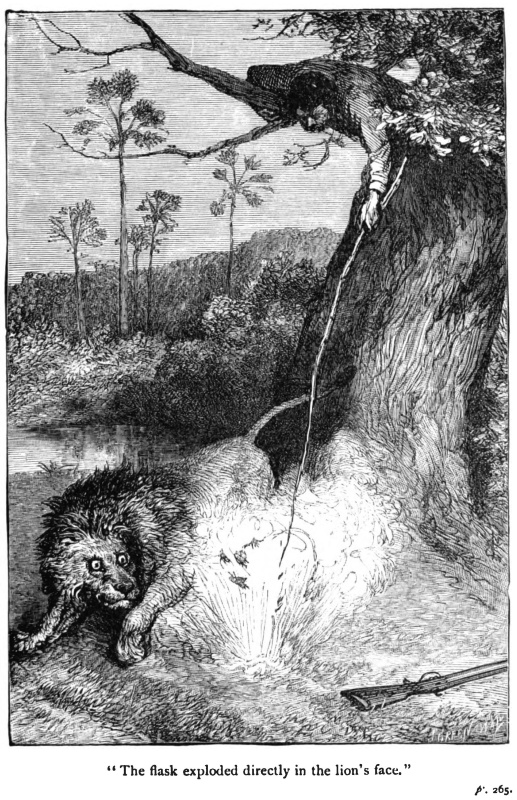
“What became of the lion?” asked Redgy.
“Nothing more was, I believe, ever heard of him. I inquired about him on my way back, but the Hottentots said he had entirely disappeared from the neighbourhood. They fancied that the fright he had had prevented his returning to his old haunts. But my opinion is that his eyesight had been completely destroyed by the explosion, and that, being rendered unable to provide himself with food, he had soon died of hunger.”
“Well, sir, that was a near touch, certainly,” said Hardy. “But I think what happened to my old comrade Robson may match it. He and I were in the same regiment in the war with the Ashantees. He told me the story, I remember, one night on our march to Coomassie, when the mosquitoes and the heat made it impossible to sleep. Robson had been servant to an officer who was very fond of field sports. He and two or three others who had got a short leave were resolved to pass it in some genuine African hunting, as they called it, going quite beyond the usual resorts of white men. They started from Graham’s Town, and travelled northwards across what is now the Orange Free State and the Transvaal, till they came within a short distance of the Limpopo. The country was wild enough even for them. They fell in with a number of savage tribes, and here and there a Dutch settler. But there had been nothing to scare away the wild beasts. When they encamped for the night, Robson said they could hear the lions roaring about them to their heart’s content. They were obliged at night to light two large fires, one on each side of the space enclosed by their waggons. The oxen were all placed in the middle, so that they couldn’t get out, or the lions get in, otherwise they would certainly have been seized and devoured. Sometimes the lions were so bold, that they were obliged to cut long stout poles and lash them to the spokes of the wheels to prevent the animals creeping in under the waggons. One or two always kept watch, and the others slept with their loaded rifles by their sides. Robson said that if any of the oxen had contrived to slip out, they would have been seized and devoured in no time. By the light of the moon, he had sometimes seen three or four lions stalking about, trying to find some way in. Till he got used to it, their roaring was the most terrible sound to him that could be imagined, and he used to lie quaking with terror. It seemed to fill the whole air in all directions, he said.”
“Ay,” remarked Prestcott; “that is because the lion when he roars puts his head close to the earth, so that his voice rolls along the ground and echoes among the rocks. Go on with your story.”
“Well,” resumed Hardy, “what the party wanted above all things was to fall in with a herd of elephants. They had been told how they went about everywhere in that country in large herds, breaking their way through the thick forests like a fleet of men-of-war through the waves. They were a good deal disappointed that several weeks passed without their meeting so much as a single elephant. Robson said that he was as much disappointed as the rest. But one day he had his wish, and something over, as the saying is. There had been a great hunt among the Matabeles to the north, and a large herd had been driven some way south of the Limpopo. One evening the scouts came hurrying in with the information that the whole forest a few miles to the north of them was full of elephants. They were resting for the night, the blackies said, but in the morning they would be pretty sure to make for a piece of water which lay about a mile to the south of us. They would pass through the very glade where we now were, in which there were some very large trees. If we climbed up into these, we should get some capital shots as they passed. But not a moment was to be lost in placing the waggons and oxen in some secure spot. The elephants would pass down the middle of the glade, trampling everything to powder that came in their way.
“The oxen were inspanned accordingly, there being just daylight enough for the purpose. Fortunately one of the party had seen some high steep cliffs about half a mile off, which the elephants could not get down if they tried. Thither the waggons and oxen were conveyed, and were placed in a shady nook immediately under the precipice, leaving some of the men in charge of them. The rest returned to the glade, and, after taking their supper, climbed up into the largest trees they could find, taking care to be fully eighteen or twenty feet from the ground. Robson made himself as comfortable as he could, but he could not sleep. The air was full of insects of one kind or another, and their bite was very annoying. Besides this, he kept continually fancying that he heard noises of one kind or another in the distance. Now it was a low rumbling, which he presently discovered to be the wind, now a shrill cry for help, which, after intense listening, he recognised to be the call of some bird. Repeatedly, too, he imagined he was falling out of the tree, in a fork of which he had fixed himself. At last he resolved to descend and lie down to rest on a heap of long grass which lay near the foot of the tree. He was convinced that his slumbers would be but light. Anyhow the crash of the advancing herd would be enough, he argued, to wake the dead. Two minutes would be enough to enable him to regain his station on the branch.
“He descended accordingly, and having made a careful examination of the grass, to make sure there were no snakes in it, he lay down with his rifle in his hand, and almost instantly dropped asleep. He did not know how long he slept, but it was probably several hours, for it was broad day when he awoke. The crash and din he had anticipated were fully realised. Babel itself seemed to have broken loose, but it was not the herd of elephants that created it. They were no doubt in motion. He could see, indeed, from the excited gestures of his companions in the great nowana above him, that the leaders were already in sight. But it was a crowd of frightened animals of all descriptions that had awakened him. They had been driven from their lairs by the approach of the monsters, and were flying in confusion from them. There were herds of buffaloes crowded so close together that it was with difficulty they could advance, whole legions of boks of every variety, a few jackals, hyenas, wild pigs, even here and there a lion or a rhinoceros, hurrying through the forest paths, in terror of being trampled under the feet of the elephants, which would have crushed them into atoms, scarcely aware of their presence. Among the runaways were crowds of monkeys, which did not join the crowd below, but sprang from branch to branch, along the lower parts of the trees immediately over his head, making it impossible for him to climb to his former perch. He would have been knocked off, gun and all, before he had mounted a dozen feet.
“It was evident to Robson that he must find some other place of refuge, and that without loss of time, for even he could now see, about a hundred yards off, the heads of the great bull-elephants which always marched in advance of the others, tearing and forcing their way through the dense forest as a man would through a field of standing corn. In a few minutes more they would be close upon him, and the crowd of animals still prevented him from escaping. The only chance that presented itself to him was creeping into the hollow of a huge nowana, close to which he was standing. The roots of this were above ground, and there was a huge cleft in them which was at all events large enough to hide him from sight. He forced his way through the opening in the bark accordingly, though with great difficulty, and found the hole inside larger than he had expected, though he could not distinguish how far it extended, for the climbing plants outside almost covered the entrance. But he had not been in his hiding-place five minutes before the leading elephants came up. On strode the giants, some of them appearing to Robson to be fully fourteen feet high, the large trees giving way before them and the very ground trembling under their feet. Just as the leaders came in front of the hole in which he was lying, a shot from above struck one of the largest behind the ear and passed into his brain. It was instantly fatal. With a loud roar the huge beast fell dead, and his head blocked up the lower part of the opening through which Robson had entered. It was impossible for him now to make his way out; but then, on the other hand, he was now safe from intrusion—so, at least, he fancied.
“He resolved to wait until the herd had passed, and then to shout to his companions for help. The tremendous noise for the present prevented the possibility of being heard, if he had shouted ever so loudly. There was nothing for it but to remain quiet. By and by the light became better, or rather, I should say, Robson’s eyes became used to the darkness, and he perceived that he was not the only occupant of the cave. There was something indistinct and shapeless in the farthest corner, a slight quivering motion showing that it was alive. It was probably some wild animal which in its terror had taken refuge in the hollow of the tree, as he had done. It might be something quite harmless, a stray goat, perhaps, from a herd,—there were plenty kept in the neighbourhood, and underground caves and hollow trees were favourite places of retreat for them. It was as well, however, for him to be on his guard. He took up his rifle and brought it to his shoulder. As he did so, there came a rustling sound from the dark corner, and two fiery eyes were visible against the light. Instinctively, rather than with any settled purpose, he drew the trigger, there was a loud hissing noise, the light from the eyes disappeared, a writhing motion which lasted for several minutes followed, and then the dark mass, whatever it was, lay motionless. Robson told me that a sickening sensation came over him, and he supposed that he must have fainted. When he came to, some time afterwards, he was in the hands of his friends. They had been engaged in cutting out the tusks of the great bull elephant, and had heard a shot fired inside the tree. In great surprise they searched the hollow, and dragged Robson out, to all appearance more dead than alive.”
“And did they pull out his companion too?” inquired Redgy eagerly.
“Yes, sir, they had pulled it out, and it was the first thing he saw lying on the ground near him when he came to his senses, and it didn’t improve his spirits.”
“What was it?” exclaimed several of the party together.
“A cobra, seven feet long, sir,” answered Hardy. “It had crept in there out of the noise, I suppose, and had been as much frightened as the other creatures were; that was no doubt the reason why it did not fly at Robson the first moment he entered. When he levelled his gun, the creature’s instinct probably warned it of its danger, and it had spread its hood and raised itself for a spring, when the bullet struck it between the eyes and killed it on the spot. If the shot had gone anywhere else, Robson would never have told me the story.”
“That was enough to shake a fellow’s nerves, certainly,” said George.
“Yes, sir; Robson could never endure the sight of even harmless snakes, and used to shake all over when he saw one, like a man with the ague. I used to joke him about it, and I think he told me his adventure to prevent me from doing so any more. Well, I suppose it is time that we go and lie down, isn’t it? We are to set off, I believe, as early, or rather earlier than usual to-morrow.”
“Are you going on to Standerton the first thing in the morning?” inquired Mr Prestcott; “and does the Dutch gentleman intend to accept my escort? He didn’t say positively.”
“I have no doubt he will,” replied George with some hesitation. “And you must accept,” he added more confidently, “our thanks for your kind and hospitable reception of us. Mr Vander Heyden is, as you have noticed, a Boer, and, like some of his countrymen, does not love the English.”
Mr Prestcott smiled. “We English settlers here,” he said, “understand all about that. This annexation of the Transvaal, though they were glad enough of it at the time, when their country was in the greatest danger of invasion, to which they could have offered no resistance, is not at all to their mind now. I hear they are trying to induce the new governor to get it rescinded; and if they are rebuffed, as probably they will be, they will get more and more discontented. But it has occurred to me, since speaking to Mr Vander Heyden, that there is an opportunity for him to travel in safety as far as Heidelberg, at all events. There are a number of waggons containing Government stores on their way to the town which are resting for the night a few miles from this. I have no doubt he might obtain leave to travel in their company. There is a military escort, which of course would make the journey quite secure. I have some acquaintance with Lieutenant Evetts, and would give Mr Vander Heyden an introduction to him, if he would condescend to make the acquaintance of a British officer.”
“Lieutenant Evetts,” repeated Rivers. “What, of the Mounted Volunteers, do you mean, who was present at the attack at Rorke’s Drift?”
“Yes, the same, only he now holds a commission in the Natal Mounted Police.”
“There is no need of any introduction to him,” said George,—“not for me, at all events. We knew one another for some weeks, before the advance into Zululand. And even if we had had no previous introduction, that night at Rorke’s Drift would have been introduction enough.”
“Were you there, Mr Rivers?” asked Prestcott eagerly. “And do I understand you that Mr Vander Heyden was there too?”
“Yes, he and I and Evetts were all three there, and saved each other’s lives at least half a dozen times during those nine or ten hours of fighting.”
“I am glad to have had you under my roof, Mr Rivers, and I must forgive Mr Vander Heyden his dislike to the English. No, sir, no introduction to Lieutenant Evetts can be required. I should as soon think of introducing one twin brother to another.”
“I say, Hardy,” said George, as they went off to bed, “that was a pretty good one about the cobra in the hollow tree, wasn’t it?”
“I wasn’t going to be beaten by him,” answered Hardy; “though his wasn’t a bad one about the lion, I must admit that.”
Chapter Eighteen.
Nearly a week had passed, and the cortège was again setting out from Heidelberg, where it had arrived three days previously. Lieutenant Evetts greeted his old companions in arms with much cordiality, and they had travelled in great comfort as well as safety under his escort. He had expressed his great regret that he could not accompany them with his men to Lichtenberg. The distance between these two towns was much longer than between Luneberg and Standerton, or between Standerton and Heidelberg. The country, too, was wilder and more sparsely inhabited. His presence, and that of half a dozen of his men, would have made everything smooth. But he was under orders to leave immediately for Newcastle, as soon as he had performed his errand. All efforts to engage trustworthy men at Heidelberg had proved vain; and they were obliged to set out at last with the same party which had started from Luneberg. It was with equal surprise and satisfaction that they overtook, a few hours after leaving Heidelberg, some soldiers belonging apparently to the Natal Contingent, with a corporal at their head, who were escorting some prisoners, chiefly natives. These were handcuffed, as well as linked together by lashings round their arms. The soldiers were all white men. George, who was riding in advance of his party, moved up and spoke to the corporal. He introduced himself as Mr Rivers, late of the Mounted Infantry, and stated that his companions had belonged to the same corps.
The man answered civilly enough, though with rather a confused manner, that he remembered Lieutenant Rivers and his friends quite well, having been present at the action at Ulundi. George then inquired whither he was conveying his prisoners, and heard with much satisfaction that it was to Lichtenberg. It appeared that there had been a riot there. Houses had been plundered and murders committed, and these men, who were believed to have been concerned in the riot, had been arrested on the frontiers, and were on their way to Lichtenberg to be identified and tried. George again expressed his satisfaction, and proposed that the two parties should travel together for mutual convenience and security. To this the corporal rejoined that he should be quite satisfied with such an arrangement; and George rode off well pleased to give the information to Vander Heyden and Margetts, who were acting as rearguard. The Dutchman at once expressed his satisfaction, as did Margetts, though in a more guarded manner, and George noticed, with some surprise, that he scrutinised very closely the corporal and his men when he rode up to speak to them. He made no remark, however, and George, riding back, resumed his place by Margetts’ side. It was still quite early. Desirous of avoiding the mid-day heat, which for the last day or two had been very great, they had started two hours before daybreak, and the whole landscape had hitherto been wrapped in a gloom through which they could not do much more than distinguish their way. But the dawn now began to dapple the skies, and with the first light appeared a scene so startling, that our two travellers drew rein to gaze with wonder on it.
As they had approached Heidelberg a few days previously, they had noticed how dull and uninteresting the landscape appeared. The ground had been rising continually for a long time past, until it had attained the height of some hundreds of feet, and then a long undulating level had succeeded, extending as far as the eye could reach, without rock or forest or scrub to break the monotony. Nor were there, for vast distances together, traces to be found of the hand of man. There were few enclosures or habitations, and even flocks of sheep were of rare occurrence. They had expected to find the country on the other side of Heidelberg very nearly the same in appearance as that which they had encountered before reaching it. But the landscape which they now beheld formed the most striking contrast to it. In place of the sparse and barren plain, varied only by dried clumps of dull vegetation and bare heaps of sand or stone, there appeared a scene which might have vied with that of fairyland. Rich forests, with a most picturesque variety of outline, were seen environing the shores of a lake whose deep blue surface was studded with verdant islets. In the foreground rose castles and abbeys and picturesque ruins, grouped with a skill that no landscape painter could have surpassed, and the distant view was closed by mountain ridges, presenting the most striking effects of light and shade.
“Pretty to look at,” remarked Matamo, who had just ridden up, as he noticed George’s admiring gaze. “Pity it is not real.”
“Not real!” returned George. “What do you mean?”
“You’ll soon see,” was the brief reply; and, sure enough, almost immediately afterwards the brilliant landscape melted away like a dissolving view in a magic lantern, and a long stretch of barren down and rock and scrub was all that could be discerned.
“A mirage!” exclaimed George. “Well, I have often heard of them, but I could not have believed the delusion was so perfect.”
“Wonderful country for cheats of that sort,” remarked Matamo; “it often looks like that before sunrise.”
The mid-day halt was made under some high cliffs, which threw a long shadow and afforded some protection from the heat. Here Vander Heyden had some conversation with the corporal, and agreed with him that, as his party could not proceed beyond a certain distance every day, all of them, except the corporal himself, being on foot, the soldiers should be allowed occasionally to change with the mounted men of Vander Heyden’s party, while the prisoners were permitted to take their seats in the waggon. Margetts uttered a hasty exclamation when this arrangement was reported to him, but he said nothing more, and everything went on prosperously till the halt took place. They sat down in three parties—the corporal and his men by the side of one waggon, Matamo, Haxo, and the Hottentots by the other, while the third, consisting of what might be termed the gentry of the party, took their places under some mimosas, on the brink of a small fountain, almost immediately under a high and steep rock.
The meal was half over, when suddenly there was heard a loud jabbering noise above, and the party, looking up, saw several hideous faces peering over the ridges of the rocks.
“Bushmen!” exclaimed Redgy. “I have been expecting to fall in with them for some time. We are not so very far from their country, I believe. Hallo up there?” he continued, as a number of large stones came rattling down from above. “Stop that, do you hear, or you’ll find two can play at it.” He raised his gun as he spoke, and pointed it at the rocks.
“It is no use talking to them,” observed Hardy, laughing; “I don’t suppose they would understand you if they were Bushmen. But they are not. They are baboons—mandrils, I believe, is their exact name. There are great numbers of them in this part of the country. I wonder we haven’t fallen in with them before.”
“Baboons, hey!” cried Redgy. “The mischievous brutes!” he added a minute or two afterwards, as another large stone passed over his head, which it very narrowly missed. “I say, I am not going to stand this sort of thing! I’ll just give them a shot or two to improve their manners.”
“Stop, Mr Margetts, don’t fire!” cried Vander Heyden. “They are the most revengeful and malicious creatures in the world, and as strong and fierce as tigers. There are hundreds of them, and they’ll attack us in a body if you provoke them.”
His warning came too late. Redgy had already fired, and a yell of pain from above announced that his aim had been successful. The next moment a dozen huge mandrils had sprung over the rocks and began to descend the cliffs, leaping from point to point as nimbly as squirrels.
“Run for it!” shouted Hardy. “Take shelter in the waggons. We may keep them off there, but it is about our only chance.”
There was no need of further warning. Matamo, Haxo, and the Hottentots, the corporal, his men, and his prisoners, though they had been too far off to hear what was passing, no sooner saw the baboons coming down the rocks, screaming and gesticulating with fury, than they became aware of the danger of the situation, and made straight for the waggons as the only haven of shelter. Nor were they a moment too soon. The front and back boards of the waggons were only just secured, when they were surrounded by a multitude of infuriated brutes, endeavouring to pull down the tilt and boards of the waggons. Others climbed on to the top and tore away the tarpaulin covering from the ribs, endeavouring to wrench out the ribs themselves with their strong, sharp claws. They became, however, in this manner an easy mark for the party inside. These at first only loaded their guns with powder, hoping to scare their assailants without further rousing their fury. But they were soon obliged to try sterner measures. The brutes, some of which were nearly five feet high and extremely strong and agile, succeeded in loosening more than one of the ribs of the waggon, and would soon have forced their way in, if the bullets which followed one another in rapid succession had not laid assailant after assailant in the dust. But undeterred apparently by the deadly shower, they continued their attack, gibbering and screaming with fury. The whole of the covering of the waggon was now torn away, and the baboons, thrusting down their long sharp claws, endeavoured to clutch their enemies within, rendering it almost impossible for them to continue to load.
“I say, George,” exclaimed Redgy, as he rid himself with difficulty from a huge baboon which had seized him by the hair, firing his revolver directly into his chest, “these brutes are worse than the Zulus. I wish I had my bayonet here. That would have been the thing for them.”
“You are right, Redgy,” answered George. “I am just going to use my wood-knife. My revolver is empty, and I have no time to reload. The knife isn’t as good as the bayonet, but it is the next best thing.”
The others followed his example—all excepting Hardy, who, with the coolness of an old campaigner, had lain himself down on the floor of the waggon out of the reach of the assailants, and from thence took aim with his revolver, bringing down one baboon after another, and always singling out those which seemed to be the most likely to break in. But, notwithstanding the vigorous resistance offered, it seemed as if the strong ribs of the roof must speedily give way, when suddenly there burst forth a volume of flame which enveloped for a minute or two the whole waggon. Screaming, not with rage now, but with fright, the mandrils leaped down and rushed away, scrambling up the sides of the rocks more quickly than they had come down. At least twenty were left on the ground, either dead or too severely wounded to effect their retreat; while several others limped in the rear of their companions, scarcely able to accomplish the ascent.
“Stop, Mr Margetts,” cried Hardy, as he saw Redgy raise his rifle; “don’t fire at them. You may provoke them to come back. Well, that was as near a thing as I remember to have seen. How did you manage it, Matamo?”
“Koboo and Utango and I had been piling a big heap of reeds to make fires of,” answered the Bechuana. “It was lucky we made the heap so large. When we saw Mr Margetts fire at the baboons, we knew what would happen, and we heaped the reeds round the waggon while the brutes were coming down the rocks. I dropped a match among the reeds as soon as they began the attack, but for a long time it wouldn’t catch. Lucky it did catch at last, or we should have been torn to pieces!”
“Well, you managed famously, Matamo,” said Hardy, “and we all owe our lives to you.”
“Yes, sir, and your dinners too. Very good eating is baboon, and there is enough for a great many dinners.”
“Eating!” repeated Redgy in great disgust. “You don’t suppose any one would eat these brutes, do you?”
“Wall, Redgy, I agree with you,—the idea isn’t pleasant,” said George. “But they can be eaten, I believe. An old messmate told me that when his ship was at Gibraltar, many years before, the colonel of one of the regiments there sent Captain Waters the haunch of a large ape, which had been shot a few days before. The captain didn’t see the haunch, but invited all the officers of the ship to dine off it. The colonel, who had only intended a joke, sent a note explaining it. But somehow it wasn’t delivered until just as the haunch was being removed from the table, having been declared to be excellent. The captain put the note into the fire, and said nothing about the matter.”
“He was a wise man,” said Hardy, “and we shall be wise to follow his example, and make a good dinner off our late enemies.”
His advice was at once followed. Fresh fuel was collected and fires lighted, and presently the cooks were busily engaged over their roasting and frying.
“Come and take a look at the soldiers,” suggested Margetts to Vander Heyden and Rivers. “I wonder how they came off in their waggon.”
“They were much luckier than we were,” said Rivers. “Either the baboons didn’t take any notice of their waggon, or they were bent, like Hardy’s elephant, on punishing the culprit who fired on them. The soldiers were not attacked at all.”
“I am very sorry, I am sure,” said Redgy; “I’ll promise to be good another time, that is all I can say. But they made their preparations against attack, I suppose.”
“Yes,” said Vander Heyden, “they took off the prisoners’ handcuffs of course. They couldn’t have left them in that helpless state to the mercy of those ferocious brutes. But I see they are going to put the handcuffs on again now.”
They moved nearer to the prisoners, and stood for a while watching the replacing of the handcuffs. Then Rivers called out to Margetts, who was standing at a short distance, and asked him and Vander Heyden to ride a little way on the road by which they had come that morning, to search for his revolver, which he must have dropped. The other two assented, and they went away together.
About half an hour afterwards, when the dinners were nearly ready, Vander Heyden and Rivers returned, looking a good deal put out.
“Corporal Sims,” said the Dutchman, riding up to the person named, “this is vexatious, but I am afraid we must stay here to-night. Mr Rivers cannot find his revolver, and thinks he must have dropped it a long way back—at the first stream which we crossed. Mr Margetts has offered to ride back, and look for it, and I am afraid we shall, in consequence, be obliged to remain here all night. As some repairs must be made to our waggon, perhaps it is not of so much consequence. But are you able to stay?”
The corporal hesitated a moment, apparently a good deal surprised. Then he answered civilly that he saw no reason why they should not remain, as there was plenty of food and a good spring of water, and there was no particular need for haste.
“Very well, then,” said Vander Heyden, riding on, “we will stay here till to-morrow.”
Nothing was said until the two horsemen were out of hearing. Then one of the prisoners said in a guarded tone,—“Do they suspect anything, do you think, Andrewes?”
“No,” answered Andrews, “I am pretty sure they do not. Why do you ask that, Bostock?”
“I have been uneasy all day,” was the answer, “lest either Rivers or Vander Heyden should recognise us. It is quite true that I am stained as dark as any Zulu in the country, and so are Gott and Sullivan. And our beards and whiskers have been shaved, and our hair frizzled and dyed black, so that we could hardly recognise ourselves in the glass. But they are both of them wide-awake fellows, and I shouldn’t like this kind of thing to go on long. I suppose our intention holds good, to make the attack to-night, doesn’t it?”
“I don’t see why not,” answered the pseudo-corporal. “It was agreed that we should, all of us, approach the waggon together as soon as the moon sets, and that will be before twelve o’clock. They keep a watch all night, I know. One of them stands sentinel at the fire near the waggon. But a rifle bullet will quiet him. Then we rush up and shoot the others. We shall have only four to deal with instead of five now. The Hottentots are sure to run off at the first shot.”
“Margetts may return,” remarked Gott.
“If he does, he’ll hardly reach the camp,” returned Bostock. “Some one had better be on the look-out for him a mile or so on the Heidelberg road. There will still be twelve of us left. That will be enough to settle four men, won’t it, even if they should not be asleep.”