Rev. H.C. Adams (continued 2)
Reading edition
“I hope he is. If those two men should be silenced, we needn’t be afraid of the others. Well, we are safe for the night, I think, and we must hope that help will come to-morrow.”
The captain’s words were so far made good, that the rest of the night passed in quiet. The forenoon of the next day was a time of great anxiety, which no one felt so keenly as the captain. He knew that if Wyndham did not return, it could be only because some accident had happened to his boat, or because he had been unable to obtain any help in Mossel Bay, and had been compelled to go overland to Cape Town. The distance thither from Mossel Bay was more than two hundred miles, and the means of getting there not easy to procure. Even if he could find horses to carry him the whole distance, it would probably take him a day or two to reach the town. Then, no doubt, a vessel would be fitted with as little delay as possible. But probably two or three days more must elapse before it could reach the reef.
Altogether, it was not unlikely that a full week would pass, during which they would have to remain in their present situation, unless, indeed, they could attract the attention of some passing vessel. As the hours went by, the captain grew more and more despondent; and at last it became only too evident that Wyndham’s speedy return could not be looked for.
“We are in for this, Rivers,” he said, as they stood together on deck, looking anxiously toward shore, half an hour or so before sunset; “unless we are picked up by some ship, we may have to stay a week on this reef, and there is no disguising that, if it should be so, our lives are in the greatest danger.”
“Do you apprehend a storm coming on, sir?” asked Rivers.
“I see no signs of that, though in this climate the changes of weather are so rapid that one is never secure for six hours together; but that is not what I am afraid of. These men will get desperate—the ringleaders, that is. They know there is a rope round their necks in consequence of last night’s work, and they will get away from the reef at all hazards before Wyndham’s return, if by possibility they can.”
“I don’t see how they can force their way on deck in the face of our fire, any more than they did last night, sir; I don’t see how they could remove the barricade either.”
“They might contrive to cut the ropes which hold one of the spars,” said the captain,—“that is, if they could work in the dark. But I shall take care that the passage is kept lighted all night, so they won’t attempt that I think they will try to blow up the hatchways. They have got plenty of powder, and it would not be a difficult thing to do. They would lose some men in forcing their way up; but their numbers so greatly exceed ours, that, once on deck, we should have no chance with them.”
“You think all the ship’s company will go along with Bostock and Van Ryk, then?”
“I am a good deal afraid of it. I don’t think they’d have done this of their own heads. But these two rascals are exceedingly clever, and will, I have no doubt, make out a plausible story. They will persuade the poor fellows that, if they are caught, they will be charged with mutiny for what has been done already. They’ll tell them it is their only hope to get off the reef before help comes, and they must cut all our throats to accomplish that.”
“And we can’t take to the boats, and be gone ourselves?”
“That is what the Dutchman proposed yesterday. But I then pointed out that we cannot get at the long-boat without exposing ourselves to the fire of the mutineers. Nor would they, of course, let us repair the other boat, even if she could be repaired. I only guessed then that they would attack us. It is unfortunately only too certain now. We should simply be playing their game. If they could overpower us, or, in plain English, murder us, they would no doubt go off in the three boats, or make a raft, if the boats would not hold them all. But while we remain here, that would be impossible.
“No,” resumed the captain presently; “we must go on as we have begun. It really looks as though the men were unable to devise any plan of attacking us; in which case it is most probable that they will submit, and throw themselves upon my mercy. It is only against a few, you see, that direct mutiny can be proved. Nor have I quite given up the hope that Wyndham may have found a ship at Mossel Bay, though her sailing may have been delayed. Perhaps the men also are reckoning on the possibility of that, and will not commit themselves further, until they feel sure that he will have to go on to Cape Town for help. But all that we can do is to keep a bright look-out, and be ready for action at a moment’s notice. I shall go and lie down now for two or three hours, as I feel quite worn out; but I shall trust to you, Rivers, to rouse me if there should be the slightest necessity. You are the only man on board I can thoroughly trust, for, though Rolfe and McCarthy are good fellows, they are not equal to an emergency. But you know what you are about.”
They parted. George took a turn or two up and down the deck, apparently buried in thought. Then he laid aside his cutlass and pistols, put on a sailor’s jacket that was lying on the deck, and tied a handkerchief round his head. Having completed these preparations without attracting notice, he disappeared below.
It was about three hours afterwards that the captain was a second time roused from his sleep by a hand laid on his chest. He started up instantly, and was about to speak, when George Rivers, who was his visitor, stopped him.
“Don’t wake the others, sir,” he said. “If you will come on deck, I have something important to tell you. I wish to say, sir,” he continued when they were seated out of the sight and hearing of any of their companions, “that I have been down among the men, and have learned pretty accurately what they mean to do.”
“Down among the men—among the mutineers?” exclaimed the captain. “How did you manage that?”
“Well, it was not so very difficult, sir. Several of the men had left their jackets on deck, as well as a handkerchief or two. I put two of these on, pulling the handkerchief well over my forehead, so that by the dim light on the lower deck it was hardly possible that I could be recognised, even if any one noticed me, which was hardly likely. Then I untied one of the ropes, and so got through the barricade. I went to the head of the ladder and listened. There was loud and angry talk going on, and several of the speakers seemed to be more than half drunk. I crept cautiously down, ready to make a bolt up again if any one hailed me, but they were all too busy to notice me. I crept into a corner and lay down, as if asleep, drawing a sailcloth half over me. I lay there for a couple of hours, I should think, and learned all I wanted to know. After that I took advantage of a violent quarrel which broke out among them, to creep up-stairs in the same way as I had crept down, and then secured the spar.”
“You have done nobly?” exclaimed the skipper. “And what have you learned?”
“I learned, first of all, that nothing will be attempted to-night, though an attempt will be made to-morrow. In the first place, it appears that Sherwin was one of those killed in the skirmish, though they contrived to carry him off. Van Ryk and Bostock were wounded, though not severely. Bostock was hit in the right leg, and is unable to use it, though the wound is already greatly better. They won’t stir unless he leads them, and that he can’t do this evening.”
“That is fortunate. They are not afraid of Wyndham’s return, then?”
“No; they seem to feel sure that he has failed to find a ship in Mossel Bay. Indeed, one of the men said he had gone over to the bay from Cape Town, only a day or two before the Zulu Queen sailed, and there was no ship there, and none expected.”
“I feared as much,” said the captain. “Well, then, what are the men’s intentions? Do they all go along with Bostock?”
“I am afraid they do,” returned George. “Bostock has persuaded them that there is an enormous sum of money in gold stowed away in the cabin—enough, as he told them, to make them all rich for life. If it hadn’t been for the barricade, he said, of which no one had any idea, this would have been in their possession already. But as it is, it is theirs as soon as they choose to seize it. They evidently believe they can get on deck whenever they please—”
“Did you ascertain how?” interrupted the captain eagerly. “Not exactly, sir, but I fancy they mean to blow a hole in the ship’s side, and so get down on to the reef, which at low water extends for several feet beyond the ship—”
“Yes, yes,” said the captain, “I was afraid so; no doubt they could do that. Go on.”
“Well, I expect they will make their way out in that manner, and, although we may be able to kill half a dozen of them before they knock us on the head, they would certainly do so, sooner or later. None of our party are to be spared, except, I am sorry to say, Miss Vander Heyden. Bostock means to carry her off with him.”
“The brute!” exclaimed the captain. “He shan’t do that, Rivers.”
“No, sir. I would blow out her brains with my own hand sooner than allow it?”
“And so, to do him justice, would her brother, or Mr Moritz either—nay, I am persuaded she would do it herself! Well, Rivers, we are in for this, and we must get out of it the best way we can. But I must own I am at my wits’ end. Can you suggest anything?”
“It has occurred to me, captain, that we might possibly, if we were hard driven, get on to the other part of the reef yonder, and take provisions with us enough to last two or three days. They couldn’t get at us there, I imagine.”
The captain looked in the direction to which George pointed. There was another reef, or, more properly, another part of the same reef, divided from that on which the ship was lying by a deep channel some twenty or thirty yards wide. It rose a good deal higher out of the water, and was so plainly visible at all states of the tide that nothing but design, or the most culpable carelessness, could have caused the disaster.
“That is a good thought,” he said. “If ever I command a ship again, I must make you my first mate. That reef will be our salvation. We must not lose a moment in getting across, and taking all we want with us. Go and wake all the hands, and bring them on deck at once. If we wait for the moon, the rascals may see us. It is lucky that we have Marks and Cookesley, the ship’s carpenters, among our party.”
Chapter Five.
The sailors who had remained loyal to Captain Ranken obeyed his summons with prompt alacrity. They were reduced to seven, three having gone with the first mate in the pinnace. The captain gave them their orders, which they proceeded to put into execution as rapidly and with as little noise as possible. The boat was brought immediately under the ship’s side, and a number of articles put into it, the first being the carpenter’s chests, and a load of spars and planks from the workshop. Then the boat returned for boxes and barrels, containing provisions to last for a fortnight, together with all the firearms and cutlasses on deck. Then a quantity of bedding, knives, forks, and crockery, and a large tarpaulin which had been used to form a shelter from the heat for the passengers. A number of empty boxes and barrels were also lowered into the sea, which, as the tide was then running, would be washed up on the further reef. There was a great deal to be done, but the hands were all active and willing; and by the time when the moon rose all the most necessary articles had been ferried over.
As soon as the light permitted, the men, under the direction of the carpenters, began putting up a hut at the spot indicated by the captain. They fortunately found one or two crevices in the rock, in which uprights could be fixed. A long spar was run across from two of these, and the tarpaulin stretched over it. Then four shorter posts were placed at the corners, but at two of these points there were no crevices, and the spars had to be placed in tall barrels filled with stones. The sides were next filled in with planks, with a door and an opening to serve as a window at the end farthest from the wreck. The gig continued her voyages under the conduct of Captain Ranken, George, and the second mate, and almost everything that would be required was brought over. Mr Whittaker’s chest had been one of the first things cared for.
By daybreak a very tolerable hut had been constructed; and the captain directed them, as the next job, to put up a barricade extending the whole length of the hut on the side facing the ship. This was formed of barrels and chests containing large stones, of which there was abundance on the reef, the spaces between them being similarly filled. When this had been completed, it was broad day, and it was impossible to expect that the crew, who by this time must have slept off their drunken debauch, could be kept any longer in ignorance of their officers’ proceedings. The second mate was sent, therefore, to inform the passengers of the removal to the further reef, and convey them over to it as quickly as possible. They were taken by surprise, but complied readily enough; only Vander Heyden making some complaint that the cabin party had been kept in ignorance of what they ought to have been told.
While they were being ferried across in the boat, the captain and George returned for the last time to the deck.
“We are well out of this, sir,” remarked George; “we shall be safe over there.”
“Yes, unless they come across to attack us.”
“Come across? what, in the long-boat?”
“Yes, in the long-boat. They can’t launch it while we have possession of the deck. But as the ship is left to them, there will be nothing to prevent their doing it.”
“It would be a desperate thing to attempt, landing on the reef under such a fire as we could open on them.”
“No doubt, if they attempted it by day. But in the dark they could get ashore unseen by us, and perhaps make one or two voyages before we found it out. Besides, the long-boat will hold a great number of men. We must not risk it.”
“What do you propose then, sir?”
“To destroy the boat,” answered the captain. “It is easily enough done, if you will lend a hand. But first, are all the others safely landed on the reef?”
“Yes. The boat, with Mr Rolfe in her, is just coming back for us.”
“Very good. Then we will go to work.”
He went below and fetched two iron pots, in each of which he placed a heavy charge of powder, rolling a piece of rag round it to prevent its escape. Then, motioning to George to pick up some heavy blocks of wood, he moved noiselessly across the deck, and laid the pots in the bottom of the boat, one at each end, with the blocks to keep them down. Next he laid a train of powder with a slow match, the end of which he ignited.
They now crept down to the boat, and put off. They had almost got across, when a loud explosion, followed almost simultaneously by a second, was heard. Immediately afterwards the men poured up on deck, having evidently contrived some way for themselves of getting up there. Some of them carried carbines, and they might have fired on the captain and his two companions, if these had not hastily drawn up the boat and made for the shelter of the shed.
“Safe now, sir,” remarked Rolfe, “unless they swim across to us.”
“They’ll hardly try that on,” rejoined the captain. “They would be an easy mark for our rifles, and they know we have several and can use them. We roust put a man to watch their movements; but I think that is all that will be needed. If breakfast is ready, we may go to it with an appetite.”
This had hardly been completed, when Hooper, the man set to watch, came in with the information that a flag of truce had been hoisted on the vessel, and three men, Gott, Shirley, and Sullivan had come down to the edge of the water to parley with the captain.
“Are they unarmed?” asked the second mate.
“Yes, sir,” answered Hooper.
“Can you see anything of the other men?” inquired the doctor.
“There are none on the reef, sir, but I thought I saw one or two peeping over the ship’s bulwarks.”
“I guessed as much,” said McCarthy. “You ought to think twice, sir, before you go to meet these men. You would be an easy mark for any one hiding in the forecastle; and they may think that, if they once got you out of the way, they could do anything they pleased.”
“That’s possible,” said Captain Ranken. “But I can’t help that. There is a chance of avoiding bloodshed, and it is my duty to go.”
“Well, any way, let us take any precautions we can,” urged Rolfe. “Five or six of us can take our rifles, and show ourselves over the top of the barricade. They will see that if they have you at their mercy, we have Gott and Shirley and Sullivan at ours.”
“You may do that, if you like,” said the skipper. “There is never any harm in showing that one is prepared.”
The mate’s suggestion was acted on. Half a dozen marksmen, including the two Dutchmen, Rivers, Margetts, Whittaker, and the mate, took their guns, climbed on to the top of the barricade, and then stationed themselves behind it, the muzzles of their rifles projecting from between the stones. Then the captain, accompanied by McCarthy, went down to the edge of the reef, and, hailing the three men opposite, asked what they had to say.
“We’re very sorry,” said Gott,—“sorry as you’re displeased, sir. But the most of us don’t know what we’ve done.”
“Do you call running the ship on a reef, and then trying to plunder her, and after that attempting to murder us, nothing?”
“It was only one or two as did that; we didn’t wreck the ship, or join in the attack as was made on you, sir,” said Sullivan.
“I am glad to hear it. What do you want now?”
“We want you and the others to come over here again, and we’ll go back to our duty,” answered Gott.
“And what about the mutineers?” asked the captain.
“There was but a few of they, and they was mostly killed in the scrimmage.”
“Indeed! were Bostock and Van Ryk killed, may I ask?”
There was no answer. The skipper repeated his question, and then Shirley said sullenly, “I don’t know as they was.”
“Very good. Van Ryk was the man who ran the ship on the reef; Mr Rivers saw him do it. Bostock fired deliberately at Mr Vander Heyden; I saw him do it. I don’t want to inquire too closely what others may have done, but these two are clearly guilty. If they are put into irons and brought over here, together with all the arms in your possession, we will return to the ship, and when help comes, no proceedings will be taken against anybody, except the two prisoners. These are the only terms I shall offer you. I shall expect to receive an answer in an hour or two.”
The men, after exchanging a few words, sullenly withdrew. The captain, and McCarthy, who had been chosen to accompany the skipper, because the men are always unwilling to hurt the doctor, also beat a hasty retreat, and informed their companions what had passed.
“Do you think they will give in, sir?” asked Whittaker.
“No,” replied the captain. “I fear Van Ryk and Bostock have too much weight with them. Besides, sailors on these occasions are apt to stick together. If we don’t get an answer within the hour, we must look for broken heads.”
The hour passed, and then another hour or two. The after noon slipped away, and there was no return of the deputies. The men kept quite out of sight. But the sound of hammering and sawing and the buzz of voices were plainly audible.
“They are up to something, sir,” said Rolfe; “making a raft, most likely, by which they hope to reach the shore. They’ve plenty of materials, and some smart hands among them. Don’t you think that is likely, sir?”
“I think it very likely,” answered the skipper; “only I am afraid they are more likely to use it to make an attack on us than to reach the shore—or rather, they will attempt the latter, but only when they have carried out the former. They won’t go without the money if they can help it. But the first thing for us will be to ascertain what they are really about, and we can do that, though not without some risk. The boat is still lying off at the place where we moored her when we came across for the last time. If we got aboard her we might row out to the other side of the reef, keeping at a safe distance, and then we should find out what they are doing.”
“No doubt, sir,” rejoined Rolfe; “but would they let us do it? I am pretty sure there are one or two fellows lying under the bulwarks, watching us from the deck. They could pick off any one who tried that.”
“I am afraid that is only too likely,” said Captain Ranken; “but it is so important to us to know what they are up to, that I think we must attempt it. Who will volunteer for the service?”
He was answered by half a dozen eager voices, declaring each man’s readiness to make the adventure.
“Very good, gentlemen; I thank you heartily,” said the skipper. “The men I want must be good divers, if possible, but certainly good swimmers. They must also, of course, understand the management of a boat.”
“I can’t swim, I am sorry to say,” cried Walters.
“I can swim, but I am no diver,” said Rolfe.
“And I can swim and dive, but I am a poor hand at managing a boat,” added Margetts. “But look here, captain, here’s your man—George Rivers. He swims like a fish, and dives like a cormorant, and can manage a boat first-rate.”
“He will do for one, no doubt,” said the captain. “And I think, Mynheer Moritz, you offered, did you not? You, I know, can both swim and dive, and, I believe, understand managing a boat?”
“Yes, sir,” returned Moritz, “I believe, without vanity, I can say I do. I shall be pleased to undertake this in company with Mr Rivers.”
“Very good,” said the skipper. “That is settled, then. Now, gentlemen, this is what you have to do. You must get into the water here, out of the sight of the ship, and swim round, keeping under water as much as possible. Then get under the lee of the boat, and bring her round, sheltering yourselves under the cover of her side. Of course our fears may be groundless. There may be no one lying in wait. But I fancy I have seen heads looking from time to time over the ship’s sides, and it is best to take every precaution. Now be off as quick as possible, for the daylight is dying out.”
George and Moritz complied. Going to the farther point of the reef, they stripped, and, slipping silently into the water, began swimming round the reef. When they got to the point where their heads would be visible from the ship, they dived, and swam under water, neither of them reappearing until their heads came to the surface close under the bows of the boat.
“Capitally managed!” cried the captain. “If they get her out from shore, all will be safe. I really hope our apprehensions were unfounded.”
But at this moment two or three guns were fired from the ship, and several bullets spattered in the water. Moritz, who had incautiously raised his head, had a narrow escape. George seized and dragged him down, himself only just escaping a bullet which whistled over his head. The boat, however, was by this time in motion, and they were enabled to drag it along with them, without again exposing themselves until they were out of shot. Then they climbed in and rowed to the place whence they had started. Here the captain received them with many commendations and thanks; and, while the two adventurers were resuming their clothes, went off in the boat with two of the men to the other side of the wreck, taking care to keep at a safe distance. He returned in half an hour with a very uncomfortable report.
“Have you found out what they are about, sir?” asked Margetts.
“I am sorry to say I have. They mean mischief, and, I fear, will be only too likely to be able to work it. They are putting together a raft, and are getting on fast with it.”
“But may not that be only to enable them to make their escape to the shore?” suggested Walters.
“If that had been their intention, they would not have fired on Rivers and Mr Moritz. There is no use in disguising facts. They mean to attack us.”
“But how can they contrive, sir?” asked the second mate. “Neither wind nor tide is favourable to them. A raft is a very difficult thing to manage at all times, and they would have to approach this part of the reef under the fire of all our guns.”
“You are right, Rolfe,” replied the captain; “but unfortunately the raft is not the only work they are engaged on. Somehow it appears that the launch was not so much injured as I had supposed. Two or three smart hands have been employed on it, and it looked as though it had been made all right again. What they mean to do, I expect, is to launch both raft and boat at nightfall, and the one will tow the other till our reef is reached. Then they will land in the dark, and then either take up a position behind our barricade, from which they can fire upon us whenever we go in or out of our hut, or else make an assault upon us as soon as the moon rises, and overpower us by superior numbers. The first would be the surest plan for themselves, but their dread of Wyndham’s return may induce them to adopt the other. They outnumber us, remember, at least six to one.”
“It is only too likely that you are right,” said George; “but what do you advise?”
“I think, in the first place, we must complete the barricade round the hut. At present we are open on two sides to a sudden rush, which would overpower us by force of numbers. Behind, the rise of the rock is so precipitous that they could only climb it with great difficulty, one by one. We must place our best marksmen up there, and the others behind our barricades down below. We must put a man, when the darkness comes on, at the very extremity of the reef, nearest to the wreck. He will be able to distinguish what they are doing sufficiently well to tell us when they are launching their raft. It cannot, I know, be completed for many hours yet. As soon as it does put off, we can burn a blue light,—I took care last night to bring some with me,—and that will enable us to fire on them, while approaching and landing, with effect. We may be fortunate enough to kill their leaders, in which case the others will submit at once.”
“If I catch sight of that Cargill,” exclaimed Vander Heyden, “he will not trouble us any more! Ha, Vrank?”
“No,” responded Moritz; “he doesn’t deserve much mercy, and I don’t imagine he would show us much.”
“None at all, I fear,” assented the captain. “But I don’t desire his death on that account, but because he is leading these poor misguided fellows into crime and ruin. But no more of him. If we mean to put up our barricades, we must go to work at once.”
“All right, captain!” said Rolfe; “we will not delay a minute.”
A quantity of barrels and boxes, with which the reef was still strewn, were brought up, and filled with stones, as well as some heaps of wreck-wood, which had been thrown up above high-water mark. In two hours’ time a barricade had been erected sufficiently strong to repel any sudden assault. Then attention was turned to the high ground behind the hut. Large stones and pieces of wood were laid along the highest ridge, behind which the riflemen might fire in safety. This party consisted of McCarthy, Rolfe, George Rivers, Margetts, Whittaker, and Walters, together with Vander Heyden and Moritz. The captain took the command of the party below, which consisted of the seven sailors. Here also Miss Vander Heyden was placed, under the captain’s special protection. When the hut was first erected, a space had been partitioned off to serve as Annchen’s sleeping-place, and George, during the captain’s absence in the boat, had employed his time in doubling this partition, and filling up the space between the boards with stones, so that even if all the other defences were carried, she would still have a last place of shelter.
When the job was done, the whole party sat down to rest and take some refreshment. The evening came on before they had finished their meal, and in a short time it was quite dark.
“If they mean to come,” remarked the captain, “it will be pretty soon now. The noise of hammering has ceased for the last half-hour; they must have completed their job; and now it will be seen whether they are going to make for the shore, or attack us.”
It was an anxious moment. The whole party sat in front of their barricade, on the stones or logs of which it was composed, listening intently to catch any sound which might determine the momentous question at issue. Presently the silence was broken by Coxwell, the sailor whom the captain had stationed at the farthest point of the reef. He came up with the information that the boat and raft were both afloat, and by the lanterns they had lighted he could see the men getting on board.
“We must all take our places,” said the captain. “I will go down to the water’s edge and listen. Mr Rivers, be ready to put a match to the blue lights as soon as I call to you.”
All obeyed in silence. Annchen took leave of her brother and Moritz, and bade also a general farewell to the others; her eye, as George could not help fancying, lighting with special kindness on him. When they had all taken up their stations, there was a silence of some minutes, and then the voice of the captain was heard,—“Light up! I hear them coming!” Rivers obeyed; and a lurid flame suddenly sprang forth, by the light of which the boat and raft were both distinctly visible, the former with only five or six rowers aboard, the other following in tow, and crowded with armed men.
“The party on the rocks fire on the boat?” shouted Captain Ranken; “those in the shed on the raft!”
He was obeyed on the instant. Eight rifles cracked almost at the same moment from the rocks. The steersman and two of the rowers dropped dead in their places. The other two flung themselves into the bottom of the boat, wounded, but not killed. Several also on board the raft fell into the sea, or into their companions’ arms, and a cry for quarter was raised. But the next moment the voice of Bostock sounded loud and clear.
“Step into the water!” he cried. “We are already on the reef; it is not above our knees.”
He sprang out himself as he spoke, and began wading ashore, followed, after a moment’s pause, by the other men. Several volleys were discharged from the barricade and rocks, not without their effect, though the mark was now more difficult to hit. In a few minutes the mutineers had found refuge, as the captain had anticipated, on the outer side of the barricade, which the besieged, if they may so be called, had run up for their own protection.
The riflemen were now called down from the rocks, and joined their companions in the shed. The fire not having been returned from either the boat or the raft, no injuries had been sustained. But the situation of Captain Ranken and his companions still appeared to be almost hopeless; as the fight would now be carried on on almost equal terms, and the mutineers still outnumbered them in the proportion of four to one. It seemed most likely now that they would try to surround the shed on all four sides, firing through the crevices, which were as available to them as to those within, and so soon pick off all the defenders. But for this light was necessary, and they were therefore waiting for the moon to rise.
While they were still waiting in anxious suspense, a stone with a paper wrapped round it was thrown through the open window. The captain picked it up and read it. It had no name attached to it, but professed to come from the whole of the crew, except those with Captain Ranken. It stated that the hut was completely surrounded, and that the assailants had the lives of all those within at their mercy. But they wished to avoid further bloodshed. If the five thousand pounds which had been removed from Mr Whittaker’s cabin should be given up, together with all the arms in the possession of the besieged party, they would go quietly away without hurting any one. But if this was refused, an attack would be made as soon as the moon rose, and no man’s life would be spared. It was added, that if no answer was sent before moonrise, that would be regarded as a refusal.
When the captain had finished reading, no one spoke for a while. At last McCarthy broke the silence,—
“Have you any idea, sir, of complying with their demand? You see they do not ask—what we could not have agreed to—the surrender of Miss Vander Heyden.”
“No,” said Mr Whittaker; “and I do not think my employers would blame you, if you did comply. I daresay we should all agree to bear some portion of the ransom.”
Several of the others broke in together, declaring their willingness to pay any portion in their power.
“What do you say, Mr Rivers?” asked the captain, observing that he had not spoken.
“I would pay my share, sir,” answered George; “anything that is in my power. But I fear it would be useless. The best hope these men have in escaping the penalty of their mutiny lies in our death. If we were to surrender ourselves to them, as this letter proposes, I think they would murder us in cold blood—all except—”
“You need not mention her name, sir,” interposed Vander Heyden. “But you say well. I know the villain who leads these men; he is quite capable of that, or any other atrocity. We had better die sword in hand, like men, than be stabbed like sheep.”
“You speak only too truly, sir,” said the captain. “Our choice lies between one kind of death or another; and I, for one, choose that of a brave man, who will have no trafficking with villains.”
He looked round him, and read approval in every eye. “You are right, sir,” said McCarthy briefly, and the others echoed the sentiment.
No one spoke for the next ten minutes. Each was busy with his own thoughts; such as are likely to fill men’s minds when on the verge of eternity. The time seemed painfully protracted, and all wished that the trial was over. Suspense was worse than death itself. At last a sudden burst of yellow light streaming through the window warned them that their time had come. The next moment the door was burst in, and a crowd of men, armed with cutlasses and pistols, endeavoured to force an entrance. They were met by a general volley, which killed or wounded nearly all the foremost assailants. But the rush from behind was kept up. Several forced themselves into the hut, and a hand-to-hand struggle ensued. Miss Vander Heyden had been placed behind the screen which Rivers had strengthened for her; and he shouted to her, when the attack began, to throw herself on the ground, as the best chance there was of her escaping injury. The screen caught the eye of Bostock as he entered in the rush, and he and Van Ryk instantly made for it. Vander Heyden threw himself in Bostock’s way, and a fierce encounter began between them; while, George in like manner interposing between Van Ryk and the screen, they were soon engaged in deadly combat.
By this time the hut was nearly filled with the mutineers. The captain, with McCarthy on one side of him and Redgy on the other, was desperately defending himself against two or three assailants. The third mate, Whittaker, and Walters, had been all struck down, and several of the men were mortally wounded, when suddenly there came from the sea a strange and unexpected sound—the boom of a cannon!
The strife was instantly suspended. Each man looked in doubt and wonder upon his opponent’s face. Then the captain’s voice was once more heard,—
“Throw down your arms, you mutinous dogs, and yield yourselves prisoners, or every man among you shall swing at the yard-arm before another hour has passed!”
Chapter Six.
About a week had elapsed. George and Redgy were standing on the deck of the Government steamer Wasp, leaning over the bulwarks and contemplating the appearance of the harbour of Port Natal; which lay immediately in front of them, with the town of Durban in the middle distance, and the Natal country in the background. The ship could proceed no farther. The bar across the harbour mouth, on which seething masses of foam were breaking, presented an insuperable obstacle.
“How are we ever to get in, George?” asked Redgy. “I suppose ships do get in somehow. Indeed it is plain they do, for there is a lot of them lying off the quays yonder. But how they surmounted that bar, it is beyond me to imagine. I should think even the Yankee captain, who declared he could run his ship anywhere where there had been a heavy dew, would be puzzled here.”
“I don’t suppose Captain Deedes will take his ship in,” answered George. “He has only to deliver and take back despatches to Cape Town, and these can be brought to him out here.”
“What, in a boat, I suppose?” suggested Margetts; “and that is the way we shall go in, then? Well, every man knows his own business best; but I should have thought there was a very comfortable chance of any boat being swamped!”
“Wait, and you’ll see, Redgy. Captain Deedes told me we should be safe ashore before twelve o’clock.”
“Did he tell you anything about what is going on at Mossel Bay?” asked Margetts. “I know he has had letters from thence. I saw them brought aboard half an hour ago.”
“Yes, a good deal. I am sorry to say Rolfe is dead; that is the fifth of our party that was killed. Walters and three of the sailors were dead before we sailed, you know.”
“I am sorry for Rolfe. How are McCarthy and the captain and Whittaker?”
“They are all doing well. The captain’s was only a slight cut across the hand. He was much more hurt by Bostock’s and Van Ryk’s escape than by that wound.”
“I don’t wonder. It is certainly a pity that they were not run up to the yard-arm, as half a dozen others may be, who were less guilty than they were. I can’t think how they managed to get off.”
“Well, I can understand it. Van Ryk and I were having a desperate tussle, and we had been driven close to the door of the shed. When I heard the gun from the Wasp, our encounter was broken off, and I thought nothing more of my antagonist for the next ten minutes. As for Bostock, who was, I noticed, a first-rate swordsman, he had disarmed Vander Heyden, and would, I daresay, have run him through, if the cannon hadn’t been fired at that moment. I judge both he and Van Ryk, who had their wits well about them, made off as fast as they could to the place where the gig had been left, when Moritz and I landed from her.”
“Ay, just at the farthest point behind the ridge, I remember,” said Margetts. “She was almost out of sight.”
“Exactly. Well, they fell in with Sullivan and one or two other fellows, got aboard, and rowed straight off for land. I daresay they had reached it, before their absence was discovered.”
“Very likely. What do you think they will do, then?”
“Most likely land on some solitary spot, scuttle their boat, and make their way into the interior. They have their carbines, and will have no difficulty in providing themselves with food. Perhaps they will make their way to the diamond fields, and there change their names, and make a pot of money; or perhaps they’ll take to hunting or farming, and you’ll meet them some years hence, driving bullock waggons, or taking flocks of sheep to the market—thriving men and respectable—at least according to their ideas of respectability; or perhaps, once more, they’ll come across a band of criminals, who have escaped from prison, and go about robbing and murdering travellers.”
“Nothing more likely, I should say. And what will become of the others?”
“Well, as you suggested, half a dozen or so are safe to be hanged—Shirley and Andersen, for example, who were among the leaders, though not the main movers, of the outbreak. As for the others, the captain is mercifully disposed. You see, the whole thing (as has been proved now) was got up by those three villains, Bostock, Van Ryk, and Sherwin, after the ship had left Cape Town. They persuaded the new men—Shirley and Sullivan among them—to enlist. Only three or four in the first instance were told about Whittaker’s money. They expected to find that in his cabin, and they would then have launched one of the boats and gone off, leaving us on the reef. When they learned, as they did from Andersen, that it had been locked up in the captain’s cabin, they told half a dozen more about the money, and persuaded them to join in the attack on the officers and passengers. Then they induced the rest of the crew to believe that their only hope of escaping hanging lay in silencing the captain and his men, and getting away from the reef. The men have been the victims of several clever scoundrels, and I hope the law won’t be put in force too severely against them.”
An hour or two afterwards, the bar having become practicable, the steam-tug arrived which was to convey such of the party as desired it to the shore. But the surf dashing over the bar was still so formidable, that it was judged necessary to secure the passengers against damage, after the very curious fashion resorted to on such occasions. They were sent down below, in what would have been total darkness, if it had not been for the glimmering light of a lantern. Then the hatches were covered over, and the passage accomplished, with an amount of shaking and rolling which was considerably worse than a stiff gale at sea. As Redgy afterwards described it, it was like as though they had been a lot of marbles thrown into a bag, and then shaken up. Happily, however, it did not last very long; and they were presently safely landed on the quay, and free to examine the prospect before them. Land is said always to look attractive in the eyes of those who have just accomplished a long sea voyage, but the scene which George and his companions beheld, when they emerged from the cabin of the steam-tug, did not need this consideration to enhance its beauties.
It was indeed a lovely sight which met their eyes. The streets of the town were spacious, and built at right angles to one another,—most of them of a dark stone, which is said to harden by exposure to the air,—but some of them of brick, or wattle covered with plaster; many of them having deep verandahs, with rows of trees in front. Along the quays, which exhibited a busy scene of cargoes in the course of landing or shipping, a mass of vessels bearing the flags of all nations were lying; and on either side of the town rich forests bordered the whole coast. A little inland were seen pastures, and plantations of sugar-cane. The monotonous appearance which this kind of landscape usually presents was varied by high hills, and valleys here and there intervening. The wonderful blue of both sky and sea, which only those who have beheld it can realise to themselves, formed a glorious background to the picture. George and Margetts, accompanied by the other passengers, made their way to a hotel in one corner of the principal street, and partook of a luxurious repast, which to be duly appreciated ought to be eaten by persons who had just landed after many weeks at sea.
This over, they had next to obtain a conveyance to Umvalosa; and for help in providing this they applied to Mynheer Moritz, who had always been friendly, and more especially since the memorable day of the battle on the reef.
“I will help you as well as I can,” he said. “I wish I could ask you to join our party, which will pass Umvalosa on our way to Vander Heyden’s place, ‘Bushman’s Drift.’ Henryk, his sister, and myself mean to ride, and the luggage will be conveyed in his bullock waggon, which is one of the best in Natal. But it would be no use for me to propose that.”
“None at all,” assented George drily.
“Well, I don’t defend him. He might, and ought to be, more courteous to you. But you mustn’t be too hard on him. He has his good qualities. He is brave, and honourable, and high-minded, and capable of very warm and strong affection. He is very fond of his sister, and there is a lady, Lisa Van Courtland, his cousin, to whom he is almost romantically attached, and whom he is soon to marry. As for you, it is not you he dislikes, but your country, and that feeling, I am afraid, is not peculiar to him. A great many of our people believe that they have been hardly used by the English. You see, the whole country once belonged to us—was our undisputed possession for more than a century. We had done nothing to forfeit it—so we feel, because we had nothing to do with the quarrels of the governments in Europe; which were the only grounds on which it was taken from us. Then, when we couldn’t live under English rule, and left the Cape to settle elsewhere, giving up the homes to which we were so long used, in order that we might live undisturbed, the English followed us to Natal, and we were again obliged to move elsewhere. And now, since this annexation, many of us fear that we shall not be left alone even in the Transvaal, and may be obliged to break up our homes for the third time, to go to some new country; where, even then, we may not be secure from interference. Henryk is one of those who feel this keenly, and he’s apt to show his feelings rather too plainly.”
“No doubt of that,” said George, smiling. “However, I am disposed to make all possible allowance for him under the circumstances you have mentioned; which are, I ought to add, but very imperfectly known to me. I suppose, as is generally the case, there are two versions of the story.”
“Probably there are,” said Mr Moritz, returning his smile, “and perhaps it is too much to expect that you should credit my version. However, whatever may come of it, I hope you and I will remain friends. I could never forget the service you have rendered me, and, indeed, Annchen also: for she tells me that she believes she is indebted to you for saving her life on the night of the attack.”
“I don’t know how that may be,” said George. “I did my best to protect her, certainly. But as you and her brother were not so close at hand as I was, to defend her, I do not know how I could possibly have done less. I hope we shall be allowed to take leave of her.”
“She will wish that too,” said Moritz, “but I am afraid her brother will not permit it. She has, indeed, charged me to give you her adieux, together with her regrets that she cannot speak them in person. But now you want my assistance in getting to your destination. Your best course, I think, will be to make the acquaintance of a Natal farmer, named Baylen; who, I have learned, means to set out in a few days for Horner’s Kraal, and will therefore pass very near, if he does not stop at, Umvalosa. He is a thriving man, and knows the country well. He is neither wholly English nor Dutch, his father having been an Englishman and his grandfather a Hollander, but his sympathies are mainly English. I will give you a letter to him. I would go with you to his son’s house, ‘Hakkluyt’s Kloof,’ where he now is, but time will not allow it, as Vander Heyden sets out in a few hours.”
George thanked him, and they cordially shook hands and parted. The two friends then walked out to Hakkluyt’s Kloof, and delivered Moritz’s letter; which at once secured a hearty welcome from the old man. He was a fine specimen of a colonial farmer, standing more than six feet high, and strongly, if somewhat heavily built. He introduced the young men first to his wife, a still comely matron of fifty, and his daughter Clara, a handsome girl of twenty, then to his sons, Stephen, the eldest, and owner of the Kloof, Walter, Wilhelm, and Ernest. They were all stout and sturdily-built young men, though hardly equalling their father’s height or breadth of shoulder. He readily agreed to convey the Englishmen and their baggage to Umvalosa, naming a very reasonable sum as their passage-money. He also invited them to take up their quarters at his farmhouse until the day of his departure came, an offer which the two lads were thankful to accept. George then went out to look at the waggons in which the journey was to be made—each of which, he found, would be drawn by no less than sixteen oxen. They were in construction not unlike an English waggon, only a good deal stronger and more solid. They were arranged not only for the conveyance of goods, but for the accommodation of travellers. At one end there were seats arranged on either side, and from the roof hammocks might be suspended, in which the females of the party might sleep; the men usually making their beds either under the waggons, or at the farther end. Two entire days were consumed in loading them. As George and Redgy were not to go the whole distance, their boxes were put in last, and then one day more was passed in careful examination of the cattle, to make sure they were all in sound condition. On the morning of the fourth day, however, they set out; the party consisting of the farmer, his wife and daughter and his three sons, three native servants, a boy, and the two young Englishmen. The first thing was to harness, or, as it is termed in that country, to inspan the cattle. This is a curious process for a stranger to witness. The oxen, which in a well-trained team are fully as well experienced in the operation as their masters, are driven close up to the wheel of the waggon, with their heads towards it. Then the waggon driver calls each ox by its name, which it knows as well as any English dog knows his, and the animal bends forward to allow the yoke to be put upon its neck. Then they are arranged in a double line—eight couple, one behind the other, a Kaffir lad, called the fore-louper, leading the way. He brandishes in his hand a huge whip of cameleopard’s hide, which he delivers with terrific effect on the shoulders or back of the unhappy animals, generally towards the close of the journey, when the team are becoming weary, or, at all events, lazy.
The farmer and one of his sons accompanied the waggon on horseback, while the rest of the party walked by the side, or took a few hours’ siesta in the waggons. Farmer Baylen proposed to George to ride the first part of the journey in his and his son’s company, and the latter gladly accepted the offer. He was greatly struck with the beauty of the scenery in the neighbourhood of Durban. The journey for the first two days lay over Cowie’s Hill, which rises to a considerable height, affording a wide prospect of the sea-coast, with its rich line of woods; while inland, the country for a considerable distance presents a succession of elevated ridges, extending as far as the Umkomanzi river. The road itself was in the highest degree picturesque. It was November, the May of the Southern Hemisphere. Every now and then the waggons would enter upon a thick undergrowth of shrubs, ploughing their way, as it were, through an inland sea; the fragrance and beauty of the shrubs far exceeding anything that an English landscape presents. When a few miles had been accomplished, the oxen were outspanned, and allowed to graze, while the men took their mid-day meal, and afterwards smoked their pipes, under the shelter of some fragrant shrubs. Just as they reached the first halting-place, George discerned in the distance some singular-looking circular erections, which, the farmer informed him, were a native village; and finding that George was anxious to see it, offered to ride up and make an examination of it. The offer was gladly accepted, and after a short canter the kraal was reached. It was situated on one of the slopes above a rapid stream, and was built after the design usual among the Kaffirs. There were two circular enclosures, one inside the other, the whole being protected by a strong palisade. The outer circle is for the Kaffirs themselves, the inner one for the cattle. As these latter constitute the wealth of the villagers, they are careful to secure them against theft or violence, and by this arrangement they could only be seized after all the resistance the men could offer had been overcome. Each hut is circular in shape, and consists of a framework, constructed of long poles, driven into the ground, and bent towards the top, so as to meet at one point in the centre. Similar poles are laid horizontally at intervals one above another, and secured to the uprights by strips of fibre, so that the whole structure resembles a huge circular crate. The portion which forms the roof is covered with grass pegged down and secured to the poles, something after the way in which ricks are thatched in England. The floor usually consists of clay, when it can be found in the neighbourhood, levelled and beaten hard. It is sometimes even polished, by being rubbed over with a flat stone. There is a circular elevation in the centre of the hut similarly formed, which serves as a fireplace, but there is nothing resembling a chimney, the smoke escaping, as used to be the case in the dwellings of the ancient Britons, through the framework above. There is generally a door formed of wattle-work, which can be closed in inclement weather, and sometimes a kind of screen of similar material can be placed to windward of the fire, when the weather is unusually severe. George was struck with the fine proportions and intelligent faces of the men, many of them exhibiting muscular, stalwart frames and expressive features, which a Greek sculptor might not have disdained to copy. The women, though some of them were not ungraceful in figure, were not nearly equal, either in personal beauty or intelligence, to their male companions. Their features were, indeed, altogether too flat to satisfy the European idea of beauty, a fault which was not observable among the men. On George’s remarking this disparity of the sexes to the farmer, he answered it was no doubt caused by the severe and incessant labour imposed upon the women, for which nature had not designed them.
“They are required,” said he, “to perform the entire manual labour of the kraal—all the digging, planting, and reaping, which in other lands is performed by the men; while the men themselves sit at home, engaged in sewing their karosses, in which they display great dexterity, and by which they realise considerable sums. There is, however, no lack of manhood among them. Their bravery in the chase and in war is not inferior to that of civilised nations.”
“If ever they should learn from us how to fight,” said old Baylen to George, “and possess themselves of the Gatling gun and Martini rifle, it would be a bad day for the whites. They outnumber us ten to one, and are as fearless and resolute as any European race.”
“But if they are converted to Christianity,” said George, “they would hardly rise against their benefactors, would they?”
“Ay,” said the old farmer, “so many think. But to my mind that is a rotten reed to lean on. The nations of Europe have been Christianised many centuries ago, but that does not prevent their going to war with one another, when they think themselves wronged, or even when they imagine some advantage is to be gained. How mistaken the idea is, was to be seen in Sandilli’s war, only a little time ago. Some of the chiefs, and some of their men too, who had been baptised in their infancy, and had lived as Christians all their lives, nevertheless took part with their heathen countrymen in the struggle with the English. Several of the chiefs—Dukwana among others, who had been a very zealous proselyte—hesitated for some time as to what course they should pursue, and did not renounce their Christianity. But they took part with Sandilli, nevertheless; and if they could have succeeded in exterminating the whites, and regaining possession of Southern Africa, would not have hesitated to do so.”
“That is a very serious consideration,” said George. “You say they are greatly more numerous than the whites, do you not?”
“There is no proportion between the two,” said the farmer. “Our European population in Natal—English, Dutch, German, and all others—is considerably under twenty thousand; the Kaffirs number not less than three hundred and fifty thousand; and, what is more serious still, the Zulu kingdom, which immediately adjoins ours, is governed by a native king, the most powerful that has ever reigned in South Africa. His army alone contains four times as many men as our whole white population, and every man among them is a trained warrior, as fearless of wounds and death, as any man in your English regiments.”
“How is it they do not attack you?” asked George.
“There are several reasons,” answered Baylen. “In the first place, the native races are not at unity among themselves. They hate one another even more bitterly than they hate the white man, and thus the English are enabled to array one tribe against another. The Basutos and the Fingos will help you to put down the Gaikas and the Galekas; and these, when reduced to obedience, would very possibly aid you against the Zulus, if you were indeed going to war with them. That is one reason. Another is, that so far, whenever your English troops have come into collision with the natives, they have always had the better of them, and there is a very general idea that the English cannot be conquered. If any one race should ever succeed in any campaign against your troops, the consequences would be very grave indeed. Indeed, I believe that the general opinion entertained respecting the Zulu king, and his irresistible military power, has already done enormous mischief; and he will have to be put down before English supremacy in South Africa can be effectually secured. But here we are back again, and it is time to resume our journey.”
About nightfall they reached their halting-place, a small village about ten miles distant from Durban, where they obtained a supply of fresh milk and mealies, resuming their journey on the following day.
For several hours they proceeded without any unusual occurrence; but about noon Matamo, as the principal driver was called, came up to Mr Baylen and exchanged a few words with him, pointing in the direction of a small knoll, which lay at a distance of a few hundred yards. The farmer, who had been on the point of dismounting, put his horse in motion, and rode in company with the driver to the spot indicated. He returned in a few minutes, and ordered the cattle to be outspanned and carefully secured inside a small thicket which lay close at hand.
“Have you ever seen one of our South African storms?” he asked of George, when he had finished these preparations.
“No,” was the answer. “But surely you cannot apprehend a storm now, Mr Baylen! It is one of the most calm and beautiful days I ever remember to have witnessed.”
“Ay, I daresay you think so,” returned the farmer. “But nevertheless we are going to have it sharp and strong, as the saying is, and that within a quarter of an hour. The suddenness with which storms come on, and pass away again, is one of the peculiar features of Southern Africa. You had better get inside the waggon, and that without loss of time. The women have been wise enough to take shelter already.”
While the farmer was speaking, he had been engaged in carefully securing his horse by a strong rheim, and then, climbing up after Redgy and George into the waggon, drew down and fastened the curtain in front. While this conversation was going on, the air had perceptibly darkened, and there came a rush of cold wind from the north, the precursor apparently of the hurricane. Then the storm broke out with a suddenness and violence which fairly took George’s breath away. The wind swept down with such force that, but for the shelter of the trees, neither man nor horse could have stood against it. The air grew so dark that they could hardly discern each other’s faces; and the hail, or rather the blocks of ice, poured down from the skies, beating against the covering of the cart with such violence, that George expected every moment to see it driven in. Presently the hail ceased and a deluge of rain followed. The men had been careful to place the waggon on a piece of ground which was slightly raised above the rest. But for this the water would have risen almost to the level of the floor of the waggon; and the ground on both sides of them was soon converted into a small river, which poured along with the fury of a mountain torrent, sweeping away shrubs and small trees, and even large stones, as though they had been so many straws. It was two hours good before the storm was over. Then the clouds dispersed, the sun came out again, and no other trace of the fury of the elements was left, but what was supplied by the uprooted shrubs and the streams of water which continued to pour along with unabated force.
“We shan’t be able to proceed any farther to-day,” remarked the farmer. “The ground will be too soft to travel upon for ten or twelve hours, even under this hot sun. We must make ourselves as comfortable as we can for the night.”
The necessary arrangements were accordingly made. The horses were hobbled, and turned out to graze. A fire was lighted, at which supper was cooked; and after the meal the males of the party sat down to smoke their pipes by it, for the night air after the rain was chilly. Mrs Baylen and Clara retired to rest in their waggon.
“I should like to hear the history of your life in South Africa,” said George, as he threw another log on the fire. “I think you said you came into these parts when you were quite a lad, and that, I judge, cannot be less than fifty years ago. You must remember a great many changes, and probably have gone through some strange adventures. If you don’t feel disposed for sleep just yet, I wish you would give us the benefit of your experiences. Redgy and I would be greatly interested to hear them.”
“Father won’t object to that,” said Wilhelm with a smile. “Nothing pleases him better than to tell us stories about his young days.”
“And they’re worth hearing too,” added Ernest. “I suppose I’ve heard most of ’em more than once, but I always like to hear them again. I only wish Clarchen were with us. She enjoys them even more than I do.”
Chapter Seven.
“Well, Mr Rivers,” began Farmer Baylen, “I don’t know why I shouldn’t gratify your fancy. It is certain that I and mine have been a long time in the colony, and know pretty well all that has happened in it during this century. And what has happened there during this century is pretty nearly all the history it has. Between the time when my mother’s ancestors first settled at the Cape, and the time when the English captured it, it can hardly be said to have had any history at all.”
“It was a period of a hundred and fifty years, though, wasn’t it?” suggested George.
“Yes, but one day was just like another day, and one year like another year, and one generation like another generation all that time. The Dutch occupied the land, and made the natives work for them; and when more land was wanted, they took more land, and enslaved more natives. So they went on, spreading farther into the country, until the English came.
“My father—I believe his name was Andrew Bailey—was a ship’s carpenter on board one of the line-of-battle ships in Sir Home Popham’s fleet. There was very little resistance offered to the English. It was generally believed that when the European wars came to an end the colony would be restored to Holland, as it had been before. Consequently the Dutch regarded the English as visitors, rather than masters.
“A good many men got their discharge after the fighting was over, and among them my father. He liked the country, and found plenty of employment, and higher wages than he could get at home. He was a skilled workman, particularly clever at house-building. An English settler wanted a house built at Stellenbosch, and my father undertook the job. He lodged, while employed in the work, in the house of a Dutch farmer named Van Schuylen, and there he soon became very intimate. The farmer was a kind and hospitable old man, as the old Hollanders for the most part were.”
“Kind to the whites, that is,” interpolated Redgy.
“Ay, Mr Margetts, I understand what you mean, and I am afraid there is too much truth in it. There is a prejudice against ‘black blood,’ which, with all the years that I’ve lived in this land, I cannot understand. ‘Black blood!’ the very words to me seem to be a denial of what the Bible says, that ‘God has made of one blood all the nations of the earth.’ Yes, you are right about Farmer Van Schuylen. He’d make no more of putting a native to do the most unwholesome work, that might kill him outright, than he would of pitching a stone into a pond. And if they were fractious or lazy, he’d stand by and see them flogged with the jamboks—the rhinoceros whips, that is—till their backs were cut to ribbons. But my father was a free man and an Englishman, and Van Schuylen had none but friendly words for him.
“Well, as I’ve said, my father became intimate with his family, and by and by fell in love with Rose, the only daughter, and she with him. The old man did not object, but Cornelius Van Schuylen, her brother, did not like the match. He was an out-and-out Hollander. He thought the English had no business in the colony. They were interlopers, he said, and jeered at our ways. He and my father had had some high words, I fancy, about the natives, very soon after they came to Stellenbosch. But Rose, though she was very fond of her brother, took my father’s part. He was a handsome and well-made man of five-and-twenty, and she would have had him, I believe, even if her father had objected. Fortunately Cornelius lived ten or twelve miles away. I say fortunately, for there certainly would have been a hot quarrel between him and his brother-in-law, if he had had any share in the business. My father became a great favourite with the old man, and in a few years nearly the whole management of the farm was left to his son-in-law, who persisted in showing favour to the blacks. He wouldn’t overwork them, and wouldn’t allow them to be flogged. What was worse, he allowed them to attend the church services, and to have their children baptised.”
“That was no offence, I suppose, sir,” said Redgy.
“On the contrary, it was one of the greatest he could commit,” said Baylen. “By the Dutch law, all baptised Christians were free. Therefore baptising a native was the same thing as setting him free, and the presence of free blacks in the colony was what they could not endure. There had been differences with the English authorities on this subject; but little had come of them, because the English were only holding the colony for a time. Two or three years after my father’s marriage, however, there came the downfall of Napoleon, and a general peace. To the surprise and indignation of the Dutch, the colony was not restored to Holland, but given permanently over to the English.”
“Well,” said George, “I must say they had some right to complain of that. I heard what Moritz said about it, and I couldn’t help agreeing with him.”
“I think the English would have acted more wisely if they had retained simply a naval station, with a fort or two to guard it,” said the farmer. “Well, when it was seen that the occupation of the English was to be permanent, and that the English discouraged slavery, and allowed the baptism of the natives, there was great discontent, which occasionally broke out into rebellion. Cornelius was among those who were hottest against the English. It was with the greatest difficulty he was kept from joining the rebels. But his father sent for him, and threatened him with his curse if he did, and the Dutch mind what their fathers say, more than any people I know. In 1834, however, when the English Government made a proclamation absolutely forbidding slavery, he could bear it no longer.”
“1834,” repeated George. “That was the year, was not it, when they put down slavery in the West Indies?”
“Yes, and it lowered the value of the property there as well as here. I don’t say the English Government oughtn’t to have done it. Slavery is wrong, beginning, middle, and end, in my eyes. But it might have been done gradually, instead of all at once. Any way, the Dutch wouldn’t have it, and they resolved to leave the country rather than submit. Great numbers emigrated: some northwards, into what is now the Orange Free State, and the Transvaal, but more into Natal. Cornelius was one of those who removed to Natal, and my father went there too. He didn’t want to go, but my mother had been always so attached to Cornelius, that he saw it would break her heart if they were parted. So, like a good husband, he went too.”
“Wasn’t it rather rash, sir?” suggested George. “Why, to say nothing of the loss of money, Natal must be a good seven hundred miles from Stellenbosch, and it was at that time quite a new country.”
“It is more than eight hundred, I believe, for the matter of that, and there were very few whites in it; but the state of things wasn’t so bad as you suppose. In the first place, my father took his time in selling his land. As he wasn’t a Dutchman, people knew that he wasn’t one of those who were mad to go, and would take anything that was offered for it. He got a very good price for it. Then, again, he knew a great deal about Natal. Lieutenant Farewell, who had obtained a large grant of land from King Chaka, came to Stellenbosch, and made large offers to the farmers there. My father closed with him, and got a large farm, and very good land, where my son is now living, for very little money.”
“Who was Lieutenant Farewell?” asked Margetts.
“I believe he was an English officer, who had been sent to survey the country, and had a fancy for founding a colony at Natal. He had been murdered by the natives before we went there; but my father had got all his information from him the previous year. Then, again, his move to Natal was well managed. His farm lay on the south side of Stellenbosch, only a short distance from Simon’s Bay. A large vessel was lent him by one of his friends, which took him and his family, his waggons, his household furniture, and such of his stock as he wished to take with him, to Natal, at a small cost, and in a few days.”
“Your father knew what he was about, Mr Baylen.”
“I think he did, sir. I remember well our arrival at Hakkluyt’s Kloof. We lived in the waggons till he and his men had run up the house and farm buildings. We soon found we had made a very good bargain.”
“That was in King Chaka’s time, wasn’t it, father?” asked Walter Baylen.
“No, Walter. It was Chaka who granted the land, or rather, leave to settle on the land, to Lieutenant Farewell. But he had been dead a year or two, and his brother Dingaan was king when we arrived there.”
“I have heard a good deal about Chaka,” observed Margetts, “and I should like to hear more. I suppose you know all about him, Mr Baylen?”
“More than I can tell you to-night, sir,” answered the farmer with a smile. “You shall hear all about it another time if you like it. But it’s getting late. We must go to sleep now, as we shall be stirring early to-morrow.”
At daybreak the journey was resumed. The ground was still soft from the heavy rain in some places, but a few hours’ hot sun dried it. The air was fresh and balmy. It was with a sense of exhilaration that George and Redgy mounted their horses, and scented the fresh morning air. Nothing could be more delicious than their journey in the early hours of the day. Aromatic shrubs, graceful sugar bushes, delicate heaths, wild-flowers of every imaginable colour, such as in England would be accounted the rare beauties of the conservatory, grew in profusion on either side of the track they followed. The air was rich with a thousand fragrant scents. In the middle distance, Kaffir hovels or white-gabled farmhouses occasionally presented themselves, each surrounded by orange or palm groves; and the white-peaked mountains, set in their frame of the richest blue, formed a perfect background to the lovely picture.
Notwithstanding the heat, several casualties occurred, in consequence of the recent rains. Sometimes they descended into dongas, where the sun’s rays had not penetrated, and there the wheels would sink several inches into the ground, and it needed all the strength of the party to extricate them. Levers had to be applied on both sides, and the unlucky oxen were lashed with rhinoceros whips, until they presented a pitiable spectacle. On one occasion, as they were passing along a gully between two steep rocky banks, they came upon another ox-waggon journeying in the opposite direction. There was not room to pass by two or three feet. At first it seemed as if there was no mode of overcoming the difficulty, except by taking one waggon to pieces. But at this juncture they were met by a man, who came up riding a stout Cape horse, and who seemed to be well known to the farmer and his sons.
“Ah, Hardy,” exclaimed Baylen, “you have come just in time to help us! We’ve neglected to keep a bright look-out, and have got into this mess.”
The newcomer dismounted, and, joining the rest of the party, made a careful examination of the banks on both sides of the pathway. Presently Hardy’s voice was heard.
“Here you are!” he cried. “Here, Baylen, Matamo, here’s a soft place in the bank which we can dig out, and it will be deep enough to hold the waggon. Bring the picks and spades here.”
All the party, more than a dozen in number, went to work with a will, and presently a hollow place of three or four feet deep was dug out, into which Baylen’s waggon was drawn, just sufficient room being obtained in this manner to allow the other waggon to go by. This contretemps caused a delay of several hours, and instead of outspanning on the bank of the Mooi river, as they had intended, they were obliged to stop some miles short of it.
It was not a bad place, though, for a halt. The oxen were outspanned, and turned out to graze on the veldt, care being taken to prevent their straying. The fires were lighted and supper for nine got ready, Hardy having agreed to join the party.
As they sat down, George took a good view of the newcomer. He was a strong, weather-beaten fellow, not much short of fifty, but still in the full vigour of life, with a face expressing sense and resolution. He had a good deal of the soldier in his appearance and demeanour; and George learned from Ernest Baylen that he had served in India, and under Lord Napier and Sir Garnet Wolseley. He had settled in South Africa as a land-surveyor and architect, though he combined some farming with it. He was a friend and frequent visitor of the Baylens, who were evidently pleased at his arrival. As soon as the supper was finished, and the pipes lighted, Margetts asked the farmer to give him the promised account of King Chaka.
“I want to learn all I can about him,” he said; “I have heard some strange stories of him.”
“I don’t know what the stories may have been, Mr Margetts,” rejoined Baylen, “but certainly enough might be told about him to startle any one. He was the first person who brought the Zulus into notice. I don’t know whose son he was, or who was king before him; nobody does seem to know. But it was about the year 1820 that he first began to attract attention. The Zulus had been an insignificant tribe before that. But soon after the beginning of his reign, he set about forming a large army, which he developed and disciplined in a manner that had been quite unknown to African chiefs before his time. There is a strange story as to what put this fancy into his head. If I don’t mistake, Hardy, it was you who told it to me.”
“Very likely,” said Hardy. “I know what I heard from some French soldiers in India. They had been in Africa, and had known Chaka.”
“What was it, Mr Hardy, if I might ask?” inquired Margetts.
“Why, these men told me they had been the servants of some French officers, who, after the close of Napoleon’s wars, travelled in South Africa, and became King Chaka’s guests. Chaka was fond of inquiring about what had happened in Europe. One of the officers told him a good deal about the Emperor Napoleon—his splendid army, the vast number of men he had collected under his standard, the perfect discipline to which he had reduced them, and their unbounded devotion to his service. By their help, Napoleon had conquered nation after nation, until nearly the whole of Europe had been subjected by him. ‘That was something like a king,’ Chaka had remarked, and from that day he began forming his famous army.”
“Well, I can believe that,” observed Baylen, “because his action corresponded very accurately to it. He got together a force of nearly a hundred thousand men, of whom fifteen thousand were always at his immediate command. He subjected his soldiers to severe and continual discipline. He built large barracks, in which they lived quite by themselves, not being allowed to marry until they were elderly men. The least hesitation in obeying his orders was instantly punished by the most cruel of all deaths, impalement. With this army he attacked and conquered his neighbours in all directions, until he became an object of universal terror.”
“A black Napoleon, in fact,” returned Redgy,—“what he wanted to be.”
“He was curiously like him,” remarked Baylen, “allowing for the differences of race. I have heard that Napoleon never spared any soldier who showed want of courage in carrying out an order. That was Chaka’s policy certainly, though he pursued it after a somewhat different fashion. After one of his campaigns, he would assemble his soldiers, and cause every regiment to pass before him. As it halted in front of his seat, he would call out, ‘Bring out the cowards,’ and any man who had not been as forward as the others was straightway dragged out and killed. The shrub, under which he usually sat in this manner to review his soldiers, was known as the ‘coward’s bush.’”
“Didn’t he overrun Natal, father?” asked Wilhelm Baylen.
“Yes, and made it a desert for the time. Before his invasion it was densely populated, and in a most thriving condition. But the carnage caused by his troops was so great, that the population was reduced, I believe, to a few hundreds. That was one reason, probably, why he was willing for the English to settle there.”
“But he was dead before you arrived in Natal, wasn’t he?” asked Ernest.
“Yes. I told you he had been dead some years, and his brother Dingaan was on the throne. Dingaan, who was quite as bloody, and even more treacherous than Chaka, caused him to be assassinated while he was sitting in his kraal, and then was made king in his place. But Dingaan was not his brother’s equal in ability or force of character, and he lost a great deal of the power which Chaka had acquired.”
“Did you ever come into contact with him, sir?” asked Wilhelm.
“He never sent his soldiers to attack us, but he was continually threatening us with his displeasure, and making demands, which we were obliged to comply with as well as we could. A Zulu Impi would have been no joke to encounter. We must have all fled for our lives, and our houses would have been burnt and our cattle driven off at the least.”
“How long did he reign?” asked Redgy.
“About twelve years. In the year 1836 the discontent of the Boers at Cape Town grew so great, that they too moved off to Natal—some five or six thousand of them. That, of course, made a great difference to our position. We could only have mustered a few hundreds to oppose Dingaan, if we had gone to war with him. But now it would be a few thousands.”
“And men who knew how to fight the Zulus, too,” remarked Walter.
“Yes. Dingaan found that out in 1837, when a war broke out between him and the Boers. Then the Zulus suffered for the first time a disastrous defeat. They rushed upon the Boers with their assegays, but the moment they came within range they were shot down like a flight of birds. They hardly got within hurling distance, and the stout leathern doublets of the Dutch repelled such assegays as did reach them. Not a single man, I believe, was so much as wounded. But it was an unfortunate victory in some ways. It caused Dingaan, instead of using force, to resort to treachery—treachery which was very nearly being the death of me, though in the end things turned out well.”
“Ah, now you are going to tell us the story of how you first got acquainted with mother,” said Wilhelm, laughing.
“Well, I daresay it will interest Mr Rivers to hear it,” said Baylen. “But, to be sure, it is a shocking history. It happened forty years ago, or one couldn’t speak so coolly of it.
“I daresay, Mr Rivers, you have heard of Peter Retieff—any way you have, Hardy—the man, I mean, who founded Maritzburg. I knew him well. He was a brave, honest, kindly man—kindly even to the natives, which is not a common feature in a Dutchman’s character. There was a treaty with Dingaan which obliged us to send back to him all the natives, who had fled into Natal from his tyranny. There were great numbers that did this; and all who were so returned were instantly put to death with most barbarous cruelty. Peter Retieff would not consent to carry this out, and paid a visit to Dingaan, to try to get him to cede Natal to the Dutch as an independent kingdom. He knew the danger of such an attempt; but he was a brave man, and trusted to the justice of his cause. He invited several of his neighbours to take part in his mission. Among others, my father and myself agreed to go. I was a lad between seventeen and eighteen at the time.
“We were received with unexpected civility, and my father and myself lodged at the house of Emilius Scheren, a Dutch missionary, whom Dingaan allowed to live at his kraal, but over whom he kept a very jealous watch—regarding him half as a spy on his actions, and half as a hostage for the good behaviour of his countrymen. He was a widower with one little girl, about twelve years old, named Wilhelmine. Mr Scheren told me some terrible stories of Dingaan’s cruelty and rapacity. He had himself, he said, long been anxious to escape from the country. But he was most closely watched, and were he to attempt flight, would most certainly be caught and put to death. He would not mind it so much if it were not for his motherless little girl.”
“‘No one would hurt her surely,’ my father said.
“‘Dingaan would hurt any one,’ Mr Scheren answered. But he was more afraid of his kindness than his cruelty. He feared that Wilhelmine’s beauty had attracted Dingaan’s notice, and before long he would insist on having her for one of his wives.
“‘Why, she cannot be thirteen years old,’ my father observed.
“‘No, she is little more than twelve. But they marry young in this country, and in another year or so she will be thought old enough.’
“We comforted Mr Scheren as well as we could, promising him Dutch protection, if Retieff succeeded in his design. The next day we had our interview with Dingaan. He was extremely friendly, and complained of nothing but the theft of his cattle. ‘If these were restored,’ he said, ‘he would be willing to leave the Dutch settlers in possession of Natal, provided they did not interfere with him. But if they stole his cattle, and would not restore them, it was impossible for him to regard them as friends.’
“This sounded reasonable enough, and good Peter Retieff was quite taken in by it. He agreed to recover the cattle, and we all went off with him, nearly two hundred in number, and soon succeeded in tracing the oxen, and obliging those who had stolen them to give them up. We returned in a kind of triumphal procession, driving the cattle before us. We were received with the greatest friendliness; all Retieff’s demands were conceded, and we were invited to a royal feast, to be given on the following day to the king’s Dutch allies.”
“I think I have heard what was the issue of that feast,” remarked George. “But I had thought that all who attended it.”—He paused.
“That all had been murdered, I suppose,” supplemented Baylen. “You heard right: all who attended that horrible feast were murdered. But I and my father did not go. We were just setting out when Mr Scheren stopped us. He told us that throughout he had suspected treachery was intended. But half an hour ago one of his converts had warned him that all the white men would be shot or stabbed. He had returned in all haste; but it was too late to warn Retieff and his friends, who were already in the royal kraal. All he could do was to save us. To convince us of the truth of his story, he pointed out to us a large force of armed Zulus, creeping stealthily up and surrounding the kraal. There was nothing to be done but to escape. We went into his stable,—where most fortunately we had kept our horses, instead of the place provided by the king for Retieff’s train,—saddling and mounting with all possible expedition. We rode off without a moment’s pause, but had not cleared the village, when we heard yells and screams which made our blood run cold.”
“None of Retieff’s party escaped, did they?” asked Hardy.
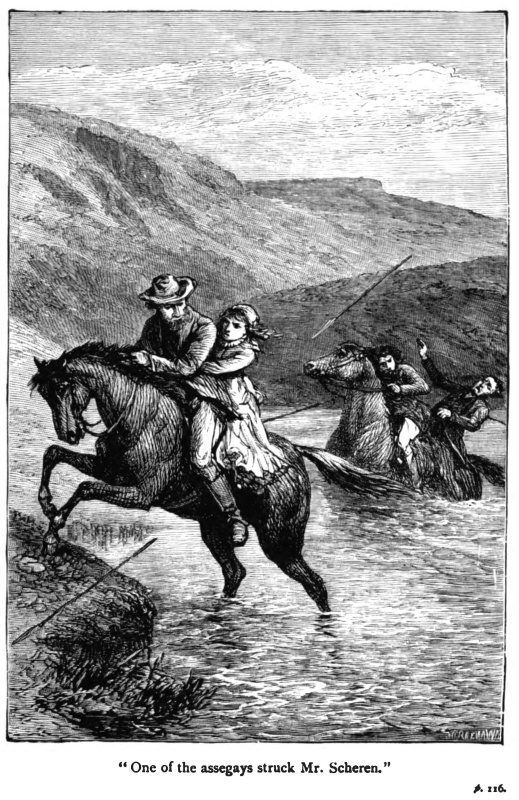
“Not one, unless you count my father and myself, and we had the narrowest of narrow escapes. We were seen by an Induna, who was late in attending the feast, and he instantly told Dingaan. He at once sent half a dozen of his fleetest men after us. They were on foot, and our horses, though cumbered with two riders, at first left them a long way behind. But the Zulus are wonderfully swift of foot, and their powers of endurance are still more surprising. When we reached the Tugela, they were not a hundred yards behind us. The river was not high, but it was with the greatest difficulty that our jaded horses could cross it. The Zulus came up before we had reached the bank, and hurled their weapons at us. One of the assegays struck Mr Scheren, who was sitting behind my father, and he fell dead into the river. Another grazed my horse’s flank, while a third stuck in the saddle, nailing Wilhelmine’s gown to it. Fortunately for us, Dingaan’s order forbade any Zulu to pass into Natal, for we could have gone no farther, and could have offered no effectual resistance.”
Chapter Eight.
“What is to be our next halting-place?” asked George of Ernest Baylen, as they rode out in the rear of the party on the following morning, having waited behind to see that none of the articles removed from the waggons on the previous day had been forgotten. “We have a long day’s journey before us, I expect.”
“We shall stop at Colenso,” replied Ernest, “rather a neat little town, and growing fast in size and importance. It stands near the Little Tugela. After that our next halting-places will be Helpmakaar, then Dundee, and lastly Newcastle. We might go farther to-day, but I expect we shall have some trouble in passing the Mooi. It is a good deal swollen by the heavy rain and the overflow of the Tugela. The flood, as yet, has fallen but very little.”
He pointed as he spoke to the river, which lay at the distance of a mile or two. George drew his rein for a moment, quite entranced by the varied features of the landscape before him. There was a stretch of green veldt, reaching almost from the point where they had bivouacked to the river’s banks, which were densely fringed with mimosas and willow-trees, through which its waters glanced, here and there, bright in the sunshine. To the right and left the ground was broken into declivities, clothed in many places with brushwood, in others presenting picturesque outlines of rock and shrub, while in the far distance towered the range of the Drakenbergs, the grandest mountains of Southern Africa.
“What are those dark objects I see floating about in the water?” inquired George, pointing with his whip to a broad bend in the river, which for some distance in both directions was free from wood on either side.