Rev. H.C. Adams (continued 4)
Reading edition
“You will soon see plenty of fun, sir,” observed Sergeant Long. “Cetewayo’s time will be up in two or three days now, and there is no chance of his knocking under.” In another quarter of an hour the party had set out. It consisted of ten persons—there was Sergeant Long, who was in command, the two Dutchmen, George, Margetts, and Hardy, the three young Baylens, and Matamo. The last-named had been very urgent to be allowed to accompany the party, and, as he was a strong, alert, and active fellow, Sergeant Long had made no objection.
The road lay for some distance along the bank of the Buffalo river, and was at first quite open and safe to travel. Knowing that the whole neighbourhood, except within the immediate contiguity of the camp, was full of dangerous characters of all kinds, Sergeant Long had impressed on the party the necessity of keeping a bright look-out Matamo, in particular, whose long training particularly qualified him for such duties, was told to report to the sergeant anything suspicious that might present itself to him. But for some time there was nothing that could occasion uneasiness. There was neither rock nor wood for a long distance on either side of the road, which could possibly afford shelter to an enemy. But after an hour’s ride the character of the country began to alter. Ridges of rock appeared rising one above another, until their height became sufficient to shut out the view beyond. Farther on, these ridges began to be clothed with thorns and shrubs of various kinds, presenting places from which it would be easy to fire unobserved on any one passing by. The farther the road ran, the more dangerous did it appear; and at last, when they were approaching Bemta’s Kop, Sergeant Long drew rein, and called up Matamo.
“I don’t like this,” he said. “Do you know this road? Have you often travelled by it?”
“I know the road pretty well,” answered Matamo. “But if the Zulus or the white robbers hide in the bank, it will not be possible to see them till they fire.”
“Just so. Are there many bad places before we reach Bemta’s Kop?”
“Plenty of bad places—as bad or worse than these. But I chance to know a way round. It is a mile or two longer, but we shall be safe from the robbers there.”
“We should lose time by taking that, but I really think it would be safer. What do you say, Mr Hardy?” he continued, drawing him aside. “I don’t like the look of the road; and if it is true that there are large gangs of ruffians of all kinds about, it is not safe to proceed farther in a route like this.”
“I am quite of your mind, sergeant,” said Hardy; “I know Matamo is entirely to be trusted.”
“Very good; so be it. Show us the way, Matamo, and we will follow.”
The Bechuana complied. Turning back about fifty yards, he urged his horse between two almost perpendicular masses of rock, and then made his way among the boles of the trees for perhaps a quarter of a mile. Then he turned sharp to the right, and followed a similar course, appearing to know his way, as if by instinct, among the yellow woods and oomahaamas, of which the wood chiefly consisted. A bare, open country followed, along which they rode for a long distance without seeing so much as an animal or a bird the entire way. Presently Matamo again turned sharply to the right, and after a short ride through some thickets of scrub, the summit of Bemta’s Kop, and soon afterwards Colonel Evelyn Wood’s encampment, came in sight.
On arriving there, Sergeant Long presented himself at the quarters of the commanding officer and stated his errand. Mr Uys, it appeared, was in the camp, and Vander Heyden and Moritz were immediately conducted to him. The others were invited to sit down to refreshments offered them. It was seen at once that they were not common soldiers, and the officers entered into friendly conversation with them.
“You are fortunate in having got along that road in safety,” observed Captain Forester to George. “It is not everybody who does. Only two days ago some waggons bringing in supplies were attacked by a lot of these fellows in open day, and several of our men were wounded. They got the worst of it, however, and perhaps that has induced them to sheer off. I believe one or two of them were killed—certainly hurt.”
“Well, we were not in charge of any valuables,” remarked George. “There was nothing to be got from us but our guns, and perhaps our horses.”
“Just so; unless they thought you were carrying despatches. Cetewayo would pay them well for any information that might be brought him.”
“Well, I suppose no white men would carry any information against their own countrymen to him,” remarked Margetts.
“Oh, wouldn’t they!” exclaimed Captain Forester. “You have much too good an opinion of our countrymen, Mr Margetts. I am afraid they would not only give information, but supply them with Martini-Henrys and Colt’s revolvers, and Gatling guns too, if they could get hold of them, always provided they could make fifty per cent, by the bargain. However,” continued the captain, “if they had meant to stop you at all, they would have done so on your way here. Most probably the losses they sustained the other day have given them such a lesson that they won’t meddle with our men again.”
In another hour the two Dutchmen returned, having had a satisfactory interview with Mr Uys, and received the reply which was to be carried to Rorke’s Drift. A consultation was then held, and it was agreed that they had better set out immediately, as it would be possible, by sharp riding, to reach the camp before dusk. It was thought better to follow the same road on their way back, as that by which they had come, it being plain that it was a route known to very few, if to any but Matamo himself. They set out accordingly, and arrived without adventure at the point in the road whence Matamo had turned off. Considering now that all danger was over, they set off at a round trot by the way which ran along the river-side; when suddenly, as they were passing a mass of rock, the top and sides of which were hidden by foliage, a puff of white smoke issued from a bush, and a bullet was fired which would have struck Vander Heyden in the chest, if it had not happened that Walter Baylen’s horse plunged forward at the moment, so that the ball intended for the Dutchman entered Walter’s shoulder. Hardy instantly fired his revolver at the spot whence the smoke had issued; and all the party, putting spurs to their horses, galloped through the first opening that presented itself into the broken ground which lay on the other side of the rock. Half a dozen rough-looking fellows, alarmed by their approach, were just springing on their horses, and making off in all directions, as they came up. One of the party, who had been wounded, doubtless, by Hardy’s shot, was leaning against a tree unable to move. By the sergeant’s direction, Hardy and Matamo alighted from their horses, and proceeded to secure him, at the same time tying up a wound in the thigh which he had received. The two Baylens and Margetts lifted Walter from his horse, and proceeded to examine his hurt. The sergeant and Moritz went off in pursuit of one knot of fugitives; George and Vander Heyden after another. The latter were not above two hundred yards ahead, and there was a long stretch of down country without shrub or stone to break the prospect. As their horses were evidently better than those of the robbers, they expected to overtake them. After a gallop of half an hour, they had approached within fire, and George, discharging his pistol, wounded one of the horses in the leg. Perceiving that he could go no farther, the man sprang from his saddle, and confronted his antagonist. An expression of surprise broke from George, as he recognised the leader of the mutineers on board the Zulu Queen, John Bostock. Vander Heyden also appeared surprised, though he made no remark.
“You here?” exclaimed Rivers. “I did not expect it, but I am glad you will not escape the punishment you so richly deserve. I suppose you will surrender yourself our prisoner, or we shall fire upon you at once.”
“You are two to one, Mr Rivers,” said Bostock, “and you are both armed. But I call upon Mr Vander Heyden here, if he is not a coward, to meet me in fair fight. He knows that I am entitled to it. My birth is as good as his own, I have served in the same army as himself, and I have twice challenged him. He is fond of saying that the English would be no match for the Dutch, if it wasn’t for the advantages that their position in the colony gives them. Does he dare meet an Englishman now, without advantage on either side? Mr Rivers, here, may stand by, and see that there is fair play.”
“Mr Vander Heyden, surely you will not think of allowing this,” said George, as he saw the Dutchman alight from his horse, and proceed to secure him to a solitary thorn which grew on the down. “Let him say what he likes, he cannot be entitled to a meeting at your hands.”
“It may be he is not, Mr Rivers,” said Vander Heyden. “He is no doubt by birth a gentleman, and has held a commission in our army. I agree with you that he has so lowered and degraded himself, that he cannot claim his privilege, either as an officer or a gentleman. But let that be as it may, no soldier, and, above all, no Hollander, can refuse to meet him face to face. You must act for both parties, Mr Rivers, and see that everything is fair. No Englishman shall ever say I refused his challenge.”
“If you insist upon it, I suppose I must,” said George, who, though greatly vexed and disgusted, knew enough of Vander Heyden to be assured he would not give way on the point. “If this duel is to take place, it had better be immediately. What weapons do you propose?”
“What he pleases,” replied Vander Heyden shortly.
“Pardon me, Mr Vander Heyden,” said George, “but if I am to have the management of this affair, I cannot allow that. You are the challenged, and, by a rule everywhere acknowledged, have the choice of weapons. I choose pistols for you, and twelve paces is the distance at which you are to fire. I presume no objection is raised to either point.” He looked at Bostock, who, though somewhat disappointed, as George fancied, at the proposed arrangement, answered sullenly, “Choose what weapons you like.”
“Very well,” said Rivers. “Then here is my revolver and Mr Vander Heyden’s; they are by the same maker, and as nearly equal as two pistols can be. Take your choice of them, and stand, if you please, on that spot. Now, Mr Vander Heyden, in what manner will you fire—alternately or at the same moment?”
“Alternately; that is the usual practice here,” said Vander Heyden. “We can toss for who is to have the first fire.”
A florin was accordingly flung up, and it was found the right of shooting first fell to Vander Heyden.
The signal was given, he fired, and his bullet tore a button from Bostock’s breast. The Englishman then discharged his revolver, and the bullet struck Vander Heyden’s helmet, through which it cut a furrow, without wounding him, though he reeled under the blow.
“I presume that is enough,” said George. “He cannot claim more at your hands.”
“Does he demand more?” asked Vander Heyden.
“I do,” said Bostock. “I claim a second shot.”
“Let him have it,” said the Dutchman.
“If you must, you must,” exclaimed Rivers. “But take notice that I will allow no more. If you persist after this, I shall ride off the ground.”
Vander Heyden bowed stiffly, and, raising his revolver, delivered his second shot. It evidently struck his antagonist, who raised, and then dropped his arm, as if in pain. Hastening up, George discovered that he had been hit in the right wrist. The wound did not appear to be a dangerous one, but it was obviously impossible for Bostock to hold a pistol.
“I cannot have my revenge to-day,” he exclaimed sullenly, when the bleeding had been stopped, and the wound bound up. “But the day will come when I shall return your fire.”
“When you please, sir,” answered the Dutchman haughtily. “After an affair of this kind, you must be allowed to go free. If we meet again, it will be different. I shall not feel obliged to answer your challenge a second time.”
They parted, Bostock leading away his wounded horse, and the other two, remounting, rode back to their companions.
“Mr Rivers,” said the Dutchman when they had ridden, a short distance, “I thank you for your friendly offices. Will you add to them by being entirely silent about this adventure?”
“Certainly,” returned George; “it would not be desirable on many accounts to speak of it.” No more was said until they rejoined their companions, who were somewhat impatiently awaiting their return.
“Did you kill either of those fellows?” asked the sergeant. “I fancied I heard several shots fired.”
“No, they got off,” said George vaguely. “I hope Walter is not much hurt.”
“Only a flesh wound, George,” said Walter Baylen. “The worst of it is that I am afraid it will prevent me from joining the other fellows when they march. They tell me I shan’t be able to stir for three weeks to come.”
“Well, we had better start now, and lose no time,” said Rivers. “Matamo, you have got the prisoner safe, I see. Why, I declare it is Van Ryk! a good job too!”
Chapter Twelve.
“Up and bestir yourself, Redgy!” cried George, entering the tent, which Margetts shared with Wilhelm Baylen, a few days afterwards. “Cetewayo’s time was up last night, and he has made no sign. The order to march has been given, and every one is already on the move. The mounted volunteers are to cross first, and our horses must be taken down to the Drift at once.”
“I am sorry to say Wilhelm and I are to be left behind,” said Margetts. “It’s an awful nuisance, but there’s no help for it.”
“Left behind!” repeated George. “Why, what is that for?”
“I don’t know, I’m sure; but last night, after you had left, there came an order that half a dozen of us would be required to stay on service here. Green didn’t know how to settle it to any one’s satisfaction, and it was determined at last to ballot for it. You are always in luck, George, and so are Ernest and Hardy, and the Dutchman Moritz. But Wilhelm and myself, and Vander Heyden—”
“Vander Heyden, eh?” interrupted George. “Has he got to stay behind? How did he take that?”
“Rather worse than we did,” answered Margetts. “And we took it bad enough. Here we shall have to kick our heels, while you are having all the fun. By the way, what is to be done with Van Ryk? His trial took place yesterday, but I haven’t heard the result.”
“He is to be hanged,” said George. “Not only you and I, but Vander Heyden and Moritz also swore positively to him. You’ll have the pleasure of being his executioners after we are gone.”
“I am not sure of that,” said Redgy. “They allow a fellow three weeks now,—at least I suppose so,—and I should think you would have chawed up Cetewayo before three weeks are past.”
“Hardly that,” said George, “though I daresay it won’t be very long. Well, I’m sorry for you, Redgy, but I can’t stop here. You had better get up and see us off.”
The banks of the Buffalo presented a busy and animated scene that morning. This river and the Tugela are often, in the later months of the year, so reduced in volume that a horse may cross them without the water rising higher than his knees. But in January, February, and March they are generally in deep and rapid flood, and difficult, and, except to experienced riders, impossible to ford. The mounted soldiers did contrive to cross, and so did one battalion of the Native Contingent, at a shallow spot a quarter of a mile or so up stream, and the 24th regiment was got over on ponts. When these were in position to repel any attack that might be made by the Zulus, the rest of the force was conveyed across, and lastly the waggons.
This was the heaviest part of the work, and occupied a long time. The waggons were dragged by the oxen to the edge of the bank; then the cattle were outspanned, and driven into the river to swim across, while the waggons were dragged on to the ponts by hand. This occupied the entire day; but by nightfall they had nearly all been got across, and on the following morning the march began.
“We are to move first on Sirayo’s kraal,” said George to Hardy, as they grasped hands. “He is the fellow, you know, that made the foray into Natal and carried off the women, whom he afterwards murdered. Cetewayo wouldn’t give him up. He is in a strong position, I am told, by the Ingutu hill, about four miles from here.”
“And he probably has a pretty large force with him,” observed Hardy. “Cetewayo is said to have sent his prime troops against our column. Well, now, George, you’ll see what these fellows fight like.”
The order to move was presently given. The advance was necessarily slow through the broken and perfectly wild country on the north side of the Tugela; through which there was not so much as a path to be traced, except where the waggon of some trader had passed, and deep ruts had been left by the wheels. The ground was for the most part woodland, broken, however, continually by ravines, with deep and high fissures intersecting them—as difficult a country for a hostile force to traverse as could well be imagined.
After an hour or two of tedious advance, they came on the banks of the Bashee, a small mountain stream, running at the foot of the Ingutu mountain. Presently Sirayo’s kraal came in sight.
“There is the kraal, George,” exclaimed Hardy, “and there are a lot of Zulus ready to defend it. Now you may have a good sight of these fellows in fighting array.”
George looked up at the crags above him, and saw a number of dark-skinned warriors, whose appearance was in the highest degree striking. On their heads they wore head-dresses, apparently of leopards’ skin, surmounted by feathers, the dark plumes waving after a most picturesque fashion against the sky. Round their wrists and ankles they wore rings of ivory or burnished copper, while their waists were encircled by the tails of wild animals bound together. On their left arms they carried oval shields, large enough to protect the entire body from neck to ankle, proof against the sharp and dangerous assegay, but no protection from the rifle bullet. Their defensive weapons were rifles and assegays; the latter long spears cut from the wood of the tree which bears the same name, with an iron head and a barbed point, and which these savages hurl with great dexterity and force. As soon as the English soldiers came within hearing distance, they began to taunt and jeer them after their barbaric fashion, inquiring, “What were the white men riding there for?”
“What did they want in the land of the Zulus?”
“Were they looking out for some place to build a kraal in?”
“Would they ascend the rocks, and receive the greeting they were ready to bestow upon them?” and the like.
Presently the order to advance was given, and the men of the 24th began climbing the westward side of the hill, on which Sirayo’s kraal stood. A fire was instantly opened upon them by the Zulus, from behind the various points of vantage where they had stationed themselves, by which a dozen men or so were struck down. But in a short time, in spite of an obstinate resistance, the enemy were driven out of the kraal, and fled in confusion along the hillside, followed, as soon as they reached tolerably level ground, by the cavalry, who cut down a considerable number in the pursuit.
“So much for the first brush with these rascals!” exclaimed Hardy as he sheathed his sabre. “Certainly these are gallant fellows, very different from either the Ashantees or the Abyssinians. But, nevertheless, savages, however brave, cannot stand against disciplined troops, and this is only one more proof of it. Well, I suppose we shall go no farther to-day.”
Hardy’s words were fully verified. Not only was the march not resumed that day, but more than a week passed before the troops were again in motion. It was found to be impossible for the waggons to make their way, without constructing for them what really was a new road; or rather, a road of some kind, the old waggon tracks being all but useless. In some places the rains or the overflow of the brooks had made the ground swampy, and here the wheels would suddenly sink up to the axles, and it was only after long and severe exertion that they could be extricated, to fall into a similar pitfall, perhaps, before another ten yards of the way had been surmounted. So slow was the progress, that it was not until the 20th of January that the column resumed its route, through a bare country, hardly exhibiting a tree or shrub, and reached on the evening of the same day, the base of the lofty eminence known as Isandhlwana, or “the Lion’s Hill.”
“This is to be our camping ground, then?” said Ernest Baylen as the order to halt was given. “Well, I have often heard of Isandhlwana hill, and have seen it from a distance. It doesn’t look a bad sort of a place to pitch one’s tent in.”
“By no means,” assented George, looking round him; “and it will be a strong position too, if it is properly secured from attack. What say you, Hardy?”
Hardy cast a scrutinising glance round him, and then expressed his assent. It was indeed a striking scene. On the west side the rock rose steep and rugged, and in some places precipitous, to a considerable height, sloping downwards towards the east until it reached the water-side. Ridges of rock and grassy mounds everywhere broke this descent, so that it was rendered very difficult to traverse. On the south there was a long platform of rock covered with grass overhanging an extensive valley. The whole ground chosen for the camp was a kind of sloping plateau, overlooked by an inaccessible eminence. The scene soon became lively and picturesque, as the white bell-tents were pitched in long rows, the fires lighted, and the men, in their scarlet jackets and white helmets, gathered in groups round them, or moved hither and thither on their various errands.
The companions, now reduced to four, for four had been left at Rorke’s Drift, sat down to their meal in a somewhat dissatisfied humour. They were terribly tired of their long inaction, and it did not look as though matters were going to be any more expeditious as regarded the future. They had been more than ten days going five or six miles, and the waggon tracks, it was said, were to be no better. At this rate, when would they reach Ulundi? Not, at all events, until long after the other two columns under Evelyn Wood and Colonel Pearson had come into contact with the main force of the enemy, and probably reaped all the laurels that were to be gained. They were rejoiced when they were informed that Lord Chelmsford meant to send a force to reconnoitre on the following morning, and Ernest Baylen and Moritz were to accompany it.
“I envy you fellows,” said Hardy. “Dartnell, who is to lead you, is a smart officer, and by all accounts the Zulus are mustering pretty thick in the neighbourhood, so that you will run the chance of some sharp fighting.”
“Lonsdale is to make a reconnaissance with the Natal force in the same direction, I am told,” said Ernest; “and Lord Chelmsford also means to take a party out, they say. There will be plenty of fighting to-morrow, I expect.”
“Won’t the withdrawal of all these detachments leave us rather a small force to defend the camp with?” suggested George.
“Oh, they will fortify it, of course, the first thing to-morrow,” said Hardy. “I rather wondered that something of the kind wasn’t done last night, seeing that the enemy are in force near us. But the men were very tired, and it was too dark to do much. But no doubt they will laager the waggons and throw up breastworks as soon as it is light.”
With the break of day, Moritz and Ernest, attended by Matamo, rode off with Major Dartnell’s force. And not long afterwards the Natal troops followed, taking the road, as they afterwards learnt, to Matejan’s Kraal and Malatoko hill. But after this no further movement occurred during the day. The men busied themselves with the routine of camp duty, or were gathered in groups, talking, and smoking, and playing games. The scene was romantic and lively. In the foreground were the white bell-tents, making a forcible contrast to the scarlet of the uniforms scattered about; farther off were the waggons belonging to the different corps, each remaining in the place where it had been unpacked; and in the background was the wild uncultivated landscape—forest, and mountain ridge, and sandy ravine, and rocky boulder, mingled together in picturesque disorder.
“They don’t seem inclined to fulfil your prediction,” observed George to Hardy on the following morning, as they sat upon a large stone under the shadow of the great Isandhlwana hill. “No order seems to have been given for fortifying the camp. Look, there’s Colonel Pulleine, who is now in command, and has been so since Lord Chelmsford and Colonel Glyn left. He is reading some letters, or papers of some kind. He does not seem to have an idea that the camp wants fortifying.”
“He ought to know best,” said Hardy, “and for the matter of that, I suppose he must have had the general’s orders about it. And he, and we also, have nothing to do but to obey. All I can say is, that if the camp were to be attacked by any large force, as things now are, I don’t see how it could be defended. What is there to stop the Zulus? The men might, of course, form into a square, if they had time to do it, with the ammunition in the middle; and as long as powder and shot lasted, I don’t suppose the Zulus could break in. But look at them, scattered up and down and everywhere. Suppose there came a sudden rush of these black fellows from under cover, what time would the men have to form and collect the ammunition? The niggers might pour in by hundreds and by thousands, and cut our fellows up into small bodies, which might be destroyed in detail.”
“It looks so, certainly,” said George; “but our officers are men well used to campaigning, and, what is more, to campaigns with the natives. They can’t have overlooked this, unless they knew that there was no risk.”
“Well, all I can say is, no commanding officer under whom I have served before ever left a camp undefended, as this is,” rejoined Hardy.
“Here comes Colonel Durnford,” said George, as a fine soldierly-looking man rode up, attended by a force of mounted Basutos. “I knew he was expected about this time. He is senior to Colonel Pulleine; I daresay he will order the camp to be fortified. I suppose it would not be a very long job, would it?”
“No, not to put it into such a state as would be sufficient to repel an attack of these Zulus,” assented Hardy. “Look at those waggons yonder. The oxen are already inspanned. If they were simply drawn together in a circle, the infantry and the ammunition collected and placed inside, the Zulus couldn’t force their way in against one-half of the numbers that we have here. No, not if Cetewayo sent his whole army. Of course they might pillage the rest of the camp, and drive off the oxen. But they couldn’t get inside,—not in a week,—and they would probably lose thousands in making the attempt. Look at those two guns there, too! If they were drawn in front of the waggons, they would shoot down any attacking force—whole heaps of men at every discharge. And they couldn’t be taken under the fire of the laager. See there, Colonel Dumford is giving some orders. I hope he sees the danger, and is going to take some precautions against it. Let us move up nearer.”
On approaching the spot, however, they found the colonel’s thoughts were otherwise occupied. News had just come in that the Zulus were retreating in all directions, and would escape unhurt if they were not pursued. The colonel therefore was on the point of going after them, accompanied by his mounted Basutos and the rocket battery which he had brought with him, leaving the camp once more under Colonel Pulleine’s command.
“I don’t like it,” said Hardy when this was reported to him. “I don’t see what there has been to make these Zulus retreat. It is certain that they are in great force, and they can hardly be said to have been attacked. I hope this retreat is not a mere feint to draw more men out of the camp. I suppose, however, Lord Chelmsford must be returning to it, and Colonel Durnford knows that he is close at hand.”
As he spoke, Colonel Durnford and his Basutos went past at a rapid pace, the rocket battery, under Captain Russell, following.
For some time after his departure there was no further movement in the camp. But presently the idea spread, and gained ground, that an attack from a large force of the enemy was to be looked for. The six companies of the 24th were drawn up—three of them in extended order on the left front, where the principal attack might be looked for, two more on the side where the waggons were posted, while one company (that of Captain Younghusband) was held in reserve. Close to the companies the artillery was stationed, and a little farther off a detachment of the Native Contingent.
About one o’clock heavy firing all round announced the approach of the struggle, and presently the Basutos, who had encountered an overwhelming force of the enemy, were seen falling back on all sides, pursued by large bodies of Zulus, who came rolling like a sable wave over the crest of the opposite hill. As soon as they came in sight, the artillery opened upon them, mowing them down with terrible havoc. But they continued to advance, hesitating now and then when the fire from the guns came among them, then rushing on more resolutely than ever. Presently they came near enough for the fire of the 24th to open, and this for the time checked their advance. Desperate as the courage of the blacks was, they could not face the storm of lead thus showered upon them.
“They won’t stand this very long, Rivers,” said Hardy, as they watched the battle from the flank, on which the volunteers were stationed. “They have wonderful pluck, certainly; but, unless the ammunition fails, it is impossible they can approach nearer. Even now I see signs of wavering among them. We shall soon be at their heels, I expect. Merciful Heaven!” he exclaimed a moment afterwards in an altered voice, as, chancing to turn round, he caught sight of some object behind him. “The Zulus have got into our rear! It is all over with us!”
Rivers glanced round, and a thrill of dismay shot through him, as he beheld the head of a Zulu column making its way round the precipitous hill in the rear of the camp, and pouring on in large and ever-increasing volumes to attack the English from behind. At the same moment the assailing force in front caught sight of their countrymen, and rushed forward with redoubled fury. Struck with terror, the native contingent broke its ranks and fled, leaving a wide gap in the fighting line, through which the black warriors burst like a raging torrent, and the whole camp in a moment became a scene of wild confusion. The various groups of white soldiers were cut off from their ammunition and from one another, presenting the appearance of an island here and there, encompassed by the overwhelming flood of the enemy. A fierce rush carried the guns, which had hitherto inflicted such deadly loss on their host. A desperate attempt was made by those in charge of them to force their way through the enemy. But the gunners were assegayed on the limbers, and the drivers in their seats. One gun was upset, the other was dragged off by the wounded horses. All was confusion, distraction, despair.
“Ride for it, George!” shouted Hardy. “The only hope is to reach Lord Chelmsford, if he is anywhere near at hand, as I hope he is, and bring him to the rescue. Some of our fellows may hold out long enough for him to come up. Ay, that is right!” he exclaimed, turning on his saddle as they galloped off; “there is Captain Younghusband retiring against the steep side of the hill. He, at all events, will hold out a long time there. All depends on how near Lord Chelmsford may be.”
Urging their horses to the utmost speed, they broke their way through some scattered groups of combatants, and had got clear of the camp among some bushes, when they came upon two horsemen riding, at the top of their speed, in the opposite direction. George recognised them as Ernest Baylen and Matamo.
“Stop, Ernest!” he shouted; “do not make for the camp. The Zulus have broken in there. Where are our fellows? Where is Lord Chelmsford?”
Baylen reined in his horse. “Broken into the camp!” he exclaimed; “the Zulus! Then all is lost! Dartnell’s men are dispersed or killed. Moritz has been assegayed. I was riding to bring help.”
“Where is Lord Chelmsford?” interposed Hardy. “Is he anywhere near at hand?”
“No, miles off, I believe, but I can’t say where.”
“Then there is nothing for it but to make for Rorke’s Drift. We may warn them in time to prepare for attack.”
He was just turning his horse when half a dozen Zulus came rushing up, hurling their assegays as they advanced. One of these grazed George’s cheek. Another pierced Ernest in the chest, who fell on the instant; while a third mortally wounded Matamo’s horse. The Bechuana leaped from his saddle, and was instantly struck down by a blow from a club. George cut down the man whose assegay had narrowly missed him, and Hardy shot two more with his revolver. The others drew back for the moment; and the two Englishmen, taking advantage of their hesitation, galloped off.
“To the left, to the left!” shouted Hardy; “make for the thicket there. I know a path through it that runs down to the Buffalo. The pursuit is, fortunately, in another direction.”
In a few minutes they reached the cover of the trees, followed only by the three or four Zulus from whom they had just escaped.
Once inside the wood they were tolerably secure. Elated by the signal success they had obtained, the news of which spread like wildfire in all directions, the Zulus were hurrying to witness the overthrow and slaughter of the white men, and get their share of the spoil, and the fugitives did not encounter a single enemy, while their pursuers were a long way in the rear. Hurrying along a path, which Hardy had often traversed when a resident of the country, in half an hour’s time they found themselves on the banks of the Buffalo, at a part which was entirely out of sight of either friends or enemies.
“Will our horses carry us across?” asked Hardy as he looked at the swollen and roaring stream, which at that point ran with extraordinary speed.
“They must,” said George. “Not our lives only, but those of our friends at Rorke’s Drift depend upon it.”
“You are right. We must cross at once.”
The horses, which had somewhat recovered their wind during the passage through the wood, were extremely unwilling to enter the stream; and it was only by sharp use of the spur that they could be compelled to breast it. For about a third of the distance the water was comparatively smooth, and they made their way, though with difficulty. But as they approached the mid-current they found its force quite irresistible. Both horses were swept down the stream, and soon lost all power of resistance. George threw himself from the saddle, and, striking out with all his force, broke clear of the current and slowly made his way to the shore, while his horse, which had ceased to struggle, was carried down the torrent. George scrambled with difficulty up the bank, and, looking round for his companion, saw him a hundred yards lower down, clinging to the long, projecting branch of a large yellowwood. His horse too had disappeared, and he himself appeared to be quite exhausted. Shouting to him to hold on to the branch, George hurried to the spot, and, climbing into the tree, was able to approach him near enough to throw one end of his belt to him, while he drew him upwards by the other. After a quarter of an hour of great peril and exertion, they both stood safe on the farther shore of the Buffalo.
“We are saved, Rivers,” said Hardy as soon as he had recovered his breath sufficiently to thank his preserver; “but I am afraid not in time to warn our friends at Rorke’s Drift. We have come direct enough so far, no doubt. But Rorke’s Drift lies some considerable distance off, and I am so much exhausted that it would take me a long time to reach it on foot. I am afraid you are not much better.”
“Hush!” said George; “I hear some one moving close at hand. We have lost our revolvers, but we still have our sabres. Can these Zulus have followed us?”
They drew cautiously back under the cover of the reeds and rushes, and listened intently. Presently the tramp of horses’ feet was distinctly heard, and two mounted volunteers came riding by at an easy trot, attended by two or three natives.
“It is some of our own fellows,” exclaimed George; “how fortunate! By all that is lucky,” he added a moment afterwards, “it is Redgy himself, and Wilhelm Baylen! Hullo, Redgy, what has brought you here? Stop a moment, and take us with you.”
Margetts reined in his horse in great surprise. “I may return your question, I think,” he said. “What brings you here? And, good heavens! what a condition you are in. You have swam the river, and are covered with blood besides! What has happened?”
“It will take a long time to tell that,” answered George, “and we must not stop here to tell it. Every moment is of incalculable importance. Give me your horse, Redgy. I think I can contrive to sit in the saddle, and Wilhelm must ride by me. You and Hardy must make your way as well as you can on foot. He will tell you all about it.”
He spurred the horse to its speed, and he and Baylen were soon lost to sight.
Chapter Thirteen.
The morning of the 22nd of January broke calm and clear on the valley of the Buffalo. At one end of this, as the reader has heard, was situated the ford of Rorke’s Drift, to which the occurrence of that day has given a world-wide celebrity. But for the fact that there are shallows close to it, by which cavalry may almost always cross, there is nothing that could cause it to be chosen as a military station. The valley indeed is open for some considerable distance above the Drift; but below it there rise rocky hills, which would enable an enemy completely to command it. On the north bank again, which is in Zululand, the ground is level; but on the Natal side there is high land, sloping abruptly down to the river at the point where the ford is shallowest. From this point, as well as from that before mentioned, the camp could be easily attacked, and probably with disastrous effect. It could therefore only be from that contempt of the most obvious dangers, which seems to be an inevitable feature in the English character, that a military storehouse and hospital could have been built in such a situation. It must have been evident to every one that, if a Zulu invasion—a thing which had already twice occurred, and which was now again apprehended with grave reason—were really to take place, and Cetewayo pour his dusky thousands across the Buffalo, the stores and the sick men must be, at once and without hope of deliverance, at his mercy.
In any case, one would have supposed that this consideration would cause some anxiety in the minds of the slender garrison left in it, when the three British columns had passed the frontier of Zululand to attack its renowned and dreaded king. All over Natal, if not all over Southern Africa, it was considered as, at all events, very doubtful, whether he would not prove too strong—not indeed for the power of England to cope with, but for the number of troops now sent against him. And if he obtained even a temporary triumph, and forced Glyn’s column back over the river, what would all their lives be worth? Did not common prudence require the throwing up defences of some kind, which might keep the enemy off, for some time at least, until succour might arrive. The grand feat of arms, which averted a second disaster, has induced the world to disregard the strange imprudence exhibited here, as at Isandhlwana. But had the result been different, and had the garrison experienced the same fate as those who fell in the fatal battle on the morning of the same day, the outcry would in all likelihood have been quite as loud and quite as justifiable.
But no thought of danger disturbed the equanimity of the slender force left to garrison their untenable post. The men, when the necessary camp duties had been discharged, appeared to be sorely at a loss to know in what manner to employ their time. The day was warm and bright, and early in the forenoon it became oppressively hot. Some amused themselves by fishing in the adjoining river. Some strolled up and down, or sat smoking and chatting in the verandah, or under such shade as could be found.
At a little distance, in front of the Swedish pastor’s house, Vander Heyden and his sister were walking up and down, engaged in earnest conversation.
“I wish you would think better of this, Annchen,” he said. “Mr Bilderjik returns this morning to Colenso. He finds there is nothing to be done here, which the pastor himself cannot do, nor is there likely to be anything. He will take you with him to his house, and thence you will find easily enough the means of conveyance to Newcastle, where a temporary residence has been engaged. There all the waggons and the goods which were saved from the wreck at Bushman’s Drift have been conveyed. There, too, you can make the necessary preparations for the journey across the Transvaal, which cannot be made here.”
“You are resolved on settling at Pieter’s Dorf, then?”
“Have I not told you so already? Bushman’s Drift was completely destroyed by those fiends of Umbelini’s. It would take a great deal of time and money to restore it; and even were that otherwise, I could never endure the sight of the place again.”
“I know, I know,” murmured Annchen, as she laid her hand pityingly on his arm.
“And Pieter’s Dorf,” resumed Vander Heyden, “is the place at which I have always wished to live, since it came into my possession. Additions to the house and farm buildings are needed, and these Hardy, the most competent man in these parts, has promised to undertake. We shall certainly set out as soon as I am free to travel.”
“That is, as soon as Cetewayo has been put down, I suppose. But if you are to have no hand in putting him down, why wait for that?”
“I mean to have a hand in putting him down. As a soldier, I know I must obey orders, and therefore I have stayed here. But I have been promised that I shall take the place of the first officer that is killed or disabled. Every day I am expecting to hear that a battle has been fought and I am free to draw my sword. I must stay here.”
“But, Henryk, may I not be as anxious to obtain the earliest information as yourself?”
“Of the safety of Frank Moritz?” suggested her brother, turning a scrutinising look on her; “or perhaps of some one else?”
Annchen coloured. “You have no right—no reason for asking me that,” she said.
“I hope I have no reason,” he answered. “As for right, that is a different matter. Let us understand one another. It was never supposed that there was any romantic affection between you and Frank, though you liked one another well enough to marry. But I have fancied once or twice that you were getting romantic about this young Englishman, Rivers. He is a fine fellow, I allow, and I admire and like him. But you shall never marry an Englishman with my consent. And though my control over you will cease after a time, you would no longer be a sister of mine if you were to marry one.”
“I repeat you have neither right nor reason to speak thus to me,” she rejoined. “Neither Mr Rivers nor myself have said or done anything that could justify it. And I really think it would be better for me to leave Rorke’s Drift. I have no doubt Mr Bilderjik will give me permission to accompany him, and, as he means to set out very soon, I will go and prepare for my journey. Good-bye, Henryk; let us part friends.”
They took leave of one another, and not long afterwards she was seen riding off in the Swedish pastor’s company. Vander Heyden lounged up to the camp and joined some of the officers, who had gathered in a group near the storehouse, listening intently to some distant sounds borne by the wind from the eastern quarter.
“That is firing, I am sure,” said Evetts, one of the volunteers; “but it is a long way off.”
“Yes, that is firing,” said the experienced Vander Heyden; “but it is not volley firing. It is only some skirmishing, I expect. How long has it been going on?”
“I should think it began about an hour ago,” said Evetts, “but it was very faint and irregular then. It has been getting more distinct for the last twenty minutes. It is just half-past twelve now.” He looked at his watch as he spoke. “But, ha! what is that?” he added a moment afterwards, as a deep, hollow boom came across the river. “That is cannon. There is a battle going on at Isandhlwana.”
“A good job too,” said Vander Heyden; “it is time there was some fighting. People had begun to think there never was to be any.”
They continued to listen for a considerable time to the roar of the cannonade, which presently ceased, and the desultory firing was again heard.
“The action is over,” observed Evetts. “The Zulus never can face the guns very long.”
“Where is Margetts?” inquired another officer after another hour’s conversation.
“He and Baylen have ridden out to the ford on the Lower Tugela,” answered Evetts, “with some letters which were to be forwarded to Pearson’s camp. I have been on the lookout for them for some time.”
“And here they come,” said Lieutenant Bromhead, the officer in command of the garrison; “I know Margetts’ horse even at this distance.”
“It is the horse, sure enough,” said Vander Heyden, as they drew nearer, “but I don’t think it is the man. No,” he added a minute afterwards, “it is Rivers, not Margetts.”
“Rivers!” repeated Bromhead. “And so it is! He must come from Isandhlwana. Depend upon it, he brings us the news of a victory. Well, Rivers, what is it?”
“I am sorry to say, Mr Bromhead,” said George, saluting the officer in command, “we have suffered a terrible defeat. The Zulus have broken into our camp and massacred nearly the whole of the companies of the 24th, the police, and the volunteers. All the guns, ammunition, and waggons have been taken. I should fear that nearly a thousand men have been slaughtered.”
“Good Heaven! you cannot mean it!” said Evetts. “Where is Lord Chelmsford? How can it have happened?”
“It is no use asking either question now,” said George. “The Zulus are in immense force—ten or twelve thousand of them at the least. They are already, I expect, on the march to attack you. You must instantly retreat, or prepare to defend yourselves.”
“We cannot retreat,” said Bromhead. “It will be impossible to remove the wounded men, and we cannot let them fall into the hands of the Zulus. Besides, it is of the utmost importance to maintain this post, if it be possible. We must throw up what defences we can, and, rather than surrender them, die behind them.”
He was answered by a general cheer and a cry of determination to defend the place as long as there was a cartridge left, or a man to fire it.
As has already been intimated, a worse position for defence than Rorke’s Drift can hardly be imagined. The two small frail buildings were more than a hundred feet apart from one another. The walls were thin, the doors weak, the roofs thatched, and easily set on fire. On two sides there was rising ground, from which they could be completely commanded. On a third they could be approached under cover within a few yards’ distance. There was neither wall nor breastwork nor trench—nothing, in fact, to keep an enemy back. The attacking party would probably consist of some thousands of desperate and well-armed savages, flushed with victory. The defenders were one hundred and four in number (for the native contingent withdrew before the approach of the enemy), and they were cumbered with the care of thirty-five sick men.
They went to work, however, with a will, and for more than two hours employed themselves in loopholing the walls and constructing barricades between the two houses. These consisted of two waggons, which had fortunately been left at the station, and of piles of sacks filled with mealies and biscuit-boxes, the parapet thus formed being only a few feet high. It looked more like a mock fortification, put together for a schoolboy’s game, than for the purposes of a real battle. The rude defences were still incomplete, when the dark masses of the enemy were seen crowding the rising ground to the south, and the foremost lines made a sudden charge down the hill, intending to carry the place by a coup de main. But when they had approached within fifty yards, they were met by a fire so heavy, as to check even their triumphant advance. Instead of continuing their rush, they withdrew into whatever cover they could find, and fired from behind hollows in the hillside, trees and shrubs and garden wall, every now and then rushing forward and trying to force their way in, until driven back by the weapon they dreaded most of all—the British bayonet.
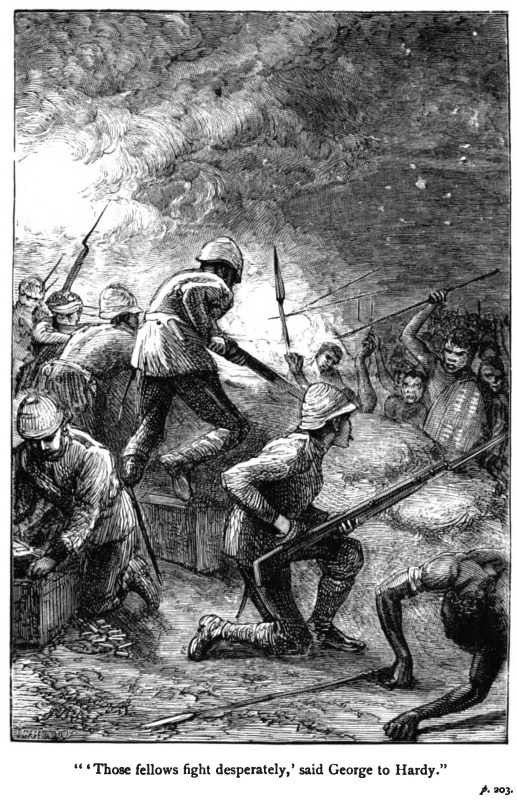
“These fellows fight desperately,” said George to Hardy, who had arrived an hour or two previously, as, aided by him and Vander Heyden, he drove back half a dozen Zulus, who had forced themselves half over the wall of mealie-bags; “yonder big fellow actually clutched the barrel of my musket as I fired it into him, and, though he was mortally wounded, attempted to tear it from me. If his strength hadn’t failed him pretty quickly, he’d have got it, too!”
“Well, the fighting has gone on for four or five hours,” said Redgy, who was close by, “and they have not gained an inch yet.”
“Ay, but if they were to gain an inch, it would be all up with us,” said Hardy. “Put those mealie-bags back again, Wilhelm. That last rush nearly had them down.”
“Look out, here is another lot coming!” shouted George, as he indistinctly caught sight of a dark mass advancing towards them. A moment afterwards a dozen blacks vaulted nimbly on to the parapet, but were instantly hurled back by a volley of musketry, which carried death among the assailants. Three only had made their entrance good. George shot one with his revolver, Hardy bayoneted a second, and Vander Heyden, clubbing his rifle, brained the third, all falling dead within the enclosure.
“Safe once more!” exclaimed Hardy; “but how long is this to go on?”
At this moment a shout was raised that the enemy were forcing their way into the hospital, and the sick must be moved, or they would fall into the hands of the savages. With the utmost difficulty this task was accomplished, the soldiers fighting from room to room, and guarding the doors by turns, while their sick comrades were carried out under the very eyes of a crowd of swarthy savages, pressing on them with brandished weapons and yells of fury. Presently the hospital was set on fire, and the flames, rising high and catching the thatch, lit up the terrible scene with a lurid splendour. It guided the bullets of the defenders, who continued to pour volley after volley into the midst of the dense array of their assailants, heaping the ground everywhere round the entrenchments with their corpses.
Who can relate the achievements, who can recount the horrors, of that long night of trial? It was like a succession of hideous dreams, from which the sleepers were continually being awakened, only to renew them in sleep again. About midnight the little garrison, forced back on every side by overwhelming numbers, had to retire within an inner circle, formed, like the outer one, by mealie-sacks; and here the same scenes were, hour after hour, renewed in endless succession—of black warriors pouring in to the attack, and being driven back by volleys of musketry and charges with the bayonet.
At last the dawn broke. The Zulu fire ceased, and the dense array of the enemy was seen retiring over the heights by which they had approached. The garrison, diminished still further by the casualties of the night, stood triumphant in their citadel. The scene which the rising sun revealed was one of the most terrible and striking on which the eye of man has ever rested. There were the handful of defenders, with their faces blackened with powder or clotted blood, their uniforms ragged with bullet-marks and charred by fire, leaning exhausted against the walls, or stretched on the ground; and all round the camp the bodies of the assailants, scattered singly here and there, or piled on heaps upon one another, in some places six and seven deep. There they lay, in every conceivable attitude of repose or agony, some struck with sudden and almost painless death, others torn by gaping wounds or forced into hideous contortions by acute and protracted torture.
“What a night it has been, Vander Heyden!” exclaimed George, as he leaned on the stalwart Dutchman’s arm, giddy with exhaustion. “A hundred times over I have given myself up for lost. I can hardly believe that it is over, and we are safe! It was like a horrible nightmare!—those interminable black faces and whirling spears and ferocious shouts! I think I shall never cease to hear them!”
“It has indeed been a tremendous struggle,” said the Dutchman. “Ha! what is that shout? They are not returning to the attack, are they, Mr Bromhead?” he continued, addressing that officer, as, grim with dust and blood, he passed them on his way to the flagstaff.
“No, some of our fellows are in sight, and coming this way—escaped from Isandhlwana, I suppose. They raised a cheer when they saw that our flag was still flying, and our men returned it.”
George and Vander Heyden followed him, just in time to see the remnant of Glyn’s column coming up, headed by Lord Chelmsford himself. The commander-in-chief rode forward and looked with approval and admiration on the frail and slender defences, which a handful of brave men had converted into an impregnable fortress, on the vast multitude of black corpses heaped on every side, and on the gaunt and war-stained figures of the few defenders. Then he asked,—“Where is the officer in command?” Lieutenant Bromhead advanced and saluted. “You have done nobly, sir,—you and your gallant followers,—and England owes you her warmest thanks. Your brave defence has probably averted the mischief I had feared, and saved the colony from invasion.”
The days which followed this fierce and protracted struggle were, as is usually the case, dull and inactive, the defenders being in truth too much exhausted to do more than lounge through the day and recover their strength and energies. It was some relief to George to find that Farmer Baylen had returned some time before to Horner’s Kraal, so that it was impossible to send him immediate news of Ernest’s death. Vander Heyden rode over to Colenso as soon as he was able, to break the news to Annchen that her lover had fallen at Isandhlwana. Walter Baylen was nearly convalescent, and it was agreed that as soon as he was sufficiently restored he should ride over to his father’s house and inform him of their loss. There had been at first some apprehension that, notwithstanding the repulse at Rorke’s Drift, Cetewayo might be so elated by his success at Isandhlwana as to send his dark-skinned warriors over the Tugela to overrun Natal. But the more the Zulu king learned of the event of the memorable 22nd of January, the less he felt inclined to be elated. He had killed a thousand of his enemies, no doubt, but they had probably killed nearly three times that number of his best soldiers. He had gained a battle at Isandhlwana, but he had lost one at the Inioni river; and presently he discovered that not only had another action been fought and lost at Rorke’s Drift, but that his favourite regiment, the Tulwana, had been half destroyed in it. More red soldiers, he learned, were coming up “out of the sea” to supply the place of those lost. He had no means of filling the vacancies that had been caused in his own army. It was no time for sending troops out of Zululand. He would want all he had for its defence. Day after day did the garrison look across the waters of the Buffalo towards the fatal Lion Hill, but they beheld none coming that way, except now and then a wounded soldier, who had escaped by some marvel from the fatal field, crawling slowly and painfully over the broken ground to the friendly shelter where his wounds would be cared for.
It was one of the last days of January, when George and Redgy, who were sitting under shelter of the kraal wall, saw on the river bank what seemed to be a wounded Zulu, who was making his way with toil and pain to the camp.
“Do you see that darky there,” said Margetts, “creeping up this way, and keeping out of sight as much as possible? He is up to no good, I expect.”
“He seems to me to be wounded,” said George, “or rather to be recovering from the effects of a wound. Perhaps he has been lying hurt by the river’s bank, and has just recovered strength to crawl up here.”
“Well, if so, we oughtn’t to refuse to give the poor beggar shelter, I suppose,” said Redgy. “But we had better not go near him until we have made sure. These black fellows take it for granted that you are going to assegay them, and generally try to anticipate the compliment. Here he comes, crab fashion! Hallo, darky, what may you please to want at Rorke’s Drift?”
“I want your help, Mr Redgy,” was the reply,—“yours and Mr Rivers’. You haven’t forgotten Matamo, have you?”
“Hey, what!” exclaimed both the young men, starting up. “Matamo!” continued George. “Why, you don’t mean it! I declare it is he! Why, we all thought you were dead, if not buried!”
“No, sir,” returned the native, grinning and showing his white teeth. “I am not dead, nor buried. There is nobody buried yet at Isandhlwana. But I am almost dead with hunger. Please to give me some food, and I will tell you all about it.”
Interested and astonished, the young men took Matamo to their tent and supplied him with food; after which he told his story.
“Mr George, you saw me knocked down by a blow from a knobkerry. I was stunned, not killed. I lay for some time, and then came to. I tried to get up, but the big Zulu you killed had fallen over me, and the dead horse lay on the other side of me. I was fast jammed in, but I could see under the Zulu’s arm what was going on.”
“What did you see? Tell us. No one seems to know the exact details,” exclaimed Rivers eagerly. “Was the fighting still going on?”
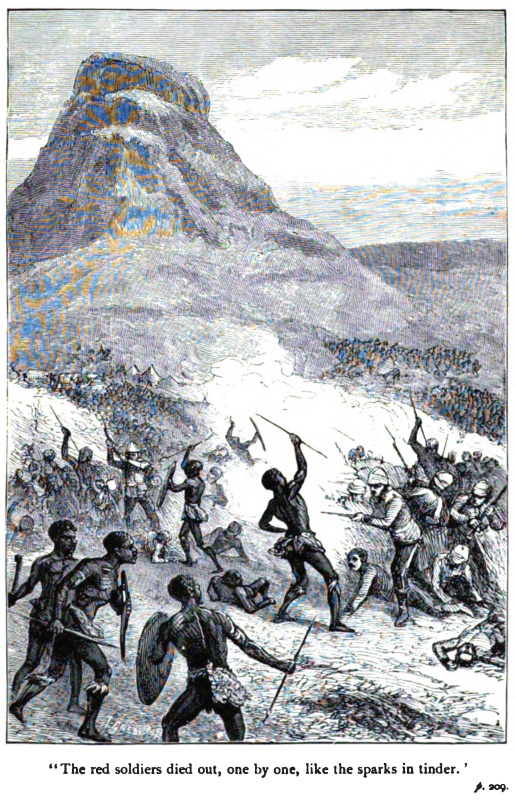
“It was still going on; but there was no chance for the red soldiers. They were nearly all killed. There were half a dozen here, a dozen there, two dozen there, with hundreds of Zulus round them. Most of them were standing back to back, and stabbing with their bayonets. They were dropping one after another, but killing at least three men for every one. I saw one tall man kill five blacks without stopping, but the bayonet stuck for a moment in the ribs of the fifth, and then they assegayed him. The red soldiers died out, one by one, like the sparks in tinder. But none of of them ran away, and none called out for mercy.”
“Could you distinguish who held out the longest?” asked Margetts.
“Yes, sir. One company had moved back against the steep rock and stood in three sides of a square. They were the last.”
“Ay; that was Younghusband’s company. I saw them retreating to the base of the precipice just as Hardy and I rode off the ground. They kept the Zulus off the longest, did they?”
“Yes, sir. They stood side by side, and couldn’t be attacked from behind. They shot the blacks down by twenties at a time, till there were great heaps of dead in front of them. The Zulus kept back at last, and only threw at them from a distance. By and by all their cartridges were used up. Then the blacks rushed at them again. But the soldiers kept them off ever so long with their bayonets. At last the Zulus picked up the dead bodies and threw them on the bayonets, and so broke into the square and killed all.”
“And how did you manage to get off yourself?” inquired Redgy.
“I contrived to pull off my uniform, bit by bit, and hid it under the horse’s neck. Then I took the big Zulu’s feathers and bracelets and put them on, and tied his cowtails round my waist. No one came near the part of the field where I was lying while I was doing it. Then I got up, took the Zulu’s assegay, and nobody guessed that I was not a Zulu. I went first to Mr Ernest, meaning to bury his body. But he was alive, and did not want to be buried!”
“Ernest alive!” exclaimed George. “Why, I saw the assegay pierce him through and through?”
“No, it only grazed his ribs, and the handle remained in his side, so that the blood had stopped. As soon as it got dark, I carried him into the wood, to a cave which I found there. There he has been lying ever since, and I have nursed him. I got some supply of food from the camp before the Zulus took it all. But it was all done yesterday, and Mr Ernest would have died of hunger, so I came here.”
“And you would have died of hunger too, you good fellow, though you never seem to think of that,” said Redgy. “Where have you left Ernest now?”
“He is still in the cave, Mr Margetts. He is much better, but not able to walk yet. But he might be brought here quite safely.”
“I’ll go and speak to the lieutenant, or to Evetts, whichever of them I can find first,” said George. “I have no doubt he will send out a party to fetch Ernest in. But tell me, Matamo, are the Zulus still in great numbers about there? Would they attack our fellows if they went out to bring him here?”
“The Zulus have been gone from Isandhlwana a long while ago,” said Matamo. “If they had remained about there, they must have discovered Mr Ernest. No; they have carried off the cannon and the rifles and the revolvers, and everything they fancied. There are nothing but dead bodies there.”
“Very well. As soon as you are rested, a party shall set out. I will go with it myself.”
“Thank you, sir, I want no rest. I can go at once.”
Chapter Fourteen.
A long interval had passed since the occurrence of the events recorded in the last chapter. It was now July, the depth of the southern winter. Although Zululand is on the border of the tropics, there is often at that season damp and chilly weather, which is extremely trying to Europeans. When our story re-opens, George, Vander Heyden, and Redgy were lying on some tiger-skin karosses, under the shelter of a Cape waggon, enjoying the warm beams of the sun, which in the forenoon had considerable power.
The scene was very different from that surrounding Rorke’s Drift, being extremely picturesque and beautiful. A rich undulating plain was spread out before them, terminating in woody heights. The green surface was varied by patches of mimosa scrub and groves of acacias and date palms. Under the hills to the right, which were mostly covered with thorns, the course of the noble Zulu river, the White Umvalosi, was distinctly to be traced, now lost between graceful masses of feathery foliage, now flashing out from behind its screen into the full sunlight.
“Do you know what that mound is yonder?” inquired Margetts, pointing to a vast green tumulus, conspicuous in the distance in the direction of the north-east. “Has a battle been fought there, or what?”
“That is King Panda’s tomb!” said Vander Heyden,—“Cetewayo’s father, you know. He was interred there in a sitting attitude, as is the custom of the country. The meaning of it, I suppose, is to signify that he is still ruling the land, as they have a sort of superstitious belief that he does. They are very particular about their funeral ceremonies. They have an idea that the spirits of the dead will punish severely any omission of them!”
“And they have an unpleasant custom of killing some hundreds of people to do honour to the dead, haven’t they?” inquired Redgy.
“Yes, they have,” assented Vander Heyden; “but to do your English Government justice, they would not allow that. One reason why I resolved to follow this out to the last, is because I know Cetewayo’s barbarity has only been kept within any bounds by the power of the English. Were he to be able to defy that, the horrors of the past would be revived.”
“Shall we pass Panda’s tomb on our way to attack Ulundi to-morrow?” asked Margetts. “I am not sure that even now I know the exact position of the royal kraal!”
“It is there,” said Vander Heyden, pointing with his hand, “in the centre of those masses of the mimosa scrub. It is as much as fifteen or sixteen miles from here. If we are to march to attack it to-morrow, as you say, Margetts, and as is generally believed in the camp, it will be a long day’s work over a country like this.”
“I agree with you,” said George; “but, nevertheless, the attempt will be made. In a very few days, perhaps in a single day, the opportunity will be lost to Lord Chelmsford of recovering the laurels he lost at Isandhlwana. Sir Garnet Wolseley has already arrived from England, and may take the command over any day.”
“I don’t suppose we shall ever get very near Ulundi without having a brush with these black fellows,” observed Margetts. “They are about in great numbers, and will never allow the royal kraal to be taken, if they can prevent it.”
Much had happened during the last few months of public interest, as well as affecting the personal concerns of the characters of our story. In the first place, hostilities had altogether been broken off after the action at Rorke’s Drift. Lord Chelmsford, over-estimating perhaps the gravity of the situation, as he had before certainly underrated it, resolved not to recommence operations until he was in command of a force sufficient to bear down all resistance. He argued, and perhaps rightly, that, after his experience at Isandhlwana, the native troops could not be relied upon in any action with the Zulus; and without them the forces at his command were insufficient to face the vast multitude still under Cetewayo’s orders. Pearson had had to intrench himself at Ekowe, where he would be obliged to defend himself, until troops sufficient for his relief could be got together. Colonel Wood was in like manner under the necessity of fortifying a camp on Kambula Hill, unable to advance; though the terror in which his name was held, and his own extreme vigilance, rendered any attack upon him too dangerous to be attempted.
Lord Chelmsford’s demands for powerful reinforcements were promptly granted. Two regiments of cavalry, five of infantry, two field batteries of artillery, and a company of engineers, were sent out in large and powerful steam-vessels, placing, with those already in Natal, not less than twenty-two thousand men at his disposal.
But, notwithstanding all the exertions made, a long delay ensued, during which the prestige of England seemed to be continually on the wane, and the terror inspired by Cetewayo continually on the increase. The general belief throughout Natal—it might be said throughout the whole of Southern Africa—was that if Cetewayo, leaving a sufficient force to keep Wood and Pearson within their camps, were to lead say thirty thousand of his braves into the colony, no resistance could be offered. The inhabitants would have to shut themselves up in the towns, which had been fortified in anticipation of such a danger, leaving their villages, their farm and country houses, their cattle and their crops, an undisputed prey to their invaders.
The anxiety was in a great measure relieved when, early in April, the battle of Ginghilovo was fought and the relief of Ekowe effected. But the disaster at Intombi, occurring at nearly the same time, which proved only too plainly how completely the blacks were masters of the country, and not long afterwards the melancholy death of the Prince Imperial, saddened all hearts. The universal feeling throughout the country was that, if the lustre of the British arms was to be vindicated, it must be by some brilliant achievement, which would throw all previous disasters into the shade.
All our friends, George and Redgy and Hardy and Vander Heyden, had been embarrassed by the untoward course of events. George had obtained leave of absence from camp duties. The Mounted Volunteers indeed had been reduced to a mere handful, and though he and Margetts and Vander Heyden all intended to accompany the British forces to the end of the campaign, they had to wait until they were drafted into some other corps. Rivers and Margetts proceeded to Dykeman’s Hollow, where they learned that Mr Rogers was still detained in England by business connected with Cape politics. He had written, however, to George, of course in ignorance of Umbelini’s raid and the disastrous issue of the invasion of Zululand, and George proceeded to carry out his instructions, as far as he was able. All the waggons and farm stock had been brought back, and nearly all the native servants had returned to their work. George commenced his duties as a Sunday school teacher, and though he felt somewhat strange and awkward in the discharge of them, he was not on the whole dissatisfied. His house was convenient enough, though curiously different in many respects from an English house. There was room enough for Redgy to be lodged in it also; and George took upon himself to engage him as an assistant at the farm, until he could hear from Mr Rogers, to whom he had written on the subject. The two young men had agreed that, although the present delay was extremely inconvenient to them,—Redgy being anxious to find some settled work, and George to set out in search of his mother,—their honour was pledged to accompany the British troops in accomplishing the overthrow of Cetewayo, and they must persevere. George had written to his mother, and a trader going up the country had promised to deliver his letter. But the weeks and months went by, and no reply was received, and he could not but be aware how slight the likelihood was that his letter had reached its destination.
The delay was equally embarrassing to Henryk Yander Heyden. He was not only weary of the enforced inactivity and anxious to set in order his new home, but his relations with his sister distressed him. He and Annchen had removed to Newcastle, to which town such of his goods and possessions as had escaped destruction at the hands of Umbelini had been conveyed. There he had found a tolerably comfortable abode, but there was nothing to employ his time, and inaction was particularly trying to him. If he had not felt himself bound by the vow he had made not to lay down his arms until Cetewayo had been deposed or slain, he would have set out for Zeerust without further concerning himself in the war. But he was a man who, when he had once taken a determination, persisted in it till the last. And when day after day passed, and the English troops, for reasons which it seemed impossible to understand, still delayed their march into Zululand, he only chafed and fretted, and made his comments on the English commander-in-chief in terms which were perhaps just, but not flattering.
As for Annchen, the present period of inactivity was even more trying to her. She had mourned sincerely for the loss of Frank Moritz, of whose good qualities she had been fully sensible. But along with this there was a sense of relief; for which she reproached herself, perhaps too severely. She had never been in love with him, in the real sense of that expression; and as time went on, the conviction stole upon her that she was falling in love, if she had not already done so, with some one else. The scenes during the wreck had brought Rivers before her in a very striking light; and she could not but be sensible (though nothing could be more respectful and reserved than his demeanour) of his devotion to herself. She saw that it was her brother’s opposition alone which prevented his coming forward, and she rebelled against her brother’s prejudices as unreasonable and even ungrateful. The mutual embarrassment that had for some time been felt increased during her residence at Newcastle. It was the nearest town of any size to Dykeman’s Hollow, and George, who had temporarily assumed the management of Mr Rogers’ property, had continual occasions of riding in thither on matters of business. Sometimes they met in the street and exchanged greetings, and some conversation passed. Sometimes it was the brother he encountered, and Vander Heyden was always cordial and courteous, though he never spoke of his sister or invited Rivers to his house. Considering that George must necessarily need refreshment after his long ride, and the hospitable habits of the Dutch, Annchen could not but feel that this was ungracious and marked. Once or twice she tried to express this to him, but stammered and hesitated so much over it that she was obliged to desist. If Vander Heyden had known much of feminine nature, he would have been aware that, if he wished to check the growth of an attachment on his sister’s part for Rivers, he was taking the most likely means possible of defeating his object.
At last, one day about the middle of June, Henryk encountered his friend in the street at Newcastle, with an expression on his face which had long been absent from it.
“We are summoned to headquarters,” he said, “at last. The march to Ulundi is to begin immediately. We are to set off to-morrow. We are to advance to Luneberg, where a junction will be effected with Sir Evelyn Wood; and then the whole army will proceed to Ulundi for what will be, I trust, the final struggle.”
On the following morning, accordingly, the three adventurers set forth, and on reaching Lord Chelmsford’s quarters, found Hardy already there. The three Baylens and Matamo, remained at Horner’s Kraal, though the farmer adhered to the promise he had given of lending them Matamo for their expedition across the Transvaal.
In a few days more the march began. George was interested and almost amused at noticing the extreme caution which was now observed in securing the troops against the attacks of the enemy. Whenever any spot was approached where a ledge of rocks or a wooded hillside might afford protection to an assailing force, scouts were always sent forward to make the most careful examination of it. Immediately after a halt, the camps were always strongly fortified, and even surrounded by lines of galvanised wire, which the soldiers humorously called “Cetewayo catchers.” The heliograph, too, was invariably set up, by which messages in cases of emergency could be despatched. The change from reckless indifference to danger, and unbounded contempt for the enemy, to the most extreme and jealous caution, was curious to notice.
On the 3rd of July, as the reader has heard, the English force had approached so near to Ulundi that an action was evidently imminent. The broad, open plain which extends between Nodwengu and Ulundi seemed to have been chosen by mutual consent to determine what might be called the decisive encounter between civilisation and barbarism. On the day following the conversation between George and his friends, the English army formed in square and marched on the royal kraal. It was an unusual order for a march, but one which rendered a surprise impossible. The infantry formed all four sides of a square; the cavalry, mounted infantry, and volunteers protected the front and flanks; the Basutos covered the rear. The cannon were placed at the angles; the ammunition and waggons in the centre.
The march proceeded past the green tomb of King Panda already mentioned, steadily moving onwards towards Ulundi. Presently there was visible in the distance a vast array of oval-shaped shields, above which rose multitudes of feathered head-dresses and the blades of glittering assegays, where the interminable host of Cetewayo’s warriors were advancing to commence the battle.
The order was now given to halt, the ranks were formed in close order, four deep,—the two in front kneeling as though to repel a charge of cavalry, and the two behind firing steadily over their heads.
“They mean it,” exclaimed George to Redgy, as they sat side by side on their horses, watching the movements of the enemy; “Ginghilovo hasn’t frightened them after all.”
“No,” said Hardy, who was next to George on his other side. “I don’t expect that any of these fellows were there, and it isn’t an easy matter to cow them at any time.”
“And look what multitudes of them there are!” said Redgy; “the whole plain seems full of them. They outnumber us, four or five to one, I should say.”
“Quite,” assented Hardy. “But if there were forty to one, it would not affect the result, if our fellows stand firm. It is impossible for them to approach the line of fire.”
“They don’t think so, though,” observed Redgy. “Here they come.”
As he spoke the dark columns were seen moving forward, the men advancing with a kind of springing step, holding their shields before them on their left arms. After firing their carbines, they did not stop to reload, but pressed forward, brandishing their assegays in their right hands. A stern silence was observed in the British line until they were within rifle fire. Then the word was given, and the fusillade began. The effect was terrific. The Gatling guns opened whole lanes in the advancing masses, and the leaden storm from the rifles struck down hundreds at every discharge. The ground was almost instantly heaped with bodies, so that the rearward file had to struggle over the piles of slain. They continued, however, to press forward with fierce shouts and undaunted valour to inevitable death, though the fire only grew heavier as they struggled nearer to it.
“What splendid fellows!” said George admiringly; “it really seems a shame to massacre them after this fashion, though no doubt there is no help for it.”
“They are stopping now, though,” said Hardy. “They have advanced nearer than any other troops in the world would, I think, have done, but they are wavering and recoiling now. Ha! there is the signal to charge,” he added, as the bugle sounded. “Now for it, then, George?”
As he spoke, the cavalry darted forth from either flank, and swept down with the force of a hurricane on the disorganised and disheartened masses. In an instant the whole body of Zulus broke and fled in all directions, the horsemen with their sabres plunging among them and mercilessly hewing them down. Even in this extremity the gallant blacks turned again and again on their pursuers, pouring in desultory volleys or hurling assegays, which cost the conquerors many a life. Nor did resistance entirely cease till tracts of broken country were reached, where it was impossible for the cavalry to follow farther. Then they halted, recalled the stragglers, and slowly returned over the scene of the long encounter, the whole route being heaped with the dead and dying with a sad and terrible sameness.
“Well, Vander Heyden,” said Rivers, as they lay on their karosses that evening, too much exhausted with their day’s work to raise their heads from their pillows, “our vows are fulfilled at last. Cetewayo is completely crushed. His army is destroyed, or too widely scattered to be gathered together again. He will never fight another battle nor summon another council. Now at last we may think of our long-delayed journey to Zeerust.”
“I do not know what the terms of your vow were, Rivers,” answered the Dutchman, “but mine remains to be fulfilled Cetewayo is neither slain nor captive yet I grant his power is to all appearance broken. But he is a brave and resolute savage, and his people are still devotedly attached to him. So long as he is alive and at liberty, my vow is not accomplished. You of course can do as you will. But I am not free to depart at present.”
George looked disappointed. “My own resolve,” he said, “no doubt, was to see an end of Cetewayo before I left, and I should not like to set out without you,”—possibly George may have added inwardly, “or without Annchen.” But if this was his thought, he kept it to himself. “I suppose,” he added a moment afterwards, “Hardy also will wait to accompany you.”
“No doubt,” assented the Dutchman; “and besides, Rivers, I ought to tell you that, anxious as I am to set out, I should not like to do so at this season of the year. Even here the weather is extremely trying,—trying even to those who have lived as long in the country as I have. But in the camp here we have sufficiency of food and firing and shelter, as well as medical attendance close at hand, if we should want it. None of these things are to be had with any certainty in the Transvaal. It would be unwise, for you and Mr Margetts at all events, to make the attempt for five or six weeks to come. One of the things that vexed me most last April, when that extraordinary delay occurred, was that I knew that we could not then set out until the beginning of September. But by that time, I have no doubt, Cetewayo will have been killed or be a prisoner in our hands.”
“I suppose you are right,” said George reluctantly. “Well, if I must remain, I shall try to make part of the force that is sent to catch him. I only hope there will not be as long a delay about this part of the affair as there was about the march to Ulundi.”
The feeling expressed by George was one generally entertained throughout the camp. But nevertheless the search after the Zulu king seemed to partake of the same inactivity which had prevailed from the first. Rumours were brought in that Cetewayo, who had refused all the offers made him, in deep distrust, no doubt, of the good faith of the English in making them, had fled into the recesses of a wild primeval forest on the borders of the Black Umvalosi, known as the Ngome Country. Here it was almost impossible to pursue him. The scenery was wild, broken, covered with rock and wood, presenting innumerable fastnesses, which could only be approached with the utmost caution, and great numbers of Zulus were still lurking in the neighbourhood, quite capable of exterminating any party which they might surprise unawares. A cordon was drawn round this district, and the circle gradually contracted; but for a long time, notwithstanding the rewards offered, and the fact that numbers of Cetewayo’s bitterest enemies were on his trail, no certain intelligence of his lurking-place could be obtained. At last, on the 26th of August, information came in, which indicated exactly where the fugitive was to be found. Major Marter of the Dragoon Guards was ordered to take a squadron of his men, together with some of the native horse and a few mounted infantry, to effect the capture. With some difficulty, Rivers and Vander Heyden were included among the latter.
On the morning of the 27th they set out, the mounted infantry acting as scouts, and the others following. They made their way through wild and picturesque scenes, where the foot of civilisation seemed never to have trodden. Here and there the rude pathway was interrupted by mountain streams, leaping over rocky heights. The horsemen passed under groups of date palms, mimosas, and euphorbias, the giant trailers dropping from branch and crag in tropical luxuriance round them; overhead jays and parrots, exhibiting the brightest hues, screamed and croaked; and troops of monkeys chattered. Every now and then a watchful eye could see venomous snakes creeping off through the brushwood or making their way along the boughs of trees, scared by the sight of the scarlet tunics or the tramping of the horses’ hoofs. It was a strange, bewildering journey.
At length they reached a mountain height, from which, at the distance of a mile or two at the most, a small kraal was to be seen, in which, as the spies confidently assured Major Marter, the royal fugitive had taken refuge.
It was a difficult point to approach. The wooded valley in which it was situated lay at a great depth, more than a thousand feet, it might be twice that distance, below; and if the party should be seen before they were close to the kraal, escape would be possible into a tangled wilderness, where pursuit would be extremely difficult.
The major made his arrangements accordingly. He caused the dragoons to lay aside their scabbards and all the rest of their accoutrements, which would make a rattling noise as they advanced. Then he sent some of the native contingent and volunteers, among whom George and Vander Heyden were included, to creep down the mountain-side, keeping carefully out of sight, and making no noise, until they reached the edge of the stream on the banks of which the kraal stood. Arrived there, they were to conceal themselves among the dense bushes which fringed the stream, until the major himself with his dragoons were seen coming up on the opposite side. Then they were to cross the stream, which a good leap would be sufficient to surmount, and surround the kraal. Marter himself led his Dragoon Guards to a point three miles distant, where the slope of the hills was sufficiently easy to allow of their riding down.
George and his companions accomplished the difficult descent successfully, clinging to the baboon ropes,—as a species of long trailer is called, and swarming down the date palms, all in profound silence. The chief danger arose from the incessant screaming of the monkeys, which rose in such a chorus that the adventurers were afraid that the attention of the occupants of the kraal might be attracted by it. But Cetewayo and his followers either felt confident in the security of the place of their retreat or were over-wearied by their recent exertions. George and his companions succeeded in reaching the bank of the stream unobserved. They could see a Zulu soldier or two moving about, and now and then a woman coming out and going back into the kraal. But all was listless and dispirited. The alert and watchful activity of the Zulus seemed completely to have deserted them. Presently the sound of hoofs was heard, and the Dragoons, sabre in hand, came galloping up. At the same moment George and his comrades rushed from their concealment and cleared the little stream at a bound.
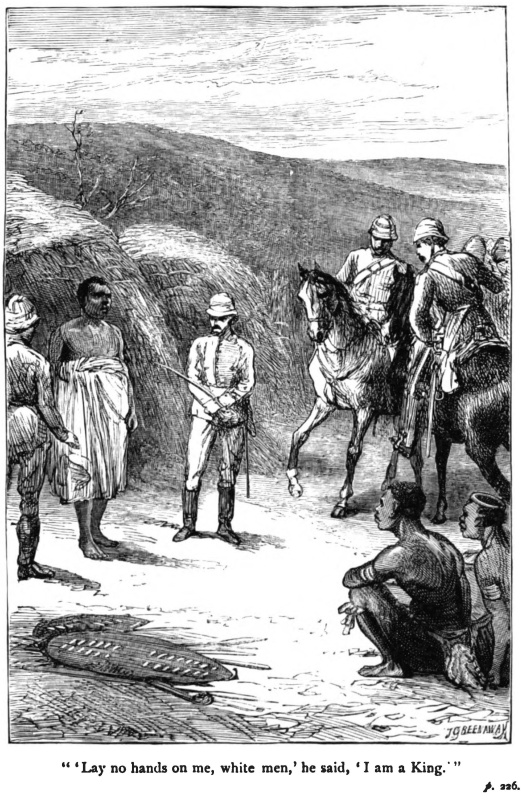
The Zulus offered no resistance. It might be that they felt that the struggle would be hopeless, but it seemed as though all heart and hope had deserted them. They raised a feeble cry. “The white soldiers are here, my father! You are their prisoner.”
There was a moment’s pause, then the door opened, and the huge and sinewy figure of Cetewayo came forth. He looked worn and over-wearied, but he still retained something of his native dignity. George and Vander Heyden stepped up on either side, as if to arrest him, but he waved them off.
“Lay no hands on me,” he said, “white men. I am a king; I surrender not to you, but only to your chief.”
Chapter Fifteen.
The waggons had stopped for the night, the oxen were outspanned, and the native servants were engaged in knee-haltering their masters’ horses, which were then turned into the veldt to graze. They had not yet advanced far enough into the Transvaal country for any danger to be apprehended from wild animals. George and Margetts, assisted by Hardy, were engaged in lighting two large fires, partly to cook the supper, partly to dispel the chill which they felt creeping over them; for, though winter was now past, and the early spring was usually mild and balmy, yet after nightfall it is apt to become extremely cold. There is no country in the world, it may be remarked, more liable to sudden and rapid changes from cold to heat, and again from heat to cold, than that which they were now traversing.
They had left Zululand—that is, Vander Heyden, George, and Redgy had left it—a day or two after the capture of Cetewayo, and proceeded straight to Luneberg, whither the waggons had been despatched from Newcastle to join them. Annchen had travelled under the charge of her brother’s two chief Hottentot servants, Koboo and Utango. Matamo and Haxo had been despatched by their respective masters to join the party at Newcastle, and Hardy arrived the following day from Landman’s Drift. The whole party being assembled, they set off about the end of the first week of September.
There were two waggons, each with its full team of oxen and four servants attached to each. All these belonged to Vander Heyden, and contained valuables of all kinds, household furniture, farm implements, guns and ammunition, and a considerable supply of provisions, it being difficult and sometimes impossible to procure even the commonest articles at various places on their route. They were to proceed first to Heidelberg, by Elandsberg and Standerton; afterwards journeying north of Potchefstroom to Lichtenberg, and so to Zeerust. Supposing them to be able to travel every day, and no casualties to delay them, it would probably be five or six weeks before they would reach their destination. But there might be obstacles of all descriptions to encounter. Heavy rains might oblige them to remain inactive for days together. Disease might attack the cattle, especially the lung disease, of which mention has already been made, to which horses were so liable in that country. There was also a risk from wild animals. The more dangerous beasts, the lion, the rhinoceros, and the like, had become very scarce of late years in all the southern portion of the Transvaal, unable to endure the vicinity of the white man and his rifle. Still they might be met with at various points of their route, and the tiger (that is, the African leopard, which is so-called in that country) and the hyena were still numerous. Annchen and her attendant were accommodated in the best waggon. Vander Heyden and Hardy usually slept in the other, as did the others indeed also, Vander Heyden having courteously offered sleeping berths to George and Margetts. The native servants usually made their bed on the ground outside.
It was now the end of the second day of their journey, and they were beginning to make their way into the wilder country of the Transvaal, leaving the more civilised parts behind them. The road during the greater part of the day had lain across lonely tracts of country—such kraals and farmhouses as they had fallen in with being few and far between. The main features of the scenery had been long undulating downs, over which the tall coarse grass was growing up in abundance, diversified now and then by masses of rock rising abruptly into sharp eminences, and crossed occasionally by deep watercourses overgrown with weeds. These were, in general, difficult and sometimes dangerous to pass. Every now and then herds of springboks came by, bounding straight up into the air, as they caught sight of the travellers, like Jacks-in-the-box, to an astonishing height, and then rushing away with the fleetness of the wind. More rarely elands and hartebeests appeared, and once a number of gnus—these strange animals, which seem to be something half-way between the horse and the ox—went by at their awkward gallop. George and Matamo rode in pursuit and succeeded in killing a hartebeest and two springboks, the more dainty parts of which were cooked for the evening meal.