Notes on the Pawnees. (continued 3)
Reading edition
“They led the naked captive to the posts, and lifting him up, tied first the left hand and then the right to the top cross-pole, and afterward tied the feet below. Every one stood there silent, looking, waiting; the men holding their weapons and the women their sticks and lances. On the ground under the sacrifice was laid the wood for a great fire, which was now lighted. Then the man with the blazing stick stepped forward, but before he reached the captive, the warrior with the bow and arrow, he who had taken the captive, ran up close to the victim and shot him through from side to side, beneath the arms, with the sacred arrow, whose point was of flint, such as they used in the olden time. After the blood had run down upon the fire below, the warrior who carried the buffalo tongue and the heart, placed them on the fire beneath the body. When this had been done the man who carried the owl ran up, and seized the burning stick and burned the body, once under each arm, and once in each groin, in all four times. Then, at a given signal, the males all ran up, and shot their arrows into the body. If any male children were not large enough to shoot, some one shot for them. There were so many arrows that the body was stuck full of them; it bristled with them.
“A man chosen for this purpose now climbed up, and pulled out all the arrows from the body, except the one which was first shot through the side of the sacrifice, and placed them together in a pile on the ground, where they were left. After pulling out the arrows, this man took his knife and cut open the breast of the captive, and putting his hand in the opening, took out a handful of blood, and smeared it over his face, and then jumped to the ground, and ran away as fast as he could. Each of the four men, after he had done his part, ran away very fast, and went down to the river and washed himself. When this had been done the women came with their sticks and spears and struck the body and counted coup on it. Even the little children struck it. After they had done this, they put their sticks together on the ground in a pile, and left them there. By this time the fire was burning up high and scorching the body, and it was kept up until the whole body was consumed. And while the smoke of the blood and the buffalo meat, and of the burning body, ascended to the sky, all the people prayed to Ti-ra´-wa, and walked by the fire and grasped handfuls of the smoke, and passed it over their bodies and over those of their children, and prayed Ti-ra´-wa to take pity on them, and to give them health, and success in war, and plenteous crops. The man who had killed the captive fasted and mourned for four days, and asked Ti-ra´-wa to take pity on him, for he knew that he had taken the life of a human being.
“This sacrifice always seemed acceptable to Ti-ra´-wa, and when the Skidi made it they always seemed to have good fortune in war, and good crops, and they were always well.
“After the sacrifice was over, then came the old women to rejoice over what had been done. They would act as the warriors used to do, when coming back from a war party. They carried the mother corn. They went to the body and counted coup on it, and then went back to the village. Some of them would take the large hollow stalks of the sunflower, and put dust in them, and then blow it out, pretending to shoot, the puff of dust standing for the smoke of a shot. They would go up to the secret lodge, and standing outside of it, would tell the story of how they came to go on their pretended war party, and what they did while they were gone, and what enemies they struck—the whole long story. The people meanwhile would stand about and laugh at them as they did these things. Imitating the warriors, the old women changed their names also. One of the leading old women once took the name ‘Mud on the Meat,’ another, ‘Skunk Skin Tobacco Pouch,’ another ‘Sitting Fish Old Man,’ another ‘Old Man Stepping on the Heart.’ The old men standing about would joke with the old women, and these would joke and make fun of each other.”
The different acts of this sacrifice appear to have been typical of the deeds and necessities of warfare. Thus the feathers of the eagle used on the arrows shot into the captive represented success in war. Their use was a prayer to Ti-ra´-wa that, as these birds were fierce and successful when making an attack, so those who shot might be fierce in war and always conquerors. The burning of the body of the captive with the blazing stick, perhaps, typified the lighting of the sacred pipe, which could only be done by one who had sacrificed a scalp. The shooting arrows into the body by the males and the striking it by the women typified the killing of and counting coup on the enemy. The cutting open the belly was the first act in the sacrifice of the animal, the burnt offering.
It will be noted that this account differs in many particulars from that given by Mr. Dunbar in his papers on this people, but I think it worth recording, as being an independent relation by a very old man, who, I have no doubt, has been an eye-witness of more than one of these remarkable sacrifices.
I know of no satisfactory and detailed account of any of the sacred dances of the Pawnees. There were many of these, among them the corn dance, the buffalo dance, the wild horse dance, the deer, bear, dog dances and so on. I give below an account of the corn dance, as detailed to me by Curly Chief, who said:
“The windy month [March] was the one in which Ti-ra´-wa gave us the seed to cultivate. The first moon of April is the one during which they had a special worship about the corn. Until these ceremonies had been performed no one would clear out the patch where they intended to plant the crop. Everybody waited for this time.
“The Kit-ke-hahk´-i was the only tribe in which this special ceremony was handed down. The Chau-i and Pita-hau-erat worshiped with them. The preparations for this dance are always made by a woman. She has to think about it a long time before she can make up her mind to undertake it. In making ready for the dance, she must furnish the dried meat made from the whole of a buffalo, fat and lean, every part of it. The sack which holds the heart she dries, and fills it with all the kinds of corn—the five colors, the blue corn, which represents the blue sky, the red corn, which stands for the evening sunset, the yellow corn, which typifies the morning sunrise, the white corn, which stands for a white cloud, and the spotted corn, which represents the sky dotted with clouds. All these she puts in the bag, placing in the sack three grains of each at a time. On the special day which has been fixed for the dance, she must offer these things to Ti-ra´-wa. The people are all gathered together, the women standing on the outside of the circle behind, and the men on the inner side of the circle in front. This is a woman’s dance, and yet the men are there in front of the women. These men are the leading warriors of the tribe. They have been off on the warpath, and in time of corn have gone to the enemy. They have been successful in war, and therefore they are with the women. They stand about the circle holding their pipes in their left hands, showing that they are leaders of war parties, and each with the skin of a particular bird[13] tied on top of the head, showing that they are warriors.
“The floor of the lodge must be hard, and swept as clean as it can be. On the left hand side as you look toward the door is a buffalo skull.
“When the day has come all the people are gathered together and are standing about the lodge. The high priest stands at the back of the lodge with the sacred bundles of the three bands before him. Then this leading woman comes forward, and presents to the high priest the dried meat and the sack of corn, and two ancient, sacred hoes, made from the shoulder-blade of a buffalo, bound to a handle by the neck ligament. She places them on the ground before the sacred bundles, the corn in the middle, and the two hoes on either side. With these things she also presents a sacred pipe, filled and ready for lighting, taken from a sacred bundle. Then she steps back.
“The old high priest must well know the ceremonies to be performed. He prays to Ti-ra´-wa and lights the sacred pipe, blowing smoke to heaven, to the earth, and to the four points of the compass. While the ceremonies are going on, the buffalo skull is taken to the sacred place in this lodge, and put in a particular position. Then the leading woman steps forward again, followed by two others. She takes the bag of corn, and the other two women take the hoes, and they stand in front of the high priest. He sings and prays. The leading woman stands in a particular position, as directed by the high priest, holding the bag of corn up to the sky in both her hands; and as he sings, she raises and lowers it in time to the music of the song.
“After these ceremonies the women come forward, holding their hoes in their hands, and dance about the lodge one after another in single file, following the leading woman. Four times they dance about the lodge. She cannot pass the priest the fifth time. These ceremonies and the songs and prayers were to ask for a blessing on the hunt and on the corn, and to learn whether they would be blessed in both. After the women had danced and gone back to their places, everybody looked on the floor of the lodge to see whether there were any buffalo hairs there. If they saw them, they all said, ‘Now we are going to be successful in our hunt and in our corn.’ Everybody said, ‘We are blessed.’
“Then when they would go out on the hunt they would find plenty of buffalo, and the messenger sent back to the village from the hunt would return to the camp and say, ‘We have plenty of corn.’ If they saw a great many buffalo hairs they would get many buffalo; if but few they would get some buffalo.
“The next day after these ceremonies every one would begin to clear up their patches and get ready to plant corn. The leading woman who prepared the dance is respected and highly thought of. After that she is like a chief.
“This ceremony is the next principal thing we have after the burnt offering of the animal and of the scalp. We did not invent this. It came to us from the Ruler, and we worship him through it. He gave us the corn and blessed us through it. By it we are made strong.
“We are like seed and we worship through the corn.”
III. MEDICINE AND MYSTERY.
It has been said that the “medicine men” or doctors among the Pawnees occupied a position by themselves. Their guild was entirely distinct from that of the priests. A priest might be a doctor as well, but not because he was a priest.
The doctors were primarily healers. Their function was to fight disease. Like many other savage nations, the Pawnees believed that sickness was caused by evil spirits, which had entered into the patient and must be driven out if he was to recover. In their treatment of injuries the doctors were often singularly successful. Major North has cited for me a number of instances, in which men, whose hurts had refused to yield to the treatment of the United States Army surgeons, had been cured by Pawnee doctors. Some of these have been detailed elsewhere. As might be imagined, however, the Pawnee treatment of disease was less efficacious. Simple ailments were often treated with success by means of the familiar sudatory, or “sweat house;” but in the case of more serious complaints, the dancing and rattling, which constitute so large a part of the doctor’s treatment, tend to aggravate rather than to check the disease. I have not space to discuss the very interesting subject of the system of therapeutics practiced by the Pawnee doctors. Mr. Dunbar has gone into this matter quite fully, and the reader is referred to his papers for an account of their practice.
As the doctors had to fight evil spirits, it is not surprising that they should have summoned magic to their aid; but this magic probably served its more important purpose in impressing the other Indians with a belief in the doctors’ powers. Some of the performances which took place at the doctors’ dances were very marvellous, and most of them were quite inexplicable to those who saw what was done. That they should have imposed on the Indian spectator is perhaps not surprising; but it is further to be noted that clear-headed, intelligent white men, whose powers of observation have been highly trained, have confessed themselves wholly unable to explain these startling performances, or to hazard a guess as to the means by which they were accomplished. That these things happened as detailed is well authenticated by the testimony of many perfectly credible witnesses.
Other masters of mystery are provided with mechanical aids of one kind or another—some apparatus which assists them in imposing on their audiences, by concealing certain objects, or certain acts, by means of which they cause things to appear different from what they really are. The Pawnee doctors had nothing of this. Their dances were conducted by naked men in a ring surrounded by spectators. The floor of bare earth, packed hard and worn smooth by the tread of many feet, afforded no apparent opportunity for concealment or trickery. Under such conditions were performed their mysteries, a few of which I will mention as they appeared to watchful spectators, distant not more than twenty-five or thirty feet, and often much nearer.
The simplest performances were the swallowing of spears and arrows. These feats were merely mechanical, and were no doubt really as they appeared, the arrows and the spears being driven down the gullet to the distance of a foot or eighteen inches. Instances occurred where men who had swallowed arrows died from the injuries received in the operation. Bear Chief, himself a doctor, and tattooed with a bear on the right side, told me that it was much harder and more painful to swallow an arrow than a spear.
Among the more remarkable performances witnessed and vouched for by my friend, Captain L. H. North, are the following:
Several men, representing elk, came into the ring, and trotted about, so as to be seen by every one, imitating the movements of those animals. To their heads were tied branches to represent horns, and each wore an elk skin thrown over his back. A doctor came into the ring, and handed to the spectators his arrows, which they examined, and found to be ordinary arrows with the usual sheet-iron points. On receiving back the arrows from those who had examined them, the doctor pretended to hunt the elk, and at length shot at them, striking them in the sides or on the legs. The arrows, instead of penetrating the flesh, bounded back, some of them flying fifteen or twenty feet in the air. They appeared to be shot with the full force of the bow, and when picked up and handed to the onlookers, the sheet-iron points were found to be doubled back as if they had been shot against a plate of iron, and the shafts of some of them were split. The elk trotted away and out of the ring without injury.
A man, representing an enemy, came into the ring on foot. A doctor followed, armed with a hatchet, which he passed to the spectators for examination. It was an ordinary hatchet of the tomahawk form. On receiving back the hatchet, the doctor started in pursuit of the enemy, who fled. The doctor overtook him, and with a vigorous blow, sunk the hatchet up to the handle in the enemy’s skull, leaving it there. The wounded man staggered on, passing within five or six feet of the ring of spectators, who plainly saw the blood from the wound running down the man’s face, and dripping from his hair behind. They saw also the gray brain-matter oozing from the wound. The wounded man was taken from the ring into the doctor’s lodge. A few days later he was seen about, and in his usual health.
A small boy, six or eight years of age, was led into the ring quite naked. He was placed upon the ground, and two men sat upon him, one on his chest, the other on his legs. With a knife an incision was made in his belly; one of the doctors inserted his fingers; and, after feeling about, pulled out of the cut what looked like a portion of the child’s liver. This he cut off and gave to the other man, who ate it. The remainder of the liver was crowded back into the hole, and the boy was carried off. Subsequently he was seen about, apparently in good health.
A man representing a bear came into the ring and was pursued by a number of Indians, who shot arrows at him for some time, without appearing to injure him. At length, however, an arrow pierced him through the bowels, and the wound was plainly seen on each side. The man fell, and appeared to be dying. He was removed to the lodge, and in a short time was entirely recovered.
Major North saw one of these bear performances, in which, the pretended bear having attacked one of his pursuers, the latter slashed him across the abdomen with a large knife, inflicting a cut from which the bowels hung down so that they dragged on the ground. The bear was carried off, and in a short time was healed, and went about as usual.
Major North told me that he saw with his own eyes the doctors make the corn grow. This was in the medicine lodge. In the middle of the lodge, the doctor dug up a piece of the hard trodden floor of the lodge, about as large as a dinner plate, and broke up between his fingers the hard pieces of soil, until the dirt was soft and friable. The ground having thus been prepared, and having been moistened with water, a few kernels of corn were buried in the loose earth. Then the doctor retired a little from the spot and sang, and as the place where the corn was buried was watched, the soil was seen to move, and a tiny green blade came slowly into view. This continued to increase in height and size, until in the course of twenty minutes or half an hour from the time of planting, the stalk of corn was a foot or fifteen inches in height. At this point Major North was obliged to leave the lodge, to take out a white woman who was fainting from the heat, and so did not see the maturing of the corn. All the Indians and white men who remained assured him that the stalks continued to grow until they were of full height, and that they then tasseled out and put forth one or more ears of corn, which grew to full size, and that then the doctor approached the plant, plucked an ear, and passed it to the spectators.
Similar to this was a feat performed with a cedar berry. The berry was passed around among the spectators for examination, and was then planted as the corn had been. Then after a few moments the doctor approached the spot, put his thumb and forefinger down into the soft dirt, and seemed to lay hold of something. Very slowly he raised his hand and was seen to hold on the tips of his fingers the end of a cedar twig. Slowly his hand was moved from the ground, the twig growing longer and longer. When nine or ten inches high it began to have side branches. The doctor still holding the topmost twig of what was by this time a cedar bush, continued to lift his hand very slowly, until it was about three feet from the ground, and then let go of the bush. Then presently he took hold of the stem close to the ground, and, seeming to exert a good deal of force, pulled up the bush by the roots; and all the people saw the bush and its bunch of fresh and growing roots.
Enough has been said of these mystery ceremonies to indicate that they were very remarkable. The circumstances under which they were performed would seem to remove them from the more commonplace tricks of professional jugglers. And I have never found any one who could even suggest an explanation of them.
As might be inferred, these mysterious doings greatly impressed the Pawnees; and the older men among them have a vast store of reminiscences of past dances, which they delight in repeating. In the course of a long talk with Bear Chief one evening, he recounted a number of instances which he had seen. He said:
“A man in our tribe was blind; he could not see. He could travel in the night as well as we can in the day, but when daylight came he could see nothing. At one time he called together his relations, and told them that, though blind, he wished to lead out a war party. He said, ‘I know that I, with my party, will kill an enemy.’ They started out, a young man leading him by the hand all day long. After they had been out several days, he told the young men to be ready, that the next morning he was going to kill an enemy. The next morning, while they were traveling along, they saw an enemy, and surrounded and killed him. They took the scalp and brought it home, and he had great credit, because, being blind, he had killed an enemy. They were all surprised that a blind man should have killed an enemy. He sacrificed the scalp to Ti-ra´-wa, and was made a warrior, and went to the sacred lodge and told the story of his campaign, and was made a warrior—a blind warrior.
“It was a wonderful thing for a blind person to be able to travel in the night. This must have come from Ti-ra´-wa.
“One of the wonderful things done by this man was at a medicine dance. Everybody was there. He stood up with his bearskin over him, and was led out before the people. A cedar branch was given him, and he sharpened the end where it had been cut off, and stuck it in the ground. Everybody was now asked to pull up this branch, and many tried to do so, but the strongest men in the tribe could not move it. He could pull it up, as if it were stuck in the mud. He thrust the pointed end in the ground again, and asked the doctors to pull up the cedar branch. They tried to do so, but could not stir it. The chiefs also were asked to try to do this. They tried, but could not move it. Something seemed to hold it in the ground. After everybody had tried to pull it up, and failed, this blind man went to it, and taking hold of it, pulled with all his strength, and pulled up with it about six feet of roots. There lay the tree with all it roots fresh and growing.
“There was, in my young days, a certain brave man in the tribe. His name was Elk Left Behind. He was so brave that, when the Sioux surrounded him, he would kill so many that he would scare the rest away. In one of the doctors’ dances he had the skin of a fawn in his hands. He called out to the people, ‘Now, you people, watch me; look close and see what I shall do, and you will find out what my bravery is, and that it all comes from this that you see.’ In our presence he shook this fawn skin, and the fawn slipped out of his hands and then stood before him, a living fawn looking at him. ‘That is what I mean,’ said he. ‘If the enemies surround me, that is the way I come out of it. The fawn can run so fast that it can never be caught, nor can it ever be shot.’
“This man was wonderful. He used to imitate the deer and the elk. He could never be driven into timber or brush, or where there were thickets. He said, ‘If I am ever wounded, it will be when I go into timber or brush.’ He always wanted to be in the open plain where he could be surrounded. He never ran to the timber for shelter.
“If they suspected that the Sioux were coming to attack the village, he would load a gun and shoot it off. If the ball came back to him, there were no Sioux coming. If it did not, then they would be coming. When I was present it always came back to him. There were no Sioux coming.
“At one time in the doctors’ dance I saw him driving ten young men, who pretended that they were deer. He had a gun and loaded it, and shot the ten men, one after another, through the side. They fell down wounded, and then got up and limped off half dying. He drove them around the ring so that the people might see their wounds. After they had looked at them, he went up to the first and slapped him on the back, and the ball dropped out of him on to the ground, and the man straightened up, healed. So he did to all, up to the tenth man, and they were all healed. This was wonderful.
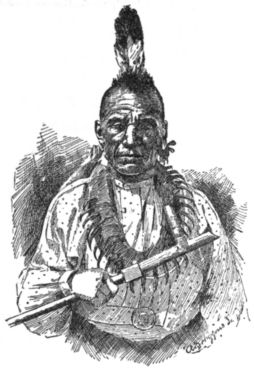
SUN CHIEF—KIT-KE-HAHK´-I.
“At one time he wanted to show the people that he could stand anything. He and two others were attacked by Sioux. He said, ‘I want to be wounded; let us go to the thickets.’ They did so, and a Sioux shot him through the back, and the other two were wounded, but he healed them all after they had got away from the Sioux.
“Another man in the doctors’ dance had four young men pretend that they were horses. All had manes and tails, and were painted to imitate horses. He had a gun, to which was tied a scalp. He loaded the gun, and while he was doing this the horses ran off, and stood looking back at the man. He cocked the gun and laid it on the ground pointing toward the horses, and placed the scalp near the trigger, and walked some steps away. Then he motioned to the scalp and the gun went off, and one of the horses went down wounded. It seems that the ghost of the scalp obeyed his motion, and shot off the gun. He loaded the gun again, and placed it on the ground as before. The second time he went way off, and as soon as he waved his hand and said, ‘wooh,’ the gun went off and another horse went down. This was repeated until all the horses were down. The people examined them and saw that they were really wounded in the breast. The man went up to them and they seemed to be dying and vomited blood, and the young man slapped them, and the balls came out of their mouths, and as soon as the balls came away from them they were healed.
“There were two people, a brother and sister, children of a man who had been helped by a bear. One time when we were having a doctors’ dance, the sister and brother came forward, each carrying five cedar branches about three feet long. They rolled a big rock into the middle of the lodge, so that all might see what they were going to do. Then they called ten private men who were not doctors, and told them to thrust the ends of the branches into the stone as if they had grown there, and they sang:
“‘See the trees growing in the rock; The cedar tree grows in the rock.’
“These cedar branches were cut square off at the butt, and were set on the stone. They were not big enough to be even and balance, but still they stood upright, as if grown from the rock. The doctors tried to blow them down with their fans made of eagle feathers, but they could not do it. You could not blow them off nor pull them off. At length the men who put them there were told to take them off. They had hard work to do it, but at last they succeeded.
“The sister (I saw her do it) put her hands up to the sun, and then putting them on the ground and scratching and throwing up dust, she would take up her hands, and have hands like a bear, with hair and long claws.
“She used to understand how to make plums and other fruits grow on trees. She supplied the doctors with choke cherries and plums. The doctors had trees brought in that had no fruit on them. She would make the plums grow, and shaking the tree, they would fall down, and everybody would have a taste of them. This was at a doctors’ dance.”
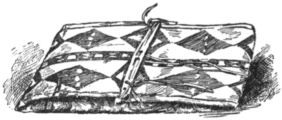
A PARFLECHE.
LATER HISTORY.
I. REMOVAL TO THE INDIAN TERRITORY.
THE project of removing the Pawnees from their reservation on the Loup River in Nebraska appears to have been first heard of in the year 1872. The Pawnee reservation was close to civilization, and the settlers moving west into Nebraska coveted the Indians’ lands. It was the old story, the same one that has been heard ever since the rapacious whites first set foot on the shores of this continent.
The Pawnees were strongly attached to their home in Nebraska. They had always lived there, and were used to it. Their forefathers were buried there. Up to the winter of 1873-74 they had no idea of moving. But they were constantly being subjected to annoyances.
Settlers crowded in close to the Pawnee agency, and even located on it on the south and east, and in the most matter of fact way drove their teams into the Pawnee timber, and cut and carried off the Pawnee wood, on which the tribe depended for fuel and for building materials. This open robbery gave rise to constant disputes and bickerings between the Indians and the whites, in which the former were invariably worsted. On the south and east side of the reservation the crowding and the depredations were continuous. On the north and west the reservation was exposed to frequent incursions from the different bands of Sioux. War parties came down from their reservations, stole the Pawnees’ horses, killed their women while at work in the fields, and sometimes even attacked the village. These attacks, though always successfully repelled by the Pawnees, were a continual source of annoyance and irritation to them, while their consistent desire to obey the rules laid down for their guidance by the Government prevented them from retaliating in kind upon their enemies.
The first proposition to remove the Pawnees to the Indian Territory originated with the whites, but there is some reason to think that an independent movement with the same object in view was made by members of the Pawnee tribe. As nearly as I can learn from conversation with Indians who took a leading part in the movement, this project for a removal of a part of the tribe to the south originated with Lone Chief, the Kit-ke-hahk´-i; and was taken up and supported by Left Hand, known also as Spotted Horse, a turbulent spirit, who was killed a few years ago by an United States marshal; and by Frank White, an intelligent soldier of the Chau-i band.
In the summer of 1870, Lone Chief led a visiting party, which is said to have numbered three hundred men, south to the Wichitas. When this party turned back to go north in the fall, many of them were sick with chills and fever—a disease unknown to them until that time—and some died on the way. At this time the notion of the removal had not been suggested, but it is probable that even then Lone Chief was considering the advisability of moving south with his own immediate family, and taking up his residence with the Wichitas. He had not yet spoken of this project, however, but in the winter of 1871-72 he announced his intention of doing this, and even started on his journey, but for some reason turned back.
The next winter—1872-73—while the tribe was absent on the buffalo hunt, the northern Sioux came down and stole from the Pawnees a number of horses. This made the Pawnees uneasy, and some war parties started out. It was at this time that Lone Chief conceived the idea of increasing the company which should proceed south with him. After some consideration and consultation, Lone Chief, Spotted Horse and Frank White planned that a small party should go south, and visit the different tribes in the Indian Territory, for the purpose of learning how these tribes would regard a general movement of the Pawnees down into their country. The plan was not fully developed until this small party, of which Spotted Horse and Frank White were the leaders, was on its way.
The party visited first the Otoes and Kaws, and then going south came to the Wichitas, Comanches, Kiowas and Apaches, and were everywhere hospitably entertained, and given presents of horses. They asked the chiefs and headmen of the various tribes which they visited to come together at a certain specified time at the Wichita camp, telling them that they had something that they wished to say to them there. The Pawnees then returned to the Wichita village, and awaited the appointed time.
Soon the representatives of the different tribes began to arrive. Day after day they kept coming in, until all were present. When they had assembled in council, Spotted Horse rose to speak. He said, “My brothers, I want you to know one thing—We, the Pawnees, want to be brothers, and to be at peace. I have made up my mind to come down here with my party of Pawnees to live with you.”
The chiefs representing the different tribes all expressed their satisfaction at this announcement, and urged him to come as he had intended. They said, “We have good land here, and lots of buffalo. We shall be glad if you decide to come.” After all had spoken, Spotted Horse again stood up and said, “Brothers, there is here with me one leading man among the Pawnees. He, also, will tell you what he thinks about this.” Frank White then spoke and said that he intended to accompany Spotted Horse when he should move south. The chiefs of the different tribes again expressed the hope that they would carry out their intentions, and arrangements were made with the tribes that they should come down and live with them.
It is stated that just before this visiting party started north toward their home, news came from the Pawnee agency that the tribe had been attacked and massacred on the Republican River by Sioux, and as they journeyed north they learned the details of the occurrence. On reaching the village, Spotted Horse and Frank White reported to Lone Chief and to their families what they had done, and their action was confirmed. The chiefs of the tribe and the agent were then notified. Soon afterward a general council was held, at which public announcement of their intention was made by these three men. To most of those present the project was wholly new, and there was a good deal of confusion in the council, the people exclaiming at the news and discussing it.
Efforts were made by the chiefs of the bands to dissuade those who proposed to move. The Head Chief, Pi´ta Le-shar, tried to persuade Frank White not to leave the tribe, but he said that he had promised, and he should go.
In the autumn of 1873, Lone Chief, Spotted Horse and Frank White, accompanied by their personal following, started south. With them went about two-thirds of the tribe. The three leaders had a pass from the Superintendent of Indian Affairs at the Pawnee agency. The chiefs of the tribe were still bitterly opposed to the notion of the removal, and Pi´ta Le-shar, the Head Chief, exerted all his influence to prevent the movement. After the migrating party had gone about fifty miles, messengers from the chiefs overtook them, directing them to return to the village. The march was stopped, and the three leaders, as delegates, returned to the agency to learn the cause of the order. They reached there in the evening, and spent the whole night conferring with the agent (Burgess), to whom they gave presents to persuade him to accede to their request to continue their journey. Lone Chief was the most determined, and insisted that they should be permitted to go on without interference.
At length the authorities yielded, and a new pass having been given them, they returned to the camp. The responsibility of taking away so large a part of the tribe was weighing heavily on these three men, however, and they determined to send back all except their own families. On reaching the camp, therefore, they told the Indians that they all were to go back, but hid their own horses, pretending that they had strayed off, so that the main body would start back without them. After the others had moved out of camp on their return march to the agency, the lost horses were at once found, and the three men with their families went on south.
The following year all the tribe followed, except the Skidi, Lone Chief, and a few personal friends, who still refused to leave the old reservation. This small company remained in their old home one year longer, and then they, too, went south to their present reservation.
Shortly before the removal of the tribe to the Indian Territory in 1874, Pi´ta Le-shar, the Head Chief, was shot, and died from his wound. It has been stated, and generally believed, that his death resulted from the accidental discharge of his own pistol, but there are well-informed persons who believe that he was murdered. There is reason to believe that the shot did not come from his own weapon, but that he was shot by a white man in order to get rid of his influence, which was consistently exerted to keep the Pawnees in their northern home. The Chief’s wound was not a serious one, and he was doing well under the charge of a white surgeon, when he was induced to put himself in the care of a Pawnee doctor, under whose treatment he died.
Ti-ra´-wa Le-shar, another bitter opponent of removal, had been killed in 1873; and the death of Pi´ta Le-shar left Lone Chief, Skidi, the only man of strong character to oppose the movement.
The full history of the plot to eject the Pawnees from their northern home may never be recorded, for there are few men alive who know the facts. If it should be written there would be disclosed a carefully planned and successfully carried out conspiracy to rob this people of their lands. This outrage has cost hundreds of lives, and an inconceivable amount of suffering, and is another damning and ineffaceable blot on the record of the American people, and one which ought surely to have had a place in Mrs. Jackson’s “Century of Dishonor.”
II. PRESENT CONDITION AND PROGRESS.
During the first four years of their sojourn in the Indian Territory the condition of the Pawnees was most miserable.
They had left the high, dry, sandy country of the Loup, and come south into the more fertile, but also more humid country of the Indian Territory, where they found a region entirely different from that to which they had been accustomed. Soon after their settlement on their new reservation, they were attacked by fever and ague, a disease which had been unknown to them in their northern home, and many of them died, while all were so weakened by disease and so discouraged by homesickness that their nature seemed wholly changed. They lost their old spirit and their energy, and were possessed only by a desire to return to their northern home. This was, of course, impossible, since their old reservation had been thrown open to settlement, and in part occupied by the whites. During the first ten years of their sojourn in the Territory more than one of the agents appointed to look after the Pawnees were either incompetent or dishonest, so that the people suffered from lack of food, and some of them even starved to death. They were miserably poor, for they did not know how to work, and no one tried to encourage or help them to do so. The few horses which they had were stolen from them by white horse thieves, and they were now in a country and under conditions where they could not practice their old war methods. The tribes against which their expeditions had once been made were now their neighbors and their friends.
When Major North and his brother Luther visited the agency in 1876, to enlist scouts for General Crook’s northern campaign, they found the Pawnees in a pitiable condition. They were without food, without clothing, without arms and without horses. Their sole covering consisted of cotton sheets, which afforded no protection against cold and wet. It is not strange that under such circumstances the people died off fast. At this time Major North had orders to enlist only one hundred scouts, but he was greatly perplexed in selecting his men, for four hundred wanted to go with him. Every able-bodied man in the tribe, and many who were not able-bodied, tried to get their names on the muster roll. Each man, at any cost, sought to get away from the suffering of his present life; from the fever that made him quake, the chill that caused him to shiver, and above all from the deadly monotony of the reservation life. After Major North had enlisted his quota of men and started with them on his way north, more than a hundred others followed him on foot to Arkansas City, in the hope that he could be persuaded to increase his force, or else that some of those enlisted would drop out through sickness, and there might be room for others.
The wretched condition of the Pawnees continued up to about 1884 or 1885. Before this time the people had become in a measure acclimated in their new home, and had come to realize that it was absolutely necessary for them to go to work if the tribe was to continue to exist. They began to work; at first only a few, but gradually many, of the Skidi, and then the Chau-i and the Kit-ke-hahk´-i. Presently a point was reached where it was no longer necessary to issue them Government rations. They raised enough on their farms to support themselves. Each year of late they have done better and better. A drought one season, and a cyclone another, destroyed their crops, but, undiscouraged and undaunted, they push ahead, striving earnestly to become like white men. The Pita-hau-erats are the least progressive of the four bands, and many of them still live in dirt lodges, and cultivate patches of corn scarcely larger than those tilled in their old villages; but as the other bands advance, and as the results of manual labor are seen and understood by those who are more idle, they, too, will catch the spirit of progress, and will lay hold of the plow.
Last March, as I drove along toward the agency, and as we came in sight of Black Bear Creek, I was surprised to see what looked like good farm houses dotting the distant bottom. A nearer view and a closer investigation showed me that the most well-to-do of the Pawnees live in houses as good as those of many a New England land owner, and very much better than those inhabited by new settlers in the farther West. Many of them have considerable farms under fence, a barn, a garden in which vegetables are raised, and a peach orchard. They realize that as yet they are only beginning, but to me, who knew them in their old barbaric condition, their progress seems a marvel. Nowadays by far the greater number of the Pawnees wear civilized clothing, ride in wagons, and send their children to the agency school. They are making rapid strides toward civilization, just such progress as might be expected from the intelligent and courageous people that they are and always have been.
The Pawnees receive from the Government a perpetual annuity of thirty thousand dollars, of which one-half is paid in money, and one-half in goods. Besides this they have a credit with the Government of about two hundred and eighty thousand dollars (the proceeds of the sale of their old reservation in Nebraska), on which they receive interest; and for some years past they have leased to cattlemen about one hundred and twenty-five thousand acres of their reservation, for which they receive about three thousand eight hundred dollars per annum. It will thus be seen that in addition to the crops which they raise, the tribe is fairly well provided with money. While a considerable part of this is, of course, wasted, being spent for trifles and for luxuries, it is nevertheless the fact that a certain proportion of it is invested by the Indians in tools, farming implements, and in furniture. Three years ago the Indians merely dropped their corn into the furrow, while some planted with a hoe. There was then only one corn-planter on the reservation. Now there are thirteen of these implements of improved pattern, bought by the Indians, and paid for with their own money. Reapers and mowers belong to the Indian Department, and are loaned, not issued, and these pass round from one family to another. Within the last four years one hundred breaking and stirring plows have been issued, and one hundred and five double shovel cultivators. Eighty wagons and one hundred and fifty sets of harness have been issued in the same length of time. Besides these, eight two-horse cultivators are loaned them by the Government.
The Pawnees seem to be saving up their money to put into farming implements, and they are looking ahead. Two-thirds of the houses built in the last three years have been built by the Chau-i, who are pushing the Skidi hard in their advance toward civilization.
The following table, taken from the official papers of the Indian Bureau, gives some statistics as to the progress made by the Pawnees during the last three years:
1885. 1886. 1887. 1888.
Number of Indians 1,045 998 918 869
Number of male Indians .... 483 414 ....
Number of female Indians .... 515 504 ....
Number speaking English .... 289 .... 225
Number can read (youths) .... 100 90 100
Number can read (adults) .... 58 60 75
Number wearing citizen’s dress wholly .... 300 350 200
Number wearing citizen’s dress in part .... 400 450 600
Number doing some farming .... 324 400 *125
Number having other civilized work .... 5 6 *7
Number of births .... 28 45 54
Number of deaths .... 77 125 106
Houses occupied by Indians .... 61 82 98
Proportion of Indians self-supporting .... ⅔ ½ ⅔
Farming operations—
Number of acres cultivated by Indians 971 1,360 2,094 2,560
Number of acres broken by Indians .... 67 310 340
Number of acres under fence 400 1,597 2,597 5,200
Number of rods fencing put up during year 200 4,435 2,181 2,975
Produce raised by Indians—
Number bushels of wheat 1,177 1,273 5,000 2,500
Number bushels of corn, estimated 35,000 26,120 30,000 60,000
Number bushels of oats 969 .... 640 2,300
Number bushels of potatoes 100 100 Est. 2,500 ....
Number bushels of onions 10 50 100 150
Number bushels of beans 300 .... 500 750
Number of melons 5,225 50,000 50,000 ....
Number of pumpkins 3,000 5,000 .... ....
Number tons of hay 500 .... 600 800
Live stock owned by Indians—
Horses, estimated .... 1,200 1,400 1,500
Mules, estimated 15 20 20 25
Cattle, estimated 300 380 575 500
Hogs, estimated 100 .... 200 ....
Fowls, estimated 200 2,500 2,500 3,000
* Families.
Twelve allotments of land made 1888. Whole number allotments to date (1888), 175. In 1885 Indians sawed 50,050 feet of lumber, and cut 126 cords of wood.
In 1886 the Indians hauled 83,814 pounds of freight, for which they were paid $541.54.
During the year 1888 three Indian apprentices learned a trade.
Besides the crops raised, the Indians during 1888 sawed 50,000 feet of lumber, and cut 300 cords of wood.
In 1886 a severe cyclone and hail storm destroyed the growing crops, and in 1887 a prolonged drought again ruined them. During these two years it was necessary to issue to the Indians half rations and one-third rations respectively. This year (1888-89) no rations have been issued.
As will be seen by these figures, corn is the principal crop raised by the Pawnees, and a large part of the surplus beyond their own wants is sold at from twenty-five to fifty cents a bushel to the dealers in Arkansas City, or to the cattlemen in the neighborhood. The Pawnees have as yet few cattle, their old meat-eating habits have not yet been overcome, and there is a tendency among them to eat any cattle they may obtain rather than to use them for breeding purposes. They ought to be encouraged to keep cattle, to which they could feed their corn, and in this way obtain a better return for their labor than is yielded by the direct sale of the grain. They are fairly well provided with horses, but most of these are small, and of the old-fashioned Indian pony type. They should be encouraged to raise a better class of horses, and at least two well bred heavy stallions should be kept by the Government at Pawnee for Indian use. There is one now at Ponca, thirty-five miles away, but the Pawnees will not take their mares so far.
Much of the improvement in the condition of the Pawnees has taken place within the last three years, and much of it has been due, as I believe, to the wisdom and judgment of Major Osborne, their agent, and to the Messrs. McKenzie, who have for three years or more been the clerks directly in charge of these people. These gentlemen appear to have been honest and firm, and yet helpful in their treatment of the people under their charge, and the results of their administration show for themselves, and are something in which these officials may feel a just pride.
Few and rapidly diminishing in numbers as are the Pawnee people, I have yet confidence that by the innate strength of their character their decline may be checked, and their race may rise again. It can never do so in its old purity. It must take to itself fresh blood from other stocks, and thus renew its vitality. What I hope for the Pawnee, to-day and in the future, is that the native vigor of the race, the strong heart and singleness of purpose, which in ancient times led the wild brave to success on his warpath, and gave his tribe so high a place among the savage warriors of the plains, may now be exercised in the pursuits of peace; and that the same qualities may give to these earnest toilers, as they tread new paths, strength, courage and endurance to hold a front rank among those Indians, who, to-day so far behind, are nevertheless resolutely setting their steps toward a place with civilized people.
But whatever the fate of the Pawnee people—whether, like so many other native stocks, it shall dwindle away and disappear, leaving behind it no reminder of its existence, or whether its native force shall enable it under its new conditions to survive and make some mark—we may remember it always as a race of strong, brave people, whose good qualities are deserving of more than a passing tribute.
* * *
It was the last day of my stay at the Pawnee agency. I had seen many an old friend; had laughed and joked with some over incidents of former years, and with others had mourned over brave warriors or wise old men who were no longer with us. My visit had been full of pleasure, and yet full of pain. When I had first known the tribe it numbered more than three thousand people, now there are only a little more than eight hundred of them. The evidences of their progress toward civilization are cheering. They are now self-supporting. They no longer die of hunger. But the character of the people has changed. In the old barbaric days they were light-hearted, merry, makers of jokes, keenly alive to the humorous side of life. Now they are serious, grave, little disposed to laugh. Then they were like children without a care. Now they are like men, on whom the anxieties of life weigh heavily. Civilization, bringing with it some measure of material prosperity, has also brought to these people care, responsibility, repression. No doubt it is best, and it is inevitable, but it is sad, too.
It was my last day, and I was again sitting with Eagle Chief, telling him that the time had come for me to go. He said, “Ah, my son, I like to see you here. I like to sit with you, and to talk over the old times. My heart is sick when I think that you are going away, and that we may never see each other any more. But,” he added, solemnly, “it may be that Ti-ra´-wa will be good to us, and will let us live a long time until we are very old, and then some day we may meet again.”