Hero Stories.
Reading edition
COMANCHE CHIEF.
The Peace-Maker.
I.
MANY years ago there lived in the Ski´-di village a young man, about sixteen years old. His name was Kut-a´wi-kutz (the hawk). At this time the Pawnees wore their hair in the ancient fashion, cut as the Osages wear theirs; the whole head was shaved except a roach running back from the forehead beyond the scalp lock.
A war party went off to the south and he joined them as a servant. They went a long way and a long way, traveling far, but they got no horses and came back. Afterward another party started off on the warpath, and he went with it. They traveled many days, going to the southwest, and at length they came to a camp, and hid themselves to wait until it was dark. It was a camp of the Comanches.
When night had come they all went into the camp to steal horses. This young man went to a lodge near which stood three horses, two spotted horses and one gray. They were tied near the door of the lodge, and from this he thought they must be fast, for the Indians usually tie up their best horses close to the lodge door, where they will be under their eyes as much as possible. He went to the lodge to cut the ropes, and just as he was about to do so he thought he heard some one inside. He stepped up close to the lodge, and looked in through a little opening between the door and the lodge, and saw a small fire burning, and on the other side of the fire was sitting a young girl, combing her long hair. The young man looked around the lodge to see who else was there, and saw only an old man and an old woman, and the fire-maker. He cut the ropes of the two spotted horses standing outside, led the horses out of the camp, and met his companion. To him he said, “Now, brother, you take these horses and go to the hill where we were hiding to-day, and wait for me there. I have seen another fine spotted horse that I want to get; I will go back for it and will meet you before morning at that place.”
He went back, as if to get the spotted horse, but returned to the lodge where the girl was. He went all around it, and looked at it carefully. He saw that there were feathers on the lodge, and rows of animals hoofs hanging down the sides, which rattled in the wind, and to one of the lodge-poles was tied a buffalo tail, which hung down. Then he went back to the door and looked in at the girl again. She had braided her hair and was sitting there by the fire. He stayed there a long time that night looking at her. Toward morning he went to look for his companion. When he met him he told him that some one had taken the spotted horse before he got to it; he could not find it. When the party all met next morning, they found that they had taken a lot of horses, and they started north to go home. They reached the Pawnee village, and every one was glad of their success.
After this, whenever this young man saw anything that was nice or pretty, such as medals, ear-rings, finger rings for women, beadwork leggings, bracelets, necklaces, wampum, beads—things that the Comanches did not have—he would give a pony for it. For one year he went on like this, gathering together these pretty things. When the year had gone by he had no horses left; he had given them all away to get these presents. He packed all these things up in a bundle, and then spoke one night to his friend, saying, “I intend to go off on the warpath again, and I would like to have you go with me; we two will go alone.” His friend agreed to go.
II.
Before the time came to start, other young men heard of it, and several joined them. There were eight of them in all. Kut-a´wi-kutz was the leader. He told his young men that they were going to a certain place where he knew there were lots of spotted horses to steal. They started out on foot. After traveling many days, they came to the place where the camp had been at the time he saw the girl. There was now no camp there.
They went on further, and at length came to a camp and hid themselves. When night came the leader told his men to remain where they were hiding, and he would go into the camp and see if there were any horses to take. He went through all the camp looking for the lodge in which he had seen the girl, but he did not find it. Then he went back to where the young men were hiding, and told them that this was not the camp they were looking for; that they did not have here the spotted horses that they wanted. In the camp of the year before there had been many spotted horses.
The young men did not understand this, and some of them did not like to leave this camp without taking any horses, but he was the leader and they did as he said. They left that camp and went on further.
After traveling some days they came to another camp, and hid themselves near it. When night came on Kut-a´wi-kutz said to his young men, “You stay here where you are hiding, and I will go into this camp and see if it is the one we are looking for.” He went through the camp but did not find the lodge he sought. He returned to the hiding place, and told the party there that this was not the camp they were looking for, that the spotted horses were not there. They left the camp and went on.
When they had come close to the mountains they saw another camp. Kut-a´wi-kutz went into this camp alone, and when he had been through it, he went back to his party and told them that this was the camp they had been looking for. Then he sent the young men into the camp to steal horses, and he put on his fine leggings and moccasins that he had in his bundle, and painted himself and went with them. He took a horse and his friend took one. They met outside the village. He told his friend to get on his own horse and lead the other, and with the rest of the party to go off east from the camp to a certain place, and there to wait for him. “I have seen,” he said, “another fine horse that I like, and I wish to go back and get it.”
His friend looked sorrowfully at him and said, “Why are you all dressed up like this, and why is your face painted? What are you doing or what is in your mind? Perhaps you intend to do some great thing to-night that you do not want me, your friend, to know about. I have seen for a long time that you are hiding something from me.”
Kut-a´wi-kutz caught his friend in his arms and hugged him and kissed him and said, “You are my friend; who is so near to me as you are? Go on as I have said, and if it turns out well I will tell you all. I will catch up with you before very long.”
His friend said, “No, I will stay with you. I will not go on. I love you as a brother, and I will stay with you, and if you are going to do some great thing I will die with you.”
When Kut-a´wi-kutz found that his friend was resolved to remain with him, he yielded and told him his secret. He said to him, “My brother, when we were on the warpath a year ago, and I took those two spotted horses, I heard a little noise in the lodge by which they were tied. I looked in and I saw there a girl sitting by the fire combing her hair. She was very pretty. When I took the spotted horses away, I could not put that girl out of my mind. I remembered her. Brother, when we went back home that girl was constantly in my mind. I could not forget her. I came this time on purpose to get her, even if it shall cost me my life. She is in this camp, and I have found the lodge where she lives.”
His friend said, “My brother, whatever you say shall be done. I stay with you. You go into the camp. I will take the horses and go to that high rocky hill east of the camp, and will hide the horses there. When you are in the village I will be up in one of the trees on the top of the hill, looking down on the camp. If I hear shooting and see lots of people running to the lodge I will know that you are killed, and I will kill myself. I will not go home alone. If I do not see you by noon, I will kill myself.”
Kut-a´wi-kutz said, “It is good. If I am successful I will go up there after you, and take you down into the camp.”
They parted. The friend hid the horses and went up on the hill. Kut-a´wi-kutz went into the camp.
III.
It was now the middle of the night. When he came to the lodge, he saw there was a fire in it. He did not go in at once; he wanted the fire to go out. He stayed around the lodge, and gradually the fire died down. It was dark. He went into the lodge. He was painted and finely dressed, and had his bundle with him. He took his moccasins off and his leggings, and hung them up over the girl’s bed; then strings of beads, then five or six medals, bracelets, ear-bobs, beaded leggings, everything he had—his shirt. He took his blanket, and spread it over the bed where the girl was lying, stepped over the bed, and crept under his own blanket, and lay down by her side.
When he lay down she woke up, and found that there was some one lying by her, and she spoke to him, but he did not answer. He could not understand her, for he did not know Comanche. She talked for a long time, but he did not speak. Then she began to feel of him, and when she put her hands on his head—Pi-ta´-da—Pawnee—an enemy! Then she raised herself up, took a handful of grass from under the bed, spread the fire and put the grass on it. The fire blazed up and she saw him. Then she sprang up and took the top blanket, which was his, off the bed, and put it about her, and sat by the fire. She called her father and said, “Father get up; there is a man here.”
The old man got up, and got his pipe and began smoking. This old man was the Head Chief of the Comanches. He called the servant, and told him to make a fire. The girl got up and went over to where her mother was lying and called her. The mother got up; and they all sat by the fire.
The old man smoked for a long time. Every now and then he would look at the bed to see who it could be that was lying there, and then he would look at all the things hanging up over the bed—at the medals and other things. He did not know what they were for, and he wondered. At length the old man told the servant to go and call the chiefs of the tribe, and tell them to come to his lodge.
Presently the chiefs came in one by one and sat down. When they had come there was still one brave who ought to have come that was not there. His name was Skin Shirt; the father wanted him. He sent for him three times. He sent word back to the chief to go on with the council, and that he would agree to whatever they decided. The fourth time he was sent for he came, and took a seat by the chief, the girl’s father. This brave spoke to Kut-a´wi-kutz, and told him to get up, and take a seat among them. He did so. The girl was sitting on the other side of the fire. When he got up, he had to take the blanket that was left, which was the girl’s. He put it around him, and sat down among them.
When the chiefs came in, there was among them a Pawnee who had been captured long ago and adopted by the Comanches, and was now himself a chief; he talked with Kut-a´wi-kutz and interpreted for him, telling him everything that was said as each one spoke.
After the young man had seated himself, the chief filled his pipe, and gave the pipe to his brave to decide what should be done with this enemy. The brave took the pipe, but he did not wish to decide, so he did not light it, but passed it on to another chief to decide. He passed it on to another, and he to another, and so it went until the pipe came back to the Head Chief. When he got it again, he asked Kut-a´wi-kutz, “Why have you come here this night and lain down in my lodge, you who are an enemy to my people? And why have you hung up in the lodge all these strange things which we see here? I do not understand it, and I wish to know your reasons.”
The boy said to him, “A long time ago I came south on the warpath to steal horses. I traveled until I came to your camp. I saw three horses tied outside a lodge, two spotted horses and a gray. While I was cutting one of the ropes, I heard a little noise inside the lodge, and pushing aside the door I looked in, and saw that girl combing her hair. I stole the two spotted horses, and took them out of the camp, and gave them to a friend of mine, and came back to your lodge, and kept looking at the girl. I stayed there until she went to bed. For a long year I have been buying presents; beads and many other things, for I had made up my mind that I would go after this girl. I came down here to find her. I have been to where you were camped last year, and to two other camps that I discovered. She was not in these and I left them, and came on until I found the right camp. This is the fourth place. Now I am here. I made up my mind to do this thing, and if her relations do not like it they can do as they please. I would be happy to die on her account.”
When he had spoken the old chief laughed. He said: “Those two spotted horses that you stole I did not care much about. The gray horse was the best one of the three, and you left him. I was glad that you did not take him. He was the best of all.” Then for a little while there was silence in the lodge.
Then the chief, the girl’s father, began to talk again; he said, “If I wanted to decide what should be done with this man, I would decide right now, but here is my brave, Skin Shirt, I want him to decide. If I were to decide, it would be against this man, but he has my daughter’s blanket on, and she has his, and I do not want to decide. I pass the pipe to my brave, and want him to light it.”
The brave said, “I want this chief next to me to decide,” and he passed him the pipe, and so it went on around the circle until it came to the Head Chief again. He was just about to take it and decide the question, when they heard outside the lodge the noise made by some one coming, shouting and laughing; then the door was pushed aside and an old man came in, and as he passed the door he stumbled and fell on his knees. It was the girl’s grandfather. He had been outside the lodge, listening.
The pipe was passed to the chief, and he gave it again to his brave to decide. While the brave was sitting there, holding the pipe, the old grandfather said, “Give me the pipe, if you men cannot decide, let me do it. In my time we did not do things this way. I never passed the pipe; I could always decide for myself.”
Then Skin Shirt passed him the pipe, and he lit it and smoked. Then he said, “I do not wish to condemn to death a man who is wearing my granddaughter’s blanket.” The interpreter began to tell Kut-a´wi-kutz that the old man was going to decide in his favor, and that when he got through speaking he must get up and pass his hands over him, and thank him for taking pity on him, and so to all the others. The old man continued, “Now, chiefs, do not think hardly of what I am going to say, nor be dissatisfied with my decision. I am old. I have heard in my time that there is a tribe up north that is raising from the ground something that is long and white, and something that is round; and that these things are good to eat. Now, chiefs, before I die, I want to eat of these things, and I want my granddaughter to go and take her seat by this man, and for them to be man and wife. Since I was young we have been enemies, but now I want the two tribes to come together, join hands and be friends.” And so it was decided.
The young man got up and passed his hands over the old man, and over the brave, and passed around the circle and blessed them all. The Pawnee, who was interpreter, now told him to get up, and get a medal and put it on the brave, and then another and put it on the chief, and so on until all the presents were gone. And he did so, and put on them the medals, and ear-rings, and strings of beads, and breast-plates of wampum, until each had something. And these things were new to them, and they felt proud to be wearing them, and thought how nice they looked.
IV.
By this time it was daylight, and it had got noised abroad through the camp that there was a Pawnee at the Head Chief’s lodge, and all the people gathered there. They called out, “Bring him out; we want him out here.” They crowded about the lodge, all the people, the old men and the women and the young men, so many that at last they pushed the lodge down. They shouted: “Let us have the Pawnee. Last night they stole many horses from us.” The chiefs and braves got around the Pawnee, and kept the Comanches off from him, and protected him from the people. The Cheyennes were camped close by, near the hill southeast of the Comanches, and they, too, had heard that the Comanches had a Pawnee in the camp. They came over, and rode about in the crowd to try and get the Pawnee, and they rode over a Comanche or two, and knocked them down. So Skin Shirt got his bow and arrows, and jumped on his horse, and rode out and drove the Cheyennes away back to their camp again.
The Cheyennes saw that the Comanches did not want the Pawnee killed, so they sent a message inviting him over to a feast with them, intending to kill him, but Skin Shirt told them that he was married into the tribe. While the Cheyennes were parading round the Comanche camp, they were shooting off their guns in the air, just to make a noise. Now, the young Pawnee on the hill, who was watching the camp to see what would happen to his friend, saw the crowd and heard the shooting, and made up his mind that Kut-a´wi-kutz had been killed. So he took his knife, and put the handle against a tree and the point against his breast, and put his arms around the tree and hugged it, and the knife blade passed through his heart and he fell down and died.
In the afternoon when all the excitement had quieted down, the Cheyennes came over again to the Comanche camp, and invited the Pawnee and his wife to go to their village, and visit with them. Then Skin Shirt said, “All right, we will go.” Three chiefs of the Comanches went ahead, the Pawnee followed with his wife, and Skin Shirt went behind. They went to the Cheyenne camp. The Cheyennes received them and made a great feast for them, and gave the Pawnee many horses. Then they went back to the Comanche camp. Kut-a´wi-kutz never went up to the hill until the next morning. Then he went, singing the song he had told his friend he would sing. He called to him, but there was no reply. He called again. It was all silent. He looked for his friend, and at last he found him there dead at the foot of the tree.
V.
Kut-a´wi-kutz then stayed with the Comanches. The Cheyennes came north and east, and the Comanches went on west, nearer to the mountains. While the Pawnee was with the Comanches, they had several wars with the Utes, Lipans and Tonkaways. Kut-a´wi-kutz proved himself a brave man, and, as the son-in-law of the chief, he soon gained great influence, and was himself made a chief.
After some years the old man, his wife’s grandfather, told the Pawnee that he thought it was time that he should eat some of those things that he had long wanted to eat that grew up north; that he was getting pretty old now. Kut-a´wi-kutz said, “It is time. We will go.” So he had his horses packed, and with his immediate family and the old man, started north toward the Pawnee country. At this time he was called Kut-a´wi-kutz-u si-ti´-da-rit, which means “See! The Hawk.” When going into battle he would ride straight out to strike his enemy, and the Comanches who were looking at him would say, “See! The Hawk.” So that became his name.
They traveled a long time until they came to the Pawnee ground. As they were traveling along, they came to a field where were growing corn, beans and squashes. The Pawnee said to the old man, “Grandfather, look at that field. There are the things that you have desired to eat.” He got off his horse and went into the field, and pulled some corn, some beans and some squashes, and took them to the old man, and gave them to him. The old man supposed they were to be eaten just as they were, and he tried to bite the squashes. This made the Pawnee laugh. When they came to the village, the Pawnees were very glad to see him who had been lost long ago. He told the people that he had brought these Indians to eat of the corn and other things; that they were his kinsfolk. He told them, too, about the young man who had killed himself. His relations went out into the fields, and gathered corn and beans and squashes, and cooked them for the Comanches.
They stayed there a long time at the Pawnee village. When they were getting ready to return, the Pawnees dried their corn, and gave a great deal of it to the Comanches, packing many horses with it for the Indians at home. Then the Comanches started south again, and some of the Pawnee young men, relations of Kut-a´wi-kutz, joined him, and went back with them. After they had returned to the Comanche camp, the old grandfather died, happy because he had eaten the things he wanted to eat.
Soon after this, Kut-a´wi-kutz started back to the Pawnee village, and some young men of the Comanches joined him. Some time after reaching the village he went south again, accompanied by some young Pawnees, but leaving most of the Comanches behind. He had arranged with the chiefs of the Pawnees that they should journey south, meet the Comanches on the plains and make peace. When he reached the Comanches, the whole village started north to visit the Pawnees, and met them on their way south. When they met, the two tribes made friends, smoked together, ate together, became friends.
After they had camped together for some time, some Comanches stayed in the Pawnee camp, and some Pawnees in the Comanche camp. Kut-a´wi-kutz was called by the Pawnees Comanche Chief. He would have remained with the Comanches, but when he went back with them his wife fell sick. The Comanche doctors could not help her, and he wanted to take her north to see the Pawnee doctors, but the Comanches would not let him. They kept him there, and his wife died. Then he was angry, for he thought if he had taken her north her life might have been saved.
So he left the Comanches, and went and lived with the Pawnees, and was known among them always as Comanche Chief, the Peace-Maker, because he made peace between the Pawnees and Comanches. He was chief of the Ski´-di band, and a progressive man of modern times. He sent his children East to school at Carlisle, Pa.
Comanche Chief died September 9th, 1888.
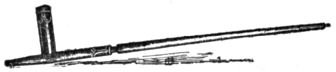
PAWNEE PIPE.
LONE CHIEF.
Skŭr´-ar-a Le-shar.
I.
LONE CHIEF was the son of the chief of the Kit-ke-hahk´-i band. His father died when the boy was very young, less than a year old. Until he was old enough to go to war, his mother had supported him by farming—raising corn, beans and pumpkins. She taught the boy many things, and advised him how to live and how to act so that he might be successful. She used to say to him, “You must trust always in Ti-ra´-wa. He made us, and through him we live. When you grow up, you must be a man. Be brave, and face whatever danger may meet you. Do not forget, when you look back to your young days, that I have raised you, and always supported you. You had no father to do it. Your father was a chief, but you must not think of that. Because he was a chief, it does not follow that you will be one. It is not the man who stays in the lodge that becomes great; it is the man who works, who sweats, who is always tired from going on the warpath.”
Much good advice his mother gave him. She said, “When you get to be a man, remember that it is his ambition that makes the man. If you go on the warpath, do not turn around when you have gone part way, but go on as far as you were going, and then come back. If I should live to see you become a man, I want you to become a great man. I want you to think about the hard times we have been through. Take pity on people who are poor, because we have been poor, and people have taken pity on us. If I live to see you a man, and to go off on the warpath, I would not cry if I were to hear that you had been killed in battle. That is what makes a man: to fight and to be brave. I should be sorry to see you die from sickness. If you are killed, I would rather have you die in the open air, so that the birds of the air will eat your flesh, and the wind will breathe on you and blow over your bones. It is better to be killed in the open air than to be smothered in the earth. Love your friend and never desert him. If you see him surrounded by the enemy, do not run away. Go to him, and if you cannot save him, be killed together, and let your bones lie side by side. Be killed on a hill; high up. Your grandfather said it is not manly to be killed in a hollow. It is not a man who is talking to you, advising you. Heed my words, even if I am a woman.”
The boy listened to these words, and he did not forget them.
II.
In the year 1867 he enlisted in the Pawnee Scouts under Major Frank North, and served in L. H. North’s company. He was always a good soldier, ready, willing and brave. At a fight near the Cheyenne Pass in 1867, he counted coup on a woman and a man, Arapahoes who had stolen some horses at Fort Laramie.
At this time the boy’s name was Wi-ti-ti le-shar´-uspi, Running Chief. After he came back from this scout, he went on a war party of which Left Hand was the leader, and they went to the Osage country. He was no longer a servant, but a scout, a leading man in the party, one of those who went ahead as spies. He had good judgment and understood his duties. When they came to the Osage country, he was selected as one of the leaders of a small branch party to steal horses. His party took thirty head of horses. In the Osage country the young men were not allowed to take all the horses they could. On account of the few fords where they could cross the streams, they could not take a big herd, but only what they could ride and lead, and at the same time go fast. Across one river there was only one rocky ford, and over another stream with deep banks there was only one rocky ford where they could cross. Because they did not know this, in former times many Pawnees had been caught and killed in the Osage country. So now they took but few horses at a time, because these rivers were very deep and no one could cross them except at these rock fords. Out of the horses taken at this time Running Chief obtained one of the best and fastest ever known among the Pawnees—a cream-colored horse, long famous in the tribe. For his skillful leadership of this party he was given much credit.
After returning home—the same year—he led a party to go off on the warpath to the Cheyennes. He found a camp on the headwaters of the North Canadian, and his party took seven horses, but these horses looked thin and rough, and he was not satisfied with them; he was ashamed to go home with only these. He told his party to take them home, but that he was going off by himself to get some better ones. He had with him a friend, with whom he had grown up, and whom he loved. This young man was like a brother to Running Chief. These two went off together, and went to the Osage camp, and staid about it for three nights, and then took five horses, the best in the camp. They took them back to the village. It was customary for the leading man in a party to make a sacrifice to Ti-ra´-wa. Running Chief did this, giving one horse to the chief priest. This sacrifice promoted him to be a warrior.
III.
The next year he led a party again to the Osage country. He took some horses and brought them home. This same year (1868) a party started south. He was not the leader, but he went with them. They went to the Wichita, Comanche and Kiowa villages—they were all camped together—stole some horses and started back with them. Before they had gone very far Running Chief stopped and said he was going back. His friend was with the party, and when he found that Running Chief had resolved to go back he said, “I will stop here with you.”
The two went back toward the village that they had just left, and climbed a hill that stood near it, and hid themselves there. They waited, watching, for they had not decided what they would do. The next day in the afternoon they began to get hungry, and they began to talk together. Running Chief said to his friend, “My brother, are you poor in your mind?[1] Do you feel like doing some great thing—something that is very dangerous?”
His friend answered at once, “Yes, I am poor. I am ready. Why do you ask me?”
Running Chief thought a little while before he answered, and as he thought, all the pain and suffering of his life seemed to rise up before him, so that he could see it. He remembered how he had been a poor boy, supported by his mother, and all that they two had suffered together while he was yet a child. He remembered how his sister had been killed when he was a boy only ten years old, and how he had mourned for her, when her husband, who was jealous of her, had shot her through the body with an arrow and killed her. She was the only sister he had, and he had loved her. He felt that he was poor now, and that there was no hope of anything better for him, and he did not want to live any longer. After he had thought of all these things he said to his friend, “My life is not worth anything to me;” and then he told him of his bad feelings. Finally he said, “Now you go off and leave me here alone. I am tired of living, but you go home. You have relations who would mourn for you. I do not want you to lose your life on my account.”
His friend answered him, “I will not go away from you. We have grown up together, and I will stick to you. Wherever you go I will go, and whatever you do I will do.”
Then Running Chief meditated for a long time. He had not made up his mind what to do. He thought to himself, “This, my friend, will stay with me. I do not want to be the cause of his death.” So he considered. Finally he said to his friend, “If I shall make up my mind to go to some place where there is great danger, I shall go.”
His friend said, “I will go with you.”
Running Chief thought again, and at last he said, “On account of my feelings I have decided to go into the camp of my enemies, and be eaten by their dogs.”
The other man said, “Whatever you have determined on I also will do.”
IV.
Then they jumped up out of the hole they were hiding in, and tied up their waists, and prepared to start. They were not very far from a trail which connected two villages, along which persons kept passing, and the Indians of these villages were all about them. When they jumped up to go toward the trail, they saw four or five persons passing at a little distance. When they saw these people, Running Chief called out to them, “High—eigh,” and made motions for them to come to him. He wanted to show his strong will, and that on account of his bad feelings he wished to have his troubles ended right there. He called to them twice, and each time the Indians stopped and looked at the Pawnees, and then went on. They did not know who it was that was calling them; perhaps they thought the Pawnees were two squaws.
The two young men went out to the trail and followed these persons toward the village. They went over a little hill, and as soon as they had come to the top and looked over it, they saw the village. On this side of it, and nearest to them were three lodges. At the foot of the hill was a river, which they must cross to come to these three lodges. When they came to the river, the friend asked; “Shall we take off our moccasins and leggings to cross?” Running Chief replied, “Why should I take off my moccasins and leggings when I know that my life is just going over a precipice? Let us go in as we are.” So they crossed with moccasins and leggings on. The river was only half-leg deep.
Just as they reached the further bank, all on a sudden, it came over Running Chief what they were doing—that they were going to certain death. All his courage seemed to leave him, and he felt as if he had no bones in his body. Then for a moment he faltered; but he could not give up now. He felt that if he was a man he must go forward; he could not turn back. He stopped for an instant; and his friend looked at him, and said, “Come, let us hurry on. We are near the lodges.” He stepped forward then, but his feet seemed to be heavy and to drag on the ground. He walked as if he were asleep.
There was no one about near at hand, and as they went forward Running Chief prayed with all his mind to Ti-ra´-wa that no one might come until they had reached the lodge, and had got inside. When they had got to within about one hundred yards of the lodge, a little boy came out, and began to play around the door, and when they were about fifty yards from him he saw them. As soon as he looked at them, he knew that they did not belong to the camp, and he gave a kind of a scream and darted into the lodge, but no one came out. The people within paid no attention to the boy. As they walked toward the lodges Running Chief seemed not to know where he was, but to be walking in a dream. He thought of nothing except his longing to get to this lodge.
They went to the largest of the three lodges. Running Chief raised the door and put his head in, and as he did so, it seemed as if his breath stopped. He went in and sat down far back in the lodge, opposite the entrance, and though his breath was stopped, his heart was beating like a drum. His friend had followed him in, and sat down beside him. Both had their bows in their hands, strung, and a sheaf of arrows.
When they entered the lodge, the man who was lying down at the back of the lodge uttered a loud exclamation, “Woof,” and then seemed struck dumb. A plate of corn mush had just been handed him, but he did not take it, and it sat there on the ground by him. One woman was just raising a buffalo horn spoon of mush to her mouth, but her hand stopped before reaching it, and she stared at them, holding the mush before her face. Another woman was ladling some mush into a plate, and she held the plate in one hand and the ladle above it, and looked at them without moving. They all seemed turned into stone.
As the two Pawnees sat there, Running Chief’s breath suddenly came back to him. Before it had all been dark about him, as if he had been asleep; but now the clouds had cleared away, and he could see the road ahead of him. Now he felt a man, and brave. As he looked around him, and saw the man lying motionless, and one woman just ready to take a mouthful, and the other woman with the ladle held over the dish, he perceived that they could not move, they were so astonished.
At length the Wichita had come to his senses. He drew a long breath, and sat up, and for a while looked at the two Pawnees. Then he made some sign to them which they did not understand, but they guessed that he was trying to ask who they were. Running Chief struck his breast, and said, “Pi-ta´-da” (Pawnee). As soon as the Wichita heard that he caught his breath, and heaved a long sigh. He did not know what to think of two Pawnees coming into his lodge. He could not think what it meant. He drew a long breath. He did not touch his plate of food, but motioned a woman to take it away. Presently he called to some one in the neighboring lodge. He was answered, and in a moment a man came in. He called again, and another entered, and the three looked for a long time at the two Pawnees. These were sitting motionless, but watching like two wildcats to see what was going to happen. Each had his bow and arrows by his side, and his knife inside his robe. At length the owner of the lodge spoke, and one of the men went out, and after a little they heard the sound of horses’ hoofs coming, and they supposed some one was riding up. Every now and then Running Chief would touch his friend’s knee with his own, as if to say, “Watch.”
The owner of the lodge made a sign and pointed to the east and said “Capitan.”[2] At the same time he was dressing himself up, putting on a pair of officer’s trousers and a uniform coat. Meantime the Pawnees heard the rattle of one saddle, and then of another. The Wichita chief put on his blanket, and his pistol belt around it, and then made signs for them to go out. He led the way, and the Pawnees followed. As they went, Running Chief touched his friend, as if to say, “Watch. They may shoot us as we go out.” But when they looked out of the lodge, the Wichita was walking toward the horses, so there was no danger. He mounted a horse, and signed to Running Chief to get up behind him. Another man mounted the other horse, and the friend got up behind him.
As they rode toward the main village, it came into the mind of Running Chief to kill the man he was riding behind, and to ride away. There was where he had to fight his hardest battle. He was tempted to kill this man in front of him, but he was not overpowered by this temptation. He overcame it. He thought that perhaps he might be mounted on a poor horse, and even if he did kill this man and his friend the other, they might be on slow horses and be caught at once. Every little while he would look at his friend and roll his eyes, as if to say, “Watch on your side and I will watch on mine.”
As he came near to the village, the Wichita warrior called out, and began to sing a song, and all at once the village was in an uproar. The men, women and children seemed to start up out of the ground, and the lodges poured forth their inmates. Running Chief felt that he was in danger, but he knew that he was not in as much danger as the man before him. He could take the pistol out of the belt that he had hold of and kill him, or he could use his own knife. The Wichita knew that he was in danger. He knew that he was in the power of the enemy.
After the Wichita had called out to the people that they had enemies with them, he kept on talking, saying, “Keep quiet. Do not do anything. Wait. Keep away from me and be still. I am in danger.” They would not have listened to him, if it had not been that he was a leading man, and a brave warrior. The riders came to the largest lodge, which stood in the middle of the village. Here they stopped. When Running Chief got off the horse, he held tightly the belt of the Wichita, who dismounted; and they went together into the lodge of the Head Chief, and the others followed and went in, and all sat down opposite the door. All this time there was a hubbub outside. People were flying from their lodges to that of the Head Chief, and lifting up the edge of the lodge, and peeping under it at the Pawnees. They chattered to each other, and called out to those who were coming; all was noise and confusion.
V.
The under chiefs came in one by one, until all were present. Then one of them made a speech, saying that it would be best to leave everything to the Head Chief, and that he should decide what ought to be done with these enemies. Then it was silent for a time, while the Chief was making up his mind what should be done; and during this silence Running Chief felt a touch on his shoulder, and looked behind him, and there was handed to him under the edge of the lodge a dish of meat. He took it and began to eat, and his companion also ate with him. After he had eaten a few mouthfuls, he took his arrows, which he had held in his hand, and put them in his quiver, and unstrung his bow and laid it aside, and his friend did the same.
Then the Chief stood up and spoke to those sitting there and said, “What can I do? They have eaten of my food. I cannot make war on people who have been eating with me.” While he was saying this, Running Chief was again touched on the shoulder, and some one handed him a cup of water, and he drank; and the Chief, as he saw this, added, “and have also drunk of my water.” He then turned and called to a certain man, who could speak Pawnee, and told him to ask these men if they were on the warpath. He asked them, “Are you on the warpath?” and they replied, “Yes, we are on the warpath.”
Then said he, “What are you here for?”
Running Chief answered, “You have plenty of dogs. I am here that my body may be eaten by them.”
When the Wichitas heard this they all made a sound, Ah-h-h-h! for they were surprised at his bravery. The Chief asked him, “Do you know anything about the horses that were missed last night?”
He said, “Yes.”
“Where are they?” said the Head Chief.
Running Chief replied, “The party have gone off with them—Pawnees.”
“Were you with them?”
“Yes, I was with them, and I stopped behind on purpose to come into your village.”
The Head Chief then turned to the others and talked for a little while. He said, “See what a brave man this is. He had resolved to die. But he shall not die, because he has eaten our food and drunk of our water. Although we are enemies of this man’s tribe, yet we are the same people with them, who have been apart for a long time. I cannot help it; my heart is touched by his talk and by their bravery. By their bravery they are safe.” And all the Wichitas said “Waugh.”
Then the Head Chief through the interpreter talked to Running Chief. He said, “Are you a chief?”
Running Chief replied, “No, I am not a chief; I am like a dog; I am poor.”
The Head Chief said to him, “By your bravery you have saved yourselves. You shall have the road to your home made white before you. Let there not be one blood spot on it.” Then he turned to those who were sitting about the lodge and said, “Now, my young men, do something for them.”
A young man named Crazy Wolf stood up and spoke; and when he had finished, the interpreter said, “That man has given you a black horse, the best that he has.”
Another young man on the other side of the lodge spoke, and the interpreter said, “He has given you a roan horse, the best that he has.” Then all the Wichitas began to speak at once, and before they knew it, the Pawnees had ten head of horses, and robes and blankets, saddles, bridles, shields, spears and moccasins—many beautiful presents. So they were well provided.
The Head Chief again stood up and talked to the assembly, praising these Pawnees; and he stepped over to Running Chief and shook hands with him, and when he did so, Running Chief stood up and put his arms around the Chief and pressed him to his breast, and the Chief did the same to him, and when Running Chief had his arms around the Chief, the Chief trembled, and came near to crying. The Chief embraced the other Pawnee, and looked him in the face and said, “What brave men you are!”
The friend said, “What my friend stepped, that I stepped; I trod in his footprints; I had one mind with him.”
As the Chief stepped back to his place he spoke through the interpreter, “Now you have eaten of my food and drunk of my water. Everything that I have is yours. My women and my children are yours. You are not a chief, but you are a chief.”[3] Then he spoke to the crowd and they all went away, leaving only the principal men in the lodge.
That afternoon the Pawnees were feasted everywhere, and had to eat till they were almost dead; and as they went about, all of their former sadness seemed to be swept away, and Running Chief felt like crying for joy.
While they were feasting, the man who had given the black horse went out, and caught it up, and painted it handsomely, and rode into the village, and put on it a silver bridle, and eagle feathers in its mane and tail, and when Running Chief was going from one lodge to another he met him, and jumped off the horse and said, “Brother, ride this.” He gave him also a shield and a spear.
These Pawnees staid two months with the Wichitas, and all their troubles seemed at an end. At length Running Chief called a council of the chiefs, and told them that now he wished to make ready to go home to his village. He thanked them for all that they had done for him, and said that now he would go. The chiefs said, “It is well. We are glad that you have been with us and visited us. Take the good news back to your tribe. Tell them that we are one people, though long separated. Let the road between our villages be made white. Let it no more show any spots of blood.”
Running Chief thanked them and said, “I will go and take the good news to my people. I shall show them the presents you have made us, and tell them how well we have been treated. It may be that some of the chiefs of my tribe will wish to come down to visit you, as I have done.” The Head Chief said, “Can I rely on your words, that I shall be visited?” Running Chief replied, “You can rely on them if I have to come alone to visit you again.” The Chief got up and put his arms about him, and said, “I want to be visited. Let there be no more war between us. We are brothers; let us always be brothers.” Then they gave him many more presents, and packed his horses, and six braves offered to go with him through the Cheyenne country. They went through in the night. Running Chief said afterward, “I could have stolen a lot of horses from the Cheyennes, but I thought, I will be coming back through this country and it is better not.”
At the Pawnee village these two young men had been mourned by their relations as lost or dead. It was in the spring (March, 1869) when they reached home, and there was joy in the tribe when they came in with the presents. Running Chief was praised, and so was his friend. Both had been brave and had done great things.
Now Running Chief’s name was changed from Wi-ti-ti le-shar´-uspi to Skŭr´-ar-a le-shar (Lone Chief).
VI.
The following summer in August, at the close of the summer hunt, three hundred Pawnees, old men and young, under the leadership of Lone Chief, visited the Wichitas, who received them well, and gave them many horses. Lone Chief was not satisfied with the peace that he had made with the Wichitas. He also visited the Kiowas, and made peace, and was given by them eight fine horses. He also led his party to the Comanches, and visited them, and got many presents. In the fall the Pawnees returned to their village. Many of them fell sick on the way, and some died.
In the winter of 1869-70 Lone Chief and his friend led a war party against the Cheyennes. They took six hundred head of horses. The Cheyennes now tell us that in the seventy-five lodges of that camp there was not left a hoof. All night and all next day they ran the herd. Then Lone Chief said, “Let us not run the horses any longer, they will not come after us; they are afoot.” When the party got on the north side of the Republican, on the table lands, a terrible storm of snow and wind came upon them, and they were nearly lost. For three days and three nights they lay in the storm. All were frozen, some losing toes and fingers. They survived, however, and brought in all their horses. Again Lone Chief sacrificed to Ti-ra´-wa. A second sacrifice is very unusual and a notable event.
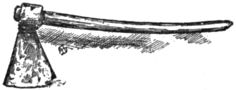
OLD-FASHIONED “T. GRAY” AX.
THE PRISONERS OF COURT HOUSE ROCK.
COURT HOUSE ROCK is a high, square-shaped bluff, or butte, on the North Platte River. It is composed of a hard, yellowish clay, which is but slowly eroded by the weather, though soft enough to be cut readily with a knife. On all sides except one, this rock or butte is nearly or quite vertical, and its sides, smoothed and polished by the wind and the rain, offer no projecting points, to serve as foot or hand holds for one who might wish to climb up or down. On one side there is a way by which an active man may reach the summit, where he finds a flat tableland of moderate extent.
A number of years ago a war party of Skidi, who were camped near Court House Rock, were surprised by a party of Sioux. There were many of them, and they drove the Skidi back, and at length these were obliged to climb the steep side of Court House Rock. The Sioux dared not follow them up on to the rock, but guarded the only place where it was possible to come down, and camped all around the rock below to starve the Skidi out. The Skidi had nothing to eat nor to drink, and suffered terribly from hunger and still more from thirst. The leader of the party suffered most of any, for he thought that he would surely lose all his men. He felt that this was the worst of all. He must not only die, but must also be disgraced, because under his leadership the young men of his party had been lost. He used to go off at night, apart from the others, and pray to Ti-ra´-wa for help; for some way to save his party.
One night while he was praying, something spoke to him, and said, “Look hard for a place where you may get down from this rock, and so save both your men and yourself.” He kept on praying that night, and when day came, he looked all along the edge of the rock for a place where it might be possible to get down. At last he found near the edge of the cliff a point of the soft clay rock sticking up above the level of the rest. The side of the rock below it was straight up and down, and smooth. At night he took his knife, and began to cut about the base of this point of rock, and night after night he kept at this until he had cut away the base of the point, so that it was no larger around than a man’s body. Then he secretly took all the lariats that the party had, and tied them together, and let them down, and found that his rope was long enough to reach the ground. He put the rope around the point, and made a loop in it for his feet, and slowly let himself down to the ground. He got there safely, and then climbed back again. The next night he called his men about him, and told them how it was, and that they might all be saved. Then he ordered the youngest and least important man of the party to let himself down, and after him the next youngest, and so on, up to the more important men, and last of all the leader’s turn came. He let himself down, and they all crept through the Sioux camp and escaped.
They never knew how long the Sioux stayed there watching the rock. Probably until they thought that the Skidi had all starved to death.
WOLVES IN THE NIGHT.
IN the year 1879 Little Warrior, with a Chaui boy and a soldier, was off scouting on the plains east of the mountains. They saw a long way off—perhaps twenty miles—some objects that seemed to be moving. It was one of those hot dry days in summer, when all the air is quivering and all things are distorted by the mirage. They watched these objects through their glasses for a long time. They seemed to move and quiver, and they could not tell what they were, but Little Warrior thought they were mounted men. They seemed to be traveling in the same direction with this scouting party. At length they could see that they were mounted men, and were driving some loose animals.
When night came, the two Pawnees left their horses with the soldier and started on foot to look for the camp of the strangers, and to find out who they were. They formed the plan to make themselves look like coyotes, so that they could go close to the camp. Each took from under his saddle a white sheet, which, when the time came, they would tie around their bodies, having their guns inside, held under their arms, and their pistols in their belts about their waists. It was a bright moonlight night, the moon being so bright that it made it hard to see far on the prairie.
The camp was found in a little hollow, and was occupied by seven Ute Indians. They had a dog with them. The Pawnees could hear them talking and laughing, as they sat about the big fire they had built. They could see the horses too.
The men put on their white sheets, and getting down on all fours, prowled about like wolves, gradually drawing nearer and nearer to the camp. Two or three times the dog smelt them and barked, but they paid no attention to it, but trotted hither and thither, smelling the ground and sometimes sitting up on their haunches like wolves, and then going on again. After a little while they came so close to the camp that they could see that the horses were staked out, and that there were some mules feeding about, hobbled. One of the Utes, who noticed the wolves prowling near the camp, got his gun and shot at the Chaui boy, but he did not hit him. The boy loped off and joined Little Warrior behind a hill, and there the two waited.
Little Warrior said to his companion, “These men have come far to-day. They are pretty tired. Wait and they will lie down and go to sleep.” Presently the camp quieted down and the Utes slept.
The Pawnees then made themselves wolves again, and went close to the Ute camp. The horses were staked close to where the men were sleeping, but the mules had wandered off a little to one side. Six mules were together, and one was by itself on the other side of the camp. Little Warrior went around the camp to this one, and cut its hobbles, and then drove it slowly toward the others. Then they drove the whole seven quietly away from the camp. If it had not been for the dog, they could very likely have stolen the horses too, and left the Utes afoot, and perhaps they might have been able to kill the Utes.
They drove the mules about two miles, and then went on to where they had left their horses. They found the soldier nearly frightened to death. He said he did not like to be left by himself in such a lonely place; he wanted to go to camp. They told him they were going to return and get those mules. They did so, and secured them, and drove them in to their own camp, which they reached about six o’clock the next morning.
It was learned afterward that fourteen mules had been stolen from a Government train, and a reward of $200 had been offered for their recovery. These taken by the two Pawnees were seven of the stolen animals, and each of the men received $50 as his proportion of the reward.
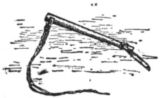
WHIP.
A LEADER OF SOLDIERS.
IN 1876, when the attack was made by General Mackenzie on the village of the Cheyenne chief, Dull Knife, the Pawnee Scouts charged down on the village on the south side of the creek, while on the north side of the stream, a company of United States cavalry, under Lieut. McKinney, were making a charge. Before the village was reached, Ralph J. Weeks, an educated Pawnee, and some others of the scouts crossed the stream and were riding near the soldiers. As they were crossing the cañon at the mouth of which the village stood, the enemy began to fire at them from the ravine. Lieut. McKinney was killed at the first volley, and immediately afterward his first sergeant fell, leaving the troop without a commander. The soldiers hesitated, stopped, and then turned round, and began to retreat.
Ralph rode up behind them, and got off his horse, and called out, “Hold on boys, don’t run. There are only seven Indians there. Come on, and we will kill them all. Get off your horses and come ahead on foot. There are only seven of them. We will kill them all.”
The men stopped in their retreat, dismounted, and under Ralph’s direction and leadership, went forward, and did kill all the Indians in the ravine.
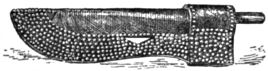
KNIFE SCABBARD.
A CHEYENNE BLANKET.
THE Cheyennes, like other Indians, do not speak to each other when they are away from the camp. If a man goes away from the village, and sits or stands by himself on the top of a hill, it is a sign that he wants to be alone; perhaps to meditate; perhaps to pray. No one speaks to him or goes near him.
Now, there was once a Pawnee boy, who went off on the warpath to the Cheyenne camp. In some way he had obtained a Cheyenne blanket. This Pawnee came close to the Cheyenne camp, and hid himself there to wait. About the middle of the afternoon, he left his hiding place, and walked to the top of the hill overlooking the village. He had his Cheyenne blanket wrapped about him and over his head, with only a little hole for his eyes. He stood there for an hour or two, looking over the Cheyenne camp.
They were coming in from buffalo hunting, and some were leading in the pack horses loaded down with meat. A man came along, riding a horse packed with meat, and leading another pack horse, and a black spotted horse that was his running horse. These running horses are ridden only on the chase or on war parties, and are well cared for. After being used they are taken down to the river and are washed and cleaned with care. When the boy saw this spotted horse, he thought to himself that this was the horse that he would take. When the man who was leading it reached his lodge, he dismounted and handed the ropes to his women, and went inside.
Then the Pawnee made up his mind what he would do. He started down the hill into the village, and walked straight to this lodge where the women were unloading the meat. He walked up to them, reached out his hand, and took the ropes of the spotted horse and one of the others. As he did so the women fell back. Probably they thought that this was some one of the relations of the owner, who was going to take the running horse down to the river to wash it. The Pawnee could not talk Cheyenne, but as he turned away he mumbled something—m-m-m-m—as if speaking in a low voice, and then walked down toward the river. As soon as he had gone down over the bank and was out of sight, he jumped on the spotted horse and rode into the brush, and pretty soon was away with two horses, stolen out of the Cheyenne camp in broad daylight.
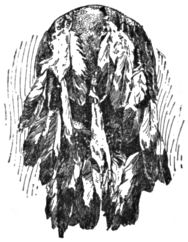
A WAR SHIELD.
LITTLE WARRIOR’S COUNSEL.
MOST of the Pawnee heroes are so regarded because of victories, daring deeds, the coups they have counted and the horses they have stolen. The glory of Comanche Chief and of Lone Chief depends mainly on their bravery, rather than on the fact that they were peace-makers. Yet there should be room among these stories for the account of an educated Pawnee—a brave—who by his wise counsel to an Indian of a hostile tribe saved many lives, both of Indians and of white men. Little Warrior was educated at a Western college, but has shown his bravery on the field of battle, and has sacrificed a scalp to Ti-ra´-wa.
In the year 1879, at the time of the Ute outbreak, after Major Thornburgh’s command had been annihilated, Little Warrior was employed as a scout for the troops. On the headwaters of the Arkansas River he was one day scouting in advance of the command, in company with four white soldiers and four Indian scouts. One day, the party saw far off on the prairie an Indian, who showed a white flag, and came toward them. When he had come near to them, the soldiers proposed to kill him, and report that he was a Ute, one of the Indians that they were looking for. But Little Warrior said, “No. He has a white flag up, and it may be that he is carrying a dispatch, or, perhaps, he is a white man disguised as an Indian.”
When the man had come close to them, they saw that he was dressed like a Comanche; he did not have the bristling fringe of hair over the forehead that the Utes wear, and his side locks were unbraided. Little Warrior asked him, by signs, if he was alone, to which he replied in the same language that he was alone. Then Little Warrior inquired who he was. The stranger made the sign for Comanche—a friendly tribe.
They took him into the camp, and after a while Little Warrior began to talk to him in Comanche. He could not understand a word of it.
Then the Pawnee said to him, “My friend, you are a Ute.” The stranger acknowledged that he was.
Then Little Warrior talked to him, and gave him much good advice. He said, “My friend, you and I have the same skin, and what I tell you now is for your good. I speak to you as a friend, and what I say to you now is so that you may save your women and your children. It is of no use for you to try to fight the white people. I have been among them, and I know how many they are. They are like the grass. Even if you were to kill a hundred it would be nothing. It would be like burning up a few handfuls of prairie grass. There would be just as many left. If you try to fight them they will hunt you like a ghost. Wherever you go they will follow after you, and you will get no rest. The soldiers will be continually on your tracks. Even if you were to go up on top of a high mountain, where there was nothing but rocks, and where no one else could come, the soldiers would follow you, and get around you, and wait, and wait, even for fifty years. They would have plenty to eat, and they could wait until after you were dead. There is one white man who is the chief of all this country, and what he says must be done. It is no use to fight him.
“Now if you are wise you will go out and get all your people, and bring them in, on to the reservation, and give yourself up. It will be better for you in the end. I speak to you as a friend, because we are both the same color, and I hope that you will listen to my words.”
The Ute said, “My friend, your words are good, and I thank you for the friendly advice you have given me. I will follow it and will agree to go away and bring in my people.”
Little Warrior said, “How do you make a promise?”
The Ute said, “By raising the right hand to one above.”
Little Warrior said, “That is the custom also among my people.”
The Ute raised his hand and made the promise.
After he had been detained two or three weeks, he was allowed to go, and about a month afterward, he brought in the band of which he was chief, and surrendered. Through his influence afterward, the whole tribe came in and gave themselves up. He was grateful to Little Warrior for what he had done for him, and told him that if he ever came back into his country he would give him many ponies.
A COMANCHE BUNDLE.
A PAWNEE boy went to the Comanche village after horses. At night he went into the camp, crept to the door of a lodge, and took a horse that was tied there. It was bright moonlight, and as he was cutting the rope he saw, hanging before the lodge, a handsome shield and a spear, which he took. There was also a bundle hanging there. He took this down, opened it, and found in it a war bonnet, beaded moccasins and leggings, and a breast-plate of long beads. He dressed himself in all these fine things, mounted the horse and rode away.