Folk-Tales.
Reading edition
THE DUN HORSE.
I.
MANY years ago, there lived in the Pawnee tribe an old woman and her grandson, a boy about sixteen years old. These people had no relations and were very poor. They were so poor that they were despised by the rest of the tribe. They had nothing of their own; and always, after the village started to move the camp from one place to another, these two would stay behind the rest, to look over the old camp, and pick up anything that the other Indians had thrown away, as worn out or useless. In this way they would sometimes get pieces of robes, worn out moccasins with holes in them, and bits of meat.
Now, it happened one day, after the tribe had moved away from the camp, that this old woman and her boy were following along the trail behind the rest, when they came to a miserable old worn out dun horse, which they supposed had been abandoned by some Indians. He was thin and exhausted, was blind of one eye, had a bad sore back, and one of his forelegs was very much swollen. In fact, he was so worthless that none of the Pawnees had been willing to take the trouble to try to drive him along with them. But when the old woman and her boy came along, the boy said, “Come now, we will take this old horse, for we can make him carry our pack.” So the old woman put her pack on the horse, and drove him along, but he limped and could only go very slowly.
II.
The tribe moved up on the North Platte, until they came to Court House Rock. The two poor Indians followed them, and camped with the others. One day while they were here, the young men who had been sent out to look for buffalo, came hurrying into camp and told the chiefs that a large herd of buffalo were near, and that among them was a spotted calf.
The Head Chief of the Pawnees had a very beautiful daughter, and when he heard about the spotted calf, he ordered his old crier to go about through the village, and call out that the man who killed the spotted calf should have his daughter for his wife. For a spotted robe is ti-war´-uks-ti—big medicine.
The buffalo were feeding about four miles from the village, and the chiefs decided that the charge should be made from there. In this way, the man who had the fastest horse would be the most likely to kill the calf. Then all the warriors and the young men picked out their best and fastest horses, and made ready to start. Among those who prepared for the charge was the poor boy on the old dun horse. But when they saw him, all the rich young braves on their fast horses pointed at him, and said, “Oh, see; there is the horse that is going to catch the spotted calf;” and they laughed at him, so that the poor boy was ashamed, and rode off to one side of the crowd, where he could not hear their jokes and laughter.
When he had ridden off some little way, the horse stopped, and turned his head round, and spoke to the boy. He said, “Take me down to the creek, and plaster me all over with mud. Cover my head and neck and body and legs.” When the boy heard the horse speak, he was afraid; but he did as he was told. Then the horse said, “Now mount, but do not ride back to the warriors, who laugh at you because you have such a poor horse. Stay right here, until the word is given to charge.” So the boy stayed there.
And presently all the fine horses were drawn up in line and pranced about, and were so eager to go that their riders could hardly hold them in; and at last the old crier gave the word, “Loo-ah”—Go! Then the Pawnees all leaned forward on their horses and yelled, and away they went. Suddenly, away off to the right, was seen the old dun horse. He did not seem to run. He seemed to sail along like a bird. He passed all the fastest horses, and in a moment he was among the buffalo. First he picked out the spotted calf, and charging up alongside of it, U-ra-rish! straight flew the arrow. The calf fell. The boy drew another arrow, and killed a fat cow that was running by. Then he dismounted and began to skin the calf, before any of the other warriors had come up. But when the rider got off the old dun horse, how changed he was! He pranced about and would hardly stand still near the dead buffalo. His back was all right again; his legs were well and fine; and both his eyes were clear and bright.
The boy skinned the calf and the cow that he had killed, and then he packed all the meat on the horse, and put the spotted robe on top of the load, and started back to the camp on foot, leading the dun horse. But even with this heavy load the horse pranced all the time, and was scared at everything he saw. On the way to camp, one of the rich young chiefs of the tribe rode up by the boy, and offered him twelve good horses for the spotted robe, so that he could marry the Head Chief’s beautiful daughter; but the boy laughed at him and would not sell the robe.
Now, while the boy walked to the camp leading the dun horse, most of the warriors rode back, and one of those that came first to the village, went to the old woman, and said to her, “Your grandson has killed the spotted calf.” And the old woman said, “Why do you come to tell me this? You ought to be ashamed to make fun of my boy, because he is poor.” The warrior said, “What I have told you is true,” and then he rode away. After a little while another brave rode up to the old woman, and said to her, “Your grandson has killed the spotted calf.” Then the old woman began to cry, she felt so badly because every one made fun of her boy, because he was poor.
Pretty soon the boy came along, leading the horse up to the lodge where he and his grandmother lived. It was a little lodge, just big enough for two, and was made of old pieces of skin that the old woman had picked up, and was tied together with strings of rawhide and sinew. It was the meanest and worst lodge in the village. When the old woman saw her boy leading the dun horse with the load of meat and the robes on it, she was very much surprised. The boy said to her, “Here, I have brought you plenty of meat to eat, and here is a robe, that you may have for yourself. Take the meat off the horse.” Then the old woman laughed, for her heart was glad. But when she went to take the meat from the horse’s back, he snorted and jumped about, and acted like a wild horse. The old woman looked at him in wonder, and could hardly believe that it was the same horse. So the boy had to take off the meat, for the horse would not let the old woman come near him.
III.
That night the horse spoke again to the boy and said, “Wa-ti-hes Chah´-ra-rat wa-ta. To-morrow the Sioux are coming—a large war party. They will attack the village, and you will have a great battle. Now, when the Sioux are drawn up in line of battle, and are all ready to fight, you jump on to me, and ride as hard as you can, right into the middle of the Sioux, and up to their Head Chief, their greatest warrior, and count coup on him, and kill him, and then ride back. Do this four times, and count coup on four of the bravest Sioux, and kill them, but don’t go again. If you go the fifth time, may be you will be killed, or else you will lose me. La-ku´-ta-chix—remember.” So the boy promised.
The next day it happened as the horse had said, and the Sioux came down and formed a line of battle. Then the boy took his bow and arrows, and jumped on the dun horse, and charged into the midst of them. And when the Sioux saw that he was going to strike their Head Chief, they all shot their arrows at him, and the arrows flew so thickly across each other that the sky became dark, but none of them hit the boy. And he counted coup on the Chief, and killed him, and then rode back. After that he charged again among the Sioux, where they were gathered thickest, and counted coup on their bravest warrior, and killed him. And then twice more, until he had gone four times as the horse had told him.
But the Sioux and the Pawnees kept on fighting, and the boy stood around and watched the battle. And at last he said to himself, “I have been four times and have killed four Sioux, and I am all right, I am not hurt anywhere; why may I not go again?” So he jumped on the dun horse, and charged again. But when he got among the Sioux, one Sioux warrior drew an arrow and shot. The arrow struck the dun horse behind the forelegs and pierced him through. And the horse fell down dead. But the boy jumped off, and fought his way through the Sioux, and ran away as fast as he could to the Pawnees. Now, as soon as the horse was killed, the Sioux said to each other, “This horse was like a man. He was brave. He was not like a horse.” And they took their knives and hatchets, and hacked the dun horse and gashed his flesh, and cut him into small pieces.
The Pawnees and Sioux fought all day long, but toward night the Sioux broke and fled.
IV.
The boy felt very badly that he had lost his horse; and, after the fight was over, he went out from the village to where it had taken place, to mourn for his horse. He went to the spot where the horse lay, and gathered up all the pieces of flesh, which the Sioux had cut off, and the legs and the hoofs, and put them all together in a pile. Then he went off to the top of a hill near by, and sat down and drew his robe over his head, and began to mourn for his horse.
As he sat there, he heard a great wind storm coming up, and it passed over him with a loud rushing sound, and after the wind came a rain. The boy looked down from where he sat to the pile of flesh and bones, which was all that was left of his horse, and he could just see it through the rain. And the rain passed by, and his heart was very heavy, and he kept on mourning.
And pretty soon, came another rushing wind, and after it a rain; and as he looked through the driving rain toward the spot where the pieces lay, he thought that they seemed to come together and take shape, and that the pile looked like a horse lying down, but he could not see well for the thick rain.
After this, came a third storm like the others; and now when he looked toward the horse he thought he saw its tail move from side to side two or three times, and that it lifted its head from the ground. The boy was afraid, and wanted to run away, but he stayed.
And as he waited, there came another storm. And while the rain fell, looking through the rain, the boy saw the horse raise himself up on his forelegs and look about. Then the dun horse stood up.
V.
The boy left the place where he had been sitting on the hilltop, and went down to him. When the boy had come near to him, the horse spoke and said, “You have seen how it has been this day; and from this you may know how it will be after this. But Ti-ra´-wa has been good, and has let me come back to you. After this, do what I tell you; not any more, not any less.” Then the horse said, “Now lead me off, far away from the camp, behind that big hill, and leave me there to-night, and in the morning come for me;” and the boy did as he was told.
And when he went for the horse in the morning, he found with him a beautiful white gelding, much more handsome than any horse in the tribe. That night the dun horse told the boy to take him again to the place behind the big hill, and to come for him the next morning; and when the boy went for him again, he found with him a beautiful black gelding. And so for ten nights, he left the horse among the hills, and each morning he found a different colored horse, a bay, a roan, a gray, a blue, a spotted horse, and all of them finer than any horses that the Pawnees had ever had in their tribe before.
Now the boy was rich, and he married the beautiful daughter of the Head Chief, and when he became older, he was made Head Chief himself. He had many children by his beautiful wife, and one day when his oldest boy died, he wrapped him in the spotted calf robe and buried him in it. He always took good care of his old grandmother, and kept her in his own lodge until she died. The dun horse was never ridden except at feasts, and when they were going to have a doctors’ dance, but he was always led about with the Chief, wherever he went. The horse lived in the village for many years, until he became very old. And at last he died.
A STORY OF FAITH.
LONG ago, before they ever had any of these doctors’ dances, there was, in the Kit-ke-hahk´-i tribe, a young boy, small, growing up. He seemed not to go with the other boys nor to play with them, but would keep away from them. He would go off by himself, and lie down, and sometimes they would find him crying, or half crying. He seemed to have peculiar ways. His father and mother did not try to interfere with him, but let him alone. Sometimes they would find him with mud or clay smeared over his face and head. That is the sign of a doctor. When you see a person putting mud on his face or head, it shows that he has faith in the earth. From the earth are taken the roots that they use in medicine.
When the parents saw this, they did not understand it. How should he know anything about mud being the sign of a doctor? They did not understand, but they just let him do it.
The boy grew up till he came to have the ways of a young man, but he never went with any of the other boys. After he had grown up, they saw that he had something in his mind. Sometimes he would fast for two days, and sit by himself, smoking and praying to Ti-ra´-wa, and not saying anything to any one. His father was a brave but not a chief, and had plenty of horses. The son was well dressed and comfortably off.
When any one in the camp was sick, this young man would take pity on him, and of his own accord would go and doctor him, and pretty soon the person would be well again. Through his doing this, the people began to hear about him, and his name became great. He was humble, and did not want to be thought well of. He was not proud, but he was always doing good. At that time, there were many doctors in the tribe, and they wondered how it was that he could cure so many people, when he had never been taught by any of them. They could not understand it, and they began to be jealous of him. He never wanted to be with the doctors, but liked to stay by himself. He wanted to be alone rather than with any one.
In that time there were bad doctors, and they began to hear about this humble man and to be jealous of him. These bad doctors could curse a man, and he would be cursed, and could poison one. They had great power and influence, for everybody feared them.
The bands of the Pawnees were not then together, as they are now. As the people talked about this young man, one of the other bands heard about him. In this band was a great doctor, and this doctor thought to himself, “This young man’s influence is growing. If I do not do something, he will soon be ahead of me.”
This great doctor went to the village to visit this young man, to see how he looked, and to find out how he got his knowledge and his power, for he knew he had never been taught. He wanted to eat with him, and talk with him, and find out whence his learning came. He reached the Kit-ke-hahk´-i village. He was welcomed, and the young man treated him with respect, and asked him to come into the lodge, and sit down with him. At night they talked together. The great doctor said, “I am glad to see you. You can come to me for advice sometimes.” The young man thanked him. They smoked together. It is the custom always when an Indian is visiting another, for the one that is being visited to present all the smokes; but at this time the great doctor said, “We will smoke my tobacco.” So all night they smoked his tobacco. The next morning he went away. He did not again eat with the young man. He said, “I am glad, and I am going.” And he went away to his village. This happened in the winter.
This young man was not married. His father had asked him to marry, but he would not. He said he had reasons.
About summer time, he felt different from what he had. He was drowsy and felt badly. He felt heavy. He seemed to be swelling up with some strange new disease. The great doctor had poisoned him with this result. How it was no one can tell, but it was so. This was a disgrace, and he did not know how to get out of it. There was no way. He would go off and cry, and pray to Ti-ra´-wa, and sometimes would stay for three or four days without anything to eat. He was so miserable that one time he was going to kill himself. He did not tell his father or any one about this, but kept it to himself. The tribe went off on a hunt and left the old village. Before they started, the man went off on a hill somewhere to meditate and pray, and his father told him that when he was ready to start he should ride such a horse, and he left it in the village for him when he should come in.
When he came into the empty village he found the horse tied there, and he saddled it and started; but instead of going in the direction the tribe had taken, he went east. His horse was a fine one. He went away off by himself for some days, and at last he stopped, and got off his horse, and tied it to a tree. Then he called aloud and said, “A-ti-us ta´-kaw-a (My Father, in all places), it is through you that I am living. Perhaps it was through you that this man put me in this condition. You are the ruler. Nothing is impossible to you. If you see fit, take this away from me.” Then he turned round and said, “Now, you, all fish of the rivers, and you, all birds of the air, and all animals that move upon the earth, and you, oh Sun! I present to you this animal.” He said again, “You birds in the air, and you animals upon the earth, we are related, we are alike in this respect, that one ruler made us all. You see me, how unhappy I am. If you have any power, intercede for me.”
When he had finished his prayer, he went up to the horse, and stabbed it with his knife and killed it, and it fell down dead. He turned it so that its head was toward the east, and raised it on its belly, doubling its knees under it, and cut the hide down the back, and skinned it down on both sides, so that the birds of the air and the animals of the earth might feed on it.
The tribe at this time was camped on the head of the Republican River. He went on toward the east until he came to the place on the Platte River called Pa-huk´ (hill island). He saw that there were many wild animals on this point, and he liked it, and thought he would stay there, and perhaps dream. He stopped there a while, feeling very badly, and mourning all the time on this point. He was there several days, and one night it happened that he went to sleep [fainted], for he was exhausted with much weeping and praying. Something spoke to him, and said, “What are you doing here?” He woke up, and looked around, but saw no one. It was only a voice. Another night when he was asleep a voice asked him, “What are you doing here?” He awoke and looked about, but saw no one. A third night the same thing happened, and he was wondering what it meant. Then he answered and said, “Who ever you are who speaks to me, look at me and you will see that I am poor in mind.[4] I am a man, and yet I am in a condition that no man was ever in before. I am here only to suffer and to die. Whoever you are who speaks to me, take pity on me and help me.” He received no answer.
The fourth night something touched him. He was half awake when he felt it. Something said, “What are you doing here?” He was lying on his side, his head toward the east and his feet toward the west. Something tapped him on the shoulder, and he looked up and saw a great big animal, big black eyes and a whitish body, Pah´, big elk. When he looked at it, the animal said, “Get up and sit down;” and the elk too sat down. The elk said, “I have heard of you and of your condition, and I am here to tell you that we all know your trouble. Right here where you are, under you, is the home of the Nahu´rac (animals). I know that it is impossible to help you, but I shall let them know—they already know—that you are here. I can only help you so far as to take you to the places where these animals are. If this animal home cannot help you, I will take you to another place; if that fails, I will take you to another place; if that fails, to another. Then you will see that I have done my part. If it is impossible for the animals to do it, we have still one above that we look to.” As soon as he had said this, he vanished like a wind; disappeared all at once.
While the boy sat there, thinking about what the animal had said to him, he fell asleep with his mind full of these things. In his sleep something talked to him. It said, “I know that you feel badly, and that your mind is poor. I have passed you many times, and I have heard you crying. I belong here, but I am one of the servants. I have informed my leaders, those who command me, about you, and that you are so poor in your mind, and they have said to me, ‘If you take pity on him, do as you please, because you are our servant.’”
At this time he woke up, and saw sitting by him a little bird.[5] He talked to it. He said, “Oh, my brother, I feel pleased that you understand my poor mind. Now take pity on me and help me.” The bird said to him, “You must not talk in this way to me. I am only a servant. To-morrow night I will come this way, and will show you what to do. To-morrow night I will come this way, and whatever you see me do, you do the same thing.” Then he disappeared. The man then felt a little easier in his mind, and more as if there were some hope for him.
The next night the bird came, and was flying about near him after dark, waiting for the time. When the time came, the bird flew close to him, and said, “Come. Let us go to the edge of the cut bank.” When they had come to the edge of the bank above the water in the river, the bird said, “Now, my friend, you are poor. What I do, you do. When I dive down off this bank, you follow me.” The man replied to him, “Yes, I am poor. Whatever you tell me to do, I will do.” So when the bird dived down off the cut bank, the man threw off everything, and cared nothing for what he did except to follow the bird. He leaped down after it, and as he sprang, it seemed to him that he felt like a bird, and could sail this way and that. He did not feel as if he were falling, and were going to be hurt, but as if he were flying, and could control his movements. Just as he reached the water in his fall, it seemed to him that he was standing in the entrance way of a lodge, and could look through into it and see the fire burning in the middle.
While he was standing there, the bird flew in ahead of him, and he heard it say, “Here he is.” He stepped toward the entrance, and just as he came to it the Nahu´rac all made their different noises, for they are not used to the smell of human beings. The bears growled, and the panthers and wild cats and wolves and rattlesnakes and other animals all made their sounds. As he went in, there was a bear standing on one side, and a great snake on the other, and it was very difficult for the man to go in. He hesitated a little to enter that narrow passage, but something behind him seemed to push him ahead, although the bear stood ready to seize him, and the snake was rattling and standing up as if about to strike. If he had not had the courage to pass them he would have been lost, but he looked neither to the right nor to the left, but walked straight ahead past them. As soon as he had passed them, they both sank back and were quiet. Then all the Nahu´rac made another kind of a noise, as if welcoming him. The bear began to lie down; and the snake stretched itself out again. As he went in he just stood there and looked around. He saw there all kinds of animals. The head doctor was a white beaver, very large, there was another a garfish, another an otter, and the fourth was a sandhill crane.
The man sat down, and he looked very pitiful. Then for a while everything was silent. Then the servant said to the four head doctors, “I have brought this man here. I have taken pity on him, and I want you to take pity on him.” Then it was more silent than ever. The man looked about him, and saw all the animals, and saw them roll their eyes around at him.
Presently the servant got up, and stood right in the midst. The head doctors sat at the back of the lodge opposite the door on the other side of the fire. The bird said, “My rulers, you know me. I am your servant, and I am always obedient to your commands. No matter what you tell me to do, I do it. No matter how long the journeys you send me on, I go. Many nights I have lost sleep because of carrying out your commands. I have seen this man many times, and I am weary of his crying as I fly back and forth. Now, I want you to take pity on this man, because I pity him. Look on this poor-minded man and pity him.”
Then the bird went to the young man, and took from him his pipe, which was filled, and carried it round and stood before the beaver, the head doctor, and held out the pipe to him to take. The white beaver did not stretch out his hand for it, and the bird stood there for a long time. At last the bird began to cry, and the tears began to run down its face, and it cried hard; and at last the white beaver stretched out his hand, and then drew it back again, and hesitated; and the bird kept on crying, and at length the head doctor reached out his hand and took the pipe. Just as soon as he took the pipe, all the animals made a kind of a hissing sound, as much as to say, Loo´ah—Good. They were pleased. Then the white beaver, holding the pipe, said, “I cannot help but reach out for this pipe, for I take pity on my servant. But it is impossible for me to promise that I will do this thing, but I will do what I can. I will leave it to this other Nahu´rac to say what shall be done;” and he passed the pipe to the other Nahu´rac who sat next to him. This animal reached for the pipe, and took it. He made a speech, and said, “My friends, I am poor, I am poor. I have not such power as that;” and he passed the pipe to another; and he said, “I have not the power;” and he passed it to another; and so it went around the circle. The pipe had passed around, and none of the Nahu´rac had the power. None of them seemed to understand how to help the man. Then the white beaver said, “My friend, you see that no one of us have the power to help you. There is another lodge of Nahu´rac at Pa´howa. You must go there and ask them.” Then the Nahu´rac made medicine, and the young man went to sleep, and when he awoke at daylight, he found himself on the point where he had lain down to sleep the night before.
He was discouraged and wept all day long. At night the elk came to him and said, “Go to sleep; I will take you over to Pa´howa.” The man slept and the elk took him on its back and carried him while asleep, and the next morning he found himself on that point of Pa´howa.
That night the messenger bird came to him and said, “Now, my friend, follow me, and what you see me do, that do yourself. When I dive down into Pa´howa, you follow me.” The bird dived down into the spring, and the young man jumped after him, and again found himself standing at the door of a lodge, and the same things took place as before. Here the same animals were the head doctors. The chief head doctor talked to the boy and said, “My friend, I am sorry you have come to me in the condition you are in. My friend, this is something impossible. If it were anything else it might be possible for us to cure your trouble. Nothing like it was ever known before.”
When he had said this he turned to the Nahu´rac and said, “Now you shall be the leaders. If there are any of you who understand things like this; if any of you can take the lead in things like this, why do it. It is beyond my power. Say what shall be done, any of you. My mind would be big if any of you could take pity on this poor man.”
Another one of the Nahu´rac stood up and spoke, “My brother [to the white beaver], and my brother [to the young man], do not feel hard at me. This is beyond my power. I cannot do anything to help him.” So it went around the circle, every one saying that it was impossible. After it had gone round, the head doctor again stood up and said, “Now, my friend, you can see that it is impossible to cure you of this trouble, but there is another lodge of the Nahu´rac on the west side of the Loup River. You go there.” Then they put him to sleep, and when he awoke next morning, he was on top of the ground near Pa´howa.
That night the elk took him while he was asleep to the place on the Loup. The next night he was sitting on the ground there, and the bird came to him, and he followed the bird down over the bank and into the Nahu´rac lodge. Here the head doctors were the same animals, and they made speeches as had been done at the other places, and, as before, it was left to the assembly, and all agreed that it was beyond their power. Then the white beaver directed him to go to an island in the Platte, near the Lone Tree, where there was another lodge of the Nahu´rac. The elk took him to this island. Under the center of this island was the lodge. The messenger bird was with him and went into the lodge and asked the Nahu´rac to help him. The white beaver made a speech, and said, “My friend, I have heard the condition that you are in. Of all these lodges that you have visited, that lodge at Pa-huk´ is the head. I want you to go back there, and tell the leaders there that they are the rulers, and that whatever they shall do will be right, and will be agreed to by the other lodges. They must help you if they can. If they cannot do it, no one can.”
When the elk took him back to Pa-huk´, the bird again conducted him into the lodge. He had left his pipe here. When he entered the lodge all the animals made a hissing sound—No´a—they were glad to see him again. The man stood in the middle of the lodge and spoke. He said, “Now you animals all, you are the leaders. You see how poor my mind is. I am tired of the long journeys you have sent me on. I want you to take pity on me.”
The white beaver stood up and took the pipe and said, “Oh, my brother, I have done this to try these other lodges of Nahu´rac, to see if any of them were equal to me. That was the reason that I sent you around to all these other lodges, to see if any of them would be willing to undertake to rid you of your burden. But I see that they all still acknowledge that I am the leader. Now I have here an animal that I think will undertake to help you and to rid you of your trouble.” Saying this he stepped out to the right, and walked past some of the Nahu´rac until he came to a certain animal—a ground dog—and held out the pipe to it. There were twelve of these animals, all alike—small, with round faces and black whiskers—sitting on their haunches. He held out the pipe to the head one of these twelve. When the white beaver reached out the pipe to this animal he did not take it. He hesitated a long time, and held his head down. He did not want to take the pipe. He looked around the lodge, and at the man, and drew in his breath. At last he reached out his paws and took the pipe, and as he did so, all the Nahu´rac made a noise, the biggest kind of a noise. They were glad.
Then the head ground dog got up and said, “Now, doctors, I have accepted this pipe on account of our servant, who is so faithful, and who many a night has lost sleep on account of our commands. I have accepted it for his sake. It is impossible to do this thing. If it had been earlier, I could perhaps have done it. Even now I will try, and if I fail now, we can do nothing for him.”
After they had smoked, they told the man to go and sit down opposite the entrance to the lodge, between the head doctors and the fire. These twelve animals stood up and walked back and forth on the opposite side of the fire from him, facing him. After a while they told him to stand up. The head ground dog now asked the other Nahu´rac to help him, by singing, and they all sang; and the ground dogs danced, keeping time to the singing, and moved their hands up and down, and made their jaws go as if eating, but did not open their mouths.
After a while they told him to lie down with his head toward the doctors and his feet toward the entrance. After he had lain down, they began to move and went round the lodge toward him, and the head ground dog jumped over the man’s belly, and as he jumped over him he was seen to have a big piece of flesh in his mouth, and was eating it. Another ground dog followed him, and another, and each one ran until he came to the man, and as each one jumped over him, it had a piece of flesh in its mouth, eating it. So they kept going until they had eaten all the swelling. The young man was unconscious all this time, for he afterward said he knew nothing of what had happened.
The head ground dog spoke to the animals, and said, “Now, Nahu´rac, you have seen what I can do. This is the power that I have. That is the reason I am afraid to be out on the prairie, because when I get hungry I would kill men and would eat them. My appetite would overpower me, and I do not want to do these things, I want to be friendly. This is the reason that I do not travel around on top of the ground. I stay hid all the time.”
The man was still unconscious, and the head ground dog said, “Now, Nahu´rac, I do not understand how to restore this man. I leave that to you.” Then the ground dogs went back to their places and sat down. Then the head doctor, the beaver, spoke to the bears. He said, “Now this man belongs to you. Let me see what you can do.” The head bear got up and said, “Very well, I will come. I will let you see what I can do.” Then the bears stood up and began to sing. The head bear would jump on top of the man, and act as if he were going to tear him to pieces, and the others would take hold of him, and shake him around, and at last his blood began to flow and the man began to breathe, but he was still unconscious. After a while he moved and came to life, and felt himself just as he had been many months before. He found that his trouble was gone and that he was cured.
The head bear still stood by him and spoke to the Nahu´rac. He said, “Now, Nahu´rac, this is what I can do. I do not care how dangerously wounded I may be, I know how to cure myself. If they leave any breath at all in me, I know how to cure myself.” Then the bears went to their place and sat down.
The man got up and spoke to the Nahu´rac, thanking them for what they had done for him. He stayed there several nights, watching the doings of the Nahu´rac. They taught him all their ways, all the animal secrets. The head doctor said to him, “Now, I am going to send you back to your home, but I will ask a favor of you, in return for what I have done for you.”
The man answered him, “It will be so, whatever you say.”
The doctor said, “Through you let my animals that move in the river be fed. Now you can see who we are. I move in the water. I have no breath, but I exist. We every one of us shall die except Ti-ra´-wa. He made us, just as he made you. He made you to live in the air. We live where there is no air. You see the difference. I know where is that great water that surrounds us [the ocean]. I know that the heaven [sky] is the house of Ti-ra´-wa, and we live inside of it. You must imitate us. Do as we do. You must place your dependence on us, but still, if anything comes up that is very difficult, you must put your dependence on Ti-ra´-wa. Ask help from the ruler. He made us. He made every thing. There are different ways to different creatures. What you do I do not do, and what I do you do not do. We are different. When you imitate us you must always blow a smoke to each one of these four chief doctors, once to each; but to Ti-ra´-wa you must blow four smokes. And always blow four to the night, to the east, because something may tell you in your sleep a thing which will happen. This smoke represents the air filled with the smoke of hazy days. That smoke is pleasant to Ti-ra´-wa. He made it himself. Now go home, and after you have been there for a time, go and pay a visit to the doctor who put you in this condition.”
The young man went home to his village, and got there in the night. He had long been mourned as dead, and his father was now poor in mind on account of him. He went into his father’s lodge, and touched him, and said, “Wake up, I am here.”
His father could not believe it. He had thought him dead a long time. He said, “Is it you, or is it a ghost?”
The young man answered, “It is I, just the same as ever. Get up, and go and tell my uncles and all my relations that I am here. I want you to give me something; a blue bead, and some Indian tobacco, and some buffalo meat, and a pipe.”
The father went about and told his relations that his son had come back, and they were very glad, and came into the lodge, bringing the presents, and gave them to the boy. He took them, and went down to the river, and threw them in, and they were carried down to the Nahu´rac lodge at Pa-huk´.
A few days after this the boy got on his horse, and rode away to visit the doctor who had brought his trouble on him. When he reached the village, the people said to the doctor, “A man is coming to visit you,” and the doctor was troubled, for he knew what he had done to the boy. But he thought that he knew so much that no one could get the better of him. When the boy came to the lodge, he got off his horse, went in and was welcomed. After they had eaten, the boy said to him, “When you visited me we smoked your tobacco; to-day we will smoke mine.”
They did so, for the doctor thought that no one could overcome him. They smoked until daylight, and while they were smoking, the boy kept moving his jaws as if eating, but did not open his mouth. At daylight the boy said he must be going. He went, and when he got down to the river, he blew strongly upon the ice, and immediately the water in the river was full of blood. It was the blood of the doctor. It seems that the ground dogs had taught the young man how to do their things.
When the people found the doctor he was dead in his lodge, and he was all hollow. All his blood and the inside of him had gone into the river, and had gone down to feed the animals. So the boy kept his promise to the Nahu´rac and had revenge on the doctor.
The boy was the greatest doctor in the Kit-ke-hahk´-i band, and was the first who taught them all the doctors’ ceremonies that they have. He taught them all the wonderful things that the doctors can do, and many other things.

OLD-FASHIONED KNIFE.
THE BEAR MAN.
THERE was once a young boy, who, when he was playing with his fellows, used often to imitate the ways of a bear, and to pretend that he was one. The boys did not know much about bears. They only knew that there were such animals.
Now, it had happened that before this boy was born his mother had been left alone at home, for his father had gone on the warpath toward the enemy, and this was about five or six months before the babe would be born. As the man was going on the warpath, he came upon a little bear cub, very small, whose mother had gone away; and he caught it. He did not want to kill it because it was so young and helpless. It seemed to him like a little child. It looked up to him, and cried after him, because it knew no better; and he hated to kill it or to leave it there. After he had thought about this for a while, he put a string around its neck and tied some medicine smoking stuff, Indian tobacco, to it, and said, “Pi-rau´—child, you are a Nahu´rac; Ti-ra´-wa made you, and takes care of you. He will look after you, but I put these things about your neck to show that I have good feelings toward you. I hope that when my child is born, the Nahu´rac will take care of him, and see that he grows up a good man, and I hope that Ti-ra´-wa will take care of you and of mine.” He looked at the little bear for quite a long time, and talked to it, and then he went on his way.
When he returned to the village from his warpath, he told his wife about the little bear, and how he had looked at it and talked to it.
When his child was born it had all the ways of a bear. So it is among the Pawnees. A woman, before her child is born, must not look hard at any animal, for the child may be like it. There was a woman in the Kit-ke-hahk´-i band, who caught a rabbit, and, because it was gentle and soft, she took it up in her hands and held it before her face and petted it, and when her child was born it had a split nose, like a rabbit. This man is still alive.
This boy, who was like a bear, as he grew up, had still more the ways of a bear. Often he would go off by himself, and try to pray to the bear, because he felt like a bear. He used to say, in a joking way, to the other young men, that he could make himself a bear.
After he had come to be a man, he started out once on the warpath with a party of about thirty-five others. He was the leader of the party. They went away up on the Running Water, and before they had come to any village, they were discovered by Sioux. The enemy pursued them, and surrounded them, and fought with them. The Pawnees were overpowered, their enemies were so many, and all were killed.
The country where this took place is rocky, and much cedar grows there. Many bears lived there. The battle was fought in the morning; and the Pawnees were all killed in a hollow. Right after the fight, in the afternoon, two bears came traveling along by this place. When they came to the spot where the Pawnees had been killed, they found one of the bodies, and the she bear recognized it as that of the boy who was like a bear. She called to the he bear, and said, “Here is the man that was very good to us. He often sacrificed smokes to us, and every time he ate he used always to take a piece of food and give it to us, saying, ‘Here is something for you to eat. Eat this.’ Here is the one that always imitated us, and sung about us, and talked about us. Can you do anything for him?” The he bear said, “I fear I cannot do it. I have not the power, but I will try. I can do anything if the sun is shining. I seem to have more power when the sun is shining on me.” That day it was cloudy and cold and snowing. Every now and then the clouds would pass, and the sun come out for a little while, and then the clouds would cover it up again.
The man was all cut up, pretty nearly hacked in small pieces, for he was the bravest of all. The two bears gathered up the pieces of the man, and put them together, and then the he bear lay down and took the man on his breast, and the she bear lay on top of it to warm the body. They worked over it with their medicine, and every now and then the he bear would cry out, and say, “A-ti´-us—Father, help me. I wish the sun was shining.” After a while the dead body grew warm, and then began to breathe a little. It was still all cut up, but it began to have life. Pretty soon the man began to move, and to come to life, and then he became conscious and had life.
When he came to himself and opened his eyes he was in the presence of two bears. The he bear spoke to him, and said, “It is not through me that you are living. It was the she bear who asked for help for you, and had you brought back to life. Now, you are not yet whole and well. You must come away with us, and live with us for a time, until all your wounds are healed.” The bears took him away with them. But the man was very weak, and every now and then, as they were going along, he would faint and fall down; but still they would help him up and support him; and they took him along with them, until they came to a cave in the rocks among the cedars, which was their home. When he entered the cave, he found there their young ones that they had left behind when they started out.
The man was all cut up and gashed. He had also been scalped, and had no hair on his head. He lived with the bears until he was quite healed of his wounds, and also had come to understand all their ways. The two old bears taught him everything that they knew. The he bear said to him, “None of all the beings and animals that roam over the country are as great and as wise as the bears. No animal is equal to us. When we get hungry, we go out and kill something and eat it. I did not make the wisdom that I have. I am an animal, and I look to one above. He made me, and he made me to be great. I am made to live here and to be great, but still there will be an end to my days, just as with all of us that Ti-ra´-wa has created upon this earth. I am going to make you a great man; but you must not deceive yourself. You must not think that I am great, or can do great things of myself. You must always look up above for the giver of all power. You shall be great in war and great in wealth.
“Now you are well, and I shall take you back to your home, and after this I want you to imitate us. This shall be a part of your greatness. I shall look after you. I shall give to you a part of myself. If I am killed, you shall be killed. If I grow old, you shall be old.
“I want you to look at one of the trees that Ti-ra´-wa made in this earth, and place your dependence on it. Ti-ra´-wa made this tree (pointing to a cedar). It never gets old. It is always green and young. Take notice of this tree, and always have it with you; and when you are in the lodge and it thunders and lightens,[6] throw some of it on the fire and let the smoke rise. Hold that fast.”
The he bear took the skin of a bear, and made a cap for him, to hide his naked skull. His wounds were now all healed, and he was well and strong. The man’s people had nearly forgotten him, it had been so long ago, and they had supposed that the whole party had been killed.
Soon after this the he bear said, “Now we will take that journey.” They started, and went to the village, and waited near it till it was night. Then the bear said to him, “Go into the village, and tell your father that you are here. Then get for me a piece of buffalo meat, and a blue bead, and some Indian tobacco, and some sweet smelling clay.”[7]
The man went into the village, and his father was very much surprised, and very glad to see him again. He got the presents, and brought them to the bear, and gave them to him, and the bear talked to him.
When they were about to part, the bear came up to him, and put his arms about him, and hugged him, and put his mouth against the man’s mouth, and said, “As the fur that I am in has touched you it will make you great, and this will be a blessing to you.” His paws were around the man’s shoulders, and he drew them down his arms, until they came to his hands, and he held them, and said, “As my hands have touched your hands, they are made great, not to fear anything. I have rubbed my hands down over you, so that you shall be as tough as I am. Because my mouth has touched your mouth you shall be made wise.” Then he left him, and went away.
So this man was the greatest of all warriors, and was brave. He was like a bear. He originated the bear dance which still exists among the tribe of Pawnees. He came to be an old man, and at last died of old age. I suspect the old bear died at the same time.
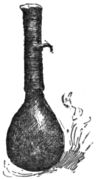
A RATTLE.
THE GHOST WIFE.
ONE time there were living together a man and his wife. They had a young child. The woman died. The man was very sad, and mourned for his wife.
One night he took the child in his arms, and went out from the village to the place where his wife was buried, and stood over the grave, and mourned for his wife. The little child was very helpless, and cried all the time. The man’s heart was sick with grief and loneliness. Late in the night he fell asleep, fainting and worn out with sorrow. After a while he awoke, and when he looked up, there was a form standing by him. The form standing there was the one who had died. She spoke to her husband, and said, “You are very unhappy here. There is a place to go where we would not be unhappy. Where I have been nothing bad happens to one. Here, you never know what evil will come to you. You and the child had better come to me.”
The man did not want to die. He said to her, “No; it will be better if you can come back to us. We love you. If you were with us we would be unhappy no longer.”
For a long time they discussed this, to decide which one should go to the other. At length the man by his persuasions overcame her, and the woman agreed to come back. She said to the man, “If I am to come back you must do exactly as I tell you for four nights. For four days the curtain must remain let down before my sleeping place; it must not be raised; no one must look behind it.”
The man did as he had been told, and after four days had passed, the curtain was lifted, and the woman came out from behind it. Then they all saw her, first her relations, and afterward the whole tribe. Her husband and her child were very glad, and they lived happily together.
A long time after this, the man took another wife. The first wife was always pleasant and good-natured, but the new one was bad-tempered, and after some time she grew jealous of the first woman, and quarreled with her. At length, one day the last married became angry with the other, and called her bad names, and finally said to her, “You ought not to be here. You are nothing but a ghost, anyway.”
That night when the man went to bed, he lay down, as was his custom, by the side of his first wife. During the night he awoke, and found that his wife had disappeared. She was seen no more. The next night after this happened, the man and the child both died in sleep. The wife had called them to her. They had gone to that place where there is a living.
This convinced everybody that there is a hereafter.
TI-KE-WA-KUSH.
The Man who Called the Buffalo.
THIS happened in the olden time before we had met the white people. Then the different bands lived in separate villages. The lodges were made of dirt. The Kit-ke-hahk´-i band went off on a winter hunt, roaming over the country, as they used to do, after buffalo. At this time they did not find the buffalo near. They scouted in all directions, but could discover no signs of them. It was a hard time of starvation. The children cried and the women cried; they had nothing at all to eat.
There was a person who looked at the children crying for something to eat, and it touched his heart. They were very poor, and he felt sorry for them. He said to the Head Chief, “Tell the chiefs and other head men to do what I tell them. My heart is sick on account of the suffering of the people. It may be that I can help them. Let a new lodge be set up outside the village for us to meet in. I will see if I can do anything to relieve the tribe.” The Chief said that it was well to do this, and he gave orders for it.
While they were preparing to build this lodge they would miss this man in the night. He would disappear like a wind, and go off a long way, and just as daylight came, he would be there again. Sometimes, while sitting in his own lodge during the day, he would reach behind him, and bring out a small piece of buffalo meat, fat and lean, and would give it to some one, saying, “When you have had enough, save what is left, and give it to some one else.” When he would give this small piece of meat to any one, the person would think, “This is not enough to satisfy my hunger;” but after eating until he was full, there was always enough left to give to some other person.
In those days it was the custom for the Head Chief of the tribe, once in a while, to mount his horse, and ride about through the village, talking to the people, and giving them good advice, and telling them that they ought to do what was right by each other. At this time the Chief spoke to the people, and explained that this man was going to try to benefit the tribe. So the people made him many fine presents, otter skins and eagle feathers, and when they gave him these things each one said, “I give you this. It is for yourself. Try to help us.” He thanked them for these presents, and when they were all gathered together he said, “Now you chiefs and head men of the tribe, and you people, you have done well to give me these things. I shall give them to that person who gives me that power, and who has taken pity on me. I shall let you starve yet four days. Then help will come.”
During these four days, every day and night he disappeared, but would come back the same night. He would say to the people that he had been far off, where it would take a person three or four days to go, but he was always back the same night. When he got back on the fourth night, he told the people that the buffalo were near, that the next morning they would be but a little way off. He went up on the hill near the camp, and sacrificed some eagle feathers, and some blue beads, and some Indian tobacco, and then returned to the camp. Then he said to the people, “When that object comes to that place of sacrifice, do not interfere with it; do not turn it back. Let it go by. Just watch and see.”
The next morning at daylight, all the people came out of their lodges to watch this hill, and the place where he had sacrificed. While they were looking they saw a great buffalo bull come up over the hill to the place. He stood there for a short time and looked about, and then he walked on down the hill, and went galloping off past the village. Then this man spoke to the people, and said, “There. That is what I meant. That is the leader of the buffalo; where he went the whole herd will follow.”
He sent his servant to the chiefs to tell them to choose four boys, and let them go to the top of the hill where the bull had come over, and to look beyond it. The boys were sent, and ran to the top of the hill, and when they looked over beyond it they stopped, and then turned, and came back, running. They went to the chiefs’ lodge, and said to the chiefs sitting there, “Beyond that place of sacrifice there is coming a whole herd of buffalo; many, many, crowding and pushing each other.”
Then, as it used to be in the old times, as soon as the young men had told the Chief that the buffalo were coming, the Chief rode about the village, and told every one to get ready to chase them. He said to them besides, “Do not leave anything on the killing ground. Bring into the camp not only the meat and hides, but the heads and legs and all parts. Bring the best portions in first, and take them over to the new lodge, so that we may have a feast there.” For so the man had directed.
Presently the buffalo came over the hill, and the people were ready, and they made a surround, and killed all that they could, and brought them home. Each man brought in his ribs and his young buffalo, and left them there at that lodge. The other parts they brought into the village, as he had directed. After they had brought in this meat, they went to the lodge, and staid there four days and four nights, and had a great feast, roasting these ribs. The man told them that they would make four surrounds like this, and to get all the meat that they could, “But,” he said, “in surrounding these buffalo you must see that all the meat is saved. Ti-ra´-wa does not like the people to waste the buffalo, and for that reason I advise you to make good use of all you kill.” During the four nights they feasted this man used to disappear each night.
On the night of the fourth day he said to the people, “To-morrow the buffalo will come again, and you will make another surround. Be careful not to kill a yellow calf—a little one—that you will see with the herd, nor its mother.” This was in winter, and yet the calf was the same color as a young calf born in the spring. They made the surround, and let the yellow calf and its mother go.
A good many men in the tribe saw that this man was great, and that he had done great things for the tribe, and they made him many presents, the best horses that they had. He thanked them, but he did not want to accept the presents. The tribe believed that he had done this wonderful thing—had brought them buffalo—and all the people wanted to do just what he told them to.
In the first two surrounds they killed many buffalo, and made much dried meat. All their sacks were full, and the dried meat was piled up out of doors. After the second surround, they feasted as before.
After four days, as they were going out to surround the buffalo the third time, the wind changed, and before the people got near them, the buffalo smelt them, and stampeded. While they were galloping away, the man ran up on to the top of the hill, to the place of sacrifice, carrying a pole, on which was tied the skin of a kit fox; and when he saw the buffalo running, and that the people could not catch them, he waved his pole, and called out Ska-a-a-a! and the buffalo turned right about, and charged back right through the people, and they killed many of them. He wished to show the people that he had the power over the buffalo.
After the third surround they had a great deal of meat, and he called the chiefs together and said, “Now, my chiefs, are you satisfied?” They said, “Yes, we are satisfied, and we are thankful to you for taking pity on us and helping us. It is through your power that the tribe has been saved from starving to death.” He said, “You are to make one more surround, and that will be the end. I want you to get all you can. Kill as many as possible, for this will be the last of the buffalo this winter. Those presents that you have made to me, and that I did not wish to take, I give them back to you.” Some of the people would not take back the presents, but insisted that he should keep them, and at last he said he would do so.
The fourth surround was made, and the people killed many buffalo, and saved the meat. The night after this last surround, he disappeared and drove the buffalo back. The next morning he told the people to look about, and tell him if they saw anything. They did so, but they could not see any buffalo.
The next day they moved camp, and went east toward their home. They had so much dried meat that they could not take it all at once, but had to come back and make two trips for it. When they moved below, going east, they had no fresh meat, only dried meat; but sometimes when this man would come in from his journeys, he would bring a piece of meat—a little piece—and he would divide it up among the people, and they would put it into the kettles and boil it, and everybody would eat, but they could not eat it all up. There would always be some left over. This man was so wonderful that he could change even the buffalo chips that you see on the prairie into meat. He would cover them up with his robe, and when he would take it off again, you would see there pounded buffalo meat and tallow (pemmican), tup-o-har´-ash.
The man was not married; he was a young man, and by this time the people thought that he was one of the greatest men in the tribe, and they wanted him to marry. They went to one of the chiefs and told him that they wanted him to be this man’s father-in-law, for they wanted him to raise children, thinking that they might do something to benefit the tribe. They did not want that race to die out. The old people say that it would have been good if he had had children, but he had none. If he had, perhaps they would have had the same power as their father.
That person called the buffalo twice, and twice saved the tribe from a famine. The second time the suffering was great, and they held a council to ask him to help the tribe. They filled up the pipe and held it out to him, asking him to take pity on the tribe. He took the pipe, and lighted it, and smoked. He did it in the same way as the first time, and they made four surrounds, and got much meat.
When this man died, all the people mourned for him a long time. The Chief would ride around the village and call out, “Now I am poor in mind on account of the death of this man, because he took pity on us and saved the tribe. Now he is gone and there is no one left like him.”
This is a true and sacred story that belongs to the Kit-ke-hahk´-i band. It happened once long ago, and has been handed down from father to son in this band. The Skidi had a man who once called the buffalo, causing them to return when stampeded, as was done in this story.
Note.—Big Knife, a Skidi, who died only recently, said that the man was alive in his time. Kuru´ks-u le-shar (Bear Chief), a Skidi, says that he knew the man. His name was Carrying Mother.
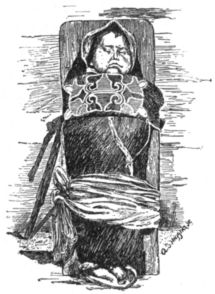
BABY ON BOARD.
PA-HU-KA´-TAWA.
ABOUT the end of the winter, before the grass began to grow in the spring, a company of three brothers and two other men went out from the village to trap beaver. When they had been gone about ten days, and had got up above the Forks of the Loup River, they camped on the South Fork, and in the morning sent one man ahead to see if he could find any beaver sign, and could look out a good trapping ground.
When he had gone a little distance from the camp, he saw some Sioux, and at the same moment they saw him. He did not run back to the camp; he was too anxious to save himself; but ran across to a little creek, and hid in the brush, not trying to let his brothers know that the enemy were near. The Sioux followed him and found him, and chased him about, and shot at him all day, until near sundown, when they killed him.
The four other men had stopped in camp, but were not so far off but that they could hear the shouts and yells, and they ran off from the camp, and hid themselves and waited. When the other man did not come back, they knew that he had been killed.
The next morning, the four men talked together. One said, “We had better go up and see if he is killed.” Another said, “Yes, let us go there. It may be that we can bury him.” So they went up where he had been, going very carefully, and looking over all the hills as they went, so as to see any enemies if they were about. They found him. He was dead, shot full of arrows, scalped, his whole head skinned, his arms and legs unjointed, his head cut off; he was all cut to pieces. So they thought that there was not enough of him left to bury, and besides, those killed in battle are often left unburied. When they found how it was, they started back to the village, and when they came close to it, one of the men called out, “Pa-hu-ka´-tawa is killed!” He called that out so that the people might know, and might begin to mourn.
When they came into the village, the relations of this man felt very badly because he was killed. It was coming on toward the time when they begin to clear up their patches, to plant the corn, and to hoe, and his father and mother mourned, and said, “Now we have no one to help us hoe. We are old, and he helped us; but now he is gone.” So they mourned for him.
They did not visit the place where he had been killed for some time. It was now spring, and they were planting, and hoeing the corn, and when they got through their work, the whole tribe started out on the summer hunt to get buffalo, as they used to do. They started up the Loup, and when they had traveled along a number of days, they came near the place where the man had been killed. When they got there, the men who had been with him said, “This is the place where Pa-hu-ka´-tawa was killed,” and his father and mother and all his relations went over to the place where he had lain, to gather his bones together and then to bury them. When they got to the place, they could find no bones at all, but the arrows were there, sticking straight up in the ground; all the arrows that had been shot into the body. They wondered that they had not fallen down, for they thought that the wolves might have dragged the body, but when they looked everywhere about for the bones, they could find no sign of them anywhere. It seemed strange to them that the arrows should be there standing up in the ground, and they wondered what had become of the bones. At length they gave up looking for them, and went back to the camp. When they could not find the bones, they went on and hunted buffalo, and killed plenty, and made dried meat. After two months they started back to the village, going down the Platte River. His mother had cried so much for Pa-hu-ka´-tawa, that she had become blind.
One pleasant afternoon they were camped on the Platte. The evening was warm and soft and still. As the sun went down toward the earth, long shining rays seemed to come down from it to the ground. All through the air was a light smoke, and in the west the sky was red. Just as the sun was setting, the people all heard a voice calling from the other side of the river. They listened; and the voice said, “Pa-hu-ka´-tawa is coming back to you.” Then all the Indians jumped up, and ran across the river to meet him, for they thought perhaps he was coming back. When they had got to the other side, they looked about, but could see no one. Then they heard a voice from behind them, on the other side of the camp, which said, “He is coming from here.” They all turned round and ran back to the other side of the camp; but no one was there; and in a little while they heard the voice again, on the other side of the river, saying, “He is coming.” Then they knew it was only a voice and not a person. They stopped running about, and that night they talked about the voice. The next day they went on down the river, and at length got back to the main village. There they stayed six months, and by this time their dried meat was all eaten, and it was toward spring.
The mother of Pa-hu-ka´-tawa had her bed near the door of the lodge on the left hand side, the last bed next to the door. One night, at midnight, he came into the lodge, and touched his mother and said, “Mother! mother!” His mother used to dream of him almost every night, and she thought she was dreaming now. She said, “Oh, my son, do not do this. You are deceiving me again.” He stopped; but presently he touched her again, and pushed her shoulder, and she awoke.
He said to her, “Mother, I am here,” and she reached out and felt him.
She said, “Are you really my son?”
He answered, “Yes, I am your son.”
Then she put her arms around him, and hugged him, and said to him, “Oh, my son, my son, you have come back to me.” She cried, she was so glad.
Then they talked together. He gave her a piece of meat—a piece of fresh buffalo meat—though they had had no fresh meat in the village for six months. He said to his mother, “I am really alive, though I was killed. The Nahu´rac (animals) took pity on me, and have made me alive again. And now I am going off; but do not cry about me any more.” Then he went away.
The next morning, when his mother awoke, she found by her side the piece of fresh meat, and she began to cook it on the coals. The people wondered where she got the fresh meat, and asked her about it, but she would not tell them where she got it, for her son had told her to say nothing. They asked her again where she got it, and she told them she found it in her bed.
After a long time her son came again in the night, and went into the lodge, and spoke to his mother, saying, “Mother, I am here again.” She awoke, and rejoiced that he had come back. He said to her, “My mother, I know that you are poor. You are blind on account of me, because you have cried so much. Now, my mother, there is standing by the side of your daughter’s bed, water in a wooden bowl. After I have left you to-night, go over there, and put your face down deep into the water, and open your eyes in the water, and then you will see.” Before he left her he gave her some ka´wis.[8]
After he had gone, she did as he had told her. She got up, and feeling her way along with her hands, crept into the place where her daughter slept. There she felt the wooden bowl with water in it, and she put her face deep down into the water, and opened her eyes in it, and when she took her face out of the water, and opened her eyes again, she could see. Then she was glad. Everybody wondered how the mother’s eyes had been cured, but she told no one, except only her oldest son.
After a long time Pa-hu-ka´-tawa came down again to see his mother. He said to her, “Mother, I am going up to see my oldest brother.” He went to see his brother in the night. His brother was expecting him, for his mother had warned him. Pa-hu-ka´-tawa said, “Now, my brother, I think you have heard that I come all the time to see our mother. I wish that you would put up your lodge outside the camp, so that I can come and see you often. I want to talk to you, and tell you my thoughts and all my troubles. I am a spirit.” His brother answered him that he would do as he had asked, and the first night after the lodge had been set up outside the camp, Pa-hu-ka´-tawa came down, and said to his brother, “To-morrow night I want you to select the two bravest men in the tribe, and let them go about through the camp, and call all the chiefs and all the bravest warriors in the tribe, and let them gather at your home. Do not build any fire in the lodge. Let it all be dark, for I am coming down in the night to see them.”
When the next night came, the chiefs and the braves gathered at the lodge just about dark. They made no fire, but sat there waiting for Pa-hu-ka´-tawa to come down. After a while he came down to the lodge, and came in where they were sitting. When they were all silent, he came in, and every step he made it seemed that sparks of fire were flying out from him. He went and stood before his brother, and said to him, “I am in everything; in the grass, the water, the trees. I am a part of all these things. I know every thought of yours, and if you only whispered, I would hear it. I know everything, and about everything, even about the ocean which is so far off, and where the water is salt.
“There are two dances that I like, in which there are songs sung about me.” Then he sang these songs and told them how to dance these dances.[9] He said, “Dance these dances and sing about me, calling me by name.”
Then he said, “Brother, I want you to know that there is a tribe of your enemies getting ready to go on the warpath against you. I will let you know when they start, and all they do. Every move they make I will tell you of. They are coming from far up the Missouri River.”
Two or three nights later Pa-hu-ka´-tawa appeared to his brother, and said, “They are coming. To-morrow night they will be here spying round the camp. Be ready for them. You must ask me to take pity on you, telling me what you want to do, and I will make you strong, so that you can succeed. If you want to strike two or three, ask me. If you want to kill two or three, tell me. You must call me grandfather.”
The next night they danced and asked him to take pity on them. One young man prayed, saying, “Let me strike nine, and at the tenth let me be wounded, but let me not die.” A second young man prayed, saying, “I want to strike five and capture the biggest man in the party.” Another man asked him, “Let me strike two, and then let me be killed.” To each one who asked a favor of him, he said, “Let it be so.” They did not see him, for there was no fire in the lodge. It was dark.
He said to them, “Be ready. To-morrow morning is the time when the enemy will attack you. I will send a fog from the north as a warning. They will come down toward the village, and you must go out on the plain in front of the village, and have a skirmish with them. Then draw off, and look toward the point of bluff which runs down into the plain on the east end of the battle field. Watch that point and you will see me. I will appear to you there. And this shall be a sign to you that it is I whom you see. When I come up over that point and turn around, facing to the north, the wind will change and will come from the south. And when the wind blows from the south, you make a charge on them.”
So it was. The next morning the enemy made an attack on them, and came down toward the village. It was the very day he had said. The warriors went out on the plain to meet them. They were wondering in what shape Pa-hu-ka´-tawa would appear to them, how he would look. On that morning, before the Sioux appeared, a white fog came down from the north. Then the Sioux made the attack, and the people began to look for Pa-hu-ka´-tawa. And while they were looking toward the bluff, a great white wolf came up over the point, and stood looking first one way and then another, and then it turned around and faced the north. And immediately the wind changed and blew from the south. When the wolf appeared, some of the braves doubted whether it was Pa-hu-ka´-tawa, but when it turned round, and the wind changed, then they knew that it was he.
Then they made the charge, and each one of those who had asked a favor received it. In every case what Pa-hu-ka´-tawa had promised came true. The man who had prayed that he might strike nine and at the tenth be wounded, struck nine and was wounded at the tenth, but he did not die; the one who asked to strike five, and to capture the biggest man in the party, did so. He caught the prisoner, and overcame him, and put a rope around his neck, and led him into the village. And when he got him to the village the women beat the captive with sticks and clubs, and threw dirt at him, and had lots of fun with him. The young man who had asked it, killed two, and then was himself killed. All that Pa-hu-ka´-tawa had promised came to pass.
The people killed many of the Sioux, and drove them far, chasing and killing them all day long. Then they came back to the village, bringing with them the scalps and the weapons that they had taken, the bows and the spears, the shields and the war bonnets. They danced in the village, and sang and rejoiced. Every one was glad because the people had won a great victory.
The next night after the day of the battle, Pa-hu-ka´-tawa came down to his brother’s lodge, and told him that he wanted to speak to him. His brother awoke all his wives, and sent them out of the lodge, telling them not to come back until he called them. Then Pa-hu-ka´-tawa said to his brother, “Now, my brother, you people have seen whether what I say to you is true or not. You have seen what has happened, you can judge. Now, brother, I want you to feel of me all over; nobody else but you to feel of me, my brother.” His brother passed his hands all over his breast and arms and body and legs. Pa-hu-ka´-tawa said, “Now put your hands on top of my head, and feel there.” He did so, and felt something soft. Pa-hu-ka´-tawa said, “Do you know what that is? That is the down feathers.”
Then he told the story of his being killed. He said, “That time after I got killed, all kinds of Nahu´rac took pity on me. The flies and bugs, the fishes and birds, the deer and the wolves, all the animals took pity on me, and helped me to come to life again. They looked all over for my flesh and my bones, and brought them all together. One part of me, the top part of my skull, they could not find. The bugs crept through the ground looking for it, the fishes swam through the water and sought it, the flies buzzed about over the sand, and the deer and wolves hunted for it on the prairie, but they could not find this piece anywhere. Nor could they find my brains. Perhaps, when I was killed, the crows eat them out. When they had gathered the pieces all together, they laid each piece in its own place, so that they had the form of a man, and in place of the top of the skull and the brains they put the down feathers. After they had put all the pieces together, they stood around me, and prayed, and passed their paws over me, and danced and sang, and at last I breathed a little. Then they prayed again, and passed their paws over me, and at length I breathed regularly. Then I was not dead any more; I was alive again. Not as a person was I alive, but as a spirit.
“I am in every thing; in the wind, in the rain, in the grass. I go over the whole world. I am the wind, and I go everywhere all over the world. There is no one above me but Ti-ra´-wa. He is the only one I am under. He is the ruler of all. Whenever any human being on this earth, man, woman or child, says anything about me, I hear it surely. You must tell all this to every one, and say to them that if they are sick or unfortunate, let them pray to me, and I will heal or help them.
“Now you know that I am living, but I am a spirit; and whenever you people have a fight with the Sioux, if you pray to me, and call me by name, and ask to be brave, and to be helped, I will hear you. If you wish to be brave, or if you wish not to be hurt in battle, even though the enemy be right upon you, and just striking or shooting at you, I will protect you. I shall live forever, as long as this world exists. So long as I come to you, I want you people to conquer the Sioux all you can, on account of what they did to me when they killed me and cut me in pieces. So long as the Sioux come down to attack you, I want you to conquer them every time.
“Now, brother, when I come down to see you, you must not get tired of me. I want to come down often to see you, and talk to you, to tell you what is going to happen, and to warn you whenever the Sioux are coming down to attack the Skidi. I go about everywhere, to the camps of the different bands of Sioux, and I know what the chiefs are saying in council; when they are talking of sending out war parties against you. If I come down to you often, do not get tired of seeing me.”
He knew himself that his brother would some time refuse to listen to him, but his brother did not know it, and he said, “I will never get tired of you.”
Some time after this, the Sioux came down again to attack the Skidi village. Two days before they came, Pa-hu-ka´-tawa came down to his brother and warned him, saying, “A big war party of Sioux will be here day after to-morrow to fight with you. But I am going to attend to them. On the morning of the second day from this, tell all the people to be ready, and to have their horses tied up close to the lodges, where they can get at them. Then, if you look up in the sky, you will see thick black clouds, as if you were going to have a great rain. When you begin fighting, do not be afraid of the enemy. Do not be afraid of them; go right up to them; they will not be able to shoot, their bowstrings will be wet, and the sinews will stretch and slip off the ends of the bows. They will not be able to hurt you.”
On the morning that he had said, the Sioux came down, and the people went out to meet them. The sky above was black with clouds. When they began fighting, a heavy rain commenced to fall, but it did not rain everywhere, but only just where the Sioux were. The bowstrings of the Sioux got wet, so that they could not use them, for the sinews stretched, so that when they bent their bows the strings slipped off the ends of the bows, and there was no force to their arrows. The Skidi overcame the Sioux and drove them, and the Sioux ran far. The rain followed the Sioux, and rained over them, but nowhere else, and the Sioux fled, and the Skidi won a great victory.
Soon after this, Pa-hu-ka´-tawa came down and visited his brother, and said to him, “My brother, whenever you have a feast or a council of old men, you must smoke to me and say, ‘Father, we want you to help us.’ Then I will hear you. At the same time you must pray to Ti-ra´-wa. There is one above us who is the ruler of all. I do not wish to be talked about commonly or by common men, but that whenever you have a feast you should call in the young men and tell them about me and let them hear.” He did not want his name used irreverently, nor wish that the story of what he had suffered and done should be told commonly or for mere amusement. It is sacred and should be told only at solemn times.
Some time after this talk with his brother, he came down again to see him. Another man was living in his brother’s lodge, and on this night his brother was not there, he was sleeping somewhere else. Pa-hu-ka´-tawa asked this man where his brother was. He answered, “He is not here to-night, he is sleeping somewhere else.” Pa-hu-ka´-tawa said, “Go over and tell him that I am here, and that I want to see him.” The man went and gave the message to the brother, who said, “I do not want to go. Tell him I am asleep.” The man went back and told Pa-hu-ka´-tawa that his brother could not come. He said, “He is asleep.” Pa-hu-ka´-tawa sent him back again, to get the brother. The man went, and said to the brother, “He wants to see you very much.” The brother said, “Tell him I can’t come; I want to sleep to-night.” The man returned and said, “He does not want to come, he is sleeping.” He was sent back for the brother the third time, to tell the brother he must come, he was wanted. He sent word back that he could not, he was too sleepy. Then Pa-hu-ka´-tawa said, “Very well. Go back and tell him to sleep now, to sleep all he wants. I told him before that he would get tired of me at last. Let him sleep all he wants, I will come to him no more. I can go to some other tribe. This is the last time I will come. Tell him to sleep. I will trouble him no more. I am going off, but tell the people not to forget me; to talk of me sometimes, and to pray to me, and I will help them and care for the tribe.”