Folk-Tales. (continued 2)
Reading edition
So Pa-hu-ka´-tawa went away to the Rees, and the people knew him no more; after that he never came down to see them. When the people learned this, they felt very badly, and were angry at his brother who would not see him. There was living not long ago, among the Rees, an old woman, who, when she was a girl, had seen and talked to Pa-hu-ka´-tawa.
Note.—This is a Skidi story. The Rees have a story of what Pa-hu-ka´-tawa did after he had come to them. The Lower Village tribes have a story of a hero of this same name, which is quite different from that of the Skidi.
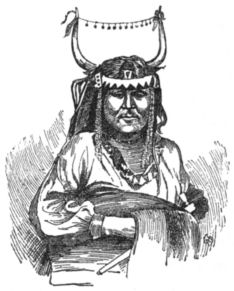
LONE CHIEF—SKIDI.
THE BOY WHO WAS SACRIFICED.
THERE was a time, far back, when some people thought that it was good to sacrifice to Ti-ra´-wa whatever they had that was most precious to them. The sacrifice of the animal, the burnt offering, has always been made by all the Pawnees; that is one of the things handed down from the ruler. It is very old. The Skidi have always performed the sacrifice of the captive. Each one of these is sacred and solemn, but it is not like giving up something that belongs to you, and that you love. It is a sacrifice, but it does not cost much.
Many years ago, in the Skidi village on the Loup, there lived a man, who believed that if he sacrificed his son to Ti-ra´-wa, it would be a blessing to him. He thought that if he did this thing, perhaps Ti-ra´-wa would speak to him face to face, and that he could talk to him just as two people would talk to one another, and that in this way he would learn many things that other people did not understand. His child was a nice boy about ten years old, strong, growing up well, and the man loved him. It made him feel badly to think of killing him. He meditated long about this, but the more he thought about it, the more he believed that this sacrifice would please Ti-ra´-wa. There were many things that he wanted to understand, and to do; and he thought if he gave up his son, these good things would come to him. So he resolved to make the sacrifice.
One morning he started out from the village, and took the boy with him. They went over to the Platte. When they got to the river, as they were walking along, the man took his knife from its sheath, and caught the boy by the shoulder, and stabbed him quickly, and cut him open. When the boy was dead, he threw the body into the river, and then went back to the village. When he got there, he went into his lodge and sat down. After a time he said to his wife, “Where is the boy?” The woman said, “He went out with you, when you went over to see the horses.” The man answered, “No; I went out to where the horses are feeding, and looked at them, but he did not go with me.”
The man went out, and looked for the boy all through the village, but he could not find him. At night when the boy did not come home, they began to get frightened, and for two days they hunted for the boy, and at last they got the old crier to call out for him from the top of the lodge, and ask if any one had seen him, but none of the people knew what had become of the boy. Now the mother was mourning, and the father pretended to feel very badly. They could not find the boy; and soon after this the tribe started on the summer hunt, and the father and mother went with them. The village made a good hunt, killing plenty of buffalo, and made much dried meat.
After the boy had been thrown into the river, he floated down with the current, sometimes turning over and over in the swift water, and sometimes grounding for a little while on a sand bar, and then being floated off again, and being carried further down. At length he came near to the place where the whirlpool is, under the bluff at Pa-hŭk´, where is the lodge of the Nahu´rac. There were two buzzards sitting on the bluff, just above this place, and as they sat there, one of them stretched out his neck and looked up the river, and after he had looked, he said to the other, “I see a body.” Then both the buzzards flew down to where the boy was floating in the water, and got down under him, and raised him on their backs, and lifted him up out of the water, and flew up to the bluff, carrying the boy on their backs, and placed him on the ground on top of the bluff over the big cave, which is the home of the Nahu´rac. In this lodge were all kinds of animals, and all kinds of birds. There were bears, and mountain lions, and buffalo, and elk, and beaver, and otter, and deer; all kinds of animals, great and small, and all kinds of birds.
There is a little bird, smaller than a pigeon. Its back is blue, and its breast white, and its head is spotted. It flies swiftly over the water, and when it sees a fish, it dives down into the water to catch it. This bird is a servant or a messenger for the Nahu´rac. Such a bird came flying by just as the buzzards put the body on the ground, and he stopped and looked at it. When he saw how it was—for he knew all that had happened—he flew down into the lodge and told the Nahu´rac about the boy. The bird said, “There is a boy up here on the hill. He is dead, and he is poor, and I want to have him brought to life again.” Then he told the Nahu´rac all the things that had happened. When the messenger bird had done speaking, the Nahu´rac earnestly counselled together for a long time to decide what should be done, and each one made a speech, giving his opinion about the matter, but they could not make up their minds what ought to be done.
The little bird was coaxing the Nahu´rac, and saying, “Come, now, we want to save his life.” But the Nahu´rac could not decide. At last the chief of the Nahu´rac said, “No, messenger, we cannot decide this here. You will have to go to the other council lodges, and see what they say about it.” The bird said, “I am going,” and flew swiftly out of the lodge and up the river, till he came to the Nahu´rac lodge near the Lone Tree. When he got there, he told them all about the boy, and said that the council at Pa-hŭk´ could not decide what should be done. The Nahu´rac here talked, and at last they said, “We cannot decide. The council at Pa-hŭk´ must decide.” Then the bird went to the lodge on the Loup, and the Nahu´rac there said that they could not decide Then he went to Kitz-a-witz-ŭk, and to Pa-hūr´; and at each place the Nahu´rac considered and talked about it, and then said, “We cannot decide what shall be done. The council at Pa-hŭk´ must decide for themselves.”
At last, after he had visited all the council lodges of the Nahu´rac, the bird flew swiftly back to the lodge at Pa-hŭk´, and told them there what the animals at the other lodges had said. In the council of the Nahu´rac at Pa-hŭk´, there were four chiefs, who sat there as judges to determine such matters as this, after they had all been talked over, and to decide what should be done. When the messenger bird came back, and told the Nahu´rac what the other councils had said, these judges considered for a time, and then spoke together, and at length the chief of the judges said to the bird, “Now, messenger, we have concluded that we will not decide this question ourselves. You decide it, and say what shall be done.”
The messenger was not long in deciding. He did not hesitate. He said, “I want this boy brought back to life.” Then all the Nahu´rac stood up, and went to where the boy lay, and stood around him and prayed, and at last the boy breathed once, and then after a little while he breathed again, and at last he came to life and sat up. He looked about and saw all these animals standing around him, and he wondered. He said to himself, “Why, my father stabbed me, and killed me, and now here I am among this great crowd of animals. What does this mean?” He was surprised.
The Nahu´rac all went back into the lodge, and took the boy with them. When all were seated in the lodge, the four judges talked to each other, and the chief one stood up, and said, “Now, my people, we have brought this boy back to life, but he is poor, and we must do something for him. Let us teach him all we know, and make him one of us.” Then the Nahu´rac all made a noise. They were glad. Then they began to sing and they danced. They taught the boy all their secrets, and all their ways. They taught him how to cut a man open and cure him again, and how to shoot an arrow through a man and then cure him, and how to cut a man’s tongue out and then to put it back, and how to make well a broken leg, and many other things. After they had done all these things, they said to the boy, “Now we have brought you back to life, and have taught you all these things, so that you are one of us. Now you must stop with us one season. Your people have gone off on the summer hunt. You must stay with us until the autumn. Then you can go back to your people.” So the boy stayed with the Nahu´rac in their lodge.
At length the Skidi had returned from the hunt with plenty of dried meat. Soon after this, the Nahu´rac said one day to the boy, “Your people have got back from the hunt. Now you can go back to the village. Go back and get a lot of nice dried meat, and bring it back to us here, and we will have a feast.”
The boy went home to the village. He got there in the night, and went to his father’s lodge, and went in. There was a little fire burning in the lodge. It was nearly out, and gave only a little light, but he knew the place where his mother slept. He went up to her, and put out his hand and touched her, and pushed her a little. She awoke, and sat up and looked at him, and he said, “I’ve come back.” When she saw him, and heard him speak, she was very much surprised, and her heart was glad to see her boy again. She called to his father, and he woke up. When he saw the boy he was afraid, for he thought it was a ghost. The boy told them nothing of what had happened, or where he had been. He just said, “I have come back again.”
In the morning all the people were surprised to hear that he had come back, and to see him, and they stood around looking at him, and asking him questions, but he said nothing. The next day the people still questioned him, and at last the boy said, “I have been all summer with friends, with people who have been good to me. I should like to take them a present of some nice dried meat, so that we can have a feast.” The people said that this was good. They picked out four strong horses, and loaded them with dried meat, the nicest pieces. The boy’s father gave some of it, and all the other people brought pieces and put them on the horses, until they had big loads. They sent two young men with the boy, to help him load and drive the horses, and they started to go to the Nahu´rac lodge at Pa-hŭk´.
When they had come pretty near the place, the boy sent the young men back to the village, and he went on alone, driving the pack-horses before him. When he reached the home of the Nahu´rac, he unloaded the horses, and turned them loose, and then went into the lodge. When he went in, and when the Nahu´rac saw him, they all made a hissing noise. They were glad to see him. The boy brought into the lodge all the dried meat, and they had a great feast. After the feast they had a doctors’ dance, and the boy was made a doctor, and again was taught all that the Nahu´rac knew. After that he could do many wonderful things. He could sometimes go to a man that had been dead for a day, and then bring him back to life.
No one ever knew what the father had done, for the boy never told any one. He knew that he could never have learned all these wonderful things unless his father had sacrificed him.
FLESHERS.
THE SNAKE BROTHER.
ONE time, long ago, a big party of Pawnees went on the warpath down to the south. They could find no enemies anywhere, and they went a long way south. In this party were two brothers, poor boys, and one day as they were traveling along, apart from the others, in a piece of woods where it was very thick, they got lost. When they found that they were lost, they tried to go back to the camp, but they could not find the others, and at last gave up looking for them and started to go back north to their home. They had no food with them, and were looking about for something to kill, so that they might eat. As they were going along, they came upon a dead buffalo that had been killed some time, and there was nothing of it left but the bones, so they took some of the marrow bones, and carried them along with them, until they made a camp.
Not far beyond here they stopped to rest. There was a tree growing near where they stopped, and as they looked up into it, they saw a squirrel run up the tree. One of the brothers caught up his bow and arrows, and the other said, “Oh, kill him, kill him, quick.” The boy shot and killed it, and they skinned it, and roasted it over the fire. While they were cooking it the elder brother said, “I wonder if it is good to eat the marrow and the squirrel together.” The younger said, “No, it is not good to do so. This is not real meat.”[10] The elder thought the two kinds of food would be good together, and they disputed about this for some time. The elder brother kept coaxing the younger to eat the squirrel and the marrow together, but the younger said, “Oh, brother, I do not like to do this. To me it does not seem good. But if you wish to do it, why don’t you?” The elder said, “I think I will do so;” and he did so, taking a bite of squirrel, and then a bite of marrow. He said, “It is nice, you had better take some.” But the younger brother would not. He ate only the marrow. After they had eaten they did not go on further, but slept there.
About the middle of the night, the elder brother felt a noise in his feet, and he sat up and felt of his legs and feet, and he found that his feet were stuck together, and were beginning to get round, like a snake, and had a rattle on the end of them, and that his legs were round and like the tail of a great big rattlesnake. He reached over, and put his hands on his brother, and shook him, and said to him, “Get up. There is something the matter with me.” The younger brother woke up, and felt of his brother, and found how it was; as if he was changing into a snake, beginning at his feet. When he saw this he felt very badly. Then the older brother began to talk to the younger, and to give him good advice, for he felt very sad.
He said, “Now I am going to die, and leave my young brother here alone on this prairie. He is so young, he will not be able to find his way home, and he must die, too. Surely this has happened because I ate the marrow and the squirrel together.” While he was talking, the change had moved up to his waist.
After a little while he got more hopeful, and he said, “Now, brother, I know that you will get home safely. I will protect you. I know that I am going to be a snake, and I shall stay right here. You see that hole,” and he pointed to a hole in the bank. “When I have changed into a snake, take me in your arms, and carry me over to that hole. I am going to stay there forever. That will be my home, for that is the house of the snakes. When you go back home, you must tell our father and mother how it was, and whenever you want to go on the warpath, take a big party and come down this way, and come right here, to this very place, and you will see me, for I shall be here. Now, brother, when you go back home, some time after you have reached home, I want you to come back all alone; come right here. You know what I told you; do not be afraid of me. I believe this was to happen to me, and I could not help it. After you have once come all alone, then the second time you may bring some others with you, but the first time come alone.” So he talked to his brother, and as he spoke the change kept going on. While it was moving up his body, until it got to his head, he was still like a man in his mind, but all his body was like a great big snake. Then he spoke to his brother, and said, “Now, brother, cover up my head with the robe, and after a little while take it off again.” The younger brother, did as he was told, and when, after a while, he took the robe off, there he saw an immense snake’s head as broad as his two hands. The elder brother had completely changed into a snake.
The young man took the snake in his arms, and carried him over to the hole, and put him on the ground by it. He felt very sad to go away and leave his brother here. Before he started, he spoke good words to the snake, and said, “Now, brother, I am going home, and I ask you to take pity on me, and to protect me. I do not know the country I am going through, and you must take care of me. Do not forget the promises you have made me.” After he had spoken he did not wait to see the snake go into the hole, but started on his journey, and went off toward his home.
When he reached the village, he told all these things to his father and his mother. He said to all his relations, “Do not mourn for him. He is alive and he is well. The only trouble is, that he is in the shape of a snake.” After he had been home ten days, he told his mother to make for him five pairs of moccasins, that he was going on the warpath for himself. His mother did so, and he stuffed them full of parched corn, and took a little sack of pounded buffalo meat on his back, and started back to see his brother.
It took him seven days fast traveling to get to where he left the snake. When he had come near the place, he saw there the hole where he had left his brother. He went up close to the hole and began to speak. He said, “Brother, I am here. I have come on the warpath, and I am here to see you. You told me to come, and to come alone. I have done what you bade me, and am here. Now, brother, remember to keep your promises. I want to see you this afternoon.”
He stood there a little while, and then there began in the hole a rattling and a rustling and scraping noise, and presently dust began to roll out, and then out of the hole came this great big snake, which was his brother. First came out this great snake, and after him many other large ones came out, and crept all about, but the great snake, his brother, lay just outside the hole. The boy went up to the big snake and took it in his arms, and hugged it, and spoke to it, and the snake put out its tongue, as if it were kissing him. Then the boy put it down on the ground, and all the other snakes came back, and went in the hole, and after them all, last, the big snake went in the hole.
Then the boy left this place, and went on a little further, and about sunset he came to a little creek, and here he lay down and slept. In the night he dreamed of his brother, who spoke to him and said, “Now, brother, I am glad that you have come down to see me, as I told you to. And now I say to you, be brave. Have courage. To-morrow morning when you awake, dress yourself up as if you were going to fight. Paint your face, put feathers in your head, make yourself ready to fight.”
The next morning the boy woke up, and as the snake had told him in the dream, so he did. He painted his face and tied feathers in his head, and dressed himself up for the fight. Then he started on. Pretty soon he came to a little hill, and as he looked over it, he saw people coming toward him; people and many horses. He thought they were Sioux, and when he saw them, he went back a little, to find a place where he could hide. He went back to the little creek where he had slept, and there he sat down in the brush. When he had hidden himself in the brush, he waited; and the people came straight toward where he had hidden himself, and camped just below where he was. After a little while he raised himself up and looked at them, and saw only two persons, and presently he saw that one of them was a woman. He watched for a long time, looking about to see if there were any more, but he could see only these two. Then he considered what he should do. While he was thinking, it came to him what the snake brother had said to him in the night, and then he knew what to do.
He crept slowly along through the brush toward their camp, and when he got close to them, about twenty yards distant, he raised up his head and looked. He saw the woman cooking, and there were hanging on a little tree the man’s bow and arrows and shield and spear, but the man he could not see. He was lying down asleep somewhere near by. The boy waited and watched. He was excited, and his heart was pounding against his ribs. After a little while, the woman left the fire and walked away toward the horses. Perhaps her husband had said to her, “The horses are going off, you had better go and turn them back.” When she went toward the horses, the boy was going to run up to the man and kill him, but before doing so he changed his mind; for he thought, “If I kill him, perhaps the woman will get on a horse, and ride away, driving the other horses with her.” So he waited until the woman had come back. When she had returned to the fire, he ran up toward her, and she heard him coming, and ran to wake her husband; but just as she got to him, the boy was by her side. He shot two arrows into the man and killed him and counted coup on him, and captured the woman. He took the whole scalp of his enemy’s head.
Then he took the woman and went down to where the horses were, and they got on two of them, and rode back to where his brother, the snake, lived, driving the horses before them. Just before they got to the hole, the boy took his lariat and caught a nice spotted horse and a mule, and tied them up to the tree, and called up the woman, and tied her up against the tree as tight as he could tie her. When he had done this, he went up to the hole and began to talk. He said, “Oh, my brother, I see now that what you have promised me comes true. I did what you told me. Now here are these two animals and the woman; I give them to you for being good to me. They are yours. I am glad for what you have done for me this day.” When he had finished saying this he spoke again, saying, “Now, brother, I want to see you once more. I am going off, and I want to see you before I go.” After a little while he heard again the rattling sound in the hole, and saw the dust coming out of it, and then his brother came out of the hole, and then afterward the smaller snakes; and these all went down to the tree and climbed up into it. The tree was thick with them. Then the boy did as he had done before. He went close to the hole, and took his brother up in his arms and hugged him, and the great snake thrust out his tongue, as if kissing him. Then the boy spoke again and said, “Now, brother, I am going away, and I give you these two animals and this woman to keep. They are yours.” Then he started for his home, and after a long time he arrived at the village.
After a time, he determined to start off again on the warpath, and this time he took a party with him. He had told the whole tribe what had happened, and how his brother had protected and helped him; and he said to those warriors who were going with him, “Let each one of you take a present with you for my brother; some beads or eagle feathers or some tobacco as an offering, so that he may help you.” They started south to go to the place where his brother lived. When they got there, the young man said to the others, “Now you must, each one of you, give something to my brother. Call him by his kin name, and ask him to help you, and to make you successful; and leave the things before the hole.” They did as he said, and when they had made their presents, they went by. They saw nothing, for the brother did not call out the great snake.
Two or three days after they had passed the place, they found a camp of Sioux, and took a lot of horses and killed some of the enemy. Then they went back, and when they came to the snake’s home, they took a horse and led it up near the hole and killed it, and gave it to him, and left the scalps at the mouth of the hole as presents to him. When they reached the village, there was great joy and a good time. They had all kinds of dances, for they were glad that the war party had killed some Sioux.
After that another war party started out, and the brother said to them, “Go straight to my brother, and make him a present, and ask him to give you good luck, and you will be successful.” And it happened as he had said.
The brother was always fortunate in war. He became a chief and was very rich, having many horses. Ever after that time, when he took the lead of a war party, all the poor men would come and say, “I want to go with you.” They knew that his brother was a snake, and would give him good luck.
O´RE-KA-RAHR.
A LONG time ago, as the tribe were on their summer hunt, a man and his wife got to quarreling. They had a child, a boy about ten months old. It was while they were traveling along, going from one camp to another, that they began to quarrel. At length the wife became very angry, and threw the baby to the man, saying, “You take that baby. It belongs to you, for it is a man child. I am not going to nurse it for you any longer.” Then she went away.
The man took the child and carried it along with him. He felt very badly, both on his own account and on account of his child. He was so unhappy that he almost wanted to kill himself. He was so poor-minded because it was a disgrace that he, being a man, should be obliged to take care of his child until it was grown up, and he had no female relatives to whom he could turn it over to be reared. So he was very unhappy, and determined to leave the tribe and wander off alone, far from his people.
He did so. He carried the child on his back, as a woman does. When it cried for its mother’s milk, he had none to give it. He could only cry with it. He hated to kill the child, or to leave it behind to die on the prairie. He wandered off to the south. He traveled on for a time, until he came near to where the buffalo were. By this time, the child had changed from a very fat baby to a very thin one, because it had not been nursed. When he got to the buffalo, he killed a cow, and took its udder, and while it was fresh he let the child suck it, until it became sour. Then he killed another cow, and did the same thing. In every way he did the best he could to nourish the child. Sometimes he would get a slice of meat, and half cook it, and let the child suck the juice. The child began to improve, and to get a little stronger. In this way he supported it for quite a long time, and it did pretty well, and at last it got used to this food, and became strong and well. By this time he had gone a long way.
At length he found that the child could sit up alone. Then he began to give it all sorts of playthings, so that it could amuse itself. First he made for it a little bow and some arrows, and taught it how to use them. He made other things for the child to play with, and at last it got to be contented playing alone. Then the father would leave the child for a few minutes, and go off a little way, perhaps to the top of a hill near by, to look off over the country, but he would look back at the child every few steps to see that it was all right. When he would come back he would find the child safe, playing, well contented. After a while he got so that he would leave it for about an hour, and when he came back, find it safe and contented, playing. By this time the child had begun to walk. Finally the father went off once for half a day, and when he came back, he found the child playing about safe. It did not seem to mind much about the father being absent. About this time he killed a buffalo cow, and made some dried meat, and put it in a certain place, and told the child when it was hungry to go there and get a a piece.
He now went off and was gone a whole day, and when he came back at night the child was safe. Finally he made his preparations and went off to stay over night, and be gone two days. He did so, and when he came back, the boy was asleep. A second time he went away and was absent for two days, going quite a long distance. When he came back he found that the child was painted with white clay. The father thought this was strange. He said to himself, “Something must have come and talked to my child, and is taking care of him while I am gone.”
When he came back the third time after a two days’ journey, he found that the child had about his neck a string of pa´hut.[11] The fourth long journey he took lasted three days, and when he returned, he found his boy still wearing this same string of beads, and with a feather tied in his head. Now his father knew that something was looking after his child while he was away, and when he went off, he would pray for the child. He would say, “No´-a, whatever it is that is taking pity on my child, also take pity on me.”
The child had now grown so large that it could talk with him, and one day it said, “Father, you go away, and you be gone for four days; I will be all right here. When you come back you will find me safe.”
The man went. He started to go way down south, to be gone for four days. After he had been gone two days and two nights, he saw a signal smoke and went toward it. As he raised up his head and peeped over a hill before crossing it, he saw, far off, a lot of people and horses coming toward the river which lay between him and them. He lay on the hill a long time, watching to see where they would camp. When they had made camp, he went into a ravine, and crept down close to the camp, until he could see that it was just one lodge, and that about it were a whole herd of horses. He waited until evening, and then went over to the lodge. It was after dark when he went. The lodge was all surrounded by horses; everywhere nothing but horses, there were so many. He crept close to the lodge, and looked in through an opening by the door, and saw lying down opposite the door a great big man, and on either side a woman; only three persons in all. As he looked at these persons, he thought he recognized one of the women. He kept looking at her, and at last he remembered who she was, and that she had been captured long ago from the Pawnees. Her people were still living. The man was a Comanche.
While the Pawnee was watching, the man inside the lodge asked for something, and the captive woman stood up to go out of the lodge, and the Pawnee stepped to one side, out of sight. The woman came out into the darkness, and went out among the horses. The Pawnee stepped up behind her very softly, and put his hand on her shoulder, and said to her in Pawnee, “Friend, do you belong to my tribe?” The woman started to scream, but he put his hand on her mouth, and said to her, “Be quiet. Keep still. Do not call out.” She answered him, “Yes, I belong to your tribe.” Then she said in a very low voice that shook, for she was afraid, “Do you belong to my tribe?” The man said, “Yes.” Then he asked her, “Who is that other woman that I see in the lodge?” She answered him, “She also belongs to our tribe, and is a prisoner.” Then the man said, “You just wait and keep still. I am going to kill that man.” The woman said, “That is good. That is good. This man is the biggest man of all the Comanches. He has come first to this place, and all the rest of the Comanches are coming here to meet him. I am glad that my people are living, and that I am going back to see them once more. Do not fail to kill him. I will tell the other woman to be ready, that our friend is here, and we will wait and watch.”
When the woman went into the lodge, she whispered to the other woman, and said, “Be ready. A friend who belongs to our tribe is here. Take your hatchet, and be prepared to help to kill our husband.”
The two women waited, and the Pawnee made ready to shoot the Comanche with his bow and arrow. The woman had said to him, “Push aside the door a little and be ready.” He made a little bit of an opening by the door, just big enough to let an arrow pass through, and when the time came he let it go. U´-ra-rīsh! the arrow flew straight, and pierced the Comanche through the heart. So he died, and the Pawnee counted coup on him and took his scalp.
The women felt so glad to meet a friend that they put their arms around the man and patted him. They were going back home to see their relations. They asked him, “How many of you are here?” He answered, “I am alone.” They were surprised.
They took down the lodge, and packed everything on the horses, and drove off the herd, leaving the dead body of the enemy in the camp. All night they traveled, and all the next day; and as they were going, he told them how it came about that he was alone. They told him that there were about three hundred head of horses in the herd that they had with them. When they had come pretty close to where he had left the child, he told them about the boy being there all alone; and the women just ran their horses to get to the boy; whichever got there first, he should be hers. When they came to the boy, they took him in their arms and petted him, and took him as their own.
Now the father was no longer sad. He had recovered two captured women, had killed his enemy, and had taken a lot of horses.
They went on, and traveled far, and at length, one night, they came to the Pawnee tribe, and camped with them. The horses just surrounded the lodge, you could just see the top of it over their backs. The next morning all the people wondered who these strangers could be. They found out that the man and child, who were lost, had returned, and with them two women, captured long ago by the Comanches. So there was great joy in the tribe. Then the man gave his relations many horses. In those days the Pawnees had not many horses, and it seems that this man brought good luck in horses to the tribe. Ever since that time they have had many horses. The mother of the child came to see it, she was so glad it was alive, but she was whipped out of the lodge.
The child grew to be a man, and was wealthy. After he had grown up, he told his father that ever since he could remember anything, a buck deer had talked to him, and taken care of him; that it had saved them, and brought them good fortune. In order that the O´re-ka-rahr might be remembered, he established a dance, called the deer dance, which has been kept up to this day.
Many wonderful things happened to this same young man. Once he went on a war party against the Cheyennes, and stole some horses from them. The Cheyennes followed and overtook them, and they had a great fight. The first man killed was this young man. He was very brave, and the Cheyennes cut him up into small pieces, but that night it lightened and thundered and rained, and soon after the storm was over, the young man came walking into camp alive. He was all scarred over, where he had been cut up, but he had come to life because the deer had looked after him. He lived long to show the scars of the battles he had been through.
THE GHOST BRIDE.
IN a place where we used to have a village, a young woman died just before the tribe started on the hunt. When she died they dressed her up in her finest clothes, and buried her, and soon after this the tribe started on the hunt.
A party of young men had gone off to visit another tribe, and they did not get back until after this girl had died and the tribe had left the village. Most of this party did not go back to the village, but met the tribe and went with them on the hunt. Among the young men who had been away was one who had loved this girl who had died. He went back alone to the village. It was empty and silent, but before he reached it, he could see, far off, some one sitting on top of a lodge. When he came near, he saw that it was the girl he loved. He did not know that she had died, and he wondered to see her there alone, for the time was coming when he would be her husband and she his wife. When she saw him coming, she came down from the top of the lodge and went inside. When he came close to her, he spoke and said, “Why are you here alone in the village?” She answered him, “They have gone off on the hunt. I was sulky with my relations, and they went off and left me behind.” The man wanted her now to be his wife, but the girl said to him, “No, not yet, but later we will be married.” She said to him, “You must not be afraid. To-night there will be dances here; the ghosts will dance.” This is an old custom of the Pawnees. When they danced they used to go from one lodge to another, singing, dancing and hallooing. So now, when the tribe had gone and the village was deserted, the ghosts did this. He could hear them coming along the empty streets, and going from one lodge to another. They came into the lodge where he was, and danced about, and whooped and sang, and sometimes they almost touched him, and he came pretty near being scared.
The next day, the young man persuaded the girl to go on with him, and follow the tribe, to join it on the hunt. They started to travel together, and she promised him that she would surely be his wife, but not until the time came. They overtook the tribe; but before they got to the camp, the girl stopped. She said, “Now we have arrived, but you must go first to the village, and prepare a place for me. Where I sleep, let it be behind a curtain. For four days and four nights I must remain behind this curtain. Do not speak of me. Do not mention my name to any one.”
The young man left her there and went into the camp. When he got to his lodge, he told a woman, one of his relations, to go out to a certain place and bring in a woman, who was waiting there for him. His relative asked him, “Who is the woman?” And to avoid speaking her name, he told who were her father and mother. His relation, in surprise, said, “It cannot be that girl, for she died some days before we started on the hunt.”
When the woman went to look for the girl she could not find her. The girl had disappeared. The young man had disobeyed her, and had told who she was. She had told him that she must stay behind a curtain for four days, and that no one must know who she was. Instead of doing what she had said, he told who she was, and the girl disappeared because she was a ghost. If he had obeyed the girl, she would have lived a second time upon earth. That same night this young man died in sleep.
Then the people were convinced that there must be a life after this one.
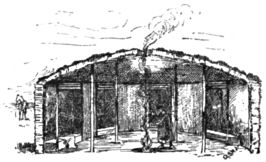
INTERIOR OF DIRT LODGE.
THE BOY WHO SAW A-TI´-US.
MANY years ago the Pawnees started on their winter hunt. The buffalo were scarce, and the people could get hardly any meat. It was very cold, and the snow lay deep on the ground. The tribe traveled southward, and crossed the Republican, but still found no buffalo. They had eaten all the dried meat, and all the corn that they had brought with them, and now they were starving. The sufferings of the people were great, and the little ones began to die of hunger. Now they began to eat their robes, and parfleches, and moccasins.
There was in the tribe a boy about sixteen years old, who was all alone, and was very poor. He had no relations who could take care of him, and he lived with a woman whose husband had been killed by the Sioux. She had two children, a boy and a girl; and she had a good heart, and was sorry for the poor boy. In this time of famine, these people had scarcely anything to eat, and whenever the boy got hold of any food, he gave it to the woman, who divided it among them all.
The tribe kept traveling southward looking for buffalo, but they had to go very slowly, because they were all so weak. Still they found no buffalo, and each day the young men that were sent out to look for them climbed the highest hills, and came back at night, and reported that they could only see the white prairie covered with snow. All this time little ones were dying of hunger, and the men and women were growing weaker every day.
The poor boy suffered with the rest, and at last he became so weak that he hardly could keep up with the camp, even though it moved very slowly. One morning he was hardly able to help the old woman pack the lodge, and after it had been packed, he went back to the fire, and sat down beside it, and watched the camp move slowly off across the valley, and up over the bluffs. He thought to himself, “Why should I go on? I can’t keep up for more than a day or two longer anyhow. I may as well stay here and die.” So he gathered together the ends of the sticks that lay by the fire, and put them on the coals, and spread his hands over the blaze, and rubbed them together, and got warm, and then lay down by the fire, and pretty soon he went to sleep.
When he came to himself, it was about the middle of the day, and as he looked toward the sky he saw two spots there between him and the sun, and he wondered what they were. As he looked at them they became larger and larger, and at last he could see that they were birds; and by and by, as they came still nearer, he saw that they were two swans. The swans kept coming lower and lower, and at last they alighted on the ground right by the fire, and walked up to where the boy lay. He was so weak he could not get up, and they came to him, one on each side, and stooped down, and pushed their shoulders under him, and raised him up and put him on their backs, and then spread their broad wings, and flew away upward. Then the boy went to sleep again.
When he awoke he was lying on the ground before a very big lodge. It was large and high, and on it were painted pictures of many strange animals, in beautiful colors. The boy had never seen such a fine lodge. The air was warm here, and he felt stronger than before. He tried to raise himself up, and after trying once or twice he got on his feet, and walked to the door of the lodge, and went in. Opposite the door sat A-ti´-us. He was very large and very handsome, and his face was kind and gentle. He was dressed in beautiful clothes, and wore a white buffalo robe. Behind him, from the lodge poles, hung many strange weapons. Around the lodge on each side sat many chiefs, and doctors, and warriors. They all wore fine clothes of white buckskin, embroidered with beautifully colored quills. Their robes were all of beaver skin, very beautiful.
When the boy entered the lodge, A-ti´-us said to him, “Looah, pi-rau´, we-tŭs sūks-pit—Welcome, my son, and sit down.” And he said to one of the warriors, “Give him something to eat.” The warrior took down a beautifully painted sack of parfleche, and took his knife from its sheath, and cut off a piece of dried meat about as big as one’s two fingers, and a piece of fat about the same size, and gave them to the boy. The boy, who was so hungry, thought that this was not very much to give to one who was starving, but took it, and began to eat. He put the fat on the lean, and cut the pieces off, and ate for a long time. But after he had eaten for a long time, the pieces of meat remained the same size; and he ate all that he wanted, and then put the pieces down, still the same size.
After the boy had finished eating, A-ti´-us spoke to him. He told him that he had seen the sufferings of his people, and had been sorry for them; and then he told the boy what to do. So he kept the boy there for a little while longer, and gave him some fine new clothing and weapons, and then he told one of the warriors to send the boy back; and the warrior led him out of the lodge to where the swans were standing near the entrance, and the boy got on to their backs. Then the warrior put his hand on his face, and pressed his eyelids together, and the boy went to sleep. And by and by the boy awoke, and found himself alone by the fire. The fire had gone out, but the ground was still covered with snow, and it was very cold.
Now the boy felt strong, and he stood up, and started, running along the trail which the camp had taken. That night after dark he overtook the camp, for they traveled very slowly, and he walked through the village till he came to the lodge where the woman was, and went in. She was surprised to see him in his new clothes, and looking so well and strong, and told him to sit down. There was a little fire in the lodge, and the boy could see that the woman was cutting up something into small pieces with her knife.
The boy said to her, “What are you doing?”
She answered, “I am going to boil our last piece of robe. After we have eaten this there will be nothing left, and we can then only die.”
The boy said nothing, but watched her for a little while, and then stood up and went out of the lodge. The door had hardly fallen behind him, when the woman heard a buffalo coughing, and then the breaking of the crisp snow, as if a heavy weight was settling on it. In a moment the boy lifted the lodge door, and came in, and sat down by the fire, and said to the woman, “Go out and bring in some meat.” The woman looked at him, for she was astonished, but he said nothing, so she went out, and there in the snow by the side of the lodge was a fat buffalo cow. Then the woman’s heart was glad. She skinned the cow, and brought some of the meat into the lodge and cooked it, and they all ate and were satisfied. The woman was good, so she sent her son to the lodges of all her relations, and all her friends, and told them all to come next morning to her lodge to a feast, “for,” she said, “I have plenty of meat.”
So the next morning all her relations and all her friends came, so many that they could not all get into the lodge, but some had to stand outside, and they ate with her, and she cooked the meat of the cow for them, and they ate until it was all gone, and they were satisfied. And after they had done eating, they lighted their pipes and prayed, saying, “A-ti´-us, we´-tŭs kit-tah-we—Father, you are the ruler.”
While they were smoking the poor boy called the woman’s son to him, and pointed to a high hill near the camp, and said, “Looah, sūks-kus-sis-pah ti-rah hah-tūr—Run hard to the top of that hill, and tell me what you see.” So the boy threw off his robe, and smoothed back his hair, and started, and ran as hard as he could over the snow to the top of the hill. When he got there he shaded his eyes with his hand, for the sun shone bright on the snow and blinded him, and he looked east, and west, and north, and south, but he could see nothing but the shining white snow on the prairie. After he had looked all ways, he ran back as hard as he could to the village. When he came to the lodge, he went to the poor boy, and said to him, “I don’t see anything but the snow.” The poor boy said, “You don’t look good. Go again.” So the boy started again, and ran as hard as he could to the hilltop, and when he got there, panting, he looked all ways, long and carefully, but still he could see nothing but the snow. So he turned and ran back to the village, and told the poor boy again that he saw nothing. The boy said, “You don’t look good.” Then he took his bow in his hand, and put his quiver on his back, and drew his robe up under his arm so that he could run well, and started, himself, and ran as hard as he could to the top of the hill, and when he got there he looked off to the south, and there, as far as he could see, the plain was black with buffalo struggling in the deep snow. And he turned to the village, and signaled them with his robe that buffalo were in sight. In a few minutes all the Pawnees had seized their bows and arrows, and were running toward him, and the women fixed the travois, and took their knives, and followed. The boy waited on the hilltop until the warriors came up, and then they went down to the buffalo, running on the snow. The buffalo could not get away on account of the deep snow, and the Pawnees made a great killing. Plenty of fat meat they got, enough to last them until the summer hunt, and plenty of warm winter robes. They did not have to move any further, but stayed right here, killing meat and drying it until they were all fat and strong again.
And the poor boy became a great doctor in the tribe, and got rich.
Before this the Pawnees had always had a woman chief, but when the woman who was chief died, she named the poor boy as her successor, and the people made him head chief of the tribe.
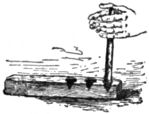
FIRE-STICK.
HOW THE DEER LOST HIS GALL.
A LONG time ago, the deer and the antelope met upon the prairie. At that time both of them had dew-claws, and both had galls. After they had talked for a little while, each one of them began to boast about how fast he could run. Each one, the deer and the antelope, claimed that he could run faster than any other animal, and at length they became very angry in their dispute, and determined that they would have a race.
They staked their galls on the race, and it was run on the prairie. The antelope ran the faster, and won, and took the deer’s gall. The deer felt very badly that he had lost it, and he seemed so miserable that the antelope felt sorry for him, and to cheer him up, he took off his dew-claws and gave them to him.
Since that time the deer has had no gall, and the antelope no dew-claws.
Note.—A story somewhat similar to this is current among the Blackfeet tribes of the northern country. In this tale the antelope won the deer’s gall, as in the Pawnee story. Then the deer said, “You have won, but that race was not a fair one, for it was over the prairie alone. We ought to run another race in the timber to decide which is really the faster.” They agreed to run this second race, and on it they bet their dew-claws. The deer ran the faster through the thick timber and over the logs, and beat the antelope, and took his dew-claws. Since then the antelope has had no dew-claws, and the deer no gall.
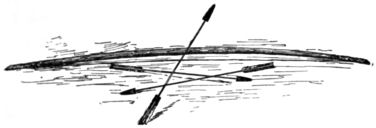
BOW AND ARROWS.
YELLOW FOX.
A LONG time ago, while the Pawnees were on their winter hunt, a young boy, Kiwuk-u lah´-kahta (Yellow Fox), went out alone to hunt, to see if he could kill a deer. When he left the camp in the morning, it was warm and pleasant, but in the middle of the day a great storm of wind and snow came up, and the flying snow hid everything, and it grew very cold. By and by the ground was covered with snow, and the whole look of the prairie was changed, and the boy became lost, and did not know where he was, nor what way to go to get to the camp. All day he walked, but he saw nothing of the camp, nor of any trail and as it became colder and colder, he thought that he would surely freeze to death. He thought that he must die, and that there was no hope of his ever seeing his people again. As he was wandering along, numbed and stiffened by the cold, and stumbling through the deep snow, he heard behind him a curious singing sound, and in time with the singing was the noise made by some heavy animal, running. The sounds came nearer, and at last, close by the boy, ran a great big buffalo bull. And as he ran near the boy, he sang a song, and as he sang, the sound of his hoofs on the ground kept time to the measure of the song. This is what he sang:
A-ti-us ti-wa-ko Ru-ru! Teh-wah-hwa´-ko, My Father says, Go on! He keeps saying, Ru-ru-hwa´-hwa´, Wi-ruh-rē. Keep going on. It will be well.
The boy’s heart became strong when he heard that the Father had sent the bull, and he followed him, and the bull led him straight to the camp.