Introductory material (continued 5)
Reading edition
As in every other important event of his life, the Parisian is obliged in this—the last—to occupy himself with the official procès-verbaux of his état civil. At his decease, an acte must be drawn up, upon the declaration of two witnesses, if possible the nearest relatives, or neighbors, giving his name, Christian name, profession, age, place of birth, domicile, those of his father and mother, and those of the attestors, with an indication of their relationship if they are relations; stating whether the deceased was married or widowed, and, in either case, the name and Christian name of his spouse. No operation upon the corpse, such as autopsy, embalming, or taking a cast, can be performed before the expiration of twenty-four hours after death, and then only upon the authorization of the Préfecture de Police, and in the presence of the Commissaire de Police of the quarter. This authorization is granted only upon the statements of two doctors,—one of the official Médecins de l'État Civil, and another physician, sworn and delegated for the occasion. The family must preserve and produce upon the demand of the Médecin de l'État Civil all the prescriptions of the doctor who had attended the deceased in his last illness; they must also give the name and address of the doctor and of the druggist who prepared the prescriptions. It is also forbidden to clothe the body or place it in the coffin, or to cover the face, before the expiration of twenty-four hours,—a light veil of very thin gauze alone is permitted. It cannot be denied that these are all very intelligent precautions.
In these funeral processions, the public authority is represented by the ordonnateur des Pompes funèbres; "it is he who, from the residence of the defunct to his last resting-place, never quits him, watching over him like a faithful friend." His official costume has been modified of late years,—he now wears a red and blue scarf, a cockade with the two colors, and his insignia is embroidered on the collar of his coat. The Napoleonic cocked hats, black garments, and high boots of the drivers of the hearses are familiar sights in the streets of the capital, especially in the neighborhood of the cemeteries, driving slowly at the head of their mournful processions, or, in their moments of relaxation, descended from the heights of their sable chariots and drinking familiarly at the zinc bar of a workman's wine-shop, side by side, it may be, with the white blouses of masons and plasterers. The four hundred porteurs of the Pompes funèbres still retain their ancient familiar designation of croque-morts, concerning the derivation of which there is much uncertainty. A number of the Revue des traditions populaires suggests that it may come from the mediæval custom of biting the little finger of the deceased at the moment of placing in the coffin, in order to obtain a final assurance of death. At the masked balls of the Opéra, these personages are represented by the traditional Père Bazouge and the cheerful Clodoche,—shedding their decorum with their official costumes.
By the decree of 1804, which forbade all inhumations within the walls of the capital, it was provided that there should be established cemeteries outside the city limits, and at a distance of not less than thirty-five or forty mètres. Four such enclosures were ordained: the Cimetière du Nord, or of Montmartre, on the north; that de l'Est, or of Père-Lachaise, on the east; that du Sud, or of Vaugirard, on the south, and that of Sainte-Catherine. The first of these was already in existence, having been established in 1798 by the municipal administration, to replace that in the plain of Clichy, comparatively new, which had replaced the old one of Saint-Roch. The Montmartre cemetery occupied the site of an abandoned and very extensive plaster quarry, whence it took its popular name of Cimetière des Grandes-Carrières, and it was also known, more poetically, as the Champ de repos, while the Montparnasse, later, was given that of Champ d'asile. When the city limits were enlarged, in 1859, Montmartre, in common with other communes of the suburbs, was brought within the enclosure, and, after the creation of the new cemetery of Saint-Ouen, called by the people Cayenne, the only interments in Montmartre were those made in the vaults of certain private families.
Père-Lachaise, the most important and most picturesque of these enclosures in Paris, takes its name from the confessor of Louis XIV, to whom it was presented by his royal penitent. The Cimetière de l'Est was inaugurated, in 1804, in a locality which originally bore the name of Champ l'Évêque, because it had been the property of the Bishop of Paris. The Jesuits purchased it, in 1626, under cover of a private individual, and established there a country house, surrounded by trees and shrubbery, the site of which is indicated to-day very nearly by the central rond-point of the cemetery. Popular report ascribed to this pleasure-house a character in keeping with the hypocrisy and luxury of the order as painted by its enemies; and young Louis XIV visited it, in consequence of which it became known as Mont-Louis. Afterward, when in the possession of the royal confessor,—who said, himself, of his office: "Bon Dieu! quel rôle!"—it was still further enlarged, and the grounds handsomely laid out around his little villa, two stories in height, overlooking Paris. At his death, it came again into the possession of the fathers of his order, and at their suppression, in 1763, it was sold to pay their creditors. The Préfet of the Seine purchased it for its conversion into a municipal cemetery in 1804.
That of Vaugirard was situated near the ancient barrière and at the entrance of what was then the village of Vaugirard; it had in nowise the importance of the two just mentioned, and was much more the burial-ground of the poor than of the rich. As early as 1810, its insufficience was recognized, and in 1824 it was closed, and replaced by that of Montparnasse. The Cimetière Sainte-Catherine was in the quarter Saint-Marcel, by the side of the old cemetery of Clamart, which was full of bodies and closed in 1793; Sainte-Catherine was also replaced by Montparnasse in 1824. The latter, the necropolis of the left bank of the Seine, is the least interesting and least visited of any of the Parisian cemeteries. The ground is quite level, and the enclosure so crowded with tombs that there is very little space left for verdure or shade. The number of distinguished dead who rest here is also less than in either Père-Lachaise or Montmartre. Previous to 1824, it received only the human débris from the hospitals and the bodies of criminals from the neighboring scaffold. Vaugirard and Sainte-Catherine have since been completely removed, and the sites devoted to other uses; and the number of ancient urban cemeteries that have thus disappeared is very considerable. That of the old church of Saint-Roch is now traversed by the narrow streets which enclose the church; that of Saint-Gervais is buried under the caserne Lobau, back of the Hôtel de Ville; Sainte-Marguerite-Saint-Antoine, in which were placed the remains of the young dauphin, is now a waste land; Saint-Joseph, and the little Cimetière de la Chapelle Marcadet which was used during the siege of 1871, are now occupied by commercial or secular establishments. Among those the sites of which are still recognizable are Saint-Vincent and Saint-Pierre at Montmartre; Saint-Médard—so famous in the last century as the scene of the extravagances of the convulsionnaires and the alleged miracles on the tomb of the Jansenist deacon, Paris—has been only partially destroyed by the opening of the Avenue des Gobelins; and on the old Cimetière de la Madeleine now rises the Chapelle Expiatoire to the memory of Louis XVI and Marie-Antoinette.
A CORNER IN THE CEMETERY OF PÈRE-LACHAISE: TOMBS OF COUTURE, THE PAINTER; LEDRU-ROLLIN, THE STATESMAN; COUSIN, THE PHILOSOPHER; AND AUBER, THE COMPOSER. Drawn from a photograph.
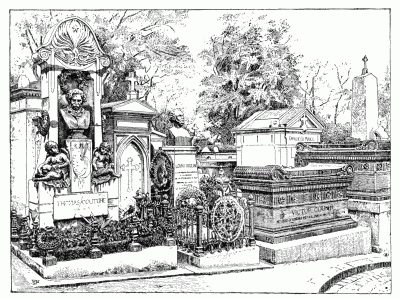
Each of the great cemeteries, both within and without the walls, is under the charge of a conservateur, having under him a receiver or steward, a surveyor, clerks, guardians, and grave-diggers. The guards, who number in all a hundred and thirty-five, including five brigadiers and fifteen sous-brigadiers, have all been sworn into office and are empowered to draw up procès-verbaux. The landscape-gardening of the cemeteries is all under the direction of the service des promenades, and the municipal administration of the city of Paris takes a laudable pride in maintaining the picturesqueness and attractiveness of these places of sepulchre. Many of the tombs, or funerary monuments, are preserved through legacies or donations, and the city assumes the care of others possessing an historical or patriotic interest, as those of Abélard and Héloïse, of Molière, of La Fontaine, of Casimir Périer, and the "four sergeants of La Rochelle." Consequently, the cemeteries of the capital are, distinctly, one of the features of the city,—Père-Lachaise, particularly, is a most curious, picturesque, original, and characteristic "sight," and, alike on the day of Toussaints when they are visited by the populace almost en masse, and when they receive the solitary funeral procession winding slowly through the streets, the carriages followed by a long train of mourners on foot, they may be said to be truly representative institutions of this people with whom we are for the moment concerned.
"The people of Paris," says M. Henry Havard, "are, assuredly, the most extraordinary people that there are in the world. [This, of course; no reference to the capital, even the slightest, is permissible without this statement.] Not only do they possess a prodigious quantity of remarkable qualities, and a number almost equally great of not less remarkable defects, but that which distinguishes them from the rest of humanity is, that their virtues and their vices, their good qualities and their defects, are in a measure contradictory.
"To cite only one example,—no population is more profoundly irreverent and more completely sceptical. The glories the most assured, the reputations the most solidly established, scarcely find toleration in their eyes. A scoffer by nature, a jeerer by temperament, a humbugger by education, the Parisian perpetually forces himself to accept nothing seriously, and to respect neither sex nor age nor glory. But, by one of those contradictions with which this character swarms, the moment that death has accomplished his sinister work, everything becomes to him sacred.
"When a funeral procession traverses a street or passes along a boulevard, all noise ceases at the moment, and it might be said that all life is momentarily suspended. Poor or rich, young or old, this dead man who, two days earlier, would have found no consideration from this jesting crowd, is respectfully saluted by the multitude. The vehicles which, during his lifetime, would have taken the chances of running over him sooner than slackening their speed, now pull up suddenly to allow him to pass. The sentry on duty salutes; the women cross themselves; the men uncover!
"In the enclosure specially reserved for death, the spectacle is not less edifying. There are but very few cemeteries in Europe as well maintained as the Parisian cemeteries. In no other city are they more frequently visited, and more respectfully. The multitude that there throngs scarcely dares to speak, and converses only in subdued tones. Even those who have in them neither relatives nor friends visit them at least once a year. The first and the second of November are generally selected for this pious pilgrimage. These are the fête-days of our cemeteries.
"In order that they may appear more attractive on these days, the toilette of the funeral monuments and the tombs is commenced long in advance. The bouquets are renewed. The wreaths that are too much faded are replaced by others. All the flowers freshly planted are carefully watered; each one employs his best taste in setting forth the resting-place of the dear absent ones. Regret makes itself friendly and gracious; grief itself takes on a little coquetry. Nothing is more delicate and more moving than this annual pilgrimage of the people of Paris to these places of eternal repose."
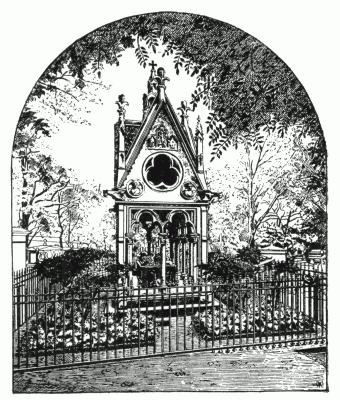
Many of the details gathered by M. Havard in the course of his careful inspection of these respect-compelling enclosures are worthy of preservation. In Père-Lachaise, for example, it is well not to be too credulous. "You may there discover, in fact, very many tombs decorated with names familiar in various ways, and even very great names, which certainly have never contained the ashes of those whose memory they honor. Neither Lavoisier, nor Lesurques, 'victim of the most deplorable of judicial errors,' as his epitaph says, nor General Malet, whose body was interred in the cemetery of executed criminals, would be able to find themselves under the monuments which a posthumous piety has reared to them. The same can be said of the tombs of Racine, of Molière, and of La Fontaine, which were the first to embellish these groves, and of which the style proclaims clearly enough that they do not date further back than the First Empire. It is the same for Héloïse and Abélard, and for their graceful little structure to which the lovers and the newly married do not fail to pay pious visits. This historic tomb, constructed of composite materials, is also of very recent erection. The two statues ornamented, in the last century, the monument which stood in the Abbaye de Paraclet; from there they were transported at first to the Musée des Petits-Augustins, and, in 1817, to the place where we now see them. The graceful canopy which covers them is formed of materials borrowed from the ancient Abbaye de Nogent-sur-Marne. As to the ashes of these perfect lovers, they have been scattered to the winds for a great many centuries."
Many of the old cemeteries in the city, he says, owe their temporary celebrity to the accidental interment within their enclosures of some particularly illustrious deceased. "That which surrounded Saint-Roch received the remains of Corneille. It is known that Molière was secretly buried in the Cimetière de Saint-Joseph, which received also the body of La Fontaine. As to the little cemetery of Saint-Gervais, we should be ignorant of its existence if the authors of the seventeenth century had not taken pains to reveal to us that Marion Delorme was there laid to rest. Still more, the fact would have remained unknown had it not been for the whim of her family which, after having crowned her with a wreath of orange flowers, had the assurance to accord her the funeral of a virgin. The curé of Saint-Gervais, who had received her confession, opposed this masquerading, and he did well. Let us not laugh too much at these curious pretensions. At Père-Lachaise, in the chapel in which Mlle. Mars reposes, there can be seen very clearly, through the gratings of the door, a wreath of white roses and orange flowers."
TOMB OF ABÉLARD AND HÉLOÏSE, CEMETERY OF PÈRE-LACHAISE.
For the poor, the three great Parisian cemeteries have long been closed,—space within their walls is reserved by the law for the fortunate owners of the ninety thousand concessions perpétuelles. The indigent and the working population are relegated to the two enormous enclosures situated, the one at Ivry and the other at Saint-Ouen, which have received from the people the picturesque appellations of Champ de Navets and Cayenne. Champ de Navets means a turnip-field, and Cayenne is a penal colony. Even in this exile, the dead are allowed to rest undisturbed only five years; at the end of that period, the earth is reclaimed, turned over again, and prepared to receive new tenants for the same length of time. The surroundings of these two suburban cemeteries are, moreover, of the most barren and forlorn character; the plain around Saint-Ouen is occupied by various factories and manufacturing establishments which fill all the air with evil odors. The Fosse commune is simply a long trench in which the cheap coffins are placed all together, and the earth heaped over them indiscriminately. But even the tombs of malefactors who have perished under the axe of Justice are not forgotten in these dreary receptacles; although it is illegal to designate with a name the grave of one of these, "there are still to be found pious hands to mark these accursed tombs with a cross and to surround them with a modest railing. In the Champ de Navets there may be seen the grave of the assassin Géomey ornamented with wreaths bearing his initials, and the tomb of the infamous Vodable surmounted by a cross with this word: Ami.—friend." In Père-Lachaise, that of the socialist, Blanqui, is still the object of annual pilgrimages and "demonstrations," which frequently culminate, as on the very last anniversary, in a free fight among the pilgrims, and the intervention of the police; and the "wall of the Federals," against which the Communists were stood up to be shot, is almost covered with memorial wreaths. "How many years longer," says M. Havard, "will there still resound these instigations to hatred and these appeals to vengeance?"
The only private cemetery in Paris is that of Picpus, the entrance to which is in the street of the same name. When the guillotine was transported from the Place de la Revolution to the former barrière de Trône, it became necessary to find in the quarter a place of burial for the victims, and the Commune of Paris selected, on the 26th Prairial, year II, a "piece of ground that had belonged to the so-called canons of Picpus." Here these victims of "the law" were interred, to the number of thirteen hundred and six, all executed between the 14th of June and the 27th of July, 1794; and this cimetière des guillotinés has been preserved as the property of the relatives and friends. It includes the tombs of a number of the most ancient and illustrious families of France, that of General Lafayette, of General de Beauharnais, of the poet André Chénier, of Talleyrand, Montalembert, etc. It was acquired, under the First Empire, by the Prince de Salm-Kirbourg, one of whose ancestors had been buried in the Revolutionary fosse commune; and is open to visitors on payment of a fee of fifty centimes. The victims of the guillotine of the Place de la Concorde were buried in two provisional cemeteries which have disappeared,—one which had served as a kitchen-garden for the Bénédictines in the Rue de la Ville-l'Évêque, and the other near the Folie-Chartres, in the neighborhood of the present Parc Monceau and the Boulevard de Courcelles.
That lugubrious institution, the Morgue, dates from 1714, at least; it was then a low room in the basement of the Châtelet, near the vestibule of the principal stairway, and in the court adjoining was a well, the water of which served to wash the corpses. It was under the care of the filles hospitalières de Sainte-Catherine, and was, as may be supposed, a noxious cell in which the bodies, thrown one upon the other, waited to be inspected by the light of lanterns by those searching for missing relatives or friends. In March, 1734, it was thronged with visitors attracted by the unusual presence of some fifteen or sixteen infantile corpses, none of them more than three years of age; it appeared that a celebrated anatomist, Joseph Hunault, had collected these subjects for his investigations, in the house of a surgeon, the affrighted neighbors had complained to the police, who had caused them all to be transported to the Morgue. A police ordinance of August 17, 1804, directed that this establishment be suppressed, and that all bodies drawn from the river or found elsewhere should be taken to the new Morgue on the Marché-Neuf, in the quartier de la Cité. The object of the municipal administration was to secure the recognition of the greatest number possible of these remnants of humanity, and for this purpose they were exposed, for three days at least, behind a glass screen protected by a rail, on inclined tables of black marble, the heads reposing upon a raised piece covered with leather. There was provided a room for the autopsies, containing two dissecting-tables; another for the washing of the garments found on the dead, and a third for those bodies recognized or in which decomposition had proceeded too far to permit of their public exposure. Two attendants were always on duty to receive any bodies that might be brought, at any hour of the day or night.
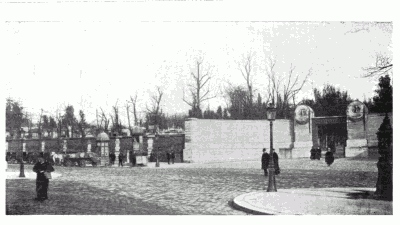
ENTRANCE TO THE CEMETERY OF PÈRE-LACHAISE.
In 1809, it was proposed to transport the Morgue to a site between the Pont Saint-Michel and the Petit-Pont, but in 1830 it was enlarged and improved where it stood; in 1864, it was transferred to its present locality, behind Notre-Dame, between the Pont Saint-Louis and the Pont de l'Archevêché. The bodies were still exposed nude, with the exception of a leathern apron across the loins, on twelve black marble slabs, to the public gaze, with their garments hanging over them; to preserve them as long as possible, they were exposed to a constant sprinkling with fresh water. When recognized, or when they could no longer delay, they were carried into the adjoining salle du dépôt; adjoining was the salle d'autopsie, and, on the ground-floor, the salle des conférences, in which the accused were brought before and after being confronted with the bodies of their supposed victims. Some of these arrangements are still preserved in the present institution; but, since the establishment of the appareils frigorifiques, or freezing machines, in 1881, the length of time during which a corpse may be preserved has been greatly extended, from one month to years, according to various claims. In the salle d'exposition the temperature is maintained at about zero, Centigrade, freezing point, Fahrenheit; and in the cells in which the bodies are first placed, at fifteen degrees below zero, Centigrade. The bodies of criminals are not submitted to the public inspection. The garments are returned to the families, when the body has been recognized or burned; their sale has been forbidden since 1883.
All persons are formally invited to furnish any indications they possess that may lead to the recognition of the bodies, and are informed that they will be put to no expense. A photographic plant was installed here in 1877, and all bodies are photographed,—those which are not recognized before burial have these, their last portraits, affixed at the entrance. The number of corpses received annually is about nine hundred, including new-born babies, fœtuses, and the remnants from the dissecting-tables, and this number increases year by year. In it are included also those bodies which it is desired to submit to a medico-legal examination. About six-sevenths of the total number exposed are those of men, and about one-seventh are never recognized. The sanitary surveillance is under the charge of three medical inspectors; not only are the autopsies here frequent, but there are also held many conferences in legal medicine, and there is a laboratory of toxicology. All departments of the establishment are cramped for want of space, and it is proposed to establish a distinct medico-legal institution on a new site, at the angle of the Quai aux Fleurs and the Rue du Cloître-Notre-Dame.
On the crest of the hill in Père-Lachaise, in a fine open space from which the tombs recede on all sides,—as if appalled at the presence of this horrible new-comer,—rises the tall Crematory furnace, with its quasi-classic columbarium behind it. Great improvements have been made in the material details of this method of disposing of the dead since its first revival in modern times, and even since the erection of this edifice,—but the overturning of immemorial prejudices proceeds but slowly. France claims the credit of introducing this excellent sanitary measure, and as far back as the end of the last century, in the year V of the Republic, a law was proposed by a commission of the Cinq-Cents granting to each family the privilege of choosing between inhumation and cremation for their dead. Later, "the administration centrale of the department of the Seine adopted a regulation prescribing the cremation of all those bodies destined for the fosse commune whose owners had not expressed, during their lifetime, a contrary desire. Under the Consulate, Madame Geneste, wife of the citizen Pierre-Francois Lachèze, chargé d'affaires of the French Republic at Venice, obtained from the préfet Frochot an authorization to cause the body of her deceased son to be burned. The préfet invoked, in support of his decision, this consideration, 'that the last cares to be rendered to mortal remains constitute a religious act of which public authority cannot prescribe the methods without violating the principle of liberty of opinions.' Madame Dupuis-Geneste, however, did not make use of this authorization."
In 1882, M. Casimir-Perier, then minister, proposed a law granting to every person who had attained his majority and to every minor who had been relieved from guardianship, the power to regulate all the details of his own funeral at his own discretion. The Société pour la Propagation de l'Incinération, which now includes six hundred members, had been founded two years before by M. Kœchlin-Schwartz and M. Georges-Salomon, and this society caused to be erected, in Père-Lachaise, in 1887, on the plans of the architect Formigé, a building destined for the cremation of dead bodies,—this process, it was declared by the Conseil d'Hygiène et de Salubrité de la Seine, on the proposal of Doctor Bourneville, could be applied to the disposal of subjects from the dissecting-tables without any menace to the public health, provided that it was effected in suitable furnaces and without emitting any odor. M. Casimir-Perier's proposal was finally recognized by the Chamber and the Senate in 1886 and 1887, and this legal sanction decided the question practically in favor of the Cremation Society and of the Conseil Municipal of Paris, which had long been in favor of the optional incineration of the dead.
The first apparatus, a reverberatory furnace burning wood, was found to be entirely insufficient, and was replaced by a chamber of combustion filled with incandescent gas, much more elaborate in construction. A special apparatus, called a Gazogène, evolves carbon protoxide, which, set on fire by peculiar burners, produces a temperature of eight hundred degrees Centigrade in the chamber of combustion. The entire arrangement at Père-Lachaise is some nine mètres in height by five and a half in width, the actual furnace is below the chamber of combustion and not directly under it, this space being occupied by long, perpendicular flues through which the air—fed through a large horizontal shaft passing under the furnace—rises. In the chamber of combustion, into which the body is introduced in its coffin, the destruction was formerly effected by the aid of the actual flames, and the result was not completely satisfactory,—the skull was left almost intact and some of the bones, with a few fatty acids and salts. The attendants gathered these remnants up with pinchers, brushed the black and greasy residue from the bones, and placed the whole in a little wooden casket, about the size of a child's coffin, for final deposit in the columbarium. Now, by the improved process, the total residue that issues from the furnace is a quantity of white ashes, varying from nine hundred to twelve hundred grammes in weight, although the flame is no longer permitted to reach the body and the combustion is effected by refraction alone. A curious detail in both operations is that the liver is the last of the organs to be destroyed, and remains an incandescent mass when all the rest of the body has disappeared.
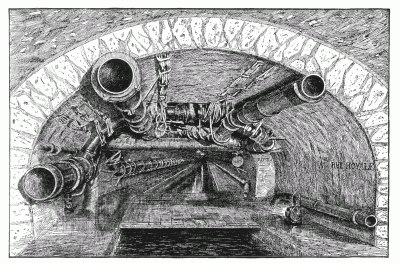
UNDERGROUND PARIS: ARCH OF THE GREAT SEWER, UNDER THE RUE ROYALE, CORNER OF THE RUE DE RIVOLI. After a drawing by A. Montader.
In the funerary chamber, in which the mourners assemble, in the second story, the coffin is received by the attendants, placed on a metallic chariot, running on rails, the long shafts or extensions of which carry it, with its contents, directly into the fiery heart of the furnace and there deposit it. The time required for the complete combustion is, at present, twenty-five minutes for a child, and fifty-five for an adult. An urn of a peculiar model is now provided for the reception of the ashes, and this can be either buried in the family vault or placed in one of the cells of the municipal columbarium, erected in 1895. Although this latter receptacle does not, as yet, meet with much favor, and has been irreverently compared by one of the apostles of cremation to a shed, it might be made a very neat and unobjectionable mausoleum. At present, it is a species of lofty white marble arcade, or porch, the wall side of which is filled up with cells about two feet square, the panels closing which bear the name and dates of the occupant. This panelled white marble wall is, however, defaced by the black wreaths, beadwork, and artificial flowers which the misguided mourners hang over the remains of their departed. In this municipal columbarium, families have a right to deposit their ashes for the space of five years, at the end of which period the urns are taken out and emptied in the fosse commune. A concession perpétuelle for the urns in a cemetery may, however, be purchased for the sum of three hundred and sixty-nine francs and eighty centimes. The columbarium provides for three hundred urns; less than half these receptacles are as yet filled, but the number of cremations increases slowly year by year. There is also a similar establishment in the cemetery at Clichy, and others are projected for other sites.
Statistics show that the annual mortality in Paris is about 22.6 per thousand inhabitants, which the Parisian publications erroneously claim is below the average for large cities. In London, for example, in the week ending January 14, 1899, it was 18 per thousand, and averaged 18.5 in thirty-two provincial towns. In some of them, as Brighton, Derby, Leicester, and Hull, it ranged from 11 to 12.9; and the highest rates were from 22.4 in Manchester to 24 in Sunderland. It is a constant source of wonder to the newly-arrived in Paris, however,—especially if he be inoculated with modern ideas concerning sanitary sewage in dwelling-houses,—that the city escapes an annual epidemic of typhoid fever. So very primitive are the methods of cesspools, and the official emptying of them, in very many quarters of the city, that it is an article of faith with the citizens to close all their windows tightly at night,—an article of faith that is adopted by many American and English residents with the usual wholesome Anglo-Saxon ideas concerning ventilation of sleeping-rooms. It may be stated, however, as the result of much experience, that—even for those who are able thus to sleep in tightly-closed rooms—the open windows at night are not deadly. The prejudice against night air, which is by no means confined to France, here takes on an acute form,—it is even asserted stoutly, and this, too, is believed sometimes by the otherwise intelligent foreigner, that the entrance of fresh air into the sleeping-room at night produces affections of the eyes. The quarters of Paris in which the mortality is the lowest—those which show quite white on the graded annual mortality plan of the city—are the arrondissements of the Élysée and the Opéra, 11.1 and 14.5 respectively; and those which are printed quite black on the same plan are those of the Observatoire and the Gobelins, 32.8 and 31.4 respectively.
Nevertheless, the sewerage system of Paris is conceived and carried out in its general plan with an appreciation of the requirements of modern sanitary science and an intelligent employment of the science of the engineer that are quite admirable. The methods of disposing of the city's refuse in use by many American municipalities, as those of New York and Chicago, are, by comparison, but dull and stupid perpetuation of antiquated traditions. The animated controversy over the great question of Tout à l'égout, "all refuse to the sewer," was not finally settled till 1894, and this method has as yet not been applied to all the quarters of the city, as stated above, but is being gradually extended, and nothing but time seems to be wanting to bring about in this capital a complete solution of one of the most difficult problems of material civilization. The object of the Parisian method is to avoid fouling the Seine in any way, and to utilize all the city's refuse, instead of throwing it away or allowing it to accumulate, a menace to health and a hideous nuisance. By an excellent system of underground conduits, well lighted and ventilated, the sewage and the rain-water are collected, carried by canals and pipes outside the city, and applied, after proper treatment, to the fertilization of certain arid tracts of land farther down the river. The principal agent in this "hygienic transformation of Paris" was the engineer Belgrand, who, at his death, in 1870, had increased the length of the municipal sewers from two hundred and twenty-eight kilomètres in 1860 to six hundred. It has now attained a total of fourteen hundred and twenty-one, representing a capital of a hundred and fifty millions of francs.
The first principle of Belgrand's system was to avoid any discharge from the sewers into the river during its course through Paris. The great main sewer, the collecteur général, of the right bank, called the collecteur d'Asnières, follows the quais from the basin of the Arsenal to the Place de la Concorde, then burrows under the heights of the Batignolles to reach Clichy; the collecteur général of the left bank, which includes the poor little Bièvre, traverses the bed of the Seine by means of a siphon at the Pont de l'Alma and is prolonged by the collecteur Monceau, which passes under the hill of the Place de l'Étoile to join the collecteur d'Asnières. A third collecteur, known as the départemental, or du Nord, at a higher level, receives the drainage of Belleville and Montmartre, and issues from the city by the Porte de La Chapelle to reach the Seine at Saint-Denis. A new siphon, constructed under the Seine in 1895 and 1896, unites the collecteur général of the left bank to the collecteur d'Asnières. The sewage of the Iles Saint-Louis and de la Cité is carried by two other siphons to the collecteurs of the quais of the right and left banks.
A new main sewer, called the collecteur général de Clichy, was commenced in 1896, to supplement those of Asnières and Monceau, become insufficient; this passes under the Avenue and the Rue de Clichy to terminate at the Place de la Trinité. The prolongation of the line of the Orléans railway to the Quai d'Orsay, by means of a tunnel, has necessitated a very important modification of the sewers of the left bank of the river, which has had much to do with the lengthening of the work of excavation which has so greatly annoyed the dwellers on this side of the river in 1898 and 1899. It was understood that this excavating was to be done entirely underground, whereas it has blockaded many of the narrower streets, and even when it tunnels it contrives to raise the street level about a mètre and substitute a wooden floor, as along the Quai Voltaire. It is stated that this work will cost the railway company not less than five million francs.
UNDERGROUND PARIS: LICENSED RAT-CATCHER IN A SEWER. After a design by G. Amato. Henri Dayre: Chasseur de rats de la Ville de Paris, fournisseur de toutes les Sociétés de France et de l'Étranger.
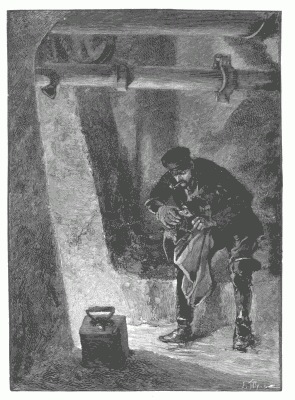
The diameter of the vault of the égouts collecteurs varies between four and six mètres; that of the égouts secondaires from two mètres to three mètres, seventy centimètres; that of the égouts ordinaires, including ten varieties, from one mètre to one mètre, seventy-five. The size the most in use has a diameter of one mètre, forty. The problem of purifying and utilizing the contents of the sewers, which were provisionally discharged into the Seine at Saint-Denis and at Asnières, occupied the attention of the municipality from the period of the establishing of the collecteurs, but the vigorous local opposition which was encountered greatly delayed the carrying out of these projects. Consequently, the purification of the river is not yet complete. On the sandy and arid plain of Genevilliers, situated in the first loop of the Seine, beyond Clichy, the experiment of fertilizing with this drainage was commenced in 1869. At present, the ground thus under cultivation includes some seven hundred and ninety-five hectares,—about two and a half acres each,—of which six belong to the city of Paris and constitute the model garden. The remainder is held by private individuals, who pay a rental of from four to six hundred francs the hectare. The distribution of the sewage is effected by agents of the administration in regular rotation, in three zones. In 1896, each hectare absorbed thirty-seven thousand and sixty-seven cubic mètres. All varieties of vegetables are grown, and this land, on which were raised formerly only meagre crops of rye and potatoes, is now a flourishing garden.
A second agricultural establishment at Achères, farther on, on both sides of the Seine, was inaugurated in 1895, the larger portion of which is held by individuals, but as each hectare of land can absorb not more than forty thousand cubic mètres annually, it has been found necessary to seek additional champs d'épuration. These have been secured by the municipality at Méry and les Gresillons and in their neighborhood, still farther westward, and the completion of these is promised for the summer of 1899. In the model garden of Asnières, all varieties of culture are practised, the sewage is carried in trenches into the cultivated land in such a manner as to bathe only the roots of the plants. The extremely winding course taken by the Seine west of Paris renders it necessary for the conduits conveying this drainage to cross the river three times before reaching Achères, as may be seen by reference to the map. From the usine elévatoire of Clichy it is carried under the Seine by a siphon, four hundred and sixty-three mètres in length; the aqueduct crosses the river again near the usine de Colombes, opposite Argenteuil, on a steel bridge, and again near Herblay, by another siphon. In 1897, on the total surface, a thousand hectares, under cultivation, there were spread seventy million cubic mètres of sewage.
After many and long debates, carried on both in the Conseil Municipal and the Chamber of Deputies, the much-discussed question of Tout à l'égout was disposed of by a law passed on the 10th of July, 1894, by which the proprietors of all houses situated in streets provided with a public sewer were required to make connections with this and drain into it all the refuse of their cabinets d'aisances. This connection was to be made within the space of three years, and a proportionate tax for this privilege was laid upon each dwelling. But the streets in which there are no public sewers,—including those private streets, impasses, and cités which the municipality considers as the property of individuals, and for which it provides neither policemen nor street-cleaners,—and those buildings in which this connection has not been made, still furnish occupation for those nocturnal vehicles the mere thought of which drives the careful citizen to close his windows. In the seventeenth century, this nocturnal agent was known as Maître fy-fy et des basses-œuvres, and he fulfilled his task by carting his material to one of the public dumping grounds and there discharging it. Many of the now picturesque sites of the city owe their characteristics to these eminences of refuse,—the Buttes of the Rues Meslay and Notre-Dame-de-Nazareth, Bonne-Nouvelle, des Moulins, the labyrinth of the Jardin des Plantes. "The voirie of Montfaucon," says M. Strauss, "with its infected basins, its pestilential reservoirs, its charnier and its gibbet, was a cause of shame and anxiety to several quarters of Paris; even after being transferred from the Faubourg Saint-Martin to the foot of the Buttes Chaumont, it was an object of horror and disgust. An army of rats garrisoned the charnier, whilst the basins overflowed with rottenness. This horrible establishment had its clientèle; in 1832, the Préfet de Police, M. Gisquet, found, according to the account of M. Mille, a hideous thing,—individuals who, in the midst of these lakes, fished up again the dead fish.
"In 1848, this notorious laystall was installed in the forest of Bondy, where it has undergone various transformations; for many years the basins were encumbered with a stock but very slightly appetizing; to reduce these mountains of refuse to industrial products was a very serious undertaking. After being, by slow desiccation by drying in the air and grinding, transformed into a fertilizer called poudrette, they are subjected to various chemical processes; there is extracted from them sulphate of ammonia, etc. The odors which are disengaged during these operations, while not injurious to the health of man, are not of those which leave public opinion indifferent; the girdle of insalubrious establishments which immediately surrounds Paris, individual dépotoirs, private voiries, manufactories of fertilizing materials, is no less menacing than disgraceful.
"A single establishment is an exception to this rule, it is the dépotoir of La Villette, in the neighborhood of the Marché aux bestiaux. It would never be thought, from its appearance, that it was the nightly rendezvous of the most infectious scavengers' carts that traverse Paris. A coquettish garden, of a surprising greenness, all flowery and perfumed, charms the eyes; the receiving cisterns conceal themselves under vaults that do not reveal their secret to the first comer. The basin of the water of the Ourcq has the most innocent air in the world, and the return-pumps reveal nothing.
"All night long, the dépotoir is visited by vehicles, two or three hundred in number, which arrive in single file, with a mysterious heaviness, to discharge themselves in the cisterns. What a discharge! a thousand to twelve hundred cubic mètres—of matter!
"The next morning, all this deposit is relegated to a distance of nine kilomètres, as far as Bondy, by elevating machines: the cisterns are washed out and cleansed by floods of water; the heavy matter which the pumps do not take up is put in casks and taken away to be employed directly in the manufacture of manure, by mixing it with other fertilizing materials. The transportal of the liquid matter to Bondy is effected by means of a machine of twenty-five horse-power, through a conduit thirty centimètres in diameter, which follows the right bank of the canal de l'Ourcq."
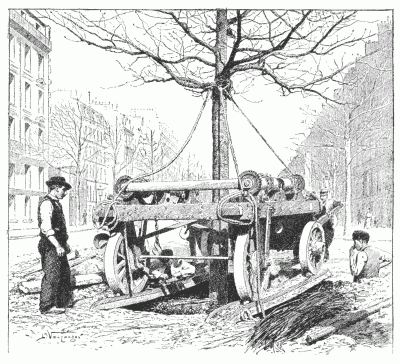
SERVICE MUNICIPAL FORESTIER: TRANSPLANTATION OF TREE ON THE BOULEVARDS. After a drawing by L. Vauzanges.
The great collecteur d'Asnières, a sectional view of which under the Rue Royale, is shown on page 299, is five mètres, sixty centimètres, in width, and three mètres, forty, in height; the channel for the water in the centre is three mètres, fifty, in width, and one mètre, thirty-five, in depth. On each side is a banquette, or sidewalk, ninety centimètres wide. The collecteurs, as well as the smaller sewers of the streets and houses, are constructed of masonry laid in mortar, and they are lined with cement which insures their cleanliness and their sonorousness. The former quality is maintained by an incessant surveillance, an organized force of nine hundred and thirty-one men being constantly employed, and an arrangement of fans or wings, mounted either upon the fronts of the boats or attached to the bottoms of the little trucks which run on rails along the edges of the canal of the larger sewers. These fans descend into the canal and sweep all obstructions before them,—the sand from the street pavements overhead constituting a large portion of this obstructive material. The siphons are cleansed by an ingenious process invented by Belgrand and applied by him to that of the Alma,—a large wooden ball, eighty-five centimètres in diameter, traversing twice a week each of the two conduits, a mètre in diameter. So thorough is this policing of the sewers, that it is recorded that the number of heavy leathern thigh boots furnished the égoutiers is some twelve hundred or two thousand annually, representing a value of nearly a hundred thousand francs. One pair of these boots lasts about six months.
An analysis of the air of these sewers gives surprising results. The proportion of carbonic acid is somewhat greater than in the air of the streets overhead, that of ammoniacal azote is much more considerable, and that of bacteria only half as great. Consequently, not only does the personnel of this underground labyrinth traverse it constantly without danger, but visitors from the upper world find amusement in exploring it. Every fortnight, on the second and fourth Wednesdays of the month, the Préfet of the Seine, or the Chief Engineer of the Service de l'Assainissement de Paris, grants permits for these visits to a certain number of applicants,—the visitors are transported through the collecteurs of the Châtelet to the Place de la Concorde, under the Boulevard Sebastopol and the Rue de Rivoli, in little vehicles forming two trains, drawn each by an electric engine; then from the Concorde to the Madeleine, under the Rue Royale, in boats drawn by an electric tug. The trip takes about an hour, and can be made in either direction; the sewers are open to this invasion from Easter to the end of October, excepting in case of storms, when the water in the canals is apt to rise rapidly over the banquettes and drive the workmen to the regards or places of ascent provided every fifty or a hundred mètres apart. The danger of asphyxia, which was formerly very serious, is now practically abolished, the ventilation being assured by numerous openings in the street gutters under the curb-stones, which are kept free from floating materials and obstructions by a special corps of égoutiers.
For the wagonnets de service in the larger sewers, an ingenious arrangement is used,—on the little four-wheeled truck which runs on rails along the edge of the central canal are laid two more sections of railroad at right angles, and on these are mounted two more four-wheeled trucks carrying each a rectangular little tank or receptacle, with a rounded bottom. The outside rail, at each end, is blocked, so as to keep these tanks in position while in transit,—when arrived at their destination, the blocks are removed and the two run off on other rails to be emptied. The Parisian sewers carry not only the drainage of the streets and houses, but also all those various underground means of communication which in other, and less well-ordered, municipalities have each their own burrowing to do,—at the cost of infinite expense and confusion. The water-pipes, the telegraphic cables, the telephone wires, the pneumatic tubes for the postal service, and the piping for the conveyance of motive power, are all sheltered in these underground thoroughfares. So complete and well organized, indeed, are these égouts, that that constant habitant of sewers, the rat, is being driven out of them,—neither the black rat nor his enemy, the great Norway animal, can find lodging and refuge in these cement-lined walls, as hard as steel. The task of the hunter of rodents is greatly facilitated by all these improved methods.
It is difficult nowadays to conceive the condition of the streets of a mediæval city, and Paris was no exception. Not only were they very crooked—each householder building where he chose, with very little consideration for the general alignment, badly paved or not at all, unsewered and dark, but they were the receptacles for absolutely all the refuse of the dwellings. The butcher, the baker, and the candlestick-maker threw everything out of the windows, and nobody carried it away. The first vaulted sewer was constructed in the reign of Charles VI, in the Rue Montmartre, by Hugues Aubriot, prévôt of the merchants; but the state of the public thoroughfares remained much as it had been in the preceding century. The houses were built on the level of the streets, and inundated at every violent shower, the choked-up gutters refusing to carry off the sudden flood. Even the kings of France struggled in vain against the universal infection,—"incommoded in their Hôtels Saint-Pol and des Tourelles, they were constantly protesting to the municipality of Paris; Louis XII, François I, and Henri II vainly attempted to secure the removal of the égout Sainte-Catherine; this unwholesome neighborhood even caused François I to change his property of Chanteloup for the locality of the Tuileries." In 1473, the Parlement ordered the Lieutenant Criminel to clear away the filth which obstructed the entrance to Saint-Nicolas-du-Chardonnet and along the course formerly traversed by the Bièvre, and three years later a more general effort at reformation was made. The main streets, the surroundings of the Palais, were submitted to a sort of system of cleaning, the cost of which was defrayed by a tax laid upon the inhabitants thus favored. The aqueduct of Belleville had been constructed in 1244, to supply the fountain of the monastery of Saint-Martin-des-Champs, and afterward furnished water to most of the fountains of Paris; in 1457, it had been repaired by the prévôt of the merchants, and thus supplied a means of cleansing the streets. In 1265, there was existing a fountain in the upper part of the Faubourg Saint-Denis, known as the Fontaine Saint-Lazare, and fed by the aqueduct of Saint-Gervais—from Romainville, near Vincennes—constructed in the last years of the reign of Philippe-Auguste. The fountain of the Innocents, that of Maubuée, and that of the Halles were also watered by this aqueduct of the Pré-Saint-Gervais. The Cité and the quartier Saint-Jacques were for centuries the most pestilential quarters of the capital, and, despite the various measures taken to ameliorate them, it was not till the reign of Henri IV that the evil was effectively attacked by the widening of the streets so as to permit the noblesse and the bourgeoisie to traverse them in carriages.
To such a height had the deposits of refuse outside the city walls attained, that, in 1525, during the panic that prevailed in Paris at the news of the captivity of François I, Jean Briçonnet, President of the Chambre des Comptes, secured the passage of an ordinance directing their razing, as from their summits an enemy could command the city walls! During this reign, however, considerable progress was made in cleansing and embellishing the capital; the king particularly enjoined upon the municipality the importance of paving and sweeping the streets, and a royal edict of November, 1539, prescribed minute regulations for the conduct of the inhabitants and the measures to be taken that would be considered very satisfactory, if enforced, at the present day. The paving of the streets, which had been commenced under Philippe-Auguste, had proceeded so slowly that in 1545 the greater portion of the Faubourg Saint-Germain was not yet paved, and the Cardinal de Tournon, Abbé of Saint-Germain-des-Prés, undertook the task. A decree of the court, March 30, 1545, ordered the commencement in the Rue de Seine; but when the cardinal desired to straighten the street lines also, he encountered a vigorous opposition on the part of the inhabitants. The Parlement was obliged to come to his assistance, and a decree of the 21st of the following October directed that all those who had valid reasons for opposing this measure should appear by means of a procureur, within the space of three days, to state them.
Five years later, another public-spirited citizen, Gilles de Froissez, an iron-master, proposed to bring the water of the Seine to aid in the great task of cleaning the city, and was instrumental in beginning this good work. In 1605, still another, François Miron, paid out of his own pocket for the facing with masonry of the égout de Ponceau from the Rue Saint-Denis to the Rue Saint-Martin. Various other open sewers were gradually transformed into covered ones, but under Louis XIV, while the total length of the first was only two thousand three hundred and fifty-three mètres, that of the latter, including the long égout de ceinture, or stream of Ménilmontant, was eight thousand and thirty-six.
Marie de Médicis, having begun, in 1613, to plant the trees for the park of her proposed palace on the site of the old Hôtel du Luxembourg, was desirous of securing a supply of water for her fountains, and arrangements were made to divide that which was to be brought from the source at Rungis by the Aqueduct of Arcueil. The old one built by the Romans in this locality—whence its name, Arculi—had fallen to ruins; one Hugues Cosnier had engaged, the preceding year, to construct a new one in three years, which should bring thirty inches of water to the Faubourg Saint-Germain, eighteen for the palace and twelve for the inhabitants. The work was carried out by Jacques Debrosse, between 1613 and 1624; and on his handsome, dressed-stone construction there was erected another in rough stone, less high but twice as long, between 1868 and 1872.
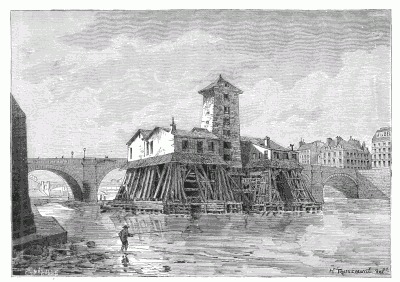
THE PUMPS OF PONT NOTRE-DAME, FROM THE QUAI DE GESVRES, AS THEY APPEARED IN 1861. THEY WERE DEMOLISHED IN 1866. From a drawing by H. Toussaint, after a contemporary engraving.
A detailed report has been preserved, setting forth the condition of the streets of the capital, made by Anne de Beaulieu, Sieur de Saint-Germain, to the king, in April, 1636. Everywhere, ordures, immondices, bouès, and eaux croupies et arrestées, the latter proceeding from the broken sewers; in the quartier Saint-Eustache, the égouts were stopped up, as everywhere else, "which causes the aforesaid waters to stagnate and to rise nearly to the church of Saint-Eustache and to give forth such a stinking vapor, in consequence of the carriages, carts, and horses which pass through the aforesaid waters, which is capable of polluting the whole quarter, and the same rising and stagnating of water is caused in the Rue du Bout du Monde as far as the aforesaid Rue Montorgueil; and it is to be remarked that the stench of the aforesaid waters is much more stinking and infectious in this locality than in others, because of the butchers and pork-butchers who have their slaughter-houses on the aforesaid esgout (the égout of the Rue Montmartre), and that the blood and the garbage and other matters proceeding as much from the aforesaid slaughter-houses as from the sweepings of the houses."
In 1670, the city established the two pumps at the Pont Notre-Dame to raise the river-water, which, elevated "to the height of sixty feet and to the quantity of eighty inches, was conducted into different quarters of the city by pipes six inches in diameter." Two mills which were standing on this site were purchased by the city, which diminished considerably the expense and hastened the completion of the work. These pumps were enclosed in a building of the Ionic order of architecture, the door of which was decorated with a medallion of Louis XIV, and with two figures sculptured in bas-relief by Jean Goujon, one representing a naiad, and the other personifying a river. These had previously ornamented an edifice in the Marché Neuf which had been demolished. An inscription by the poet Santeuil completed the decoration of this building. These pumps were restored and reconstructed in 1708, and finally abandoned in 1854.
The most important reformation effected in the eighteenth century was the reconstruction, throughout its whole length, of the great main sewer and the construction of a reservoir for the water with which to flood it. This was decided upon in 1737, and completed in 1740. Sewers were constructed also in the Rue Vieille-du-Temple and Rue de Turenne, the open ditch Guénégaud was covered over, and the Invalides and the École militaire were supplied with water. A police ordinance of January 9, 1767, forbade the inhabitants to put out in the streets any broken bottles, crockery, or glassware, or to throw them out of the windows; all individuals were forbidden, also, by the eighth article, to throw out of the windows in the streets, "either by night or day, any water, urine, fecal matter, or other filth of any nature whatsoever, under penalty of a fine of three hundred livres." The Parisians objected strongly to this interference with their usual habits, and this question of sanitation remained long unsolved; in 1769, the Contrôleur Général, M. de Laverdy, proposed to establish at the street corners brouettes, or small, closed vehicles, in which could be found lunettes for the benefit of the public. "The contractors promised to turn in a certain sum to the royal treasury," says the author of the Mémoirs secrets, "which transformed the affair into an impost worthy of being compared to that which Vespasian laid upon the urine of the Romans."
This idea, much derided at the time, was the germ of the modern cabinets inodores, those very useful institutions which do so much to disfigure the streets of Paris. In 1845, small cabinets of this species, mounted on wheels, could be seen on the Place de la Concorde, drawn about by a man, who stopped when signalled by the passer-by, but these soon disappeared. By a special law, passed February 4, 1851, the establishment of lavoirs publics was authorized in several quarters of Paris, and these establishments have continued to multiply.
The problem of supplying Paris with good drinking water is not yet completely solved, though immense progress has been made within the last sixty years. The cholera epidemic of 1832 did much to arouse the municipal authorities to the necessity of radical reform both in the water-supply and in the system of sewage. At this date, the city was furnished by the pumps in the Seine, by the selenitic water drawn from Belleville, from the Pré-Saint-Gervais and from Arcueil, and from the canal de l'Ourcq,—inferior in quality and insufficient in quantity. The public fountains had long been the great resource of the inhabitants, and these were frequently architectural constructions worthy of their importance,—the Fontaine des Innocents, that of the Birague—now disappeared, that of the Arbre-Sec, of Gaillon and of Grenelle. The porteurs d'eau were robust young fellows, mostly from Auvergne, who carried about the Seine water in two metal buckets by means of a neck yoke, and delivered it in the loftiest houses. At night, the water-casks, always filled, were stationed at various points, so as to be available in case of fire;—the first water-carrier who reached the scene of conflagration received a reward of twelve francs. The eau de Seine, filtered, was retailed at ten centimes the voie, or two pailfuls, of ten or fifteen litres, twenty times the price it is to-day; the poor preferred to use the water just as it came from the river, polluted as it was by the sewage.
As late as 1608, the only resource available outside the Seine water and that of wells was that furnished by the two little aqueducts of Belleville and the Pré-Saint-Gervais, constructed by Philippe-Auguste about the beginning of the thirteenth century. This supply was called les Eaux du Roi, and was dispensed graciously by the monarch to the grand seigneurs and the rich monasteries. The aqueduct of Belleville, which was falling into ruin, was partly reconstructed by the prévôt of the merchants in 1457. Henri IV, in 1598, granted the first concession for a fixed price, which was the origin of the custom of paying for the municipal water-supply. At the end of the eighteenth century, the city was furnished by the "Eaux du Roi," which included that brought by the aqueduct of Arcueil and drawn from the pompe de la Samaritaine (1606-1608); and by the "Eaux de la Ville," from the aqueduct of Belleville and the pompes Notre-Dame. The Eaux du Roi were ceded outright to the city in 1807; their administration is confided to the Préfet of the Seine, under the authority of the Minister of the Interior.
In 1802, the first attempt to seriously increase the volume of water supplied the city was made by drawing on the little river Ourcq. This canal brings a supply to the Bassin de la Villette, which serves as a reservoir to distribute it through Paris by means of the aqueduct of the Ceinture and large mains. The necessity of securing a larger supply, and a much purer one, was strongly felt by Baron Haussmann, who did so much for the embellishment of the city during the Second Empire, and in conjunction with the Engineer-in-chief of the navigation of the Seine, M. Belgrand, the present system was inaugurated. The latter found means of solving the problem after a careful study, in 1854, of the basin of the Seine. The bed of gypsum on which Paris is built furnishes neither water of a good drinking quality nor sources high enough to bring it into the city at the requisite altitude; it was therefore necessary to go outside this basin, extending from Meulan to Château-Thierry. At present, Paris is furnished with potable water by three aqueducts,—that of the Dhuis, a hundred and thirty-one kilomètres in length, constructed from 1862 to 1865, running from a source nearly due east of the city; that of the Vanne, a hundred and eighty-three kilomètres, 1866-1874, from the southeast, and that of the Avre, a hundred and eight kilomètres, 1890-1893, from the west. A fourth is to be built, of a length of seventy-two kilomètres, which will draw its supply from the valley of the Loing and the Lunain, a little west of Vanne.
When the city was enlarged by the annexation of the surrounding communes, in 1860, the municipal administration signed a contract with the Compagnie générale des eaux, which then held similar contracts with several of the communes both within and without the walls. By this, the city obtained the control, not only of its own water-supply and distribution, but also of that previously established by the company. The general management of the distribution is in the hands of the Compagnie, which collects the subscriptions, constructs branch pipes from the public conduits to the façade of the dwelling to be served, and turns the gross receipts into the municipal treasury, less its commission. To it, or to the bureaux d'inspection, all complaints are to be addressed. The purer eaux de source, brought by the aqueducts, are reserved for domestic use; the eaux de rivière, from the Seine and the Marne, are elevated to the altitude requisite to serve the higher quarters of the city by eleven usines, within and without the walls. The river-water is served by means of gauges and meters; the eau de source by meters only, which are officially examined and verified by the Municipal Laboratory, established in the Palais du Bardo, in the Pare Montsouris. This laboratory also analyzes this water, that of the drains, the sewers, and the wells, and reports to the municipal administration. With a view to the diffusion among the people of correct hygienic ideas, the Préfet of the Seine appointed, March 21, 1898, a commission of savants, architects, and hygienists to draw up a series of measures the most practical available for rendering dwelling-houses healthful.
The general distribution is effected from the eighteen reservoirs fed by these various sources; the eau de source is furnished on the public streets by six hundred and seventy-three fountains established against walls, etc., and by ninety-seven of the "Wallace fountains;" the water of the Ourcq and of the rivers is furnished by thousands of bouches d'eau, on the sidewalks, in the streets, etc., for service in case of fire, watering the streets, the innumerable lavoirs, etc. The monumental fountains, such as those of the Place de la Concorde and du Châtelet, which play every day from ten in the morning to six in the afternoon, are furnished by the canal de l'Ourcq, whilst that of the Trocadéro and its cascade, that of the Place d'Italie, and the luminous fountain of the Champ de Mars, which function only on fête-days and Sundays, are supplied by the Seine water. The fountains of the Luxembourg are fed by the Arcueil aqueduct. The water-pipes throughout the city are generally carried in the upper part of the égouts,—on curved shelves in the smaller ones, and on upright stems carrying a curved holder in the larger ones. In the grand galerie du Boulevard Sebastopol, for example, the water of the Ourcq is carried on one side in an eighty-centimètre main, and that of the Seine on the other in a main one mètre, ten, in diameter.
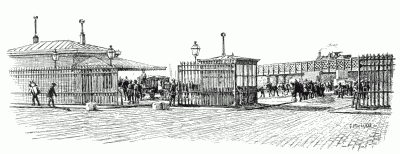
MUNICIPAL PARIS: POST OF THE OCTROI AT THE BARRIÈRE DE LA CHAPELLE SAINT-DENIS. After a drawing by G. Maréchal.
When the canal de l'Ourcq was first opened, the work was carried out by a company to which was granted the right of navigation on the new channel, connected with the Seine by the canals Saint-Martin and Saint-Denis, but in 1876 the city of Paris repurchased this concession from the canal company. A supply is also drawn from several important artesian wells in different localities,—that of Grenelle, in the Place de Breteuil, driven between 1833 and 1852, draws the water from a depth of five hundred and forty-nine mètres and elevates it to a height of seventy-five. This supply is turned into that of the Ourcq. The artesian well of the Butte aux Cailles, begun in 1863, was resumed in 1892 and is just being terminated; the depth attained is some six hundred mètres. That of Passy, 1855-1860, somewhat less deep, supplies the lakes of the Bois de Boulogne; that of the Place Hébert, 1863-1893, seven hundred and eighteen mètres in depth, furnishes some large ponds in the neighborhood.
Among the great reservoirs, the most noticeable is that of Montmartre, rising high by the side of the church of the Sacré-Cœur, and containing within its gray walls no less than three lakes, one above another. The largest of all these storage basins in the city is that of the Vanne, at the side of the principal entrance to the Parc Montsouris; in its vast, vaulted enclosure, covered with turf, may be stored two hundred and fifty thousand cubic mètres of water. Visitors are admitted to the under vault, where, by the light of torches, the enormous walls and the innumerable columns that sustain this weight are dimly visible. The water of the Avre, drawn from the two sources of the Vigne and Verneuil, is to be stored in the still larger reservoir on the heights of Saint-Cloud, similar in construction and now nearly completed. Each of the three sections in which it is built will contain a hundred thousand cubic mètres.
The ancient mediæval methods have all been put away, the inevitable little open gutter running down the middle of the street—celebrated by Boileau and Mme. de Staël, and many others—has long since disappeared, but the water-supply is not yet entirely adequate, and the citizens may still suffer for the lack of a pure liquid to drink,—as they did through so many centuries. It not infrequently happens, as it did in the early autumn of 1898, that several quarters of the city are simultaneously deprived of eau de source, and compelled to use the river-water alone. Every effort is made to avert this—as it is rightly considered—calamity, the streets are placarded with official notices warning the inhabitants of the approaching curtailment of their supply, and they are notified in a similar manner when the scarcity is over. Two solutions have been proposed for this insufficiency, both of them involving such heavy expense that the municipality shrinks from adopting either;—the first, to supply every dwelling with a double set of pipes, one carrying the pure water of the aqueducts, and the other the river-water, forced up into the upper stories; the second is to go as far as the lakes Neuchâtel, or Geneva, for an uncontaminated supply. The complete application of the tout à l'égout system has been delayed by the want of the greatly-increased volume of water necessary for its application, and strong petitions have been presented demanding the postponement of the application of the law of 1894. The present supply is about a hundred and twenty-four litres of eau de source and ninety-six of eau de rivière daily for each inhabitant, but in summer this amount may become greatly diminished. Paris thus stands second in the amount of daily water-supply in the European capitals,—the figures ranging from Rome with four hundred and fourteen litres per capita, daily, to Constantinople with fifteen. London has only a hundred and seventy-three for each inhabitant daily; and Berlin, seventy-three, next to the Turkish capital. The figures for American cities are very much higher,—New York, three hundred and fifty-nine; Boston, three hundred and sixty-three; Philadelphia, six hundred; Chicago, six hundred and thirty-six, and Buffalo, eight hundred and forty-five (September, 1898).
ANOTHER grave evil produced by an insufficient water-supply is the lack of pressure in the pipes in case of fire, and the possible lack of water itself. The number of bouches d'incendie, or fire-plugs, which it is proposed to raise to eight thousand, placed a hundred mètres apart, in all the streets of the city, is as yet far from attaining that figure. The infrequency of serious fires in the capital is, however, very noticeable when compared with the losses of American cities. Various causes contribute to this result: the solid character of the dwelling-houses generally, especially in the older quarters of the city—the handsome, new apartment-houses that have been put up in such numbers of recent years in the neighborhood of the Arc de l'Étoile are, very many of them, much less well built; the general absence of furnaces and of those overwrought fires to which the severity of his climate incites the American citizen; the total absence of buildings of an inordinate height, and, in modern times, the much more restricted use of electricity and the consequent diminution of that too frequent danger of the present day, "defective insulation." The fire service is, also, very efficient; the brass helmets of the pompiers are as inseparable from any public performance, theatrical or musical, as the uniforms of the Garde Républicaine; these faithful sentinels are on duty behind the scenes as well as before them, and even up in the "flies," where, before the introduction of electricity, they were obliged to pass several hours in a temperature of, frequently, thirty-five degrees Centigrade, ninety-six Fahrenheit. At present, the fire department of Paris has adopted most of the modern improvements common to other civilized capitals, and the details of its service differ from those with which we are familiar principally in the military character given it.
The regiment of Sapeurs-Pompiers is, in fact, a regiment of infantry, lent to the city of Paris by the Minister of War. It is paid out of the municipal budget, with the exception of the pensions of the Legion of Honor, the military medal, and the retired list, which are the charge of the State. The regiment is composed of two battalions, of six companies each, with a total strength of seventeen hundred men. The pay of the men and their indemnities are the same as for the regiments of infantry in garrison in Paris, there are special privileges for the officers, and the quality of the recruits, especially with regard to their physique, is maintained at a very high standard. Their bravery, their efficiency, and their devotion are equal to those which are displayed so frequently by this well-organized service in other large cities, and are equally appreciated by the public; when, at the annual review at Longchamps on the day of the national fête, the regiment of sapeurs-pompiers defiles before the reviewing-stand, the great wave of applause and recognition which envelops it, drowning the other cheers in its roar, betokens the intimate appreciation of the Parisian, of high and low degree, of these unpretentious heroes.
By the new organization of this service, now in process of completion, the city is divided into twenty-four "zones," in the centre of each of which is a post of men and material, known as a centre de secours. The smaller posts, scattered through the city, in case of fire, notify by telephone these central stations and the état-major of the regiment, adjoining the Préfecture de Police; if the fire is of sufficient importance, the centre de secours sends a reinforcement and the steam fire-engine, the pompe à vapeur, but in very many cases the service of the latter is not needed. Its appearance in the streets is comparatively rare, and it is seldom driven at the mad gallop of the American machines. Moreover, its whistle is the curious thin treble so common in European motor engines, railroad and other. The old-fashioned hand-pumps have almost completely disappeared, with the exception of some localities like the Butte Montmartre, too steep to be approached by horses. In the central stations, the arrangements are those generally adopted nowadays to secure the quickest possible service,—even to the harness suspended from hooks in the ceilings to be dropped on the horses' backs, and the metal pole down which the men slide from their sleeping-rooms above.
SAPEUR-POMPIER AT A FIRE-PLUG. After a drawing by M. Carney.
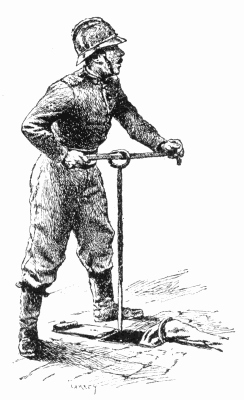
For particular service, details for the theatres, balls, private clubs, etc., the number of men is fixed by the Préfet de Police, and there is extra pay in all these cases. The department is also called upon in case of street accidents, falling buildings, asphyxia in sewers, etc. The service material includes special apparatus for respiration in cellars, basements, etc., where the presence of gas or smoke is to be apprehended; and the great ladder, carried on a special truck, has a length of twenty mètres, greater than the average height of the Parisian houses. It is stated that the time allowed to elapse between the receipt of an alarm in the stations and the departure for the fire is often under a minute, and never exceeds two; in 1896, the time between the alarm and the attack of the fire was less than five minutes in ten hundred and seventy-nine fires out of a total of twelve hundred and four. In seven hundred and eighty-four cases, in the same year, the conflagration was completely extinguished in five minutes, and the very longest fire lasted six hours and a half.
At the entrance of each of the twelve casernes, or barracks, of the regiment, the names of the officers and soldiers who have been killed in the discharge of their duty are engraved on a slab of black marble, the Golden Book of the regiment. In the court of the état-major the names of the forty sapeurs-pompiers who have thus died since 1821, are engraved on a marble panel. In his order of the day, March 11, 1888, "the colonel informs the regiment, with profound grief, of the deaths of Corporal Toulon and former sergeant Sixdenier, who perished yesterday, at noon, victims of their devotion, in endeavoring to save an imprudent workman who had descended, without taking precautions, into an excavation of the Rue des Deux-Ponts." Three citizens were also asphyxiated in trying to save him, two of whom died; "and the deaths of Sixdenier and Toulon will be for all another and a grand example to add to the history of the regiment."
A Parisian merchant or manufacturer, Dumourrier-Duperrier, in 1699, furnished the first effective, organized system of combating fires in the city, and in 1717 he received, by letters-patent, the direction of the Compagnie de Garde-Pompes, the origin of the present organization. In 1792, the total effective of this force was two hundred and sixty-three men, officers included, with forty-four force-pumps, twelve suction-pumps, and forty-two casks. The men were provided with uniforms and, later, armed with sabres; in the year IX of the Republic, the corps, then four hundred strong, was placed under the direction of the Préfet de police, under the general administration of the Préfet de la Seine. The frightful conflagration which ended the fête given by the Austrian ambassador, Prince von Schwartzenberg, to the Emperor, in honor of his marriage with Marie-Louise, in 1810, awoke public attention to the insufficiency of the arrangements for extinguishing fires, and in the following year measures were taken to secure a larger authority and more energetic action. Napoleon decided that the gardes-pompes should be put on a strictly military footing; an imperial decree of September 18, 1811, created a battalion of sapeurs-pompiers consisting of four companies with thirteen officers and five hundred and sixty-three men. For the first time, they were armed with muskets, and as a military force were held as an auxiliary in the police service and in the maintenance of public order. One of the articles of this decree provided for the payment of this force by the city until the establishment of a company to insure against fire,—which was held to foreshadow an intention to place this expense, at least in part, upon these companies, and thereby relieve the municipal budget.
During the Revolution of 1848, the provisory government thought it prudent to deprive the pompiers of their muskets; and in April, 1850, the President of the Republic disbanded the battalion and reorganized it, retaining a small proportion of the former members. Down to this date, it had been recruited from the engineers and the artillery of the army, but since then, from the infantry only. In 1860, the annexation of the banlieue necessitated a new reorganization; the successive augmentations of the force brought its total effective, in 1866, up to a regiment of twelve hundred and ninety-eight men, divided into two battalions of six companies each. The efficiency of the organization was greatly augmented by the introduction of steam fire-engines in 1873.
BY the law of December 29, 1897, all the communes of France were authorized to suppress their octroi duties upon "hygienic beverages," wines, ciders, beers, perry, hydromel, and mineral waters, and replace them by others, after December 31, 1898. As the entrance duty upon these boissons hygiéniques constituted a very important fraction,—in Paris, in 1895, sixty-eight million five hundred thousand francs out of a grand total of a hundred and fifty-five million six hundred and one thousand,—the question of supplying this deficiency in the municipal budget is exciting discussion. In case the octroi is not suppressed altogether, the communes are obliged to diminish the tax in certain proportions, according to their population and their locality,—the cider-producing departments standing on a different footing from the wine-growing ones. To replace the octroi, they are given their choice of five other taxes—upon alcohol, or upon horses, dogs, billiards, clubs, and various other articles of luxury. It was generally predicted in Paris that the consumer of alcoholic beverages would not experience any benefit from the removal of this tax.
Under the ancient régime, the octroi, like most other imposts and duties, was in the charge of the fermiers généraux, who obtained the royal authorization to enclose Paris within a wall to facilitate its collection. Consequently, one of the first manifestations of the Revolution was the demolition of these barrières by the people, on the very day of the taking of the Bastille. On the 1st of May, 1791, at midnight, all the gates of Paris were thrown open to the hundreds of vehicles, boats, and barges which had been waiting for weeks for this moment of free entry; a triumphal mast was erected in honor of the Assemblée and to celebrate the abolition of "the most odious of tyrannies;" the National Guard, under Lafayette's orders, paraded around the demolished barriers in the midst of the universal rejoicing. But, seven years later, the necessities of the municipal finances constrained many of the thus emancipated cities, Paris included, to return to the system of levying a tax on articles entering their gates, and the masons continued the work of enclosing the capital again within walls.
GUARDS OF THE OCTROI AND THEIR DOGS IN THE ENTREPÔT OF WINES AT BERCY. After a drawing by L. Vauzanges.
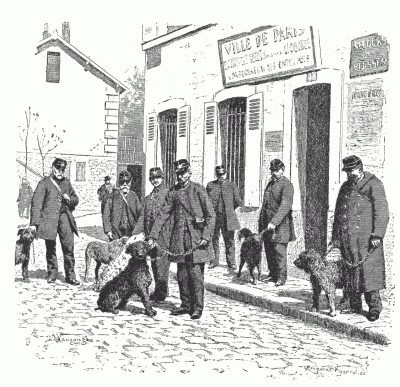
Many difficulties attended the levying of this impost; "as soon as night fell," says M. Maxime Du Camp, "the city was literally taken by assault; the tavern-keepers of all the villages of the suburbs set up their ladders against the city wall, and the casks of wine, the bottles of brandy, butcher's meat, pork and vinegar, were lowered by means of ropes to the confederates who were waiting for them inside, in the chemin de ronde. Should some ill-advised customs clerk undertake to interfere with these fraudulent practices, he was set upon, beaten, gagged, and the introduction of the prohibited commodities continued undisturbed. They did even better; they excavated tunnels, which, passing under the exterior boulevards, under the wall of fortification, under the chemin de ronde, opened communication between the inns of the banlieue and those of the city; it was a veritable pillage,—the octroi was sacked." These violent measures have been replaced in the present day by more suitable ones, and the musée des fraudeurs, in the administration centrale of the octroi, contains a very curious assemblage of objects used in this contraband service. Alcohol was the favorite object of smuggling, and it was carried into the city in rubber corsets, worn under the blouse, rubber petticoats which would contain as much as thirty litres of the liquid, and were known as mignonnettes, false backs, false calves, false stomachs, and false upper arms, mostly in zinc. The women would not hesitate to appear as plantureuses wet-nurses, or as in an interesting condition; the vehicles were mined and hollowed with concealed receptacles, and even the collars of the harness; the blocks of granite, the rolls of carpet,—all the arts of the smuggler were employed. That very general popular disposition to consider the evasion of a customs duty as a trivial offence is as common in France as elsewhere.
At all the gates of the city, in the railway stations, and at the river entrances of the capital, the posts of the octroi are established, and the formula of address of the green-uniformed officials is generally the same: "You have nothing to declare?" Foreign visitors are especially advised against the carrying in their baggage of tobacco and matches, the manufacture of these being a government monopoly; French allumettes are very bad, but it is better to throw away your cherished boxes of neat wax-matches before entering the barriers. With these exceptions, the officials are tolerant of the introduction of contraband articles in small quantities,—a half-bottle of ordinary wine, two pounds of fish caught by hook and line, a pound of salt, a bundle of hay or straw, etc. The agents act under the authority of the Préfet of the Seine; the objects submitted to this duty, intended for local consumption, are designated by the Conseil Municipal and approved by the government. The officials have the right of search; dutiable objects to be carried through the city are entitled to "escort" by the agents of the octroi, or they may pay the tax at the entrance with the privilege of having it refunded when leaving. All the communes of the Department of the Seine, considered as the banlieue of Paris, have the right of levying an entrance duty upon brandies, spirits, and liquors. The penalties provided for smuggling are the confiscation of the article and of the means used in its transportation; a fine of from a hundred to two hundred francs, and even imprisonment, if the attempt has been made by means of escalade or subterranean proceedings, or with prepared methods of concealment. All dutiable articles must be declared, no matter how small the quantity carried.
As both the city and the State are interested in the collection of this tax, the agents have a double mandate to execute their duties, and the contraventions of the law are pursued at one time in the name of the public Treasury and the octroi, and at another in the name of the Préfet of the Seine. Each gate of the city has its peculiar class of produce to tax, according to the locality to which it gives entrance; and the daily receipts vary to an astonishing degree. At the Orléans dépôt, the duties on merchandise have reached a hundred thousand francs a day and fallen to five hundred; the Porte de Saint-Denis ranges from fifty thousand francs to four!
To the establishment of the octroi municipal et de bienfaisance by the Directory is due that of the great dépôts or entrepôts of wine and alcohol on the quais of the Seine,—the importers finding it very inconvenient to pay the duties upon all their casks on their first arrival. They are, therefore, allowed to store them, under the supervision of the octroi, and pay as they are sold. When the ancient corporation of the crieurs jurés announced throughout the city the arrival of a shipment of wine, the purchasers would throng to the banks of the Seine; when Louis XIV granted the first authorization to establish a halle aux vins, on condition that the profits should be divided with the Hôpital Général, the site selected was the Quai Saint-Bernard, the entrepôt of Bercy being then a market outside the city walls. The latter, on the site of the ancient Halle des Hôpitaux of the seventeenth century, developed greatly after its incorporation within the city limits; it is at present divided into two sections, Le Grand Bercy and Le Petit Château. The city is the proprietor, and rents spaces to applicants, generally for a year at a time. The octroi is stationed at every gate of exit, and at numerous posts within the enclosure. Not only is the wine stored here, but it is blended and assorted in great tuns, and there is also storage for alcohol, liquors of all kinds, and oil. The huge enclosure is very carefully policed, not only for the detection of thieves, but also of fraudulent practices; at night there are four rounds, of which the second and third are made by guardians armed with revolvers (a recent innovation), and accompanied by eight shaggy watch-dogs.
AMONG the scientific establishments of the city may be mentioned the observatory established on the top of the Tour Saint-Jacques, the beautiful fragment remaining of the old church of Saint-Jacques de la Boucherie, demolished in 1789. In the vaulted open chamber of the base of the tower stands a statue of Pascal, who, from the top of it, repeated his experiments on the weight of the air; and on this top—only fifty three mètres from the pavement—there has been in operation for the last seven or eight years a meteorological observatory. The varying conditions of the atmosphere, the winds, and the smoke which pollutes it, are closely investigated, weather predictions are hazarded, and the observers even descend into the sewer at their feet, under the Rue de Rivoli, to investigate and analyze the subterranean air. About 1885, M. Joubert, the director, established here a gigantic pendulum, to repeat the experiments made by Foucault at the Panthéon in 1851, and afterward a water-barometer, the only one in existence. The incongruity of this modern scientific apparatus on top of this mediæval tower, among the four monsters of the Evangelists at the corners, is rather amusing,—even the statue of Saint James himself carries placidly an anemometer on his back.
Another of these minor municipal details—and possibly a more affecting one—is the official Dépôt des Marbres, established adjoining the official museum of the Garde-Meuble at the end of the Rue de l'Université, by the side of the Champ de Mars. Here are deposited irreverently and in various stages of dilapidation all the official statues, royal, imperial, and republican, that have out-lived their day. "The marble of the statues of the State," said a cynical sculptor, "has the peculiarity of cracking after only a very short period of use." Some of these official marbles have had a longer period than others; but they all end here. Our illustration shows a corner of this depository,—at the angle, Napoleon III, sculptured by Iselin; behind him, a relief representing the return of the ashes of his great uncle; in the foreground, the Imperial eagle, with his fiery glance forever dimmed, and, at the left, a seated figure of Louis XVIII. Kings, potentates, and powers, official allegories, emblems, and symbols, are all set down here together, at the mercy of the weather. In the adjoining grand central pavilion are accumulated the official portraits of these departed rulers, including very many of the late Emperor and Empress,—"all the old rattles of France, all the playthings that she has broken."
Louis XVIII. Group: Transferring the Napoleon III. ashes of Napoleon I. KINGS IN EXILE: DEPOSED STATUES IN THE GARDEN OF THE GARDE-MEUBLE DE L'ÉTAT, ON THE QUAI D'ORSAY.
If the city is regardless of the effigies of her deposed rulers, she at least has some consideration for the living citizen who falls into trouble. The official Mont-de-Piété, or pawnbrokers' establishment, stands always ready to rescue him from the grasp of the usurer—provided he has some security of any kind to offer, and although its services are not altogether gratuitous, they are of very great benefit to the public. No private individual is allowed to make a business of lending money on personal objects. It was by letters-patent of the king, dated 9th December, 1777, that the original establishment was authorized, to be placed under the inspection of the Lieutenant Général of Police and of four Administrateurs of the Hôpital Général; the amount to be loaned to applicants was fixed at four-fifths of their value on objects of gold or silver, and at two-thirds on all others. The administrators were permitted to establish branch offices in different quarters of the city, and the central bureau was located in the Rue des Blancs-Manteaux, where, very much enlarged, it still is. This institution proved to be of the greatest service to the people, well-to-do as well as poor, but the undiscriminating Revolution promptly abolished it as a monopoly, and was forced to restore it under the Directory, May 22, 1797. By the law of February 4, 1799, no similar establishment could be opened without the consent of the government.
At its reconstitution under the Directory, it made its loans at the rate of thirty per cent., this was gradually reduced to twelve, and it was not until after the Revolution of 1830 that the figure was fixed at nine. At present, the interest and the charges amount to seven per cent. In the first century of its existence, from 1777 to 1877, the total amount of the loans advanced was two trillion three hundred and eight million six hundred and fifty-five thousand six hundred and ninety-six francs. The number of objects pledged was over a hundred and twelve million five hundred thousand, of which there were redeemed, or sold as forfeited, a hundred and ten million seven hundred and ninety thousand.
The first of the succursales, or branch establishments, was for a long time in the Rue Bonaparte, the ancient Rue des Petits-Augustins, in the neighborhood of the École des Beaux-Arts; in 1814, a royal ordinance authorized this succursale to enlarge itself, and granted to it an old building and a slice of the garden of the Musée des Monuments français, on several conditions, one of which was that it should transport to Père-Lachaise and reconstruct there the tomb of Héloise and Abélard, which was in the ceded portion of the garden. This was faithfully carried out, but in 1833 the State changed its mind, the cession was revoked, and the Mont-de-Piété was obliged to restore the ground and demolish its building, but was not reimbursed for its outlay on the tomb of the lovers. At present, the succursales are three in number, in the Rues de Rennes, Servan, and Capron, and there are bureaux auxiliaires for very nearly all the letters of the alphabet, by which they are designated. These latter have no storage-room, and consequently are unable to deliver an object redeemed until the following day; the transportation of these pledges through the streets is effected in the company's own wagons, and with every precaution against loss. In the auxiliary bureaux, or bureaux of the quarter, no loan is made for a greater sum than five hundred francs, while in the central establishment the limit is ten thousand francs, but all the regulations are otherwise the same; only one style of ticket is used, and this varies in color according to the year, being white, pink, yellow, green, etc., in sequence.
By the terms of the present regulations of the establishment, the object offered as a pledge is appraised by eight official commissaires-priseurs who are responsible for the deficiency in case the object, being neither renewed nor redeemed, is sold at public auction at less than their valuation. As may be supposed, they take care to guard against this eventuality,—the amount to be loaned on each pledge being the same proportion of its value as that fixed by the ordinance of 1777. The disappointment of the borrower at the inadequate sum offered him is not considered; but it has been proposed to establish by law a percentage nearer the actual market value of the security. The borrower is also subject to a tax,—of one per cent. on the sum he receives, without regard to the duration of the loan, and of six per cent. additional,—three for interest and three for running expenses. This last is calculated proportionally on the sum received and on the length of time the pledge remains unredeemed, counted by fortnights; loans of three, four, and five francs, not remaining unredeemed longer than two months, are not subject to this six per cent. tax.
Careful precautions are taken against the Mont-de-Piété being made a receptacle for stolen goods. The applicant for a loan must be known and have a permanent residence, or be vouched for by some one fulfilling these requirements; a married woman must bring the authorization of her husband, and no loans are made to minors. If the employés have any reason to suspect the integrity of the applicant, his loan is refused until he furnishes more satisfactory guarantees. In one year the number of watches recognized as stolen was two hundred and fifty, out of a total of three hundred and fifty thousand received. Loans are made for a year, at the longest, but in practice two months of grace are added; if at the end of this period the object is not redeemed, it is sold at public auction. Some of these pledges have been in the establishment for forty, forty-five, and fifty years, and very many for twenty,—constantly renewed and never redeemed. When sold, the surplus or boni remaining after deducting all charges is held at the disposal of the owner of the pledge for three years, and then turned over to the administration of the Assistance Publique.