Introductory material (continued 3)
Reading edition
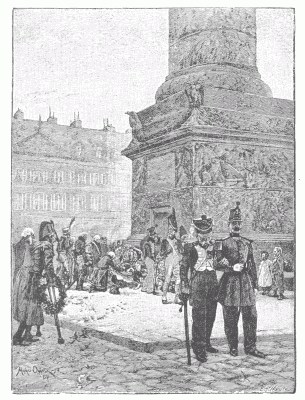
Something of this contrast of costume may be seen in the reproduction of M. Orange's painting from the Salon of 1891, the "Medallists of Saint Helena," on page 175,—the annual ceremony of the old soldiers of the First Empire depositing their memorial wreaths at the base of the Vendôme column; and it is with a very natural impulse that the French citizen and the French soldier of to-day turn from the bitter memories of their last war to recall the images of those great days when the nation was afire as it has never been since. The curious revival of Napoleonic literature which we have witnessed within the last few years may doubtless be ascribed in part, at least, to this longing to dispel somewhat the national depression. There is not wanting in these memoirs abundant testimony to the strange transformation which the casting off of the ancient régime wrought in the whole people. In the Consulat et l'Empire, M. Thiers quotes the testimony of an astonished Prussian officer after the astonishing battle of Auerstadt in which Davout with twenty-six thousand men overthrew sixty thousand of the soldiers trained in the school of the great Frederick, repulsed twenty times the charges of the cavalry considered the best in Europe, and took with his forty-four cannon one hundred and fifteen of the enemy's. "If we had to fight the French only with our fists, we would be vanquished. They are small and weakly; one of our Germans could beat four of them; but under fire they become supernatural beings. They are carried away by an inexpressible ardor, of which no trace can be seen in our own soldiers." In much more recent publications, the Mémoires du sergent Bourgogne, the Souvenirs d'un officier danois, the Lieutenant Frisenberg, there is further testimony as to the quality of this Grande Armée. The latter, a young soldier, records the strong impression made upon him by the French officers when he first met them, their sobriety, their moderation, wonderful in the conquerors of Europe, their easy acceptance of orders. "What will not a Frenchman dare!" he exclaims. It is this apotheosis of military valor and efficiency which we see apostrophized in so much contemporary national art,—as in Karbowsky's "Drums of the Republic," Bac's spirited sketch of the return of the troops to Paris after Marengo, Marold's "Review in the Carrousel," under the eyes of the Emperor, and Le Blant's return of the veterans of the Republic and their fierce impatience under the supercilious inspection of the dandies and incroyables of the capital.
The military souvenirs of the Second Empire are much less imposing. Among the most interesting of those recently published are those of Marshal Canrobert, taken down from his verbal recitals by M. G. Bapst, afterward written out and corrected by the old soldier. His portrait of Louis Napoleon is interesting; he came to Paris on the eve of the Coup d'État and was presented to the Prince-President. "The man whom I saw before me was small in stature; his eyes, very small, were dull and very mild; while they were professedly looking at me, they had the appearance, at the same time, of being directed at some much more distant object; his black hair, smooth on his head, very much pomaded, was long and fell below his ears and on his collar; his heavy moustache, not waxed, covered his lower lip. He wore a frock-coat, buttoned up, and a very high collar which enclosed the lower part of his face. He stood with his side rather toward me, the left arm considerably in advance, and offered me his hand with a constrained gesture. I felt, in clasping it, as though I were grasping the hand of a paralytic, almost an anchylosed one. He addressed to me some commonplace phrase, so commonplace even that I no longer remember it; but he spoke with a peculiar accent, which you would have taken for an Alsatian accent. This was all that happened."
In the military operations of the 2d of December, Canrobert took part as general of brigade: according to his own account, he constantly exerted himself to suppress the fire of the troops on the citizens and to save the lives of the latter. But when he was offered the grade of general of division afterward, he refused it, and thereby, says one of his commentators, "violated military discipline and condemned, himself, his action of the day before."
Among the recent minor monographs relating to this epoch is one devoted to the Imperial picked body-guard of a hundred men, the Cent-Gardes, by M. Albert Verly, a fervent Bonapartist. One of his incidents is worth quoting. One day, the Empress Eugénie, traversing her apartments, accompanied by Colonel Verly, stopped before one of these sentries, whose rigid immobility in the correct military attitude made her smile. "Admit, colonel," she said, "that this perfect motionlessness is only an appearance, and that the slightest thing would cause it to disappear." "Your Majesty may assure yourself to the contrary," replied the colonel. "And if I were to offer him an insult?" "I have nothing to reply to your Majesty. You might ascertain yourself!" The Empress, knitting her brows in an attempt to frown, approached the sentry and reproached him severely for some imaginary infraction of discipline; stiff as a statue in his position of salute, he made no sign whatever. Whereupon, pretending to take offence at his silence, she dealt him a vigorous blow on the cheek. She might as well have struck a statue! So she returned to her apartments.
But, not willing that the affair should rest there, she ascertained his name, and the next day, through his superiors, sent the soldier a note of five hundred francs as some recompense for the gratuitous insult offered him. And he immediately returned it, through the same channel, answering that he esteemed himself as "too happy in having received on his face the hand of his well-beloved sovereign." M. Verly considers this response as very fine, and as justifying all that has been said concerning the correctness of appearance and attitude, and the intelligent and affectionate devotion which all the men of the squadron of the Cent-Gardes maintained toward their Imperial Majesties.
COMPAGNIE CYCLISTE: ÉCOLE MILITAIRE DE GYMNASTIQUE AT JOINVILLE-LE-PONT.
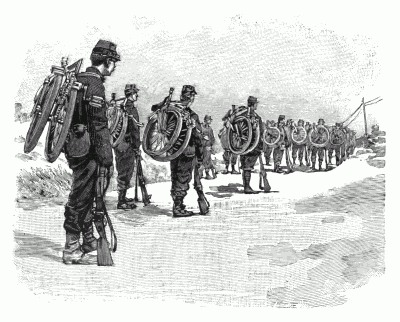
One of the first acts of the military administration after the Coup d'État was the disbanding of the National Guard throughout France. By a decree dated from the Tuileries, January 11, 1852, the superior general commanding was charged with its reorganization. On the 2d of December of the same year, the new Emperor signed at Saint-Cloud the decree promulgating the sénatus-consulte ratified by the plébiscite of the 21st and 22d of November, endorsing the Empire, and made his solemn entry into Paris. At one o'clock in the afternoon the cannon thundered, the drums beat, the trumpets and bugles sounded: "then might be seen," says the official Moniteur, "an inspiring spectacle, the new Emperor passing under that Arch of Triumph erected by his uncle to the glory of the French army.... From all the ranks of the army, from the Garde Nationale and from the people, there arose but one cry, powerful, unanimous, drowning the sound of the cannon of the Invalides which announced the entrance of Napoleon III into this ancient palace still resonant with the glory of his name. His Majesty, followed by his suite, traversed on horseback the Pavillon de l'Horloge and passed in review, on the Place des Tuileries and the Place du Carrousel, the troops of all arms there drawn up. He rode along the front of all the lines, receiving everywhere the most enthusiastic acclamations. After the review, the Emperor, followed by the generals who had formed his staff, ascended into the grand apartments of the palace," etc.
The renewal of the traditions of the First Empire was incessantly pursued. On the 21st of March, the President reviewed the garrison of Paris and distributed the military medal which he had just instituted, addressing the troops in a discourse in which he explained his object in creating this badge of distinction; on the 10th of May, there was a great military display on the Champ-de-Mars and the distribution of the eagles of the colors to the army. A decree of the 12th of August, 1857, instituted the medal of Saint Helena, given to those old soldiers of the first Napoleon who had served in the campaigns from 1792 to 1815. The Imperial Guard for the army, a reserve corps and corps d'élite, and the Cent-Gardes à cheval for the service of the Imperial palace, had been organized two years earlier. In 1867, at the culmination of the prestige of the Empire, when "the whole Almanach de Gotha passed through the salons of the Tuileries," these crowned heads were honored with a grand review of sixty-two thousand men in the Bois de Boulogne;—"the honors were carried off by the artillery of the Guard; the chasseurs, the zouaves, the guides, and the cuirassiers divided these acclamations, ... all these soldiers, presenting the most brilliant appearance, defiled before the King of Prussia, the Count Bismarck, the general Baron von Moltke, the major-general Count von Goltz! And three years later!..."
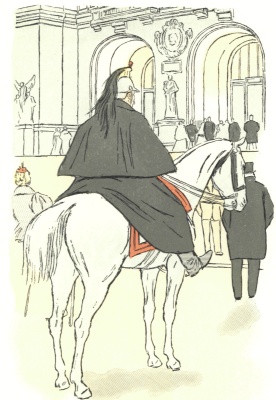
At the present day, the great number of these very red and blue soldiers, officers and privates, always to be seen promenading in the streets of Paris, the sentries on duty before all the principal public buildings, the mounted dragoons, or estafettes, riding about the streets with official messages, and the dragoons of the Garde-Républicaine, the municipal force, on duty before the Opéra-house on nights of performance, add greatly to the animated and picturesque aspect of the capital. To those who were in the city in the early fall of this year, the efficacy of a standing army to maintain public order was abundantly demonstrated. There can be no doubt that the threatened general strike of workmen and laborers, affecting all private and municipal works, and even the success of the coming Exposition of 1900, was prevented, almost in its inception, by the abundant protection afforded those workmen who continued to labor. If it were necessary, a single ouvrier, or terrassier, could have half a dozen soldiers or police to protect him against the violence of those of his fellows en grève, and the city was dotted with pickets of infantry and cavalry, sergents de ville, sentinels before all unfinished buildings, railway stations, etc. The arts of the demagogue are by no means unknown in this land of universal suffrage, and frantic appeals were made to them on this occasion, but the government remained entirely unimpressed, to its praise be it said.
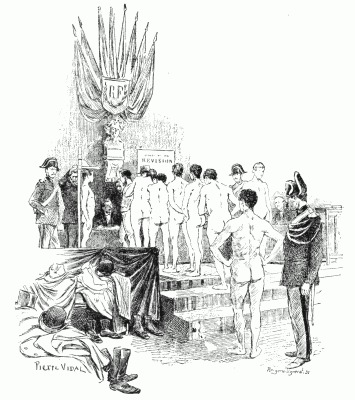
The drawing of the conscripts for the army by lot, and the revision of those thus selected, were formerly conducted in the Hôtel de Ville, but of late years have been apportioned among the Mairies of the various arrondissements. For those which offer no suitable locality for these operations, the Palais de l'Industrie was used until its recent demolishment. The conseil de révision held its sittings in the great Salle Saint-Jean at the back of the Hôtel de Ville, on the rez-de-chaussée, or ground-floor. These sittings began at eight o'clock in the morning, the members of the council took their places, according to their rank, at a large table in the shape of a horseshoe, the general or the colonel present at this function at the right of the president, then the oldest conseiller général, the intendant, the mayor of the arrondissement whose citizens were to come up for inspection, and who was present in an advisory capacity; at the left, the conseiller of the prefecture, the second conseiller général, the captain having charge of the recruiting. Before the table the examining doctor took his stand, and the patients presented themselves before him, after having been measured, all of them as naked as they were born, and yet in a correct military attitude, heels together, arms hanging by the side, the hands open and the palms forward. A sufficient force of gendarmes kept this somewhat incongruous parade in due order. And yet, in summer, a certain odor arises which compels the least delicate of the judges to have frequent recourse to flasks of smelling-salts judiciously provided. The decisions of this court are without appeal, and are pronounced by the president, either after having consulted his colleagues or in voicing their common opinion. The conscripts are then directed by the gendarmes toward the neighboring salle, where they resume their garments. The réservés pass into a special chamber, where a médecin-major examines them carefully, either as to their eyesight or as to the action of the heart. Attempts to avoid military service are comparatively rare in the conseil de révision of the Seine, and the shammers are readily detected.
COMPAGNIE CYCLISTE: ÉCOLE MILITAIRE DE GYMNASTIQUE AT JOINVILLE-LE-PONT.
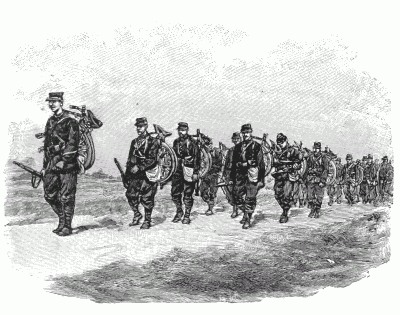
Theoretically, there is an absolute equality of all classes before the conscription. Even the law-givers have not been supposed to be exempt from the obligation of military duty. The law of the 24th of July, 1895, declared, in its first article, that no citizen was eligible as a member of the Parlement unless he had fulfilled all the conditions of the military regulations concerning active service. Those residing in Algeria or in the colonies came under the special regulations of a law of 1889. By article second, no member of the Parlement was to be called upon to do military duty during the sessions of that body, unless it were on the request of the Minister of War, by his own consent, and with the approval of the Assemblée of which he was a member. By article third, the members of the Parlement while doing military duty could not participate in the deliberations, nor in the voting, of the Assemblée. In case of convocation of the Assemblée Nationale, their military service was suspended during the session of this body.
This general abolishing of social privileges to maintain the military strength of the nation naturally works with a good deal of friction. On the one hand are what might be called the inevitable tendencies of all human society to oppose it and to violate it; and on the other, the fierce watchfulness of the demagogues and the socialists to maintain it. M. "Job's" amusing sketch on page 126 of the arrival of a rich conscript at the caserne, adopts the evident and plausible view of the situation. The new soldier brings along his footman to carry his equipments, the officers of the regiment, colonel at the head, come out to welcome him, the sentry on duty is petrified with astonishment. This was supposed to be designed with reference to the celebrated M. Max Labaudy; but it is curiously at variance with the real facts in his case. This too-rich young man, the Petit Sucrier of the Boulevards, was the son of a great sugar refiner, deputy to the Chamber from the department of Seine-et-Marne, and who left a fortune of more than two hundred millions of francs. The young man in question spent his portion with commendable freedom, but when he drew an unlucky number in the conscription he was declared eligible, though it was said at the time that he was already threatened with an affection of the lungs. He speedily fell ill; there was immediately raised such a violent demagogic outcry that his illness was feigned that "not one military commission dared to declare him unfit for service, he was transferred from one hospital to another, from Vernon to Rouen, from Rouen to Val-de-Grâce, from Val-de-Grâce to Amélie-les-Bains, where he died,—died of his millions, it may be said, for if he had been only a poor devil he would have been immediately mustered out." The young man, fully recognizing the disability under which he labored in the eyes of his cowardly and truckling superiors, wrote pathetic letters from his hospitals, regretting his fatal millions.
For the service of the city of Paris, there is a special corps d'élite, the Garde Républicaine, comprising an infantry force of two thousand two hundred and ten men and one of one hundred and ninety mounted men. This is recruited from the sous-officiers, brigadiers, corporals, and soldiers of the active army under certain conditions. Each applicant must have served at least three years uninterruptedly in the regular army, have an irreproachable record, be able to read and write correctly, be at least twenty-four years of age and not over thirty-five, and have a stature of, at least, 1 mètre, 66 centimètres—1.70 mètres for the cavalry. The members of this force have special privileges of pay, pension, ability to compete for the grade of brigadier and succeeding ones, and of resigning from the service after having complied with the requirements of the recruiting law. Those who serve as guards at the theatres and the race-courses have an additional indemnity of from 75 centimes to 1 franc .25, according to the length and nature of the service. It appeared, from statements published during the strike in the capital in the autumn of 1898, that the soldiers and police, of all grades, received, on an average, less pay than the workmen whom they were protecting.
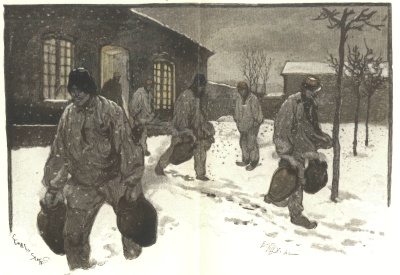
LA VIE À LA CASERNE: THE MORNING COFFEE. After a water-color by Georges Scott.
In the multiplicity of military regulations of all kinds, and of men who promulgate them and who are affected by them, there naturally appear from time to time some of the aberrations and eccentricities of ordinary human nature. Sometimes the French wit appreciates these oddities and makes much of them; and sometimes it completely fails to perceive them. One of the most distinguished of their generals, Poilloüe de Saint-Mars, enjoys quite a little reputation for the cocasseries of certain of his orders. One of the most famous of these was that of the soldat-tender, designed to enhance the prestige of the infantry officer. For this purpose, he was authorized to select from among the men in his command one of the "most robust and alert," who would be the "most sympathetic and the most devoted to his officer, and who would follow him like his shadow." This soldier-tender, who "would be to his officer what the tender is to the locomotive," would carry his déjeuner and all his other baggage, being relieved from the ordinary company equipment,—the officer, thus lightened of everything but his weapons, would enjoy over his men the same physical and moral advantage that his comrades of the artillery and cavalry do by the excellence of their mounts and their "aureola of an orderly," and those of the marine by the superiority of their technical knowledge. "In campaign, the mission of the tender will accentuate itself and aggrandize itself. He will be authorized to halt if his officer fall wounded. He will assist him affectionately, will bandage his wounds, confide him to the litter-bearers, and, to avenge him, then hasten to rejoin his comrades." Practically, an arrangement is made by which the infantry officer, in reviews and parades and while in charge of detachments,—as may constantly be seen in the streets,—marches along unencumbered by the side of his heavily-charged men.
Another of General de Saint-Mars's theories was that the foot of man had been especially created by Providence for the pedal of the bicycle. During the annual manœuvres of 1896, he issued an order to the mounted escort of the foreign officers, recommending to them an extreme cleanliness, even to the point of cleaning their finger-nails with "a piece of paper folded in four." This was really a very practical regulation, for the hands of the French soldier are capable of the most extreme dirtiness. In this respect, they practice more than even the usual neglect of their countrymen for the most elemental rules of decency in washing. It may be said that they would be a much pleasanter people to live with if they observed the Semitic regulations and observances of their hated Jewish fellow-citizens.
In the present year, General Billot issued an order to the commandants of the corps d'armée to request the chiefs of corps and of detachments to take measures against those civilians who, by the unseemly cracking of whips, caused the soldiers to fall off their horses and get hurt. This measure calls attention at once to two national peculiarities, nowhere more noticeable than in the streets of Paris,—the ungraceful and apparently insecure equitation of the mounted soldiers, and the childish, not to say idiotic, delight that the French driver and teamster takes in cracking his whip. It is not only the reckless youth who have in charge light wagons and trotting horses, but carters of every grade may be seen amusing themselves by filling the air with an ear-splitting series of detonations produced by their long lashes. Naturally, the more intelligent beast they conduct soon learns that this is not addressed to him, and plods along without even moving his ears while his master is awakening all the echoes in the neighborhood. The military horses are, apparently, more spirited or less intelligent, for General Billot proposed to hold these inconsiderate civilians to strict account, to make them pay the hospital expenses of his unhorsed troopers, and even, if need should arise, to hold them responsible for the pension charges that may ensue because of their intempestiveness. The sudden irruptions of barking dogs are also responsible for many equestrian accidents, and "the proprietors of chiens hargneux" are also to be held to strict account for any diminution of the military strength of France for which they may be responsible.
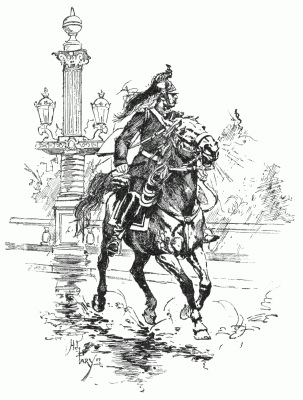
In the streets of the capital, the French soldier trots his horse instead of cantering him, and his military bearing disappears as soon as he gets in motion. There is no pretence of the fine old centaur theory, that horse and rider are one; there is no attempt to preserve the straight leg and stiff carriage which distinguishes the American military seat; the dragon, or the cuirassier, stoops forward and jounces up and down in his saddle like any amateur. The President's cavalry escort comes down the Champs-Élysées bumpety-bump, with an anxious and uneasy expression, instead of a proud and martial one. The officers, of course, ride better, and look very fine cantering out to the Bois in their peg-top red trousers and high boots; but it may be noticed that the only occasion on which they abandon their swords is on these equestrian promenades. Otherwise, officers and men are never seen without their side-arms, excepting an occasional escort of a wagon-train. These weapons are not allowed to trail, and there seems to be no method known of hooking them to the belt so that the wearer can walk comfortably; they are therefore carried in the left hand, or nursed under the left arm. As they are very long and heavy, with steel scabbards,—with the exception of the straight cuirassiers' swords, far heavier, both in blade and grip, than any of the sabres of the First Empire, and as the wearers are by no means always tall men, they are sufficiently cumbrous. The shapeless, full trousers, and the leathern leggings in imitation of boots, combined with the heavy shoes and the inelastic tread of these dismounted cavaliers, give them an appearance that an English drill sergeant would scarcely consider "smart." The dragoons of the picked Garde Républicaine wear a blue uniform with the Napoleonic horse-tail helmet, and high boots, and have a much more efficient appearance; but there is not to be seen in Paris as truly imposing and martial a figure as a mounted sentry of the Horse Guards on duty. The undersized, callow, and youthful infantry soldiers seen in the streets are such evident rustics, in spite of their uniform, that the contemner of war drops an additional tear as he passes them. It may be observed that this uniform, with its red and blue, white gloves and white gaiters, is peculiarly adapted to being picked out by the enemy's sharpshooter at the longest possible range in a green landscape. The gloves and gaiters, however, promptly disappear in active service.
AN ESTAFETTE.
The most coveted position in the French army is that of military Governor of Paris, and the administration of this post, it seems, is attended with all the inconveniences which arise from a peace organization differing seriously from that which would be necessary in time of war. These difficulties, it is contended by the military writers, would largely disappear if more definite authority were given this officer, if the grade of général d'armée were created, as in other countries, and the holder made practically irremovable. To this the civilians reply—and not without a certain show of reason, as the events of the last few months have demonstrated—that it is probably safer for the constituted authorities not to do so. The duties and responsibilities of the Governor of Paris are very definite, engrossing, and important; very different from those which would be adjudged to the incumbent if he were officially appointed to a post similar to that which the King of Prussia fills, or that held by Lord Wolseley in England, replacing the Duke of Cambridge. As Governor of Paris, this officer has a general staff which is not similar in composition to that which he would have in active campaign in time of war; the officers who constitute it are occupied with duties which bear but little analogy with those they would be called upon to fulfil at the outbreak of hostilities.
That union which makes strength, it is asserted, is unfortunately lacking in the organization of the army. In its stead prevails an evil which is called particularisme. The origin of this evil is in the office of the Minister of War, where there is a direction of the infantry, one of the cavalry, and one of the intendance, or administration. These directions do not converge; each one goes off with its own theory and practice; consequently, there is wanting that military unity, that community of sentiment, which the Russian General Dragomirov calls "the comradeship of combat." This unity must necessarily come from above, that is to say, from the officers; hence, it has been proposed to educate them all in the same school, in hopes that this community of origin may give rise to intimacies, to friendly relations, and cause all jealousies and suspicions to disappear. Fruitful emulation will replace noxious rivalries; all the inconveniences which arise from the functioning of the present nurseries of officers will be done away with. Perhaps it will do to divide the army into two classes only; to instruct all the field combatants in Saint-Cyr, and the officers for the fortresses at the École Polytechnique.
These military critics are very positive in their statements. The Revue hebdomadaire, M. Veuglaire in the Revue encyclopédique, Captain Gilbert (G. G.) in the Nouvelle Revue, support each other in these statements. The former, in an article on the instruction of the officers, says that this instruction is very badly conducted; the special editor of the Nouvelle Revue, after having demonstrated that the competitions, the methods, the programmes, considered individually, are characterized by grave defects, proceeds to show that, taken together, there is a complete absence of co-ordination. "No general view," he exclaims, "no common impulse, presides over the functioning of our establishments of military education. Saint-Cyr, the École Polytechnique, the École d'application, the École de guerre, are so many entities absolutely independent; have distinct inspections, comités de surveillance having no relations with each other; admitting only one common attachment,—the Minister of War. Now, our ministers have a too precarious and too brief existence to exercise any regulating influence upon the schools." The administration varies according to the personal qualities of the successive directors; sometimes it is the physical exercises which are cultivated at the expense of the intellectual, and sometimes the reverse. The general commanding at Saint-Cyr two or three years ago, a former colonel of Zouaves, was, above all, a man of action, and that which he exercised upon the school "was bad;" he was succeeded by one of the most brilliant professors of tactics at the École de guerre, who gave to the oral instruction an importance which it had never had before, the evolutions, the perfectioning of the manual of arms, the manœuvring in the field, the blacking of the shoes, and the proper alignment of the beds in the caserne.
"At the École de Versailles, where are formed the future officers of artillery and of engineers, there is to be found the same incoherence. The changes brought about each year in the 'coefficients de majoration' demonstrate with how little spirit of consecutiveness these affairs are managed. Having attributed more importance to the general information than to the qualities of manœuvring, you are quite stupefied to see admitted novices, bachelors who have failed, more or less, and very mediocre subaltern officers, whilst excellent maréchaux des logis, intelligent, vigorous, industrious, are refused, because the blackboard intimidates them, because they design in but a mediocre fashion, and have, concerning the rivers of Asia, only vague ideas and perhaps erroneous ones," etc. Captain Gilbert has proposed, in order to do away with the inconveniences attending this anarchic régime, to institute, as in Germany, an inspector-general of all the schools, a sort of high master of the military University. "In any case, it is necessary to adopt some method that will put an end to a situation that is truly dangerous."
The greatest danger of all, of course, lies "in the fault of the French mothers, who do not give to the army soldiers enough," says another writer, M. Armand Latour, "and, alas! it is to be foreseen that they will be, in this respect, less and less generous in the future."
Of these military schools, the oldest is the École superieure de guerre at the École militaire, founded by Louis XV in 1751, under the name of the École royale militaire. It was the king's intention to devote this institution to the education of five hundred young gentlemen, born without property, and, in preference, those who, having lost their fathers in battle, had become the children of the State. In addition to the five hundred young gentlemen, the hôtel was to be grand and spacious enough to receive the officers of the troops to whom the command was to be confided, the learned professors of every species who were to be proposed for the instruction and exercise of all those who would take any part in the spiritual and temporal administration of this household. The architect Gabriel commenced the construction of the buildings in the following year on what was then a portion of the plain of Grenelle, and in the meanwhile the school was opened provisorily in the Château de Vincennes. The architect was soon arrested by want of funds; but the king applied to these expenses the proceeds of a tax on playing-cards, those of a lottery,—the favorite method of raising funds at this period,—and the revenues of the Abbaie de Laon, which was then vacant. The first stone of the chapel, blessed by the Archbishop of Paris, was not laid by the king, till 1769. The pupils were admitted in 1756, divided into eight classes; at the age of eighteen or twenty years, they were graduated, and passed into the royal troops, receiving a pension of two hundred livres on the funds of the school.
In the month of August, 1760, the king issued a long statement setting forth the motives which had actuated him in drawing up the code of regulations; in the following February, the Archbishop of Paris published an equally long manifesto defining the functions and exercises spiritual which the pupils were to practise. All this did not prevent the king from modifying the organization of the school, in 1764; recognizing the truth that a strictly military education was not the best adapted to the wants of youth, and establishing the Collège de la Flèche for a preparatory educational institution; in 1776, Louis XVI suppressed the École, and distributed the pupils among various colleges whose graduates were gentlemen cadets for the various royal regiments. In 1778, the school was re-established, and the king granted it an endowment of fifteen millions; a decree of March 26, 1790, abolished the restriction of titles of nobility for all applicants, and threw the entrance open to all sons of officers of the land and sea forces. The Convention, by a decree of 13th of June, 1793, ordered the sale of all the property from which the revenues of the school were drawn, and converted the buildings into cavalry barracks and a depot for flour. Under the Empire, Napoleon installed his Guard in the École Militaire; in 1815, under the Restoration, the Garde Royale was lodged there; under Louis Napoleon, the Imperial Guard again,—very important demolitions and reconstructions having been found necessary between 1856 and 1865.
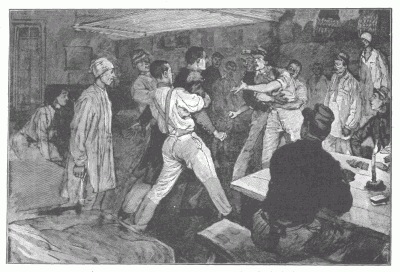
LA VIE A LA CASERNE: NIGHT IN THE "CHAMBRÉE." After a drawing by Georges Scott.
The aim of the school, as at present conducted, is to develop the highest military studies, and to form officers for the service of the general staff. Captains and lieutenants of all arms of the two branches of the service, having served a certain number of years, and being acceptable to their superiors, are admitted to compete. Three failures to pass the examination disqualify the aspirant.
The terrible Convention wished to have a military school of its own, and by a decree of the 1st of June, 1793, it founded the École de Mars, in the plain of Sablons. The idea had originated with Carnot; the institution was intended to educate soldiers for the corps of artillery, the cavalry, and the infantry. The pupils, from sixteen to seventeen years of age, were there to receive a Revolutionary education, "all the acquirements and the manners and customs of a Revolutionary soldier." Their costume, at first, consisted of a blouse of white ticking and a police cap. But this uniform was considered to be not sufficiently military, and the painter, David, was commissioned to design another. Being then in the classic and impracticable mood of his career, he furnished, for these budding warriors, a tunic à la polonaise, decorated with knots, d'hirondelle, to serve as epaulettes, and with frogs, a waistcoat à châle, a fichu à la Collin, as a cravat; tight pantaloons, disappearing in half-gaiters of black canvas. Each of these articles was of a different color from all the others, the stuffs having been procured by requisitions made among the merchants of the Halles. The footman was armed with a Roman sword with a red scabbard, suspended across his body by a black scarf, on which might be read: Liberté, Égalité, over the image of a sword placed over a row of other swords. The horsemen carried the sabre of the chasseurs à cheval. The cartridge-box was in the Corsican shape. The pupils were all awakened at daybreak by the report of a thirty-six-pound gun, which indicated the hour of morning prayer; this prayer being the hymn that Méhul had set to music, and which began with the invocation:
"Sire of the Universe; intelligence supreme."
The École de Mars was abolished by a decree of the 23d of October, 1794.
Almost behind Saint-Étienne-du-Mont are the buildings of the famous École Polytechnique, which, "to our French families, so essentially fonctionnaresques, appears like the portals of the Administrative Paradise: all the mothers dream of it for their sons." To be a graduate of this institution is to have a certain title to distinction in the intellectual and scientific world. It was founded by a decree of the Convention, under the initiative of Monge, in March, 1794, and consequently celebrated its centennial in 1894, with great ceremony. It was instituted as a school of public works, a school of mines, maritime construction, bridges and highways, the marine, the artillery, etc. It was established in the Palais Bourbon, under the direction of Lamblardie; the pupils were to be admitted between the ages of sixteen and twenty, this limitation being afterward extended to the age of twenty-five. Their number was fixed at four hundred. By a decree of September 1, 1795, the name of the institution was changed to École Polytechnique. Within the next two years, the annual allowance from the State was fixed at three hundred thousand francs, and the number of pupils at three hundred. Napoleon, who took a great interest in this institution, entitling it his "hen with the golden eggs,"—and this hen has remained the emblem of the school,—changed its organization radically in 1804, and transferred its seat to the ancient college of Navarre, founded by Jeanne de Navarre, wife of Philippe le Bel, and De Boncourt. In 1840, in 1843, and 1844 the buildings were enlarged and improved; by a decree of November, 1852, the school was reorganized and made a dependency of the Ministry of War. Its general staff was composed of a general of brigade, commandant supérieur; of a colonel or lieutenant-colonel, commandant en second; of six captains and former pupils who had the title of inspecteurs des études, and of six adjutants, sous-officiers. Thirty-nine professors imparted instruction in analysis, mechanics, descriptive geometry, physics, chemistry, land-surveying, architecture, the military art, fortifications, plans, French composition, the German language and design.
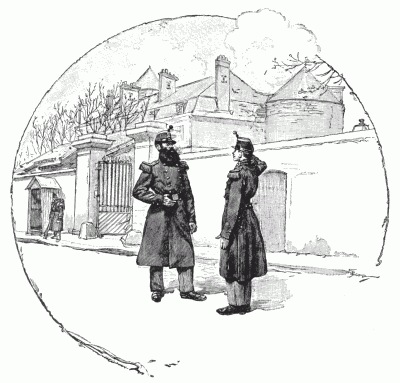
INFANTRY OF THE LINE: CORPORAL AND PRIVATE. After a drawing by Georges Scott.
The pupils were admitted through an examination; they could not be less than sixteen nor more than twenty years of age, unless they had served two years under the flag; in that case, the limit of age was fixed at twenty-five. Since the re-establishment of the Republic, these regulations have been somewhat modified. The number of pupils admitted annually is now from two hundred and twenty to two hundred and fifty; it is, perhaps, worthy of notice that the number of applicants, after having reached its maximum, seventeen hundred and twenty-nine, in 1893, has since greatly declined,—sixteen hundred and seventy in 1894, fifteen hundred and twenty-six in 1895, and twelve hundred and ninety-nine in 1896. The institution is now designed especially to furnish trained men for the artillery, marine and land; for military engineering; for maritime engineering; for the national marine; the corps of hydrographic engineers; the commissariat of the marine; the bridges and highways; mines; State manufactures, in which are included tobacco, gunpowder, and saltpetre; and the telegraph. At its foundation, in 1794, the pupils were not lodged in barracks, but billeted upon private citizens, and they received an annual allowance of twelve hundred francs; at the present day, this allowance is reduced to a thousand francs, plus seven hundred for wardrobe and a hundred for outfit. To those pupils who are unable to meet the necessary expenses, an allowance, or Bourse, is accorded, provided the parents engage themselves to repay the cost of his education in case the ex-Boursier does not remain ten years in the service of the State. The duration of studies is two years.
At their close, the choice of the graduate's profession is determined by his standing in his class. Rather curiously, the civil professions are generally preferred,—mines, bridges, and highways, telegraphs, and manufacture of tobacco. The pupils admitted into the civil professions enter special schools, École des Mines, des Ponts et Chaussées, etc., with the title of Élève Ingénieur, and a brevet of sous-lieutenant de Réserve in the artillery or the Génie [Engineers]. The pupils who select the military career are appointed sous-lieutenants, and pass two years at the École d'Application of Fontainebleau.
A royal ordinance of May 6, 1818, created an École d'État-Major [General Staff], which was established in the old Hôtel de Sens, near the Place des Invalides. The school was destined to furnish officers to the general staff of the army; its organization was modified in 1826, and again in 1833. Under the Empire, it was designated as the École d'Application d'État-Major; it is to-day part of the École Supérieure de Guerre.
In the little village of Saint-Cyr, about three miles from Versailles, is the famous military school of the same name, which had existed at Fontainebleau since 1803, and which, in 1808, was transferred by Napoleon to the ancient buildings of the institution for the education of the female nobility founded by Madame de Maintenon, and for which Racine composed Esther and Athalie. This institution was, naturally, abolished during the Revolution, and the buildings appropriated to the reception of wounded soldiers. Under the Restoration, the school was suppressed, but later reorganized, and definitely reorganized by the decree of January 18, 1882. Its object is to educate officers for the infantry, the cavalry, and the marine infantry. The number of pupils is generally from seven hundred and fifty to eight hundred, from seventeen to twenty-one years of age. The number of pupils admitted each year is determined by the Minister of War. The requirements of the examination for admission are sufficiently strict to make it somewhat difficult to secure this honor. Each pupil receives an allowance of a thousand francs, plus seven hundred francs for his outfit. Bourses and half-Bourses, outfits and half-outfits, are accorded by the Minister of War under certain conditions. Each pupil volunteers to do military service for the space of three years. The duration of studies is two years. The pupils graduate with the grade of sous-lieutenant, and select their corps and their garrison according to their standing in their class.
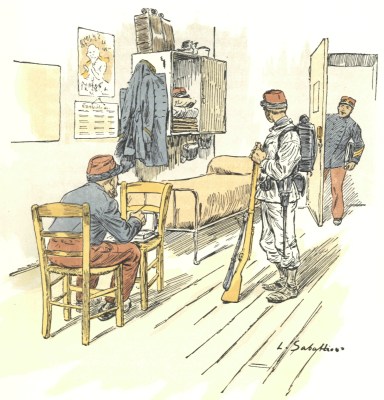
RESERVISTES DURING THE TWENTY-EIGHT DAYS. After a water-color by L. Sabattier.
The pupils of this school, with their jaunty white plumes, add much to the liveliness of certain quarters of Paris on Sundays and fête-days. Permission for these outings is greatly appreciated, and, it seems, is by no means easy to obtain. Many formalities have to be complied with before Cyrard,—as these gay young men call themselves,—in his neat uniform, can set out for the conquest of Paris. From time to time,—but not too frequently,—the Poireau, the general commanding, put in a good humor by some event which has flattered his professional pride in the school, grants a general permission to all the pupils for an outing, a sortie galette, without any regard for moyennes and punishments. This qualification of galette derives its name from the fact that this general permission specially affects the pupils fins or fines galette, whose ranking in their classes does not always attain the desired altitude. The galettes, as happens in other educational institutions, frequently make the best officers. One day, a good while ago, it is related, an unfortunate melon, wandering about in the great space of the cour Wagram of the school buildings, found himself in the midst of a group of the elder pupils. "Monsieur," said a corporal to him, haughtily, "what are you doing here? you have the appearance of a toad in a basket of strawberries!" The humble saumâtre thought it better to reserve his reply to this mortifying comparison for a later date. A respectable number of years afterward, the President of the République, reviewing the garrison of Orléans, reined up his horse before an old colonel with a white beard, and said to him point-blank: "Well, colonel, have I still the appearance of a toad in a basket of strawberries!" The humble saumâtre was now the Maréchal de Mac-Mahon.
Sometimes the President of the République, or the Minister of War, on the occasion of some solemnity, requests the Poireau to grant a sortie galette. Sometimes a personage croco—that is to say, distinguished foreigner—visits the school; then the cry is: "Calot, les hommes! calot! sortie galette!"
On these great occasions, the pupils who have secured this coveted privilege of an outing assemble in the cour d'Austerlitz or the cour Wagram to be formally inspected by the captain of the week. "Oh! this inspection!" says an ex-élève; "I know nothing more terrible, more feared, and more to be feared. How many laborious efforts, how many cherished hopes, are made naught before this inflexible judge, who, for the slightest spot, the smallest grain of dust, transforms into bitter sadness the secret exultation of a heart which felt itself full of the joy of existence! One day, when I had painfully acquired my petites moyennes, the captain halted in front of me. I was confident; I felt myself to be irreproachable. 'Give me your promission!' said he, suddenly. And, before my eyes, sarcastically, he tore into fragments this talisman of my liberty;—it appeared that the contact of my cheek with the collar of my capote had left on the latter the almost imperceptible touch of a little rice-powder! There was nothing for me to do but to go back to my chamber, resume my working costume, and increase the number of petits-cos, prisoners."
Without going into the infinite details of the administration of justice in the capital, it may suffice to indicate briefly the different attributes and functions of the four great courts of Paris. These are: Cour de Cassation, which sits in the Palais de Justice; the Cour des Comptes, at the Palais-Royal; the Cour d'Appel, at the Palais de Justice; and the Cour d'Assises, at the Palais de Justice. The duties of the first of these—at the present moment occupying so large a share of the attention of the civilized world—are briefly stated to be "to maintain the sound and uniform application of the laws." This court sits in judgment on all demands for the quashing of judgment and decrees rendered by courts of the last resort; it decides upon the demands for transferral from one court to another, in case of legitimate suspicion or for the benefit of the public security, conflicts of jurisdiction, and decisions of judges. It has the power of annulling all procedures in which the legal forms have been violated, and all judgments which are in direct contradiction with the text of the law. It can take cognizance only of questions of law, and not of those of facts and material details; after having quashed a judgment, it sends the case back to another court of the same order as that of which the decision has just been annulled. This new decision may be again attacked and set aside, but to prevent the endless repetition of this process, the tribunal or the court to which the case is referred after a second reversal must conform on the point of law with the decision of the Cour de Cassation.
It can pronounce upon the decisions of all the tribunals of the judiciary, properly so called, but cannot take cognizance of any decision of administrative justice. The decisions of the military tribunals can be brought before it only by non-military persons appealing against the incompetence of the military jurisdiction in their case. It can quash the decisions of Juges de Paix only when they exceed their power. It cannot determine upon the decisions of voluntary arbitrators, who are not considered as legal tribunals, nor upon judgments which are not definitive and conclusive, or which have acquired the authority of the famous chose jugée,—decision rendered.
The Cour de Cassation consists of a first President, three Presidents of Chambers, forty-five Conseillers divided among the three chambers (of Requêtes, Civil and Criminal), a Procureur général, six Avocats généraux, a Greffier en chef, and four Greffiers. The Chambre des Requêtes sits in judgment in all civil matters not excepted by some law, if the appeal is admissible. In this case, it sends back, by a decision the grounds of which are not given, the case to the Chambre Civile. Otherwise, it rejects the appeal by a decree the grounds of which are given. It renders judgment in electoral matters, and, within certain limits, in various special affairs.
The Chambre Civile decides definitely upon all appeals received and sent to it by the Chambre des Requêtes, it takes cognizance directly of appeals in questions of expropriation for the public utility, of appeals brought, in questions of law only, in civil matters, by the procès gallican before the Cour de Cassation; of appeals, when there are grounds, in disciplinary matters.
The Chambre Criminelle decides directly upon appeals in affairs criminal, correctionnelle, and of the police, upon demands for revision in judicial decisions and transferrals from one tribunal to another, in cases in which the legal powers have been exceeded and the decisions are annulled under proceedings instituted by order of the Minister of Justice. In certain cases, determined by the law, the three Chambres are united in a solemn audience to sit as the Conseil Supérieur de la Magistrature.
Since 1883, the Cour de Cassation has constituted the Conseil Supérieur de la Magistrature and has been in possession of all disciplinary powers with regard to those magistrates who cannot be removed from their offices, of the Cour de Cassation, of the Cours d'Appel, Tribunaux de Première Instance, and Juges de Paix. The Conseil Supérieur determines, the three Chambres being reunited, upon the requisitions of the Procureur général; representing the government. No irremovable magistrate of the courts and tribunals can be displaced excepting upon the decision of the Conseil Supérieur. This removal does not entail any change of functions nor diminution of position or income. The magistrates can be placed upon the retired list, for grave and permanent infirmities, by the decision of the Conseil Supérieur.
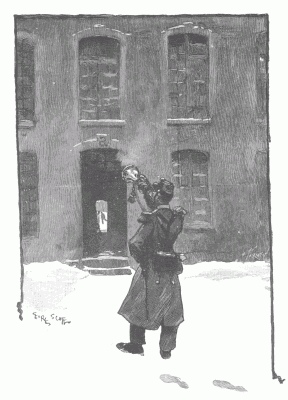
LA VIE À LA CASERNE: LE RÉVEIL. After a drawing by eorges Scott.
It may be interesting to know that the salary of the first President is thirty thousand francs; of the Presidents of Chambres, twenty-five thousand francs each; of the Conseillers, eighteen thousand francs each; of the Procureur général, thirty thousand francs; of the Avocats généraux, eighteen thousand francs each; of the Greffier en chef and the four commis-Greffiers, together, thirty thousand francs.
It is before the Chambre Criminelle of this court that the inquiry into the case of Captain Dreyfus has been conducted; and one of the many frantic appeals of the anti-revisionists, anxious to prevent another trial at any cost, has been to have the case transferred before the full Cour de Cassation,—which has been finally granted by the government.
The Palais de Justice, in which this august tribunal sits, shelters also the Cour d'Assises, the buildings of the Cour d'Appel, the prisons of the Conciergerie and of the Dépôt, the apartments devoted to the service of the Parquet, of the Juges d'Instruction, the smaller ones belonging to the library and to the Salle du Conseil des Avocats, etc., and encloses jealously the beautiful Sainte-Chapelle, the slender spire of which and the great angel rise so incongruously over these secular buildings devoted to windy and dusty Law.
Through the great gilded gates which from the Boulevard du Palais lead into the Cour du Mai the visitor enters this ancient building, now almost completely rebuilt by the restorations which have been going on since 1840. Turning to the right, he passes into the great Salle des Pas-Perdus, and from that into the long Galerie des Prisonniers, which traverses the whole length of the Palais from east to west, and which was originally constructed by Philippe le Bel. This gallery gives access to the halls of audiences of the three Chambres of the Cour de Cassation and the Galerie Saint-Louis. A curious detail of municipal administration is connected with this supreme court. Though from an architectural point of view it is undoubtedly an integral part of the Palais de Justice, it is considered from an administrative point of view as a separate construction, appertaining to the direction of civil edifices, having its separate budget for construction and maintenance and its special architect. This variety of budgets and services extends throughout the building, the different institutions and tribunals under its roofs being considered as belonging to different branches of the administration. The State alone has charge of that portion of the building occupied by the Cour de Cassation; that occupied by the Cour d'Appel comes under the authority of the Minister of the Interior, since the costs of the maintenance of this court are supplied by a group of the departments of the nation. The department of the Seine and the City of Paris have each their portion in the costs of construction and of maintenance of the building, that of the city being by no means the lightest. The Galerie des Prisonniers, for example, on the ground-floor appertains both to the City of Paris and to the State, since on one side it communicates with the Cour de Cassation; the basement, which is a dependency of the Dépôt and of the Conciergerie, belongs both to the city and to the department of the Seine, and the upper story is equally divided in its allegiance. So that, if there is a question of replacing a tile in the pavement, of repairing a ceiling, or of repainting a wall, the architect is obliged to divide the cost, to a centime, between the State, the Minister of the Interior, the City of Paris, and the department of the Seine, each in its due and exact proportion.
The Cour de Cassation is very handsomely lodged, as is its due, the Salle des Délibérations, with its heavy ceiling of carved and gilded wood, being one of the most important and luxurious in the Palais, and the Chambre d'Audience having for its plafond the celebrated Glorification de la Loi of Paul Baudry. The literal and realistic magistrate who doffs his cap in the midst of all these pretty allegories, at the pedestal of the Law, wears the gown of the President of the Cour de Cassation.
"If, in the middle of the afternoon, you should issue from the Salle des Pas-Perdus, your ears buzzing with the incessant hubbub which fills it for three hours every day, deafened by the shrill ringing of the bell which calls the attorneys in different directions, and after having followed the long Gallery des Prisonniers, you should penetrate into the passages of the Cour de Cassation, you would be astonished at the extraordinary contrast presented by these two portions of the Palais, such near neighbors. Over there, the noise and the tumult of the crowd of lawyers, the arguing of cases and the spectators; here, the dull silence of deserted edifices.
"It would seem that Jurisprudence, a magician with somnolent powers, had steeped in lethargic slumber his faithful servitors, and the old councillors who nod their heads, during the hearing, in their majestic seats, wearing the toque of black velvet the peculiar form of which has procured for them the disrespectful appellation of 'lancers,' the occasional attendants who pass silently through the long corridors, the solitary soldier of the Garde Municipale seated on a bench in the gallery Saint-Louis, frightened almost at the solemnity of the place, all seem but sorrowful shadows guarding the sanctuary of the Supreme Court. Even the spectators complete the impression of profound ennui which disengages itself from the very walls; here are none of the ardent or tedious pleadings, the passionate or cheerful discussions, which keep alive the attention of counsellors and judges in the Cour d'Appel and the Tribunal. Facts, actions, with their complications and their peculiar interests, with their infinite variety, are here banished from the argument. The Law here takes an ample revenge; here are discussed only matters of pure legislation, profound decrees of the supreme court, or the interminable argumentations of authors who have produced sapient dissertations upon the uttermost juridical disputation.—It is the triumph of the ancient classic controversy, for discussions are still held in the supreme court pro et contrà, to conclude in baralipton, in the same manner as in the ancient Sorbonne;—Latin alone is wanting to the festival.
"Pleadings, indeed, have but little importance before the Cour de Cassation: it is the mémoire, laboriously and lengthily composed by the avocat, which is the pièce de résistance in every case, because it sets forth a complete exposé of the affair and the minute discussion of each one of the juridical problems which it brings up, with infinite divisions and subdivisions. The monotonous reading of the Conseiller-rapporteur being finished, the avocat proceeds to develop his mémoire, and the Avocat général states his conclusions; then, if the question present only mediocre juridical interest, the conseillers gather in a circle in the centre of the Salle d'Audience to discuss, adopt, or reject the judgment prepared in advance by the Rapporteur;—this is what is called faire le rondeau. And there may be seen, in the unshaded light of the hall, under the ceiling in gilded oak of the Chambre Civile, these gray or white heads agitating themselves, and Passion (passion inspired by abstract law!) reappears. The apathy, the somnolence of a few minutes ago, have disappeared, and these hoary old men find again, for the moment, an ardor which seemed to have been forever laid to sleep....
MEDALLISTS OF SAINTE-HÉLÈNE IN THE PLACE VENDOME. After the painting by Maurice Orange. The Médaille de Sainte-Hélène was, by a decree, in 1857, a special distinction awarded to all survivors of the wars of 1792 to 1815.
"Silence, a silence which is scarcely troubled by the sound of the discreet footfalls of the rare promenaders, an icy chill, are the inalienable characteristics of the locality in which sits the first court of the justice of France. Respect it, do as do those who frequent it willingly or because of the necessities of the daily task, and issue from these deserted galleries, speaking in an undertone, and with the finger upon the lips, in order not to trouble the repose of its inhabitants."
The Cour des Comptes, which sits in the Palais-Royal, ranks immediately after the Cour de Cassation, and enjoys the same prerogatives. It is the modern representative of the Chambres des Comptes of the old monarchy and of the Commission de Comptabilité Nationale which replaced these Chambres at the period of the Revolution. It was created by a law of September 16, 1807, and constitutes at once an administrative tribunal charged with the verification and examination of certain financial accounts of the administration and an institution of the body-politic intended, by its control over the financial measures of the administration and other administrative accounts which it is not called upon to examine, to advise the executive and legislative powers. It may therefore be considered as the superintendent of the public fortune and of its financial measures.
It consists of a first President, three Presidents of Chambres, eighteen Conseillers Maîtres, twenty-four Conseillers Référendaires of the first class, sixty of the second class, a Procureur général, fifteen Auditeurs of the first class, ten of the second class, a Greffier en chef, etc. The salaries of these officials are about the same as those of the Cour de Cassation. The first President has the supreme direction of all the deliberations of the court, as well as of the police and general surveillance. The court is divided into three Chambres, having each a President and six Conseillers Maîtres who alone have a voice in the deliberations and constitute, themselves, the members of the administrative tribunal sitting in judgment. The deliberations are not public. The Presidents and Conseillers cannot be removed, and are placed on the retired list, the Presidents and Maîtres at seventy-five years of age, and the Référendaires at seventy years. The court addresses an annual report to the chief of the State, in which it sets forth those matters which, in the course of its examinations, have seemed to it worthy of the attention of the government, and advocates those reforms and ameliorations in the administration of the public finances which have been suggested to it by its consideration of the various facts and enactments.
The Cour d'Appel, at the Palais de Justice, includes in its jurisdiction the departments of the Aube, Eure-et-Loir, Marne, Seine-et-Marne, Seine-et-Oise, Yonne-et-Seine. In all cases, the decrees are rendered by the magistrates deliberating, in groups of some odd number,—at least five, including the President. In all civil and commercial cases, appeal can be made from all decisions rendered by the tribunals of the arrondissements or of commerce, by referees, judicial reports upon cases in litigation in which the amount involved exceeds fifteen hundred francs of injury to the person or to personal property, or sixty francs of revenue from real estate.
This court is composed of a first President, nine Presidents of Chambres, and sixty-two Conseillers, divided among nine Chambres, of which seven decide upon civil and commercial appeals, one upon appeals Correctionnels, and the ninth is the Chambre des Mises en Accusation, before which are brought criminal cases after they have passed the stage of preliminary examination. The Parquet connected with the Cour d'Appel consists of the Procureur général, seven Avocats généraux, and eleven Substituts of the Procureur général. The Cour d'Appel sits in judgment as a court of first and last resort in all cases of misdemeanors, involving a legal penalty, committed by the magistrates of the Cour de Cassation, of the Cour d'Appel, of the Tribunal de Première Instance, by the Juges de Paix, the Préfets, the Grand Officers of the Legion of Honor, generals, archbishops, bishops, presidents of Consistoires in the Protestant and Jewish organizations.
In each department of France there is a Cour d'Assises to try those individuals who are sent before it by the Chambre des Mises en Accusation of the Cour d'Appel. In the departments generally these courts sit every three months, and more frequently if occasion requires. The Cour d'Assises of the department of the Seine holds its sittings every day, in the Palais de Justice. This court consists, first, of three Conseillers of the Cour d'Appel, the first sitting as President, the two others as Assesseurs, designated every three months, the President by the Garde des Sceaux, the Assesseurs by the first President; second, of a representative of the Ministère Public, selected among the Avocats généraux or the Substitutes of the Procureur général; third, of a Greffier; fourth, of a jury composed of twelve citizens selected by lot by the President from the list of thirty-six jures designated for the session. After the examination of the accused, the depositions of the witnesses, the Réquisitoire of the Ministère Public and the presentation of the defence, the jury retires to deliberate upon the probable guilt of the prisoner and the extenuating circumstances. When the jurors have agreed upon their verdict, the President causes the prisoner to be brought back into court, the Greffier reads to him the conclusion of the jury, and the court pronounces his acquittal, or sentences him to the penalty due the crime of which he has just been convicted, even when this penalty is only a matter of police regulation.
The decision of the jury is supposed to be final, but when a prisoner is found guilty and the court is convinced that the jury is entirely in error, it may set the judgment aside and postpone the case to another session. Against the sentence of the court, appeal may be made to the Cour de Cassation. The Cour d'Assises exercises full jurisdiction in all cases criminal, correctionnelle, or of the Simple Police, excepting in the case of some special law. It takes cognizance, moreover, of actions qualified as crimes, of actions qualified as misdemeanors which a special law places under its jurisdiction,—misdemeanors committed during its sessions, political misdemeanors and those of the press, excepting offences against the public morality and slander, or insults offered to individuals, which all come before the Tribunal Correctionnel.
SCENE IN A MAIRIE DURING THE PHYSICAL EXAMINATION OF MILITARY CONSCRIPTS. After a drawing by Pierre Vidal.
One of the oldest and most characteristic features of the French administration of justice, the juge d'instruction, has but recently disappeared. The very extensive powers of this magistrate, but vaguely defined by law and custom, lent themselves readily to the abuses which undoubtedly constituted a grave defect in the criminal jurisprudence of the nation. To him were confided all the details of the preliminary investigation of a crime and the detection of the criminal, the seeking for clues, the right of search, of arrest of any suspected characters, of summoning witnesses and experts, of interrogating the accused, and—but too generally—of wresting a confession from him by any means that might present themselves. One of the methods employed was the ostentatious consultation before him of a blank memorandum which, the accused was given to understand, contained the complete avowal of a confederate. In the famous affaire Wilson of a few years ago, concerning the alleged sale of decorations of the Legion of Honor, M. Vigneau, the official charged with this investigation, telephoned to one of these purchasers of red ribbons in the assumed character of M. Wilson. These irregular practices, however, it is asserted, were mostly practised by younger and more inexperienced Juges d'Instruction, and were greatly disapproved by the graver and older magistrates. The accused—who not infrequently would declare subsequently that the statements which he was reported to have made by the curieux, in thieves' slang, were but a distorted version of his words—was considered to have an additional security in the presence of the magistrate's greffier, or clerk, who took down his testimony, and in the fact that he himself need not sign this statement if he considered it inexact.
It was recognized that the qualities, physical, moral, and mental, possessed by a truly able and upright Juge d'Instruction were necessarily exceptional. He should have a very extensive judicial knowledge and experience, he should be gifted with powers of precision, of observation, of decision, of activity, of patience, and of evenness of temper. He should be affected by nothing, surprised by nothing. His bodily health should be sound, his brain cool, and his digestion excellent. He was liable to be summoned from his bed at any hour of the night to investigate a new crime; and when he entered his cabinet tranquilly at one o'clock in the afternoon, it was possible that a minute afterward he would be leaving it hastily on the trail of a fresh offence against justice. In Paris, these magistrates, twenty-eight in number,—with the exception of two who sat in the Petit Parquet,—occupied the three upper stories of the Palais; in the antechamber of each, under the eye of an attendant, or garçon de bureau, might be found waiting, more or less impatiently, a number of witnesses and persons interested, from all classes of society. In the inner room, before the magistrate seated at his desk, and flanked by his greffier, the prisoner or the suspected criminal, guarded by two soldiers of the Garde Municipale, would be undergoing his examination,—badgered, bullied, cross-examined, threatened, matching his dull and unaccustomed wits against the keener, trained, and experienced ones of the judge, outmatched at every point, and but too frequently failing to demonstrate his innocence which it should have been as much the care of his examiner as his own to demonstrate.
SENTRY OF THE GARDE RÉPUBLICAINE BEFORE THE OPERA-HOUSE. After a water-color by Pierre Vidal.
Lowest in the scale of the courts of justice of the capital, but by far the most industrious, is the Tribunal de Simple Police. Before it appear the minor offenders against the law, those whose penalties, when convicted, attain a maximum of fifteen francs, or at the very worst, five days of prison. Usually, however, they range from about a fine of three francs if the culprit appear before the court, to five francs if he be condemned by default. The difference is not sufficiently great, usually, to compensate him for the expenditure of time and trouble in appearing, and he permits Justice to take her course without protest. These offenders are usually hotel-keepers, shopkeepers, cab-drivers, concierges, small proprietors, etc.; their crimes consist in neglecting the proper sweeping of their sidewalks, in shaking a carpet out of a window, in watering a window-plant too copiously, in putting up the shop-shutters too late, in permitting the family dog to go about without collar and muzzle,—crimes usually committed in honest ignorance of the police regulations thus violated. As there exists but one Tribunal de Police for the twenty arrondissements of Paris, we are not surprised to learn that this court is the busiest one in France. The number of offenders who appear before it annually averages from forty-three to forty-five thousand.
But, as it does not sit on Sundays, Mondays, fête-days, and but three days a week during the vacation, the total number of hearings amounts to two hundred and forty annually. This makes nearly two hundred cases for each sitting, and as the sittings last from an hour and a half to three hours, the court has about one minute to devote to each case. To enable it to dispose of them with this rapidity, it classifies the offenders, and tries all those accused of the same offence at once. The Ministère Public announces: "Are accused of violation of the ordinance of police regulating public cabs: Pierre, Paul, Jacques," etc. From time to time, a voice from the audience answers to one of these names: "Present!" This roll-call finished, the Juge de Paix, who has marked on his list the names of the absentees, reads these names again and condemns them all by default to the maximum penalty. Then there is a second roll-call of those who are present. The Ministère Public calls on all those who have anything to say to come forward; two or three of the offenders advance, stammer out some excuses which are scarcely listened to, and this second list is condemned in a lump to the regulation minimum penalty. By this simple process, the forty-five thousand cases are tried in the course of the year.
The Tribunal de Simple Police is provided with apartments on the ground-floor, almost in the basement, of the Palais de Justice, under the stone arches that date from Saint-Louis, and where the atmosphere is always damp, chilly, and sombre. The Juges de Paix, in addition to their civil functions, are charged with sitting in judgment upon these petty misdemeanors, and they take their places in the Tribunal alternately, a week at a time. In addition to the Juges de Paix, the court is composed of three Commissaires de Police, delegated by the Procureur général, who fulfil the functions of the Ministère Public, one as Chef de Service, the two others as Substituts, and of a Greffier en chef and of four commis-Greffiers.
A grade higher in the judiciary scale is the Tribunal Correctionnel, which sits in the wing of the Palais on the south side of the court of the Sainte-Chapelle, and which occupies itself with what may be called the bourgeois of crime and poverty. The sittings of this court draw so many spectators that the visitor is frequently stopped at the entrance by the Garde Municipal, who says: "C'est complet!" like an omnibus conductor when his vehicle is full. Four Chambers are devoted to the sittings of this court, two on the first floor, and two on the second; on each of these stories is a Salle des Pas-Perdu. All these halls of justice are thronged by such a compact and democratic crowd that one of the attributes of the magistrates is a little flask of vinegar or smelling-salts placed on the bench, by the side of the Code, before each of the three judges of the Tribunal and before the Substitut. The avocats do not enjoy this privilege, nor the Greffiers unless they have been very long in the service of the court. Here, also, the pressure of affairs is so great that the judges leave the bench, saying to their consciences: "Well! those who are innocent can appeal!" The terror and ennui of the law are, however, so great that but very few of those condemned do thus appeal. One of the characteristics of this tribunal of the Police Correctionnelle is the number of avocats raccrocheurs who infest it in the search for clients of any degree, and who seem to bear a close resemblance to that unsavory class known in New York as "Tombs lawyers," or "shysters."
In the rear of the Palais, looking out on the Place Dauphine, is the Chambre des Appels de Police Correctionelle. The Salle d'Audience is a vast, chilly, and cheerless hall in which the appellant follows anxiously the retrial of his case in the formal and dispassionate résumé of the magistrates. The president begins by interrogating him courteously on his age, profession, etc.; then he says, with equal civility, turning toward one of his colleagues: "We will now hear Monsieur le Conseiller-rapporteur." One of the group of seven counsellors thereupon proceeds to read a strictly legal and impartial summing-up of the whole case, quite devoid of literary ornament or of personal observation; when he has finished, the president, turning again to the appellant, directs him to arise and interrogates him summarily on the principal points of his affair. During this examination, the counsellors, for the first time, turn their attention upon the appellant, but very briefly, and then, like magistrates whose judgment is quickly enlightened, resume the various occupations in which they have been engaged. Then the president calls upon the counsel for the defence; to him replies M. l'Avocat général. After these two orations, pro and con, the president announces that "the court will now deliberate;" all the counsellors rise, and, after some moments of consultation in a circle behind the arm-chair of the president, retire in procession into the Chambre du Conseil. This journey indicates that there is a question of law to be considered. Otherwise, the decision would have been rendered immediately, upon the spot.
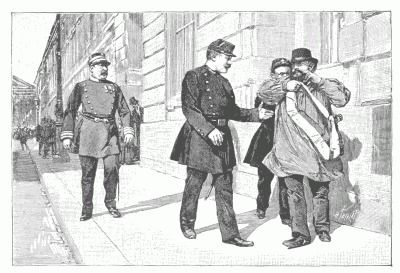
SCENE IN RUE ROYALE DURING THE LABOR MANIFESTATIONS OF MAY FIRST. ARREST OF A SOCIALIST CANDIDATE. After a photograph.
The poor prévenu draws favorable auguries from this solemn deliberation. But his hopes are generally dashed; the court, usually, retires into the Chambre du Conseil only to correct the law, while affirming the decree, of the lower court. The president re-enters, the dossier of the case under his arm, and followed by his six counsellors; he proceeds to read the decision of the court, setting forth that, while the reasonings of the lower court are entirely erroneous, its conclusions are, nevertheless, irrefutable. Sometimes, however, this court, called the "Chamber of Bishops" by Henri Rochefort, demonstrates its judicial independence by overturning the decisions brought before it, even though they may be sustained by the popular verdict,—as it did in the case of M. Wilson.
The jury system of France resembles, in a general way, in its alleged safeguarding of the public liberties, and in its injustices, inequalities, and obstinate bringing to the service of Themis the uncertain aid of Chance and of Prejudice, that of the United States. Each year, in each canton of France, these generally unwilling aids in the administration of justice are selected among the respectable citizens by a council composed of Maires, Juges de Paix, and Conseillers généraux. Their names, forwarded to the central judicial authority, are subjected to a second revision, by a commission sitting in the chief town or the capital. In this manner is obtained the "general list of the jury;" from this is drawn by lot, every three months, and in Paris every fortnight, the jury of each criminal session, composed of thirty-six titular jurors and four supplementary. All citizens, having the required qualifications, between the ages of thirty and seventy, are obliged to serve, under a penalty of five hundred francs. The juror receives a very small sum for travelling expenses if the court is at a distance from his residence, but nothing at all if it be in his neighborhood. Consequently, these arbitrary summonses in the name of Justice are viewed, generally, with as much disfavor by the recipients thereof as in other countries, with the exception of the members of some such leisure class as retired officers on half-pay. The tendencies of certain classes of jurors are well recognized, the law and the evidence being as they may;—thus, before a jury of peasants and farmers, the young girls guilty of infanticide are nearly always acquitted, the rural economy entertaining a natural aversion to illegitimate children, reared at the public cost to become vagabonds at the age of fifteen. On the contrary, incendiaries, counterfeiters, and those accused of assaults upon young children in the fields, receive no mercy at the hands of these honest countrymen. The severity of the juries of Versailles is well known. Composed of market-gardeners, ex-officers, and retired shopkeepers and employés, living in small cottages in the suburbs, and exposed night and day to the incursions of the Parisian marauders, they give always to the prosecution the verdict which it demands, and sometimes even more. There was a case, a few years ago, of three young rascals who set out from Paris to assassinate an old innkeeper of Argenteuil; the Ministère Public claimed one of them for the guillotine, but the Versailles jury gave him all three.
As to the Parisian jury, its composition is naturally more complex, but its results are said to be equally unreliable. Its deliberations are not affected by any spirit of caste or class, since these distinctions are not sharply enough defined; "but it is at the mercy of a fine talker. This will not be the avocat, rarely listened to, nor even the Avocat général, offensive in the eyes of the Parisian frondeur as the representative of authority. No; it is among its own members that the jury will select this veritable chief, some reasoner with abundant and facile speech, discovering in everything concealed meanings, hidden allusions, and all the more dangerous for the good sense of his colleagues that he has an elegant talent for paradoxes."
The Parisian jury is also, it appears, peculiarly under the influence of the fashions and customs of the day, no matter what they may be. For several years it was almost impossible to secure a verdict of conviction in the so-called "passionate dramas;" the heroines of vitriol and the revolver passed with impunity before these complaisant juries. The Parquet was obliged to withdraw most of these cases from trial by jury and send them to one of the Chambres of the Tribunal Correctionnel, which did not fail to do them justice. The notoriety, the celebrity, of a case have also a great effect upon these citizen jurors. If a crime has been committed on some fête-day, or in the midst of a ministerial crisis, the twelve jurors take into favorable consideration all the extenuating circumstances and render a verdict of acquittal. If, on the contrary, the crime has attracted much popular attention, been exploited in the daily papers, with portraits of the accused, of his victim, etc., then is the condemnation to death inevitable. "The Parisian jury is nothing but a great child whom it is necessary to keep in leading-strings and to watch very closely."
One of the most picturesque and characteristic features in the train of justice, one in which the French themselves have always taken a lively, though a professedly disparaging, interest,—as befits a military nation,—is the black-robed multitude of avocats, the attorneys, the lawyers. The nature of their profession, their professional costumes, certain peculiarities of whisker and absence of moustache, all those qualities which, in all countries, offer cheap handles to easy wit at the expense of the members of this judicial order, all these unite to lend them an interest, of various kinds, as a class somewhat apart. Their intelligent, shrewd, generally unimaginative heads, under their cylindrical black caps, offer endless studies to the physiognomists and the caricaturists. Their services are indispensable for all those who seek the aid of the law. At Paris, the avocats alone have the right to plead for litigants, before all the Cours d'Appel and the Tribunaux Civils. They can also plead before the military, commercial, and administrative tribunals and the Conseils de Prud'hommes. The only exceptions are the Conseil d'État and the Cour de Cassation.
The Ordre des Avocats, with its monopoly of this privilege, claims to date back to the year 518 A.D., and to have had for sponsor an uncle of the Emperor Justinian. It was restored by Charlemagne and continued under various names: Causidici, Avantparliers, Plaidoux, and Chevaliers de la loi, and was constituted the Ordre des Avocats in the time of Saint-Louis to distinguish it from the various confraternities of artisans which were then being organized. A decree of the Assemblée Constituante dated September 2, 1790, announced that "the men of the law, formerly called avocats, shall not form any order or corporation, nor shall they wear any peculiar costume in the exercise of their functions." This eclipse, however, was not of long duration. The former avocats had drawn up a list of the recognized members of their profession in good standing, this list became the official one, and the roll of the Ordre des Avocats was reconstituted by the law of the 22d Ventôse, year XII, reorganizing the law schools, the Écoles de Droit.
By the word avocat is designated those lawyers who, after having obtained the title of Licencié en Droit, have taken the professional oath before a Cour d'Appel. But, in order to be able to plead, they are required, in addition, to be admitted to the bar of the tribunal or the court. The Avocats-Consultants are those who, not having been admitted to the bar, cannot plead in the courts, but give legal consultations in their offices. The Avoués, attorneys, are appointed by the court or tribunal to represent the litigants before it. They cannot be avocats, and are obliged to be residents of Paris.
PUPILS OF THE ÉCOLE SPÉCIALS MILITAIRE DE SAINT-CYR. Engraved, from a photograph, by E Tilly.
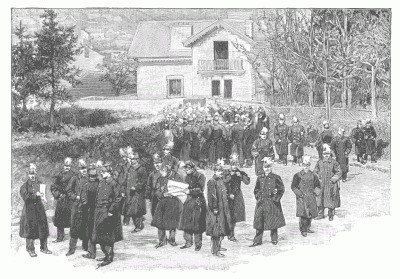
Among the multitude of attendants and habitués of the judicial tribunals are the necessary witnesses and experts, of all kinds in degree,—the témoin à charge, important witness, listened to with attention; the témoin à décharge, uncertain and ill at ease; the expert-comptable, very conscientious; the expert en écriture, in handwriting, very positive and authoritative and unreliable, after the manner of his kind; the experts in medicine, in mental ailments, in physics, etc. The various degrees of willingness and unwillingness on the part of those who receive these official assignations à témoin are much as in other climes.
After the summer vacation, the opening of the courts is preceded by an annual divine service, the messe rouge [the red mass], held in the Sainte-Chapelle and attended by all the magistrates in their robes of office, red, black, and ermine. In 1898, this ceremony took place on October 17th, and was presided over by Cardinal Richard, Archbishop of Paris. The mass was celebrated by Canon Pousset, of the cathedral of Notre-Dame. After the service, the magistrates return to their courts in hieratic procession, following each other strictly in the order of their rank, the walls of the passage-ways being hung, for the occasion, with Gobelins tapestry.
A similar ceremony has been introduced in London. For the second time, in this same month of October, 1898, the legal year was inaugurated by a religious service celebrated with great pomp at Westminster. The Lord Chancellor, the judges, the Queen's Counsel, and a great number of representatives of the bar were present at this messe rouge English and Anglican. The Catholic judges and lawyers have long been in the habit of attending a similar service on this occasion in one of their own churches.
OBVERSE. CENTENARY MEDAL, ÉCOLE POLYTECHNIQUE.

By an excellent arrangement, the Palais de Justice is enabled to lodge its criminals in one of its dependencies, the prison of the Conciergerie, whence the guards conduct them directly, by private staircases, to the court-room where they are to be tried,—thus avoiding any unseemly exposure of these unfortunates to the populace. An ingenious supposition as to the origin of the name of this famous prison, a barracks under the old kings of France, is furnished by M. Pottet,—that it was inhabited by a certain captain who provided himself with the title of Comte des Cierges [Count of Candles], concierge, janitor, or house-porter. Those who are confined in the Conciergerie are the criminals who are to appear before the Cour d'Assises; those convicted by the police correctionnelle of the departments, waiting the result of their appeal to a higher court, and those condemned to death during the three days which the law allows them for their appearance en cassation.
REVERSE. CENTENARY MEDAL, ÉCOLE POLYTECHNIQUE.
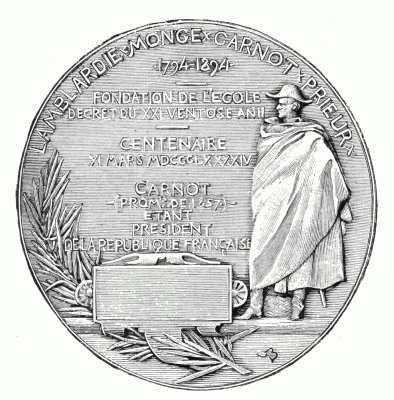
In the Dépôt are deposited temporarily all the individuals arrested in the department of the Seine, for any crime whatever, and held for justice. This general depository receives on an average a hundred and fifty prisoners a day. Any one arrested by a police agent and conducted to the poste, if not delivered by some friend before the arrival of the panier à salade, is put into this cheerful vehicle, much like a closed-up omnibus, and carted off to the Dépôt. There, he is interrogated, searched, measured by the service anthropométrique of M. Bertillon, and held for three days. At the end of this period, he is transferred to some other prison,—to Mazas, before it was demolished, or to the Santé. The desperate criminals have the privilege of remaining in the Dépôt under the eye of the agents de la sûreté.
Within the walls of the Palais de Justice is included a third place of detention, the Souricière, in which are confined the accused brought from the various prisons of the city,—la Santé, Sainte-Pélagie, la Petite and la Grande-Roquette, Saint-Lazare,—to appear either for their trial or for their examination before the Juge d'Instruction. The Souricière [mouse-trap] is a gloomy and ill-smelling basement, almost without light and air, and frequently crowded to suffocation, situated under the chambers of the police correctionnelle. The prisoners are very often confined here from eleven o'clock in the morning to eight o'clock in the evening, without being given either food or drink. This abuse is of long standing, notwithstanding the many protestations that have been raised against it.
ENTRANCE FAÇADE OF THE ÉCOLE POLYTECHNIQUE. Engraved, from a photograph, by E. Tilly.
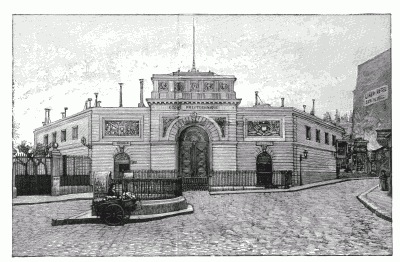
Before 1826, the entrance to the Conciergerie was from the grand court-yard, the Cour du Mai, to the right and at the foot of the grand stairway. This entrance, with its iron railings, still exists, it now gives access to the Tribunal de Simple Police, and through it the multitude of victims, illustrious and obscure, of the Revolution and the Terror, issued to take their places in the cart for the guillotine. This doorway was walled up in 1826, and the entrance to the prison is now on the Quai de l'Horloge, near the tower of Cæsar. It was at this latter date that the Conciergerie was transformed into a modern prison, with the régime cellulaire. In the course of this transformation, the ancient dungeons in which had been confined so many eminent historical personages disappeared; to-day there can be seen only the cell of Marie-Antoinette, which now communicates with that of Robespierre, and the latter with the Salle des Girondins. The apartment of the unhappy queen was transformed into a chapel in 1816. Of the original furniture of her cell, there now remains, it is said, the little lamp hanging from the ceiling, and the ivory crucifix which she kissed before mounting the scaffold. As to the arm-chair in which she sat, it was prudently removed some years ago to his office by one of the directors of the Conciergerie, to protect it from the ravages of the tourists of all nations who were gradually carrying it away piecemeal. This apartment of the prison can be visited on Thursdays by securing a permit from the Préfecture de Police. The grande salle which was the prison of the priests and royalists during the Terror, and in which the Girondins passed their last night, is now the chapel of the Conciergerie. Through the little door at the left the latter passed on their way to the scaffold, and in this court-yard took place the massacres of September.
Before its demolition in the summer of 1898, the immense Mazas prison (Maison d'Arrêt et de Correction Cellulaire), on the Boulevard Diderot, received the prisoners from the Dépôt. This gloomy institution contained twelve hundred cells, of which eleven hundred and fifteen were occupied, the others being used for the service of the hospital and of the baths. Among the more illustrious prisoners who have been within these walls was Victor Hugo, confined here on the morrow of the Coup d'État, and who has left this description of his cell: "Walls whitened with lime and soiled here and there by various emanations; in a corner, a round hole, furnished with iron bars and emitting an infectious odor; in another corner, a shelf hinged to the wall like the strapontin, or folding-stool, of the city folks, and which might serve for a table; no bed, a chair stuffed with straw. Under the feet, a brick floor; the first impression was of darkness, the second, of cold." In addition to the hammock and the bedding, the furniture consisted of a table with a drawer, an earthenware vessel, a porringer, a cup in wrought-iron, tinned over, a wooden spoon, a spittoon, called génieux, two brooms, three shelves in whitewood, a wardrobe set in the wall. The round hole, to which M. Hugo objected, was used by the prisoners as a means of speech with each other; by conquering their scruples—if they had any—and inserting their heads in this hole, they were able to make their words carry from one cell to another and even the entire length of the gallery, as through a speaking-tube. The authorities were not unaware of this arrangement, and by placing an agent in the basement they could have surprised these confidential communications.
The new arrival from the Dépôt, after being subjected to the usual formalities, after having lost his civil personality and changed his name for an official number, was at first disposed to rejoice in the solitude of his cell after the hideous promiscuousness of the Dépôt, but this solitary confinement would soon have become unendurable, had it not been for the daily labor with which they were all occupied. Their exercise was taken in the préaux cellulaires, oblong or converging cells under low sheds, through the iron grating of one side of which they could look out into the narrow space of the court-yard. All the prisons of the department of the Seine are furnished by a contractor, who supplies the provisions for the prisoners at a fixed price plus a percentage of their small earnings.
SEARCHING A PRISONER AT SAINT-LAZARE, THE GREAT PRISON FOR WOMEN. After a drawing by G. Amato.
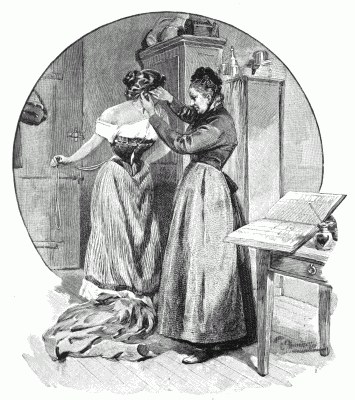
This prison was built between 1845 and 1850 by the architects Gilbert and Lecointe, on the general plans of the English prisons of the same nature, and was considered at the time a model institution. It succeeded the Prison de la Force, in the Rue Pavée-au-Marais, immortalized in a chapter of Les Misérables; the new prison was known officially as the Nouvelle-Force. Popular usage, however, gave it the name which it retained, from the Place Mazas, at the end of the Pont d'Austerlitz,—the name of the colonel of the Fourteenth Regiment of the line, killed at Austerlitz. His family protested strongly against this usage, and in 1858 the administration of prisons abandoned the popular term and recognized the institution only under the formula: Maison d'arrêt cellulaire. All in vain, even though, in 1879, the Boulevard Mazas became the Boulevard Diderot.
This prison was the first in France in which was adopted solitary confinement. In a single night, that of the 19-20th of May, 1850, the eight hundred and forty-one inmates of the Force were transferred to Mazas,—a much more expeditious operation than that of the transportation of the prisoners of Mazas to the Santé, in May, 1898, which took ten days, at the rate of eighty men a day. It appears that the prisoners from the Force objected strongly to this system of solitary confinement in their cells; they gave way to such excesses of fury and despair that the Académie de Médecine was moved in their behalf, and protested against the système cellulaire as conducive to suicide and insanity. The new prison—as any one might see from the top of the viaduct of the Vincennes railway—was built in the form of a great wheel, the spokes represented by six long galleries, eighty mètres in length and twelve and a half in height. The hub of this wheel was a two-story rotunda, the ground-floor of which was occupied by the central post of observation, and the upper story by the chapel, which could be seen from any point in any of the six galleries. At the hour of the celebration of the mass, on Sundays, the guards set the door of each cell partly open, so that the prisoner might receive spiritual comfort if he so pleased,—and if his distance were not too great. Each of the six galleries was two stories in height, lit by a glass roof. All the cells received light and air through a grated window, opening on one of the outside galleries or on one of the interior courts, but placed too high to afford the inmate any view outside. Each prisoner was entitled to an hour's exercise in one of the twenty préaux into which the interior courts were divided. This promenade was always a solitary one, under the eye of the guardians in the rotunda, and to be deprived of it was the lightest punishment inflicted. The most severe, in extreme cases, was imprisonment in the cachot, or dungeon.
Saint-Lazare (Maison d'Arrêt et de Correction), on the Faubourg Saint-Denis, is at once a hospital, a police station, and a prison for women, and its methods and regulation have long been the object of earnest denunciation. As a prison for women, it is divided into two sections, for those accused, and for those condemned to less than two months' imprisonment; among the latter are women of the town, who have a special hospital. The only condamnées who remain for any length of time within these walls are the sick, nursing women having a child less than four years of age, and those enceinte. There is a special crèche for the newly-born babies,—for there are no less than fifty or sixty births annually. The nursing mothers, whether convicted or only accused, have special dormitories, and there is a shady garden for the wet-nurses. The prostitutes are provided with a special section. These unfortunates have not passed before any court; they have been condemned without appeal by a Chef de Bureau of the Préfecture de Police to an imprisonment of from three days to two months. During the day, the inmates are assembled in a workroom under the surveillance of one of the Sisters of the Order of Marie-Joseph, to whom is confided a general oversight of the workrooms and the dormitories. These prisoners take their meals in common, take their exercise walking in a long file, and at night sleep in a great chilly and crowded dormitory. Those who have merited it by their conduct are given one of the cells of the ménagerie, a double story of grated cells, furnished each with a bed, a stool, a shelf, and an earthenware vessel. The menagerie was formerly devoted to the service of the correction maternelle.