Introductory material (continued 2)
Reading edition
The starvation in Paris had become so general, that the people, in their ignorance, murmured: "Ah! if the king only knew of our miseries; he is good, but he is deceived by the courtiers; if he were only here, and not at Versailles!" The news of this banquet, and of another given the following day in the salle du manége, set fire to the powder, an army of women assembled, crying: "Bread! bread!" and, accompanied by a great multitude, set out for Versailles, notwithstanding all the efforts of Bailly and Lafayette. Some of the gardes du corps were killed, and their heads paraded through the streets on pikes; the royal family were brought back to Paris, virtually prisoners, and the Assemblée committed "the unpardonable fault" of following them, and thus placing itself also within the reach of the mob that had finally learned all its power. The great nobles had already begun to "emigrate," leaving the king defenceless in the hands of his enemies, and rendering his situation still more desperate by their intrigues with foreign powers, which brought about the first of the coalitions against France.
On the 5th of November, it was decreed, and promptly approved by the king, that the sittings of the Parlement of Paris should be suspended until further orders, their powers to be exercised by the Chambres des Vacations; on the 24th of March, 1790, this ancient body was formally abolished, on the grounds that the nation had not concurred in its election. The consideration of the innumerable reforms, civil and political, voted by the Assemblée in its complete reconstruction of the government belongs rather to the history of the nation than to that of the city,—the absolute monarchy was deprived of the power of making laws, establishing imposts, deciding on peace or war, and reduced to the condition of the first of the administrative branches of the government, with a civil list of twenty-five millions. Complete liberty of action was given to the press, to industry and commerce. The rights of primogeniture, of rendering estates inalienable, were abolished, and of confiscation, on the principle that the expiation should be strictly personal, like the fault. Protestants and Jews were admitted to all civic and civil rights, and the former recovered their property which had been incorporated in the domains of the State. All titles were abolished, the nobles were reduced to the condition of citizens, and the priests to those of public functionaries; the application of the death-penalty was greatly restricted; all Frenchmen, without regard to their birth or religion, were eligible to all public offices and all military grades; the ancient provincial departments of the nation were replaced by departments. "The territory of France is free throughout its length and breadth, like the persons who inhabit it."
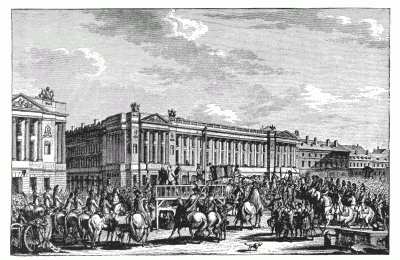
EXECUTION OF LOUIS XVI, JANUARY 21, 1793, PLACE DE LA CONCORDE. MINISTRY OF THE MARINE IN BACKGROUND. After a contemporary engraving by Swebach.
To save the new State from bankruptcy, Necker proposed, and Mirabeau caused it to be voted by acclamation, that each citizen should sacrifice a quarter of his income. The domains of the Church were placed at the disposition of the nation, and the minister of finance was authorized to sell them to the amount of four hundred millions of livres, the State to take measures to provide suitably for the maintenance of religion and the support of its ministers, and the care of the poor. The crown-lands and the property of the émigrés, which were confiscated July 26, 1792, were also declared national property, biens nationaux, and these biens were said to be the dot of the new constitution. The collection of the revenue was simplified and made less vexatious, each citizen to contribute his just proportion.
The supreme moment of the Revolution was, perhaps, the Fête of the Fédération, celebrated on the first anniversary of the fall of the Bastille, on the Champ-de-Mars, by the Parisians and the delegates sent by the army and the departments. The citizens, fearing that the great amphitheatre destined for this celebration would not be prepared in time, armed themselves with spades and picks, and thronged to the location to aid the workmen in this patriotic labor. The king presided; the queen, seated in a gallery of the École Militaire, took the dauphin in her arms and presented him to the people at the moment when his father was taking the oath to employ all the power delegated to him by the constitutional law of the State to maintain the constitution decreed by the Assemblée and accepted by him. The Te Deum was chanted before the immense "altar of the country" erected in the midst of the Champ-de-Mars, and the sun, suddenly breaking through the rain-clouds, illuminated the scene as if the heavens approved. In the evening, and for three days following, the populace danced on the Place de la Bastille.
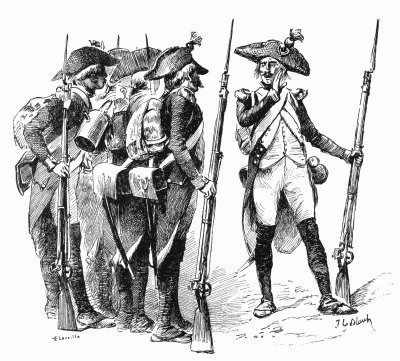
SOLDIERS OF THE DIRECTOIRE. From a drawing by J. Le Blant.
It was in this year, 1790, that the municipalité or commune of Paris was organized by the law of the 7th of May, which decreed that it should be administered by a maire, or mayor, sixteen administrateurs, thirty-two members of the council, ninety-six notables, a procureur of the commune, and two substitutes. The city was divided into forty-eight sections, which were to be as nearly equal as possible, relative to the number of citizens. The ninety-six notables, the maire, and the forty-eight members of the corps municipal constituted the conseil général of the commune. The municipality had a treasurer, a secrétaire greffier with two assistants, a keeper of the archives, and a librarian.
A very important part in the administration of the State, which became more and more an irregular administration in which the powers of the authorized government were tempered or set aside by popular clamor and bloodshed, was taken by the various clubs. That which was composed of the moderates, who wished to maintain the Constitution of 1791, having for leaders Lafayette and Bailly, took its name from the convent of the Feuillants in which it was lodged, and had separated from the formidable club of the Jacobins. The building of the latter was destroyed by the mob on the 28th of March, 1791, but the sittings were not finally suspended until November 11, 1794. The Feuillants ceased to exist after the 10th of August, 1792. The Jacobins, also named from the convent in which it held its sittings, had been the club Breton, and had left Versailles at the same period as the government. At first under the influence of moderate men, it gradually came under the sway of Robespierre. Danton presided over that of the Cordeliers, established in the ancient refectory and school of the former convent of that order; there was another turbulent association known as the Amis de la Vérité [friends of the truth]; a ladies' club which published a journal; and even two royalists' clubs, one closed by the police in May, 1790, and the other by a decree of the municipalité in January, 1791.
The Constituante Assemblée held its last sitting on the 30th of September, 1791, having finished its labors on the constitution, and seen it accepted by the king,—apparently restored to a position of security after the unsuccessful attempt of the royal family to escape on the night of the 20th of June. The maire of the city, Bailly, addressed his resignation to the officers of the municipality, and Lafayette resigned the command of the Parisian national guard, "the Revolution being terminated, and the reign of law established," according to a decree of the municipalité of the 1st of October. The Assemblée Legislative, which was to carry on this peaceable government, and to which no members of the Constituante were eligible, held its first sitting on this date. But the new constitution satisfied no one, republicans or monarchists, and the former were divided into numerous factions with very different views,—the Girondins, so named from the eloquent members from the Gironde, who directed the new Assemblée, and who wished to overthrow the royal authority without going to extremes; the extreme republicans, called Montagnards because they occupied the high seats on the left in the Assemblée, and the Feuillants, or constitutional royalists, who sat on the right.
On the 21st of September, 1791, the Assemblée had decreed that every criminal condemned to death should be beheaded, and to facilitate the execution of this law a Doctor Louis drew up a mémoire which he presented to this body on the 20th of the following March, in which he described an instrument of his own construction, and which, after preliminary trials on animals and dead bodies, was finally adopted. Its name was derived from a Doctor Guillotin who, on the 1st of September, 1789, demanded that the sufferings of those condemned to death should be abridged by their execution with a species of machine that had been formerly in use. "With my machine," he said, "I will strike off your head in a twinkling, and without your suffering the slightest pain." This phrase, which provoked the Assemblée to much laughter, was repeated throughout Paris, and when a German mechanic, Schmidt, had constructed on the plans of Doctor Louis an apparatus, it was immediately called the machine à Guillotin, and presently, the guillotine. It was inaugurated on the 25th of April, 1792, in the Place de Grève, upon the person of a highway robber named Jacques Pelletier. "The novelty of the execution increased greatly the number of those whom a barbarous pity brought to view these sorrowful spectacles. This machine was preferred with reason to the other methods of execution; it did not soil the hand of a man with the blood of his fellow-creature."
The new instrument was put to such frequent use in the numerous political executions that it soon acquired a great notoriety, the prisoners jested concerning it, it was called the national razor, the mill of silence, and there were some persons who wore in their ears small representations of it. "In several of the hôtels of Paris, those aristocrats who could not succeed in emigrating killed time with a little guillotine in mahogany which was brought on the table after dessert; there were passed under its axe, successively, little figures or dolls whose heads, made to resemble those of our best magistrates, allowed to escape, as they fell, a reddish liquor resembling blood, from the body, which was a flask. All the guests, especially the ladies, hastened to dip their handkerchiefs in this blood, which proved to be a very agreeable essence of ambergris."
The site of the present Place de la Concorde, in which the guillotine was afterward set up, was embellished with a bronze equestrian statue of Louis XV, by Bouchardon, sculptor in ordinary to his Majesty, inaugurated on the 17th of April, 1763, and, Bouchardon having died, the design was completed by Pigalle, who placed on the marble pedestal four bronze figures typifying Strength, Prudence, Justice, and Love of Country,—supposed to represent the typical qualities of the monarch. Consequently, the Parisians soon had the pleasure of reading on the pedestal the following unofficial couplet:
"Oh! la belle statue! oh! le beau piédestal!
Les vertus sont à pied, le vice est à cheval."
[Oh! the fine statue! Oh! the beautiful pedestal! The Virtues go afoot, and Vice rides on horseback.] This statue was overthrown on the 11th of August, 1792, and the Place Louis XV became the Place de la Revolution, a stone and plaster figure of Liberty seated, colored to imitate bronze, being set up on the pedestal. On the 26th of October, 1795, it was rebaptized Place de la Concorde; the Restoration restored its name of Louis XV, and the Revolution of 1830, its present name.
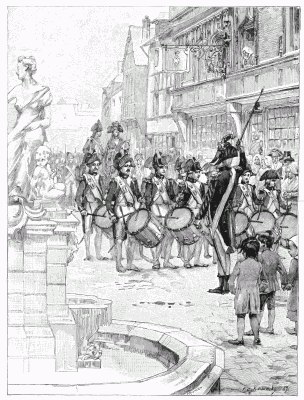
THE DRUMS OF THE REPUBLIC. From a drawing by Adrien Karbowsky.
A very great majority of the bishops having refused to take the oath to the new constitution civile du clergé, decreed by the Constituante Assemblée, which placed them under the control of the civil authorities, and being strengthened in this refusal by the authority of the Pope, the new Assemblée, by the law of May 24, 1792, directed that as a measure of public security all these priests non assermentés should be banished. The king refused to sanction this measure, and dismissed his Girondist ministers; he sent a secret agent to the foreign coalition menacing the frontiers: in the Assemblée, which allowed its sittings to be constantly interrupted and overawed by irruptions of so-called delegations of the citizens, of the sections, of the national guards, the suspicion and the open denunciation of the court constantly increased. The agitation and violence in the clubs, in the streets, in the journals, augmented from day to day; on the 20th of June an enormous mass of the populace overflowed the Assemblée chamber, broke into the Tuileries, shook their fists in the queen's face, and compelled the king to assume the red cap. A thin, pale young artillery officer, standing on the terrace by the river, watched this mob with indignation. "The wretches!" he exclaimed, "they ought to shoot down the first five hundred; the rest would take to their heels quickly enough." His name was Napoleon Bonaparte; he had been born in Corsica, in 1769, the year after that island had become French.
Not daring to do otherwise, the king was compelled to recall the Girondins to power, and to declare war against the German emperor on the 20th of April; the first actions of this war were unfavorable; the Duke of Brunswick, the commander of the Prussian army, issued a proclamation on the 20th of July declaring that he was coming, in the name of the allied monarchs, to restore the authority of Louis XVI, and the infuriated Parisian mob replied by the attack on the Tuileries on the 10th of August. The king, with all his family, escaped to the Assemblée at seven o'clock in the morning; the Swiss guards, badly led and short of munitions, were massacred after a gallant and ineffective defence. The atrocious Marat was hailed as the victor of this evil day; the Assemblée, under the inspiration of Robespierre, began to incline toward more extreme measures. The populace demanded of it that the king should be dethroned and a national Convention convened, it granted the second but not the first; the king was removed from the Assemblée to the prison of the Temple, and the Commune, headed by Danton, minister of justice, and composed of those leaders who had been elected to the principal municipal offices, became the real power in the capital. Through its instigation most of those confined in the various prisons of Paris were massacred in the first week in September. The helpless Assemblée held its last sitting on the 21st of this month, and the president, remitting its authority to the new Convention Nationale, announced in phrases which the future was to make but sinister mockery: "The aim of all your efforts shall be to give the French people liberty, laws, and peace."
The first step of the new legislators was to declare that "royalty was abolished in France," and to proclaim the Republic. The struggles to maintain the direction of affairs between the Girondins and the Montagnards increased in vehemence until the latter succeeded in acquiring the ascendency at the end of May, 1793. "Educated in the ideas of Jean-Jacques Rousseau, they dreamed of the rude virtues of the best period of Rome and of Sparta for the France of the eighteenth century, and, even though society should perish in the experiment, they were determined to apply their theories." The question of bringing the king, or "Capet," as he was now termed, to trial was debated in the Convention as early as the 7th of November, 1792; on the 2d of December, the Conseil Général of the Commune of Paris sent a petition to the Convention inviting that body to expedite this affair, and asking that the debate should be on these two questions: "1. Is Louis worthy of death? 2. Would it be advantageous for the Republic that he should perish on the scaffold?" By the terms of the constitution, the person of the king was sacred, and the extreme penalty provided for him was deposition, but the spirit of the "Terror" was already in the air; the situation on the frontiers was extremely critical; it was with some vague idea of defying or of awing the coalition that Danton had exclaimed in the Assemblée: "Let us throw them, in defiance, the head of a king!" The execution of the monarch, on the morning of the 21st of January, 1793, had, on the contrary, the effect of uniting against France all the sovereigns of Europe.
Around this execution have clustered the usual growth of legends and invention that supplement the great, trenchant facts of history with an embroidery to which history does not always condescend. The fine words which the king's confessor, the Abbé Edgeworth, are supposed to have addressed to him on the scaffold: "Son of Saint-Louis, ascend to heaven!" were invented on the day of the execution by a journalist named Charles His. The picturesque story of a secret midnight mass, celebrated every year on the anniversary of the execution, at the instigation and at the expense of the executioner Sanson, is equally devoid of foundation. It first appeared in the preface of a work published in 1830, under the title of Mémoires pour servir à l'histoire de la Revolution française, by Sanson, exécuteur des arrêts criminels. The preface was written by Balzac, the work itself by a certain Lhéritier, and Balzac reproduced the story with appropriate embellishments in his Une Messe en 1793, and later in the Episode sous la Terreur. One of the nuns who, in the first account, appeared as Mlle. de Charost here becomes the Mlle. de Langeais who figures so picturesquely and improbably in several of his romances. In the Biographie universelle, Michaud relates that Sanson, in his will, left directions to have a commemorative mass celebrated every year on the 21st of January; that he was so affected by the execution of the king that he fell ill immediately afterward, and died within six months, and that the provisions of the will were faithfully executed by his son and successor until his own death, in 1840. It appears, however, that the elder Sanson continued "to function" all through the Terror, did not die till 1806, and that any attempt to carry out the pretended provisions of his will would have been very dangerous to his son, and to any notary who might have drawn it up. Through the Terror, and even under the Directory, there are numerous records of sentences of deportation against priests who had celebrated requiem masses for the repose of the soul of Louis XVI. The famous Messe de Sanson appears to have been invented out of the whole cloth by Balzac.
In the Convention, divided into factions, and rent by mutual suspicion and terror, efficient measures were, nevertheless, taken against the allied enemies on the frontier, and those in the bosom of the nation; a committee of general security was formed to look after the latter, with a revolutionary tribunal to judge them, and a committee of public safety, "a species of dictatorship with nine heads," took energetic measures for the national defence. To the cry of "Citoyens la Patrie est en danger!" the volunteers flocked to the enrolling offices in such numbers that it was thought necessary to issue a decree commanding the bakers and the postal employés to remain to exercise their functions. Everything was lacking in the way of equipment for the armies, the officers were suspected, and two or three of the generals went over to the enemy; but the nation, inspired with a double fury, against the foreign enemy and against its own citizens, put one million two hundred thousand men in the field, and the fourteen armies of the Republic, organized by the minister of war, Carnot, inaugurated that tremendous series of victories which carried the French name to its apotheosis of military splendor.
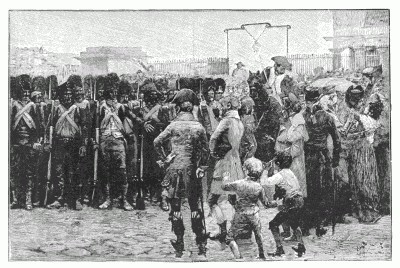
RETURN OF A REGIMENT OF GRENADIERS FROM THE CAMPAIGN IN ITALY. From the painting by J. Le Blant.
The excesses of the Reign of Terror are explained by the historians as the result of the universal fright and suspicion. "Under the reign of Hébert and Danton," said Saint-Just, "every one was wild and fierce with fear." A young girl, Charlotte Corday, came up to Paris from Caen and assassinated Marat, on the 13th of July, in the hopes of allaying the universal madness by the death of the principal wild beast; the queen was beheaded on the 16th of October; the king's sister, Madame Elisabeth, Bailly, the former maire of the city, Mme. Dubarry, the former mistress of Louis XV, and the Girondins, on the last day of October; the Hébertists on the 24th of March, 1794; and Danton, Camille Desmoulins, and other leaders of the so-called moderate party on the 5th of April. There remained only Robespierre, and a contemporary engraving, from the collection of M. Félix Perin, of Paris, reproduced on page 59, represents this dictator, "after having guillotined all the French," as executing with his own hand the executioner. He stands with his feet on the constitution of 1791; each guillotine represents a group of his victims. "A is the headsman; B, the Committee of Public Safety; C, the Committee of General Security; D, the revolutionary tribunal; E, the Jacobins; F, the Cordeliers; G, the Brissotins; H, the Girondins; I, the Philipotins (for Philippeautins, the followers of Philippeaux); K, the Chabotins; L, the Hébertists; M, nobles and priests; N, men of genius; O, old people, women, and children; P, soldiers and generals; Q, the constitutional authorities; R, the Convention Nationale; S, popular societies." The ingenious draftsman might have added still another, one for himself, for we are not surprised to learn that he paid with his head for this work of art.
Another of these contemporary engravings, also reproduced for these pages, from the collection of M. le Baron de Vinck d'Orp, of Brussels, designed by Laffitte and engraved "under the supervision of Me Poirier, avocat of Dunkerque," is dedicated to Joseph Le Bon, an unfrocked Oratorian, who had caused to be put to death more than one thousand five hundred persons; he had even established an orchestra at the foot of the guillotine. The title of the engraving, Formes acerbes, is taken from a phrase used by Barère in his defence of this sanguinary ecclesiastic: "If Le Bon had employed certain formes acerbes [harsh methods]," he said, "he had at least given proof of his devotion to the Republic." He is represented as standing upon a heap of naked and headless corpses, between the two guillotines of Arras and of Cambrai, drinking alternately from the two cups which he fills from the red streams from the scaffolds. At his side, two Furies excite the tigers to devour the bodies of his victims. But the invention of the caricaturists was no longer competent to record the actual march of events.
"An instrument of death better adapted to conciliate the requirements of humanity and the demands of the law could not be imagined," says a Paris journal of 1793. "The ceremonial of the execution might also be perfected, and delivered of all that pertains to the ancient régime. This cart in which the condemned is transported, and which was granted to Capet; these hands tied behind the back, which obliges the condemned to assume a constrained and servile position; this black gown in which the confessor is still permitted to array himself notwithstanding the decree which forbids the ecclesiastic costume, all this apparatus fails to proclaim the manners and customs of a nation enlightened, humane, and free."
Everything was reversed, reorganized and regulated by decree, from the conduct of those persons suspected of treason against the Republic because they ate only the crust of their bread, in the restaurants (18th of February, 1794), to the recognition of the Supreme Being and of the immortality of the soul (8th of May). A more practicable piece of legislation was that which divided the commune of Paris into twelve arrondissements or municipalités (21st of February, 1795), it having been recognized that the city united under the power of one maire had been too powerful a force for seditious purposes, and that, divided into forty-eight sections, it had furnished too many centres of insurrection, which, communicating secretly with each other, had been able to elude the vigilance of the supreme authorities.
It was in this year 1795, "year III of the Republic," that was abolished the democratic constitution of 1793, which had not yet been put into execution, and established the Directory, of five members, one to be retired every year and replaced by a new member, all to be named by the legislative power and responsible to it. The latter was also divided, the council of the Five Hundred (Cinq-Cents) being charged with the duty of proposing the law, and that of the Anciens with that of examining it and executing it. By this division of power it was hoped to avoid a dictatorship and to constitute a liberal republic. The two legislative councils were composed two-thirds of members of the Convention and one-third of newly-elected delegates; the new government established itself in the palace of the Luxembourg. Carnot, the most illustrious of the five Directors, gave the command of the army of Italy to Napoleon Bonaparte.
On the 4th of September, 1797, the Directory, with the aid of Augereau and some twelve thousand men, suppressed the majority of the two Conseils, who had become royalists and anti-revolutionary, and sent a large number of them into exile. To this coup d'état of the 18th Fructidor, year V, succeeded that of the 22d Floréal, year VI (May 11, 1798), which annulled the election of the deputies who were called patriotes. General Bonaparte, with his army, was in Egypt; the European powers judged the time propitious to form a new coalition against such an unstable government and exhausted people. On the 30th Prairial, year VII (18th of June, 1799), the Conseils combined against the Directors and forced three of them to resign, but Bonaparte landed at Fréjus, and to all these futile little revolutions succeeded the vital one of the 18th Brumaire (9th of November, 1799), in which his grenadiers turned the members of the Cinq-Cents out of their hall at the point of the bayonet, and the Anciens, left alone in session, conferred the executive power on three provisional Consuls, Bonaparte, Sieyès, and Roger Ducos. Two commissions, of twenty-five members each, were appointed to revise the constitution.
"It was the Revolution abdicating, transferring its power to military authority, and about to enter with it on a new phase. And, moreover, it was still one more journée, that is to say, violent measure. What lessons given to the peoples by these perpetual insurrections, of the Commune, of the Convention, of the Directory, of the Conseils, of the royalists as of the republicans, and, finally, of the army! And how could it be possible to form citizens respecting the law, careful to modify it only with wisdom, instead of tearing it to pieces with rage, when, for the last ten years, nothing had been accomplished without sudden and violent measures?"
The new constitution, of the year VIII, was promulgated on the 15th of December, 1799. The consuls were three in number, elected for ten years, and eligible for re-election, but to the first was given all the power, his two colleagues being merely advisers. These three consuls were Bonaparte, Cambacérès, and Lebrun. The laws were to be prepared under the direction of the consuls by a Conseil d'État, named by them and revocable by them; these laws were to be discussed by the Tribunat, composed of one hundred members, but voted or rejected only by the three hundred members of the Corps législatif. Between these two powers, executive and legislative, was placed a Sénat conservateur, consisting of eighty members named for life, who were to watch over the maintenance of the constitution and select from the national lists, selected by a process of successive elimination from the whole body of electors, the members of the Tribunat and the Corps législatif.
THE ARMY UNDER THE FIRST CONSUL: RETURN OF A REGIMENT FROM MARENGO. From a water-color by F. Bac.
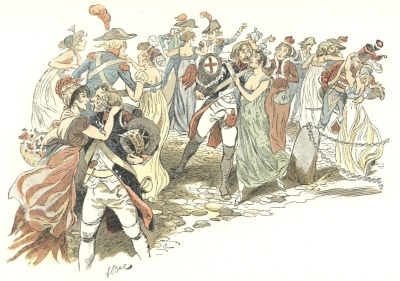
The whole administration of the State was reorganized and given that character of "centralization," apparently rendered necessary by the danger from abroad by which it was threatened, which is still maintained, notwithstanding the many evils to which it has given rise and the extent to which the public liberty is impaired. Under the able hand of the First Consul, the new government was quick to inspire such confidence that the Parisian bankers lent it readily the first funds of which it had need. The laws against the recalcitrant clergy were greatly modified, the churches opened, the list of the émigrés was declared closed, and the former nobles admitted to their rights as citizens, but not to the enjoyment of their property which had been confiscated for the benefit of the biens nationaux. The Parlement of Paris having been suppressed, a new judiciary organization was established in the capital, the tribunal de première instance and the cour d'appel were created; the cour de cassation and the cour d'assise, the justices of the peace, were all reorganized. The army, strongly revolutionary in tendency, was so willing to be relieved of the incompetence of the Directory, and was so promptly provided with equipments, munitions, and confidence in the new order of things, that it willingly accepted the change in the State.
Marengo and Hohenlinden brought about the Peace of Lunéville, February, 1801, with the Continental powers; the fear of the camp of Boulogne from which the First Consul proposed to descend upon England (if we may believe the French historians), that of Amiens, March, 1802, with that power. The wars of the Revolution were finished, it was thought, even by Bonaparte himself. Then commenced that extraordinary display of the genius of reorganization, unhampered by any undue scrupulousness, which made his legislation almost as admirable as his military talent; the nation willingly resigned itself into his powerful and most skilful hands, and the machinations of the royalists against his life, the conspiracies and the infernal machine of 1800, only paved the way to the Consulate for life, 2d of August, 1802. The Empire followed on the 18th of May, two years later.
The name of the Republic, however, was retained long after its substance had departed. The title of Emperor appears as early as 1790, in a proposition made by M. de Villette on the 17th of June, before the club of 1789, that the king should be saluted by that title on the day of the fête of the Federation. "Let us efface," he exclaimed, "the names of king, of kingdom, and of subject, which will never combine with the word 'liberty,'" Empire signified, under the monarchy as under the Republic, rather the extent of the territory of France than a form of government. The first article of the sénatus-consulte organique of the 28th Floréal, year XII, which modified the Consular constitution, read: "The government of the Republic is confided to an emperor who shall take the title of Empereur des Français." And the Emperor's oath was: "I swear to maintain the integrity of the territory of the Republic." The word République did not disappear entirely from the official language for four years. The figure of the Republic ceased to appear on the seal of State in 1805, and the inscription RÉP. FRA. from the official stamp on the news journals on the 1st of January, 1806. It was on this date also that the Gregorian calendar replaced that of the Republic. The decree of the 28th of May, 1807, is the last act of the Imperial government in which appears the phrase par les constitutions de la République, but it was only from the 1st of January, 1809, that the coinage was stamped Empire Français, instead of République Française. It would seem that in 1808, Napoleon, little as he liked the Republic, was the only one who remembered its official existence.
Among the most efficient of the minor measures taken to replace the old order of things by the new was the creation of a new honorary order, to supersede those of the ancient régime,—the cross of Saint-Louis, for military services; the cordon of Saint-Michel (cordon noir), for civil services; and the order of the Saint-Esprit (cordon bleu), which included only a hundred chevaliers, of the most ancient nobility. A law of May 19, 1802, created a Légion d'honneur, to be composed of a grand administrative council and of fifteen cohorts, each consisting of seven great officers, twenty commandants, thirty officers, and three hundred and fifty legionaries. By the eighth article of this law, every individual admitted into this Legion was to swear on his honor to devote himself to the service of the Republic, to the preservation of its territory in all its integrity, to the defence of its government, of its laws, of all property which it had bestowed, to combat, with the aid of all the means which justice, reason, and the laws authorized, every enterprise tending to re-establish the feudal régime, to revive the titles and qualities which had been its attributes,—in short, to aid with all his power in the maintenance of liberty and equality. By the denial of any hereditary privileges it was thought thus to create an order which would not offend the new spirit of equality while offering a suitable reward to the soldier, the diplomat, the scientist, the professional or the commercial man who had rendered notable service to his country.
"The Empire succeeding the Republic," says M. Steenackers in his Histoire des ordres de chevalerie, "brought about certain changes in the Legion of Honor. In the first place, the form of the oath had to be modified, and was refused by certain men, such as the admiral Truguet and the poet Lemercier. The first distribution made by the Emperor, on the 14th of July, 1804, in the church of the Invalides, to the principal personages of the Empire, was again made the occasion of a manifestation of opposition by Augereau, although a grand officer of the order, and of about sixty military officers who remained in the court, not wishing to enter the chapel. In this distribution, the old invalided soldiers came first, then the members of the Institute, and finally the military legionaries. The youth of Paris also made its small protestation, some days after this distribution. It was the season for carnations,—the young men put these flowers in their buttonholes and thus were enabled to receive, at a distance, military honors from functionaries a trifle near-sighted. Napoleon, informed of the jests which ensued, and of the discontent of the soldiers, ordered the minister of the police to take the most severe measures with regard to these insolents. Fouché replied: 'Certainly these young people deserve to be chastised, but I will wait for the autumn, which is coming.' This clever reply disarmed the master, and presently the protesting carnations were seen no more, but the sarcasms and the pretended witticisms were not so easily checked. Thus, in the spring of 1803, General Moreau, giving a dinner, summoned his cook and said to him, in the presence of his guests, 'Michel, I am pleased with your dinner; you have truly distinguished yourself with it, I wish to give you a stewpan of honor....' Lafayette refused the decoration, characterizing it as ridiculous. Ducis and Delille would not accept it."
REVIEW IN THE PLACE DU CARROUSEL. FIRST EMPIRE. From a drawing by L. Marold.
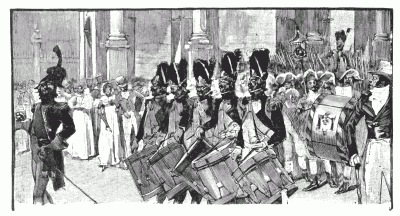
The grand officers received a pension of five thousand francs; the commandants, two thousand; the officers, one thousand; the legionaries, two hundred and fifty. The poor daughters, or the orphans, of members of the Legion are educated by the State; but it is not considered "good form" to accept this honorable charity. A decree of the 30th of January, 1805, instituted a fifth degree in the order, superior to all the others, which was designated as the grand decoration or the grand eagle,—the number of these was limited to sixty. Later, the cross was surmounted by an imperial crown. The decoration, at the period of its founding, was in the shape of a star with five double rays, attached to one of the buttonholes of the coat by a red moiré ribbon. This ribbon had at first an edging of white, but this edging was soon suppressed. In the centre of the star was placed the head of the Emperor, crowned with a wreath of oak and laurel.
At the present moment, this decoration, which has been retained by all the succeeding governments of France, is passing through one of its periodical, but never very important, periods of partial disesteem. The somewhat inconsistent conduct of the administration of the Legion of Honor with regard to those of its members whom it has disciplined and those whom it has retained unquestioned on its lists, among those active in the Dreyfus-Zola-Picquart-Esterhazy affair, has led to considerable comment and disaffection,—even to resignation of the generally much-coveted red ribbon by certain peculiarly indignant members of the order.
In the year 1807, that of the peace of Tilsit, the Empire attained its highest point. After the Concordat, which aimed to establish peace and toleration in religious matters and the Legion of Honor, a system of national recompense for distinguished services, came the founding of the Université, and the publishing of the civil Code. "On his return from Marengo, the First Consul had empowered Tronchet, Portalis, Bigot de Préameneu, and Maleville to draw up a plan for a civil Code, for which the preceding Assemblées had prepared the materials. This great work was accomplished in four months. Bonaparte ordered that it should be sent to all the judicial courts, and a number of valuable observations were thus obtained. The section of legislation of the Conseil d'État examined them, then drew up the sketches of the laws, which were communicated to the Tribunat, and returned to the Conseil amended, clarified, but destined to be still more so. Then, in fact, commenced, under the presidency of the First Consul, those admirable discussions in which he took such a glorious part. He animated every one with his ardor; he astonished these old jurisconsults by the profundity of his views, above all by that exquisite good sense which, in the constructing of a good law, is worth more than all the science of the lawyers. In this manner was elaborated that chart of the family and of property which the Corps législatif adopted in its session of 1804, and which received, three years later, the name which it merited, of Code Napoléon."
Among the many testimonials by contemporaries to the prodigious faculties, the authority which seemed to disengage itself from the person of Napoleon, in this work of legislation in which lay his truest glory, one of the latest is to be found in the Mémoires of the Comte Mollien, who, after the 18th Brumaire, was called to the direction of the Caisse d' Amortissement, or bureau of liquidation, just established, and in 1806, to the post of Minister of the Treasury. "I felt myself," he says, "if not convinced, at least vanquished, brought to the ground, by this puissance of genius, this vigor of judgment, this sentiment of his own infallibility, which seemed to leave to other men only that of their inferiority. If he saw himself contradicted, his polemics armed themselves with arguments the most pressing, as likewise, in some cases, with a censure the most bitter, almost always with a torrent of objections which it was impossible to foresee, still more impossible to combat, because you would have as vainly endeavored to seize the thread of the argument as to break it."
After Wagram, Napoleon himself perceived the waning of his star, and it was with a view of reassuring public opinion, as well as of providing for the future, that he divorced Josephine and married the Austrian archduchess, Marie-Louise. A year afterward, on the 20th of March, 1811, the policy of this marriage seemed to justify itself, and the Empire to have acquired a new security, by the birth of a son. A contemporary writer, M. de Saint-Amand, gives a lively picture of the emotions with which the Parisians awaited the news of this auspicious event. "All the inhabitants of the city knew that the reports of twenty-one cannon only would announce the birth of a daughter, but that if a son were born, there would be fired a hundred and one. The explosions of the artillery commenced. From the moment the first report was heard, the multitude kept perfectly silent. This silence was interrupted only by voices counting the sounds of the cannon,—one, two, three, four, and so on.
"The suspense of the waiting was solemn. When the twentieth report was heard, the emotion was indescribable; at the twenty-first, all the breasts were breathless; at the twenty-second, there was an outburst of joy which rose almost to delirium. Cries of delight, hats in the air, applaudings; it was an ovation, a victory over Destiny, which it seemed was to be henceforth the servant of Napoleon."
Nevertheless, three years later, the Allies were in Paris, and the Senate, convoked and directed by Talleyrand,—to whom the Chancellor Pasquier, qualified by Taine as "the best informed and the most judicious witness for the first half of this century," denies every quality of "the heart or the soul," the superiority of talent with which he is generally credited, and even the sole virtue usually left him by his detractors, that of having skilfully and worthily represented France at the Congress of Vienna,—named a provisional government, on the 1st of April, 1811. On the 3d, it pronounced the end of Napoleon's power; on the 6th, it adopted a new constitution and called to the throne a brother of Louis XVI, who became Louis XVIII.
THE FLOWERS. CEILING DECORATION FOR THE GRANDE SALLE DES FÊTES IN THE NEW HOTEL DE VILLE. Painted by Gabriel Ferrier.
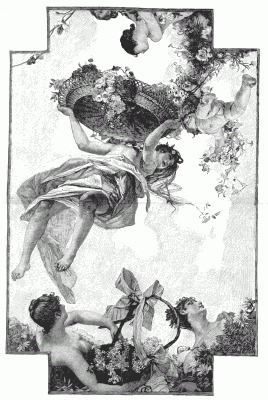
The return from Elba, the Chancellor states in his Mémoires, so far from being desired by the nation at large, was viewed with terror; and the unpopularity of the government of the Bourbons, after their return to power, he ascribes to the very poor opinion that it caused to be entertained "of its strength and of its capacity." Of its gross violation of law and justice, one of the most striking instances was that of the execution of Marshal Ney, after Waterloo, and the Duc de Richelieu, Louis XVIII's minister of foreign affairs,—whom the latest historical researches seem to combine to elevate, and of whom even Pasquier was an admirer,—here appears in the ignoble rôle of judge and accuser combined. Scarcely was he settled in the Tuileries again when the new king proceeded to draw up a list of eighteen citizens and eighteen superior officers to be proscribed, though in so doing he formally violated the articles of the capitulation of Paris, which provided that no citizen or soldier was to be prosecuted for having taken part in the preceding events. The presidency of the council of war which was to try, and condemn, "the bravest of the brave," was offered to the eldest of the marshals, Moncey, Duc de Conegliano. He declined it, in an indignant letter to the king, as "sanctioning an assassination," and was imprisoned for three months in a fortress for disobedience of orders. By a majority of five votes against two, the council, in fact, declared itself incompetent, and Ney, with a sigh of relief, exclaimed: "You see, ces b ... là would have shot me like a rabbit."
He rejoiced too soon; the Duc de Richelieu made a furious speech before the Chamber of Peers in which he openly demanded the condemnation of the marshal; in the acte d'accusation, read before this new court, "the truth was so outrageously abused and mutilated that it was justly characterized as a masterpiece of hatred." In vain his defenders demonstrated that this prosecution was a violation of the solemn engagements made by the Allies in the name of the king; Davout and his chief-of-staff, General Guilleminot, deposed that they would have "delivered battle," instead of capitulating, had it not been for article 12 of this capitulation, in which an amnesty for all persons was expressly stipulated; they were peremptorily silenced, and at nine o'clock the next morning the marshal was shot by his old comrades in arms in the grand alley of the garden of the Luxembourg. A recent monograph by M. Henri Leyret, from which we draw these details, quotes the remark of a foreigner who was present at this execution: "The French act as if they had neither history nor posterity."
During the ten years of the Empire, the aspect of Paris had greatly changed, no less than one hundred and two million of francs having been spent on the embellishment of the capital. Among the minor details of these architectural changes may be cited the regulation of the numbering of the houses in 1805, and in 1808 a serious attempt to provide some sidewalks in the principal streets. Curiously enough, this latter measure met with considerable opposition on the grounds of its impracticability because of the numerous portes cochères. But it was not till 1825 that the use of these pavements for foot-passengers became general.
M. Duruy's summing-up of the reign of Napoleon may be compared with that he gives of the epoch of Louis XIV: "Victories gained by the superiority of genius and not by that of numbers, immense works accomplished, industry awakened, agriculture encouraged by the security given to the acquirers of the biens nationaux, an administration enlightened, vigilant, and quick to act, the unity of the nation consolidated and its grandeur surpassing all imaginations,—this is what will plead always for him before posterity and to the heart of France."
The new Bourbon styled himself "king by the grace of God," without any mention of the national will or of the foreign enemy to whom he owed his crown; he replaced the tricolor by the white flag, and dated his accession from the death of his nephew Louis XVII, the dauphin, considering 1814 as the nineteenth year of his reign. So far was this fable pushed that in certain school histories of the Restoration the victories of the campaign in Italy were stated to have been gained by "M. de Buonaparte, lieutenant-general of the king." In a recent review of this reign, however, it is stated that when Blucher was mining the bridge of Jéna, during the occupation of the capital, and refused to be dissuaded from his purpose of blowing it up, Louis XVIII declared his intention of stationing himself on the bridge and perishing with it. The intervention of the Russian Emperor, Alexander, however, had probably more to do with the preservation of the structure; and a recent biography of the Duc de Richelieu asserts that the Czar's affection for this minister, who had been at one time governor of Odessa, brought about the evacuation of French territory by the allied armies at a date earlier by two years than that fixed by the treaty of November 20, 1815.
Notwithstanding the liberal provisions of the Charte constitutionelle, drawn up on the 27th of May, 1814, the restored monarchy returned so promptly to all its old abuses that in ten months it had exhausted the public patience and brought about the return from Elba. On the second restoration, after the Hundred Days, it was so vindictive, as we have seen, adding even religious persecution to political, that it also has been given in history its reign of terror, la Terreur blanche. In 1824 the king was succeeded by the Comte d'Artois, under the title of Charles X, a typical Bourbon, who had "learned nothing, forgotten nothing," who considered himself called to revive all the powers and privileges of the ancient monarchy, and who did not hesitate to violate the prescriptions of the Charte when he found them in his way. Consequently, the nation, with Paris at its head, at the end of its patience and finding its constitutional opposition about to be encountered with a coup d'État, got up the bloody revolution of July, 1830, in the streets of the capital, and the last of the Bourbon kings took the road to permanent exile,—let us hope.
The Chamber of Deputies replaced him by the head of the younger branch of the Bourbons, the Duc d'Orléans, who assumed the title of Louis Philippe I, Roi des Français. The new monarch affected certain airs of bourgeois simplicity, not unmixed with bourgeois prudence. He declined to take up his lodging in the Tuileries until all traces of the devastation attending the exit of the late tenant had disappeared, and not even then until the windows opening on the garden had been protected by a ditch, bordered with lilacs and with an iron railing. "I do not wish," he said, "that my wife should be exposed to the risk of hearing all the horrors that Marie-Antoinette heard there for the space of three years." "The new royalty," writes M. de Saint-Amand, "adopted a demi-etiquette which occupied a position half-way between the customs of absolute power and those of democracy. The sovereign assumed the uniform of a general of the National Guard. He had neither écuyers, nor chamberlain, nor préfet of the palace, but there were aides-de-camp and officiers d'ordonnance. The bourgeois element increased greatly in the fêtes of the Tuileries. Nevertheless, for those who observed this court of the July monarchy, there was a sensible tendency to return to the methods of the past."
THE FRENCH DANCES THROUGHOUT THE AGES. DECORATION FOR THE GRANDE SALLE DE FÊTES IN THE NEW HOTEL DE VILLE. Painted by Aimé-N. Morot.
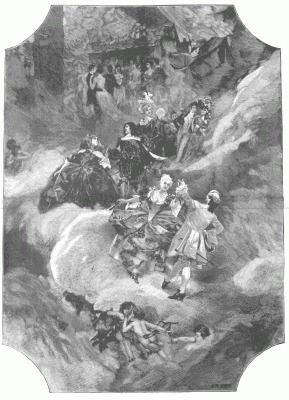
This tendency gradually became accentuated in the successive ministries which the king called to his aid; the republican and liberal aspirations on the one hand and the Bonapartist and Imperial souvenirs—greatly strengthened by the imposing ceremonial attending the return of the ashes of Napoleon to the capital in December, 1840—combined to make difficult the task of the government. Paris, which, in the words of M. Duruy, "loves to fronder as soon as it ceases to be afraid," was entirely given over to the opposition. At the opening of the session of the Chambre in 1848, the ministers persuaded the king to declare in a discourse that a hundred of the deputies were enemies of the throne. The republicans planned a great reunion at a banquet to be given in the twelfth arrondissement, the ministry forbade the assembly, the conflicts began in the streets between the citizens and the soldiers, the préfet de police, who, in his daily reports, was able to dispose of the 12th of February in this paragraph: "Order and tranquillity continue to prevail in Paris: no extraordinary agitation is to be observed," was obliged, ten days later, to conclude a long account of the manifestations in the capital by a recommendation to hold the army in readiness for an organized attack "in case the insurrection recommences." It did recommence, that night, and the next day Marshal Gérard announced to the insurgents in the Palais-Royal the abdication of the king.
He abdicated in favor of his grandson, the Comte de Paris, with the Duchesse d'Orléans for regent, and the duchess was left in the Tuileries when the king, taking off his grand cordon and his uniform, depositing his sword on a table, arrayed himself with his wife's assistance in a bourgeois costume and took his departure for Saint-Cloud. The duchess, with her two sons, was escorted to the Chamber, where the president declared that her regency should be proclaimed by that body, and Lamartine was in the midst of a speech advising the constitution of a provisory government for that purpose when he was interrupted by the invasion of a revolutionary mob shouting: "A bas la Régence! Vive la République! A bas les corrompus!" The little Comte de Paris was seized by the throat by one of these demonstrative citizens, and only saved from being choked by the intervention of a national guardsman. The provisional government proclaimed the Republic; before the Hôtel de Ville, Lamartine, in a burst of eloquence, repelled the proposition of the mob to adopt the red flag and secured the adoption of the tricolor, and the provinces, following the lead of the capital, seemed to accept the Republic.
But a stable administration of the city and the nation seemed more unattainable than ever. The new government had to suppress popular uprisings in the streets of Paris in March, in May, and in June; the new Assemblée Nationale, elected by universal suffrage,—nine millions of electors, instead of 220,000, as under the late monarchy,—made haste to organize a new government consisting of a single president, to be elected, and a single legislative body. The new president, elected by an overwhelming majority, was Louis-Napoleon Bonaparte, a nephew of the Emperor. He was given power to nominate all the innumerable employés of the government, to negotiate treaties, and to organize the army, but he could not take command of the latter nor dissolve the Assemblée, and he was not eligible for re-election. The two chief powers of the government were not long in coming into collision; the legislative body, divided into numerous factions, lacked decision and initiative, and it lost in popular favor by the law of the 31st of May, 1850, which struck three millions of electors from the lists by restricting the suffrage to those only who could prove a continuous residence of three years in the canton. The President, seizing his opportunity, demanded the repeal of this law (November 4, 1851), and on the 2d of December following, by a series of summary nocturnal arrests, succeeded in putting all the chiefs of the various parties in the Assemblée, and all his most formidable opponents, under lock and key. "I have broken out of the way of legality," said he, "to re-enter that of the right;" and the nation, by 7,437,216 votes against 640,737, accepted the new constitution which he proposed for it, the renewal of his power for ten years, the abolition of the law of the 31st of May, and the dissolution of the Assemblée Nationale. The Empire followed naturally, a year later, and was ratified by the nation by an even more overwhelming majority.
So much obloquy has been attached to the person and the reign of this sovereign, he has been made the object of such unlimited denunciation, deserved and undeserved, at home and abroad, that it will doubtless come as a surprise to many of our readers to find how liberal and enlightened were at least many of the aims of his administration, and how enthusiastically he was supported by the people that have since found no terms too strong to express their detestation. "Napoleon III," says M. Duruy, "at the very moment that he took possession of the throne, had promised that liberty should one day crown the new political edifice. After Solferino, he endeavored to introduce her again into our institutions. He began this work by the decree of the 24th of November, 1860, which associated the Corps Législatif more directly with the politics of the government. He continued it by the sénatus-consulte of the 2d of December, 1861, which deprived the Emperor of the power of decreeing extraordinary credits in the intervals of the sessions; by the letter of the 19th of January, 1867, which gave the ministers the right of appearing before the Chambers, in order that they might at any moment render an account of their acts to the nation; by the laws on the press, which was restored to its natural privileges, and on the popular assemblages, of which a few were useful and a great many detestable (11th of May and 6th of June, 1868). Finally, at the period when, abroad, the unfortunate issue of the expedition to Mexico, and the menacing position assumed in Germany by Prussia, after her victory of Sadowa over the Austrians; in the interior, the progress of public intelligence, favored by the general prosperity, had developed stronger desires for freedom which the elections of 1869 made evident, the Emperor renounced his personal authority, and by the sénatus-consulte of the 20th of April, 1870, proposed to the French people the transformation of the autocratic Empire into the liberal Empire. On the 8th of May, 7,300,000 citizens replied yes to this question, against 1,500,000 who replied no."
Thus this dignified and candid historian does not hesitate to lay the responsibility of the war of 1870-71, "most certainly, on the ministers, the deputies, and the unreasoning folly of Paris." "Paris," says another writer, an eye-witness, "was inflamed with a peculiar fever, and even words changed their meaning. Workmen were maltreated on the Boulevard des Italiens for having traversed it crying: 'Vive la Paix, vive la Travail!' ['Give us Peace! Hurrah for Labor!'] The courts themselves interfered, and citizens were condemned to prison for having uttered publicly this seditious cry: 'Vive la Paix!'" The latest historian of the war, the Commandant Rousset, who "has summed up, with more clearness and force than any other, the political and military considerations which explain its issue," in the opinion of the critics, defines as one of the three principal causes of its disasters after the 4th of September, the excessive importance attributed to the capital. The necessity of delivering Paris paralyzed all the efforts of the armies of the provinces, in depriving them of all liberty of action. "Enough can never be said of the fatal incubus which weighed upon us in the shape of the specious theory which certain pontiffs of the high strategy had erected upon the abstract value of positions, and of entrenched camps, nor of the amount of profit which the German army derived from the disdain which it entertained for this theory." This inordinate importance of the capital, as we have already seen in many instances, is one of the most striking facts in the history of France.
"THE PROGRESS OF MUSIC." PLAFOND OF THE GRANDE SALLE DES FÊTES IN THE NEW HOTEL DE VILLE. Painted by H. Gervex.
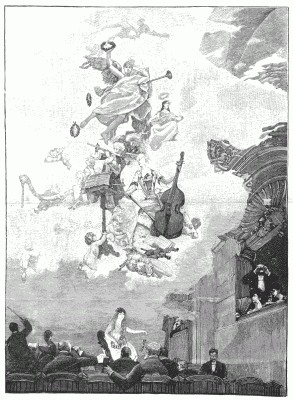
The capital once more effected a change in the government, and by the familiar methods,—on the 4th of September, 1870, the mob invaded the Chamber and overturned the Empire. In the civil war that followed the withdrawal of the Germans—brought about by the Commune and the Internationale, the former, with the pretext of restoring to the city its legitimate rights by giving back to it the election of its municipal officers, and the second, a socialism which was practical anarchy, repudiating patriotism, denouncing capital as theft, aiming to overthrow all society—it was again the capital which acted. In the private correspondence of one of those leaders of revolt, the nihilist Bakounine, lately published, he writes to his confidant: "What do you think of this desperate movement of the Parisians? Whatever the result may be, it must be confessed that they are brave enough. That strength which we have vainly sought in Lyon and in Marseille has been found in Paris. There is there an organization, and men determined to go to the bitter end. It is certain that they will be beaten, but it is equally certain that there will be henceforth no salvation for France outside the social revolution. The French state is dead, and cannot be revived."
In the number of the Contemporary Review for March, 1898, may be found an admirable condensation of the history of France for the last hundred years (quoted, without comment, in a Parisian journal), in the shape of a résumé of the various street cries heard in Paris during that period. (It is probably scarcely necessary to explain that A bas is "Down with" and Conspuez, practically, "Spit upon.") In 1788, the people cried: Vive le roi! Vive la noblesse! Vive le clergé! In 1789: A bas la noblesse! A bas la Bastille! Vivent Necker et Mirabeau! Vivent d'Orléans et le clergé! In 1791: A bas les nobles! A bas les prêtres! Plus de Dieu! [No more God!] A bas Necker! Vivent Bailly et Lafayette! A bas Bailly! In the first half of 1793: A bas Louis Capet! A bas la Monarchie et la Constitution de 1791! Vive la République! Vivent la liberté, l'égalité, la fraternité! Vivent les Girondins! In the second half of the same year: A bas les nobles, les riches et les prêtres! Vivent les Jacobins! Vive Robespierre! Vive Marat, l'ami du peuple! Vive la Terreur! In 1794: A bas les Girondins! Vive la Guillotine! In 1794 and 1795: A bas la Terreur et ses exécuteurs! A bas Robespierre! From 1795 to 1799: Vive le Directoire! Vive Bonaparte! A bas le Directoire! Vive le Premier Consul! A bas la République! Vive Napoléon empereur! Hourrah pour la guerre et la Legion d'honneur! Vive la Cour! Vive l'impératrice Joséphine! From 1809 to 1813: A bas le Pape! A bas Joséphine! Vive Marie-Louise! A bas Napoléon, l'oppresseur, le tyran! A bas les Aigles! Vive le Roi légitime! Vive les Alliés! In March, 1815: A bas les Alliés! A bas les Bourbons et les Légitimistes! Vive Napoléon! In June of the same year: A bas l'aventurier corse! [the Corsican adventurer!] A bas l'armée! A bas les traitres Ney et Lavalette! Vive le roi Louis le Desiré! From 1816 to 1830: Vive Charles X le Bien-aimé! A bas Charles X et les Bourbons! Vive Louis-Philippe, le roi citoyen! In 1848: A bas Louis-Philippe! Vive Lamartine! In 1849: A bas Lamartine! Vive le Président! A bas la liberté de la Presse et les Clubs! In 1850: Vive Napoléon! In 1851: A bas l'Assemblée! Vive l'Empereur! In 1852: A bas la République! Vive l'Empire! In 1855: A bas la Russie! In 1859: A bas l'Autriche! Vive l'Italie! Vive Garibaldi! In 1869: A bas l'Empire autoritaire! Vive l'Empire parlementaire! Vive Ollivier! In May, 1870: Vive la Constitution! Vive la Dynastie impériale! In July: A Berlin! A Berlin! In September: A bas l'Empire! Vive la République! Vive Trochu! In October: A bas Trochu! Vive la Commune! Vive Gambetta! In 1871: Vive Thiers! A bas Gambetta! In March: Vive la Commune! A bas Thiers! In May: Vive Thiers! Vive Mac-Mahon! A bas la Commune! In 1872: Vive Thiers! Vive la République! In 1873: Vive Mac-Mahon! In 1874: Vive l'Amnistie! A bas Mac-Mahon! In 1879: Vive Grèvy! A bas Gambetta! In 1881: Vive Gambetta! A bas Grèvy! Vive Lesseps! In 1887: Vive Carnot! Vive Boulanger! In 1889: A bas les Panamistes! A bas Boulanger! In 1895: Vive le Tsar! In 1898: Vivent la liberté, égalité, la fraternité! A bas les Juifs! Vive l'Armée! Conspuez Zola!
And in the latter part of the same year may be added: Vive Picquart, Vive la Révision! Vive Zola! and, naturally, A bas! and Conspuez! all three.
As to the administration of the Third Republic, it may be illustrated with tolerable exactness, and without too much malice, by two extracts from the Figaro of the summer of 1898, in which will be recognized certain great theories of universal aptitude on the part of its citizens not at all unlike those which prevail on the part of the public functionaries of our own beloved country. The first of these articles appeared at the period when the precarious Brisson ministry was in process of formation, after several ineffectual attempts on the part of other statesmen summoned to this task by the President of the République. It may be premised that the care taken to identify M. Durand by the department which he represents is rendered necessary by the fact that his family is as prevalent in France as Smith or Jones in English-speaking lands.
"At noon, M. Peytral requested Durand (of the Loir) to enter his cabinet and offered him the portfolio of Minister of the Finances.
"Durand, who had never been minister, accepted with empressement.
"'I am acquainted with our financial system from the bottom up,' he said. 'This is, therefore, excellent.'
"'Truly,' replied Peytral. 'I was not aware of it.'
"But about half-past one of the afternoon, in consequence of the refusal of one of the members of the future cabinet, M. Peytral was obliged to change the combination. He summoned again M. Durand (of the Loir) and said to him:
"'My dear colleague, I appeal to your patriotism. I have need of the portfolio of the finances. Will you be good enough to do me the friendly office to accept the Public Works?'
"M. Durand reflected a second.
"'I came near being an engineer,' he replied, 'I believe that I could be able to render great service to the country in this new ministry.'
"And after having been Minister of the Finances from noon to half-past one, he was Minister of Public Works from half-past one to three.
"At two o'clock, M. Peytral sent a petit bleu [telegram, so called from the color of the official paper] to Durand (of the Loir) to invite him to call for the third time.
"'I have just perceived, my dear colleague,' he said to him, 'that my combination is not workable. It is not the Public Works that you require, nor the Finances, it is the Marine.'
"And Durand accepted the Marine, which he preserved up to half-past five, the hour at which the political necessities threw him upon the Public Instruction and Religion.
TYPE OF THE GARDE MUNICIPALE. MILITARY OF THE CITY OF PARIS. After a drawing by L. Marchetti.
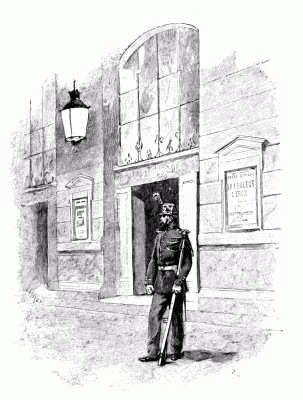
"But rivalries suddenly sprang up. It was necessary to make new arrangements in order to appease the Isambert group. Durand left the Public Instruction.
"He was, during twenty minutes, Minister of War; he had the Post-Office and Telegraphs three-quarters of an hour; he was Minister of Foreign Affairs at a quarter to seven.
"Finally, at seven o'clock, M. Peytral convoked him once again and said to him:
"'My dear colleague, I appeal in this moment to all your republican energy and to your patriotic disinterestedness. My cabinet is constituted. You are no longer a member of it.'
"'Good,' replied Durand, coldly. 'I hereby give notice of my intention to interpellate the government.'"
The second of these contemporary documents professes to relate actual facts. "We announced, the other day, that the ex-deputy Fabérot, not re-elected at the late elections, had philosophically resumed his former occupation of journeyman hatter.
"Another victim of universal suffrage, the barber Chauvin, has also returned to his dear razors. Is it quite certain, moreover, that he ever left them, even in the Chamber of Deputies?
"However this may be, he has just reopened his shop. Only, M. Chauvin has abandoned his former quarter of the Rue des Archives, and has established himself in Passage Tivoli, near the Gare Saint-Lazare, where, in the most democratic fashion, he will shave you for twenty centimes and cut your hair for six sous.
"This melancholy return to former surroundings has, moreover, nothing in it but what is very honorable,—only, it is necessary that the customers should be notified.
"Which we hereby do."
The great question of the army, of its relations with the civil authority and of the apparent hopelessness of any attempt to reconcile its maintenance and effectiveness with the democratic evolution of the age,—never a more burning question in France than at the present day,—scarcely admits of any of these pleasantries. But seldom have the amenities of discussion more completely disappeared than in the polemics now raging over the trial for treason of an officer of the general staff. One of the more recent of these dispassionate studies of the military problem appears in an article by M. Sully-Prudhomme in the Revue des Deux Mondes, and the failure of his attempt to solve the antinomy is striking. "To say, with Renan," he prefaces, "that 'war is essentially a thing of the ancien régime,' is to say that it is not of the essence of the new one; and as formerly war would be considered as destitute of any cause in the case where there were no enemies, that is equivalent to supposing that to-day no people have enemies. Such an assertion assuredly does not express Renan's meaning. He intended to say, doubtless, that in our day the use of force to decide international conflicts is in contradiction with the moral principles professed by civilized nations; in other terms, that, logically, they should never have enemies.
"Would to God that it were so! Unfortunately, we know only too well that in reality this is not so. Therefore, no people, having a due regard for their preservation and their independence, can reasonably diminish their military forces, nor even risk diminishing them, unless other peoples do as much. For any one who has informed himself in this respect as to the dispositions of the greater number of them, this simple remark will suffice to condemn in any one of them any attempt at individual reform in its military laws in any manner tending to compromise its security in the midst of the others."
But he finds, very naturally, that all the qualities of the military spirit, and those conducive to military power, are becoming "more and more incompatible with the inclinations of the individual, and contrary to the expansion of his intellectual and impassioned life." None of the methods proposed to diminish this incompatibility—civilizing war by an attempt to reduce its horrors, modifying the rigors of discipline, specializing and restricting the military service—are available; the last two, indeed, are directly at variance with the necessities of the actual situation. For the acceptance thus rendered necessary of this survival of the past, this persistence of war and all its consequences, he finds that the intelligence may recognize the fact that to place itself under the direction of those more competent is not necessarily to abdicate, that an unprejudiced examination will demonstrate the necessity of military obedience. For the soul, for the spiritual qualities, he finds nothing in the progress of modern ideas "to aid in the perfecting of the instruments and the apprenticeship of death." The blind fanaticism of the Mohammedans, the unquestioning faith of the early Christians, which faced extinction even with joy, have been replaced among modern men by sceptical, questioning, and even material philosophies which "offer us really nothing which is worthy a sincere faith in a dream, in a survival eternal and heavenly." So true is this, that, were he able, by enlightening him, to detach a Breton conscript from his blind faith which enables him to die bravely for the honor of the country, he would not do so, he would "prefer to betray philosophy." "A ridiculous compromise, perhaps, but certainly less disastrous than a defeat. This is one of the ironical inconsequences to which war condemns us, and for which it alone is responsible. Whilst waiting for its suppression, let us resign ourselves to submit to it, and let us endeavor to make the best of its violences; it imposes upon us at least the cultivation of the virile virtues, the esteem of a labor which does not enrich, and which places us in a position to interrogate very closely, willingly or unwillingly, the profundity of the tomb."
Another writer, who concerns himself more exclusively with military matters, M. Abel Veuglaire, arrives at an equally depressing conclusion. He, too, finds nothing to quite replace the old-time qualities which fed the military spirit. The soldier of the last century, under the rod of his corporal, did not rebel because he had been made an artificial being, brutalized, deprived of all those sentiments which, if they could excite enthusiasm, could also produce discouragement. In him, the desire for wine and pillage, the eagerness for quarrel, the sentiment of a point of honor, were carefully substituted for the family affections and the consciousness of moral duties. The promise of plunder and the fear of the gallows, a certain pride in his corps or his regiment, a certain esprit cocardier, made of him a soldier. But the moral worth of the modern recruit is derived from his family or from his school. "Very scarce, indeed, are those whom the regiment transforms. Scarcer still are those whom it will transform in the future. We are dupes of an illusion. We see the young men leave the military service very different from what they were when they entered it. We exclaim that the discipline is wholesome, that the air of the barracks is vivifying, that the regiment is a school of moral tendencies at the same time that it is a sanitary establishment. Ah, no!... I do not believe, in fact, that the moral qualities, that the civic virtues, are acquired in the caserne. If they exist in a condition more or less latent in the recruit when he arrives, they may be developed in him through the care of the officers, as, moreover, they run the risk of shrivelling up if their cultivation is neglected. But the result of this tardy education is always sufficiently meagre. The evil natures, the vicious characters, accentuate their defects, instead of attenuating them, under the compression of discipline. It is not strong enough to master the souls rebellious at the bottom. It chastises misconduct; it has no authority over thought.... Therefore, it would be logical to diminish the duration of the military service strictly to the minimum necessary to learn the trade."
LIFE IN THE CASERNE: AN ESCAPADE. From a drawing, in colors, by George Scott.
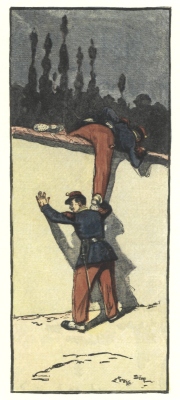
And in summing up, after describing the "moral degradation" of the old soldiers, he concludes: "Imagine what, in our modern society, can be a soldier who re-enlists. He is a man who definitely bids adieu to family affections, who desires simply a small, tranquil existence, regular, well secured. This man is most decidedly a mediocre. Perhaps he may render some service to the bleus; but he cannot be offered to them as a model nor as a guide."
It is to be said, however, that not all the pictures drawn of this life in the caserne are as gloomy as these. On this subject there is indeed abundant information. Notwithstanding the respectable number of exceptions provided by the more or less merciful various laws of conscription,—the eldest of a family of orphans, the only brother of six sisters, the eldest of a family of seven children, the elder of two brothers drawn at one time or the younger brother of one actually doing service,—the experience of the class of the bleus, as the raw recruits are called, is sufficiently common among French citizens of very varying classes of society. Naturally, the gentlemen find this very democratic experience more trying than do the peasants and the bumpkins. Every visitor to Paris who has passed the inoffensive looking and very youthful infantry sentinels on duty, or seen their comrades crowding in the open windows of the great, bare barracks, has experienced some desire to know something of the interior life of these great military warehouses. Our illustrations may serve to suggest many of the more picturesque and, so to speak, domestic of these minor incidents, and one of the most cheerful of the scribes who have participated in them, M. Henri de Noussanne, can give us further information. His experience lay in the daily life of an infantry soldier, but the general lines are the same for all arms of the service.
Unfortunately, to begin with, as there is always a possibility of war with the return of the swallows, the usage has been established of summoning to the colors the neophytes in the month of November. The rigors of the wintry season are thus added to those inherent in the rudiments of military discipline. Consequently, and as the State provides her budding warriors with but one handkerchief, two pairs of gloves, and no stockings, M. de Noussanne earnestly counsels the mothers and sisters to furnish these young men with thick underclothing and warm woollen stockings. Behold them finally enrolled in "the grand class, the real class, the most sympathetic of classes, that of the bleus," parading the streets, escorted by parents and relatives in tears and by joyous and unsympathetic urchins! At the sight of the great caserne which yawns to swallow them, their respect for authority becomes definite and concrete; otherwise, their ideas are like their marching, much bewildered. Once entered, the anciens take them in hand, tutoying them fraternally: "Thou, thou art my bleu.... Don't be afraid.... No one will mistouffle thee.... I will fix thy affairs." They even show them maternally how best to tuck themselves in their narrow beds; and the regulations no longer permit hazing of any kind. So that the first night is apt to be one of the repose that follows various and conflicting emotions.
The réveil sounds at six o'clock. The great operation of shedding citizens' garments and assuming the uniform is at hand, and is one of the most amusing in the life of the caserne. The captain of the company oversees it with the utmost care. "He has to verify everything, see everything. In the exact terms of the regulations, he is the father of the company. His rôle is of capital importance. No detail of the instruction, of the tenue, of the discipline, should escape him. Two hundred men are confided to his care, for whom he is responsible to the colonel and the chef de bataillon, who, to reward or to punish, govern themselves by his notes. At every moment he is called upon to dispense justice, for in a family of two hundred members the conflicts are frequent. He can inflict only two weeks in the salle de police, or a week in prison, but his decrees are brought to the knowledge of the superior authority, which takes upon itself to increase their severity.
THE FRENCH ARMY OF TO-DAY. ARRIVAL OF A RICH CONSCRIPT.
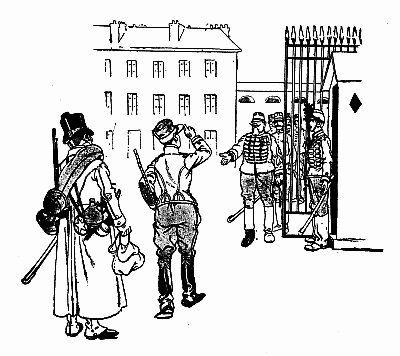
"The captain is not only a judge, a father, an instructor, he is also an administrator. To his paternal duties are added maternal ones. The nourishment, the clothing, and the care of the men depend upon him. Certain funds are allowed him which he uses at his discretion. The material and moral comfort of a company depend absolutely upon the skill and the character of its captain, who is seconded in his delicate functions by the lieutenant, the sous-lieutenant, the sous-officiers, and the corporals. The perfectionnement of the whole of this organization concerns him. The captain is, in a word, the keystone of the vault of the military edifice. Everything depends upon him. It is not then surprising that the smallest details interest him. It is specially on the occasion of the arrival of the bleus that he multiplies himself.
"I was very much surprised, on arriving at the regiment, at the attention which the commander of the company gave to the selection of the shoes. At every moment he could be heard exclaiming;
"'Chaussez-vous large, chaussez-vous long [get your shoes long and wide]!'
"When we were shod, he passed us in review, causing all our foot-gear to be felt by a sergeant kneeling to assure himself that they were of a sufficient length, and this is the little speech with which he gratified us:
"'My children, there are no good soldiers without good shoes. All the strength of Samson lay in his hair, all the strength of the foot-soldier is in his shoes. Never forget my principle: Chaussez-vous large, chaussez-vous long!... Rompez!'"
Rompez signifies: Be off! scatter! clear out!
Then comes the initiation into the mysteries of the paquetage, the arrangement of the soldier's few effects, the regulation method of folding and disposing and hanging up, each on its peculiar hook. One of the first lessons in the Code militaire is that of the salute, and the language of the corporals is energetic in proportion to the dulness of the recruit. "Salute in three times.... Attention, Fouillon, listen to what I am saying to you!... You throw out the right arm, the hand flat, open, and the fingers together.—Un! ... Mark time, animal!" (Fouillon begins again; it is better, the corporal continues): "You carry the hand up straight as high as the button on the right side of the peak of your cap.—Deux!" (Here, a horrible roar): "Lift your elbow!..." (Fouillon, terrified, menaces the sky with an obedient elbow.) "Trois: you turn your head toward the superior officer whom you are saluting and throw the hand back quickly into position six paces after having passed him.—Trois! ... Go, now, and defile before the lieutenant and try a little to commence the salute six paces in advance, without marching as if you had a broomstick in your back!"
One of the favorite of the many jokes on the new recruit turns on the zeal with which, after he has mastered this lesson, he salutes everything in the street that has the slightest appearance of an officer, even the sergents de ville and the many cocked hats worn by municipal officials of various grades. There are various minute regulations concerning this ceremony, it is always obligatory, but there is a certain amount of elasticity provided to prevent its becoming absurd, as in the case where the soldier encounters his officer every few minutes, in a gallery of a museum, etc.
The young recruit is strongly advised not to let the pleasures of his first sortie in the streets in all the splendor of his new uniform (duly arranged with the regulation folds in the back by his particular ancien) tempt him to prolong this promenade unduly. "Above all, no frasques! One is young, and the sunny Sunday jacket sets a man off admirably. Love beckons.... Take care! take care! The recall is sounded. It is necessary to return at a double-quick. Ten minutes late, that is four days in the boîte. If passion carries thee away, my poor Pitou, and if, with thy pays Dumanet, thou 'jumpest the wall' after recall, that will be la grosse. It is not gay, my friend, la grosse. A demi-fourniture, two soups, 'one of which without meat' and, for an aperative and digestive, the peloton de chasse, three hours in the morning, three hours in the afternoon, the knapsack charged according to the regulations. B-r-r-r!
"Believe me, youth, no fredaines.... Thou wilt be caught!"
Other writers who might be cited, more definite and unsparing in their details, give unquotable descriptions of the nights in the chambrée, or great dormitories, the uncouth associates, the language, the manners, the practical jokes, the quarrels, the hideous lack of ventilation at night and the rancid odor of so many imperfectly washed bodies, cheap tobacco, and soiled linen. Even M. de Noussanne is obliged to omit the termination of one of his recitals of the amusements of the caserne: "No; it is better to slide over this passage. The nude is difficult to paint. This is a pity; it plays a very important rôle in the facetiousness of the caserne. Would you have another example?
"The evening call has sounded; the sous-officiers are at mess or outside, and the men are preparing to go to sleep. All at once, charivari in the adjoining chambrée! The door opens, and two lapins, clothed only in a sack ... on the back, enter, rifle in hand, fixed bayonet, and in this picturesque costume parade round the room, leaping, cavorting, howling, whilst their comrades roll in delicious enjoyment of the joke." And he adds: "You amuse yourself the best way you can in the regiment; for, it is only justice to say for it, the military authority does nothing to render the caserne agreeable to the soldier.
"Whenever there is an officer who, having a care for the private comfort of his men, looks after them outside of the service regulations and brings himself in contact with them, he very quickly becomes a target for the jests of his obliging little comrades who leave the club of the Caricature or the Annuaire only to go and swing censers before 'Madame la Présidente,' who has a mania for match-making.
"Even if this officer be the commander of a corps d'armée, the whole of France will badger him if he lays himself open ever so little to criticism. Nevertheless, if it be true that everything is becoming ameliorated and humanized, what is there surprising in the supposition that the army should become less rude, since it declares itself better instructed? But no: routine rules, and no minister concerns himself to enliven the life in the caserne.
"How simple it would be to put at the disposition of the men games of skittles, of bowls, of crocket, to organize in bad weather amusing and instructive entertainments with magic-lantern slides and dramatic spectacles. Actors, musicians, singers, they are all to be had.... But it is the business of the officers to organize everything, to conduct everything. Now, our officers think their duties ended when, at five o'clock, they leave the caserne."
THREE-YEAR MEN IN BARRACKS. A GOOD JOKE. After a water-color by Georges Scott.
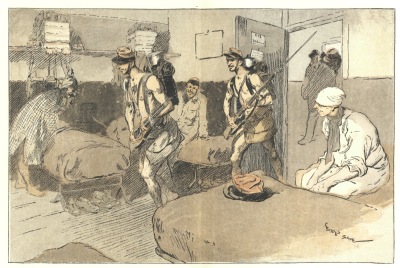
Fortunately, correspondence is not forbidden, and the arrival of the mail from home is always a great event. It is Saturday evening in the chambrée, and Pitou has arrived at the end of the week without a reprimand. His heart feels the need of expansion, and he is laboriously writing out a letter to his betrothed, down in the country. "The sweat stands on his forehead.... It is, perhaps, his method of showing tenderness, for he is greatly moved. I watch him out of the corner of my eye, and can see that his heart has returned to the paternal dwelling in the province, in the familiar chamber, where his promise, Françoise, has come to spend the evening, and says to herself as she knits:
"'At this moment, what is he doing, my Pierre?'
"He is writing to thee, my poor Françoise; he has commenced a second letter, on beautiful lace paper ornamented with an immense rose, arranged like a transformation scene in a theatrical spectacle. When you unfold the sheet, the flower blooms out. It is a small prodigy of ingenuity, of open-work, and of coloration. This marvel resembles a symbolic cabbage; you look to see issue from it an infant newly born.
"But Pitou ceases writing and looks toward me with anguish. What has happened to him? Finally, confiding, he comes to a decision, and, in a low voice:
"'I say, thou, embaume, how dost thou write that?'
"'Embaume?'
"'Yes, embaume.... "The rose, may it embaume [perfume] this letter...."' (With a sly smile): "'I am writing to my payse.... I am not sure.... She was with the Sisters three years.'
"'Ah, well! embaume: E-m-b-a-u-m-e.'
"'B-a-u.'
"'M-e.'
"'M-e.... Merci, pays.'
"And he continues, without deigning to reply to the loustic who has remarked our colloquy, and who calls to him:
"'Hé! Pitou, say to thy people that thou hast lost the umbrella of the squad, and that they send thee a hundred sous to buy a new one with.'"
At ten o'clock the bugle sounds: "Lights out!" and the dormitory sinks into darkness and slumber. "In the silence of the night, when sleep has already dulled all the caserne, a sound as gentle as a caress comes from outside, mysterious and far-away. The clairon has transformed itself into something soft and cradling, and modulates tenderly an old, old song:
"Do, do do, petit soldat,
Pense à ta bel', la plus belle des belles,
Do, do do, petit soldat,
Sois-lui fidèle,
Si elle t'aime, aime-la."
At two o'clock in the morning, a heavy step is heard on the stair, the door of the room is pushed violently open, and a hoarse voice, without any respect for the slumber of the others, calls out the name of the unlucky "cook for the day." The latter gets out of bed, feels around for his blouse and his sabots, and departs with an equal amount of unnecessary noise. Outside, he finds the corporal commanding the culinary department, with the keys of the store-house; between them, they open the kitchen, light the fires, and prepare the morning meal, first the soup and then the coffee,—five kilogrammes of the latter for a battalion. When réveil sounds, the beverage is ready, the men of the corvée carry it up into the dormitory in great earthenware jugs, one in each hand. If their iron-pegged shoes should happen to slip on the ice or snow of the court-yard, not only would the unlucky bearer run a strong chance of being frozen on one side as he fell, and scalded on the other, but he would also have to face the wrath of some thirty hungry warriors. This coffee is not exquis, but it is hot, and the men receive a good allowance of it; if the corporal be good-natured, they drink it sitting on their beds, and steeping their bread in it in the inelegant fashion dear to all their compatriots.
Finally, when the conscript has become a soldier, mastered the intricacies of the Théorie and the details of the manual of arms, learned the secret of keeping his accoutrements in parade order, taken part in the interminable drills in the secrecy of the caserne that prepare for the great ones in public, he departs for the grand manœuvres. When they are over, the classe for that year is dismissed, except those unfortunates who are detained as many days longer as they have served days in prison. The cheerfulness with which the soldiers undergo the fatigues and discomforts of these annual exercises is rightfully considered as an excellent sign of the efficiency of the service. In the present year of grace, these manœuvres were rendered unusually trying by the persistent abnormal midsummer heat, and by the blinding dust that blotted out whole parades. And yet, says a correspondent of the Temps, "if the armoire à glace (the knapsack) be heavy, the road dusty, and the march across cultivated fields laborious, it is none the less true than in the ranks of each detachment there are to be found certain loustics whose inexhaustible repertory is sufficient to unwrinkle the most morose brows.
"The ancient French gaiety is dead, you say; follow, then, for a couple of hours a column of infantry on the march, and you will not be long in being undeceived. You will recognize very quickly that, in the army, this gaiety is still in very good condition, even though it be at times a little too gross. And, if you know your authors a little, you will see things that would astonish them.
"You will hear chanted the Boîteuse, which was hummed, some two hundred and odd years ago, by the troops of Louis XIV, and the couplets of which swarm with allusions to the infirmity of Mlle. de la Vallière; Auprès de ma blonde ... song addressed to Mme. de Montespan, and a multitude of others bearing witness to the passage of noble sovereigns, or of illustrious chiefs now long since disappeared."
You will also, if you are a foreigner, see many other interesting traits of national character, and, not improbably, some such curiously unmilitary proceeding as that represented on our page, engraved from the record of an unsympathetic photograph. This particular incident took place at the manœuvres at Châteaudun in 1894; the President of the Republic, M. Casimir-Perier, is distributing the cross of the Legion of Honor to a number of specially deserving officers and sous-officiers.
That very modern instrument of warfare, the bicycle, appeared in the manœuvres of this present year of grace with more importance than ever. One correspondent, writing from Dompierre-sur-Besbre, on the 11th of September, says: "The compagnie cycliste, covering the advance of the march of the thirteenth corps, threw itself into Thiel at the moment when the advance guard of the division was attacked by superior forces. Taking advantage of the shelter of the woods, of the hedges, of the houses, it held the enemy at bay long enough to permit the division to come up, and the company bivouacked with the division." Another writes: "I rejoined the column by a cross-road at the end of which the dragoons were defiling past at a hard trot, followed by the compagnie cycliste, whose support at this moment was most valuable. It protected the retreat by delivering at certain distances volleys which momentarily arrested the pursuit. It was wonderful to see with what rapidity the men of Captain Gérard's command threw themselves into their saddles, covered a distance of five or six hundred mètres, faced about and opened fire. If they had been more numerous, what service would they not have rendered! The cavalry officers who see them every day at work are the first to recognize their usefulness." The employment of these instruments has even been extended to the gendarmerie by an order of the Minister of War, at the close of the manœuvres,—two legions of this force having been furnished with them. In 1897, some machines constructed by the artillery were distributed to a legion near Paris, as an experiment, with very satisfactory results,—the transmission of orders, maintenance of communication, etc., being thus assured in a satisfactory manner. There is, of course, some opposition manifested to this innovation, and the employment of mounted gendarmes is not yet discontinued. As may be seen from the illustrations on page 139, the French military bicycle, the invention of Captain Gérard, is constructed in such a manner as to fold up and be transported on the soldier's back.
THE PRESIDENT CASIMIR-PERIER, KISSING ON THE CHEEK A RECIPIENT OF THE RIBBON OF THE ORDER OF THE LEGION OF HONOR.
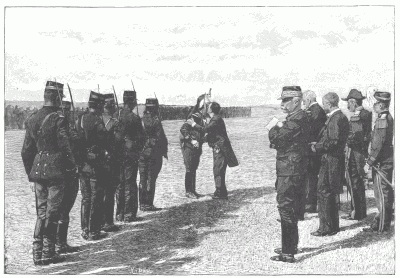
As in all old armies, very many of the regiments have records which date back to the last century, and of which they are very proud;—one of the cavalry regiments, the Fourth Chasseurs, celebrated in 1890 the anniversary of its creation in 1744 with an historical restoration and a military carrousel of the most picturesque character. In the immense court of their caserne in the Quartier Gramont of Saint-Germain-en-Laye there might be seen to defile a cavalcade of all the uniforms worn by the regiment, and of all the standards borne by it since the date of its organization. The tendency of modern warfare is to abolish more and more the picturesque and artistic, but the wars of the Republic and the First Empire have contributed a series of costumes among the most martial and the most imposing known to history.