Introductory material (continued 4)
Reading edition
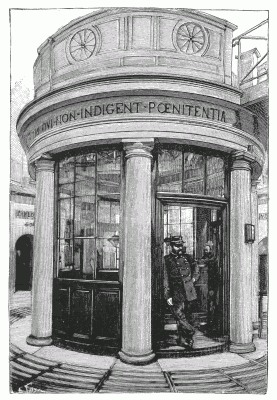
RECORD-OFFICE OF THE ROTUNDA OF THE DEPARTMENTAL PRISON OF MAZAS. ABOVE IS THE PULPIT FROM WHICH MASS IS SAID EACH SUNDAY. Engraved by E. Tilly.
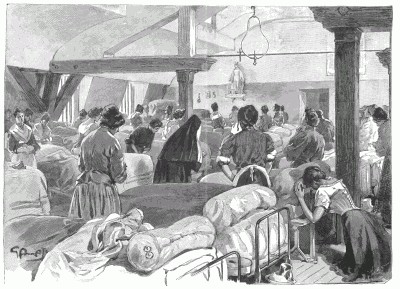
In the great dormitories, there may be witnessed each morning such a scene as that reproduced in the illustration, the prayer addressed to the image of the Virgin on the wall, decked out with faded artificial flowers and with tapers in front of her; following the example of the Sister, all stoop with more or less reverence before this symbol and utter with more or less sincerity from impure lips the prayer for a pure heart. This grand dormitory is a great hall containing more than eighty beds arranged in four rows. The red tile floor is of irreproachable cleanliness, the eighty beds, with their gray blankets and white bolsters, are arranged with military symmetry. But this cleanliness and this good order, it is claimed, count but for little in the amelioration of these unfortunates, gathering contamination from each other in this indiscriminate herding together.
According to the law, those merely accused, the prévenues, and those actually convicted, are kept apart from each other, but in each of these two classes no distinctions are made,—the homeless unfortunate, arrested for délit de vagabondage, is associated with the criminal guilty of infanticide or assassination. Even the little girls of ten and twelve years are kept together in the same promiscuousness, those already hardened in criminal ways corrupting the more innocent.
The prévenues enjoy certain privileges; they are not obliged to work, though it is but seldom that they refuse to take up some of the light sewing which occupies their leisure and brings them in small sums of money; they are not obliged, when they take their exercise, to walk round and round in a circle in the préau, forming in line only at the entrance and the exit. The formalities of search and interrogation, upon entering the prison, are the same for all, as are the general regulations and the discipline. All rise at five o'clock in summer, and at six or half-past six the rest of the year, and all go to bed at eight; all receive meat with their bouillon only on Sundays. The children are more favored in this respect, being furnished with eggs, roast meat, etc.
SAINT-LAZARE: MORNING PRAYER IN THE SECTION DE FEMMES DE MAUVAISE VIE. After a drawing by G. Amato.
Everywhere are seen in these gloomy and unwholesome halls and corridors "the austere and consoling figures" of the Sisters of Marie-Joseph. They wear a dark robe, sometimes with a white apron, a white cornette under a black veil which has a blue lining, and they supervise all the details of the monotonous life of the prison. Rising in the dawn, a half-hour before any of the prisoners, they perform their devotions, and one of them rings the bell which summons all to leave their beds; they direct the workrooms in which the prisoners sew, a Sister sitting upright in a high chair, like a teacher presiding over her class, and they keep a watchful eye during the night on all the sleepers, in all the dormitories, great and little. Their hours of service as guards are from five or six o'clock in the morning to ten o'clock in the evening. After this hour, until the morning again, two Sisters remain on watch in the first section of the prison and one in the second. Their sole comfort and recompense is found in prayer and meditation in the mortuary chamber of Saint Vincent de Paul, now transformed into an oratory for their use. There is also a chapel for the use of the inmates, as well as a Protestant oratory and a synagogue.
The historical interest attaching to the buildings of this institution is very considerable. As far back as the time of Clovis, there was a hunting-lodge on this site; this was transformed, under the Carlovingians, into a debtors' prison. About the commencement of the twelfth century, this collection of ancient buildings was used as a hospital for lepers, under the appellation of Saint-Ladre [Saint Leper], standing near the road from Paris to Saint-Denis. In the year 1147, Louis VII, setting an example followed nearly a century later by Saint-Louis, visited this lazaretto, before setting out for the Crusades. "This was an action praiseworthy and very little imitated," says the chronicler. The hospital counted among its revenues the profits arising from an annual fair, known as that of Saint-Ladre; Philippe-Auguste, in 1183, annexed the proceeds of this fair to the royal revenues, and transferred it to the interior of Paris, where it became famous under the name of Saint-Laurent. In return, he provided the hospital with an annual revenue. Among the buildings attached to the hospital was one known as the Logis du Roi, where the sovereigns were in the habit of halting to receive the oath of fidelity from their good citizens of Paris before making their solemn entry into the capital. This was also the principal halting-place for the royal funeral cortèges on their way from Paris to Saint-Denis; and as late as 1793, when it was demolished by the all-demolishing Revolution, a Gothic tower standing here perpetuated the first rest made by Philippe le Hardi in his pious transportation on his shoulders of his father's coffin to its final resting-place.
In 1515 the canons of Saint-Victor established themselves at Saint-Lazare, and for more than a century here maintained a rich abbey, flourishing at the expense of the hospital. By 1623 their abuses had become too flagrant, and the direction of the institution was confided to Vincent de Paul, already renowned for his virtue. After having re-established order and discipline, he here installed the headquarters of his congregation of the Missions, created in 1624, and which became more generally known as the Congrégation des Lazaristes. The authority of the Archbishop of Paris compelled the new possessors of Saint-Lazare to continue to receive the lepers of the city and its suburbs. To these were gradually added those ecclesiastics and laymen who here sought a voluntary retirement, and certain youth here confined unwillingly by their parents or guardians that they might recover from the effects of a life of dissipation. Ten years before the Revolution, before the expulsion of the Lazaristes in 1792, and the appropriation of their property by the Revolutionary government, the use of Saint-Lazare as a temporary prison had become well established; Beaumarchais was confined here for three days after the first representation of the Mariage de Figaro. On the 13th of July, 1789, the day before the taking of the Bastille, a band of pillagers invaded the enclosure of the buildings, destroyed the tomb of Saint Vincent de Paul, and nearly set fire to the whole quarter by the burning of one of the store-houses of the establishment. During the Terror, it was crowded with the victims destined in advance for the scaffold; and under the Consulate it became definitely a jail, prison civile, prison administrative et maison de correction, to which was added a special hospital, as if to preserve the souvenir of the lazaretto of former times.
Of the buildings still standing, the superstructures mostly date from the reign of Louis XIII. The remains of the church built by Saint Vincent de Paul, in which he was buried at the foot of the high altar, may still be distinguished. The very extensive grounds surrounding the establishment, divided up and sold during the Revolution as biens nationaux, have now disappeared under the buildings and streets of the quarter. The chapel constructed by Saint Vincent is now a store-room; the crypt, with its tombs of bishops, is a bath-house; the low apartment on the ground-floor was reproduced by the painter Charles Muller in his Appel des Condamnés, formerly so popular at the Luxembourg; in the Passage du Massacre, between two courts, the victims of the Terror, in 1793, found death when they had expected liberty; and the bells which sound the hours in the clock-tower are the same which rang under Louis XIII.
Saint-Lazare encloses also the general magazines, the store-houses of linen, and the central bakery, for all the prisons of the department of the Seine. It is here that is effected the panification for five thousand prisoners. In common with the general victualling of these penal establishments, this bakery is not managed by the State, but by private enterprise. In the prisons of the Seine, with the exception of Saint-Lazare, the food of a prisoner costs the administration daily 59.9 centimes, about twelve cents.
The Prison de la Santé (Maison d'Arrêt et de Correction), in the Rue de la Santé, has been devoted to three classes of prisoners,—those condemned to periods of from one day to one year, prévenus whose sentences have been appealed, and convicts and prisoners condemned to solitary confinement. The régime cellulaire adopted is known as the système de Philadelphie; this absolute solitary confinement is reserved for convicts awaiting their departure for New Caledonia, for other grave offenders, and also for minor offenders serving short sentences. The prisoner thus isolated leaves his cell only for an hour's exercise in promenade cellulaire; he is allowed to see no one and to receive no communication from outside, but the ingenuity of the prisoners contrives to modify these regulations. There is also a section in which the inmates pass the day together, but sleep in solitary cells. This Quartier Commun is to disappear in the reorganized prison which is to take the place of Mazas, and which will be specially devoted to prévenus, to those whose cases have been appealed and to those condemned to death. Among the numerous light industries to which the short-sentence prisoners are compelled to devote their time, that of the manufacture of dolls is one of the most important; designers, painters, and carvers, of sufficient artistic excellence, are all found among the inmates.
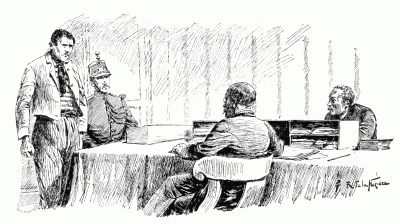
This prison was constructed to replace that of the Madelonnettes, destroyed by the opening of the Rue Turbigo. In the Protestant chapel attached to the institution, which serves also as a school for one hour a day, the prisoners accused of various offences appear each morning at ten o'clock—as in all the prisons of the Seine—in the "prætorium," the three judges of which, the director, the comptroller, and the inspector, sit under an immense open Bible displayed on the wall and surmounted by the somewhat incongruous text: "Man may not live by bread alone, but by every word which proceedeth out of the mouth of God."
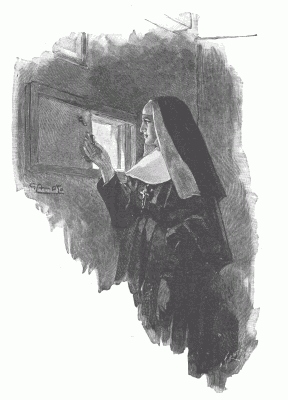
SAINT-LAZARE: SECTION DE FEMMES DE MAUVAISE VIE, UNDER SURVEILLANCE OF A SISTER. After a drawing by G. Amato.
Sainte-Pélagie (Maison de Correction), in the Rue du Puits-de-l'Ermite, though one of the smallest and worst-conditioned prisons in Paris, is one of the most celebrated, and the only one imprisonment in which is made a subject of jest. This singular reputation it owes to the numerous journalists and men of letters—Béranger, Alfred de Musset, Théophile Gautier, Balzac, Eugène Suë, J. Richepin, Henri Rochefort, among others—who have been sent here by a censorious government. These gentry have so exploited the Pavillon, the section of the prison devoted to the politiques, with its "great and little tomb," "little and great Siberia;" they have so ostentatiously received their friends every afternoon, from one to five, in their cells; they have so proudly worn their beards and their usual garments, as to diffuse a popular impression that imprisonment in this edifice is rather a joke than otherwise. Nevertheless, the Pavillon, says M. Paul Strauss, "is only one quarter of the ugliest, the most frightful prison in Paris; fortunately, it is devoted to speedy destruction, and it is by this one that the work of reformation of the penal institutions of the Seine will doubtless be inaugurated; there is no demolition more urgently demanded than this, in the unanimous opinion of all those who have visited it. The extent to which the buildings are falling to decay, the narrowness and lack of cleanliness in the workroom, corridors, and dormitories, are not less offensive than the promiscuousness of the life in common, daily and nightly. Nowhere is the defile of the prisoners at the sound of the workroom bell, or from the sinister court-yard to the chapel refectory, more lamentable; the gray or chestnut-colored garb of the prisoners is more forlorn in its worn shininess than anywhere else, and the canvas sack itself hangs more dismally at the prisoner's back. It is not the fault of the penitentiary administration and the government of the institution; the establishment itself is worthless, the life, moral and material, that is there led is intolerable."
INTERROGATORIES BEFORE A "JUGE D'INSTRUCTION." After a drawing by R. de la Nézière.
The prisoners for debt (to the State) enjoy the same privileges as the politicians. The baser, or more unfortunate, inmates, serving sentences of from one day to one year, are obliged to work in one of the six ateliers and to submit to the usual prison regulations, rising at six o'clock and going to bed at half-past seven. Among the articles produced in the workroom are toy balloons, Venetian lanterns, and, in general, all those materials for the illuminations with which Paris amuses itself on nights of festival. The fine gentlemen in the first and second quarters of the prison, instead of partaking of the meagre prison fare, are nourished at the expense of the State by some restaurant designated by themselves. This prison was erected in 1635 by the Order of the Sœurs Repenties; it was a prison for debt till 1793; until the suppression of the Garde Nationale, it was known familiarly as Prison des Haricots [beans], because those refractory citizens who objected to serving in this corps were here confined on a strictly vegetable diet. In the chapel which serves as the refectory is preserved a relic of Sainte-Pélagie. Madame de Beauharnais, afterward the Empress Josephine, was here imprisoned in a chamber, which is still shown, on the second floor.
In the Grande-Roquette (Dépôt des Condamnés), in the Rue de la Roquette, are confined those condemned to death, or to deportation to some penal colony. As late as the first months of 1899, the executions were public, the guillotine being erected in front of the prison, in the space between it and the Rue de la Roquette; the locality was marked by five large oblong stone slabs in the pavement of the sidewalk. Hereafter the executions will take place in the Place Saint-Jacques; and the prisoners condemned to death will be confined in the Prison de la Santé. The three cells devoted to these unfortunates in the Grande-Roquette were larger than the others, and the condemned man enjoyed certain privileges. He was not compelled to work, he was given meat every day, he could smoke, read and write, and play cards with the two guards who kept him company day and night until the moment when Monsieur de Paris took possession of him. In the chapel, an upper lodge or box was provided for him, where, behind a grating, he could hear the mass without being seen by those below. The library which was at the disposal of these unfortunates, and which was their principal distraction, included some four thousand volumes. The books most read were novels and romances, and of these the works of Dumas père were the favorites. After these came those of Alphonse Karr, Mayne Reid, Eugène Suë, books of travels, and the Magasin pittoresque.
For those condemned to lighter penalties, the regulations were more severe;—there was not space in the workroom for all, or there was not work for all, and the greater part of the unhappy prisoners wandered round and round all day in the dreary court-yard, in all the weariness of utter idleness. They were even obliged to eat in this court-yard, having no refectory. This prison, constructed in 1836, was taken possession of by the Commune in 1871, and in May was the scene of a series of massacres. The cell occupied by the most illustrious of these victims, the Archbishop of Paris, Monseigneur Darboy, has not since been occupied by any inmate, and has been preserved in the condition in which he left it at half-past seven on the morning of the 24th of May.
Directly opposite the Grande-Roquette, facing on the same street, is the Prison des Jeunes Détenus, the Petite-Roquette, which was devoted to three classes of youthful offenders, those placed here en correction paternelle; youths of not less than sixteen, prévenus, and those condemned to various terms of imprisonment and from sixteen to twenty-one years of age. The first class, imprisoned in cells in a separate quarter, were known only by their numbers, their names and stations in life were carefully concealed, and the guards themselves were kept in ignorance concerning them. All the inmates of this prison were isolated in their cells; in them they worked alone, and were visited by the instructor; they took solitary exercise in the préau cellulaire; and in the chapel-school, which occupies the central rotunda, each was imprisoned in a high stall from which he could see and hear but was invisible to all his fellow-prisoners. As he shut himself in his stall, he opened the door of that of his neighbor, who followed him at a distance of twenty paces. In this school he passed two hours a day, and in his promenoir cellulaire, one hour. A modification of this system was recently introduced;—the good-behavior inmates, those who were soon to be liberated, were brought together in a common workroom where they were employed in the manufacture of artificial violets. A new annex was recently added to this establishment, the Infirmerie Centrale des Prisons de la Seine, formerly installed in the Prison de la Santé. This hospital included three wards which could receive each thirty patients, an operating-room, and extensive bathing-rooms. This portion of the institution was entirely separated from the rest of the prison.
The Petite-Roquette, no longer in its gloomy surroundings, now stands on the banks of the Seine, nearly opposite the Terrace of Saint-Germain-en-Laye, from which it is visible, at the end of the road which leads from Montesson to the river. This happy removal marks an equally fortunate transformation in the character of the institution, for the stupefying and demoralizing system of solitary seclusion has been substituted the wholesomer labor in the open air of an agricultural and horticultural colony.
THE END OF AN AFFAIRE. After a drawing by Émile Bayard.
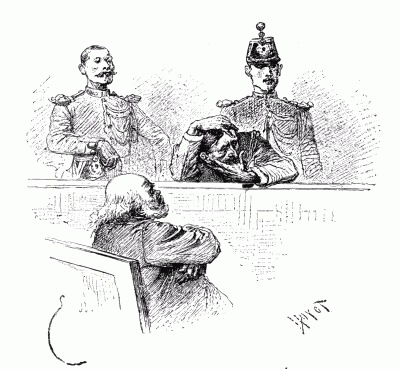
This important reform has been extended to the greater prisons of the capital: those of Mazas, Sainte-Pélagie, and the Grande-Roquette are all to be removed to the new penal institutions at Fresnes-lès-Rungis, in the department of Seine-et-Oise, inaugurated on the 18th of July, 1898. These were solemnly transferred by the Préfet of the Seine and the President of the Conseil Général to the administration pénitentiaire, and in the speeches which formed part of this ceremony the principles actuating this departure from ancient principles were duly set forth. M. Thuillier, Président du Conseil Général, after citing the transformation of the Petite-Roquette as the initiatory step in this great movement, declared that "from our profound compassion for the unfortunates who come under the hand of Justice sprang the desire to place the prisoner henceforth in surroundings in which might be born and strengthened the sentiments of self-respect, of bodily cleanliness, of propriety, which will frequently inculcate in him the noblest ideas of repentance and of moral regeneration. Hence those salubrious and almost comfortable arrangements which you have just seen.... Hence our desire to render the stay in the prison as little depressing as possible for the body and the conscience." "Without the récidive [the offender for the second time]," said M. Selves, Préfet de la Seine, "criminality in France would have diminished within the last twenty years. It is, then, the récidive, above all, who is responsible for the augmentation of criminality, and, as it is the prison which makes the récidive, it follows that the amelioration of the penitentiary system should have a greater influence for good than all other methods."
It was accordingly resolved to endeavor to better the condition of the prisoners while at the same time preventing as much as possible their corruption by indiscriminate herding together. As far back as 1849, M. Dufaure advocated the keeping apart of prévenus and of those condemned for minor offences. But it was not till 1875 that a law was passed decreeing the separation of those serving sentences of imprisonment of less than a year. The department of the Seine endeavored to carry out the requirements of this law on as large and complete a scale as possible, and accordingly laid the foundations of these two large penal establishments outside the walls of the city. Those at Fresnes may be considered as model prisons; it has even been suggested that the comfort of the inmates has been almost too closely considered, and that, with the exception of the guards and the jailers, these buildings suggest the model cheap lodgings of modern practical philanthropy. The architect had taken the greatest care to assure the well-being of his involuntary clients, their health and personal cleanliness; their cells—more spacious than usual—have hardwood floors, the walls are painted and varnished, as are the table, the chair, and the iron bedstead provided with softer bedding; the latest mechanical and electrical appliances are to be found in these very modern dungeons. The extent of the mental and moral amelioration of the Parisian criminals that will follow the introduction of this new régime will doubtless be profitable to contemplate.
In addition to its various prisons, the department of the Seine maintains two very large establishments for beggars, paupers, vagabonds, and the wretched of every description, whether they have or have not records approved by the police. The largest of these Dépôts de Mendicité, that at Nanterre, is at once a prison and a hospital; it contains three thousand inmates of both sexes, and cost some twelve millions of francs. Of the five sections into which it is divided, the first, reserved for voluntary mendicants, is the only one which contains prisoners, properly speaking, men in one quarter and women in another. The other sections, each divided likewise into male and female quarters, are devoted, the second, to voluntary patients whose antecedents are known; the third, to those whose antecedents are doubtful or unknown; the fourth, to the impotent, infirm, paralytic, and septuagenarians; the fifth is the hospital proper. The inhabitants of these different sections are distinguished from each other, the men by the color of their woollen caps, and the women by the little trimming of imitation lace in theirs. The Dépôt de Villers-Cotterets, which occupies the buildings and dependencies of the celebrated château built by François I, on an admirable site, was at first a prison, devoted to vagabonds and beggars of all ages and conditions; since 1889 it has been a Maison de Retraite, an asylum to which are admitted only the aged and infirm indigent whose past has been without reproach. The number of these peaceable inmates is about a thousand men and half as many women.
HÔPITAL DE LA SALPÈTRIÈRE, ORIGINALLY AN ARSENAL BUILT BY LOUIS XIII, AND NOW AN ASYLUM FOR AGED AND INSANE WOMEN. THE STATUE IS THAT OF DOCTOR PINEL, AN EMINENT BENEFACTOR OF THE INSANE.
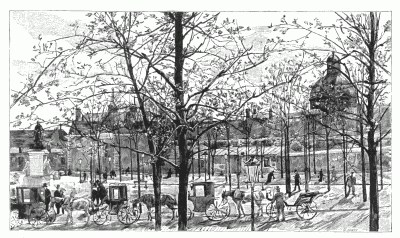
All this imposing judicial edifice of Dépôts, prisons, magistrates, and high courts of justice is, of course, fed and maintained by the much humbler, almost unknown, and much more troubled service of searching out the criminal and laying hands upon him when found. Without the aid of the "simple police," serjents de ville, gendarmes, brigadiers, and agents de la sûreté, there could be no ermined judges and no maîtres des hautes-œuvres. The general methods employed in this obscure but indispensable preliminary work are much like those made use of elsewhere in civilized countries, but there are many details, not generally published, which are interesting, and we are indebted to a spirited newspaper article, by M. Guy Tomel, for some information concerning the ways and means of the French police in these matters. He begins by putting in a plea for these very useful employés of justice: "Have you ever thought of the very material difficulties which the agents de la sûreté have to encounter in arresting malefactors? These modest defenders of society risk their lives daily that you may sleep in peace, Madame, and earn less at this perilous trade than your coachman or your valet de chambre. For their moral recompense, they have the prospect of being treated as 'mouchards' [police spies], not by the thieves and the assassins, who call them the 'flics,' but by the respectable tax-payers who are indebted to them for the minimum of security which we possess.
"If, by chance, some of the chiefs of this force, as Houillier, Jaume, and Rossignol, succeed, by dint of acts of bravery, in causing their names to be known to the general public, the private soldiers of this army of real salvation live and die in the most perfect incognito, fortunate if they succeed in attaining the age of retirement without being crippled by some malicious stroke! Remember that they are obliged to carry out their task without arms, without any brutality. A bandit injured in a hand-to-hand struggle assumes very quickly the character of an interesting victim, and there are always to be found sensational newspapers that will exploit his woes under flaming head-lines: 'Another Police Outrage!' 'A Brutal Police Agent!' etc.
"The problem that presents itself is, therefore, this one: 'To get in your power, in exposing yourself as little as possible, and without doing him any injury, a blackguard who is armed and who is capable of anything.'"
And he proceeds to explain the very simple tricks and tools by means of which this somewhat difficult task is accomplished. In the first place, he states a curious psychological fact,—that, generally, any criminal, no matter how dangerous or brutal, if suddenly arrested by surprise, is for the moment so stupefied that he does not think of resistance, and in this moment may be secured, by the handcuffs or otherwise. This brief paralysis is apt to be succeeded by a furious outbreak, but in the majority of cases it is then too late. Were it not for this temporary catalepsy, how would it be possible, asks M. Tomel, to effect the arrest of such desperate fellows, dynamiters and anarchists, with no more bloodshed and fracas than if they were girls of the town! This little peculiarity of their clients is well known to the police agents, and they but very seldom fail to take advantage of it.
In the second place, the most dangerous offenders are not, as might be supposed, the hardened criminals, those who have repeatedly fallen into the hands of Justice. For them, a long experience has convinced them that, once caught, there is no escape. Neither are the assassins the most to be feared,—the sudden collaring by the iron hand of the law reduces them to temporary imbecility. Those whose arrest is usually attended with the greatest difficulty are young rascals in their first offence, and those who are accustomed to being rescued by a band of their companions. Bankrupts and ruined financiers are also apt to give trouble,—they take to their revolvers with "deplorable facility, quite ready to lodge the last bullet in their own heads if the others have not cleared the field for them."
SCENE IN THE CELL OF AN ACCUSED. After a drawing by R. de la Nézière.
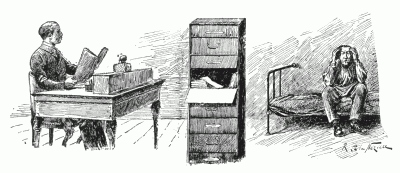
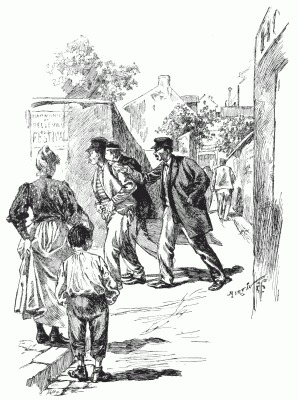
It is, therefore, not without a certain amount of information concerning the irascibility and the bodily prowess of their quarry that the agents set out in his pursuit. Usually, they hunt in couples; if the game is reputed unusually dangerous, in larger numbers. For weapons, they carry each two pieces of stout cord,—a small one, fastened to the middle of a wooden handle at each end, this is the cabriolet; and a large one, the ligote, about two mètres and a half in length. These simple methods of correction have replaced—except in the country districts and where the prisoner has to be conducted a considerable distance—the old-fashioned poucettes, or handcuffs. Thus provided, the pursuers endeavor to surprise their prey as it issues from a house or an inn,—they wear no uniform, and they in nowise begin by summoning their victim in the name of the law, so that it is strongly advisable for them to be very sure of his identity ere they fall upon him from behind, exactly in the manner of the highwaymen themselves. With one hand they grasp the collar of his coat, a little below the nape of his neck, and with the other, not his arm, but the sleeve of his coat. An individual thus collared on each side is helpless; if he wish to strike with his fists or his feet, he is obliged to lash out sidewise or obliquely, his arms are held securely; and the coup de pied de vache, which he may endeavor to give with his feet, though "it will break a tibia like glass," is easily avoided. Moreover, while he has one foot in the air, his equilibrium is in danger, and he is promptly brought to earth and secured. Usually, however, the cabriolet is round his wrist, and he is bouclé before he can say "Jack Robinson!"
These cord handcuffs are replaced by chain ones in the hands of the Gardes Municipaux in the service of the Palais de Justice, and the method of their application is the same,—once around the wrist of the victim, they can be tightened at pleasure by a simple turn of the handles in the grasp of the captor, and the pain speedily becomes intolerable. Even a slight pressure soon produces a numbness in the muscles of the arm. This simple apparatus—which can be replaced, as in Tunis, by a noose made in a silk handkerchief—is a somewhat brutal one, but it has the advantage of securing the victim absolutely for the time being. For a longer journey, and to avoid the constant personal attention which the cabriolet requires, the ligote is brought into action;—this is arranged in a double running noose in which is enclosed one of the prisoner's wrists, the cord then goes round his waist, passes under the flap of his pantaloons, and returns to be knotted on the opposite side. If the captured offender is not likely to give trouble, one arm is left free, but it is then necessary to watch him;—if both wrists are secured, he is helpless, and could be confided to the care of an invalid. So long as he keeps his hands quiet, carrying them in his pockets, for example, his cord is scarcely felt, but the moment he begins to agitate them with violent movements, it cuts into his flesh much like the cabriolet. He cannot rid himself of it, and, as he cannot swing his arms, he cannot run,—at the end of a hundred yards he is sure to come to the ground. It is related that a disciple of the Davenport brothers recently giving an exhibition of his skill in the Salle des Capucines was brought to confusion by a "flic" who happened to be in the audience and who asked permission to ligoter the magician ere he was enclosed in his cabinet. On this occasion, the spirits were quite unable to liberate him.
This method of securing the prisoner has the disadvantage, if maintained for too long a period, of checking the circulation of the blood, and for longer journeys, by railway or steamboat, its employment is now superseded by that of iron-handcuffs, or menottes, of which there is a pleasing and instructive variety in use. The principle is always that of a double bracelet secured by a padlock, which permits the victim to move his arms only in a very restricted manner. For a very objectionable client, two anklets of iron, connected by a chain, are also applied. On those occasions on which one agent finds himself with several prisoners on his hands, or when he comes suddenly upon a sought-for malefactor and is quite unprovided with the tools of his trade, a very ingenious method is employed,—he cuts off all the buttons of his prisoner's trousers. The unhappy offender is thus compelled to hold on to the upper portion of this useful garment with both hands, and is quite incapable of either battle or flight, as at the first manifestation they come down about his heels! Thus is the dignity of Justice maintained, and the interests of society preserved, as may be seen in the illustration on page 235.
Equally formidable, from the point of view of a perfect commonwealth, and, perhaps, even more to be commiserated, the immense army of the helpless and sickly poor,—paupers, paralytics, scrofulous, consumptive, idiotic, cancerous,—demands from the State or the municipal administration a machinery as complex and as extensive as the criminals. For a multitude of these unfortunates the words of Victor Hugo are true: "They begin in the hospital, and end in the hospice." "The child comes into the world in a Maternité, and, later, if life has not been generous to him, he finishes his days in one of the asylums for the aged, at Bicêtre, at the Salpêtrière, at Debrousse, at Brévannes, at Ivry, after having more than once paid his tribute to sickness in the wards of some hospital! And still more, at intervals, during certain difficult hours, he has been obliged to ask aid of the Bureau de Bienfaisance, so that, during the whole of his life, this unlucky one has been the pensioner of the Assistance Publique."
ARREST OF A DANGEROUS MALEFACTOR BY "AGENTS DE LA SURETÉ" IN THE QUARTIER BELLEVILLE, CELEBRATED FOR ITS "GUINGUETTES." After a drawing by M. Martin.
Very fortunate are those who succeed in obtaining a bed at the hospice in which to end their days; the number of applicants each year exceeds by three or four thousand the number of vacancies. The crippled and incurable paupers, for whom all labor is impossible, are admitted without regard to age; the octogenarians, cancerous, blind, and epileptic, and the sick transferred from the hospitals to the hospices, are always eligible; but the slightest misdemeanor recorded on their civil papers, even though atoned for by a long life of honesty, is fatal to the hopes of the unfortunate aged;—for them there is no asylum but the Dépôt de Mendicité. The most celebrated of these hospices of Paris are the Bicêtre and the Salpêtrière; the former at Gentilly, about a kilomètre from the southern fortifications, and the latter on the Boulevard d'Hôpital. The Bicêtre especially, under the ancient régime, represented everything that was abhorrent in a mediæval hospital, asylum, and jail combined; it was "at once a prison, a dépôt de mendicité, an asylum for the aged, a special hospital, a lunatic asylum, a political Bastille, an establishment for receiving sick children." It owes its name, it is recorded, to Jean de Pontoise, Bishop of Winchester,—corrupted into Bicêtre!—who built a château here in 1286. The present edifice was constructed largely by order of Richelieu, for invalided soldiers, in 1632; it has been devoted to its present uses as a modern hospital and asylum since 1837.
It is organized in two great divisions,—a hospice for old men, and an asylum for the deranged; but the latter includes an infirmary for idiot, epileptic, and feeble-minded children. The insane and the children are received from the Asile Clinique de la Seine, in the Rue Cabanis, and are maintained by the department of the Seine. The buildings of the hospice proper are arranged around four rectangular courts, planted with trees and gardens, in which the aged inmates sun themselves, and when it rains they take refuge under arcades known as the Allée des Bronchites and the Rue de Rivoli de Bicêtre. For a considerable distance around the establishment these pensioners may be seen in fine weather taking the air; they have this privilege for the whole of the day on Sundays, Tuesdays, and Thursdays, and from eleven o'clock in the morning to four in the afternoon on the remaining days of the week.
All the sounder ones, to the number of some four hundred, are obliged to work at one of the many useful trades practised in the various ateliers, and they gain, for their own use, from forty centimes to a franc a day, money which goes to provide them with various small creature comforts. Those who are not strong enough, or capable enough, to work in the ateliers are obliged to pick vegetables for the culinary department, for which they receive no pay;—from this obligation no one is free excepting the octogenarians, the sickly, and the active workers. The administration also encourages the enterprise of those who wish to work on their own account; it provides them with a locality and facilities, for which they pay a monthly rental of from twenty centimes to one franc twenty centimes a month. Some of these petty industries are very curious and ingenious.
At both the Bicêtre and the Salpêtrière, the quarters devoted to the children, boys and girls, in which almost every variety of childish affliction, bodily and mental, is under treatment, are the most worthy the visitor's attention, though the inspection is not always a pleasant one. The general method employed is that of Séguin and Delasiauve; by its aid, and that of infinite tact and patience, very many of these helpless unfortunates are provided with faculties and made useful members of their community. At the Bicêtre, this section is visited by foreign physicians as a model institution; the honor of its installation is due entirely to Doctor Bourneville, who was a zealous advocate of its establishment before the Conseil Municipal, and who, as médecin de service at the hospital, has succeeded in obtaining admirable results from the methods employed. The number of his little patients is somewhat under four hundred; some of them are sound bodily and others almost helpless; with the exception of the gâteux [feeble-minded and incontinent], they are divided, according to their age, or their infirmities, into two schools, the "little" and "great," the first under the direction of women, and the second of men. The children of the first are taught to exercise with the gymnastic apparatus of the system Pichery, and their rudimentary senses are cultivated by giving them small objects to see, to touch, to weigh, etc.; in both schools, but principally in that of the older pupils, systematic instruction is imparted in the workrooms of cabinet-making, shoemaking, sewing, locksmithing, basket-making, the plaiting of straw seats for chairs, brushmaking, and printing. The children are gradually accustomed to this labor; the cabinet-makers and locksmiths are selected from among the most intelligent, the makers of baskets and straw seats from among the most feeble, and the tailors from among those paralyzed on one side. "We have in the sewing-room," said Doctor Bourneville, in one of his reports, "twenty-four afflicted with hemiplegia, that is to say, unfortunates condemned, almost certainly, to pass their entire existence in the hospice; five of them are already good tailors, the greater number of the others will be. Formerly, they knew how to do nothing; now, thanks to the instruction which they receive, whether transferred to the epileptic adults if they are still subject to attacks, or to the divisions of the hospice if they are not, they will be able to work in the common atelier of the institution, and their work will compensate in part, and during very many years, for the cost of their maintenance, and, at the same time, will afford them a small pecuniary resource." The little workmen are rewarded with slight payments, of from ten to forty centimes a week, and special efforts are made, as recommended in the system Séguin, to provide them with amusements and variety,—such as walks abroad, visits to their families, games, etc.
In the similar quarter of the Salpêtrière, similar results are obtained among the little girls afflicted with epilepsy, hysteria, gâtisme, and idiocy; they are taught to sew and to make artificial flowers; they are easily interested and amused by the concerts, the dramatic representations which are provided for them, and the ball of the Mi-Carême, in which they dance in company with the demented and insane women, is a great event in their lives.
SKETCH BY M. LOÉVY ON A WITNESS-SUBPŒNA.
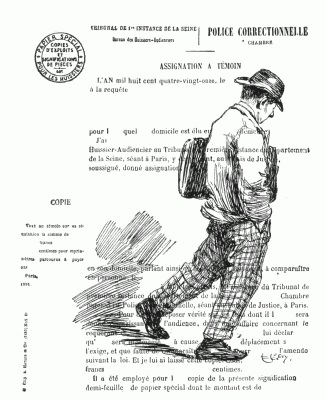
The foundations of the older portions of this immense edifice were laid by Louis XIII, who began here the construction of an arsenal; the name, Salpêtrière, is derived from a manufactory of saltpetre (salpêtre) either in the buildings or in the neighborhood. By a decree of 1648, the buildings of the Salpêtrière or the Petit-Arsenal, situated in the Faubourg Saint-Victor near the confluence of the Seine and the Bièvre, were assigned as a prison for filles et femmes débauchées; and in 1653 this establishment was placed under the direction of the administrators of the pauvres enfermez, under the supervision of Mazarin. In 1656, the whole establishment was presented by Louis XIV, then in his minority, to the administration of the Hôpital-Général; the greater part of the present buildings date from this period. At this time, says a contemporary report, the asylum consisted of "two main buildings and of fifteen grand dormitories of thirty or forty toises each, which are now occupied by six hundred and twenty-eight poor women of every quality that human misery could cause to conceive; one hundred and ninety-two children, from two to seven years of age, legitimate and bastards, exposed and abandoned to the care of Providence, and which are brought up by the poor women of the institution and shared among themselves as adopted, with the same affection as if they were their own, and twenty-seven officers and mistresses of the aforesaid dormitories, who are charged to watch over the conduct of the poor.
"Then there is a large new building which has been commenced for the reception of the married beggars...."
The chapel of the establishment was originally constructed of planks from demolished river-boats; in 1669, Louis XIV replaced it by a church more in keeping with the importance of the institution. In 1684, there was constructed a special quarter for "the debauched women," which was called the maison de force; the unfortunates confined here were subjected to the most rigorous regulations, their labor was made "as severe as possible," but was ameliorated if they showed signs of repentance; their food was restricted to bread, soup, and water, they were clothed in linsey-woolsey gowns and wore sabots, and they slept upon straw, with a thin coverlet. For lighter faults they were punished by withdrawal of the soup, imprisonment in the cachot, and the wearing of the carcan, or wooden collar; for graver offences they were locked up, for longer or shorter periods, in a dark and filthy dungeon which was called the Malaise, and which was much like the in pace of the Middle Ages. A regulation of this same year, 1684, applied the same system to the convicted prisoners and to the women imprisoned at the instance of their relatives or their husbands. The maison de force, placed in the centre of the Salpêtrière, became the prison de la Force. It included the commun, for the most dissolute and degraded women; the correction, in which were placed those who gave some hopes of reform; the prison, reserved for those detained by the king's orders, and the grande Force, for those condemned by the courts. The women and young girls destined to be sent to the colonies were kept in the Salpêtrière while waiting for their embarkation.
ANNUAL PROCESSION OF JUDGES, MAGISTRATES, ETC., ON THE OCCASION OF THE GRAND MASS, HELD AT THE BEGINNING OF THE JUDICIARY SEASON, IN THE SAINTE-CHAPELLE. After a drawing by E. Loévy.
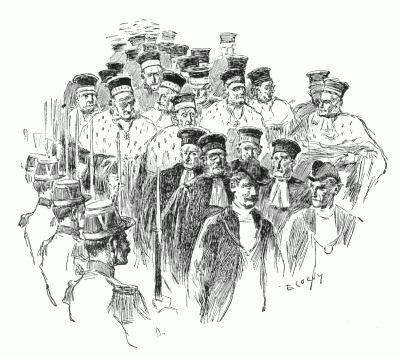
In 1780 were erected the infirmaries of the prison; these were destined for the reception of young girls enceinte, furious insane female patients, and the incurables of all kinds. Previous to this, all the inmates who became ill were sent to the Hôtel-Dieu. Eight years later, Tenon wrote that he had seen eighty thousand persons in the Salpêtrière; and La Rochefoucauld's description of the condition of this prison-hospital and its inmates is almost equally incredible: "The most horrible enclosure that could be presented to the eyes of those who have preserved some respect for humanity is that in which nearly two hundred women, young and old, attacked by the itch, scald-head, and scrofula, sleep four or five in a bed promiscuously, communicating to each other all those diseases which contagion can propagate. How many times, in traversing all these haunts of misery, does not one say to himself with horror that it would be almost less cruel to allow the human race to perish than to preserve it with so little care and consideration!" There were then imprisoned here a considerable number of female insane who were considered incurable, and whose condition was even more frightful,—they were "chained in small wooden cells, low and narrow, veritable dungeons, damp and infectious, receiving light and air only by the door, and they were treated with the utmost brutality. That which rendered their dwellings more deadly, frequently fatal, was that, in winter, during the inundations of the Seine, these cells, situated on a level with the drains, became not only much more insalubrious, but, moreover, a place of refuge for very large rats, which during the night attacked the wretches confined there and bit them on every exposed portion of their bodies."
"At the morning visit, these lunatics would be found with their feet, their hands, and their faces torn by bites, which were very often dangerous, and of which several of them died."
In a report of one of the administrateurs des hospices, M. Desportes, this fact is attested; and one of the first cares of the conseil général of the hospices was to order a general renovation and reform, a thorough cleansing out. On the 1st Germinal, year X, the population of the Salpêtrière was reduced to four thousand individuals,—three thousand and forty in good health, six hundred insane, and three hundred sick. In 1815, the large building devoted to the epileptics was completely restored, and three years later the basement cells were all closed; in 1823, the hospital took the name of Hospice de la Vieillesse-femmes. In 1834, 1835, and 1836, further improvements and additions were made, and in 1845 the great reservoir of water was constructed, fed by the canal de l'Ourcq.
GARDES MUNICIPAUX: ARREST OF A DESERTER. After a drawing by I. Marchetti.
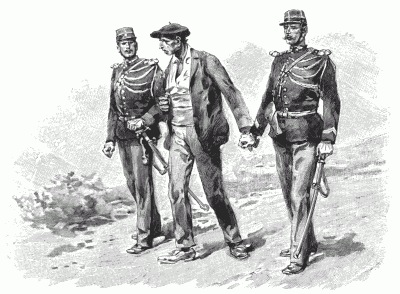
By royal letters-patent accompanying the edict of April 27, 1656, the union, under the direction of the Hôpital-Général, of the Salpêtrière, the hospital Saint-Jacques, the Hôtel de Bourgogne, and other houses, revenues, and dependencies appertaining to the Confrérie de la Passion, was declared; but the Hôpital Saint-Jacques never came into this union. To the Bicêtre were sent all the poor, men, sick and well; the Pitié was devoted in part to boys and youths, and at the maison de Scipion were established the butchers and the bakers for all the inmates of these various establishments. All mendicants, sick and well, came under the jurisdiction of the Hôpital-Général; all were required to labor according to their strength, and fifty-two skilled workmen were designated by their corporations or guilds to direct the workrooms established in the different branches of these institutions. "Prison labor" was not then the bugaboo it has since become to "organized labor." The directors had the right to administer justice among all the inmates of their institutions; the punishments most in vogue were the whipping-post, the carcan, the prison, and the lower dungeons. The missionary priests of Saint-Lazare had charge of the spiritual instruction of the mendicants, under the authority and jurisdiction of the Archbishop of Paris.
All this being regulated, it was announced in all the pulpits of the different parishes of Paris that the Hôpital-Général would be opened the 7th of May, 1657, for all the poor who wished to enter it of their own free will, while all mendicants were forbidden, by the voice of the public crier, to ask alms anywhere in the city. On the 13th, a mass of the Saint-Esprit was celebrated in the church of the Pitié, and the next day it was announced that five thousand of the poor had been admitted to the hospitals. It was then proposed to expel from Paris all those who had not come to constitute themselves inmates, or to imprison them by force; but this was found to be difficult. A patrol was sent through the city to gather up all these refractory ones, but the populace rose to recapture all those who had been arrested,—lackeys, bourgeois, artisans, soldiers, and especially soldiers of the guards, excited by the women of the town, gave themselves up to thieving and pillaging in the vicinity of the Salpêtrière and the Bicêtre and the other establishments of the Hôpital-Général.
The liberality of Mazarin, of the king, and of some of the wealthier citizens provided the administration of this great institution with its principal resources; the cardinal gave it at one time a hundred thousand livres, and left it sixty thousand francs in his will. It was exempted from numerous taxes and imposts, it was entitled to a third of all the confiscations awarded the king; to those fines imposed in the city, the faubourgs, and the jurisdiction of the prévôt of Paris which were not otherwise applied, to the duty on wine entering the city, to five sous on each minot [three bushels] of salt sold in the granaries of Paris, to a quarter of the fines from the departments of streams and forests, to a tax on the admissions to theatres, etc. Later, the Hôpital-Général was authorized to open the first mont-de-piété, or pawnbroking establishment, in France.
In addition to all their other functions, the Bicêtre and the Salpêtrière were created, by the regulation of April 20, 1684, maisons de correction for children of good families, of both sexes. The bureau of the Hôpital-Général ordered the arrest of idle, disobedient, or dissipated children, at the request of fathers or mothers, tutors or guardians, or of the nearest relatives, and even, in case of the death of the parents, on the complaint of the curés of their parishes. "Although originally created principally as a philanthropic institution, the Hôpital-Général was assuming more and more a penitentiary character; the regulation of 1680 had already added to the list of its criminals 'vagabond individuals, whom idleness leads to an infinite number of irregularities,' and had directed its officers to imprison them in a special prison, either for a determinate period or for life; there, they were to be given only the amount of food actually necessary to sustain life, and were employed at the hardest labor that their strength would permit. It does not appear that this frightful severity produced any result, for, from year to year, new edicts were constantly appearing, redoubling these rigorous measures against the mendicants."
IN THE GALLERIES OF THE PALAIS DE JUSTICE: A CONFERENCE OF "AVOCATS." After a drawing by E. Brun.
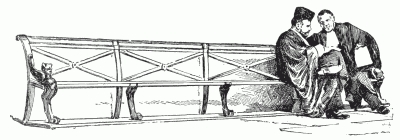
As organized at present, the Bicêtre contains three thousand one hundred and fifty-three beds, and the Salpêtrière three thousand eight hundred and eleven. The latter includes also a clinic for nervous diseases, with consultations for out-door patients, the former clinic of Doctor Charcot, and one service of electro-therapeutics, for both in-door and out-door patients, which attracts many from outside. There is a very curious medical museum; and the institution itself claims to be one of the great centres of scientific research.
An interesting feature of the general administration of the Parisian hospitals is the arrangement made by the internes, the graduates in medicine and pharmacy in the in-door service of the institution, for providing themselves with the necessary meals. These young men are paid by the Assistance Publique the modest sums of from six hundred to a thousand francs a year, from the first to their fourth year, out of which they have to provide for themselves until they are de permanence. They therefore make provisions for dining in common, and their salles de garde are cheerful and very informal gathering-places, gay and hospitable, liberally adorned with inscriptions, engravings, and paintings, permeated with the souvenirs and traditions of the institution to which they are attached. At the Hôtel-Dieu, owing to the size of the hospital and the number of clinics, the number of internes and externes, bénévoles and provisoires, and their friends, is so great that the social character of the salle de garde naturally suffers; each one dines hastily, occupies himself only with his invited guest, and, after coffee, if his duties do not claim him, goes off in search of some shady promenade, which the cloisters of the Hôtel-Dieu—unlike the green courts of the Bicêtre and Salpêtrière—do not offer him. Consequently, the gastronomical qualities of the repast assume a considerable importance, and the duties of the économe become proportionally heavy.
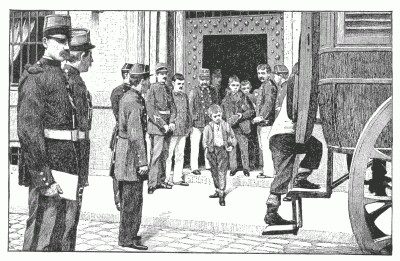
DEPARTURE FROM THE "DÉPÔT" FOR THE HOUSE OF DETENTION—LA PETITE-ROQUETTE. After a drawing by E. Vavasseur.
This very useful official is a comrade endowed with the necessary domestic and executive qualities, who assumes the onerous task of directing this refectory. He must be a gourmet, of course, this is indispensable; he must have imagination and experience in order to prepare and to suitably vary the ménus; he must be economical, orderly, judicial, and discriminating, so as to know which rebellions and protests are to be heeded and which ignored, and to preserve suitable relations with his cantinière. The interne on duty alone has a right to have his repasts served by the Assistance Publique; as these are constantly changed, the administration furnishes the equivalent of what it owes in provisions, which are turned into the common stock. It also furnishes the necessary utensils and cooking apparatus. The cantinière must have given proof of her worth either as a cook in the hospital or as a cordon bleu in the city. She must also be provided with a husband or some other connection capable of serving at table. At the end of each repast, the économe marks on a list of his subscribers a cross opposite the name of each participant, or two or more crosses if he has had guests. At the end of the month, the permanent expenses are added up, wages, etc., which sum is divided into as many parts as there are internes. This is a fixed amount, the proportionate share of which must be paid whether the subscriber has dined only once, or not at all. Then the cost of the number of meals actually consumed is added up and divided by the number of crosses. This cost of each meal varies greatly in the different hospitals, those outside the city walls being able to provide more cheaply. Thus, in 1893, it was one franc seventy-five centimes at the Hôpital de la Charité, and only eighty-five centimes at the Bicêtre. The presence of the monthly fixed charges which have to be met brings about the apparent anomaly that the more meals the young doctor eats in his messroom the less proportionally do they cost him.
As a recompense for his labors in the general service, the économe has the privilege of presiding in the centre of the table, of carving, and of sitting as umpire on all the manifestations. When any one of the habitués of the common table has passed an examination, assisted his master in some difficult operation, or otherwise had a chance to distinguish himself, it is in order for him to celebrate the great occasion by discreet libations in which his friends may share. As it sometimes happens that these fortunate ones—entirely through timidity and modesty—omit to mention their professional successes at the hospitable board, the custom has arisen of proclaiming their virtues for them and thus causing them to "manifest" themselves. "But, as the examinations are rare, and the flasks of Chartreuse small, some one is called upon to manifest, on the slightest provocation, for the promulgation of an unseasonable political opinion, for a bad pun, for anything you please. The manifesteur is made aware of the fate which menaces him by a clinking of bottles and plates, by a hammering with the backs of knives;—however, his condemnation is not definite until the économe has pronounced judgment upon it. He is careful to see that it is not always the same culprit who is executed."
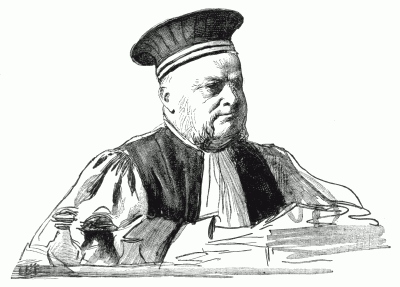
PRESIDENT M. DELAGORGNE, OF THE COURT WHICH SENTENCED M. ZOLA TO IMPRISONMENT AND FINE ON ACCOUNT OF HIS DEFENCE OF DREYFUS. After a drawing by L. Sabattier.
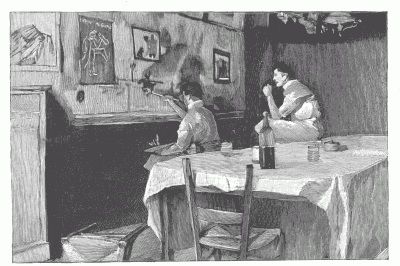
As a contrast to the Hôtel-Dieu, the Hôpital Cochin, in the Faubourg Saint-Jacques, has one of the smallest salles de garde in Paris. In recompense, its diners have under their feet an immense city, with streets, open places, and many inhabitants, a city cool in summer and warm in winter, and which, for a long period of time, the internes of this hospital had been in the habit of considering as an annex to their dining-room. It is not every one who would take this view of the catacombs; but the practice of medicine and surgery does not lend itself to the cultivation of squeamishness. Every evening, accordingly, exploring parties were organized to visit these subterranean streets; underneath the hospital itself is a large open square, from which radiate, in every direction, lanes and avenues. These the internes at first explored by means of a compass, but, as a result of some judicious meditation before the commemorative slab recording the death by starvation of Philibert Aspaut, concierge of the Val-de-Grâce, lost in the catacombs in 1793, they took the trouble to unearth an old plan in the Musée Carnavalet and draw up a new one, probably now one of the best in existence. In consequence of this prudent conduct, they have never had any losses to deplore; but the frequency of these unprofessional rambles finally aroused the administration to action, and the hospital entrance to the underground city was closed. Since then, the disconsolate diners have had to seek other distractions;—it is said that they are greatly given to equitation, but as they have no horses in their salle de garde, they paint them by squadrons on the walls, as illustrated on page 259.
The catacombs are those portions of the ancient stone-quarries under the city which have been used as municipal ossuaries since 1786. As far back as the Roman epoch, the inhabitants of Lutetia were in the habit of drawing their building material from these subterranean quarries, of clay, gypsum, and limestone. The clay, argile plastique, is found in the region of Passy and Grenelle; the zone of gypsum extends from Montmartre to Bercy, and the limestone, rich in fossils, is found under Passy and most of the city on the left bank of the river, from the Jardin des Plantes on the east to the former barrière de Vaugirard on the west. This stone was largely used in the construction of ancient and mediæval edifices,—the Palais des Thermes, the portal of Saint-Julien-le-Pauvre, a portion of Notre-Dame, Saint-Germain-des-Prés, and the old Hôtel-Dieu, were all supplied from the quarries of the Faubourgs Saint-Jacques and Saint-Michel. As the capital increased, these excavations were carried farther; those nearer the centre of the city were gradually filled up after being exhausted of their building material. By 1774, they had become the refuge of numerous thieves and vagabonds, and in consequence of the many accidents caused by the sinking of the earth over them, in the quartiers Saint-Jacques, of the Observatoire, and of Montrouge, in 1774, 1777, and 1778, an official inspection was ordered by the government, and a corps of engineers was directed to carry out all the necessary measures. The credit of the idea of using the quarries of Montsouris and of Montrouge as a receptacle for the bones from the ancient cemetery of the Innocents is ascribed to M. Lenoir, lieutenant général de police, as early as 1780; but it was not till November, 1785, that M. Guillaumot, inspecteur général of the quarries, received definite orders to prepare a suitable place for these relics of mortality.
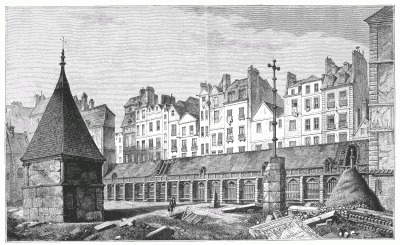
ANCIENT CEMETERY DES INNOCENTS, IN THE RUE AUX FERS, 1780, SHOWING THE CHARNIERS FULL OF SKULLS. After a design by Bernier. The accumulation of human remains, during eight or nine centuries, in this place had become so great and evil that, in 1786, they were all transferred to the Catacombs, and a market was erected on this spot.
This officer selected the quarries under the plain of Montsouris in the locality known as the Tombe-Issoire—it was said from a famous brigand of the time of Louis VII, who ravaged this neighborhood, because of their extent and their proximity to the city. It was proposed to deposit in this ossuary not only the bones from the Innocents, but from all the other cemeteries, charniers, and sepulchral chapels of Paris. On the 7th of April, 1786, the quarries were formally blessed by the clergy and consecrated to their new use, and on the same day the transportation of the bones from the Innocents was begun. It was carried on constantly, at the close of each day, in funerary cars covered with a pall and followed by surpliced priests, chanting the service for the dead. This operation, interrupted only during the heat of summer, was completed in less than fifteen months; and the catacombs—so called from this date—have since received a vast number of bones from other cemeteries and churches, and also of the victims of the many street revolutions of the capital. During the Revolution and the Terror, a number of bodies were also thrown in here, and down to 1810 no attempt was made to arrange the bones, which were piled up like rubbish. It is estimated that these subterranean crypts now contain the remains of nearly three millions of persons,—the guide-books say six.
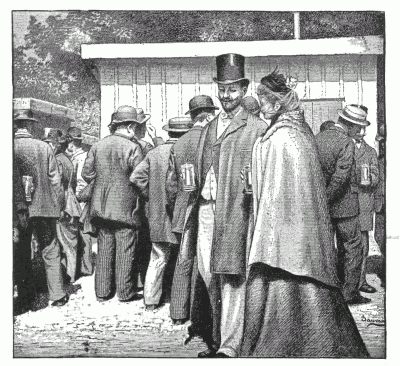
In 1810, a new organization and rearrangement of the catacombs were carried out, the falling roofs were propped up, the galleries cleaned out, ventilated, and dried, and the bones all symmetrically arranged along the walls—the large bones of the arms and legs piled up like cord-wood, presenting their ends, and interrupted by occasional rows, or centre-pieces, or cornices of skulls, and the smaller bones thrown in behind them, between them and the wall, so as to be out of sight. Various attempts at grotesque or fanciful designs, wrought out with craniums and tibias, break the monotony of these grisly corridors. Between 1792 and 1814, the catacombs permitted the suppression of sixteen cemeteries, and they still receive the bones that are turned up in the course of various excavations in the city. Visitors were formerly admitted to explore them every day, but in consequence of the numerous accidents which happened, greater restrictions were imposed, and it is now permitted to make this visit only on the first and third Saturdays of each month, and when furnished with a permit obtained from the Préfet of the Seine. The entrance is on the Place Denfert-Rochereau, and the exit on Rue Dareau; the journey is made under the care of a guide, and the visitor—who is advised to wear sufficiently thick clothing and heavy shoes—is furnished with a candle and a holder for which he pays fifty centimes.
The total number of entrances is sixty-three, many of them outside the city; these galleries are sufficiently well ventilated by numerous openings, and dry. The visitors traverse a certain route, in a general southerly direction, inspecting the various curiosities on the road and the great Ossuaire. In the latter are included several of these,—the Fontaine de la Samaritaine, so called from an inscription which recalls the words of the Saviour to the Samaritan woman; the Tombeau de Gilbert, which is only a column supporting the roof to which was given the form of a sepulchral monument; the Lampe sépulcrale, the Crypte de Saint-Laurent, similar constructions, and the geological collection formed by M. Héricart de Thury, chief engineer of mines and inspector-general of quarries in 1810, which contains specimens of all the earths and minerals encountered in excavating the quarries.
UNDERGROUND WARD-ROOM OF THE MEDICAL STUDENTS OF THE HOSPICE COCHIN, IN THE CATACOMBS. After a drawing by Henri Bellery-Desfontaines.
There were formerly to be seen in the Samaritan fountain numerous red fish, which were placed there in 1813 and thrived, but have now disappeared. The quarries are not without animal life,—in the region of the Jardin des Plantes have been found various insects, species of coleoptera, myriapod and thysanoura, and several small crustacea, all more or less blind. One of these latter, a species of small crayfish, inhabits the waters of a little stream which traverses the Ossuaire. The bones of the combatants of 1789 and 1790, and those of the victims of September, 1792, are collected and arranged by themselves in this ossuary. The walls of the galleries are set off with numerous quotations drawn from sacred literature and engraved on pillars in French, Latin, Greek, Italian, and Swedish.
One of the most remarkable of these curiosities, one which was the favorite show-place of the young doctors of the Cochin when they had guests and sufficient candles, is now no longer to be seen. This was a representation of the fort of Port-Mahon, in which he had been imprisoned by the English, cut in the face of the rock in high relief by an old soldier of the king, named Lescure, who had become a stone-cutter after his retirement from the army. This is situated in the quarry of Port-Mahon, under another quarry in the quarter of the Tombe-Issoire, which was discovered by Lescure, who kept his discovery to himself and passed his leisure in executing this record of his past career. When it was completed, he began to talk, and in order to enable his visitors to reach it easily he undertook the construction of a stairway uniting the two quarries; he had scarcely commenced it, when the earth gave way, and the unfortunate artist was crushed in the débris.
Notwithstanding the care taken to shore them up, the roofs of the abandoned quarries still give way occasionally under the superincumbent weight. In May, 1879, a house in the Passage Gourdon, Boulevard Saint-Jacques, sank through the earth; in the following year, a tree in the Luxembourg garden, near the Médicis fountain, did the same thing, and in July of this year, 1880, the lightning fell in this garden, and at almost the same moment two houses in the Boulevard Saint-Michel began to sink, as well as a large section of the sidewalk. These events naturally produced a great excitement in the quarter, and measures were taken to prevent a possible recurrence of such happenings. Proprietors proposing to build in these suspected districts are now required to conform to certain regulations of the inspector-general of quarries, who examines the subsoil under their properties.
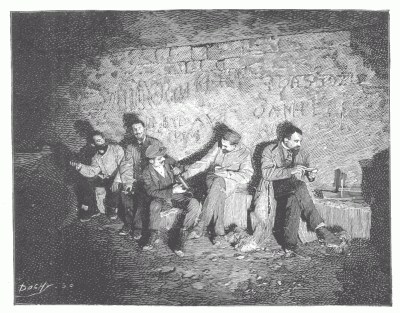
PARTY OF STUDENTS LUNCHING DURING A VISIT TO THE CATACOMBS. Engraved from a flash-light photograph.
The Cimetière des Saints Innocents,—said to have dated from the time of Philippe-Auguste,—which thus contributed to the first furnishing of the catacombs, was one of the institutions of mediæval Paris. Surrounded by its arcades of charniers, it had long been one of the most popular resorts of the city, and the Danse Macabre, earlier than the famous one at Bâle, painted along fifteen of these arcades, with inscriptions "to incite the people to devotion," only incited them to dance themselves. It was believed that the Duc de Berry had caused these paintings to be executed after the assassination of the Duc d'Orléans, the king's brother, in 1407, and the verses written under each personage were attributed to Jean Gerson, who was "inspired by serious contemplation to appeal, by the presentation of death, to his contemporaries of this fifteenth century—so abounding in calamities of every nature." The contemplation of death ceased to appal them,—for the space of six months, from August, 1424, to Lent, 1425, the people were in the habit of assembling in the cemetery on Sundays and fête-days, grotesquely attired to represent various classes of society, and, led by a mask disguised as Death, dancing frantically over the graves and along the charniers heaped with skeletons. In this ronde infernale might be recognized some obnoxious abbot, or procureur, or bourgeois, or serjent, travestied and caricatured; the people, "seeking for the moment to forget their cares and sorrows, mocked at that death which they no longer scarcely feared, for it was, at this disastrous epoch, very often for them a deliverance." Too close familiarity with the Camard—"the flat-nosed," the death's-head—had bred the proverbial lack of respect.
There is not very much information available concerning this Danse Macabre,—it is known that it was the most important mural painting of the cemetery of the Innocents, and it is now attributed to Jehan d'Orléans, valet de chambre and painter in ordinary to Charles VI, familiar companion of Jean, Duc de Berry. The first record that is known of it is found in the memoirs of a contemporary, printed under the title of Journal de Paris sous Charles VI et Charles VII, à l'année 1424, and which gives this "Item: l'an iiiie xxiv fut faite la Danse Macabre à Saint-Innocent, et fut commencée environ le moys d'aoust et achevée au carême ensuivant,"—begun in August, 1424, and finished in the following Lent. In the library of the city of Grenoble is the only known copy of a work illustrating this painting with wood-cuts,—"cy finit la dāse macabre imprimée par ung nommé Guy Marchant demeurant en Champ Gaillart à Paris le vingt-huitiesme iour de septembre mil quatre cēt quatre vings et cinq,"—printed by Guy Marchant, Champ Gaillart, Paris, September 28, 1485. The earliest known wood-engraving is the German one of Saint Christopher, dated 1423,—one year before the execution of the Danse Macabre on the walls of the Innocents. The famous Dance of Death in Bâle was not executed till 1439, and Holbein—to whom it has been attributed—was not born till 1498. The Paris dance is thus much the earlier, and in the reproduction given by Guy Marchant the varying buffoonery of the grotesque figures of death is remarkable,—they laugh, they become astonished, they become enraged,—the "serious contemplation," which they were to inspire, seems far away to our modern eyes, so conventional in their conception only of a conventional horror, silent, menacing, without any shade of humor.
Another image of this mediæval Death has been preserved to our day. This is the small alabaster statue, formerly known as the Mort Saint-Innocent; now preserved in the museum of the École des Beaux-Arts. It stood under the fifth arcade, when issuing from the church, in the charnier of "Messieurs les Martins," and had been executed by their order. It was kept enclosed in a box of which the church wardens had the key, and on All-Saints'-day it was exhibited to the people until noon of the next day. Although attributed to Germain Pilon, it is probably anterior to his time, and is now considered to be the work of a sculptor named François Gentil, a native of Troyes. As shown in the illustration, on page 278, it represents a corpse in the process of dissolution, "a much more striking figure than a skeleton;" it is about a mètre in height, stands upright, with a menacing expression, in its right hand it holds the folds of a shroud or winding-sheet, while the left rests upon the top of a species of shield on which is engraved the following quatrain, which was indicated by a dart placed between the fingers of the left hand:
"Il n'est vivant, tant soit plein d'art,
Ni de force pour résistance,
Que je ne frappe de mon dard,
Pour bailler aux vers leur pitance."
Which may be translated "There is none living, however artful or strong to resist, that I do not strike with my dart, to give to the worms their share." Underneath this somewhat trite observation is a sort of monogram, the upright of which is supported by an M. When the church, the cemetery, and the charniers of the Innocents were all suppressed in 1786, this figure was transferred to the church of Saint-Jacques-la-Boucherie, afterward to the Musée des Monuments français, by M. Alexandre Lenoir, then to the Louvre, and finally to the Beaux-Arts.
"In the Middle Ages, Death played a very important part; in the arts, the games, and the ornamentation, his image was everywhere. The churches, the cemeteries, and the charniers were covered with epitaphs and with sinister phrases relating to death, and paraphrases of the De profundis and the Dies iræ. At every step, says the author of the Légende des trépassés, the thought of the life eternal presented itself, sombre and terrible;—the melancholy chants and lamentations sobbing under the vaults of the churches hung with black, the hurried tolling of the death-bell which seemed to appeal for help and to sound the tocsin of eternity, the slow and solemn processions of the monks and the penitents intoning in the public squares the seven psalms of penitence, the great dance macabre performed in the cemeteries and the city streets, the representation of the Last Judgment by the brothers of the Passion, ... the bell-ringer of the dead making his nocturnal round,—all these formed an ensemble of awe-inspiring scenes well calculated to alienate the living from the frailties of this world."
ENTRANCE TO THE CATACOMBS, PLACE DENFERT-ROCHEREAU. After a drawing by A. Sauvage.
The use of charniers to receive the bones of the dead, disinterred to make room for more recent corpses in the century-old cemeteries, was peculiar to Paris, and began with the Cimetière des Innocents at an unknown date. The word seems to have first been used in France in the eleventh century;—the historian, Raoul Glaber, quoted in MM. Firmin-Didot's important work on Paris, previously cited, tells us that after a terrible famine, "as it was no longer possible to inter each body separately because of their great number, the pious people who feared God constructed in divers localities charniers, in which were deposited more than five hundred corpses." A dictionary of architecture, published in Paris in 1770, defines the word as meaning a "gallery or portico, formerly constructed around the parish cemeteries, in which the catechism is taught, and in the lofts of which are stored the fleshless bones of the dead. They may be found in several parishes of Paris." Their use was not entirely discontinued till the close of the last century. A pious regard for the relics of the departed led to the search for some honorable place in which to store this constantly increasing multitude of skeletons; sheds or penthouses were used, chapels, the lofts of cloisters and churches. In Paris there were six important churches, the cemeteries of which were surrounded by extensive galleries, lit by rich windows and ornamented with elaborate funerary monuments, and eight other parishes of minor importance; one of the latest built of these, that of Saint-Philippe-du-Roule, prided itself on having its steeple and its charnier in miniature. The two most important were that of the Innocents, the popular cemetery, and that of Saint-Paul, the aristocratic one.
To the accidental and isolated places of storage in the former succeeded a series of symmetrical constructions, built independently of each other, yet rapidly succeeding one another, and apparently all by funds proceeding from pious legacies and donations in the fourteenth century. These different galleries enclosed from twenty to twenty-five arcades each, and were largely open to the air, so that their ghastly contents were plainly visible. Some of them, it is thought, had no roofs, or very imperfect ones. Notwithstanding these charnel-houses and the reeking soil of the cemetery itself, a deposit for refuse and offal of every description, this locality was one of the most thronged in the mediæval city. The present Halles Centrales and the Marché des Innocents, which occupied the same site from 1785, are but the legitimate successors of the busy commerce carried on in this locality from the earliest times. Louis XI authorized the construction, in the Rue de la Ferronnerie, against the walls of the charniers, of little stalls or sheds to be let to poor trades-people on condition that they did not display their merchandise on the public street, very narrow in this quarter,—a restriction which was speedily disregarded. "An ordinance of Henri II, on highways, directed that this street should be widened, May 14, 1554; it was not executed, and, fifty-six years later, to the day, Henri IV was assassinated here, May 14, 1610." It may be remembered that the temporary obstruction of the narrow street, which compelled the royal coach to halt, gave Ravaillac his opportunity. In 1669, the charnier des Lingères was ordered to be demolished, and two years later it was reconstructed to form the northern wall of the Rue de la Ferronnerie.
Even the very imperfect sanitary science of the Middle Ages recognized this cemetery as a centre of infection, and innumerable complaints were addressed to the civic authorities from reign to reign. Toward the middle of the eighteenth century, these protestations became more frequent, and various reports were made upon the subject. In 1737, the Parlement, by a decree dated July 9th, appointed a committee of experts, consisting of MM. Lemery and Hunault, physicians of the Hôtel-Dieu, and Geoffroy, médécin chimiste, all three of them members of the Académie des Sciences, to report "upon the grounds for the complaints which have been made for more than forty years, perhaps for more than a century, upon the infection caused by the Cimetière des Innocents." The report of this commission, dated May 22, 1738, gives some lively details concerning the manners and customs of the times that may be sought for in vain in other and less candid records. "Two causes of these evil odors may be observed,—the fecal matter which the inhabitants of the neighboring houses throw into the cemetery, partly in a trench that has been made along the sides of the houses that are on the Rue de la Ferronnerie, and the infection from the graves during the time that they are open and being refilled. The first cause is the most obvious; the second does not seem to exercise any injurious effect on the health of the neighborhood.... Do the exhalations from the cemetery augment in time of epidemics?... The experience of the past does not seem to furnish any grounds for these slight suspicions.... The soil is not exhausted, but it is less fit to bring about the dissolution of the dead bodies."
Various remedies were proposed in the conclusion of the report: "Prevent the lodgers in the neighboring houses from throwing their water, urine, and filth into the cemetery, and, to this end, increase the number of lunettes in the closets and close the windows up with gratings." This particularly concerned the row of houses along the Rue de la Ferronnerie, which formed one of the long sides of the cemetery; they were five stories in height, and had been reconstructed under Louis XIV, eighty years before. A typical detail of the period may be found in the fact that there were "lunettes" only on the first floor; the dwellers in the upper stories found it more convenient to throw their refuse out of the windows than to carry it down-stairs. In fact,—says MM. Firmin-Didot's editor, from whom we gather these details,—had the private individuals any right to complain when, in building the palace of Versailles, only one thing had been forgotten,—the closets? "And yet these were the good old times, and Monsieur Purgon [of Molière's Malade Imaginaire] was then held in great honor!"
The commission also made several recommendations concerning the cemetery, which to-day would be thought to be very insufficient. It was proposed to level the ground, to divide it into squares, to dig graves in a diagonal direction opposite to the one formerly followed, to oblige the grave-digger to take out the bones each time, to have only one common grave open all the time—instead of three, to double the size of the graves, to cover the bodies with eight inches or a foot of earth—according to the season, to open the graves by preference only in the winter, to burn the bones or transport them to the new grounds of the Porcherons, acquired by the chapter of Saint-Germain, and to exchange part of the soil taken from the graves for new soil from this locality. Another report, made by the commissioner Laumônier in 1780, advised the establishment of a provisional cemetery under the charge of the Capuchins,—"it were better," said the commissioner, "to have monks for a guardian rather than a drunkard, like that of the Innocents."
This was Maître Poutrain, who had been fossoyeur here for thirty years, and who made application to be transferred to the new cemetery as soon as he heard that his old one was to be suppressed. It was not suppressed, however, till six years later, and in 1785 we find another commission from the Académie des Sciences taking testimony and adopting the recommendations of the grave-digger Poutrain as though he had been a member of their own learned body. They even accepted this statement from him:—there was a square tomb in the cemetery, near the church, then only some three feet high, and which, when he commenced his labors in the grounds, had been so high that he could scarcely reach the top with his hands. That the soil had risen, however, cannot be doubted. There were two thousand or three thousand burials a year; Poutrain said he had officiated at ninety thousand himself during his term of office; and M. Héricart de Thury has estimated the number of inhumations in the course of six centuries as high as one million two hundred thousand. This has even been considered as below the probable number, on a basis of three thousand a year, and not allowing for famines, pestilences, epidemics, and wars,—all in a space estimated at nine thousand six hundred square feet.
Another account says that the cemetery was closed on the 1st of December, 1780, in consequence of the following incident: In July of that year, a shoemaker of the Rue de la Lingerie, having occasion to go down into his cellar to get some leather, was driven back by an insupportable odor. His neighbors having been called in and due investigation made, it was discovered that the foundation wall had yielded to the pressure of the earth of the cemetery, and that the cellar was half full of decomposing bodies, mostly from a trench that had been opened on that side of the grounds in the latter part of the preceding year, for the reception of some two thousand corpses. The police forbade the gazettes and journals to give any publicity to this incident, and a commission was appointed to investigate. A decree of the Archbishop of Paris, June 10, 1786, definitely closed the cemetery, the earth was screened, the bones placed in sacks and transported in covered carts to the old quarries under the plain of Montsouris in the locality called the Tombe-Issoire, as has been stated. Those which it had been intended to transport to the cemetery of the Faubourg Montmartre were, for want of space, taken to Montrouge.
The vegetable market which had been held in the Rue de la Ferronnerie was transferred to the site of the old cemetery, and for a number of years this Marché des Innocents, with its four or five hundred immense red parasols, under which the vendors sheltered themselves, was one of the sights of Paris. In 1813, galleries of wood were constructed around the enclosure for this purpose. In the centre was placed the old fountain from the corner of the Rues Aux Fers and Saint-Denis, with the five naiads in relief sculptured by Jean Goujon supplemented by three more, more or less in the same style, by Pajou. Since the reconstruction of the Halles Centrales, the Marché des Innocents has been transformed into a public garden, surrounding this monumental fountain.
As early as 1766, the Parlement of Paris had taken up the very important reform of suppressing all interments within the city, "a custom which had its origin only in the growth of the city which, in extending its limits, had gradually taken into its enclosure the cemeteries originally outside its walls." A municipal decree, in nineteen articles, forbade any further burials in the cemeteries then within the city walls, after the first day of January, 1766, or in churches, chapels, or vaults, excepting under certain limitations. This sanitary measure was, however, so vehemently opposed by all the curés of Paris that it was never enforced; the question of compelling all interments to take place in suburban cemeteries was not seriously taken up till 1804, when the grounds of Père-Lachaise were purchased by the city, and, to this day, the only interments that are forbidden within the built-up limits of the capital are the temporary ones, and the common ones for the poor,—the fosses temporaires, and the fosses communes.
CLOISTERS OF THE CHURCH DES INNOCENTS, SHOWING UPPER PORTIONS CONTAINING HUMAN SKULLS, AND THE FRESCOES OF THE "DANSE MACABRE."
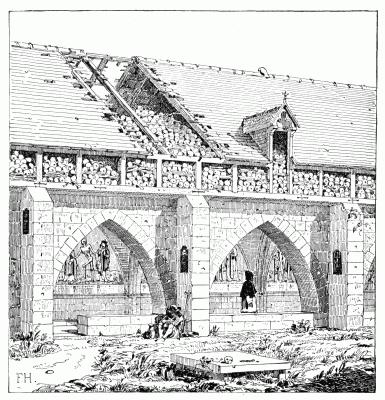
By a grotesque arrangement, the funeral arrangements in Paris were formerly in charge of the town-criers, the crieurs de corps et de vins, the crieurs-jurés, who held a monopoly of these public announcements, and who bawled through the streets, indifferently, the proclamation of choses estranges which were lost, mules, children, horses, and the like, of wine to sell—when they carried a gilded drinking-cup, and of deaths—when they wore a sort of dalmatic sown with black "tears" and death's-heads. Their number was at first fixed at twenty-four, then at thirty, and an edict of January, 1690, raised it to fifty. They had a reprehensible fashion of announcing deaths and ringing their bell through the streets at all hours of the night: "Pray to God for the soul of Messire Suchaone, who has just died! Awake, all ye who sleep, and pray God for the dead!" The Parisian bourgeois, suddenly aroused from slumber by this hoarse appeal under his windows, entered into a state of fright, or of fury, according to his temperament. These crieurs and clocheteurs des trépassés, moreover, formed a wealthy and influential corporation which held the monopoly of what is to-day the Pompes funèbres,—they furnished the serge, the robes, the mantles, the chaperons or hoods, the hangings, and the torches for the funerals, they even furnished the hired mourners when required, who preceded the cortège to the graves in black garments, "ringing their bells, drawing lugubrious sounds from grotesque instruments, appealing to the people to pray for the defunct, making an infernal uproar, and, in order to honor the dead, nearly killing the living." This corporation was in existence after 1789, but the hospitals and hospices had obtained the right of furnishing hangings for funeral ceremonies, and a decree of the year XII transferred it to churches and consistories.
The arrangements for interments, generally, were in harmony with the condition of the overcrowded and reeking cemeteries,—the bodies were usually transported to their last resting-places on men's backs or by their arms, the poor enjoyed the luxury of a bier only during this journey and were thrown half-naked into the common grave. From this period of the Revolution, these summary processes were forbidden; the bodies were obliged to be carried in wagons or cars, excepting those of children, though sometimes several coffins were placed in the same vehicle. For more seemly processions, the cars were drawn by two horses, walking, accompanied by an ordonnateur and three porters in costume, or even by four aumôniers on horseback supporting the canopy. In the latter case, the hearse would be furnished with no less than eight horses. For these sumptuous occasions, however, the jurés-crieurs would deem it necessary to accompany the funeral cortége with a convoy of saddle-makers, harness-makers, and wheelwrights, in case the heavy funeral car should happen to upset or to become stalled in the mud. The presence of these auxiliaries in their working costumes was concealed as much as possible; they were placed in the hearse, sitting on the coffin itself, and concealed from view by the heavy black curtains of the vehicle,—here they amused themselves by playing at dice on the bier, drinking, if they had had the forethought to bring a bottle along, or sometimes by showing their faces through the openings of the black curtains and making grimaces at the four mounted aumôniers, whose dignity forbade them to reply in kind.
A certain contractor, a Sieur Bobée, was authorized by the Préfet of the Seine, M. Frochot, in 1801, to furnish to wealthy families the means necessary to give their interments the desired pomp, and he was, in fact, the first organizer of the Pompes funèbres. He collected, at his own cost and risk, all the requisite material, and drew from his wealthy clients a sufficient recompense to reimburse him for the gratuitous burial of the poor, which was required of him. He received, also, the proceeds of the funerary tax, which provided the indigent with a shroud, a coffin, and the necessary transportation to the grave. Under his successors, the business gradually enlarged till, in 1869, the municipal administration judged it expedient to purchase a site and erect buildings that should assure a sufficient establishment for the future. The war with Germany delayed the completion of this undertaking, but the new buildings of the Pompes funèbres, offices, stables, store-rooms, etc., all complete, were finally inaugurated in 1873. They were constructed in the name, and at the cost, of the city of Paris, and the funerary establishment pays a rent of two hundred thousand francs. These buildings are situated on the site of the former abattoirs de la Villette, on the Rues Curial and d'Aubervilliers. In the manufactory is kept a large stock of coffins and caskets of all kinds, and a reserve stock is always on hand in case of epidemics; in the carriage-houses are nearly three hundred and fifty vehicles of all kinds, and in the stables, three hundred and sixty-four horses,—two hundred and ninety-one black ones.
The service of the Pompes funèbres is placed under the surveillance of the Préfet of the Seine. The administration centrale may be addressed directly by telephone, to 104 Rue d'Aubervilliers, when required, or application may be made to the bureau of the Pompes funèbres in each Mairie, or to their agents in each arrondissement. There is a conseil d'administration of thirteen members, elected, ten by the city churches, one by the consistory of the Reformed Church, one by the consistory of the Confession d'Augsbourg, and one by the Israelite consistory. This conseil represents the fabriques—that is to say, the revenues and property—of the parochial churches, divided into ten circonscriptions, and the consistories of the non-Catholic churches of the city. There is also a vicar-general, delegated by the Archbishop of Paris, who is a member of the conseil, and ranks next to the president.
DEATH. Alabaster statuette, one mètre high, kept in the charniers of Saint-Innocent; uncovered on All-Saints'-day.
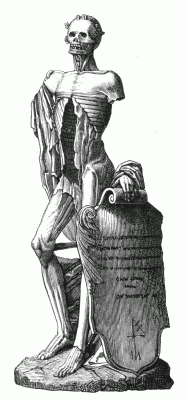
The expense of a funeral, of course, varies very greatly. An ordinary coffin costs from eight francs to forty-four. The municipal tax, which brings in to the city treasury annually some eight hundred and sixty thousand francs, is included in the cost of each class of funeral, and varies from forty francs for the first and second classes to six francs for the ninth. For the convois catholiques, the expense is from eight thousand to ten thousand francs for the first class; for the convois protestants, four thousand two hundred to seven thousand five hundred for first class; for the enterrements israelites, two thousand nine hundred at the most. The ninth, or cheapest, class of funeral, of all these may be had for eighteen francs seventy-five centimes for the Catholic, nine francs for the Protestant, and three francs for the Israelite. These figures vary according to the parish, the size of the church or temple, etc., but they generally include the decoration of the residence, the draping of the place of worship in which the service is held, the payment for this religious service, etc., but not the cost of the coffin, of the land in the cemetery, of the tickets of invitation or notices of death, and other details. In the Jewish service, there is an item of a thousand francs for the choir, either at the dwelling or in the cemetery. For the convois civils, where there is no official religious service, the price varies from eighteen hundred and fifty to twenty-four hundred francs for the first class to nine francs for the ninth. For incinerations, the cost is about the same, adding the tax to be paid the city,—three hundred francs for the first class, and fifty for the sixth, seventh, and eighth. A permit for a gratuitous interment may be obtained by presenting at the Mairie a certificate of indigence obtained from the Commissaire de Police upon application sustained by two witnesses in good standing.