PALS (continued 5)
Reading edition
"Carried unanimously by a large majority, as Denny would say," cried Joe the spokesman.
On arrival at the camping grounds, the place of the late serio-comic adventure, the explorers—for such we must call them—unsaddled, and short-hobbled their horses.
"I vote," said Joe, "that we boil the billy an' have a go at the tuck before we tackle the caves. It'll be better than taking the prog with us, an' 'll save us coming out for lunch."
"Agreed!" chorus the rest with a readiness and gusto which in matters of meat is almost an instinct of boyhood. Accordingly the wood is gathered, and ere long, with whetted appetites, they are absorbingly engaged on a substantial meal.
"There are three things to remember, mates. First of all, the candles. We'll divide them equally, three apiece. Here's a box of matches for each. Father gave me a caution, about lights. We're to carefully watch the candles as we proceed through the passages. He says the poisonous gases collect in places that are not well ventilated, an' that means death in no time if we remain in such spots."
"How'd we know, Sandy?"
"I was just going to tell you. If we get into such places, father says, the candle will burn dimly, an' if it's very bad, will go out altogether. When we happen on such spots, if there are any, we are to retreat immediately; so don't forget, boys, should we be separated."
"That," said Neville, "is most important." He related one or two incidents of fatal accidents in connection with English collieries through fire-damp. That danger, though, is seldom encountered in such caves as the boys were intent on exploring.
"What's the third thing, Sandy?"
"The third thing, Hawkins, is to make fast to this green-hide. It is twenty-five feet long, an' we'll tie on to it as we go through the passages. Father says there are often holes in the floors and very steep inclines. Best to be on the safe side, though I don't suppose we'll really need it."
"I say," queried Neville, "hadn't we better take some stout cudgels with us, for fear of snakes and wild beasts?"
"Happy thought, Mr. Neville. Not for wild beasts, though an old-man kangaroo can be as dangerous as a bear with his paws when he's bailed up by the dogs."
"What about monkeys, then?"
"Monkeys? We haven't any."
"Well, I heard one of the travellers say, while he was having a feed at the men's hut, that he'd been engaged to go for a mob of monkeys."
"Ha—ha—ha! Well, you are a——Why, the man was talking about sheep. Monkey is a pet name for them. We'll want some sticks, though, as well as the tomahawk."
So saying, Sandy proceeded to hack at a cluster of gum saplings, and cut three waddies about five feet in length, and a fourth one eight feet long, and proportionately thick. Armed with these and carrying the other necessaries, including a billy of water and a snack of food, the exploration party proceeded to the cave entrance.
After gaining access to the first cave, the boys allowed Neville a few minutes' pause to get at home with his surroundings, before going on to the second or cathedral chamber. They then pursued their way through the tortuous and difficult passage between the two chambers, till at length they arrived at the opening.
"Hello!" exclaimed Sandy, who was in the lead, with an involuntary gasp.
"What's up?" cried Joe, who was immediately behind him.
"Why, ladder's gone!"
"Jemima! you don't say so. Why—how——?"
"It's gone, all right," replied the leader, as he peered by the light of his candle into the gloomy recesses of the cave. "Clean gone! Don't see it on the floor below, so it can't have dropped."
Joe, squeezing abreast Sandy, and doubling the light power, added his eyes to those of his mate in the search.
"No go," said he, after a keen but vain search. "Anyway, I can see how to get down easy enough." So saying, he placed his stick across the mouth of the passage, jamming it on either side into an interstice. "There!" he exclaimed, as he hung his weight upon the transverse beam, which, though bowing, did not crack when bearing his weight. "Let's put the rope round this, an' we'll slip down less'n no time."
"Wait a jiffy, Joe," said Sandy, who had been critically eyeing the staff. "We'll make 'assurance doubly sure,' as your father said in his sermon last Sunday,"—poking his stick while he spoke, into the same cavities as the other occupied. "That will stiffen it. It's easy enough getting down: we could jump, for that matter. It's the getting up that's the problem. There, it's as stiff as a fire-bar now. Here's the first to go down."
Holding the rope, the boy swung off, and was soon standing on the floor of the lower cave. The others followed rapidly. They could find no trace of the missing ladder. Not only was the ladder spirited away, there were other signs which showed that the caves had been entered since the last visit of the boys, and on proceeding to the third chamber, where the bushrangers slept, there were manifest signs of disturbance.
"Some un's been here, that's certain."
Sandy gave voice to the one opinion. The bark bunks occupied by the outlaws were thrown off their trestles to the ground. There was no gainsaying Sandy's statement. The situation was peculiar. The boys might well be pardoned for being a little fearsome and creepy under the circumstances.
"I heard Dickson tell your father, Sandy, at the brumby hunt, that a party was comin' out from Tareela to visit the caves. P'r'aps it's them that have moved the ladder."
"Don't think it could have been," persisted Joe. "There's no sign of their camp outside."
"What about the 'rangers?"
The thought was decidedly unpleasant, and when voiced it struck a chill in the hearts of all. As a matter of fact, the thought had lain in Sandy's mind from the time he missed the ladder.
Ben Bolt was not a desperado of the Morgan or Kelly type—men who were conscienceless, treacherous, and full of the blood-lust. Many, indeed, of his acts of gallantry and open-hearted generosity, if theatrical, were nevertheless redeeming qualities in the old-time bushranger. A man of great resource and daring, a thorough bushman, a superb rider, mounted always on the finest of horses,—stud stock mostly, which he "lifted" from celebrated breeding stations,—the 'ranger was, in some respects, a picturesque figure, and had a most adventurous career. Often located and even sighted by the police, he was always able to make good his escape, either by bush strategy or by an amazingly daring piece of riding in rough country, at which even his intrepid pursuers, themselves accomplished horsemen, stood aghast.
There was a spirit of romanticism about the fellow. His dress and appearance gave colour to that. He was passionately attached to his wife and children, and often incurred desperate risks in visiting them when "home-sickness" seized him. His house was ever under the surveillance of the police, who fondly hoped to catch him by that lure. Yet, though often within an ace of capture, he always escaped. Outwitting the subtlest efforts of the police, he was their despair. Though of a sanguine temperament, there were seasons when he was the victim of a black mood. At such times he was most dangerous and cruel.
"It could hardly be Ben Bolt," said Sandy at length. "It's quite possible that the town party has been. How could Ben be here an' in Queensland?"
"Well, what's next, Sandy?"
"I'd like us to explore the opening in the passage first, Joe. Come, boys, let's shin up."
This was speedily accomplished, and the pals proceeded to the spot that was in Sandy's eye, so to speak.
"Here's the place I meant!" exclaimed he, when they had retraced their steps some distance through the passage. The opening, at first sight, appeared to be a deep recess. Upon close examination, however, it was found that the wall and the roof did not meet. There was a hole some two feet in diameter.
"I spotted this when I came with father," explained the leader. "Now, if one of you fellows will give me a hoist, I'll get my head and shoulders into that opening above, and find out whether it's a chimney, or takes a turn and forms a passage."
Accordingly Joe, stooping a little, received Sandy on his shoulders, by which he was able to rise into the hole.
"Hurrah—hurrah!" he exclaimed a minute later. "It's a passage all right, boys. There's a sort of landing, anyway, and it looks as though there's a passage beyond. Hold steady, Joe, an' I'll try an' get my hands on the ledge."
The boy made several efforts without avail, for he was an inch or so too low.
"Step on my shoulders, Sandy." It was Neville who had placed himself alongside Joe. His shoulders were at least three inches higher. Thus raised, Sandy had no difficulty in grasping the ledge of the landing. Catching the lad's feet with his hands, Neville pushed the boy higher, and soon he worked his way on to the floor of the ceiling, as it were.
This done, he proceeded to light his candle and explore, for it was impenetrably dark. Following the passage inwards, the boy advanced some distance. He found that it widened as he proceeded, and became easier to traverse.
"I'd better return now for the other chaps," muttered the lad. Accordingly he retraced his steps and explained matters to the anxiously waiting group. By the aid of the green-hide lariat, the others were soon up with the leader on the landing.
Here, then, was a new situation. In all probability the foot of man had never trodden this place. There were no traces of any living thing. It was in no light mood, therefore, that the boys made a start. Their position was unique and thrilled them. They might, in a literal way, bring to light the hidden things of darkness. Not for ages, or ever, in all likelihood, had those walls been lighted up and gazed upon. Whither would the pathway lead?
Proceeding, they encountered no difficulty for some time, as the passage widened in places, enabling them to walk abreast. Soon, however, it began to contract, and in places it became a squeeze. The roof, too, dipped considerably, so that it could be touched by the extended hand.
Sandy, who was still leading, began to experience a tired feeling. There was a peculiar sensation in his ears, and a tightening in the throat. After advancing a few steps farther he stumbled and almost fell. His candle, too, began to burn very dimly. His followers were experiencing similar feelings. In a moment the cause of this untoward feeling came flashing across his mind.
Joe, behind him, cried out, "I say, Sand ... I'm gettin' ... short..."
"Back, everybody! Fire-damp!" cried the leader in a raucous voice, after a violent effort.
It was a narrow squeak. Though only a few minutes in the poisoned air, they were all on the verge of unconsciousness. Gasping, trembling, the sweat oozing from every pore, they struggled on until they reached the widened area of the passage, and then sank, exhausted, to the ground. Tom, who was at the tail of the procession was not so bad as the others, not having penetrated so far into the poison zone.
The pure air soon revived them. Their respiration, which was very laboured at first, improved as soon as the sweet, dry air entered their lungs, and ousted the putrid gas which had lodged there. A pull at the water-can, which fortunately they had brought with them, helped them a lot, and in a short time they were themselves again.
"That ends chapter one," said Joe dryly. "Whereaway now, Captain?"
"We've come to the end of our tether sudden enough, and with a vengeance. It'll be something, Mr. Neville, to tell 'em in England. Let us get back to the old passage. This is nothing but a death-trap."
CHAPTER XXVI
THE EXPLORERS
"'The best hearts, Trim, are ever the bravest,' replied my uncle Toby."—STERNE.
"That's a valiant flea that dares eat his breakfast on the lip of a lion!"—SHAKESPEARE.
"How quickly we ran into that poison-trap! No smell or anything to warn us," remarked Neville, when the normal condition of the lads was restored, "save a nauseous feeling which supervened."
"Whatcher think made it hang like that, Mr. Neville? Seemed to me like an invisible fog that we suddenly encountered."
"That is really what I believe it to be, Tom. I know from what I have read and heard, the gas is colourless and quite heavy. An uncle of mine is a colliery manager in Wales, and this fire-damp, or choke-damp, as it is sometimes called, is often fatal, because it fills the lungs so that no other air can enter, and in this way suffocates its victims. We were just on the fringe of it, I think.
"As I was saying, this fire-damp, which is always much more dangerous after an explosion in the mines, is generally formed by the decomposition of certain substances in vegetable fibres, or in veins of carbonised mineral. That is why it is called carbonic acid gas. It is much heavier than the air. You remember the passage was contracted, and the air seems to have become impregnated at that particular place."
"Well, whatever it is," said Joe, who had just made a few spasmodic heaves, "it's good enough to keep out of. Let's give the acid, or gas, or damp, or whatever it's called, leg bail."
The party of defeated but not disgraced explorers now retraced their steps. Eagerly scanning the walls as they retreated for signs of diverging passages, they soon found themselves at the landing, whence they swung down into the blind alley that led to the main passage.
"Sandy," said Joe, when the party had emerged, "give that passage a name. Leichhardt gave names, you know, to all the creeks, hills, and water-holes he discovered in his travels. I reckon yon's our discovery. Faugh!" ejecting a mouthful of saliva, "it tastes like rotten soda-water. Let's call the beastly place by a name that'll fit it."
"Christen away."
"Me! Well—er—how'd 'Poison Pot' do?"
'"Death Trap' would be better," replied Sandy. So thought the others, and it was accordingly named "Death Trap Passage."
"Now, chaps, let's get back to the cathedral. There's a likely spot there—that hole, I mean, where the boulder was jammed."
"What's the time, Mr. Neville?" asked Joe, on arrival at the big chamber.
"Quarter to one."
"Why, we've hardly been three hours in! I made sure it was about six."
"I vote we have a go at the prog," chipped in Tom. "It'll help to take the nasty taste away."
"Good idea!" was the general verdict.
The pals had lost a good deal of their natural spirits. Three hours groping in semi-darkness, with a throat full of choke-damp thrown in, was enough to stale the strongest; yet they had no thought of surrender. They were "baffled, to fight better."
In a few minutes the outer entrance is gained, and in another five minutes they reach camp.
The hot tea was particularly acceptable. Nothing in the wide world could have been more refreshing and stimulating. Billy-tea boiled with gum sticks, just so far sweetened as to countervail the natural roughness without impairing the aromatic flavour, stands at the head of all beverages—whether aerated, brewed, distilled, or concocted.
"My word, this is bully tea, ain't it?" cried Tom, smacking his lips with satisfaction, after emptying his pannikin for the third time.
Neville in particular—to whom the outing and the exploration was a new experience—felt, as he puffed at a cigar, the stirrings of a larger and a nobler nature than that which had hitherto exercised him. Business life seemed flat and stale compared with this al fresco existence.
"Time to be goin' back again," said the practical Sandy, breaking in on a post-prandial reverie. "Gimme the tommie, Joe."
Tomahawk in hand, the boy walked to the sapling clump, and selecting a stout specimen, vigorously attacked it with the weapon. From this he cut two six-foot lengths, sharpening the thicker ends, crowbar fashion.
"What's that for, Sandy?"
"To prise the boulder. They'll make capital levers."
Armed with these additional implements, the lads returned to the caves, and in due course lowered themselves into the cathedral.
The spot which Sandy had mentally marked as a likely one has already been described. It was a cleft in the floor at its junction with the wall, and immediately behind a huge stalagmite. It must have escaped the vigilant eyes of the professional trackers. The corner was a very dark one, and unless one looked closely behind the boulder the cleft would not be observed. Sandy had lit upon it in a promiscuous search, and was impressed by its possibilities as another outlet, or inlet, to other cavities.
No sooner had the boys arrived at the spot, and Sandy had cast his eye upon it, than he exclaimed, "Somebody's been here!"
"How d'yer know?"
"This stone is not in the same position as when I last saw it."
"Who could it 'a' been?"
"Dunno. I'm crack sure, however, that this stone was not square down the other day. The flat of it was down and the point of it up. Now it's reversed. Besides, here are crowbar marks."
"It'll be hard enough to get out—much harder than it would 'a' been if it hadn't been touched."
"Must have been a strong chap that turned it!"
"Strong? No one man could ever have done it! It would be difficult for two. Why, that stone's not a pound less than four hundredweight!"
"Well, time's goin'," said Joe, "and what's done's done. Let's at it, Sandy. Up-end her, and throw her over on the floor."
The lads vainly tried to insert the wooden bar. The cracks between the lid, so to speak, and the edge at the opening were not sufficiently wide to admit this.
"It won't do," said Sandy after a while; "we're gettin' no forrader."
"I suggest," interposed Neville, "that you widen the cracks."
"How can we do that?"
"Will you let me have a try?"
"My!—rather. Anything to get the blame thing out."
Neville picked up the tomahawk that was lying near at hand, and began striking the edges of the hole where Sandy had been prising.
"That's the stitch!" cried Tom. "Well done, Mr. Neville!"
The limestone readily yielded to Neville's strokes, and the crevice was soon wide enough to take in the thick end of the stout gum sapling.
Sandy and Neville, taking a pull at the end, levered the stone high enough for Joe, who had the other bar ready to insert between the raised end and the floor stone. With this additional lever power the "stopper" was canted on one side, high enough to put the stone chocks in. Another application of the bars, with two boys hanging on each and pulling simultaneously, brought the "stopper out of the bottle," and toppled it over with a thud that shook the floor; bringing down a stalactite with a crash, fortunately without harm to the exploring party.
Before venturing down, Joe, in whose mind an idea had been fermenting while the stone-raising business was being carried on, critically surveyed the stone "stopper."
"Look here!" remarked he, "these are the marks of an iron crowbar. Whoever removed this had the proper tools for it. Whatcher make of that? That upsets the town party theory, don't it?"
"It certainly makes the puzzle harder," said Neville.
"Think so? Makes it easier to me," quoth Sandy.
"How's that?"
"Looks more'n more like Ben Bolt's work."
"Think he's in there now?" exclaimed Tom, in an awed whisper.
"No, I don't think that. But it shows me that he's knocking about here again, an' he's been in the caves quite recently."
The boys looked into each other's faces, and felt—well, just as you would feel, brave reader, were you in the cavernous depths of earth, in the very haunts of proclaimed outlaws, not knowing at what moment they might spring upon you. Standing in the cold, damp, dim underground, at the mouth of an unknown passage, which might take you to the innermost den of the outlaws, could you contemplate advance without an attack of the creeps? The crevice, after going down sheer a few feet, turned on a level plane, right across the floor of the cathedral, in a westerly direction. How far could be known only by actual travel.
"Come on, boys," said Sandy, after a moment's silence; "it's what we've come here for. I believe, for one, we're goin' to solve the mystery."
One by one the lads dropped into the bottom of the well. The passage was of unequal width, but always wide enough to allow the party to proceed without squeezing, and had a fairly level floor. The floor, after extending two hundred paces or so in a westerly direction, began to decline somewhat sharply, and presently Sandy gave a warning shout—
"Water ahead!"
The others crowded round him as well as they could. There, at their very feet, was a pool of water of unknown depth.
"Here's a go, chaps! Looks as if it might be a swim."
The pool covered a fairly wide stretch, and was in a dip of the passage.
"Don't think it's a swim myself," remarked Joe. "Let's take off our boots an' pants. I fancy we'll find it only a wade. We can move cautiously and test it with a bar as we proceed."
The party did as suggested, and found to their satisfaction that the water did not rise above their knees; for none of them relished a swim in the icy water. After re-dressing, the company moved forward, and soon emerged into a spacious cavern that fairly sparkled with lime crystals. Little time, however, was spent in admiration. They moved across it in the same direction, and found two exits. After a short consultation, they decided to take the larger of the two passages, because it seemed to be a continuation of the old track. Just as they started, Tom, who was in the rear, on looking round, saw what appeared to be a bundle on the floor of the cave, some distance to the right.
"Wait a moment," cried he, as he ran to the object. "Oh, I say, here's a find!"
The others, who were in the entrance, backed out, and ran to his side. Tom held the old vine ladder in his hands.
There was no longer any doubt. There could be only one conclusion. At the sight of this the boys had a bad attack of the creeps.
"It's the 'rangers all right. They've slipped the police again." There seemed to be no alternative to this conclusion. "Seems to me," continued Joe, who was the quickest of the lot in reasoning out a thing, "that they've been back here again, and knowing that the bobbies'll be on the watch to trap 'em at this spot, they've locked up the house, in a way of speakin', an' thrown the key inside. I vote that we go on."
No one said nay, and so the advance was made. The passage presented no serious obstacle, widening and narrowing at intervals, but never too narrow to proceed. As they were squeezing through a difficult place, Sandy again sounded the alarm.
"What's up now?" said Joe, who was just behind.
"'Nother big cave, an' a deep drop into it, same as the other. There's a bar across here where they've slung ropes. Undo the lasso, chaps."
"Let's hope we're getting near the end of it."
The speaker was Joe. The truth is, the work was most tiring in its nature, and the spirits of the party were yielding to a very uneasy feeling, despite Joe's plausible theories that the end might be the reverse of pleasant. Should Ben Bolt, after all, be in hiding, well—the worst might happen.
Fixing the rope, they slipped down to the floor of the new cave. This, though not remarkable for beauty, was commodious enough, and had several outlets, in one of which there were indubitable evidences of the one-time presence of horses.
"Hello! here's the stable," cried Tom, who was first in this recess.
Sure enough in a vault-shaped but very roomy cavern, entered by a wide passage, was the robbers' stable. Several bundles of bush hay were stacked in one corner. A manure heap filled the other. All this pointed to a prolonged occupation. The idea of the robbers' presence had so materialised by these later evidences that the boys felt they might be confronted at any moment by the desperadoes.
"What'll we do, Joe?" said Tom. "Slip quietly back again?"
"Slip back again, after getting this far! Don't be frightened, Tom."
"I'm not; y'are yourself."
"Well," replied Joe, with a smile, "I'll not deny that I've felt like it more'n once. But there's one thing you've not noticed, chaps."
"What's that?" chorused the group.
"There's not been any horses here for weeks."
"How d'yer know?"
"No fresh droppings."
That fact was indisputable, conclusive, and enheartening. It lifted a load of apprehension, to call it by no harder name; and now, with buoyant spirits, to which they had been strangers for some time, the boys continued the search. The end, indeed, was close at hand.
"Look out sharply for tracks," was the command of the leader on leaving the stable, stooping low as he spoke, and eagerly scanning the floor. Hoof-prints were discovered and followed. They led to a corner of the big cave which narrowed at that point, and continued on as an opening. After going a few paces, Sandy called out, "Hurrah—hurrah! Light ahead!"
Sure enough, a few yards farther the passage was lighted with natural rays that shot through a small opening some distance ahead. The party was exultant, and needed no telling that this was sunlight. In this subterranean fashion the explorers had traversed, mole-like, the range spur, and proved the theory of the dual entrance.
Like as the exultation of Columbus when the first sight of the new world convinced him that he had solved the riddle of ages, or as Leichhardt felt when he and his dauntless band stood upon the shores of the great northern gulf, after having passed through the very heart of Australia's terra incognita, so did the breasts of these brave youths swell with the spirit of triumph when that ray of light revealed the joyful fact that they, a group of mere youngsters, had succeeded where the experts had failed.
The whole company darted through the spacious passage to the opening. It was in the face of a cliff, and fully fifty yards from its sloping base. So steep was the cliff that, viewed from a distance, it appeared perpendicular; forbidding to anything save rock wallabies and—Ben Bolt.
Its very roughness, however, made its ascent a possibility. Had it been a smooth face, no horse, however capable, could have climbed it. Ben Bolt was always able to achieve the possible. Many of his wild rides bordered on the miraculous. His personality magnetised his steeds. Wherever he led they would go, and so the steep ravine that rose from the rocky base to this entrance afforded a precarious footing for the outlaw's horses.
"Now then, boys, before we go down, let's give a cheer," said Sandy. Led by the leader, the group signalled its victory—for such it was, and no mean one—by a rousing cheer that woke the echoes of the precipice and spread wave-like over the landscape beyond.
It penetrated the ears of two men who were riding quietly in the bush that lay beyond the rocky plateau which formed the base of the cliffs.
"What's that?" exclaimed the elder to the youth who rode at his side.
"Sounds like a cheer," replied the youth. "Who can it be—traps?"
Turning their horses' heads, they rode swiftly but silently to the edge of the scrubby timber which they were traversing. Halting just within the bushy barrier, they parted the leaves, and there, perched high up the cliff's side, were four youthful forms—the band of cave explorers.
"Now, boys, we'll go back an' have another look round before we leave. Might find something belonging to Ben Bolt worth carryin' away. We can easily get out on this side, and cross the spur a little higher up, where the cliff runs out. 'Twon't take long neither! I say—won't we have a yarn to spin to-night!"
But the unexpected is yet to happen. The company retraced their steps to the cave, and did a little exploration; finding nothing, however, but a couple of leather mail-bags and some opened letters—the remains of coach-robbery spoils.
"This is the last one, mates," remarked Sandy, as the group entered the mouth of a passage. After traversing its course a little distance, it opened up into a small cave, twenty feet square. On one side of it were bunks similar to those in the other cave. While in the act of examining it, Joe fancied he heard a footfall. Stopping a moment to listen, he distinctly heard the sounds of stealthy footsteps.
"'S-s-sh-h-h, boys! Some un's followin'!"
At this startling statement the boys halted and turned round, to be confronted by two forms hardly distinguishable in the surrounding gloom. The pals gave a gasp of terror as the call peculiar to highwaymen smote their ears and they faced two weapons, levelled point blank.
"Hands up!"
Candles are dropped in sheer fright in an eye-wink, and hands go up in gross darkness.
The sun had just set as the four youths, in company with two men, mounted their horses and took the track leading to Bullaroi. Strange to say, the lads showed no signs of fear, nor were they bound with cords.
"By jingo!" cried Tom, who had just put his horse at a big log and cleared it in fine style, followed in order by Joe, Sandy, and Neville, "this is the grandest outin' I've ever had!"
"It's a' very weel," answered Mr. M'Intyre, who with Denny Kineavy had been following the tracks of some strayed cattle which were making for the ranges, and were passing the cliff opening while the cave explorers were ringing the welkin with cheers, "but supposin' that instead o' us, it 'd really been the bushrangers returnin' and catcht ye trespassin'? What then, ma laddies?"
This query raised visions of possibilities that sobered the vaulting spirits of the pals for some brief moments. Very thankful were they in a moment of reflection that they had been bailed up by a friendly enemy.
"Heigho!"
"What's matter, Joe?"
"Fun's all over: measly school opens to-morrow!"
CHAPTER XXVII
A RESPITE
"Ah! those were the days of youth's perfect spring,
When each wandering wind had a song to sing,
When the touch of care and the shade of woe
Were but empty words we could never know,
As we rode 'neath the gum and the box trees high,
And our idle laughter went floating by."
GEORGE ESSEX EVANS.
Joe little thought when making the melancholy statement, "measly school opens to-morrow," how prophetic the utterance was.
The first words that greeted the party on their return to the homestead were: "School won't open for another three weeks; the town's full of measles."
The pals tried hard to look sober and concerned as Mrs. M'Intyre dilated upon the nature of the epidemic. It was a vain attempt. To their credit be it said, they were very poor hypocrites. Whatever sorrow they might feel on account of their friends who were in the grip of the disease was more than counterbalanced by the blissful intimation that, owing to the epidemic which had unexpectedly broken out, the school authorities had resolved, for at least three weeks, to keep the school closed.
"There's no going home at present, boys. I wouldn't dream of letting you return. I'll just write to your mothers to say I intend keeping you here, unless they want you particularly. I feel sure they will be thankful for your absence at such a time. So you'll have to make the best of it, boys. Are you sorry?"
"Well—er—of course—I'm a——"
"Yes—a—of course—you're—a—shedding tears at the thought of staying here another fortnight or so—aren't you, Joe? You and Tom do look as miserable as moulting fowls in wet weather at the bare thought of holiday extension."
The lads burst out laughing at Jessie's sally, and declared that it was the crummiest news they had received during the holidays.
"That's a' very weel, and ye needna fash, laddies, that you'll ootwear your welcome. But here's some news that may no' be so pleasant," said the squatter, who had been busy with his mail. "Here's a letter frae Inspector Garvie to say that Ben Bolt and his mate are in the deestric' again. He stuck up Dirrilbandie Station three days ago, drivin' a' the hands aboot the homesteed, along wi' Wilson and his faimily, into ane o' the men's huts, in which they were held by his youthfu' confederate while he ransacked the place."
"Oh! the poor Wilsons! Did he hurt any of them? and did he get much?"
In reply to a fusillade of questions from the excited household, M'Intyre stated that though Ben Bolt was in one of his black humours, was in fact on the point of shooting one of the men for cheeking his mate, and was only dissuaded from this atrocity by the pleading of Mrs. Wilson, no one was injured. He had taken a considerable amount of loot, however, in the shape of jewellery; also a pair of new improved revolvers, as well as three horses, one of them being Wilson's handsome chestnut gelding, the finest hack in the district, and for which he had a short time previously refused seventy pounds from the police authorities.
There had been an outcry against the Government for not having provided a better class of mount for the troopers. Again and again the schemes of the police to capture the bushrangers in various parts of the colony failed, chiefly because they were out-classed in horse-flesh. A tardy Government, aroused at last to action by the clamour of the people, was doing its best to remedy this unequal condition.
"I suppose, sir, the police are in full chase of the desperadoes?"
"They're doin' their best, ye may be sure, Mr. Neville. Garvie has two pairties oot scoorin' the country, and is holdin' himsel' in readiness to move to ony pint at a moment's notice. As the scoondrels hae cut the Walcha telegraph line, the presumption is they will be raidin' the place, and Sergeant Hennessey is following up with the utmost speed. The Sub wants the loan o' Jacky or Willy, or both, as trackers, and to let him ken at aince should there be ony signs o' them on Bullaroi, 'specially aboot the caves."
"Are you goin' to lend him the boys, father?"
"Weel, it's very awkward, but I'll hae to assist the coorse o' juistice when ca'd upon. We maun dae oor pairt to catch the rascals."
"Suppose you had tumbled across the 'rangers in the caves, boys?"
"Well! an' s'p'osin' we had, Miss Jessie?" replied Tom, whose answer in tone and query suggested unspeakably bad things for the outlaws had they been unfortunate enough to meet the cave heroes.
"Let me pit ye a sum in arithmeetic, Thomas, ma laddie; juist a sma' sum in proportion. If twa stock wheep hondles, pinted at fowr cave explorers, each wi' a lighted candle in his hand, would cause the said candles to drop to the flure and fowr pair o' hands to go up like a toy acrobat when ye pu' the strings, what attitudes would the aforesaid explorers strike if a pair o' rale loaded peestols had been presented?"
"Tom is always a duffer at proportion," interjected Joe laughingly. "He has a trick of givin' answers that make Simpson sit up. To tell you the truth, sir, I don't think that the real article could have given us a greater shock. Speaking for myself, I confess that I've never had so bad an attack of the shakes before. My skin went goosey in a moment, an' my hair stood up like a hedgehog's spikes. I couldn't 'a' said a word for a hatful of sovereigns. You see, sir, it was all very real to us for the moment, and none of the others felt any better than myself, I bet tuppence."
"Joe's quite right, sir. I had a most dreadful feeling as we stood there in the black darkness. It seemed as if a vast abyss had suddenly engulfed us and we were sinking to fathomless depths."
"I'll back up Joe and Mr. Neville, dad. My word, when you spoke, it was as if some one had suddenly pulled me out of a dreadful nightmare."
The pals went to bed early, as they were tired out after the unwonted exertions of the day, but not to sleep. They were too excited for that.
"I say, chaps," exclaimed Sandy, jumping out of bed after he had tossed about for a few minutes, dragging his stretcher alongside the bigger bed, "let's settle what we're goin' to do."
"Was just thinking of doin' a sleep, Master M'Intyre, when you commenced to drag the jolly stretcher with enough noise to wake the seven sleepers. An' as for ole Tom, I fancied I heard a snore comin' through a hole in his pumpkin——"
"Pumpkin yourself, Blain. I'm as wide awake as you, or that grinnin' ape Sandy."
"How d'yer know I'm grinnin'?"
"'Cause I can see your jolly teeth shinin' in the dark. But I say, ole chap, I'm on for a confab. Ouch! my legs are stiff. Wish I'd taken that hot bath your mother advised. Whatcher got in your ole noddle?"
"Something big, mates, but the difficulty will be with mother. You see, now ole Ben's prowlin' about, mother'll be hard to persuade."
"Well, tell us what's up your sleeve; we can discuss ways an' means after."
"It's this: go on a campin' trip to the Bay, where there's grand fishin'; then go out to the gold-diggin's, an' put in a couple o' days with the fossikers."
"Jemima! that'd be no end of a prime lark! It'd top off our stay here, wouldn't it, Tom?"
"Susan Jane! it would that, Joe. My word, it'd be a scrumptious finish! but what charnce would we have of carrying it out?"
"I don't think that either your Jemima or Susan Jane'll have much to do with it. Mother'll be the chief obstacle."
"What about a tent, Sandy? We'd have to get one, wouldn't we?"
"There'll be no trouble about that part of the business. There's a big drover's tent in the harness-room; 'sides, Harry has a small one he'd lend if necessary. Lemme see: what would we want? First an' foremost, a tent or tents, an' a packhorse to carry 'em an' the other things. Then plenty o' prog, o' course: fishing lines—there's tip-top schnapper-fishin' down the Bay, to say nothin' of jew, bream, an' whitin'. Then, the guns—we ought to get some good shootin'; both fur an' feather."
"A fryin'-pan and a camp-oven 'ud come in handy, pannikins too, and some tin plates."
"Yes, yes, we'll need those; at any rate, the fryin'-pan for the fish. Don't think there'll be any need to bother about a camp-oven: it's a plaguey thing to carry; we wouldn't use it 'cept for bread, an' we can make plenty of damper in the ashes. But I'll tell you what we must have, an' that's a couple o' small barrels an' a good few pounds o' salt."
"Why, what for?"
"Fish. We'll be down at the Bay pretty near a week, I reckon; an' as we'll catch whips o' fish, it'd be a fine chance to dry some, an' salt some as well. Mother's got two good barrels that hold about half-a-hundred-weight each; they're salmon casks. The salmon's all used, an' I reckon schnapper is as good as salmon any day. That reminds me we'll want three or four sheath-knives; they'll come in handy for scalin' an' splittin' the fish."
"I say, Sandy, when'll we start?"
"Start! Ah—well—we'll talk about that when we get leave—which, let me tell you, is pretty doubtful. 'Twouldn't take long to get ready once we have permission: a day at most. I declare I'm gettin' sleepy. Good-night, chaps."
The boys opened at short range during the breakfast hour the next morning. In other words, they pled most vigorously for permission to camp out for a week or so, according to the programme concocted the night previously. The chief objection lay in the reappearance of Ben Bolt in the district. It was all in vain that the boys insisted that even were the redoubtable 'ranger to visit their camp, which was most unlikely—he would not harm them: would, in fact, have no interest in bailing up a parcel of boys. Mr. M'Intyre showed palpable signs of yielding, and had it been left to him would have granted a reluctant permission. The insurmountable barrier, as indeed the boys knew beforehand, lay in Mrs. Mac's excessive fear. She held the fort, so to speak, against all comers.
"I'm more sorry than I can tell you, boys, to say no, but nothing you could say would alter my mind. Neither Joe's mother nor Tom's would dream of letting them go camping out while those dreadful men are about."
The pals felt the reasonableness of the refusal, and showed not a flicker of resentment, though of course their disappointment was keen.
"I say, chaps, let's put in the mornin' fishin'," suggested Joe.
The vote was unanimous, and in a few minutes, armed with rods and lines and a tomahawk—the latter for use in cutting grubs out of the honeysuckle trees—the boys were en route to some of the deep pools in the creek. They had a really good time with some giant perch. The dangling grubs formed an irresistible lure to these voracious denizens of the water-holes, and the fishermen had no reason to grumble at the result. On their return home to lunch they were dumbfounded with the news shouted out by Denny as soon as they were within speaking distance, "Owld Ben's dead!—shot by the p'lice in th' ranges."
The whole household was greatly excited by the news, which had been brought by a stockman from Captain White's station. There seemed no reason to doubt the intelligence, which had come via the "bush telegraph." Hennessey's lot had picked up the 'rangers' tracks and partly surprised them in the mountains. The outlaws promptly but barely succeeded in getting away. They gradually drew away, however, from all save the Sergeant, who was on a new mount—one of the Tocal noted breed—which proved to be a "ringer."
The leader and his companion, who was a light weight, tried every dodge to shake off the pursuit, and in this they were past masters; but they had to reckon with Hennessey, who was one of the finest troopers in the force—as dare-devil a rider as Ben Bolt himself.
After some marvellous riding among the ravines and tangled mountain scrub—during which a few long-range shots had been exchanged—Hennessey began to draw upon the outlaws. Even that equine magician, Samson, was reaching his limits. The capture of this illusive freebooter seemed now a certainty, could the Sergeant hold out another ten minutes.
He was now within a hundred yards of his man. He lagged a little behind his youthful mate, who was riding the chestnut gelding looted from Wilson's station. Had he wished he could have shot the 'ranger down; but being extremely anxious to capture him alive for the bigger reward, he refrained. The only advantage Ben Bolt possessed was an intimate knowledge of the ground, by which he often gained a bit. They were now racing up a steep ravine which presently terminated abruptly at a precipice. Down this the outlaws apparently flung themselves; or so it appeared to Hennessey.
Arriving at the spot a few seconds later, the trooper perceived a winding, narrow pass. He was a stranger to the precipitous track, but both the bushrangers and their horses were familiar with it, for they slithered and scrambled down at breakneck speed: a single stumble, and man and horse would inevitably be dashed to pieces. In vain did the gallant Sergeant spur his steed towards the pass. His horse resolutely refused to face it. His chances of capture are fast diminishing to a vanishing point, as in a few minutes his prize will have escaped.
The outlaws have now reached the comparatively even ground below, distant about five hundred yards from where the trooper stood gnashing his teeth in rage, and praying that they might break their necks before they reach the bottom. Fortune favoured them, however, and they might have made good their escape without further trouble. But, instead of galloping off to safe cover, they reined up their steeds, while Ben Bolt, standing in his stirrups, shouted at the top of his voice an insulting message for the Sub-Inspector, making at the same time an ironical bow.
While this little piece of comedy was being enacted, and just as the bushranger was in the act of bowing, the Sergeant had dismounted. Swiftly throwing his rifle to his shoulder and adjusting his sights in an eye wink, he made a hasty but true shot. The outlaw had not finished his bow ere he toppled from his steed and lay prone, shot through the heart.
Such was the news brought by the stockman, and accepted by the station folk.
"Weel, it was bound to come sooner or later. It's what happens to a' law-breakers—simply the choice of bullet or rope. It's no' for us to ca' the unfortunate and misguided mon names. If a's true, he suffered a grave injuistice at the hands o' the police when but a youth, which embittered his whole life an' gave a moral twist to his actions. We maun leave him to Ane above wha mak's nae mis-judgments."
CHAPTER XXVIII
THE CAMP BY THE SEA
"Bright skies of summer o'er the deep,
And soft salt air along the land,
The blue wave, lisping in its sleep,
Sinks gently on the yellow sand;
And grey-winged seagulls slowly sweep
O'er scattered bush and white-limbed tree,
Where the red cliffs like bastions stand
To front the salvos of the sea,
Now lulled by its own melody."
GEORGE ESSEX EVANS.
"And now, boys, what about the camping-out project? I see no reason why you shouldn't carry out your little plan, now all danger's removed; indeed, I should love you to have the jaunt. Who were going?"
The boys could hardly believe the good news, it was so sudden.
"Us three, and Denny, if father could spare him, mother," was Sandy's remark.
"Oh, ye can tak' the laddie. He's due for a holiday, onyway. So's Harry, for that matter. I can do wi'oot 'em for a spell."
Harry was nothing loth, and entered into the scheme with considerable enthusiasm. As an old bushman he was able to give good advice in the matter of camping-out requirements, and was later to render signal service by which a life was saved.
Behold the party, early the next morning, accoutred and ready for the road; making, as they held their steeds, quite an imposing cavalcade. Two stout roadsters were requisitioned for packing purposes; for the maternal solicitude of Mrs. Mac was both prolific and varied, judged by the articles of food and service which she forced upon the travellers.
The squatter's pawky humour found ample scope for indulgence. He expressed a hope that "the pairty would keep a guid look oot for traces o' the lost Leichhardt expeedetion; and look oot for alleegaitors when ye strike the Gulf o' Carpeentairia."
The girls, too, indulged in good-humoured banter, raising hearty laughs against the boys, in which the victims joined as lustily as any.
Said Maggie, striking a grandmotherly attitude, "There are three things I would warn you against, boys; damp socks, draughts, and earwigs. Don't leave out the flour when mixing the damper. Have you packed the tape measure, Sandy?"
"Tape measure! What in the name of Madge Wildfire do you mean?"
"Why," cried Jessie, breaking in, "to measure the giant jew fish that will snap Joe's line as he is in the very act of landing it."
"Whatcher givin' us, Jess?"
"It will also come in handy," continued the saucy girl, turning on Tom, "to record the girth, length, and throat capacity of the monster snake that you, Tom, are sure to see when roaming alone in the scrub."
"That's one for your nob, Tom!"
"Your turn next, Sandy," retorted that youth.
"Then there's the 'old-man' kangaroo that me brither Sandy will shoot at, missing by 'just an hair's-breadth,' of course, and which he will declare—when he returns to camp—to be as 'high as one of those extinct mammals that Simpson has in his natural history book'; at any rate as 'big as Bullocky Bill's off side poler.'"
"But, Miss Jessie, how wud th' bhoys put th' measure on th'——?"
"As for Dennis Kineavy," continued the sprite, "he will be sure to run into a group of mermaa-des, when diving in the deep blue sa-ay, who will be discussing the all-important question of waist measurement. As Denny's an expert in fairies and hobgoblins, he will be appointed judge and referee."
So, amid laughter and banter, and final good-byes, the gay party start for the Bay.
Neville was prevented from joining them through important business interests in Sydney. The "call" of the bush, however, was strong and insistent, and, as he bade farewell, he announced his determination of returning at no long date to settle as a landholder.
The road to the Bay passed within a short distance of the caves, and, despite the news of the tragic end of Ben Bolt, the lads, as they jogged past the neighbourhood, were unable to rid themselves of a feeling that the outlaw still lurked about his old haunt, and felt relieved when they had left this region behind them.
The journey to the Bay proved uneventful save in one particular. In mounting a very steep incline, the cinch strap, that formed the final fastening of the pack on one of the animals, broke, whereupon the pack-saddle, being loosely girthed, worked backwards. Some of the contents, also, fell to the ground, frightening the horse, who bolted along the road, parting with sundry utensils and eatables, which lined the track for some distance at irregular intervals. The frightened steed was at length secured, the wreckage gathered and replaced—this time more securely—and the journey resumed.
The Bay is reached without further mishap or adventure. After coasting it for some little space the party cast anchor, in seamen's parlance, on a miniature promontory which jutted for a furlong or so into the waters of the Bay, forming a grassy, treeless plateau throughout its area. The advantage of this site was apparent to the group of campers, inasmuch as the foreshores of the Bay were covered for the most part with a stunted scrub that extended to the beach. The advantage was twofold: it obviated the necessity of clearing a space for the tents, and it was comparatively free from bush vermin.
To the southern part of the Bay, distant some six miles, was the Pilot Station; while towards the northern extremity, where a large creek debouched into the sea, was a camp of cedar-getters. Otherwise, in its shore vicinity, the Bay was uninhabited.
Two hours of daylight yet remained, and the members of the party made instant preparation for pitching camp. The necessary tent poles and pegs were speedily secured from the neighbouring scrub, and, under the direction of the experienced stockman, willing hands are busily engaged in the erection.
The bigger tent was set upon a ridge pole that rested in the forks of two upright saplings which had been firmly fixed in the ground. When the requisite number of pegs had been hammered into the ground, the tent was hauled taut by cords passed through eyelet holes at intervals along each side, and about thirty inches from the bottom. This under section of the tent assumed a perpendicular position, forming the walls, which were secured by the same method. This formed the pals' cover, while the smaller tent sufficed for the other two. A rough shed formed of four uprights, with a brushwood roof, held the provisions and saddles.
So expeditiously were all these arrangements made that ere the darkness fell they were completed, and Denny—who was promoted to the responsible position of cook—was building a fire for tea-making purposes. Meanwhile the horses were led to a small, freshwater lagoon in the vicinity, where they were belled and short-hobbled, and left to browse on the succulent grass. The last act of preparation was that of cutting a quantity of gum bushes for bedding. No sweeter or healthier bed can be contrived than a layer of fragrant eucalyptus leaves. The beds had scarcely been made ere the welcome summons to supper came, in the Irish boy's best brogue: "Jintilmen, will yees come to ta-ay?"
There is a charm peculiar to an evening meal taken in the open. The charm is heightened in the present instance by the contiguity of the sea. The youths dine to the musical accompaniment of the rolling waves, which strike the beach in deep, muffled thunder-tone, rising crescendo fashion as they race to a finish along the shelly incline. Then, landward, are the insistent noises of the things of the forest. Ever and anon the soft tinkle-tinkle of "The horse-bell's melody remote" is to be heard as the cropping animals move over the lush grass. The illimitable dome above is alive with sparkling lights. Thus an environment is created which gives a sacramental aspect to the feast. At least it forms a romantic picture which centres in the fire-lit faces of the happy, care-free youths.
Supper ended, they eagerly discuss their projects, the while they clean their guns and fix the fishing tackle.
On the morn, at earliest dawn, they will try likely spots for fish, and have a swim in the briny. And now the slow movements of the tongue, with frequent yawns, proclaim the nightly toll which nature is wont to exact.
Ere the pale dawn is flushed the pals, sleep banished, half-dressed, tongues wagging, trudge along the beach to the rocky point of the promontory, stopping here and there at likely places to dig in the sand for whelks, which make capital bait. The water is fairly deep where the nose of the promontory marks the terminal point, and soon lines are unwound, hooks are baited, and practised hands fling the lead-weighted hempen cords far into the Bay. Fair success rewards their efforts. Sandy's line hardly reached the bottom ere he experienced the delightful thrill of a fierce tug, followed by a smart, strong rush which betokened a good fish. After a few minutes' play he landed a fine specimen of black bream, scaling over two pounds.
Sandy and Tom had varying luck with black and white bream, and flat-head. Joe, however, was out of it. He did, indeed, have a gigantic bite soon after Sandy had captured his first fish. The line whizzed through his fingers with a rush that skinned them as he began to take a pull. When the line had reached its limit it snapped like a piece of pack-thread. The biter was either a young shark or a big jew fish. After this no fish troubled the boy. His mates struck their fish at frequent intervals, while his line remained motionless. After a time he wound up and left his companions. Retracing his steps some distance along the beach, he halted at a shelving rock that ran out into the water. It looked a likely spot, and he determined to try with a lighter line than the one he had been using. Baiting his hook with a soldier crab, he made a cast, and almost immediately had a bite, hauling in a black-back whiting. It was a good specimen, weighing at least a pound. He had good sport for about half an hour, catching in all about a dozen whiting and half a dozen soles.
The sport began to slacken about an hour after sunrise, and the pals, having captured sufficient for the day's requirement, set to work and cleaned their catches. This task finished, they have a plunge in the sparkling and cool waters of the Bay.
Meanwhile Harry attended to the horses, and did little jobs about the camp, whilst Denny devoted his attention to the preparation of the breakfast. The lads returned in due course with the spoils of the sea, and with appetites as keen as a razor. In a few minutes the pan is full of sizzling fish, which are presently transferred to a hot dish, and the pan is filled with a fresh lot.
"Goin' to try 'nuther panful, Denny?" said Tom, when the second lot had been demolished.
"Anuther pan! Howly Moses! div yees hear him! Och, thin, me bhoy, ye'd soon rise th' price ov fish. Not anuther scrap will Oi cook f'r yees. Oi've kep' th' rest f'r dinner? Sure, if we go on loike this 'twill be Fridah ivry da'; glory be!"
The morning was devoted to a go-as-you-please programme, in which there was much disporting in the water; even the juvenile pastime of building castles in the sand was not considered infra dig.
In the afternoon the whole party set out for Schnapper Point. It was on this spot that the fond expectations of the lads were centred. It was reputed to be the best fishing ground in the extensive Bay, and owed its name to the fact that school-schnapper frequented its vicinity. A schnapper trip—taken as a rule in a small steamer—is voted one of the finest outings by Australian sportsmen. This highly prized fish, be it said, is known variously, according to its age and changing habits. It often attains large dimensions, weighing up to thirty pounds.
None of the party had previously visited the Point. Their great concern was to find out if suitable bait could be procured in its neighbourhood. The principal bait was a small species of whiting. These, they discovered, were to be obtained without much trouble on shelly patches along the beach.
Early next morning the campers are astir, and busily engaged in necessary preparations. After a hearty breakfast, in which the corned round and the spiced beef are conspicuous features, behold the young sports jogging along the beach towards Schnapper Point. A stoppage is made at the whiting patch, where the fishermen are kept going for an hour with very fine lines. By this time they have secured about two hundred small fish as bait.
And now, having arrived at the fishing ground, leaving Harry and Denny to attend to the horses, the pals, all eager for the promised sport, unwind their heavy schnapper lines, and prepare for the catch.
It was agreed that the boys were to fish, while Harry, who voted fishing a bore, and was devoted to the gun, would scour the adjacent scrub for birds, and the forest beyond for kangaroo; Denny having promised the boys a "foine boilin'" of kangaroo-tail soup. To quote the actual words in which he preferred his request—"If Harry wud shute wan iv thim fellas as hops wid their ta-ales, and carries their childre in their pockets,[#] Oi, wud ma-ake sich a soup as niver was."
[#] The natural pouch of the marsupial for bearing its young.
The shooter, armed with a fowling-piece and a short rifle, after attending to the horses, disappeared in the scrub in search of game. Meanwhile the fishers, having cast their lines, assume an expectant attitude.
To their great disappointment there are no bites; not even the stimulating nibble. The patience of these amateurs is sorely tried. A whole hour passes without the slightest sensation of a bite. Lines are cast and recast. The fishermen move to and fro, to no useful purpose.
"Well, of all the rotten frauds of places for fishin', this takes the bun! Dash it! we'd better have stayed at the camp an' fished there. At least we'd——"
"Howld yer whisht, bhoys!" said Denny in an excited whisper. "Oi'm jist goin' to git a boite; th' line's thrimblin' sure. Faith 'tis a Dutchman smellin' the ray-shons, Oi'm thinkin'."
"It's not a schnapper, if that's what you mean by a Dutchman. No nibblin' about a schnapper, Denny. More likely a crab."
"By Saint Michael! Joe, div yes call that a crab? Be dad, thin, it's a big sa-ay whale, or maybe one iv thim mare-mades Miss Jassie warned me aginst. Be th' hokey, th' loine's cuttin' me fingers!"
The line, which for a minute or two had given faint twitches, and a few premonitory shakes, now suddenly whizzed through the Irish boy's fingers.
"Take a pull on her, an' steady her!" cried Sandy. "You'll lose fish an' line, too, if you're not mighty smart."
Denny thereupon made a "brake" of his fingers, which steadied the fish after it had run out about fifty yards or so of the line. He began to haul it as if it were attached to a sulky calf. The fish was a heavy one, and a fighter; but what Denny lacked in skill he made up in strength. Fortunately for the angler the line was stout and new, or it would surely have snapped in the struggle. By sheer strength the fish is drawn to land.
CHAPTER XXIX
AT THE MERCY OF THE SEA-TIGER: A NARROW SHAVE
The pals watched the seaman-like efforts of Denny to land his "sa-ay whale," or "mare-made," with great curiosity.
"It's no schnapper, unless, maybe, a real boss 'un. More like a young shark," was the remark passed by Joe.
Their curiosity is soon satisfied; the fish is now in the shallows, and the next moment is drawn to the water's brink. Denny has landed a monster sting-ray.
It was the first of the kind the Irish boy had ever seen, and, as he pulled the struggling ray into the shallows and exposed its body, he was struck mute for a few seconds with astonishment, and not a little alarm, at its uncanny appearance. Dropping his line in the excitement, he half turned to the boys, and, pointing to the floundering fish, exclaimed, "Begorrah! 'tis th' div-vil himsilf. Saints presarve us, but if yen's not he'es ta-ale! Or, ma'be 'tis th' dhragon phwat Father Daly towld us about at Mass larsht Sun-day."
"He'll be a drag-off in a moment," cried Joe, making a clutch at the line, for the brute was wriggling into the deeper water. The next minute the ray was smacking the earth with his flappers, and whipping it with his tail.
"Phwat be th' crathure, anny ways, Sahndy?"
"It's a stingaree, Denny. Mind you don't touch its tail, or you will find out to your cost that it's the dragon, black angel, an' 'th' owld bhoy,' all mixed up like an Irish stew. Run for the tommy, an' we'll whip it off."
"And does it bite wid its ta-ale loike a schn-ake, bhoys?"
"No, you precious duffer! it's got a spike near the tip that it rams into you like a needle, an' then look out! Yellow Billy trod on one once when he was havin' a bogey down below Tareela, in the river—they make a hole in the mud an' lie there—an', by jings! he was ravin' mad in twenty minutes. The doctor had to shove a syringe into his arm, and squirt laudnaum, or somethin', to quiet him down. There!" flourishing the tomahawk, "that's off, clean as a whistle!"
"My word!" continued Sandy, a moment later, "we'll keep the tail for Harry. He promised Bill Evans, the jockey, to get one for him if he could. He's goin' to ride White's horse at the Armidale races, an' he's the laziest o' mokes he reckons. Bill says it'll be only by sheer floggin' that he'll fetch him along. Says if he only had a stingaree-tail whip[#] he could do the trick."
[#] The sting-ray tail is sometimes used for this purpose. It is a cruel instrument of flagellation in the hands of an unfeeling rider.
"This is not schnapper fishin'," interjected Joe. "My word! the stingaree'll make stunnin' bait. Put a bit on your hook, Denny, it may entice 'em."
Sandy cut off a slice from the flapper and baited Denny's hook with it. The line had hardly reached the bottom ere it was seized by a fish—a monster. The fish did not rush, he bored; the resistance was of a sullen nature. Joe came to Denny's help, and between them they drew the fish to land. It proved to be a huge rock cod, or groper, as it is more commonly called, scaling close upon a hundredweight.
"A jolly groper, by dad! We're in luck all right," exclaimed Tom. "We'll have groper steak for supper to-night; besides, we can pickle one half of this cove and dry the other."
Their luck had changed in more respects than one. The ray and the groper seemed to be avants courier for the school-schnapper, which now began to bite freely.
For the next two hours the boys were kept well employed, landing near upon forty fish, varying from three to twelve pounds in weight. The tide now began to ebb, and after that there were no more bites. It was just as well, for by this time they had caught as many fish as they could cure. Counting the groper, they had nigh upon three hundredweight. The weight of these when scaled and cleaned would be reduced by at least one-fourth, leaving about two hundred and fifty pounds of choice fish.
"What's bes' thing to do now, Joe?"
"W-e-l-l—er—I dunno. Oh, I say, how'd a jolly swim go down?"
"Spiffin'! A swim, a feed, an' then start cleanin' the fish an' gettin' 'em ready for smokin' an' saltin'. 'Bout noon I reckon it is."
"Come on, Denny," cried Joe, as they walked down to a sloping beach a little back from the Point; "come an' have a dip in the briny."
"Bedad, thin, that same will Oi not. 'Twu'd be threadin' on wan iv these stinkin'-rays Oi'd be. Oi can seem to feel th' brute's dirty pisen fangs already in me leg. No, no, thanks be, Oi'm not takin' th' wather tra-atement at prisint. Oi'll go an' start the foire so as to be ready f'r yees; that is, if th' sharks div not ma-ake mince-ma-ate of yees."
Was it a premonition which caused a cold, tingling thrill to run along Joe's nervous system, from tip to toe; to be followed by the creeps, which made goose-flesh of his smooth skin? Disagreeable as the sensation is to the lad for the time, it lasts but for a moment, and in less than no time, so to speak, he is revelling in the glories of the crisp, emerald-tinted wavelets of the Bay.
It should be stated that Schnapper Point did not extend into the Bay at right angles to the beach. It inclined northward, and at the spot where the boys were bathing was not more than two hundred yards from the beach.
"Say, chaps," shouted Joe, who was some distance out, "I'm going to swim over to the main beach."
So saying, he swam slowly towards the other side, enjoying to its fullest extent the luxury of the exercise. He had covered about a third of the distance when he heard a great commotion behind him.
Denny, who had been attending to the fire, had his attention attracted by a moving object in the sea. Gazing intently thereon for a moment, he left his occupation and ran swiftly towards the boys.
"Look, bhoys! look at that gra-ate fish sa-alin' in forninst the Point. Troth, it's a monsther groper, Oi'm thinkin'! Glory! but he'es a gra-ate big bullock-groper!"
So saying, Denny came towards the boys with a puzzled air, as though his description of the object to which he was pointing did not exactly determine its species.
"Whereaway, Denny?" exclaimed Sandy, who was paddling in the surf, standing up and gazing in the direction indicated. "A bullock-groper. That's a new creature surely. Never heard——Hello! why, it's a—— Hi, hi! Joe! Joe!" shouted the lad in a wildly excited state. "Joe, there's a big shark roundin' the Point an' coming this way. Come back, quick! quick!"
Joe, who was almost on a level with the water, was unable to locate the enemy as quickly as the others. It was not until he began to tread water that his eye caught the moving object. In a flash he realised his danger, for it was a large tiger-shark, the man-eater of the sea. Not even the man-eater of the jungle, roused through the blood-lust to a killing frenzy, could be more merciless to his victim than this cold-blooded, pitiless, silent tiger of the seas.
Terrible as was the shock, his courage survived. He conned the situation, and formed his judgment in a moment. The shark was eighty yards or so above him, swimming parallel with Schnapper Point beach, and within thirty yards or so of it. As far as he could judge the fish was ignorant of his presence, but were he to return to his companions he could not expect to escape its vigilant eyes; would be crossing its bow, so to speak; and, were it in an attacking mood, would not have the ghost of a show.
His only hope of escape lay in keeping along his course, getting to the farther shore in the smallest number of minutes possible. All this cogitation did not cover twenty seconds, and the boy resumed his swim with the utmost vigour.
Had not something happened to divert the shark from its course nothing alarming would have occurred, for Joe was rapidly widening the distance, and every stroke was improving his chances. The boys on shore, with the hope of frightening the monster away altogether, began to make a great clatter; pelting the shark at the same time. No more fatal policy could have been adopted. The only result of their tactics was to divert the shark from its course, and to drive it out in the direction of their comrade.
Almost as soon as the brute's course was changed it sighted the swimmer. This it indicated by giving two or three strong strokes with its powerful tail, and gliding at a rapid rate in the wake of the lad. Joe was made acquainted with this change of course by the frantic cries of his mates. Throwing his head over his shoulder for a moment, he saw the shark heading directly for him. He knew in that moment that unless the miraculous happened his hours were numbered, and in a few seconds—or minutes at most—his body would be mangled by this pitiless sea-tiger. Yet, although this terrible result appeared an absolute certainty to the fleeing youth, he did not lose his head, but swam with a strong and steady stroke. There is such a thing as hoping against hope. He would not surrender life; it must be torn from him. Joe's home upbringing, with his father's daily chapter and prayer, sent his thoughts heavenwards in this his moment of extreme peril: "What time I am afraid I will put my trust in Thee."
Here was the situation. Joe was about sixty yards from the beach, while the relentless pursuer was within thirty yards of him. His mates were powerless to aid him, and were racing round to the spot where he intended to land as swiftly as their legs could carry them.
The shark glided within a few yards of the lad, and then swam round him, while conning him. This the boy felt to be simply the preliminary, yet every stroke was taking him nearer the shore. The water should be even now shoaling. Might he dare to sound it? But, alas! the enemy seems to understand this, and gives a cunning look as it half-raises its body from the water, and scrutinises its helpless victim preparatory to making its final swoop.
"God help me!" cries the youth, with a dry sob; his last moment has come. In that supreme moment—as in the case of drowning men—the whole past came before him. Home, parents, sisters, brothers, pals! There, almost within arm's-length, is his merciless foe; while there is still quite a stretch of water between him and the beach.
The great, cold-blooded, insatiable fish is poised for the final spring. A single second now, and——
Instead of falling upon its victim, the huge brute lashed the water into foam, and swam round and round in a circle. What had really happened Joe knew not. He no longer swam shorewards, but, half stupefied, watched the "flurries" of the frenzied fish as it lashed the water in rage or pain.
Then he heard a great splashing shorewards, and a voice shouting encouraging words. Turning in that direction, the boy beheld, with unutterable joy, Harry, rifle in hand, rushing through the water to him. In a few seconds the stockman is abreast Joe, the water being only up to his arm-pits. Pointing the rifle at the fish, which was circling in blind fashion, but a few yards off, the rifleman—for it was he, under God, who worked the miracle—drove a bullet through the shark's brain.
"My word! 'twas a touch-and-go, old feller!" exclaimed the man, as he put an arm round the boy—who had, in a sense, collapsed—and drew him to the shore. "There now, Joey, me brave boy. Y're all right, ain't ye? Y're not the chap ter faint, I know. Here's the others," as the rest dashed up, breathless; the Irish boy fairly crying with excitement.
They could do nothing for a while but look at Joe as he sat leaning against a mangrove—where Harry had placed him—making a brave but weak effort to smile. The reaction had set in, and the boy felt it was only by the most resolute exercise of his will that he kept from swooning.
Tom, who was blowing like the proverbial grampus, stuttered at last: "Let's m-make tr-racks h-home, b-boys. I-I'd rather be b-b-bailed up by a thousand 'r-rangers, than w-w-w-one of th-hose sea-devils. Oh! the sight of the m-monster as he r-rose to make a d-dive at p-poor Joe! Y-yes, let's c-clear."
"Clear, be hanged! What are you drivelling about, you jolly idiot?" It was just the tonic Joe needed. "We're not goin' to let a thing like this spoil our sport, not by a long shot. I'm all right. Was a bit knocked out for a few minutes, I will confess. Tell you what, boys; I'll never be nearer death till my last moment comes. That I am alive is due, first to God, an' then to ole Harry, here. 'Twas a great shot, that first one of yours. 'Nother second later an' 'twould have been too late. Ugh! don't believe I'll ever get the green glitter of the thing's eyes outer my mind. Tell you what, I'll jolly well punch the first cove that hints at goin' home. I vote we go back an' scale an' gut the jolly fish."
"Bedad, thin, it's a plucky wan y'are, Joe, me bhoy! Y're th' mahn f'r me money ivry toime. But, ye'll not do a sthroke iv wark till yees have a feed. Faith, Oi'll do a sthreak an' get th' billy boilin' f'r a pipin' hot cup o' tay. It's what we all want; Joe in particular." Suiting his action to the word, the cook strode off in quick time to prepare the lunch.
Meanwhile the dead shark had drifted into the shallows until it stranded on the beach. The party now made a closer examination of the brute. The first shot, fired from the bank as the creature raised itself, had caught it in the throat; the second passed through the eye to the brain.
"Why, it's a tiger-shark!" exclaimed Harry; "twelve foot if he's an inch. Thought 'twas a blue-nose at fust; they're bad enough, but this joker's the worst kind that swims the sea. My word, Joe, it'd been all U P if this chap'd once got 'is teeth intil yer."
"Budgeree, budgeree, you bin shootem shark? Him murry bad p-feller. Catchem plendy black p-feller; eaten. This p-feller live longa Point plendy years."
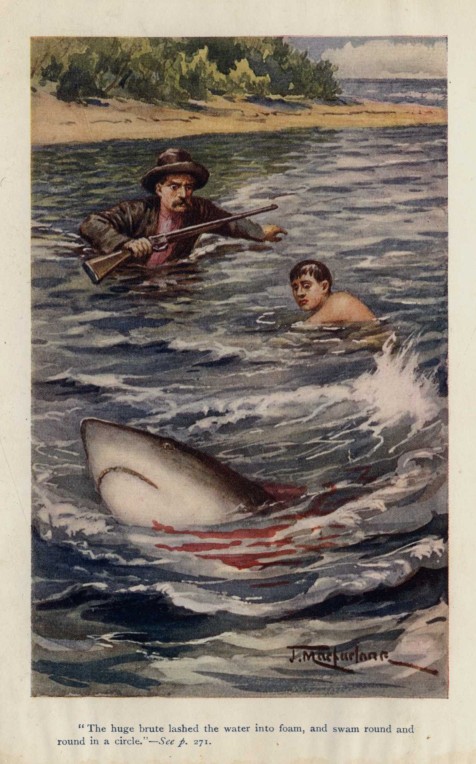
"The huge brute lashed the water into foam, and swam round and round in a circle."—See p. 271.
The group, which had been intently gazing at the carcass, turned round in a startled manner on bearing these guttural sounds. Immediately behind them was a cluster of aboriginals, five in number, who had stolen silently upon the scene.
"Hello, Cock-eye! that you?" cried Harry, as he surveyed the blacks. "Where you bin sittin' down, eh?"
"Cedar Crik. We bin come longa here get fis' for choppers."
"Oh, the timber-getters, hey! Well, you seem ter know this ole boss. You bin see 'im afore?"
"Plendy times. Bin often try catch 'im. He kill-ee mine sister. He too much lika dingo; no take bait."
"Well, you can git even with this joker, Cock-eye. He eat your people; now you chaps gobble 'im up."
The blacks are inordinately fond of shark's flesh, and—cannibal as this sea-tiger is—no question of sentiment may stand between these primitive men and a gorge.
"I say, Harry, cut that dorsal fin off for me, there's a good man, before these niggers tackle it. I'd like to keep that."
After a considerable amount of hacking, the stockman managed to separate the fin, and, leaving the blacks in undisturbed possession of the carcass, they returned to the Point, to feed, and to finish their work.
CHAPTER XXX
IN AND ABOUT THE CAMP
"O mellow air! O sunny light!
O Hope and Youth that pass away!
Inscribe in letters of delight
Upon each heart one golden day—
To be there set
When we forget
There is a joy in living yet!"
G. E. EVANS.
The fish cleaning occupied the best part of the afternoon; and when the party reached camp, about sunset, they were dog-tired; inclined for little else than supper and sleep.
"But you haven't told us how it came to pass that you were just on the spot to prevent the shark scoffing Joe," exclaimed Tom to Harry. "We didn't expect you back for hours."
"Niver had such a thing 'appen afore, I give yer my word. Lost me way in the dashed scrub; carn't understand it nohow. As a rule yer carn't lose me in a scrub; can feel me way be day or night. Instinct, they calls it. Ole Dumaresque says ter me one day, when we'd bin ridin' fer hours through heavy pine country after some strayed heifers, gettin' caught in the dark long afore we makes the homestead: 'How do you manage to tack an' criss-cross this beastly country without track or compass; not even a star to guide you? It fair beats me, my man. Why, I'd 'a' bin lost a dozen times over but fer you. You always seem ter be goin' wrong, yet always come out right.'
"'Carn't explain it, sir,' ses I. 'I jist do it.
"'It's all instinct,' ses 'e. 'It's like wot the dingoes an' blacks 'ave.'
"Instinct or no instinct, I got bushed all right ter day. There's something erbout it I carn't understand. 'Twasn't that I was careless, an' takin' no notice. I 'ad worked through the scrub a distance of four mile or so when, all of a suddent, I ses ter meself, ses I, 'Where the dickens am I?' Well, as soon as I put the question to meself I knows I was bushed, an' fer the fust time in me life I begins ter feel quite creepy like. I didn't know which way ter go. At larst I starts out in a direction that seemed the likeliest, but, somehow, I cud make no headway. Something seemed ter clog me feet, an' I was allers gettin' mixed up with vines an' brushwood.
"'Dash it all,' ses I, 'this won't do. Don't believe I'm goin' the right way, after all. Believe this ere way's leadin' me back to the Bay, an' I wants ter git through this blarmy scrub ter the forest, fer 'oppers' tails. I'll righterbout face, danged if I won't!' So round I turns, an' as soon as I started I got on fust clarss. Didn't git mixed up an' stumble as afore, but gits through the brushwood as slick as a bandicoot. 'Mus' be nearly through the belt,' ses I, after goin' fer an' hour or so. 'Mus' git the rifle ready, fer I might sight a kangy any moment now.' So I unslings the rifle from me back an' puts the gun in its place, an' stops a minit ter load 'er—the rifle I mean. I'd jist finished when I heers voices shoutin', an' then a great yellin', as if somethin' orful was 'appenin'. So orf I rushes through the scrub, an' comes out on the beach. I was knocked inter a heap, I gives yer me word; fer there before me was the sea, an' I thought I was on t'other side of the scrub altogether. Then, in a flash, I sees wot was really 'appenin'. Jist afore me very eyes was Joe. He was strugglin' in the water not more'n a hundred yards away, an' that 'er brute seemed as if it was jist a-fallin' on 'im. Why, I fired the rifle a'most without pintin' it. Somethin' seemed ter say, 'If yer waits ter aim yell be too late.' Be gosh! I'm thinkin' 'twas the Almighty Hisself directed that shot."
"If ye'd not losht your enstink, as ye calls it, ye'd be moiles an' moiles awa-ay at th' toime th' shark was goin' to gobble Joe up, wuddent ye?"
"In course I wud."
"Well, don't ye think th' good God had a hand in losin' ye in th' scrub?"
"It's wot yer father'd call an answer ter prayer," replied the stockman, turning to Joe as he spoke.
By this time the camp-fire—around which the group had been sitting—was burning low, and the party was quite ready for bed after the exciting and tirng adventures of the day.
The campers were astir at an early hour next morning, to make the final preparations for curing the fish. After filling both barrels, there was a quantity available for smoking. To carry out this object a sapling frame, about four feet square and seven feet high, was constructed, and enclosed with bushes, leaving an opening at the top and bottom. The fish were hung by stout cords, and a fire kindled on the earth inside the curing shed. Some green wood was used with the dry, to produce a fair, volume of smoke; and so the curing went on apace.
Leaving Denny in charge of the camp, the others spent the afternoon shooting over a chain of lagoons that lay back from the beach a couple of miles or so. The ducks were plentiful, and they returned to the camp well laden. They passed the two following days shooting and fishing, both fins and feathers being exceedingly plentiful. By this time they judged the fish to be cured, and packed it in a maize bag.
"Tell you what, boys! S'pose we ride over to the Pilot Station to-day? It'll be a change, won't it?"
The others received Joe's suggestion with ready approval, and before long were racing along the beach towards the Pilot Station. This was situated at the mouth of the river, and consisted of the residences of the pilot and the boat's crew.
It should be said that at the mouth of every Australian river flowing into the Pacific is a sand-bar. These sand barriers frequently shift their position, owing to tidal and other ocean influences. This makes entrance and exit to be a somewhat dangerous proceeding, and many a craft has come to grief on these treacherous sands. To reduce this danger to a minimum a pilot station exists at each river entrance. The pilot is generally a sea-captain with a large experience of these treacherous bars. It is his duty, weather permitting, to take daily soundings so as to locate the exact position of the bank, and by means of signals to apprise incoming and outgoing vessels of the position and depth of water on the bar; also, when required, to pilot the vessel over the dangerous spot.
Captain Craig, the pilot, was an old salt, with nearly half a century's experience of the eastern rivers of Australia. He received the boys very kindly, and, after offering them refreshment, took them to the signal station and look-out. When he had explained the methods of signalling, he allowed them to look through a very fine telescope. He was justly proud of this instrument, it having been presented to him by a company of passengers for his gallantry and seamanship in extricating his vessel from a rocky shore in a hurricane.
The time had now arrived for taking the bar soundings. Much to the boys' delight Captain Craig invited them to accompany him in the life-boat, and a few minutes later the crew were pulling the party from the miniature cove to the bar.
The water here, owing to the bar formation, was generally in a turbulent condition. Although it was a calm day, they found the boat exceedingly lively as she moved to and fro over the bar while soundings were being taken. They experienced sundry disagreeable qualms, and a certain screwed-up feeling in the region of the "bread-basket." The clacking tongues of the youngsters grew suspiciously quiet, and Tom's ruddy cheeks paled to an exceedingly bilious complexion. Had you quizzed these boys upon their sickly looks, they would have protested with might and main against the insinuation of mal-de-mer. Nevertheless they were mighty glad when the pilot, after half an hour's sounding, having accomplished his purpose, turned the boat's nose in the direction of home. Once out of the troubled waters, the sick feeling passed away, and at the solicitation of the lads "for a pull," the pilot good-naturedly allowed them to row to the landing-place.
Before leaving, the pals recited the story of the shark adventure, ending in the death of the tiger shark. Captain Craig listened with great interest, and not a little excitement, to this narration.
"You have had the narrowest of escapes, Joe Blain, and have very much to be thankful for," exclaimed he. "That shark was a most notorious character. He has roamed the Bay for years and years, and has destroyed many human lives. Innumerable efforts for his capture have been put forth by the fishermen, and by my own men, but in vain. Often sighted and fished for, he has resisted the many lures set for him. Again and again, when enclosed in their nets, he has broken through, and has long been their despair. Now, however, thanks to a good Providence, and to the clever shot of your friend here, this dreadful man-eater has been removed." Advancing to the stockman, the pilot shook him warmly by the hand, and thanked him in the name of the community.
As the party rode home in the cool of the evening, they decided to break camp next morning, in order to carry out their original intention of paying a visit to the old diggings.
CHAPTER XXXI
OFF TO THE GOLD DIGGINGS
"The mountain air is cool and fresh,
Unclouded skies bend o'er us,
Broad placers, rich in hidden gold,
Lie temptingly before us."
SWIFT.
Tents were struck, and the campers' impedimenta securely fastened to the pack-saddles, in the grey dawn of the following morning—the party having breakfasted by starlight.
The gold diggings about to be visited was situated in the ranges, equi-distant from Bullaroi and the Bay. The route from the Bay lay along the homeward track as far as the caves. At this point the trail turned due north—winding among the rugged country to the site of the mining camp, which, in its palmy days, covered a flat that lay between some precipitous hills and a swiftly flowing mountain stream.
The diggings in question was deserted, save by a few fossikers, or gully-rakers, as they were generally called—men who earned a precarious living by following up the dry gullies, and picking out wash dirt from between the rocks; or else dry-blowing likely spots of the surface. The lure of gold—so common to all—fed the imagination of these men. They became nomads; lived in the most primitive ways; faced and endured untold hardships; and, if not cheerful, were always hopeful. They saw visions and dreamed dreams—of gold. The years passed, age pressed heavily, eyesight grew dim, and limbs palsied with weakness: but even when broken down and encompassed with infirmity, their very senility sustained its spirits upon visions of the rich find that was surely coming—to-morrow.
When the diggings "broke out," and the rush "set in," the flat was white with tents, the population running into four figures. It was an alluvial diggings; that is, the gold was washed from the earth, and not crushed from the quartz. In the flush days of Rocky Gully, rich "pockets" of gold were struck, and huge fortunes made. Life then, in the character of its splendours and pleasures, was barbaric. Lucky diggers, with the spending lust upon them, ordered champagne baths, lit their pipes with five-pound notes, shod their horses with plates of gold, squandered their suddenly acquired riches on camp wantons, and among the harpies of the gambling hells. There were many exceptions to this foolish course, 'tis true; but such is the mental intoxication consequent upon a lucky find, and the sudden acquisition of wealth, that the majority of lucky diggers succumb, and in a few weeks or months, shorn of their possessions, either blow out their brains in remorse, or challenge fortune once more upon the same or some other goldfield.
Rocky Gully was now a worked-out diggings, and its population had long ago drifted away to other fields. Naught remained to remind one of its glory now but a few tumbledown houses, and the wood skeletons of iron buildings, together with countless heaps of empty tins and other refuse. Naught, that is, save a dozen or so of fossikers, who were distributed over the field; each having his area, into which the others never intruded.
How was it, then, that the Bullaroi party should have included a trip to the deserted mining camp in their programme of sport and adventure? There was nothing inviting in the region so far as game was concerned; nor was there the rough excitements of a live diggings. The truth is, it was the outcome of a suggestion of Harry. The stockman had a yarn he was very fond of relating, which included some tragic incidents associated with Rocky Gully. As a youth he lived there in its "boom" days, and towards the close of his stay there he was mates with Humpy Bob. Humpy Bob was an eccentric character, well known on a dozen goldfields, whose shrewdness as a gold finder was countervailed by his incredible folly in spending his riches. On one occasion, when he had struck a "pocket," from which he drew over a thousand ounces, he began a carouse which continued until the last penny was spent.
As illustrative of his folly during that spree, he purchased a general store for the sum of one thousand pounds. The same evening, in company with the drunken guests of a champagne party he had given, he proceeded to the store, deliberately fired it, and, with the other banqueters, stripped stark naked, danced a wild corrobberie while it burned.
Bob sober was the antithesis of Bob drunk. Abstemious, taciturn, industrious, solitary, with a genius for divining likely places, he followed the pursuit of gold: seldom failing to earn good wages; often winning handsome profits; occasionally making a pile.
Humpy's end came suddenly and tragically; and of this Harry was a witness.
The two men were driving a tunnel at a likely spot in the bank of a blind gully about three miles from the main camp. They worked in relays, and had driven in about a score of yards, when Harry suggested shoring it with saplings for safety. Humpy Bob, however, who was always running risks, made light of the suggestion. They had just struck a vein of promising stuff, which gave "prospects" of several grains to the dish. When it was Bob's turn to go on, Harry again suggested shoring up certain loose spots; especially one near where he had been picking, for there had been a small fall during his shift. This the other would not consent to, though his partner pleaded earnestly.
"There's a hundred to one chances against there being anything serious, mate, and I'm not goin' to waste any time in propping up the blessed tunnel. It's not worth it. We'll most likely clean it out to-morrer. So-long!"
So saying, the digger entered the drive, and was soon at his work. Harry, having nothing to do for a while, went to the tent and stretched himself on his bunk for a rest, intending to return in an hour or so to wheel out the mullock. Unfortunately he fell asleep, and hours passed by before he awoke. When he did, he jumped from his bunk and ran out to the drive, scolding himself for his negligence. The barrow was missing from its usual place, and, after a hasty search, the youth went to the tunnel's mouth and shouted to his mate. There was no response, nor were the usual pick sounds to be heard. The light was still burning at the end of the tunnel. Hastily traversing the drive in a half-stooping position, as indeed compelled by the size of the tunnel, the youth covered about half the distance when he stumbled over the barrow, severely barking his shins. Using hot language against the carelessness of his mate at leaving the barrow in such a place, and with a half fear at the unsatisfactory look of things, he scrambled up and went on towards the end of the tunnel. He had not taken more than two steps when he again stumbled; this time over a softer substance. It was his mate!
Humpy Bob was lying unconscious, half-covered with a mass of fallen earth and rocks. Groping his way across this pile of débris, the excited and frightened youth reached the end of the drive, seized the light and returned to his mate.
Tearing frantically at the soil and stones, he liberated old Humpy, and, as gently as possible, drew him to the tunnel mouth. Then dashing to the little stream below, he brought water in a billy, and made the customary attempts to restore his stricken mate to consciousness. His utmost attempts availed not. The vital spark had fled. Not all the resources of medicine or surgery could bring light into the half-closed eyes, or life into those rapidly stiffening limbs. Humpy Bob would never again unearth a nugget, rock a cradle, appraise the value of a prospect, or get on the "razzle-dazzle" and "paint the town red."