PALS (continued 2)
Reading edition
The woman made no response to this appeal and plan of salvation. "Is she really alive?" The eyes are half closed and seemingly peering; the form is rigid, the face immobile. There was naught of that expression in this countenance that Joe, from hearsay, was wont to associate with death—the peace that passeth understanding. Yet as the lad gazed at this apparently inanimate object there was a movement of the body. The blanket, bunched into many folds across the breast, stirred visibly.
Again that eerie, inarticulate cry!
Disengaging one hand from the tree, the boy stretched it forth to the woman's breast, which, covered as it was with the clothes, had all the seeming of life and movement.
Joe was in the very act of removing a fold of the blanket, when suddenly, and without the slightest warning, there rose up into the lad's face an angry, hissing, venomous snake, the deadliest of its kind. Its beady eyes glittered; its forked tongue shot in and out with inconceivable rapidity; its sibilant hiss was accompanied with a musky odour, sickening in the extreme; its head and body for half its length were erect, and bent forward from the neck, vibrating and swaying in a rhythmic movement. The reptile was within striking distance. In another second that almost invisible death-stroke will be dealt; invisible, that is, by reason of its lightning-like speed.
But this deadly intention is defeated by an involuntary movement on Joe's part. This young man, for the briefest of brief moments, clung to the tree with a rigid grasp; eyes staring in amazement and terror, with mouth wide open in automatic gape. Any attempt to defend himself were useless in the most absolute sense of that term. In another tick, before he can move a hand, these poison fangs will be deep buried in his horror-stricken face, so temptingly near. The only hope for the lad lay in doing a disappearing trick. And this happened. Had it been premeditated, however swiftly, the time taken to make up his mind, and to telegraph the resolution formed in the brain to the nerve cells and muscles, would have been sufficient for the lightning stroke to fall.
What really happened was this: the apparition of the red-bellied, black snake simply petrified Joe. An awful, blood-curdling, hair-raising, galvanic shock of abject terror, contradictory as it may seem, paralysed the lad. Simultaneously with that he is falling through space, an inert mass, to be soused into the water with a splash that sent the spray flying over the boat's crew.
At the moment of the splash, Joe's mind, will, and nerve were restored to their normal activity. The instinct of self-preservation, so strong in all healthy natures, especially boys', did for the lad in an infinitesimal fraction of time as much and as effectively as though he had taken, say, half an hour to plan his procedure.
He had, however, in escaping Scylla fallen into Charybdis. As soon as Joe reached the water he made for the boat. Fortunately he did not fall into it, or this story might never have been told. He fell into the stream, some two or three yards away from the skiff. Quickly as he was carried down-stream he managed by violent efforts to reach the boat at the stern. Tom clutched him frantically by the shirt collar, enabling the swimmer to get his hands on the gunwale. Joe, thus helped, clambered into the boat or ever the boat's crew had recovered from their consternation.
"Oh, Moses!" exclaimed, or rather gasped, he, "that—was—a go. Whew!"
"My goodness! How'd yer come to fall kersplosh like that?"
"Why!" pointing up. "See! there's the beast. See him crawling out there?"
The boys, looking up, descried the snake winding its sinuous way along a lateral bough that grew up above the forks. The disturbed and excited snake, having reached the limb, wound its course till it reached a clump of bushy branches on the limb's extremity. On this it coiled itself, save the head and neck, which stood erect in vigilant attitude.
"Oh, crikey! was that there on—in the body's—the woman's body?"
"Yes, Jimmy; right in the blanket on her breast. 'Twas that brute moving under the blanket that I thought was her breathing. Oh, my!" again exclaimed the youth, with a shudder, as he thought of the imminence of the danger which confronted him a moment before.
"Is—it—her—dead, Joe?" asked Tom after an interval of silence.
"No doubt of it, boys."
"Wonder if the snake bit her?"
"May have. Anyway the poor thing is dead all right."
"What's bes' thing to do now?"
"W-e-ll, I d-o-n't know——"
Again that shrill wailing cry!
"Can't be the woman!" said Joe excitedly. "Why, she's as dead as a herrin'!"
"I have it, boys!" shouted Tom, as he jumped up excitedly and cut a caper. "It's the darned ole cat!"
A look of great relief passed over each countenance at the thought.
Tom, meanwhile, lifted up the locker lid, disclosing the rescued cat, which, together with her two bairns, were stowed in the locker shortly after being saved from the flood. The animals were snuggled together on a cornsack, and looked the very picture of contentment. The kittens were dining baby fashion, and the mother's purr declared the very excess of maternal rapture.
On seeing the boys, pussy gave a low, affectionate miaow, and made a sympathetic movement of the tail, as if to say: "Thank you a thousand times, young gentlemen, for the good deed which we never, never shall forget." And then, motherlike, proceeded to "lick" her offspring.
"It's not the cat, Tom."
"Well, what on earth, water, or air is it?"
The mystery is insoluble. As the boys look down upon the happy and contented felines, they one and all reject Tom's confident affirmation of a moment before. If not the cat, what then?
Again the tiny, shrill cry arose, but not from the cat's mouth. It came from the tree above, and as the startled youths looked up they saw the overhanging end of the blanket agitated.
"Why, why—the poor thing must really be alive after all, chaps. There's something more up there than I've discovered; so here's up again!"
Acting on this impulse, Joe again ascended the tree. Those below watched intently, their feelings strained to the utmost tension. As soon as our hero got to his former position in the forks, he received another shock. It was sudden as the other, but not so disastrous. An inarticulate and involuntary cry brought fresh alarm to his pals, who all the while were staring up, too frightened to ask any questions. The boy, despite the second shock, still clung to the tree. The woman was dead beyond all doubt, but death is counterbalanced by life. A brief and astonished survey, and the boy leans over the limb and speaks quietly to those below—
"The woman's dead, boys, but there's a baby here. It's tied to her breast. It's alive!"
Just then, as if to demonstrate the truthfulness of the statement, the babe lifted up its voice once more in a feeble cry. The scene in that tree Joe never will forget; the like he will not see again though he rival Methuselah in age. The only thing he can yet see is a little hand and arm, which have wriggled from the covering. Moving cautiously along the branch to the converging point, leaning on one fork, and placing his feet against another so as to stiffen himself, the boy was able to use his two hands. He first, and not without an inward tremor, removed the dead hand which lay upon the blanket, the stiffened fingers still clutching the clothes and holding them to the breast. The last thought and the last act of the exhausted and dying woman was to succour and to defend her little one.
Straightening the arm so that it lay by her side, Joe opened the blanket from where the little hand stuck up. There, on the breast of the dead, she lay, a sweet-faced baby girl! The little one's face was puckered up, 'tis true, and there were tears upon her pale cheeks. The cries and tears were not the symbols of pain, they were those of hunger. Joe could plainly see that all the mother's thoughts were for the child. It was snugly folded in the blanket end; then tied to her waist by a handkerchief passed round the body. The remainder of the blanket was then arranged so as to thoroughly protect the child from the inclement weather.
Untying the handkerchief, the lad folded it in a peculiar fashion like as he had seen the black gins do. Carefully lifting the babe, he laid it in the widest part, made it secure to the body under the arms, and placed it on his back, bringing the ends of the wrapper together. round his neck.
This done, he prepared for the descent. It was easily accomplished, even with the incumbrance of the child. Landing safely in the boat, which was kept well up to the tree, Joe placed her in the stern on the locker seat, where the little one lay squirming and crying piteously.
The news of the baby variously affected the boys. Jimmy Flynn, whose baby sister had died a few months before, looked very tenderly upon this nameless waif.
"Make a place on the floor for it, Joe," said he. "It'll lie there more comfortably, an' it'll be more like a cradle."
The advice was good. The coats, which the boys shed soon as they entered upon the expedition in the morning, made a soft bed for the little one. The wee mite was evidently about nine months old. For all its adventure and exposure it seemed to have suffered little, and now in its cry is only voicing the pleadings of its empty stomach. It was adequately, though very plainly dressed, and through all the rain of the preceding night had kept dry. Fortunately, too, the snake which had been curled up in one of the blanket folds had not come into actual contact with the child. There were only two things required to bring it to a condition of happy contentment: nursing and feeding.
Capable as this quartet of Australian lads were in many ways, in this they were novices. So it was with a look of ashamed helplessness that they gazed at the new passenger, as she lay in the bottom of the boat on her back, kicking her heels in the air at a great rate, and doubling her dimpled hands first into her eyes and then into her mouth. The cry went forth without ceasing, its only variation being the peculiar noise caused by an intermittent sucking of her diminutive fists.
By a happy thought of Jimmy the hunger difficulty was overcome. The boys had picked up a fine lot of oranges, as well as some dozens of plantains, in the back-water. After they had eaten a quantity they stowed the balance away in the bow locker, and completely forgot them in the exciting events which followed. Jimmy suddenly remembered the fruit. Selecting a fine specimen, he quickly peeled and quartered it. Then, seeding some of the quarters, he put one in baby's fist, guiding the same to her mouth. The sweet, juicy orange was simply nectar to the famished child. It sucked as only a hunger-bitten baby can. The boys were highly amused at the way in which she mouthed the skin, and the difficulty Jimmy encountered in unlocking her little fingers order to substitute a full for an empty quarter. It indeed a happy solution; an admirable recipe for tears and squalls. As long as baby had an orange quarter it was peaceful. After a little while Jimmy took the little one on his knee, giving furtive glances towards the others as he did so. The boys, however, under all the sad circumstances forebore to chaff. Substituting, at length, a ripe plantain for an orange section, the babe was taken to the seventh heaven of gastronomic bliss.
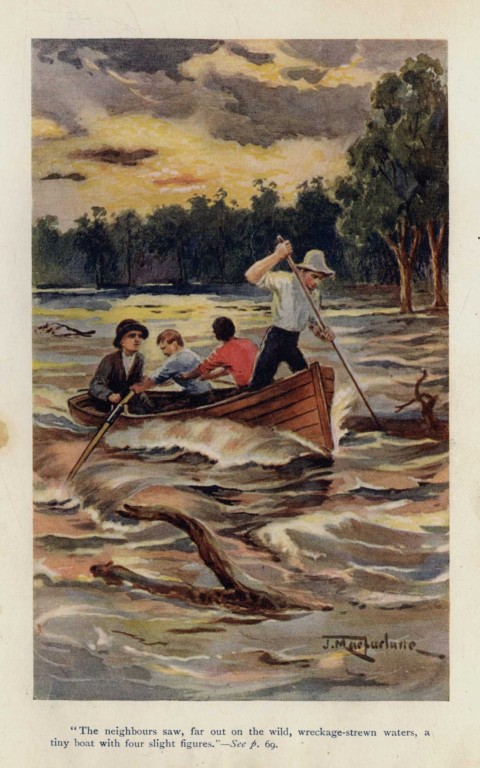
"The neighbours saw, far out on the wild, wreckage-strewn waters, a tiny boat with four slight figures."—See p. 69
And the while above them in the she-oak, whose thread-like leaves make mournful music to the wind, lies the mother who has sacrificed her life for that of the babe. There is no doubt of this. The poor woman must have been exposed to the winds and waves long before she reached the tree refuge. How she got there was never known. She had almost denuded herself to protect the babe. Little wonder that at some moment of that awful night vigil the vital spark should have quitted its terror-haunted tenement.
CHAPTER X
THE RETURN
"See the conquering hero comes!
Sound the trumpet, beat the drums."
After baby's hunger was satisfied the boys' attention was given to their immediate surroundings.
"What are we goin' to do about her?" asked Tom, pointing upward as he spoke.
"It's simply impossible for us to do anything. If she were alive we would take any risk. But as things are it is beyond our power to shift the body, it is jammed so tightly. The only thing left for us to do is to inform the police when we get to the other side."
"What'll we do now, Joe?"
"Get back to our former anchorage first. River's goin' down pretty fast, I reckon; and it'll be all dry about here before morning if it recedes at the same rate. The current is not nearly so strong as it was when we came over, and that will make it easier for us to get out of the clump. There's no need for us to go back by the same course. We can take a slant across to that red gum, and when we're there we're out of the stream."
The exit from the cluster of trees was very well managed, and in a few minutes from the time of casting adrift from the she-oak the boat was out of the clump and across the narrow stream into the slack water. They continued on to their former camping place, and hitched on to the tree.
This gallant attempt at rescue, though not accomplishing what was in the minds of the boys, was not altogether a failure. Indeed, it was the reverse of that. Though but little time is consumed in reading the account of this episode, it covered a goodly portion of the day. By the time the boys had made fast to their former anchorage, the slanting sun-rays proclaimed the advance of eventide.
"Let's have a confab, chaps, on what's best to be done. I don't s'pose any of us is wanting to stick here all night. What d'you say, Tom?"
"I say pull over to the hillock on the other side of the slack. See! the water's retreated from the high ground. We could camp there, I dare say, easy enough, and get home early to-morrow morning. I don't think we ought to tackle the river to-night. I bet you it'd be a measly, tricky trip. So I vote to do as I said."
"What d'you say, Billy?"
"I say same as Tom. Plenty dry land over there. Might get matches in that house behind the hill. I'll pull 'possum outa spout, an' we'll roast 'im an' make bully feed."
Billy, as indeed were all the boys, was beginning to feel desperately hungry.
"What have you got to say, Jimmy?"
Jimmy Flynn, who had been gazing wistfully across the flood waters, turned round slowly as Joe put the question to him. "Oh, Joe! can't we get home to-night? The river isn't so bad as when we crost up at the Bend. There's not nearly so much timber goin' down now. 'Sides, it's easier crossing down here to what it was above. I give a straight vote for—home!"
"Bravo! Well done, Jimmy! You're a brick. It's just the word, an' we're the coves to do it. It's my vote too, my hearties. We've half an hour of sun left: say an hour before it's right dark. I reckon 'twill be about two mile an' a half from here to Tareela. It won't be near as difficult as up by the Bend. Yes, we'll do it, boys; an' the sooner the better. Then there's the blessed little baby, you know! Some of us would have to mind her in the night, an' what about your beauty sleep then? I reckon the kiddie would be too much for the whole boilin' of us. And I've a notion that too much fruit'll be worse for her than none at all. S'pose she gets the jim-jams! And, lastly, as father says when he's preaching, what about the old folks at home?"
There was no need to say anything further.
"I'm game, for one," said Tom.
"I'm game, for two," said Billy.
"I'm game, for three," said Jimmy.
"Put me down for the fourth," said Joe.
"Now, boys, that's settled. We'll tackle the river straight away; for better or for worse, as dad says in the marriage ceremony. And I say, chaps, let's ask God to help us."
Though there was no audible form of expression, the spirit of prayer was in each boy's heart. He who sat above the floods heard and answered.
"Billy and Jimmy are to take the oars. We want the best men at the paddles. Now then, Tom, let the painter go an' keep the pole handy for driftwood."
The painter is slipped, and the boat's head is turned riverwards. She is soon out of the slack, and feels the full force of the flood. The starting-point was nearly a mile and a half above the township, so that there was a liberal margin for drift. The river was quite a mile wide. There was still a quantity of driftwood, and many difficulties beset them which made delicate steering and skilful management incumbent. When they had travelled about half the distance, Tom, who was eagerly conning the other shore, gave a shout, pointing at the same time to a headland above the village.
"Some 'un's waving! See 'em, over there!"
Mrs. Blain was the first to spy the advancing boat. The boys' mothers had been trapsing the lagoon shore and river-side for hours, in a semi-demented manner. The minister and the others had returned after a fruitless errand. The police, with a strong crew in the Government whale-boat, were scouring the shores in the vicinity of the Bend, and had not returned. The disappearance of the boys had seemed most mysterious until the break-away was discovered. Then the accident as it really happened was immediately conjectured. The profoundest sensation was created in the village, for the boys were dearly loved by all.
The feelings of the poor parents may be but faintly imagined. Great was the relief, therefore, when Mrs. Blain, whose eyes were devouring the flood waters in her frantic eagerness to discover some hopeful sign, suddenly screamed out in an alarming manner, gesticulating wildly as she did so, and acting to outward seeming in a frenzied fashion. Other searchers, scattered along the river-bank, hearing the piercing cry, and seeing the untoward gestures of the joy-possessed woman, came running towards her, thinking for the moment that she had lost her reason.
"See, see!" screamed she, pointing to a distant spot on the waters. "They're saved, they're saved! God be praised, our lovely boys are returning all safe; yes, one, two, three, four—the darlings."
Looking in the direction indicated, the neighbours saw, far out on the wild, impetuous, wreckage-strewn waters, a tiny boat with four slight figures running the blockade; threading their course between the thousand objects which intervene and threaten destruction.
The good news is now shouted from end to end of the township, and in a few minutes the river-bank is lined with exultant and yet anxious spectators. For the joy of the discovery of the lads is almost quenched at times by sights of the perils of the passage.
The mothers of Joe, Tom, and Jimmy are grouped together, wrought up to such a pitch of anxiety as to be well-nigh silent. They noted every danger and counted every oar-stroke. The gallant rowers lifted their blades in the twilight, as the last rays sparkled on the flowing waters. Beyond a landward look the boys had no time to bestow upon the excited spectators. Eye and mind, in close conjunction, are continuously engaged in evading danger and maintaining the boat's position.
"We'll make the point," exclaimed Joe, after an interval of silence. "We'll make the point, all right. Keep her steady, lads," turning the boat's nose, as he spoke, well up stream, at an angle inclining shorewards. "Now, pull like a prize crew for five minutes an' we're there. We're out of the driftwood as it is."
The rowers needed no further stimulus. They bent to the oars like old salts.
"Capital! just the stroke! Keep it up! Hear 'em cheering!"
The cheering spurred on the boys, and in less than five minutes they landed in the midst of a wildly excited and loud-cheering crowd. And wasn't there a hugging and kissing, and hand-shaking and back-slapping!
Just as the women were up to their necks in it, to use a homely figure, some one happened to glance at the boat. The glance extorted a scream.
"A baby, a darling baby! See, see, see! a little baby in the boat!"
A moment's dazed surprise, and every one crowded to the boat. Joe, who had not moved far from the boat's nose, and who only waited for the violence of the welcome to abate a little that he might call attention to the precious freight, waved the jostling crowd back, and in a few words related the incident of the rescue.
A great wave of feeling passed over the crowd as he spoke. The women wept copiously as the scene was conjured us, and strong men unconsciously shed briny tears as the story reached its culminating point of the discovery of the helpless and orphaned babe, bound to the dead breast of her who had thus made the great sacrifice of motherhood.
While Joe was reciting the story of the rescue, Jimmy Flynn held on to his mother's arm and whispered excitedly into her ear. The narrator had hardly finished ere Mrs. Flynn stepped forward to his side and faced the crowd. Ordinarily, this woman was undemonstrative and shy. Now she is unconscious of any timidity. The moment was an inspired one; to produce which Jimmy's whisperings had played an important part.
"Mr. Blain, and friends all, give me the darling baby. It'll take the place of the one God took from me last month. The clothes'll fit——"
The bereft mother could get no further. Any woman who has lost a child will tell you why.
"My friends, you all know Mrs. Flynn, as I know her. If it were a matter of choosing between you, I should still say that no one in the town is better fitted for the sacred duty of mothering this little flood-driven stranger. None of us can say to whom the child belongs; whether there is a father or near relations. But until it is claimed by those who can prove the right to do so, the very best of all possible arrangements, and one I regard as providential, will be for Mrs. Flynn to take this baby to nourish and cherish it."
The murmurs of assent were unanimous. Joe, without any more delay, stepped into the boat, and, picking up the child—which all this time looked round, wondering in its baby way at this ado—put the little one into its foster-mother's hands.
The river baby was evidently delighted beyond measure to receive a warm motherly embrace; judging, at any rate, by the way it gooed and crowed.
As soon as she could get through the admiring throng, Mrs. Flynn hastened home, and before long the baby, washed and dressed anew, was filling its "little Mary" with sweet new milk.
CHAPTER XI
THE BREAKING-UP
"With trumping horn and juvenile huzzas,
At going home to spend their Christmas days,
And changing Learning's pains for Pleasure's toys."
TOM HOOD.
Out through the gateway of the National School, on one sultry afternoon in late December, tumbled a pack of noisy boys and scarcely less noisy girls; the while they kicked up a fine dust, yelling in an uproarious fashion. Were you, a stranger, to ask the cause of this demonstration of voice and capering limbs, you would be answered by a score of voices in rousing chorus—
"Hip, hip, hurray for Christmas Day!
School's broke up, hip, hip, hurray!"
However strongly one might be disposed to question the quality of the couplet as he listened to the trumpetings of this cluster of children, he would cheerfully admit the gusto of the proceedings as the juveniles issued pell-mell.
If truth be told, the master was no less pleased than the youngsters when the actual moment of dismissal came. Like all schools, this particular one was infected for weeks previously with a spirit of restlessness, which made it well-nigh impossible to secure the undivided attention of the children. There was no disposition for serious study, and Simpson, who was a wise teacher, attempted no coercive measures. Natural history was presented in its most attractive forms. Grammar and arithmetic were for the most part tabooed, and instead of puzzling refractory brains with arithmetical and grammatical abstractions, the children lived in the jungles of India, crossed Sahara, took a trip to the Booties, wandered into Arctic circles, or, what was equally exciting, made transcontinental trips in company with Sturt, Burke and Wills, Leichhardt, and other great Australian explorers.
Many were the schemes unfolded and plans laid by the boys during the last schooldays. The holidays would not be an undiluted playtime to any one of the boys. Many of the lads would work hard on the farms; their parents, bearing in mind the old adage of Satan and idle hands, will take good care to anticipate the sinister designs of that interfering old gentleman. The wood pile stood as an unfailing object of labour. Sheds were awaiting the whitewash brush. Fowl houses loomed expectant. Fences demanded attention. These, and many other duties about house and farm, were put off till the "holidays."
There were other anticipations, however, far more highly coloured and bewitching than these. Charm the schoolboy never so wisely, his thoughts, with a dogged obstinacy or triumphant breakaway, return to the delectable things of the groves, streams, mountains, and plains. Horse, gun, dog, rod, bat, duck, quail, pigeon; perch, bream, mullet; kangaroo, wallaby, dingo, brumby, scrubber! These are the sources and instruments of pleasure; things that people the imagination, and make an earthly paradise.
Sobering down, after an unusual indulgence in larks to mark the auspicious event, Joe, Tom, and Sandy, separating from the others, sauntered to the slip-rail entrance of the school horse-paddock. Joe and Tom, at the express request of Mrs. M'Intyre, are to spend the holidays with Sandy on the station. Here all kinds of fun and alluring adventure are promised the lads. How well that promise was redeemed let the sequel bear witness.
"Now then, you fellows, don't forget that you are to be at Bullaroi on the morning of Christmas Eve without fail."
"I say, ole boss, what does eve mean?"
"Eve! Why, a—er—short for evening, I s'pose. What makes you ask, Joe?"
"Well, if Christmas Eve is evening, how can we be there in the mornin'?—you savee?"
"You're mighty smart, Blain, but did you ever know an evening that didn't have a morning to it?"
"Oh—ah—yes, I see. We're to come out on the morning of the evening. Sure it's an Irishie ye ought to be instead of a Scotchie."
"Scotchie or no Scotchie," replied Sandy, who was the essence of good-humour, "ye're not to be later than ten o'clock of the forenoon of the day before Christmas. There! Will that fit you, you pumpkin-headed son of a bald-bellied turnip?"
"Thanks, M'Intyre; I'm sure my father'll be delighted when I tell him the respectful titles you've given him," returned Joe, with mock sarcasm.
"He'll no dispute the title of his son's head, anyhow," flung back the Scotch lad, as, bridle in hand, he strolled on to round up his steed.
This parthian shot nettled Joe, but the answer he would have given remained unuttered, for at this moment his eldest sister appeared and beckoned to him in an emphatic manner, at the same time calling upon him to hurry. So, contenting himself with levelling Midshipman Easy's masonic sign at the retreating lad, he hurried along towards his sister.
"Father wants you to go down the river with him in the boat."
"Where's it to?"
"Down to Beacon Point. Tom Tyler's had a bad accident, and they've sent for the doctor; but he's away. He was called out to a bad case at Dingo Creek head station, and is not expected to be back till midday to-morrow. So they've asked father to go down, and you've to hurry along. Father's waiting down at the boat for you."
Mr. Blain was waiting at the boat with everything that was required for the trip. As soon as the lad was in, he pushed off, and, taking the stern oar, with Joe at the bow, father and son started on their twelve-mile pull.
In answer to the boy's question the minister gave some details of the accident, and, further, informed the lad that it was his intention to call at Mrs. Robinson's, distant about five miles from Tareela.
They had now settled down to a steady stroke, and as the sun was on its westering wheel, and the sting out of its slanting rays, the row became enjoyable. Mr. Blain was a sort of newsletter to the settlers, and in his trips up-stream and down-stream was frequently hailed and made the target of questioning from the riverbank.
Robinsons' was reached a little before sunset, where they were made abundantly welcome. Some years previously Mr. Robinson met his death by one of those accidents all too common in new settlements. Felling scrub timber is a risky performance. It so happened that in felling a stout fig tree, Robinson failed to notice some lawyer vines that, hanging from the high branches, had attached themselves to the bare limbs of an adjacent dead tree.
Standing at the base and watching the toppling fig tree, as it slowly swayed preparatory to its final crash, he was unaware that the cable-like vines were retarding its progress. Gathering way, however, the falling tree brought a strain upon the vine, and tore away a heavy limb of the dead tree. This falling upon the axe-man, killed him instantly.
The widow was blest with a family of boys and girls who were true grit. Misfortune breaks some people—it makes others. The latter was the truth in this case.
In all the trying times Mrs. Robinson underwent, the minister was her friend and counsellor.
CHAPTER XII
DOWN THE RIVER
"When the full moon flirts with the perigee tide,
On a track of silver away we ride,—
Oh, glorious times we have together,
My boat and I in the summer weather."
ELLA WHEELER WILCOX.
The boat was sighted from Robinsons' some time before its nose grated on the shingle at the landing-place.
Isaac, the younger son, a giant in stature and a prime favourite with Joe, was at the landing-stage. Seizing the bow what time it touched land, he half lifted, half dragged the boat two-thirds of her length out of the water, and made her fast to an old stump.
"Mother's so glad you've come, sir. She wants to talk with you about that boy of Maguire's, who's bin givin' us a lot of trouble."
"Won't be able to stay long, Ike. We've got to be at Beacon Point to night. We just put in for a cup of tea and a bite. Mother's inside, I suppose? I'll go in and have a chat with her."
"You'll find her in the kitchen, sir. When we saw you roundin' Piccaniny Point we knew you'd be here for tea, and mother's lookin' after things."
"I hope she won't go to any trouble. A mouthful is all we want."
"Well, you know mother, sir. She feels that nothin' is near good enough."
"Any pancakes for tea, Ike?"
"Pancakes! Why, of course. That's what mother's makin' now. She knew that'd be the first thing you'd be askin' fur, Joe."
"Rather, Ike!" said Joe, pursing his mouth and drawing in his breath with the peculiar, half-whistling, unwriteable sound which boys instinctively make when visions of goodies arise. More especially when such goodies come within measurable distance of consumption.
Master Joe had a healthy boy's appetite. The rowing exercise gave additional spice to his hunger. Pancake was at that moment the gate of entry to the boy's very material heaven.
"Tea won't be ready fur a few minutes, Joe. Let's go down to the barn. I was just goin' to rub some more mixture inter the skins when I seen your boat roundin' the point. Sorry you're goin' on, my son. When I seen you on the river I ses to meself, ses I, 'By George! Joey an' I'll have a great night at the 'possums.' I wish to goodness you'd been stayin'. There'll be a grand moon ter night, an it's very temptin'."
"By gum, ain't it just! It'd be simply, rippin'. 'Member last time I was down? That was a grand bit of sport we had. Forty-seven was it, or forty-nine? I know it took a dashed long time to skin 'em."
"Forty-seven it was. We'd do over fifty to-night."
"Well, as mother says, 'What can't be cured must be endured.' By dad! that's a grand wallaby skin! Where'd you get it?"
"Got it larst night." Ike had the Colonial drawl to perfection. "I was up at the top end of the scrub cultivation paddick, mooseying around after some cockatoos that'd bin skinnin' the corn. It was just about dusk, an' I was waitin' in the corner for the cockies, as I knew they'd soon be leavin' fur their roosts, an' my bes' charnse at 'em was on the wing. They're so 'tarnal cute, yer know, yer carn't git 'em on the corn."
"I know. Didn't I try my best to stalk 'em the last time I was down, Ike! I got three altogether, you 'member, an' you said it'd be a crest apiece to take home to the girls."
"Waal, as I was sayin', I'd sarcumvented the ole boss cockie, which was keeping watch in the dead gum-tree that stood in the middle of the patch, an' was posted in the middle of the corner expectin' them ter fly over every minit. But ole Pincher, who was chevyin' about, starts this ere boss outer the pumpkin vines; they're death on pumpkins, yer know. The dorg made a dash at 'im, an', by jings! he did streak. Greased lightnin' wasn't in it with 'im. I tried to draw a bead on 'im, but, what with the dusk an' the bushes an' stumps, I couldn't get a good line. I banged away one barril, but was yards off, I reckon.
"Pincher, he disappeared in a brace of shakes, an' I made sure the vermin ud get through a 'ole in the fence. I was makin' for 'ome, 'cause the cockies, yer know, 'ad all gone. All of a suddent I heers a yelp, an' knew ole Pinch 'ad somehow 'eaded 'im. Reckon 'e missed the 'ole, or the dorg'd never got near 'im. Anyhow, 'e was a-streakin' a bit now, an' Pinch at 'is 'eels. He was makin' fur the maize agen. I lined 'im this time all right, though it was a longish shot; about sixty-five I reckon; an' dropped 'im clean at the very edge."
"It's a prime pelt, anyway."
"Yaas, 'e was a grand ole buck fur a wally; about the biggest I've got this season."
"How many skins have you taken, Ike?"
"Two more'n I'd 'ave six dozen."
"Gettin' a good price for 'em?"
"Waal, Jack Croft, 'e offered me nine shillin' a dozen fur 'em. There are about twenty kangaroos among 'em. Jack reckoned it was a stiff price, an' 'e sed 'e'd not offer anythin' near it but fur the kangaroo skins, which 'e 'ad a fancy fur."
"Old Jack can put it on, you know."
"Oh, I know Jack all right! Me an' 'im's 'ad dealin' afore. Jacky's not too bad, but 'e knows 'ow to draw the long bow. Anyway, ole Eb Dowse's boat'll be along nex' week. He's sent word ter say as 'e'd do a deal with me fur 'em."
"Better wait an' see what Eb'll shell out for 'em, Ike, I reckon. German Harry, up the river, says he can always knock a shillin' a dozen more out of Eb than Jack."
"I ain't hurryin', Joe."
Just then the welcome supper cooee reached their ears. The boys lost no time in getting to the supper-table. Joe instinctively eyed the contents. Cold streaky bacon; a big dish of fried pumpkin and potatoes; a mountain of home-made bread, sliced; a basin of prime butter; Cape gooseberry jam galore, and amber-tinted honey in the comb. What more could any hungry lad desire?
Mary Robinson, a great tease, caught Joe's glance, and said, with an amused smile, "No pancakes to-night, Joe."
Joe was abashed for the fraction of a second. Quickly rallying, he laughingly said, "Tell another, Mary, while your mouth's hot."
"Very well, my boy! If you don't believe me ask our black tom-cat. He chased a mouse into the batter and upset the bowl; so there!"
"Mary, Mary!" remonstrated Mrs. Robinson. "There's only a grain of truth in the pound of fiction she's giving you, Joe. The cat, it is true, did chase a mouse; but it did not jump into the batter, nor was the bowl upset. The pancakes are cooked, with currans in 'em; just the sort you like; and they're keeping hot by the fire."
"Thanks awfully, Mrs. Robinson; I believe you anyway. As for Mary, she's like Sandy M'Intyre's old, toothless sheep-dog."
"How's that, Joe?" interjected Ike.
"Bark's worse than her bite."
"My stars! what originality, what refinement! Sandy's razor is not in it with master Joe Blain for sharpness. I'll remember this, though, the next time you ask me to go out to the scrub with you for passion fruit. Anyhow, there's no resemblance between you and Sandy's wonderful barker."
"Indeed!"
"No; your bark's noisy enough, but your bite's a hundred times worse—especially when pancakes are about."
With this "Roland" Mary ran out to the kitchen to get the teapot.
Joe made a royal repast, topping off with the hot pancakes at a rate which caused his father to dryly remark: "Too much pancake won't help the boat along, my boy."
Tea finished, the visitors prepare to continue their voyage. With Ike's powerful assistance the boat is shoved into the water, and her nose pointed down-stream. In due time Beacon Point is reached.
CHAPTER XIII
OFF FOR THE HOLIDAYS!
"Boyhood is the natural time for abundant play and laughter, without which rarely does high health touch young cheeks with its rose-bloom, or knit bones strongly for the fighting and the toiling that awaits them."—JOSEPH H. FLETCHER.
"Now then, Norah, look slippy with breakfast! It's half-past six, an' Sandy's to be here at seven. Said he'd leave the station at five with the spare horse for me."
"Begorrah! at the rate breakfast's cookin' it'll be midnight before it's ready. 'Tis the bastliest wood that niwer was."
"Time the fish was fryin', Norah."
"Fish, bedad! For two pins ye wuddent have anny fish. The thrubble Oi've had wid thim! Phwat for did youse lave thim in the bag all night? If ye'd put thim out on the dish, ye spalpeen, Oi'd have seen thim and claned thim long ba-fore Oi wint to bed. 'Sted of which it's tuk me two morchial hours to scale the brutes, they was that dry and hard. Be Saint Pathrick, they scales was loike porky-pine's pricklies!"
"Sorry, Norah; my fault as usual," remarked Joe good-humouredly. "Father called out to turn the horse from the lucerne just as I reached the back door. So I threw the bag down on the steps to chase the moke, an' clean forgot 'em when I came back."
"Well, Oi'll forgive ye wanst more, which makes about a million tousandth toime; but, moind ye, 'tis——"
"All serene, Norah! Oh, I say, Norry, I'd nearly forgotten it! Paddy Lacey asked me yesterday to tell you that they want you to go to the Hibernian picnic on Boxing Day. They've chartered the Firefly, an' are goin' down to the Bar."
"God's truth! 'tis only gammoning me ye are, Masther Joe. It's a young thrick ye be, indade, with yure Hayburnion picnacs."
"It's as true as true, Norah. No make-up this time. An' oh! I say, d'you know what Jimmy Flynn tole Tom Hawkins?"
"Nawthin' good, bedad!"
"Ain't it! Well, opinions differ. At any rate he was goin' to set a line on Friday night, an' as he was roundin' the point he hears somewheres ahead of him a noise between a smack an' a crack. Then comes a bit of a squeal, an' a woman's voice sings out: 'Don't, stop it!' Then there was another smack-crack, an' just as he got round the corner he sees a couple, for all the world like you and Paddy, sittin' on a log. No, 'twas Paddy that was on the log, an' you were on Paddy's——"
"Ye loi-in spalpeen! Oi'll pull yure tongue from betune yure teeth," screamed Norah, as, blushing furiously, she chased the nimble Joe out of the kitchen right into the arms of Sandy M'Intyre, as he was coming up the back doorstep.
"Hello, Sandy!"
"Hello, Joe! What's row inside? Norah givin' you the rounds of the kitchen as usual, eh?"
"Only jiggin' her about Paddy Lacey, an' got her paddy up a bit. You're up to time, Sandy, ole man. By jing! I see you've brought Curlew in. Am I to ride him? My word! it is good of your governor to let me. I thought you'd a brought the piebald."
"So I intended, but he was limpin' when he was run into the stockyard; so father says, 'Take Curlew.'"
Curlew was Mr. M'Intyre's favourite horse, and Joe was highly honoured in being allowed to ride this mettlesome but lovely paced steed.
Just then breakfast appeared. After a substantial meal Joe brought out his father's valise and strapped it to the saddle.
"All ready, Sandy? Good-bye, mother. Good-bye, father. Good-bye, girls!"
And so, with kisses and cautions from the family, the boys mounted their steeds and cantered down the street to the punt, on their way to Bullaroi, as Mr. M'Intyre's station was called.
Across the river the boys were joined by Tom Hawkins, who was to accompany them. Tom, who was mounted on a brisk pony, greeted them with a cheery cry as the punt reached the shore. A jollier trio of young Australians could not be found than this chattering, capering band, who on that brilliant morning raced along the bush track.
Plans of fun and frolic were projected during the ride, including astounding adventures that would have taken half a year to carry out. In anticipation the lads were already having tip-top fun. Tom's riotous imagination, especially, made the spoils of the gun, the rod, and the chase to assume brobdingnagian proportions.
In due course they pulled up at the slip-rails marking the Bullaroi boundary line. Thence to the white gate seen in the distance, and which fronted the homestead, a mad race ensued. In this Curlew was first, the rest nowhere. Indeed, Curlew became so excited by the gallop and the shrill shoutings of the riders that Joe, who had made no attempt to pull him till the horse was almost on the gate, found it impossible to stop his steed, which was full of running. Before the boy fully realised it, Curlew was soaring through the air, clearing the gate by at least a couple of feet. Joe, parting from the "pigskin," was sailing through space on his own account, leaving a foot or two between his sit-down and the saddle seat.
Joe, though a fair rider, was not a practised steeple-chaser. He was not a horseman, as were Sandy and Tom, who were to the manner born. Little wonder, then, that his heart rose with the horse and his rider, and for some brief moments palpitated furiously in his mouth. That mysterious and natural law of the universe called gravitation was on hand, however, and saved the situation.
Curlew's hoofs struck the ground on the descending curve as lightly as a cat. Joe's legs, which in this aerial flight had assumed the shape of an inverted V, came plop into the saddle at the right moment. But his body was thrown forward, his hands clutching frantically at the horse's neck and mane. In this condition, unable to recover his equilibrium, with but the loss of his hat, the rider is carried over the intervening distance to the stables, amid loud laughter from the station people, who had been attracted by the shouting of the boys.
Sandy cleared the gate in pursuit of Joe, but failed to catch him. Tom was obliged to haul up and open the gates, as the jump was too high for his pony. Thus the rider of Curlew came in a winner, and all three dismounted amid laughter and teasings.
"Weel, Joseph, my lad," said Mr. M'Intyre, who possessed a pawky humour, "Johnny Gilpin couldna hae done the trick better. You kep' up wi' Curlew, anyway. I thocht he was goin' to leave ye behind. Ma certie it's deeficult to say which is the winner, you or the horse. We'll juist ca' it neck an' neck."
"Take no heed to him, Joe," said Mrs. M'Intyre. She saw through the lad's apparent good-humour a sense of humiliation at his unhorsemanlike entry. "You did well to stick to him, not knowing his intention. But come away in, boys; ye'll be ready for something to eat after that ride. We're right glad to see you. Sandy was so excited last night at the prospect of your coming that I am sure he didn't sleep a wink. Why, he had the horses saddled at dawn, and was off without a bite if I hadn't stopped him and made him drink a cup of coffee."
The day was a busy one on the station. Every one was engaged in finishing off jobs and cleaning up. For during Christmas week, and until after New Year's Day, only that which was absolutely necessary in the way of work was expected.
During the previous week drafting and mustering had been the all absorbing work on the run. That finished, and a mob of "fats" despatched overland to Maitland to catch the Christmas market, the last few days were occupied in culling "boilers" and in branding calves. On this particular day all the available hands were engaged in tidying up; the whitewash bucket being in great request.
Willy and Jacky, the aboriginal boys, together with an Irish lad,—Norah's brother, in fact,—were enrolled as whitewash artists. Their special work consisted in converting dingy looking hen-roosts, dog-kennels, pigsties, milking sheds, and the like into a brilliant white. Meanwhile two of the men, with rough brooms made of stiff brushes, were sweeping the ground within a fair radius of the house.
Inside, the housework was prosecuted with great vigour. Two gins were set to work with the scrubbing brush; while in the kitchen, where Mrs. Mac and the two elder daughters were domiciled, Christmas cooking went on apace. There was, indeed, such a weighing of flour and raisins, such a slicing of candied peel, such a dressing of flesh and fowl as to make Ah Fat, the cook, fairly amazed, and to wonder how in the name of Confucius the oven was to stand the cooking strain that was being brought upon it. While from the kitchen an odoriferous perfume was wafted across the yard, assaulting all noses, and breeding high anticipation, most pleasurable from the standpoint of creature comforts.
Mr. M'Intyre, no patron of idleness either in man or boy, took the lads early in the day into the harness room, and set them to the task of cleaning the saddle and harness ware. Saddles, girths, bridles, various sets of light and heavy harness, required attention. All leather was to be well cleaned and oiled, stirrups and bits to be burnished, and broken straps to be repaired.
The pals threw themselves, con amore, into the work. It was hard to say which moved the more briskly, tongues or hands. The afternoon was well advanced before the last piece of steel and electro silver was polished, the last girth and surcingle refitted, and the whole placed on their respective brackets. This task finished, the boys felt that they had earned the promised reward—a glorious swim. Within a couple of hours of sunset the whole of the outside work was accomplished, and, for the time being, each employé was a free agent.
The homestead faced a large affluent of the river, which was known as Crocodile Creek. Why the creek was so named was a sort of a mystery. No species of the saurian tribe was ever known to infest its waters. The name may have been given to it through some fancied resemblance in its course to the aforesaid reptile.
Crocodile Creek formed a fine frontage to Bullaroi run, being distant from the homestead about a quarter of a mile. Immediately opposite, the creek widened out into a fine sheet of water some three miles long, and varying in width from one hundred to one hundred and fifty yards. There was a particular spot which stood about seven or eight feet above the water. Here Mr. M'Intyre had a spring-board constructed. The water was fully twelve feet deep at the jump off, and, added to other advantages, formed an ideal spot for bathing purposes.
Having finished their allotted tasks, the lads came bounding out of the harness-room and across the yard to the house, shouting, as they capered, "Who's for a swim?" The stockmen certainly looked, and no doubt felt, that the one thing above all others necessary for their ease and comfort after the stable and the house-yard cleaning operations was a plunge into the cool, sweet waters of the creek. If they were semi-black by reason of their employment, it was no less true that the black boys, Willy and Jacky, were semi-white.
Dennis Kineavy, the Irish lad, was the "broth of a bhoy," and all three were cram full of impishness. No sooner were the finishing touches of whitewash decoration given, than Denny, sneaking up behind Willy and Jacky, who stood off a little from the hen-roost admiring their artistic handicraft—with capacious brush well charged with the sediment of his bucket—smote them in quick succession across the bare shoulders and breech, and then, with an Irish yell, darted round the stable.
Surprised for the moment, but nothing loath, the black boys snatched their buckets, wielded their brushes, and, shouting their native war-cry, dashed off in hot pursuit; Denny dodged them successfully for a while, but was at length outflanked, and then ensued a battle royal which only ceased when the supplies of ammunition (whitewash) were exhausted.
It was at the tail-end of the fray that Sandy and his mates came racing along with the cry of, "Swim O! Swim O!"
Boys and men, black and white, were all ready and willing, nay, eager, for a jolly bogey.[#] There was a rush by the whites for towels; then, in quick procession, the motley band made for the water.
[#] "Bogey," native name for bathe.
After a plunge and a short swim to get rid of the dust and muck, an impromptu carnival was arranged. First of all came the long dive. This meant a run along the spring-board and a dive straight out. The diver in each case, when reaching the surface, had to tread water, keeping as nearly as possible to the spot of emergence.
Tom Hawkins led off, the others followed in order at twenty seconds' interval. The blacks, by reason of their native abilities in this direction, were made to do the dive with arms interlocked, Siamese twin fashion. The darkies were the whippers-in of this diving procession. Tom, who led off, faltered in his stride when leaving the spring-board. He rose to the surface at about thirty feet from the bank. Joe, who followed, dived a good ten feet farther out than Tom. Sandy, however, when he shot up through the water, was fully fifty feet from the shore. Both of the stockmen beat Joe, but were behind Sandy.
Then came the blacks, side by side. With an even, measured, and springy stride they raced down the board, which was wide enough to admit of this manoeuvre. They took the water without a splash, like a pair of frogs, leaving scarce a ripple. It was naturally thought that by being coupled in this way matters would be evened. It was the general opinion that they would fail to reach Sandy's limit, and probably not get beyond Joe's. The boys eagerly awaited their reappearance, watching the water closely for some sign. After what appeared to be an interminable period they were startled by a double cooee, and, lo! the twins, so to speak, had risen at least twenty feet beyond Sandy, or seventy feet from the shore.
Somersault diving followed the long distance trial. In thia Harry the stockman, who had been a circus rider and acrobat in his youthful days, outshone all the others.
Then came the exciting game of "catch the devil." Willy was chosen devil. It was his business to dive off the spring-board and run the gauntlet, the others being scattered in the water. To catch the aboriginal seemed a comparatively easy matter, all things considered. He was, however, a superb swimmer and trickster, diving and dodging like a cormorant. A dozen times surrounded, he marvellously eluded his pursuers. The game was at its height, and there was no knowing how long the "devil" would remain at large, when the station bell rang out a lusty summons to supper.
This brought the carnival to an instant conclusion. And now each swimmer scrambled for the shore, and soon the whole company, with clean bodies and healthy appetites, were hieing along the track. When the boys reached home they found a new arrival in the person of a young Englishman. This gentleman was out on a business tour, and, being anxious to see something of station life, was recommended to Mr. M'Intyre by a mutual friend. Mrs. M'Intyre's hospitality was proverbial, and Neville, for such was the "new chum's" name, was heartily made welcome.
The day had been a long one, and, supper ended, the boys were quite resigned to go to bed, or at least to the bedroom. The noises therefrom, after their retirement, were very suggestive of prime larks, and continued long after lights were out. The pals were domiciled, to their great delight, in a big spare room, which contained a double bed and a single one. Joe and Tom shared the former, while Sandy camped on the latter, which was, indeed, his stretcher brought in for the occasion.
Silence reigned supreme at length within, and without was broken only by the hoarse croaking of the frogs, an occasional call from a night owl, and the weird wail of the curlew.
CHAPTER XIV
CHRISTMAS FUN AND FROLIC
"It was the time when geese despond
And turkeys make their wills;
The time when Christians to a man
Forgive each other's bills.
It was the time when Christmas glee
The heart of childhood fills."
BRUNTON STEPHENS.
Daylight had barely broken. The only stir in the household is that produced by Joe, whose slumber had been disturbed by the persistent crawling of flies across his face.
There are three things in animated nature which run each other very closely for the supremacy in downright tenacity to purposeful cussedness. Pig, Hen, Fly—these three! And of the three, the cussedest and most exasperatingly tenacious to its rooted purpose of squeezing in between one's eyelids, sinking a well in the corner of one's eye, or climbing the inside walls of one's nose, is the Australian species of the common house-fly.
It is possible at times to circumvent the "gintilman wot pays the rint," and persuade him to return through the same hole in the fence which gave him escape, by appearing to be anxious to drive him out on to the plain. That is pig strategy; or rather, strategy with a pig. He is beaten, so to speak, by the law of contrairy. When all resources fail in persuading the hen that the flour-bin, or the linen basket, is not specially constructed to suit her convenience in the daily duty of egg producing, one can at the last resort requisition the services of Madame la Guillotine.
But neither strategy nor tactics, neither force nor fraud, avail anything when the early fly, with recruited energies and fiendish intent, starts on her mission of seeking whom and what she may annoy. She—it is quite safe to put the insect in the feminine gender—can be neither coaxed, persuaded, shoo'd, deceived, frightened, nor driven from her prey. The fly always wins—in the end.
Driven from Blanket Bay on this eventful Christinas morning by the incorrigible fly, Joe proceeded at once to reverse the Golden Rule, and promptly made war upon his mates on that morning which, of all the days in the year, makes for peace and goodwill among men.
Tom had sought refuge from the fly in the bed-clothes, and muffled nasal monotones made a sonorous chorale. On the other hand, Sandy, impervious to all impious fly assaults, lay on his back, mouth wide open, breathing heavily and steadily. Sandy was of the pachydermatous order. Neither mosquito nor fly troubled him. The flies evidently found his eyes to be a dry patch, while they were unable to obtain a permanent foothold at his nostrils owing to the intermittent, horse-like snorts which blew them as from the mouth of a blunderbuss. But they heavily fringed his mouth, eating with manifest relish their bacilli breakfast.
In a jiffy the bed-clothes are whipped off the slumbering lads, and in less than no time the latter, pillows in hand, make common cause against the aggressor. Joe puts up a gallant fight, but the odds are too much for him; he is driven into a corner at last and unmercifully pelted.
This prelude to the day's enjoyment concluded, the pals jump into their clothes and proceed to execute the second item on the day's programme, namely, a horseback scamper through the bush before breakfast.
Oh, the glory of it! Out from the confines of four walls into the open spaces of the world when night is merging into day; to move in the dawn of a new day; to stand enwrapped in its pearl-grey mantle ere the mounting sun has turned its soft shades to rosy brilliance; to inhale the spicy breeze which, during the night watches, having extracted the perfumes of the forest flowers, comes heavily freighted o'er gully and range, and diffuses the sweet odours as the reward of the early riser. And then—to watch the daily miracle of sunrise!
"See! the dapple-grey coursers of the morn
Beat up the light with their bright silver hoofs
And chase it through the sky."
Sandy, on old Rufus, kept for that work, soon rounds-up and yards several steeds from the horse-paddock. From these three are picked and saddled; and ere the rising sun has walked "o'er the dew of yon high eastern hills," the lads are scampering through bush and brake, o'er dale and hill. They chivy the silent kangaroo through the lush grass; have a glorious burst after a belated dingo; rouse screaming parrots and paroquets from their matutinal meal off the honey blossoms of box and apple trees; pulling up at last on the summit of a dome-shaped, treeless hill, from whence, with the bloom of the morning still upon it, the landscape extends in a vast stretch of undulation, broken at irregular intervals by silver ribbons of creek and river.
Belts of scrub and forest, rich pasturages and arable lands, are dotted here and there, with minute spots from which rise slender threads of smoke indicating settlers' houses; while away in the background are the purple hills and the blue mountains.
Boys are not usually considered to be impressionable creatures on the æsthetic side of things. Herein we wrong them. They may not attitudinise, nor spout poetry when under the supreme touches of nature, for the boy is too natural to be theatrical. But, without doubt, the morning and evening glories of dear old mother earth do touch their sense of beauty; and though these impressions may seem to be effaced by other and more sordid things, nevertheless they linger through the long years, called up from time to time in sweet association with days that are no more.
The lads, while they rested their steeds, stood in silent and wondering gaze, broken at last by Tom, who, pointing across the intervening spaces to the broadest of the many silver threads, exclaimed, "Tender's Tareela!" Many miles away, as the crow flies, lay the river village, a small cluster of dots, a few of which glistened in the sunlight. These shining spots indicated the "superior" houses that sported corrugated iron roofs, new in those days. For the most part the "roof-trees" were shingle or bark.
And now, homeward bound, the horsemen slither down the hillside, plunge into a pine scrub, to emerge therefrom on the border of a small plain, and chase a mob of brumbies grazing thereon. They, with snorting nostrils and waving manes, headed by a notorious grey stallion—of whom more anon—dash up a ravine into the fastnesses of the scrub, and, though followed some distance by the reckless riders, vanish from sight with a celerity possible only to wild bush-horses.
Skirting now the banks of the Crocodile, they disturb flocks of teal, widgeon, water-hen, and other aquatic birds. At length they give a view halloo, for the old homestead is in sight. This scares a flock of cockatoos that are camping in the river gums, after an early morning's poaching expedition to the adjacent maize-fields, and brings out the station dogs with a babble of barking, as they pound up the track with a final spurt.
"Breakfast ready, Ah Fat?" sings out Sandy, as the boys come rushing into the kitchen from the stables.
"Leddy? Tes, allee globble upee! Missee say no kleep anyling for bad boy. Lockee allee glub." Ah Fat's twinkling, humorous eyes redeemed his hatchet face and stolid countenance.
"It's all right, fellows. He's only pokin' borak at us," said Sandy, giving the Celestial a familiar slap. "Come along, I'm as hungry as a hunter. They've only started, I know."
The family were seated, heads were bent, and Mr. M'Intyre was saying the long Scotch grace, when the boys burst into the room with a fine clatter. The rude intrusion brought a severe remonstrance from that gentleman when the exercise was concluded. Mrs. M'Intyre—always ready to defend the boys and to champion them, to condone their faults and to extol their virtues, in which she was wise or otherwise, as the reader may decide—broke in with a Christmas greeting. For a minute there was a fusillade of "Merry Christmas to you and many of them!"
"Now, boys, take your seats before breakfast's cold."
On proceeding to their places the boys stood stock still, for there, resting against their respective chairs, stood three brand-new, double-barrel shot-guns.
"Weel, bairns!" exclaimed Mr. M'Intyre, with quiet amusement, surveying the amazed boys as they gazed at the weapons. "What are ye frichtened at? Is it snakes y're lukin' upon? Why dinna ye sit doon to yure food?"
"Oh, father! mother!" cried Sandy at last, picking up his gun, pleasure beaming from his face. "This is what Harry meant when he said last night he'd brought out a parcel from the town that'd come by steamer." Then with a rush, Joe and Tom at his heels, he danced round the abashed Scotchman, and gave him a hug, repeating the dose with interest on Mrs. M'Intyre. It was hard for the boys to settle down to breakfast and dislodge their eyes from the weapons. What their souls coveted most was a gun. The clamant claims of hunger, however, are not to be disregarded; so, stacking their guns in a corner, the boys did ample justice to a generous meal.
"Did you have a pleasant ride this morning, boys?" inquired Mrs. M'Intyre. "You've not been out on the run before, Tom, have you?"
"No, ma'am. We'd a good time, though!"
"How far did you go, Sandy?"
"To the top of Bald Hummock, mother."
"Splendid view from the top, is it not, Joe?"
"Not bad, Mrs. M'Intyre."
"That's a negative descreeption o' ane o' the graundest sichts the hale deestric' can boast," said Mr. M'Intyre, with emphasis.
Joe became conscious of the banality.
"An' why did ye no' tak' Mr. Neville wi' you, boys? Ye did wrang no' to invite him to ride wi' you. I think ye owe him an apologee, Saundy."
"I'm very sorry," said the lad, turning in some confusion to Mr. Neville. "If I'd thought——"
"Oh, I shouldn't have dreamed of going out at such an early hour, my lad," replied Neville loftily. He had a somewhat affected accent and a superior air. "I nevvah exert myself before breakfast. Besides, I am not sure that I should find a safe escort in a parcel of—er—schoolboys. With the young ladies, now," he continued, fixing his monocle and bestowing a patronising stare upon Sandy's sisters, Maggie and Jessie, "I—I—should be delighted to go for a bush ride, as I think these equestrian expeditions are called in Awestralia, in the cool of the afternoon."
"We don't call them even bush rides out here, Mr. Neville," answered Jessie saucily. She resented patronage. "We call 'em spins. Boys, I vote we all go for a spin this afternoon. Let's ride as far as Ben Bolt's cave. It'll be something interesting to show Mr. Neville. Ben Bolt's a famous bushranger hereabouts, you know, and the cave is a favourite rendezvous for his gang, as well as a safe hiding-place. At least, it was so until a few months ago, when the police and black trackers discovered it, and nearly nabbed him. Fancy having a bushranger's camp on the Bullaroi boundary! But Ben never uses it now. So let's ride out to it. Are you game, boys?"
"Game!" snorted Sandy. "What's to be game about? The main thing is, will Mr. Neville care for an eighteen-mile spin? If not, we could go for a short ride down the Crocodile."
"Please don't question my ability, boy!" retorted the new chum, who resented the implication contained in Sandy's remark. "I find," continued he, addressing his host, "you good people out heah seem to think that Awestralia is the only place where horseback riding is indulged in——"
"We ride steers also, an' billies too," slyly interjected Joe, with a wink at the girls.
"And we read that they ride donkeys and—er—hobby-horses in England," chipped in Jessie, whose eyes sparkled with mischief.
"Good for you, ole Jess! Let 'em bring out their English fox-hunters an' steeple-chasers that they brag so much about, and we'll give 'em a dingo run, or a go at cutting out scrubbers,[#] an' see how they'd be with their pretty coats an' breeches, at the tail of the hunt!"
[#] Wild, unbranded cattle, frequenting scrub country,
"Are ye addressing the English nation or oor guest, Saundy?"
M'Intyre could be caustic when he willed. He had no liking for Australian blow, and hit at it as he would hit at a snake, whenever occasion arose. He now turned the laugh against his son, Jess laughing loudest of all.
"It's settled, then, that we ride out to the cave this afternoon?" said Maggie, with an inquiring eye on Neville.
"I'm shore 'twill be a pleasant jaunt, Miss M'Intyre," replied the Englishman. "I shall have pleasure in acting as your escort. But this—er—famous—er—notorious—er—highwayman, is it—er—safe? I mean—er—I'm thinking of the—er—ladies, you know."
"What's to be afraid of?" quoth Jessie. To her, risk meant spice, an added zest. Her whole heart went out to the life of the open air and the pleasures of the chase. Her greatest delight was in a mad scamper through the bush behind the dogs, in the kangaroo hunt.
"Don't be alarmed, Mr. Neville; Mag and I'll protect you should the—er—famous—notorious—bushranger—highwayman turn up," went on the audacious minx. "I'd dearly love to see Ben Bolt. I think he's a lot better than many who run him down. Oh my! wouldn't it be fun if we surprised him in the cave? I'd——"
"Stop, Jess; cease your blether!" said Mr. M'Intyre sternly. "The mon may no' be as black as he's pented, but he's no' an honest mon. Misguided he may be to an extent, and no' a'thegither answerable for some of the steps in his doonward career, but a creeminal for a' that, whom the country were weel rid o'. But as for the reesk, there's na reesk in ridin' to the cave. The Sub-Inspector telt me a few days ago that Ben Bolt's gone o'er the border. News is to hand to the effect that he stuck up a Chinaman on the Brisbane road. So the cave's safe enough."
"That's settled, then," broke in Maggie. "If we leave here about four o'clock 'twill be early enough, and will give us plenty of time to get back by dark."
"Maidie, my pet," said Mrs. M'Intyre to her little three-year-old, a dainty, precocious miss, "what are you staring at? It's rude to stare at any one like that."
"Oh, muzzer!" exclaimed the child, turning her bright eyes mother-wards for a moment and then fixing them with a fascinated gaze upon the Englishman.
"What is it that interests you, little girl?" remarked Neville in a patronising tone. "Is it the colour of my tie?"
Maidie shook her curly head, and, without removing her eyes from Mr. Neville's face, leaned towards Jessie, who sat next to her, and whispered, "The genkilmun's got somesin' on his fevvers."
Suspended from the tip of one of Neville's incipient moustaches was a yellow string of egg-yolk. Jess had observed this for some time, with a tendency to hilarity whenever it caught her eye. Maidie's comical description added fuel to the fire of the girl's merriment, sending her into convulsive laughter. She answered looks of interrogation by pointing to the dangling egg thread, and saying as well as circumstances permitted, "Maidie says—ha—ha—ha!—that Mr. Fevv—he—he—he!—Mr. Neville's got egg on his—fev—feathers." This explanatory and ludicrous mixture created a general explosion among the young folk. The situation, however, was promptly ended by Mrs. M'Intyre, who discreetly rose on seeing that the guest did not join in the general laugh.
There was nothing much for the men-folk to do; but the boys were burning to try their new fowling-pieces, The squatter, seeing their intent, directed them to use their skill on the cockatoos and king parrots that were devastating the maize crop.
These birds, especially the former, proved wily customers, so that not many opportunities offered for testing the guns. Enough was done, though, to prove that the guns were no "slouches," and great things were predicted when the lads should "know" their respective weapons.
"Whatyer think of the new chum, Joe?" said Sandy to Blain, as they sat on a log under a low-spreading wattle tree, on the look out for a flying shot.
"Goes thirteen to the dozen, ole man, don't he? Knows a lot more'n us, he reckons, and can't help showin' it."
"Yes, he can't stand us chaps at no price. By George! Jess's got his measure, and Mag too, for that matter. They'll take his nibs down a peg or two before he goes, I bet tuppence."
"Little Maidie fitted him all right," chipped in Tom. "Fevvers—ha—ha!—yes, goose feathers."
It was evident that the visitor was not in favour with the young people. He had struck a false note. No one can be quicker than boys to detect superciliousness and to resent it. The patronising air is to them the unforgivable sin. Henceforth Neville went by the name of "Fevvers" among the boys, to the great amusement of the girls, who, unfortunately for the Englishman, had assigned him a place in prig-dom.
Neville, it must be confessed, was a bit of a prig; but at heart he was not at all a bad fellow, and there came a time not far ahead when respect supplanted contempt in the pals, and the ridiculous nickname was dropped; while he on his part discontinued the use of the irritating comparison, "the way we do things in England," which at the beginning he was for ever introducing.
The household was enjoying a siesta after the typical Christmas dinner which was partaken of at midday. Stillness reigned within the house, save the cracking of house timbers under the influence of the heat. This seductive calm and the sweet sleep of the girls was at length rudely broken by Sandy, who in the exercise of a brother's privilege shook the door violently as he shouted, "Now then, lazies, get up and dress! It's half-past three."
"Bother you, Sandy, you are a nuisance!" sleepily complained Jessie. "I—I—was having such a lovely dream. Neptune was just on the heels of a blue flyer,[#] and I was galloping alongside him. The chase led us to Blind-fall Gully, and we three took the jump together, and were almost landed on the other side when you thumped the door. I thought at first it was the thud of Kangie's tail, but no! there she was flying through——"
[#] Maiden kangaroo, a very fast runner.
"That comes of eating too much plum-duff an' mince-pie, my girl. But I say, you two, look slippy, or you'll be too late. I told Jacky to saddle Nigger for you, Jess. What'll you take, Mag? Rainbow or Sultan? They're both up."
"Don't care, Sandy. I'll take Sultan, I think. No, I'll take Rainbow. Wait a moment, p'r'aps——"
"Oh! stop your silly nonsense. I'll put the saddle on Sultan," shouted the impatient boy, as he made off through the house to the stockyard.
"Say, Sandy!" cried out Jess, who was now wide awake. "Have you roused Mr.—er—Fevvers yet?"
"'Ssh! mother'll hear you," exclaimed the boy warningly, as he returned to the door. "He didn't have a snooze. Says it's unbusinesslike to sleep in the daytime. Says they never do that in England. England be blowed, say I. An' whatyer think? Harry offered him the loan of his leggin's, but he wouldn't have 'em. Says they smell of the stockyard, ha—ha! Says they don't wear 'em in England. Listen! He's got on a pair of white duck britches, an' my crikey! they won't be white any longer. He asked Harry for his fourteen-foot stockwhip. Says he was told an 'Awestralian' horse would never budge without one. Only dad was there I'd 'a' put his saddle on Dick Swiveller, an' by jing! we'd 'a' had some sport. We'll knock fun out of him as it is, I reckon. But look alive, girls, or y'll be left behind."
CHAPTER XV
A BUSH RIDE AND ITS CONSEQUENCES
"Then hey for boot and horse, lad!
And round the world away;
Young blood will have its course, lad!
And every dog his day."
KINGSLEY.
The weather in Australia at Christmas is not ideal for riding parties. Midsummer heat and dust, together with hordes of flies, largely countervail the delights of the saddle.
The enthusiastic party that cantered along the tracks leading from the Bullaroi homestead on this particular Christmas, with one exception, made small bones about either dust or heat. Neville, however, was irritated by the dust which the horses' feet knocked up. Nor would he seek alleviation as did the others by leaving the track at every opportunity. The victim of prejudice and conventionality, expressed in terms of cussedness, he obstinately stuck to the dusty track. The boys and Jessie frisked here and there, making short cuts, jumping gullies and logs, and generally enjoying themselves. They raised, it is true, clouds of dust, to the annoyance of the new chum, as they pounded along the track on their return to the others, after having forged ahead some distance; behaving, in short, like gambolling dogs. Mag would have dearly loved the frolic, but hospitality's demands made it imperative that she—the eldest—should partner the guest.
Neville was no rider. His knowledge of the ways of the horse was of the most elementary kind. Had he had the common sense to have admitted that palpable fact, many of his painful experiences, and indeed tortures, would have been minimised, if not altogether avoided.
Like all inexperienced riders, he responded to every movement of the horse. He had no sense of balance. He held the reins shoulder high, and was for ever jerking them. When his body was not stiffly straight it inclined forward. The inevitable result was made abundantly manifest in chafed limbs and aching bones. With Neville, as with most new-chum riders, the trousers legs would work up from the bottom, displaying a section of calf, to the great amusement of the boys, who baa'd most vehemently at such times.
This, however, must be reckoned for grace in Neville: he made no complaint, nor admitted any discomfort. He was forward in his criticisms of the boys' style of riding: their seats were un-English and cowboy.
No greater contrast between the riders could well be imagined than that which the new chum and the pals presented. Theirs was to the manner born, to be confounded neither with cowboy nor military. While there is an utter absence of stiffness in the Australian style, there is at the same time nothing bordering on the truculent as affected by the cowboy. The movements are willowy and rhythmic. Horse and man are one and indivisible. This means to both the minimum of work with the maximum of ease.
How far removed from this attainment was poor Neville! His figure was of the ramrod pattern for the first few miles—ultra military, so to speak. His feet, well through the stirrups, inclined outwards at a sharp angle; his left arm, held at right angle as rigid as a semaphore, gripped the reins; while his right clutched the stockwhip with tenacious grasp. The steed, a fair pacer in experienced hands, in his became a veritable jogger. He rose and fell in springless fashion with every motion of the horse.
It was not in Neville's power to maintain that iron rigidity, and so he gradually inclined forward. His back became bowed, and his nose at times was in imminent danger of the horse's head. His arms, too, hung listlessly at either side, until at last his appearance resembled nothing so much as a doubled-up Guy Fawkes perched on a rail. Yet his dogged spirit, essentially British, half courage, half cussedness, bore him up.
Nearing the caves, the party, with the exception of Neville and his companion, raced ahead, and by the time that the latter arrived were cooling off beneath the shade of some coolibahs.
And now disaster of such a character as to shake from him the last remains of superiority and propriety, overwhelming him in the depths of humiliation, overtook poor Neville. These mortifying results were brought about by his attempted gallantry.
The selected camp, as related, was beneath the grateful shade of a cluster of coolibah[#] trees that grew on the banks of a mountain stream, close to the mouth of the caves. Seeing that Maggie was about to dismount unassisted, the youth exclaimed in eager tones, "Wait a moment, Miss M'Intyre!" and so saying, threw himself from his horse in order to do the gallant by helping his companion down, "as they do in England."
[#] Water gum trees.
Sad to say, however, so cramped and stiff were his limbs, especially his nether extremities, that the instant he touched ground his legs doubled in a powerless condition, and he fell prone to the earth. Unfortunately, the ground at the spot where he tumbled down began to slope towards the creek. In his frantic efforts to rise quickly to his feet he overbalanced himself, and began to roll down the incline. He saved himself for a second, and the impending disaster might have been averted but for the confounded stockwhip, which led to his undoing in a most effectual way. This weapon, which he still held in his clenched right hand, got entangled with his legs by some means, lasso fashion, bringing him smartly to the ground again in a fresh attempt to rise. The sloping bank at this point became almost precipitous: with a rapid turn over-and-over, he rolled down the steep gradient, crashed through an undergrowth of bushes and bracken that fringed the perpendicular bank of the creek, and shot out into its clear, deep waters.
This unrehearsed performance, taking less time to act than to relate, brought a powerful shriek from Maggie, who, arrested in her intention to dismount unaided by Neville's proffered aid, beheld from her horse the undignified collapse of her escort, with its quickly succeeding acts of comedy and tragedy.
The others, who were witnesses of this performance, hugely enjoyed it, giving a loud hurrah as the new chum splashed into the creek. There was one exception. Sandy, who was on his way to the creek with the billy can, and who realised in a moment that the discomfited Englishman had fallen into a deep pool,—the very spot where he had often fished for big perch,—threw away the billy and rushed to the spot where the unfortunate man had fallen in. Only that day had Neville declared that "my water exercises have been confined to the house bath."
Beyond the agitated surface there were no signs of their visitor in the water. Without pause, the lad took a header to the bottom, which was at least ten feet from the top, discerned the sunken man kicking and clawing, hauled him to the surface, and towed him to the bank. Here willing hands were ready to grip the victim of this misadventure and pull him to land.
As soon as he was dragged to safety, the cause of his abject helplessness in the water was revealed. The stockwhip had so encircled his legs as to prevent the free use of them, besides which the shock of the whole accident had to an extent numbed his senses.
In sooth he was a sorry sight as he lay on the turf. The immersion did not cover more than half a minute; it was long enough, though, to take him to the verge of unconsciousness and to fill his lungs and stomach with water. The boys speedily unwound the whip, and subjected Neville to some rough but wholesome treatment, during which process the water was rapidly ejected from his interior regions.
The girls, as soon as Neville was landed, discreetly withdrew. Merriment had dissolved into pity.
"Poor Mr. Neville! I'm so sorry. Isn't it a shame, Mag?"
"Seems like a dream; it all happened so quickly and unexpectedly. I'm afraid father'll be very angry about it. The poor fellow was going to be so gallant, too. 'Permit me to assist you,' he said, and the next moment——"
Here the whole scene comes up so vividly and comically that, strive as she may, Maggie cannot withhold laughter of a somewhat hysterical kind. And so, between laughter and tears, the two girls superintended the billy-boiling and tea-making business.
Meanwhile the lads, stripping Neville under the lee of the bank, wrung his clothes, and then re-dressed him, bringing him up to the fire little the worse for his cold douche. The girls quickly recognised the finer qualities of Neville's character, which broke through the crust of his artificiality in the hour of adversity.
"I'm very sorry to have caused this trouble, Miss M'Intyre. No one's to blame but myself. Your brother and his mates have been exceedingly kind to me. Indeed, I owe a debt to your brother that I can never repay, for without doubt he saved my life. I was utterly helpless with that wretched whip curled around me."
Indeed, it was true. The accident might easily have had a fatal termination, and the thought of it (for all that Neville cut such a grotesque figure in his shrunken clothes) drove the last remains of latent hilarity away. Maggie assured the forlorn-looking youth that no thanks were due to any one; that all deplored the accident, and were thankful that the finale inclined rather to the comic than the tragic.
"Take this pannikin of hot tea, Mr. Neville. Father says that whisky's not in it with tea for recruiting one's jaded energies."
As there was no need for starting on the return ride awhile, the three boys, leaving the girls and Neville at the camp, proceeded to the caves.
The caves, three in number, were connected with one another by narrow entrances. The outermost one had an inlet through a narrow crevice. This opening was concealed from the casual eye by a sentinel-like boulder which stood directly opposite, and about eighteen inches in advance of the wall of rock. It was a squeeze for any one above the average size to get through.
Before its occupation by the bushrangers the outer cave, by evident signs, formed a favourite wallaby haunt. These had been disturbed and hunted by the bushrangers, who from time to time, according to police report, used it as a hiding-place. They had often lain there when the district was filled with troopers. On one occasion, as was afterwards known, Ben Bolt and his mate, a youth of eighteen years, lay concealed for weeks. The boy had been badly wounded in the thigh during a brush with the police in the New England ranges. Ben Bolt, who was passionately attached to him, by incredible labour and consummate skill—for the pursuing police were on their tracks all the time—brought his wounded mate to the caves in order that he might lie in safety until his sores were healed.
Sandy was the only one of the lads who knew anything about the caves. In company with his father he had visited them a few weeks previously. He therefore acted as a guide to the party.
The fissure, a mere crack in the limestone rock, extended in tortuous fashion for some distance. Lengthening out and making a curve, it suddenly broadened into a chamber of respectable dimensions. At the entrance of the crevice Sandy had lit a candle, one being sufficient for the cramped passage. Before entering the cave proper, all three candles brought for that purpose were lit.
The cave was bat-inhabited. Large numbers of these uncanny creatures, which were clinging to the roof and sides, disturbed and dazzled by the light, flew about in aimless fashion, often striking the boys in their uncertain flight. Numbers of them fastened on to their clothes and limbs with their claw-like pinions.
Joe and Tom, to whom this was a new experience, were uneasy and a good bit scared. Their nervousness increased when the fluttering nocturnals more than once extinguished the lights.
"You must do as I do, boys!" sang out Sandy, who was in advance, as they walked cautiously over the uneven and stone-littered floor. Sandy had removed his hat and held it over the candle. This, while it darkened all above, gave ample light on the floor space, and protected the candle from the nocturnals. The others thereupon followed suit, and soon reached the opening on the opposite side that led to the second chamber.
This narrow passage made a stiff ascent for some yards, inclining to the left, and then extending like a funnel. Sandy was proceeding very cautiously, for the opening into the interior cave was made at about ten feet from its floor. A rough ladder of lawyer vines hung from the opening in the wall to the basement. Down this the boys speedily slipped, and found themselves in a dome-like space, bigger by far than any room, barn, or church that they had seen. The atmosphere was very chill, and the continual drip of falling water made a monotonous sound. A narrow, clear stream of running water flowed along one side, disappearing in a floor crack near the far corner.
Contrary to what one would have expected, the lime crystals were few, and for the most part small; not to be mentioned in the same breath with the matchless statuary of the far-famed Jenolan Caves. On the ground, however, were some interesting stalagmites, whose grotesque figures highly amused the boys. At the first sight, though, a fearsome feeling possessed them. They were children of the sun, and this new and cryptic experience in the cold, dark, vaulted chamber quickened their pulses and shortened their breaths.
Everything seemed to have a ghostly appearance to the pals. It was a fitting abode for spectral creatures, and they had a feeling that at any moment such might appear. This sensation, however, was of short duration. A few minutes' familiarity with their surroundings dissipated it, and the lads moved freely in their investigations.
"Didn't you say there was another cave adjoining this, Sandy?"
"Yes, I'll show it to you in a few minutes."
While the question was being asked and answered, Sandy was peering into a crevice immediately behind a huge stalagmite, and in a dark corner of the cave.
"This looks as if it might open out somewhere, but the opening's jammed with a big limestone boulder."
"Let's have a pull at it," said Tom, as he leaned forward to take hold of a projecting point.
"No go, Tom. Look at its weight! See how tightly it's wedged! You'll never budge that. It'll need a crowbar to shift it. Come along, boys, and we'll take a peep at the other cave, just to say we've seen it; then we must make tracks back."
Sandy, however, bore in mind this sealed chamber which was destined later to yield important and far-reaching results. He made for a low, narrow aperture in the wall, at a far corner, which opened directly into a vault-like ceil—a small bedroom or pantry, as the case might be.
"Here's where the rangers camped," said Sandy, when the boys had struggled through. "Here's their beds, an' there's where they had their fire."
A couple of sheets of stringy-bark, placed stretcher-fashion on crossed sapling frames, formed the sleeping-bunks of the outlaws. On these were placed a quantity of bracken which made a comfortable resting-place for men who more often than not slept upon the ground.
"I say, Sandy," remarked Joe, after standing a moment in deep thought, "this is an all-right place for hidin' in, but where'd they keep the mokes? That's what beats me."
"It beats more'n you. It beats father. It beats the police. Yes, they can't get a clue. Must have had the horses handy, too; for when the police got into the cave the time they tracked 'em here, the rangers couldn't have been gone more'n a few minutes, 'cause a fire was still burning in Ben Bolt's room, as they call it. The bobbies have searched inside and outside and all over the ridge for another opening, but can't find it."
"They've clean bunged the p'lice, the cute beggars!" exclaimed Tom, with a grin. "Wonder if they'll ever come back again. Ole Ben's a game un. They say he wears a reversible suit of different colours. An' sometimes he straps up a leg an' fastens a wooden peg on it an' stumps along, led by a dog on a string like a blind beggar."
"He's always bluffin' the police, anyway," said Joe. "The Sub-Inspector was at our place about a month ago, telling father how he an' the others were fooled not so long ago."
"Tell us, Joe."
"Well, 'twas like this. A bushman on a piebald horse rode up to the police camp out Kean's swamp way, bearing a note from Sub-Inspector Garvie, ordering them to cross the ranges an' get into Walcha secretly, as he possessed reliable information to the effect that Ben Bolt intended to stick up the bank two days later.
"It appears this same man called at the Sub's quarters earlier in the day, who was laid up with a sprained leg. This chap told how he'd been in Ben Bolt's company two nights previously. The ranger and his mate—the same boy as was wounded—came upon him as he lay by his fire in the evening, and asked permission to camp alongside. They pretended to be stockmen in search of strayed heifers, and made out that they had come across their tracks just at nightfall. As it was a goodish way to the station, they would be glad to sleep by his fire and get after the cattle at dawn.
"The man said that as soon as he spotted 'em he knew 'em, but he was too frightened to let on. He gave 'em some grub, an' then lay down in his blanket. As soon as they had scoffed the prog they lay down too, on the off side of the fire.
"The man didn't go to sleep, though he pretended to. By an' by the two men began to talk in low tones. He could hear 'em, though, pretty well, and found out that they were goin' to stick up the Walcha bank. The date they named was four days from that night. Although the chap lay as if he were dead he didn't sleep a wink. Just before daylight the coves saddled their horses, which had been short-hobbled, and singing out, 'So-long,' they galloped off.
"'And what prompted you to bring this information?' said the Sub.
"'Well, if you cop the rangers,' he answered, 'I shall expect something substantial for supplying these particulars.'
"'As for that, you'll get your share. And now you can do something further that'll help you in the matter of reward. Take this note to Sergeant Henessey, who is camping with four police and a tracker in the foothills, at the head of Kean's swamp.'
"The Sub-Inspector, who had hastily written a note of instruction to the Sergeant, handed it to the man, who said his name was Sam Kelly. Sam promised to deliver it by daybreak; which he did. As soon as the Sergeant read it, he roused up the men, and after a hasty meal it was 'Saddle up.' A few minutes later the troopers were on their way to cop the rangers. Now listen: that very day, towards evening, the Port Macquarie mail was stuck up!"
"My eye!" said Sandy, "weren't the p'lice sold! Fancy ole Ben goin' into the lion's den with his information an' then takin' the letter out to the camp, an' none of 'em cute enough to twig 'im! He's a downy cove is Ben. Ain't he, Joe?"