PALS (continued 3)
Reading edition
"They say," concluded Joe, "that the piebald he rode was his favourite horse, the blood-bay he calls Samson."
"But how was it he turned him piebald?"
"Painted patches of pipeclay on him!"
"Now, then," exclaimed Sandy, pulling out his watch, "we've only a few minutes left, an' we mustn't be late, as Mr. Neville won't be able to ride fast."
"Poor old Fevvers!" exclaimed Tom reminiscently. "This hasn't been much of a treat for him."
CHAPTER XVI
THE DINGO RAID
"What's up, old horse? Your ears you prick,
And your eager eyeballs glisten.
'Tis the wild dog's note, in the tea-tree thick,
By the river to which you listen.
* * * * *
Let the dingo rest, 'tis all for the best;
In this world there's room enough
For him and you and me and the rest,
And the country is awful rough."
ADAM LINDSAY GORDON.
"Here's a fine how-d'ye-do!" exclaimed Mr. M'Intyre wrathfully, as he strode into the house, one hot morning shortly after the events recorded in the previous chapter. "Why sic rubbish were ever created passes understanding!"
The irate squatter, contrary to his usual habit, clattered through the hall and out on to the front verandah, slamming the door most vigorously as he made his exit.
"Whatever's stung dad this morning, Jess?" remarked Maggie to her sister, as their excited parent made his noisy intrusion.
"Something bad, you may be sure, to cause dad to parade in that fashion. I expect the blacks have been performing. They madden father at times by their 'want o' intellect,' as he calls it."
"I'll—I'll cut the livers out o' them, the sneakin' hounds! Rot 'em, I'll pizen every faither's son o' the dirty vermin!"
"Oh, father!" cried Jessie, "you surely are not going to poison the poor things?"
"Pizen 'em, that am I! Pizen's ower guid for them, thieving brutes that they are! 'Puir things,' as you ca' the wretches," continued he sarcastically, "I'll hae the life o' the hale o' them, if it tak's a' the pizen in Tareela!" barked the exasperated man.
"Then you're no father of mine!" blazed out Jessie. "What have the poor boys done that you should threaten such dreadful——"
"W-h-a-t!"
"Why, poor Willy and Jacky: what have they done that you should——"
"What on earth is the lassie haverin' aboot?" roared Mr. M'Intyre to Maggie.
"The blacks, father. Didn't you say that you were going to poison them? But I don't believe it for a——"
"The blacks! Wha's talkin' o' blacks? It's the reds, the blessed dingoes, wha've been playin' havoc wi' the calves. The blacks? Ma certie!" continued he, as the humour of the situation seized him, forcing a smile. Turning to his daughter, he exclaimed, "Ye're a fine bairn, I maun say, to be accusin' yer ain faither o' black murder!"
"Forgive me, dad!" cried the impulsive girl, as she threw her arms round his neck; "I never thought of the dingoes. I—I—I made sure the black boys had been up to tricks, and never dreamed——"
"There, there, that's enough, my lassie! It's a case of 'misunderconstumbling,' as Denny Kineavy would say. But it's enough to make ane feel wild and gingery. Eleeven fine yearlin's killed! It's the wantonness mair than the actual loss that vexes me: though the latter is bad enough, for some o' the best, of course, are sacrificeed to their slaughterin' instincts."
That evening, in conference with his chief stockman, Mr. M'Intyre laid his plans for the extermination of the pack of dingoes which had just given an exhibition of their destructive powers. In this particular instance the brutes had driven a number of yearling calves, weaners, into a blind gully. Having boxed them up in this cul de sac, the rapacious dogs found them an easy prey.
The Australian wild dog is a combination of several very excellent qualities—from the canine standpoint, that is. He possesses more sagacity than any other wild thing of the bush. Keen of sight, quick at scent, subtle of wit, noiseless in tread and bark, tenacious to rooted purpose, he pursues and stalks his quarry, whether bird or beast, with all the odds in his favour.
There he stands, this indigenous dog, with a great, broad forehead, his eyes narrowing in sinister expression; well set in body, showing big sinews and a good muscular development; strong jaws, with teeth like ivory needles; white in paw and tail-tip, bright yellow everywhere else, save the chocolate-coloured streak running along the spine from neck to tail. There he stands: but that is a figure of speech, for a more restless animal than this same dog does not exist.
Australian cattle-dogs have a world reputation, and the very best are they which by crossing inherit a strain of dingo nature. That which makes the dingo so hated by stock owners—who pursue him relentlessly—is the killing lust which possesses him. Were he to simply kill for food, and be satisfied with a victim that would furnish enough for present needs, settlers would be far more tolerant of him. The plain truth about him is that his predatory instinct is so strong as to practically intoxicate him. The sight of a flock of sheep or a bunch of calves makes him "see red," and then he simply runs amok. One snap—he does not bite in the ordinary sense—of his steel-like jaws is enough. The mouthful of flesh and muscle is torn out in an instant, and the victim invariably dies of shock. One dingo in a sheepfold will kill fifty sheep in a few minutes.
These dogs are more troublesome in bad than in good seasons. When the cattle get low in condition and weak, they become a comparatively easy prey, then the cunning of the dingoes becomes manifest. They will select their victim and drive it towards a water-hole or swamp. In dry times these are mere puddles and exceedingly boggy. The object of the canine drovers is to reduce the bullock to helplessness by bogging it. The drive will sometimes take hours, and no experienced drover could do the work more cleverly. Finally, when their quarry is down in the mire and practically helpless, he is tackled and bitten to death. In good seasons, when the cattle are strong, Mr. Dingo, save for an occasional foray on the calves, has to content himself with his natural diet—kangaroos, 'possums, and emus.
Fortunately, there was at the station at this time an eccentric bushman who combined the work of horse-breaking and dingo-trapping. Nosey George was reputed to have a sense of smell equal to that of the dingo itself. Certainly, his slouching gait made it often appear as if he were "nosing" the tracks of the game. But in truth he owed his prowess as a trapper to a pair of eyes that knew no dimness. At first sight of Nosey, one saw nothing but his nose. But when you noticed his eyes you forgot the nose, and lived in the presence of a pair of eyes that sparkled like diamonds, or as searchlights that permitted nothing to escape their scrutiny.
Nosey's feats of tracking were really marvellous. On one occasion he got on to the trail of a dingo bitch which had raided his hen-roost, and followed it for twelve miles, mostly through scrubby and rocky country that was criss-crossed with innumerable tracks of bush vermin. For all that, this human sleuth-hound tracked Mrs. Dingo to a cave in the mountains where she had five pups, and returned with six scalps.
The dingo trapper rode out early the next morning in company with Harry the stockman and the boys to the scene of the slaughter, there to devise means, for which he had received carte blanche from Mr. M'Intyre, for the capture of the raiders.
The weaners' paddock was about three miles from the house, and had an area of five thousand acres. Most of the enclosure consisted of plain, but a corner of it contained a belt of scrub; and it was in this corner, where the weaners camped for warmth in the night-time, that the drive and slaughter had been made. The beasts, most of them, lay huddled, showing evidence of mangling; others had struggled out of the gully into the scrub. After gazing awhile at the slain, Tom Hawkins broke the silence—
"I say, Nosey, ain't this a go? Poor brutes!"
"Here, you kid," cried the trapper, turning sharply on Tom, "who gave you leave to call me names? Like yer blessed cheek! How'd yer like me ter call yer monkey-face? If yer had a decent nose, I'd tweak it fer yer."
Nosey, who was very sensitive on this question of nickname, and had had many a fight over the same, made such a menacing move towards Tom that the lad shrank back in fear.
"That'll do, George," said Sandy. "Leave the boy alone. He didn't mean anything. It's what everybody calls you."
"I'm not goin' to let brats of boys miscall me, anyhow. Don't know why the boss sent you blokes, for all the good y'are!" growled the grumpy, cross-grained, but not really bad-hearted old man. "Youse better be keepin' quiet, anyways, till me an' Harry has a look round."
"Let him be," whispered Harry. "If you get his dander up he's as likely as not to chuck the whole blame thing. He always jibs at that name; carn't stand it from kids nohow."
Nosey, or to be respectful, George, now proceeded to examine the surroundings of the carcasses. Bending forward until his protuberant nose almost touched the earth, the trapper moved his eyes swiftly, now concentrating on twig or grass-blades, now wildly roving and all-comprehensive. The rest of the party were following at his heels, when he turned round and fiercely waved them back.
"All right, Nos—George!" sang out Joe. "I see; you want to keep the tracks clear. We'll stay here till you've finished."
Drawing on one side, the group watched the proceedings with great interest. The ground was hard and stony; quite unimpressionable and barren of sign to the pals' untutored sight, yet to this man of the woods, who was ignorant of the alphabet, the rough earth surface was all-revealing, and made known to him in unmistakable characters the story of the attack.
Having at length concluded his investigations, the trapper straightened his back and moved to where the others stood. Producing his knife and a plug of tobacco, he began to shred a pipeful, making no remark to the expectant onlookers.
"Reckon we'll have to drag it out o' the old un," said Harry to Joe in a low tone. Then raising his voice, the stockman began to question the man.
"Had a good look round, George?"
Nod.
"Ain't missed anything worth seeing, I bet?"
Head-shake.
"Whatyer make of it?"
"Razorback pack," replied the old man of frugal speech, as he cleaned out his pipe.
"Razorback pack? You surely don't mean it! Why, that is a matter of twelve mile or so!"
"Suppose it is; what of that?"
"Oh, I say!" exclaimed Harry dubiously, yet not wishful to offend the old man's susceptibilities. "Of course you know best, George. How many of 'em do you consider they'd be?"
"Five dorgs an' two bitches."
"Good gracious, Nosey!" cried Tom the unlucky, the next moment beating a rapid retreat as the dog-trapper made a vicious dart at his caudal appendage, finally coming to grief over a fallen log which lay in the line of retreat. The pursuing foe, even, had to stop and join in the laugh raised at the ludicrous figure which Tom cut as he lay, head down, heels up.
"Beg pardon, George!" he cried breathlessly the next moment, as he recovered his original position. "It slipped out, old fellow. I—I didn't mean it."
"Come, now, George, that's handsome. You must accept the apology," interjected Joe.
The trapper nodded assent, and the incident passed.
"How do you know what pack it is, George? Blest if I can understand how you find out all these things! First you tell us the sex an' then where they come from."
"Tell it by their paws."
"By their paws! How on earth can you tell they've come all the way from Razorback by their paw marks? Mightn't it be the turkey scrub lot?"
"It carn't be, an' isn't, 'cause I knows the pack."
"How's that?"
"Got two of the vermin in the traps six months ago over at the mountains, an' a cove wot got away left two toe nails of his near hind-foot in the trap."
"Too fly for poison, eh?"
"'Twould be a waste of good strychnine over the rubbage," replied the trapper, waxing more communicative. "They know a bait better than a Christun. 'Sides, I tried them over at Razorback. Got plenty o' cats, gohanners, an' crows; an', be gosh! laid out one of my own cattle puppies, but ne'er a dingo."
"The traps'll fetch 'em, won't they, George?"
George returned no answer, but "smoled" a cryptic smile. Mounting their steeds, the party turned in the direction of home. Mr. M'Intyre received the trapper's report without interruption, and then consulted as to the best way to work their destruction.
"Hunting them is out of the question," said the squatter in reply to a remark of his son that it would be grand sport hunting them. "We'd only ruin the horses in that country and miss most o' the dingoes. Na! the traps are the best an' safest. If ony ane can catch 'em in that fashion, George is the mon. I leave the hale matter in his hands. He kens best what to do to circumvent the brutes; so go your own way to work, George. What aboot traps? Have ye enough?"
"Got seven or eight, dunno for sure. Ought to have a dozen."
"Varra weel; ane o' the laddies will ride to Tareela and get ither fower."
Accordingly, Joe and Tom mounted their horses and rode into the store for the additional traps.
A dog-trap, it should be explained, is simply an enlarged spring rat-trap, with extra strong jaws and saw-like teeth. These instruments of capture weigh about ten pounds, and are planted in likely spots. The native dog is an exceedingly suspicious animal. His reasoning faculty is large. A mere glance at his head will convince one as to his capacity, and those who have had to do with him count him as the slimmest of the slim. Hence, only by outmatching him in cunning may his adversary succeed. In this Nosey George was an adept, and Mr. M'Intyre did not overstate the facts when he declared no one to be capable of matching the dog-trapper in the art of setting lures.
The pals readily obtained leave to accompany the trapper next morning to watch the proceedings, on the understanding that they were in no way to interfere with him. Each lad had a pair of traps slung across his horse's withers, and George carried the balance on the neck and croup of his steed. They made their way to the weaners' paddock, and after a brief inspection of the carrion the trapper declared that there had been no return of the dogs.
"I didn't expect them larst night," remarked George. "They're like the blacks, can eat enough at one meal to do 'em fur days. A gorge is Chrismus to 'em."
"What do you intend doing with the dead beasts, George?"
"Leave 'em be, o' course. They'll help me more than anythin' else. Dogs'll come again to get another feed or two; an' as boss's took the weaners away to a safe paddock, they'll go fur these dead uns like winkie—likes 'em a bit high, in fact. Supposin' we burn these wretches, the vermin'll keep about their own haunts. They're out of their beat when they come over here, while they knows every stick an' stone of their run. Consequently, it gives me a better charnse with 'em on unfamiliar ground."
So saying, the cunning hunter proceeded to carry out his plan. The dingo has a well-defined method of carving his veal, so to speak. The hide of the animal is not uniformly thick. The softest and tenderest part is that underneath and between the thighs. The ravager, therefore, attacks this tenderest and most susceptible part. He tears a big hole through the skin and into the flesh in a short time, and literally eats his way into the body; until, when he and his fellow-feasters have finally finished, and cleaned paws and jaws with that self-provided serviette the tongue, nothing of the animal remains but the skin and bones—always providing that no foe appears to stay proceedings against the gourmands. This finish, of course, entails several feasts when the course happens to be a bullock, or, as in the present case, toothsome veal.
The trapper proceeded to lay a trap facing the torn portion of each carcass—that, of course, being the place of attack on each occasion of the canines' visits. After a careful consideration of the ground surrounding each beast, he dug a hole in the earth and then placed a trap in it. He next produced some sheets of the inner bark of the ti tree, which is as flexible as paper and softer. A sheet of this is laid over the gaping jaws of the trap, which is, of course, properly set. The "jaws" are now level with the ground. Over this fine earth is sprinkled until all appearance of the trap is hidden. The superfluous soil is now removed with care, and the surroundings are made to look as natural as possible. This in itself is a work of art; for the slightest appearance of disturbance or make-up alarms the wary dingo, and nullifies the trapper's design.
There is one thing, however, that Nosey George had not reckoned upon when starting his operations—the number of carcasses to be treated. It will be remembered that eleven animals were slaughtered in the dingo raid. This would mean the use of eleven traps, were every animal to be used as a lure. But it is contrary to the design of the trapper to use up all his traps in the vicinity of the beasts. Some are to be set along the line of approach. A number of carcasses, therefore, must be removed. With the help of the boys, five of the beasts are dragged about two hundred yards away, put in a heap, covered with dry wood, and then burned.
This left the trapper with several traps to use in other directions. Having laid six traps in the vicinity of the calves, he proceeded to follow up the tracks of the dogs. The first gin was laid in a soft patch of ground directly in their footmarks. This he continued at intervals, until the last one was placed at a spot about two miles distant.
"How many dingoes do you think you'll nab, George?" exclaimed Tom, as the party rode homewards in the late afternoon.
"Tell you when I visit the traps termorrer, boy."
"I say three," judged the judicious Joe.
"I say one," opined the cautious Sandy.
"I say the whole bloomin' lot," loudly proclaimed the sanguine Tom.
"I say, wait," drily remarked the wise trapper.
The trapper's prophecy was justified; for, on a visit to the traps in the early morning by the expectant and impatient boys, in the company of Nosey George, to the surprise and disgust of these same youngsters, not a trap was sprung.
The trapper, who while examining the ground had maintained a sphinx-like attitude, broke silence at length under a fusillade of questions.
"Yees want ter know, does youse, why it is no dog's copp'd? Simple enough. Dogs didn't come."
CHAPTER XVII
DINGO V. EMU: A FIGHT TO A FINISH
"Afar I mark the emu's run;
The bustard slow, in motley clad;
And, basking in his bath of sun,
The brown snake on the cattle-pad,
And the reddish black
Of a dingo's back
As he loit'ring slinks on my horse's track."
GEORGE ESSEX EVANS.
The next morning's visit told another tale.
The dingoes, having recovered from their surfeit, hunger-induced, made a second nocturnal trip to the feeding-grounds. Cunning and wary as they habitually are, they fell, some of them at least, before the wiles of the trapper. Four of their number paid the death penalty. Two female dogs were caught in the traps set about the calves. The trapped animals had not moved any great space.
It should be said that the traps are not fastened to the spot whereon they are laid; because, were they stationary, the dingo, especially the dog dingo, in his frantic efforts to escape, and by reason of his great strength, will frequently save his life at the expense of his paw. That dog, it is safe to say, will never be trapped again; as on the principle of, once bitten twice shy, he will ever eschew the most deftly constructed device of man.
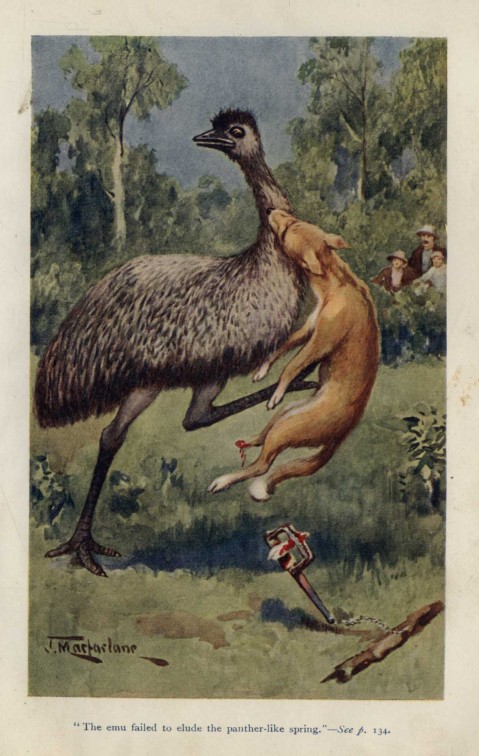
"The emu failed to elude the panther-like spring."—See p. 134.
On the other hand, should there be no fastening, a strong dog will carry a trap for miles, especially if caught by the hind-leg. In order to remedy this, a device, similar to that which sailors use, called a sea anchor, is attached. A block of wood not too heavy is tied to the trap by a chain or a piece of wire. This acts as a check to the animal, besides leaving a broad trail that is easily followed up.
When the trapped dingoes were approached they set up a dismal howling, which turned to a vigorous snapping with their teeth; the while they tore the earth with their paws in vain efforts to escape.
"Put the poor wretches out of their pain," cried Sandy, after watching the agonised efforts of the canines for a few seconds.
The trapper, armed with a heavy "nulla-nulla," dispatched the brutes, and scalped them; for the district Stock Board, to induce their extermination, gave £1 per scalp, and experienced trappers like Nosey George did well at times. They concluded that there was at the least one other victim; for while the bitches were snapping and howling, answering howls of rage and sympathy could be heard in the distance along the trail.
The next act was to cremate the slain, which was speedily done. After this the group proceeded to follow the track along which the other snares were secreted. The very first trap contained a dog. It was set in the centre of a soft depression, at the edge of the scrub belt on the farther side. The dog had dragged the trap about three hundred yards, when the "anchor," fouling in some saplings, his retreat was stopped. The beast was immediately brained and scalped, and the body flung into a clump of bushes.
There was still another victim. The farthest out trap was gone. Nothing was to be seen but the trap-hole. George, however, was soon upon the trail. The country here was fairly open, and offered little obstruction to the determined dog. The track led on and on with little deviation until a course of three miles or so had been traversed. It now curved outward and down toward a patch of scrub. Nosey suddenly stopped and pointed to the ground.
"What's up, George?" exclaimed Joe, who stood nearest the trapper.
"Look an' see fur y'reself."
Bending over, Joe saw in a sandy patch the deep impress of the toes of a large bird.
"I can't make it out. What in thunder is it? Far too big for a crow; bigger even than an eagle or a bustard."
"As big as two eagles, young mutton-head," declared the old tough. "Tell 'im, Sandy."
"Why, you greeney; that's an emu track!"
"Emu!" shouted Joe in great excitement. "It's the first time I ever saw an emu track. What an enormous foot he must have."
"Ye'd know it, me boy, if ivver ye got a kick," grunted the trapper. "I've seen them break a dog's leg like a carrot."
"Blest if I don't think he's follerin' up the dingo!" continued Joe.
"Just wot 'e is a-doin' of," answered the man. "These 'ere emus is more curious nor a woman."
Joe now remembered Sandy relating how his father used to lure the emu he was stalking within shot of his fowling piece, by lying flat, and slowly waving his handkerchief from the point of his ram-rod; or even doubling his leg as he lay breast downward, and elevating his hat on the foot thus raised. With slow and hesitating yet irresistible steps, fascinated by the mysterious object, or a victim to curiosity, the bird would approach to its undoing.
This particular emu was no stranger to the dingoes, nor they to him. Never before, though, had he beheld a dingo with such an appendage, or in such difficulties. The unwonted appearance of the canine furnishes the bird with an unusual sensation, and queries in rapid succession flit through its brain. "What on earth is the matter with the limping, whimpering brute? What is that object trailing behind the horrid creature? Let me draw near and behold this great sight!" Fate has delivered his old-time enemy into his hands. That lolling, swollen tongue, those blood-shot eyes, that painful whimper, the wild despairing glances; all these loudly proclaim his downfall. "Well, what matter! He's getting his punishment now. What is there to prevent me wiping out old scores?"
And so, with cautious yet confident step the huge bird, second in size only to the ostrich, strode on at a short distance behind his enemy; and in a few minutes both are swallowed up in the scrub. The huntsmen follow well on the heels of the animals.
"I wonder if the bird's still following?" asked Tom.
"Soon see," answered the trapper, carefully examining the ground. "Not a quarter of an hour since he passed this spot: must be in the scrub still."
A minute or so brought them to the edge of the scrub. Pushing along, they were soon enwrapped in its gloom. Following the advice of George, the boys tied their horses to saplings at the outskirts of the belt, and proceeded on foot. Suddenly the trapper, who was leading, stopped dead in his tracks, and uttered a warning note in a low voice. Motioning the pals to remain where they were, he noiselessly moved forward, and was soon lost in the thick foliage ahead.
"Wonder why ole Nosey made us stay back?" muttered Tom, after the lads had stood silently awhile. "What can be in the air, now?"
"Hist!" exclaimed Sandy in a whisper; "he's returning."
At this moment the trapper reappeared.
"Follow as quiet as mice, an' ye'll see summat like wot ye've ne'er seed afore." There was an unusual gleam in the man's eye as he made this deliverance.
Cautiously and silently the party moved Indian fashion through the wood. After going in this way a hundred paces or so the hunter stopped again, and beckoned the boys, indicating a stealthy approach. Very gingerly they trod until they were abreast the man. Following his muttered directions and example, they quietly parted the intervening brushwood.
It was an unique sight on which their eyes fastened; one they would not readily forget. Beyond them was a small natural clearing, such as often occurs in the densest scrub.
It was circular in form, and about fifty yards in diameter. Here, almost in the centre of the clearing, the bird had bailed up the beast. Curiosity in the emu had grown into anger, and was at a white heat, judging from the manner in which it pirouetted and menaced the dog, keeping up the while an incessant gabble. The gabble, rightly interpreted, declared that the time of vengeance was at hand. The fates were thanked for being so kind as to furnish this fitting opportunity for paying off old scores: "Here, you sneaking thief and flying murderer, stop! It's you and I for it now; so, off with your coat and roll up your sleeves!"
Nor was Master Dingo disinclined to accept the challenge thrown down by the strutting bird. Weary as he was and full of pain, he was in no humour to eat humble-pie, or to fly before another foe. His warring instincts rose to the gage of his hereditary enemy. Many of his kind were scarred with wounds from the terrible emu kick, or deep score made by the horny toe of this formidable antagonist.
Nor could he retreat, if so inclined: behind him, to a certainty, was the monstrous biped; far more to be feared than this animated piece of impertinence, whose wicked eye squinted and winked in defiance.
Forgotten in a moment is all fear, whether of the visible bird or the invisible pursuers. Handicapped as he is, and goaded by his pain and shameful condition, the dingo fires the first shot, as it were, by making a sudden jump at the emu's throat, narrowly missing it, and still more narrowly missing the leg stroke of the bird as it made its counter-stroke.
Both bird and beast are practised in all the arts and devices of animal warfare. Each knows the tactics of the other. But for the disability of the dog through the tenacious trap the chances would be in his favour; but his exhaustion and encumbrance give the odds to the other. Still, he makes a gallant fight, and the bird needs all its wits and agility to escape his savage snaps, one of which, had he been able to lay hold, would tear out the neck from throat to breast.
The combat was at its height between these gladiators when the pursuers sighted them. The boys hold their breath in fair amazement as they eagerly watch the two figures in the sunlit arena struggling for the mastery. So engrossed are the combatants that the spectators may come out into the open and surround them, for all the notice that will be taken of them. As it is, the boys' astonishment is quickly transmuted into animal excitement and battle-lust. They take sides, and cheer, now the beast and now the bird.
But the end comes quickly and tragically enough. The pace of the conflict tells terribly upon the dingo. He is now weakening fast; can hardly see, so bloodshot are his eyes. Yes, he can hold out but little longer. Realising this, he fights purely on the defence for breath. Then, concentrating all his energies in one last irresistible stroke, he springs, arrow-like, and this time strikes fair on the bullseye—the neck of his adversary. The emu had failed to elude the panther-like spring. But now the counter-stroke!
When the dingo's fangs close vice-like upon the emu's throat the bird's fate is irrevocably sealed. The jugular vein is torn out with a mouthful of flesh and muscle, and the skin is stripped to the bosom. What time this savage and fatal stroke is given the vengeful bird, by one terrific downward blow of its powerful leg and toes, disembowels the hanging dog; and then with a lightning side-stroke, delivered full on the forehead of the prone beast, smashes in its skull. A vain attempt to crow a note of victory; a few short, uncertain, rotatory movements, life-blood gushing the while from its severed jugular, then a collapse, falling across the body of its slain adversary!
Which of the two is the victor?
The surprise of the boys, at the sudden and bloody termination of the fight, may be better imagined than described. They stared aghast for some moments at the spectacle, too dazed to move or speak. Even the hardened bushman, George, was moved.
"Well, of all the fights I ever seed, this licks creation; it's better nor cock-fightin'. Be gosh, 'twas a grand fight to a finish!"
The trapper now busies himself with the scalping-knife, and, as the boys stand around, a feeling of sadness rises within as they contemplate the slain.
"Poor brutes!" said Sandy feelingly, "I've a notion, lads, that they deserved a better fate."
"The boss wouldn't agree to that as fur as the dorgs is concerned. As fer the emu, he's neither good nor bad," grunted the old man.
"Well, after all," broke in Joe, "it's their nature, as old Simpson is always preaching to us in school. They're not to blame for following their instincts. By jings! there's no coward's blood in these poor brutes,—they're as brave as brave."
But such moralising was beyond Nosey George.
"Emus is sight enough in a way, an' only eats grass an' roots,—but dingos! they're vermin, an' any death's good enough fur them. By the hokey!" exclaimed he as he looked at the trap; "I'm blamed if here isn't the blessed paw!"
It was true. The wretched beast's foot was evidently so lacerated and broken by its efforts to escape, and in dragging the trap, that when it made the last and fatal spring the imprisoned paw parted from the leg in the very act, and that severance enabled it to reach the emu's neck. Having secured the trap and the scalp, the group retraced their steps to where they had hitched the horses.
The haul proved successful beyond measure. To secure four dingoes in one scoop was a great stroke of luck. Not so much luck, on reflection, as skilful management. An amateur might have set a hundred traps with seeming skill and not have bagged a dog. No one save a trapper like George could trap with any degree of certainty.
"I s'pose you'll bag the balance to-night," remarked Tom to the trapper when they had remounted.
"No jolly fear! Never catch any more along this line."
"How's that?"
"Why, d'yer think a dingo's no sense? Be gosh! all the calves in creation wuddent tempt what's left of the vermin to come along this track again. Wish we'd a' got the old dog, though."
"What are you going to do next?" inquired Tom.
"Fust an' foremost thing is to collect the traps, then we'll burn the weaners."
"Won't you try for the other dogs?"
"My oath, won't I?"
"Give us your programme, George, there's a good fellow."
"I'll try 'em about Razorback with the traps, as soon as they've quietened down a bit. They've been scared out of their precious wits by this 'ere business."
In due time the party arrived at the homestead. Mr. M'Intyre expressed his gratification at the result of the trapper's work, and praised his skill. He further bade George continue his work until the beasts were exterminated, promising him a liberal reward should he achieve this end.
The boys related with great gusto, to an almost incredulous household, the particulars of the fight to a finish.
The trapper fixed his camp in the hills, and employed his best endeavours to trap the remaining dingoes with but partial success, securing one only. The old dingo, which on a former occasion had left two of his claws in a trap, and now had received this additional fright through the ensnarement of his comrades, was not to be lured by any device, however crafty. George, who knew their run intimately, surrounded them with traps. 'Twas all in vain, set them never so wisely.
This defiance and immunity irritated the old man beyond endurance, and he swore by all the dignities to get their scalps, if it took him till the crack of doom.
As he was camped on the ranges, in the vicinity of Razorback, his weekly ration was taken out to him by the boys, who were keen on this matter. They had been out twice with the rations, and now were being sent out the third time. What befel them on that trip will be related in the next chapter.
CHAPTER XVIII
THE CHASE, AND ITS SEQUEL
"A southerly wind and a cloudy sky,
Proclaim a hunting morn;
Before the sun rises away we go,—
The sleep of the sluggard we scorn."
OLD SONG.
"Now then, sleepies,—up you get!" cried Sandy in the early morning, as he performed his usual preliminary of whipping off the bed-clothes from the sleepy-headed Joe and Tom.
"Sun's laughing at you through the windows. Come, Master Hawkins!" cried he with a grin as he tumbled that grunting individual on to the floor, piling the bed-clothes on top of him, and then seating himself on the wriggling pile. "If soft measures won't avail I am prepared to adopt severe ones."
Tom, now thoroughly aroused, and as peppery as you like, shouted and yelled and writhed, getting his arm at last round his persecutor, the laughing Sandy, and by a violent effort pulling him on to the broad of his back, thus reversing their positions.
"You red-headed Scotchman, I'll teach you meddle with—" pommel—"me again"—pommel, pommel.
Here a cold douche arrested the uplifted arm of the irate Tom, and took his breath for a moment, as it descended upon the prone bodies, accompanied by sundry "ouchs" and shrill yells. As the boys scrambled to their feet they joined forces and rushed the dodging Joe, who, after a few ineffectual dives, was caught and jolly well punched.
The usual early morning diversion ended, the lads, rosy with health and brimming over with animal spirits—the essence of good nature for all their rough play—dressed with haste and made for the stockyard, to pick their steeds.
This occupied their time till the seven o'clock breakfast, after which they secured from the storeman the rations for the trapper.
"Now Sandy, my boy, ye'll no forget to tell George what I named at breakfast."
"M-yes, about the dingoes, father?"
"No, stupid. Didna I ask you to tell him that, dingoes or no dingoes, he is to come next week at the latest, to handle the colts?"
"Oh yes, dad, I won't forget. I expect he'll growl a bit, as he's mad on getting the dogs and the reward. He's quite cranky over it."
"He'll come richt enough if ye gie him my order."
The trapper's camp, as previously stated, was situated about eleven miles from the homestead. Four miles or so from home the track roughened, and became what is known as broken country, all hills and gullies, for the most part very rocky, and heavily wooded in places.
The boys' progress was but slow, owing to the nature of the ground, and it took them nearly three hours to reach the camp, which they found unoccupied. After cooeeing in vain for the absentee, they proceeded to light a fire in order to boil the billy, spreading the substantial lunch which Mrs. M'Intyre had furnished them.
"Bother old Nosey; wish he'd turn up!" exclaimed Sandy, when the boys had finished their repast. "We can't go till he comes. There'd be no end of a row if we went home without delivering the message."
"Oh, he'll be here before long," interjected Joe. "I vote we do a camp in the shade for an hour or two; it's hot enough to fry a steak."
This was good advice, and the boys made themselves as comfortable as circumstances permitted under the shade of the trees. So the hours passed without any sign of the trapper.
"Well, I declare," exclaimed Tom for the twentieth time in the course of the last hour, "it's too bad of Nosey. I'm full up of waitin' here with nothing to do. Can't you leave a message somehow for the ole cuss?"
"How is it to be done, Hawkins?"
"Oh bother! write a note, of course."
"Well, you are a greeney, Tom. Where's the pen, ink, and paper to come from?"
"Why, hasn't ole Nosey——?"
"Old Nosey, be hanged! Of course he hasn't, any more than he's got a dress suit and a toilet mirror."
"I've got a pencil," said Joe, feeling in his pocket.
"No good in the world; where's the paper to come from; an' supposin' we had pens, ink, paper, blotting-pads, writing desks, and whatever else you like to name in the scribbling line, what good 'ud it all be?"
"Meaning——?"
"Meanin' this, you dunderheads—it's got to be read."
"Well?"
"Well!—of all the thick-heads, muddle-pates, soft-uns, hodges, and idiots that ever I came across——!"
"Here, draw it mild, young porridge-pot. There's two to one against you: mind that, you red herring!"
"I'll mind more than that, if I am the son of a Scot, which is no great disgrace, after all," replied Sandy jeeringly. "But look here and listen, chiels. I'll tell you a story—
"Once upon a time, when pigs were called swine an' monkeys chewed tobacco, there lived a bully English captain, the commander of a man o' war. This frigate, sailing up the channel on her return from foreign parts, sighted a French ship, not more'n about twice her size. Instead of closing with the Frenchy slap bang, an' givin' her what-for, she turned tail an' showed her a clean pair of heels. This outrageous proceeding on the part of a British sea-dog demanded instant investigation, and so the jolly captain was promptly court-martialled. After the case had been put by the prosecuting officer, and not denied by the prisoner, he was asked by the president of the court why he did not engage the enemy. The captain, in reply, said that he had ten reasons. 'Name them,' says the boss officer. 'The first is: I had no powder; it was all used up.' 'Enuf sed,' sings out the judge. 'We don't want the other nine. You're discharged, my man, without a stain on your character.'"
"Oh, that's all right for a yarn," cried Joe; "but I want to know what it's got to do with your father's message to Nosey?"
"Just as much as it's got to do with the grass of a duck in a forty-acre paddock," jeered Sandy.
"It's a story with a moral, boys; and as Captain Kettle—no, I mean Cuttle, says in that book of Dickens, the moral of the story lies in the application."
"Apply it, my wise man."
"Here then: old Nosey has ten reasons for not gettin' a written message."
"Name the first!"
"He can't read."
"Now then, Joe," said Tom, turning to that worthy, "what's the verdict of the court?"
"I s'pose we'll have to discharge the prisoner without a character," replied Joe with a wink.
"Blow these bally flies!" cried Tom, after an interval. "They're here in millions. Faugh!—splutter—there's one down my jolly throat. Say, Joe, what are you goin' to do?"
"Boil the billy," replied that youth laconically. "May as well do something, an' kill time."
So the hours sped until the sun was well on its descending curve in the late afternoon. Their patience was now thoroughly exhausted in waiting for the trapper. They canvassed the reasons for his non-appearance, until they were mortally sick of discussing the subject.
"Tell you what, boys, message or no message, Nosey or no Nosey," cried Sandy at last, "we must make tracks for home. We are not to blame for old George's absence. They'll be wondering what's become of us. It'll take us all our time to get there before dark as it is. At the worst, we'll have to come out to-morrow."
It took but a few minutes after this to secure the horses, saddle them, call the dog which had accompanied them to heel, and set out on the return journey.
After jogging briskly for a couple of miles or so the cattle dog, a strong wiry hound and a noted warrior among his species, began to sniff about, uttering a series of low, short barks.
"Hello, Brindle, what's up? Got 'possum scent? Bandicoot, I 'spect. Fetch him, boy!"
Just at this moment Brindle made a dash forward, what time a big dog-dingo started out from under an old log a hundred yards or so ahead. The route taken by the chase lay up a long gully. This gully was, more correctly speaking, a depression, lacking abrupt and precipitous sides, and was comparatively free from rocks.
The boys hesitated a moment, but the temptation was too strong. Joe, clapping his spurs to his steed's sides, started off with a clatter, the others following pell-mell. The gully was long and winding, and to this, for some reason, the dingo stuck. The hunters now began to gain a little on the beast, and were in full sight, the cattle dog just holding his distance. At length the gully petered out at the base of a ridge, over which the quarry sped, the dog and boys in full chase. The other side of the ridge was more precipitous, and covered with bracken and stunted bushes. Down this the pursuit thundered, Joe in the lead and well to the cattle dog's heels: the dingo leading by not more than seventy yards. So absorbed was the boy in the hunt that he remained in ignorance of a calamity that was even now happening to one of his mates.
Tom's horse, in bounding down the ridge, and when close to the bottom, put his foot in a wombat's[#] hole that was hidden by bracken. Over came horse and rider, Tom striking the ground on head and shoulder, while Sandy, who was about a length behind, narrowly averted collision with the fallen steed and boy. As quickly as possible he pulled up his galloping animal, shouting out as he did so to Joe, who was too far away and too much engrossed in the chase to hear the call.
[#] Wombat—-a burrowing marsupial.
Returning to the collapsed pair, Sandy jumped off and lifted Tom's head, for the lad lay stiff. His appearance frightened the boy as he lay still and death-like. To his great joy, however, on feeling Tom's wrist, Sandy detected a feeble pulse-beat. Laying his stricken mate gently down in the bracken, he made a hasty examination of his head. It bore no trace of wound, save some gravel scratches and a nasty bruise under the left eye. The relieved boy hurried to the bottom of the ridge, where by good hap was a rill of water. Filling his hat he returned and laved the brow and wrists of his companion. After some twenty minutes or so Tom began to stir, and quickly regained consciousness. No bones were broken, but the boy was badly shaken, and all thoughts of further pursuit were out of the question. The horse, by a miracle, was without hurt.
"You're a lucky beggar, Tom," said Sandy, after a few minutes. "From the way you crashed down I made sure every blessed bone in your body was broken. How do you feel now, ole boss?"
"Oh, I'm all right," replied Tom feebly. "Shoulder's the worst. It's not dislocated, but it pains a lot. Phew! but it does hurt when I move it. I expect it felt the full force of the tumble. But—where's Joe?"
"Joe's ahead. Goodness only knows where he's got to by now. He hasn't a ghost's show of getting the dingo if he makes for the hills."
"I tell you what," continued the boy; "we'll get off home as soon as you feel fit. It's no use waiting for Joe. He can easily catch us. You'll have to go slow, old man, you know."
This was true, for Tom's shoulder was in an agony of ache, which the movement of the horse, after they had mounted, intensified to an almost unbearable degree.
It was long after dark ere the pair sighted the homestead lights. They had not been overtaken by Joe, much to their surprise. They were met at the slip-rails by Harry and Jacky, who had just been dispatched to look for them, as the family were getting uneasy at their prolonged absence. The men returned with the lads to the house. Beyond a severe word to Sandy for being tempted to pursue the impossible when on the homeward track, the squatter justified their act of returning from the camp; also in not waiting for Joe.
"I expect the rascal will turn up in a few minutes. His horse would soon be knocked up in that country, and he would therefore be unable to catch you after he abandoned the dingo. The cheek of you boys, to think you could run it down in that country!"
The minutes sped without sight or sound of the huntsman. Anxiety deepened in the women; the men, too, became uneasy.
"Some one ought to go after the lad," broke in the perturbed mother, at length. "The poor laddie must have met trouble. His horse has knocked up. Perhaps he has lost himself. Perhaps he——!"
"Perhaps nothing of the kind has happened, except that the horse may have knocked up. You women will always jump to the worst conclusions. Willy, you and I'll ride back a bit; come you too Sandy, if you're not too tired."
Mr. M'Intyre feared more than he showed. It would be easy enough after all, he reflected, for a boy who was ignorant of the lay of the country and who had no experience in bush travelling, to lose his way. He determined, therefore, to take his son with him, so that he might lead them to the spot where the accident occurred, if it were necessary. Accordingly the three set off on the track. Fortunately it was moonlight and clear, so that they were able to make good headway through the bush.
It is time, however, to return to Joe. That ardent hunter had followed the chase for some distance ere he missed his pals. What with the severity of the pace and the increasing roughness of the course, its twistings and turnings, all his attention was focussed on the quarry. If he did think at all of his companions, it was to picture them following close behind. But in the heat of the chase he had little thought for others. When it did dawn upon him that he had outdistanced his companions, as happened eventually, he attributed little importance to that. They, no doubt, had good reason for slackening their pace. His horse, as he well knew, had a dash of speed denied to theirs. Maybe their steeds had caved in. Anyhow, he was having a glorious time, and "the finish" was touched with roseate hues to his imagination.
His horse was justifying the reputation given of him to Joe by Harry, the stockman, one day when they were discussing the relative merits of their mounts.
"For a hack," that worthy had remarked, "there's nothing on the run equal to the little thing you're ridin'. With a light weight up like yourself she can show a dash of foot an' staying powers that'll take a tremendous lot of lickin'."
This was a just criticism, as events were proving. Still, the pace was beginning to tell, and Joe was forced to ease the mare somewhat, even at the risk of losing sight of the quarry. The rough ridges, too, made the going to be precarious.
Things were as bad with Master Dingo, however. The pursuit was hot enough to extend him to the fullest. He was always in view, and could not shake off the foe. As long as he remained in sight it was impossible to resort to any trick by which he might gain time or wind. The ordinary pace of the dingo when on the chase may be described as a lope. This can be kept up the live-long day, and thus wear down the fleetest victim. To keep extended at full gallop in this unwonted fashion is not at all to the dingo's liking, and the sooner he can reach the distant scrub, which is his objective, the better pleased he will be. The cattle dog, though not ordinarily a hunter, is strong and tough, and possessed of a good pair of bellows. He started the game with the utmost alacrity, and now continues it with the greatest vim and determination.
So the chase continues, and is now but little more than a mile from the scrub belt which fringes the base of the hills. To this ark of safety, therefore, the dingo strains every muscle, and seizes every small advantage which his instinct discerns. No less strenuous is the cattle dog. He has the staying powers of his class, and he too runs to win. In this way the pursued and pursuers hurry-skurry over bush and brake, over stony ridges and across intersecting gullies.
Within half a mile of the scrub the country flattens out, and this gives an advantage to the cattle dog, who closes up. Joe's horse is now in distress. The course has been long and rough, the pace severe, and the grass-fed steed is weakening, can make no headway, is indeed losing in the race. The lad sees this, and chevies the dog on, for he can plainly mark now that unless the chase be ended on this side of the scrub all hope must be abandoned, Oh, to win! A supremely glorious thing were he to achieve the impossible! There are chances. Lots of things might happen yet. On, on, good doggie! Catch him, Brindle! Hurrah, Brindle is closing; is surely creeping up!
They are now about three hundred yards from the timber belt, and the dingo is slowly but surely being overhauled. Visions of the scalp as a proud trophy fill the boy's imagination. If only Brindle may seize his victim and hold him till he rides up and gives the brute its quietus with the stirrup iron! Brindle is now not more than four lengths behind, and the beasts are still a hundred yards from the scrub.
"On then, doggie: catch him: hold him!" shouts Joe across the widely intervening distance. The voice is borne faintly to the dog's ears, and nerves him to heroic effort in this the final stage of the struggle, the last lap, so to speak. Breath is too precious to be wasted in answering cry, but the spurt of the hound speaks volumes: "I shall catch him, master, never fear: I am gaining; but ''twill be on the post."
Both dogs, wild and domestic, are stretched to their fullest extent. It is the crowning burst. They are labouring heavily, staggering, and rolling in their stride. The pace is slow but hard. It is a question of endurance. Every ounce of strength in each body is laid under contribution. Once within the scrub the chances in favour of the dingo will immediately increase a hundredfold, for in doubling and dodging through the densely timbered belts the native dog has no equal.
Only thirty yards now lie between the dingo and his salvation—the good thick scrub that will swallow him up; but—the breath of the pursuer blows hot upon him. Throwing his head over his shoulder for the fraction of a second, the desperate beast sees that only by a miracle can he escape. The adversary is upon his quarters, and in another second the brute's fangs will be buried in his back. It is a supreme moment. Now or never! Making a super-canine effort, the fear-stricken thing draws away from its enemy in the last dozen strides. Saved, saved! Alas, alas! Right at the very fringe, and within a single step of safety, he tumbles in a heap, and with a convulsive gasp rolls over and gives up the ghost: the prolonged exertions have broken his heart.
You can work your will on the hunted one now, Brindle: no need to fear the vicious snap that was reserved for you should the worst happen. But the dog's instincts inform him that all power of resistance has gone from that mute and still form; indeed, he has no strength to worry should the call be made: the last spurt has left him without a vestige of strength. And so, when Joe appeared upon the scene a few minutes later, it was to behold the motionless dingo, and by his side, with lolling tongue and cavernous mouth, the panting and exhausted Brindle.
In a moment the boy has slid from his horse, and is dancing a grotesque fandango, expressive of his unbounded joy. But, when in a calmer moment he understood the tragedy of it from the dingo's side of things, a feeling of compassion possessed him, yet joy persisted. "He's a noble fellow, and has given me the grandest sport I've ever had. I'm sorry, and yet I'm glad," quoth the lad. "What'll old Nosey say to this! My stars, ain't the boys out of it! Wonder where the poor beggars have got to. Hope nothing's happened to them. Poor beast!" apostrophising the dingo, "you made a royal struggle and deserved to escape, but the fates were against you. And you, good old Brindle; my word, you've covered yourself with glory, sir! Poor fellow, you are done up; can only blink your pleasure; can't wag even the tip of your tail. Good doggie, I'm proud of you!"
"I'm blest if I don't skin the dingo," exclaimed he, after a moment's pause. "I'll keep it as a trophy. Something to look at in after years when I'm a grey-beard," chuckled the youth. So saying, he whipped out his knife. Joe had never before skinned a dingo, but as he had performed that office on many a wallaby and 'possum he was fairly expert, and in a few minutes had achieved his object. Rolling the pelt in the approved manner, the youth bound it with a stout piece of cord which he extracted from his pocket, and fastened it to the saddle ring.
"Next thing's to get some water. My word! I'm as dry as leather, an' could drink a tank dry. The animals, too, are clean done up, an' I'll get nothing out of them unless they have water. Good gracious! why—the sun's down, an' it'll soon be dark."
Not until this moment did the young hunter realise his position. "Must be miles and miles off the track," muttered he as he took a brief survey of his surroundings. "I'll have to make tracks with a vengeance! Won't do to be nipped here. Let's see; yes, the way back is across that flat for a certainty, and then over yon stony ridge. Beyond that we bend to the right till we reach a rocky creek." In this way the hunter strove to recall the innumerable bends and curves taken in the chase. "Ah, here's the moon rising: good old moon!"
Joe had plenty of heart, nerve, and resource. His good spirits were proverbial. Yet the situation was not at all inviting. Fourteen miles or so from home on the eve of night. A complete stranger to this rough and trackless region, and his horse badly used up! These were things calculated to try the nerves and tax the courage of the benighted youth.
He made small bones of these, however, and started off at a slow pace on his return. The dog had recovered sufficiently to drag himself along at the horse's heels. The boy eagerly scanned the country for signs of water for this would afford the greatest relief to man and beasts: all of whom felt an intolerable thirst. At last they dropped across a small pool in a stony creek, to their great delight.
Both horse and dog drank as if they would never stop. This, the boy felt, would be bad for the animals, and he sought to stay them. He with difficulty checked the horse, but the dog would not quit lapping until he was as tight as the proverbial drum. Joe himself drank sparingly, and then moved onward. The dog soon began to vomit, and appeared to be on the verge of collapse. So after vain waiting and entreaty the lad was forced to leave it behind, in the hope that it would recover during the night, when he had small doubt as to its ability to find its way home. The horse went easier, now that she had assuaged her thirst. All light had vanished save that of the moon, which shed an uncertain light, making puzzling shadows on the rough ground.
"It's time I was at the head of the long gully," muttered the lad. "From there it's only a mile or so to the home track. Get up Jill, and moosey along. The other chaps are home by this time I expect, and they're wondering what's become of me."
Strange to say, the long gully refused to appear, until it dawned on Joe at last that he was off the track. None but those who have experienced it can understand the weird feeling that possesses one in the dawn of that consciousness. To be in the lonely Australian bush, where the silence is an oppression, is something like being cast adrift in mid-ocean on a raft, with nothing in sight save the wild waste of waters.
That he had lost his bearings became increasingly evident to the wanderer as he moved along. He became a prey to disquieting qualms and the creeping chill of apprehension. Gruesome accounts of the fate of lost travellers had often been related at the home fireside, and these memories awoke in his mind.
"I'm off the track all right; still, I'm sure to cut across the Razorback trail; it'll lie over in that direction." After a pause he determined to adhere to the way that he had been pursuing for some little while. On then "breast forward." There is no semblance of a track, and presently the lad gets into very difficult country. It would be bad enough to travel through in daylight, but now the trouble is accentuated; yet the boy, with strong faith in his ultimate emergence from this chaos, bravely faces the situation. Up hill, down dale, across gullies, forcing the patches of scrub, slithering down ridges, going on hands and knees, ever and anon, to feel for the hoof-prints on what appeared to be the longed-for track—an unceasing march goes on.
At last the mare, completely done up, comes to grief over a tree root, and tumbles to mother earth. The rider rises, unhurt; not so the mare, who has strained her fetlock. What is to be done now? It is a serious mischance, and the boy feels the gravity of the situation. The only thing to be done is to relieve his steed of saddle and bridle, cache his accoutrements, and trudge along on foot.
"Might have been worse," sighed the philosophic lad. "Poor Jill! I don't like leaving you; but it won't be for long, my beauty. Your master will send some one to look after you to-morrow. To-morrow!—Why, it must be past midnight now! Good-bye, Jill."
On speeds the gallant youth, whistling and singing snatches as he tramps the interminable bush. "Might be worse," he reiterates in thought. There's a chill in the midnight air, and the walk will warm him nicely. On, then, through the still hours! Not even the hollow note of the night-owl or the familiar thump made by the feeding marsupial breaks the monotony of silence. No sound, indeed, save the crunching of the traveller's boots on the rough ground. How long drawn out the day has been. It seems an eternity since he dowsed Tom and Sandy on the bedroom floor. Lucky beggars, they are snug and sound under the blankets, dreaming the happy dreams of youth; while he, Joe Blain, is tramp, tramp, tramping. At length the thought of his comrades' sweet repose fills him with longing for rest and sleep.
"How long ago it is since I broke my fast? Must be eight, ten, twelve hours; yes, twelve mortal hours! Eat! Oh, for a slice of damper and salt junk! That were a feed if you like. Puddings, tarts, cakes! Bah! Gimme a slice (thick) of Nosey's damper, an' a slab of that corn-beef."
What a sinking seems to fill his being! How heavy his boots have grown! How steep those everlasting ridges have become! How lovely to crouch down on that patch of bracken—for five minutes only! He must stop and rest awhile; not to lie and sleep: just to get his wind and ease his tired limbs. Shall he——? But no! he must first cut the track—then! His limbs are trembling; he must not stand still, or he will fall. On, on—to the station track! Onward, then, creeps the tottering, stumbling lad. Whistle and song have long ceased. Fatigue reigns supreme, and sheer weariness confuses his brain, and bears heavily on will. Mechanically now, the dear lad staggers over the pathless waste.
But see! Yes, there is a change. What is that line ahead? Is it on the ground or in the air? It rises and falls in the moonlight, but still persists. The ground, too, is getting smoother. The ridges have disappeared. Hurrah! Is not this the end? A few steps more now, and—the station track!
On trudges the lost boy with rising hope. But, alas! the line thickens, darkens, deepens, until it stands out solid, an impregnable scrub. How weird it all is; how awful! In a moment the benighted lad is stripped of hope. He is frightened beyond words. With a momentary strength born of despair the wretched youth coasts the dismal scrub, seeking an opening in vain. Suddenly he stumbles over a soft, dark mass, and falls to the ground. Putting out a hand instinctively, he touches the substance. Great Cæsar, it is the dingo! Yes, it has happened to poor Joe Blain as it has to many a one more experienced in the ways of the bush—he has circled!
This shock is the last blow. Nature is drained of her resources and can hold out no longer. The lad sinks back into a half-swoon, which presently merges into a dreamless sleep.
* * * * *
"Joe, old fellow, wake up! Wake up, I say; Joe—Joe—d'ye hear?"
"W-w-w-what is it? Drat you, lemme lone. 'Snot mornin'. There's goo-good fler, so s-s-sleep——"
Joe Blain, eyes sealed, dead with sleep, rolls over on the ground, and never was any creature more gently rocked in the arms of Morpheus than he.
Another voice now breaks the silence, sharp and penetrating.
"Hi! hi! there, you sleepy lubber. Are ye going to lie there all day? Rouse up, laddie!"
This imperative speech was accompanied by vigorous shakings and rollings.
"Well, well," grunted the half-awakened boy, "sounds like Mr. M'Intyre's voice. Never knew him to come into the room be-before. Wish they'd leave us alone. Can't open"—and the next moment Joe had relapsed into sleep. Only for a moment, though. The next he was taken neck and crop, lifted to his feet, and shaken violently, what time a voice rasped his ear drum: "Wake up, wake up, ye young Rip Van Winkle!"
Opening his eyes, the dazed Joe starts at the unwonted scene. He is not in his bedroom, then! What on earth has happened? Who are these that surround him? Why—he's in the bush! And then the truth dawns upon the weary and weakened lad; he was really lost, and—thank God he is found!
He greets the squatter with a wan smile, and, with the grace characteristic of the boy, begins to thank him. But Mr. M'Intyre, patting him affectionately on the back while supporting him with his arm, extracts the cork of a pocket flask with his teeth, and puts it to the lad's mouth.
"Tak' a pu' at this, ma laddie; it'll revive ye wonderfu'."
The brandy worked wonders on the boy, so unaccustomed to it.
"We—we ran the dingo down, sir—Jill and Brin—why, here's ole Brindle! Left him at the water-hole; too sick to follow. The horse too——"
"Horse's all right, Joe. We picked her up at the water-hole, where we'll leave her for a few days, as she's limping badly. Can you sit on the saddle before me?" Joe is sure he can, and no time is lost in starting homewards. M'Intyre, to whom the country was an open book, knew a short cut that would take them home in ten miles.
During the ride Joe recited his experiences to the squatter, who in return related how Willie had picked up the tracks, sighting first the horse and then the dog, and followed the trail till they came upon the sleeping lad.
It was a weary but not unhappy boy who reached the homestead at length. The household, duly apprised by Willy, who had ridden on ahead, were in readiness to cheer the conquering hero.
CHAPTER XIX
CONCERNING WILD HORSES
"Now welcome, welcome, master mine,
Thrice welcome to the noble chase:
Nor earthly sport, nor sport divine,
Can take such honourable place."
Ballad of the Wild Huntsmen.
"Where's Floss and Jeannie, Harry? Don't see 'em in the yard this morning."
"No, sir, they didn't come in with the others."
"Hoo's that, mon?"
"I harsk'd Jacky about 'em when he yarded the others, an' he said they wasn't with the rest. Too lazy, I bet, to look after 'em."
"But I dinna see Tallboy or Dolly, eyther," said the squatter as he peered through the rails at the horses.
"I speck they're with the mares down by the dam, or p'raps campin' on the box ridge."
"Weel, see that they're no missed the morn. Here you, Jacky," to the black boy; "come along here."
"What's matter, Boss?"
"What for you bin no yard all yarraman?"[#]
[#] Yarraman—native name for horse.
"Bail me see some, Boss."
"You bin getting lazy. I'll hae to gie you a taste o' the stock whip."
"Me no 'fraid you, Boss," replied the black with a grin. "You not like my ole boss, Cap'n White. Him murry quick with whip. Sandy bin tellin' me you only gammon."
"See that you drive in every hoof to-morrow morning, or, Sandy or no Sandy, ye'll get a surprise, my boy."
"I cam across some brumby tracks yesterday aifternoon in the springers' paddock," continued the squatter to Harry, the head stockman. "Meant to hae spoken aboot it afore."
"They're a rare nuisance, they brutes! There maun be a gap in the dog-leg fence at the far side for 'em to ha'e got in. You'd better tak' Jacky and Denny at once, and mak' the fence secure. That pack o' rubbage'll be doing a lot o' mischief among the springers wi' their galloping. Ye'd better go across by the horse-paddock, an' see if ye can get a sicht o' the mares. It's almost as near as the other track."
"All right, Boss. Jacky, you go to Ah Fat an' tell 'im to put up some grub. Git the billy an' tots, an' bring 'em along. Tell Denny I want 'im. He's working in the garden."
"Oh, I say," bawling after the retreating boy; "tell Denny to git the small cross-cut, an' a couple o' tommies, an' a bit o' wire to do the mendin' with. Slither away, now, ye son of a black buck!"
In a few minutes the men are on their way through the horse-paddock to the slip-rails in the far corner, to carry on the repairing work in the springers' enclosure.
It may be explained to the uninitiated that the horse-paddock is that nearest the homestead, where the station horses in use are kept; a larger or smaller mob according to requirements. These are yarded at daylight every morning. When the horses required for the day's work are selected the balance are turned loose for the day. The springers' paddock, reserved for the breeding cows, was a large one; one of the best on the run, in fact. The men as they rode along kept a sharp look-out for the missing steeds. Separating as they neared the dam—which was a large sheet of water backing up in the gullies for a mile or so—they rode on either side, coming together at the box-tree ridge where the slip-rails were located. No sign of the horses!
"Strange, chaps! Wonder where they can be. Floss an' Dolly are fair terrors for hidin'. But—hello! there's the slip-rails down!"
Sure enough, the two topmost rails were down. Who could have done it?
The mystery is soon solved; the ground on the outside being trampled with horse hoofs. It told its tale of cause and effect quickly enough to these bushmen.
"The blessed brumbies hev got in an' coaxed 'em out, sure enough. It's the warrigal's[#] mob for a quid. Fifty of 'em, if there's a hoof.
[#] Warrigal—wild, savage; applied indifferently by the natives to animals and men.
"How d'yer think they horses got the rails down, Harry?"
The speaker was Denny Kineavy, who was a new chum at this kind of work.
"Why, it's the ole warrigal's work o' course. Trust 'im fur findin' out a way o' gettin' up a flirt with the ladies. He's the cutest cuss in Australia, bar none. Full o' blood he is too. New Warrior strain outer a great arab mare of Kurnel Dumaresque. I know 'im well, fur I was with Captain White just after he'd bought both dam an' foal from the ole Kurnel; or rather, I should say, Dumaresque swopped 'em fur a stud Hereford 'e was terribly struck on.
"Yes; he was allus a wild un. My word, you should 'a' seen 'im as a yearling! Allus leadin' the other youngsters into mischief; breakin' into the lucem paddocks, an' chasin' the dorgs till they was in mortial terror of 'im; gettin' mad fits among the horses; kickin' an' squealin' an' chiveyin' em', till one day the Captain gits in a towerin' rage an' says to me an' one-eyed Bob, who was workin' fur 'im then: 'Run in that dad-busted, bloomin' brute an' fix 'im; it's the only way ter take the divvil outer 'im.'
"You see, 'e was a grand, upstandin' beast as a colt, an' the Captain wunst thought to have 'im fur stud purposes, fur all 'e was a mix breed; but 'e soon seed that was outer the question.
"Well, as I was sayin', the Captain orders me an' one-eyed Bob to yard 'im. 'Twarn't no easy job nuther, I tell you; for the brute soon cottoned what we was up to. At larst, after a lot of trouble, we yards 'im, and with 'im a couple o' colts an' a lot er fillies. Bob threw the lasso a dozen times afore 'e noosed 'im, cause 'e kept dodgin' in an' out among the fillies. It was the deuce's own job to separate 'em.
"At larst, I say, Bob fixed 'im, an' didn't 'e perform. Howe'er, Bob 'olds 'im, an' I gits 'old of the slack to give a turn round the post, so's ter bring 'im up. But all of a suddent 'e makes a mad rush at Bob, sendin' 'im sprawlin' with three ribs broke; whisks the rope outer my hands, an' streaked fur the slip-rails—six on 'em there wor—an' by 'evans! jumps like a cat at 'em; comin' down with 'is belly on top, smashin' the rail, but fallin' on the outside; never, of course, breakin' 'is bloomin' neck—an' galloped orf like mad.
"Must 'a' bin red mad sure enuff, fur 'e broke through the wire fence the Cap had round 'is 'orse-paddock; and that's the larst we seen of 'im fur months.
"Then one day I was on the out station, lookin' after some steers, when I come acrost 'im in a mob of brumbies he'd chummed up with. 'E was 'aving a pretty rough time of it, I could see; fur there was a couple o' stallions in the mob as wasn't agreeable fur 'is company in the 'arem; an that's 'ow we come ter git 'im a few years after, I 'spect."
"Thin you did git hould iv th' grey divvil?" exclaimed Denny.
"Yes; we got 'im all right. But, look here, chaps, no time's to be lost. These beggars may be still in the paddock. If not, they've got out the way they came in, an' are 'eadin' fur the ranges. We'll cut across to the north end where the fence crosses Rocky Crick. I 'spect that's where they've broken in. It looked a bit shaky a fortni't ago, as I come by. I don't think they've got in at the dog-leg end, that the Boss spoke about. Anyhow, we'll try the Crick fust."
A sharp ride of about four miles brought the men to the spot indicated by Harry. It was a rocky bit of country, and sure enough they found the "shaky" post and rails lying on the ground. The immediate cause of this was a big limb of a dry stringy-bark tree, which had fallen upon the weak spot and smashed it down. The horse tracks about the spot showed conclusively that the mob had gone in and out by this means.
According to Jacky, the black boy, the inward tracks were about three days old; the outward, a few hours. Without doubt, the brumbies had "nosed" the rails to which the mares had been attracted by their neighings, early in the night. Then in the dawning of the morning they had moved out to one of their haunts in the ranges.
"The only thing now is to get back an' tell the Boss. 'E'll be mad when he knows, you bet; thinks no end o' Floss an' Jeannie. Put up the rails, boys, quick an' lively." In a few minutes the men had fixed up the broken panels securely, and then rode homewards.
"Saay, Harry, me bhoy, how'd yees yard th' ould stag, as ye was sayin' when ye was talkin' forninst th' slip-raales?
"Wasn't an old stag then, an' isn't now, fur that matter, the brute's in 'is prime yet. Let's see, 'e's risin' 'leven now, an' we got 'im just afore I left the Captain fur the Boss here. Lemme think. Yes, it's just over five year ago; he'd be about six, then. Fur all his tricks, the two stallions had driven 'im off their beat. 'E'd got a couple o' mares, though, an' kep' 'em in the range country on the out-station; but it was all of an accident that we got 'im.
"One day me an' the Captain was ridin' through the run, havin' a good look at the stock; fur we had a notion of cuttin' out a mob o' fats. Well, as I was sayin', we was ridin' along the back part of the run, an' we came acrost a couple o' brumbies, each with a foal. 'Stead o' scootin', as they does in giniral, the mares galloped in a circle, but didn't clear.
"'It's mighty strange,' ses the Captain. 'What are they 'angin' about fur, an' where's their mate? Never seed 'em parted afore.' 'It is strange,' ses I; 'an' there's only one thing to account fur it, an' that is the cove's about sumwheres 'andy.'
"We moved on to a rocky gully that opens out on to a big plain. At one place a log fence runs acrost to keep the stock in. Bymby we comes plump onter it, an', great gosh alive! if there weren't the grey. 'E seed us as soon as we spotted 'im, an' set up a great squealin' an' pawin', but cuddn't get away. There 'e was, like a bandicoot in a V-trap. 'E was caught by the off hind-leg, between two big logs that lay clost together. 'E was jammed tight enough. Wunder was 'e didn't break a leg.
"When the Cap saw the fix 'e was in, didn't 'e just cuss fur joy. Then 'e sends me back to the hut, about two mile away, fur ropes, an' ole Jack the keeper. Well, I streaked fur the hut, you bet, an' was there less'n no time. Soon me an' Jack, with two green 'ide lassoes an' an 'emp one, also a axe, was on the spot.
"When the 'orse sees the ropes 'e yelled, an' roared, an' pawed, an' snapped 'is teeth, fur all the world like a trapt dingo. An', wud you believe it? the blarmy mares hadn't follered us up! There they was just ahind us, whinneying and screamin'; their way o' swearing an' cussin' I s'pose. Wish-I-may-die if we didn't have to put the stock whip on 'em to roust 'em away.
"'How are yer goin' ter manage 'im,' ses I to the Cap when I comes up with the things.
"'I'll soon let yer see,' ses 'e. 'Fust of all we'll pass a rope round 'is free 'ind-leg well up on to the shank. Then we'll put another on the front fetlock an' acrost 'is flanks.'
"Well, it took us a goodish bit to fix 'im up. I forgot ter say that we tied the third rope round 'is neck, an' that was no easy job, fur every time the Cap threw the lasso he'd dodge it with 'is 'ed like a fightin' kangaroo. But, ter make a long story short, when we'd roped 'im, we levered one of the logs with saplin's so's ter git 'is other leg free. Then, didn't 'e play up! But by the time we'd given 'im arf a dozen falls, an' two o' them riglar croppers, 'e seed it was no use, throws up the sponge, an' comes along quietly.
"We didn't give 'im any charnse, you bet, as 'e was such a sly demon. So we got 'im ter the stockyard at the 'ead station, a matter o' thirteen mile or so. We put 'im in the crush fust, then got a 'evvy 'alter on 'im, an' tied it to 'is front off leg so's 'e cuddent jump; in that way we fixed 'im fur the night.
"Early nex' morning, just as I was thinkin' o' gittin' up, there comes a tremenjious 'ammerin' an' bangin' at the door, shoutin' out sumthin' I cuddent understand. I jumps up an' opens the door, an' there was ole Jack singin' out an' makin' a great fluster.
"'What in thunder's the matter, Jack?' ses I.
"'Warrigal's gone!' ses 'e, all tremblin' like. 'Cleared right out in the night.'
"Off I rushes ter the yards, an' sure enuff, the beast had cleared; yet the rails was up.
"''Ow the dickens 'e got out, Jack?' ses I, lookin' round. Presently I comes ter the slip-rails, an' soon spots 'ow 'e done it. I'm blest if the ole cuss didn't lay down ter it at the rails an' 'riggled 'is way out sideways. You cud see the ground all tore up by 'is 'oofs as 'e inched 'is way out. There was a knot at the lower side o' the rail, an' it was covered with 'air an' blood, which shows what a tight squeeze it was."
"But 'ow the blazes did he gat out iv th' pathock whin he was knee-haltered?"
"Like enuff 'e worked 'is 'edstall off as 'e 'riggled through. We thought we'd made it tight enuff fur anythin'. Anyways 'e cleared, an', what's more, 'e an' the mares moved off the run an' wasn't 'eard of fur long, then 'e was found bossin' a mob on Bullaroi."
By this time the men had reached the homestead. Leaving the others at the stockyard, Harry proceeded to the house to break the bad news to the owner.
The squatter was greatly put out by the turn the affair had taken. Two of the horses were brood mares on which he set a high value, and for which he had given a big price. They were full of breeding, having the famed Gemma di Vergi strain on the sire's side. The occurrence was no less than a calamity in more ways than one.
Their location was in difficult country, and with such a rogue as the grey outlaw to lead and direct, the job of rescue seemed by no means easy or certain. Mr. M'Intyre, however, was determined to regain his mares, and at the same time to capture or destroy that equine demon. One thing in his favour was the fact that in midsummer there was a scarcity of water in the ranges, and their run, for a while, at any rate, must be in and about the foot-hills.
As was usual in those days, the neighbouring station-holders were invited to join in the brumby hunt, which is, as a rule, the most exciting, and, at times the most dangerous, sport that Australia can furnish, keenly relished by bushmen.
The brumby is no more a native Australian horse than the mustang is a native American horse; that is to say, it is not indigenous to the country. Brumbies are the descendants of imported horses which have escaped into the bush and bred there.
When Australian settlements were confined to the barest fringe of the continent, it was very common for stock, both horses and cattle, to stray from the settled areas into the great wilderness beyond.
An historic illustration is to be found in the genesis of colonial expansion. When the first expedition sailed from England, not only were officials, soldiers, and convicts shipped; but also an assortment of domestic animals to furnish the requirements of the penal colony proposed to be established on the shores of Botany Bay.
As the cattle in the new settlements increased, many beasts strayed beyond the borders of the occupied country to the interior forests and plains; and before very long "brumbies" (wild horses) and "scrubbers" (wild cattle) covered large tracts, often to the great annoyance of the advancing line of settlers.
CHAPTER XX
THE BRUMBY HUNT
"Like a wintry shore that the waters ride o'er,
All the lowlands are filling with sound;
For swiftly we gain where the mobs of the plain
Like a tempest are tearing the ground!
And we'll follow them hard to the rails of the yard,
Over gulches and mountain-tops grey,
Where the beat and the beat of our swift horses' feet
Will die with the echoes away."
HENRY KENDALL.
"How many are coming to the hunt to-morrow, dad?"
"About a score all told, my son. That is," continued the speaker somewhat inconsequently, "if they a' turn up."
"Gills coming, ain't they?"
"Yes; the old man, son, and ane o' the stockmen'll be here this evening, so as to be ready for the early stairt the morn's morn. That reminds me, I've no telt your mother. They'll be here aboot supper-time."
"Captain White coming, I s'pose?"
"If he's above ground. We'd best coont 'em up. Get a bit o' paper, Saundy, and pit doon the names. Then we'll ken for sure."
"Ready, father."
"Pit doon oor ain lot first. Mysel', you, Hairry, the blacks, Denny, the bullock driver, the ration carrier, Redgate and Broon from the oot-station, Joe, Tom, N-eville—I suppose. Hoo mony's that?"
"Thirteen."
"So mony's that? At that rate we'll hae ower a score. Weel, that's a' the better. Let's see, noo: pit doun the Gill lot, that's three more. Then there's Captain White. Old Dumaresque says he'll be along, but I dinna reckon on him, so you needna coont him in. White's going to bring twa men wi' him. And, m-yes, there's Davison o' the bank, and Dickson the lawyer. Told 'em the other day I'd let 'em know. They'll need to be here the nicht, too. We'd better send Willy in wi' a message at once. That's a' noo I think. Hoo mony does that tot up?"
"Twenty-one not counting the Colonel."
"Weel, I hope they'll turn up, that's a'."
"I say, father, could Jimmy Flynn an' Yellow Billy come?"
"Eh? Weel, I—I dinna ken. Can they ride?"
"Ride? Listen to him! Why, Yellow Billy's the boss rider among the boys. You know his steer——"
"Ah weel," said Mr. M'Intyre laughingly, "we'll hae 'em. Send word by the boy."
Accordingly, the invitation was taken to the four Tareelians. Gill and party turned up about dark, and shortly after them the town lot, all of whom were welcomed by their hospitable host.
M'Intyre had made extensive preparations for the hunt. There are various methods for trapping wild horses. The one in vogue at Bullaroi and the surrounding stations was that called the "wing" trap. This consists, first of all, in determining the usual brumby run. The next work, and an important one, is the building of yards in a locality specially selected, the object being to get as near as possible to the natural line of the horses' travel when stampeded.
The yards must be well constructed, with a high, strong fence, having an open mouth so wide as to give the hunted steed no suspicion of running into a trap. The upper and nether lips of this mouth, after running parallel a short distance, gradually converge to the throat, as it were, finally meeting, and forming a cul-de-sac.
From the mouth extremity a vast roll of canvas, or, rather, calico strips about six inches wide, is made fast to one of the fence terminals, and from there, at a slight outward angle, is often taken for miles, being secured at intervals to trees or stakes which are driven into the ground. The wing is fixed breast high. This, to the inexperienced, seems but a flimsy obstacle; but the calico barrier, frail as it appears, acts as an effectual boundary. Brumbies are both timid and suspicious, and very rarely charge a wing. When driven on to one they wheel either to right or left, with never a thought of breaking through or jumping it.
The strategy of the "drive" is to station men at intervals from the terminal point of the wing; each man is armed with a heavy stock whip, a cruel enough weapon in the hands of an adept. Others are left at the trap-yard mouth on the outward side, concealed as a rule, and ready to dart out and head the mob should it scent danger when nearing the opening. The remainder of the men proceed to locate and enflank the mob, and drive them in the given direction. This, often, is a very difficult matter, and sometimes the best laid scheme is defeated by a determined and irresistible rush of the mob in the teeth of their assailants.
Premising the "round up" and drive to be successful as far as the wing, the wing supports wheel them in the right direction; then close in and pass to the outside to strengthen the flank men, who now form a parallel line with the racing brumbies. Thus, with the calico wing on one side, a living, whip-cracking, yelling cordon on the other, and a harrying force behind, the spectacle is as brilliant and as exciting as Australia can furnish in the line of sport.
At sunrise, on a glorious morning in mid January, the Bullaroi party, well mounted, wend their way to the appointed rendezvous, from whence the amalgamated forces are to proceed to the brumby grounds.
The men and boys are variously mounted. All the horses, however, are used to stock work; some of them, within certain limits, being as intelligent as the men who bestride them. Many of them are what is known as "camp horses"; that is, horses trained for mustering and cutting out work on the cattle camp. Quick to wheel, to dodge, to out-manoeuvre the charging bullock, and even to divine the enemy's intention; skilful in wedging through a pack; ready to advance backwards, so to speak, and to use heels when head and shoulders unavail; needing scarce any control, and with a keen zest for the work, the camp horse is an invaluable auxiliary on a cattle run.
Both M'Intyre and Gill were specially well mounted on favourites of the above-named variety. The price of each was regarded by its rider as beyond rubies. Both men were strong-boned, grizzled, and expert bushmen, with not a superfluous ounce of flesh on their bodies. Neville was of the company. He had learned many things in the intervening days; the first, and most essential, was that England could furnish no precedent to Australia in things that are peculiar to station life. He gradually dropped his pet phrase, "The way we do things in England." The scales had fallen from his eyes concerning many things "Colonial."
Mr. M'Intyre, who liked him, paid him no little attention. He rode out on the run with him, giving common-sense hints in his dry way, from time to time, which his guest was ready enough to take. He learned to ride fairly well, and, after many mortifying failures, could crack a stock whip without entangling it in the horse's legs.
Mr. M'Intyre was dubious about Neville going. The Englishman, however, was so set on joining the cavalcade that to object seemed discourtesy. All hints of the danger attached to this expedition were scouted. So, on this eventful morning, mounted on his host's favourite hack, Curlew, the visitor formed one of the company.
The others need no description. With spirits mounting high in anticipation they pass over open plain, through brigalow scrub, along box ridges, and across country on a ten-mile spin to a spot on Rocky Creek called the Glen—a place already decided upon. As there was no knowing to what extent the powers of both men and horses would be tried during the day, the journey was made at a moderate speed, so as to spare them for the arduous task of the drive.
The pals, on this occasion six in number, were compelled to curb their tendencies to fun and frolic; though there were some very tempting and well-nigh irresistible inducements to spurts as the game rose or scudded before them. Inviting jumps, too, lured them; but high jump or low jump, kangaroo or emu, charm they never so wisely, are resisted.
But their tongues are uncurbed. How they did chatter, to be sure! It did the older members good to hear their gay and joyous prattle. Their views of life in general, and brumby hunting in particular, were novel and unconventional. They settled everything touching the day's proceedings, from the place of the "find" to the number yarded. All that the warrigal might do, and all that they would positively do to circumvent him, together with many other things, were discussed with the self-confidence of youth.
In due time the Glen is reached, and the Bullaroi party find that they are first upon the scene.
"Off saddles all o' you. Must ease the horses a' we can. Saundy, you and the boys mak a fire and get the billy going. Denny, bring the tucker-bag from the pack-saddle. Mr. Neville, what in the name of common-sense are ye tying yure nag to that dead tree for?"
"What's wrong with it, sir?"
"What's richt wi' it, mon?"
"I—I—don't know what you mean."
"Boss means yer a fool ter tie the moke up in the blazing sun," said Harry in an undertone, as he passed by the new chum. "Put 'im under a shade tree same as the rest of us."
"Beg pardon, yes—er—I see," answered he, mortified for a moment, as he moved from the leafless trunk to a clump of currajongs, whose thick foliage effectually screened the sun's rays.
"Wot sort of a bloke's that 'ere cove?" asked Jimmy Flynn of Tom Hawkins. "He's a regular greeny, ain't he?"
"Oh, a good enough sort!" replied Tom. "He's new, but he's a learner. He picks up pretty fast, considering. You should 'a' seen him when he came here first; my word, he was a greenhorn then!"
"Here's the Captain, father!" sang out Sandy, as three men cantered up the track.
"Guid-day, White! Guid-day, men! Glad to see you. Off saddle and join us in a tot o' tea and a bite."
"Good-day, M'Intyre! By George! you've got quite a troop, man. Day, Dickson! Day, Davidson! What on earth do you townies think you're going to do? Stand a good chance, Dickson, of cracking your skull and spilling all that legal soph—I mean lore, that's bottled up there. Oh, I say, Mac, old Dumaresque's coming along," rattled on the Captain.