PALS (continued 4)
Reading edition
"I'll believe it when I see him, no' afore. The auld boy's better at hame when this wark's on."
"Well, all I know is that he sent me word last night by one of the men, and cautioned me to be sure and tell you."
"If he comes he comes, and if he disna he'll no' be much missed. Noo, boys, bring in the tea!"
"By Jove! M'Intyre, your wife's a sensible woman: this is the sort of grub to work on. Last month I was over at the Glenormiston mustering. De Little asked me to join him at midday after a heavy morning's work, and as I was as hungry as ten hunters I readily consented. What d'ye think he produced from his tucker-bag? Some lettuce sandwiches, no less; and cream puffs! De Little's as good as gold, you know, so I couldn't refuse to take some; but, I give you my word, I strolled over to his men as soon as I could get away decently, and got a slice of beef and a chunk of damper."
"Hoo's De Little getting on?"
"Well, between you and me and the billy-can, he's no more cut out for a squatter than for an archangel. Pity he ever left London. He'd be more at home in Rotten Row. Hello! here's the old Colonel and two boys. Seeing will dissipate even your scepticism, Mac."
Dumaresque was a choleric but plucky old superannuated Indian officer, who on his retirement came over to Australia and purchased a small cattle run, living bachelor fashion. He was now quite old, yet fancied himself equal to any toil. To hint at his age infirmities was to raise a very sirocco of indignant language.
"Hello, Cornel! wha'd 'a' thocht that you——"
"Stop, M'Intyre, stop! I know right well, sir, what you are going to remark. If you, sir, look upon a bit of a brumby hunt as an extraordinary thing, let me inform you that to me 'tis but a trifle. Why, man, when I was stationed on the northern frontier——"
"Yes, yes, Dumaresque," broke in the Captain, who knew the other's weakness, "we're all delighted to see you. Just in time for a pannikin of tea and a mouthful. Here you, Dick, Tom, Harry, one of you, take the Colonel's horse."
A few minutes later the men filed out of the Glen, and proceeded along the creek to a spur in the foot-hills. Then they left the water-shed, crossing the spur, from which they continued up a grassy valley which extended nearly three miles before it broadened out into an open plain, lightly timbered at the upper or ridge side, but perfectly treeless at its other extremity.
Two-thirds of the way up the valley, in a belt of box trees, was the trap-yard. The trap mouth, before described, extended across the belt to the outermost verge.
After a short inspection of the yard the calico wing was fixed. It was attached to the terminal post of the yard mouth, nearest to the ridge that skirted the valley on the top side. From thence it was taken in a straight line on the ridge side of the valley, until the plain was reached. From this point, inclining slighting outward and made fast at short intervals, it extended right across the plain, ending in a clump of iron-barks.
"Noo, men, ye'll jist hae a wee bit grub and then we'll stairt."
The meal was soon dispatched, and a short consultation ensued. M'Intyre apportioned the men their places. Six, under Gill, were located in the iron-bark clump. Five others were sent back to the trap-yard, two miles distant, to assigned duty there. The remaining sixteen were to execute the task of first "feeling" the enemy; then of outflanking them; and, finally, directing the stampede.
CHAPTER XXI
THE WARRIGAL'S STRATEGY
"Hast thou given the horse his might?
Hast thou clothed his neck with the quivering mane?
* * * * *
The glory of his snorting is terrible.
He paweth in the valley and rejoiceth in his strength.
He goeth out to meet the armed men.
He mocketh at fear and is not dismayed.
* * * * *
He smelleth the battle afar off:
The thunder of the captains, and the shouting."
JOB.
"Noo, men, we'll be on the move."
The leader sprang to his horse and directed him on to the plain.
"Where do you expect to pick 'em up, Mac?"
"Micht sicht them at ony minute, maybe no' for hours; maybe no' at a', Captain."
"Willy and Jacky, you gang on aheed and keep your een weel peeled for signs. No sae fast, lads; mustna spoil the sport at the stairt. Let the blacks get weel aheed. We maun sicht them afore they tak alairm, or it'll be a hopeless stern chase."
Joe, Tom, and Sandy, greatly to their delight, were with the "flying column." Yellow Billy was with the trap contingent, while Jimmy Flynn was stationed with Mr. Gill in the iron-bark clump. Neville, at his earnest request, was given a place with Mr. M'Intyre.
As soon as he touched the myall country, the leader cautiously skirted it, until the party were well out and away from the range of hills that continued on the eastern side. He then took an inward course, and made a slant which carried them back to the foot-hills.
So far there was neither sight nor sound of the mob, nor were there any indications of their presence at any recent date. From the range base another tack was taken, which brought them upon the edge of a scrub that had wedged itself into the plain. By this time the column had covered a lot of ground.
"We'll fringe the timber for a while, and then, if we've nae luck, we'll hae to divide; half to go into the ranges, and the other to keep richt along the plain. Keep weel in, lads, we'll cut that pint," continued the leader, as the men moved on through the outer fringe of scrub; while out on the plain, which was dotted with rosewood and myall clumps, the black boys moved with lithe and stealthy movements.
"Father, I hear a whistle!"
"Hist, men! quiet all o' ye!"
"There it's again!" exclaimed Sandy after a moment's silence, as a low whistle came from the plain. "That's Jacky's whistle, dad, sure enough. I'd know it among a thousand——"
"A' richt, my boy. Jacky's got something. We'll move oot quietly and see."
Wheeling to the right, the column soon arrived at the spot indicated by Jacky's whistle. The black boy stood by the side of his horse, pointing to some fresh droppings and to numerous hoof-tracks.
"What is it, Jacky?" exclaimed Mr. M'Intyre as the men rode up.
"Blendy brumby bin here, Boss, few minutes ago."
The tracks and signs were so fresh that, as the black said, it was only the question of a few minutes since they occupied the spot.
"Most fortunate we've got ahint them. They're near by. At ony moment we micht sicht them. Ye'll fa' into a doubble column, men. Captain, ye'll tak seeven men and I'll keep the ithers. We'll hae twa columns a hunder yairds apairt."
In this fashion the men proceeded slowly, with a black boy ahead of each column as a scout, and following the tracks of the brumbies. As predicted, in a few minutes Willy held up a warning hand.
The columns quickly closed up to the scouts, and their leaders saw, through the willow-like branches of a myall clump, the long-sought-for mob. The horses were standing close together in an expectant attitude. Their suspicions were aroused. Though they had not scented the wind of their pursuers, nevertheless, with that wonderful something so common in wild things, they felt the enemy's presence.
The intervening distance was about three hundred yards. According to arrangement, each column opened out at its head, with the object of outflanking the horses. Silently the columns wheeled to the left and right sharply, and then moved forward. While in the act of executing this tactic their presence was detected, and scanned in a moment. Then, with a snort, or rather a fusilade of snorts and neighs, heads erected, manes and tails streaming, away flew the alarmed steeds; and in swift pursuit, maintaining their formation, the men followed.
There was no intention of unduly alarming the brumbies, therefore all shoutings and stock-whip crackings were restrained. And now the hunters begin to feel the ardour of the chase, both horses and men; for so eager were the station horses to join in the hunt that the riders were obliged to take a double pull on them.
Neville, in the excitement of the raid, forgot the orders, and broke his line, making a rush for the tail of the flying mob. The Captain, however, nipped his intention in the bud with a few red-hot expletives, ordering the Englishman back to his place in the line.
The brumbies, when started, were about eight miles from the wing, and headed directly for it, going off from the jump with a fine burst. The wily warrigal, however, was not going to be run off his legs in a spurt; in a short time the breakneck pace is moderated, and the straggling mob close up.
The horsemen hung on the flanks of the galloping steeds, steadying into an accommodating pace, and, as previously directed, making a semicircle, whose points extended beyond the sides of the retreating animals. The station mares were in the mob, capering for the moment as wildly as any in their company. Tallboy lagged somewhat in the rear. He had evidently received scant courtesy from the brumbies. It was observed that his heart was not in this matter. Had they wished, the horsemen could easily have cut him out of the mob.
The flying steeds—about fifty, young and old—had covered about two-thirds of the distance to the terminal point of the wing, and had not once swerved from this direction. The men were in high glee. So far it was nothing more than an exhilarating gallop, and they kept up the formation beautifully. The horses, too, although the day was very hot, had not yet shown any sign of distress. It was a different thing with some of the hunted animals, however. There were some very old stock among the mares. The pace and the heat combined were telling heavily upon them, and they that rode could read.
One of these was a chronic "roarer," and her distressed gasps were plainly heard above the thunder of the hoof. Two of the mares began to lag in a palpable manner, despite the encouraging whinneying of the stallion, as he turned from side to side with a troubled look.
They who belittle the intelligence of animals, and treat them as lacking heart and soul, can have had little experience of their nature and ways. The old sheik of the wilderness was full of concern for his many wives. Love, despite all that the poets may say, is not blind; it is open-eyed and alert. Had he been alone the warrigal would have snorted at his foes with the utmost disdain, and led them such a dance as not all their imaginings had ever conceived. But, alas! some at least of his faithful ones would be overtaken; were even now in peril. Desertion? Never!
Rescue! but how? Yes; he will plan, he will outwit. He will use strategy against strategy, and at once, by which he may draw these merciless foes from the weaklings and give them an opportunity of escape.
Quickening his pace, he raced along, closely followed by his company—save some half-dozen of the more exhausted mares, who were now widely separated from their mates. Then, wheeling sharply, the flying squadron dashed across the plain towards the foot-hills in a furious gallop.
Divining his altered tactics, the Captain and M'Intyre increased their speed, taking no notice of the hindermost horses, and closely watching the head and ruck of the flying squadron.
On, on! in mad gallop, whip and spur going freely now, sped the hunted and the hunters; and as they suddenly dashed across the face of the Captain's column, it seemed as if nothing human could stay their flight. The bold Captain and his men, however, nothing daunted nor surprised, wheeled a little more to the left, having some advantage in being well out, as well as being high up on the brumbies' flanks.
"Now, boys," cried Captain White, "head 'em, rush 'em!" Saying which, he rode straight for the stallion's head—who was leading—with four men pounding at his heels. It was a splendid attempt to head the mob, and succeeded save with one exception. That exception was the warrigal!
The bunch of men hurled themselves on the leader, and had he not swerved there would have been a terrific impact, which might have spelled disablement or death to more than one. When a man's blood is up in riotous chase he joyously challenges death in ways that chill him to the bone in cool blood.
The grey demon, however, swerved to the right with tremendous speed, and the Captain crossed his course within a couple of feet of his stern; his only revenge being a savage cut with his whip across the retreating animal's flanks. But if the men's rush failed with the leader, they stopped the stampede of his immediate followers.
Floss and Jeannie, who were hard on the heels of the warrigal, were intercepted and turned. The stock whips, cracking like a blaze of musketry, played upon the ruck of the confused animals in merciless fashion, scoring their flanks and ribs. In a few seconds they were driven, pell-mell, back to the line of retreat. In the meantime those immediately behind the mob, and those on the right flank, kept the balance going and together. Thus the defeated ones regained their fellows, discomforted, and not a little cowed, in their leaderless condition.
And what of the warrigal?
To continue the chase of him were only to knock the horses up in fruitless pursuit. No! he must be abandoned. With liberty uncurtailed let him roam the wilds, fancy free. The station runaways remain, as well as others that will be of value and service.
So wisely reasoned man, but not so the warrigal. Foiled in his purpose, regardless of his own pursuit, the great equine leader wheeled in a wide circle, uttering the while shrill neighs to attract his consorts. 'Tis for naught, however, that he utters challenge to his enemies and appeal to his mates. The stockmen have ringed the mob, and now at a slower pace they continue the drive; the men opening out, and keeping abreast the leading horses.
And now the iron-bark clump is near at hand. To this the enraged stallion gallops. The wing men, on the alert, watch this last manoeuvre, and line out to intercept him should he make for the hills. Such was not his intention, though; and their appearance only accelerates the execution of his determination, which was simply to regain his companions; this he did with a rush, no one saying nay.
M'Intyre and his men were careful not to push the driven beasts, but were content to let them make the pace. And now at a swinging canter—old mares well up, despite all fatigue—-they struck the clump, and passed the point to which the wing extended. The wing men, joining in the cavalcade by orders of their leader, pass to the right flank and reinforce the drivers there.
They are now within half a mile of the trap. At a preconcerted signal the men close up, and amid an unceasing fusilade of stock-whip crackings the beasts are hustled, the rear men flogging up the lagging ones.
The calico wing acts effectually on the one side, allowing a strong line to form up on the other. Barring accidents, the hunt is as good as finished; for in a moment or two the horses will be entering the trap mouth.
The outlaw is leading the mob in a direct line for the yard. But, stay! His keen eyes sight the fence. It is a trap! Past adventures flood his recollection and shape judgment and determination. Inside the trap, death or slavery! Outside, liberty!
Is it too late? No! By the ashes of his fathers he will elude his would-be captors! His faithful spouses, naught, alas! will save them. Let those who dare follow him! Away, then!
With a wild rush, when within some two hundred yards of the trap mouth, he turns swiftly to the right at a tangent, so as to head his enemies and cut away on the outside of the fence.
The gallant grey well deserves his freedom. His courage, devotion, and intelligence should surely prevail upon the men. But the pursuers were not indulging in any sentiment just then, and as soon as his last tactic was revealed the race of interception was begun. He might yet have escaped, for he was full of running, but, alas! the unseen foe!
The five men detailed at the trap mouth, were grouped thereat, just behind a cluster of silver wattles, ready for any emergency. It seemed to them that their services would not be required.
But, see! the warrigal!
There is no time to reason. In a flash they streak out from cover and ride straight at the flying barb. Something must happen. The fearful impact, narrowly escaped but an hour ago, occurs. There is no attempt on either side to avoid the issue. With a mighty bound and a savage snap of his teeth the warrigal flings himself at the foremost, bringing horse and rider down with a crash, both lying motionless upon the plain.
At the same moment, and scarce a length behind, came Yellow Billy. His attempt to head the runaway was blocked by the impact of the steeds. Too near to swerve, his horse struck the leading beast on the hind-quarters at the moment of the crash, adding to the confusion, and coming down a cropper.
Staggered by the violent collision, the stallion is brought to a sudden stop, but not to the ground. And now an astounding thing happens. Yellow Billy, while falling with his steed, to save himself from the warrigal's feet clutched frantically at that animal's mane, and, by a clever vault, to the amazement of his comrades, sprang upon the outlaw's back.
It would be hard to say if at that particular moment the horse himself was cognisant of the act. The pause covered but the fraction of a second. With a bound he leaped the fallen bodies, and, there being no one in front to stay him, tore off in a direction that skirted the trap fence.
CHAPTER XXII
HOW YELLOW BILLY BROKE THE WARRIGAL
"The snorting of his horses is heard from Dan: at the sound of the neighing of his strong ones the whole land trembleth."—JEREMIAH.
The tragic ending of the last rush held all breaths for some brief moments. Such a contretemps had never happened before. It beat all previous experiences. The vanishing horse and rider seemed a wild fantasy of the brain, that passes like the breaking of a soap-bubble. There, before their very eyes, lay the slain; the victims of the mad charge.
Several of the men dash after the desperate horse and his acrobatic rider. Simultaneously, a small group of men—among the foremost is Mr. Gill—rush to the fallen men and beasts.
Dick Gill, his son, who lies across his horse, was known as a fearless and somewhat reckless rider. At the critical moment, with the lust of the chase upon him, the lad made a mad dash for the racing steed. To swerve him he instinctively felt would be a vain attempt. "I'll ride the beggar down!" With naught of tremor, but with a disdainful scorn of consequence, hawk-like he swooped upon his quarry.
But, as we have seen, the outlaw had his own resolves. These, alas! more than defeat the object of the horseman. The warrigal's last hope trembled in the balance. A narrow gap of open space, and—liberty! This way then, with slap-dash speed!
We have already related the countervailing efforts to stay that rush: how that hidden horsemen flash from their ambush; how that one, a little in advance, moved to the strike with tornado-like velocity. Then Greek met Greek. Comes the inevitable, the sickening thud; and then—oblivion! Come running men who lift young Dick with all the gentleness of women, and bear him to the shade trees.
Yellow Billy's horse lies stone dead with broken neck. Dick's, with broken back, vainly strives to rise. Its great brown eyes look round with painful entreaty that sends Harry silently to the camp for a rifle, and then the handsome filly joins her companion in the happy hunting grounds.
Meanwhile, under the shade trees, Dick Gill lies, the image of death. An examination reveals a fractured forearm; while a blue-black bruise on the right temple, as big as a crown-piece, attests the violence of the blow. The general verdict is that Dick, the life and soul of his company, will never more crack joke, sing song, or join in the merry chase; and so the conclusion is, dead, or as good as dead—a distinction with a slight difference.
There were two, however, who clung to some shreds of hope; the father of the boy and the Colonel: the latter with obstinacy and emphasis.
"I've seen 'em on the frontier far worse than your boy, Gill, and get better. The lad's stunned with that dickens of a blow; but he'll rally directly and be as spry as ever."
"Poor Dick is alive yet; of that I feel sure, even though I cannot detect any pulsation. What the issue may be, Dumaresque, neither you nor——"
"Tut, tut, man! he's young, and as tough as leather. Neck's all right. Keep up heart, old man. I'll trot down to the yards and see what they're doing to the brumbies."
With that the old officer, whose words were braver than his heart, strode to the yard, where all the others had congregated, save Joe and Sandy, who were in the rear-guard when the accident happened; and who, chilled at heart and filled with apprehension—all zest in sport gone—remain by the side of their companion.
When the warrigal broke, the others of the mob were in full gallop, being rushed by the men. They are subjected to a battery of flogging whips, and swept into the trap-yard; down the converging sides of this they hustle, only to find an impasse. There they huddle, a compact mass of sweating, shivering, and cowed brutes.
The horsemen form a line across the way of retreat, until half a dozen wires are stretched. The rest is a matter of detail which expert bushmen make small bones about. When all is secure the men inside cut out selected horses under the direction of Mr. M'Intyre, who, with those not actively employed in the arena, occupies a place on the rails. The brumbies designed for use are thrown and branded, etc., then haltered and made fast to the rails. The station runaways were secured early in the proceedings, which, from first to last, consume a couple of hours. The final act is one of horse massacre; all the discarded stock are shot down. It is cold-blooded but necessary work, for brumbies are rightly regarded as a pest on a run.
By this time the sun is well down in the west, and having finished their work at the yards, the men repair to the camp for a bite and a drink.
To their great surprise and delight they find Dick Gill "nather dead nor spachless," as Denny Kineavy put it.
While his father and the boys anxiously watched him, hoping against hope for signs of life, the unconscious lad suddenly stretched his limbs and opened his eyes, as one just awaking from a sound sleep.
The as-good-as-dead youth sat up in wonderment, falling back in pain and weakness the next moment. A wave of joy surged through Gill's heart at this manifestation of life. "God be thanked for His mercies!" he exclaimed. Putting an arm under the sick boy's shoulders, and carefully raising his head, he held the Colonel's brandy flask to his lips. "You've had a spill, that's' all. A bit of a knock-out. Your left arm is broken, and there's a nasty bruise on your forehead. Sip a little of this spirit; it'll brace you up."
A pull at the flask revived the youth, and he pillowed his head on his father's arm, who laved the bruised head with cold water. This greatly helped in the work of restoration. By the time the men had finished, Dick was able to sit up, and expressed a desire to have a look at the brumbies. Beyond acute pain in head and arm the lad seemed but little affected. He enjoyed a feed with the men, and especially was he grateful for a pannikin of tea. Good billy tea is better for the tired feeling than all the grog ever invented.
After a short consultation it was decided that Dick and his father, with Sandy, should proceed to a selector's house about three miles distant. They would be sure to get the loan of Mrs. Mulvaney's spring-cart, and by that means reach Bullaroi. This was carried out despite Dick's protests that he was fit to start on another brumby drive.
What of Yellow Billy and the bolting warrigal! Have they been forgotten? Not by long chalks!
As soon as Mr. M'Intyre had selected the horses that were to be saved and used, he left the other work to the Captain, and, accompanied by Jacky, started off on the tracks of the outlaw. Before long they met some of the pursuers returning. Their horses were knocked up, and they had failed to trace the runaway. "Deeficult as the country may be," mused Mr. M'Intyre, "Jacky's equal to onything in the trackin' line. It's only a maitter o' time when we'll run 'em doon."
There was much speculation at the camp over the fate of the half-caste. It did not lean to pessimism, though jeremiads were uttered by some. The pals, who knew Billy's ability better than the others, had unlimited faith in their mate. Whatever happened to the steed, the boy would turn up safe and sound. The steer rider, in their opinion, could ride bare-back the toughest outlaw that ever sniffed the wind. "You'll see," said Tom confidently to the Captain, "Billy'll more'n hold his own."
"Didn't youse tell us the other day thet at your gra-at billy-horse-ma-ale-robbery, the steer slung the yallar bhoy——"
"Oh!" retorted Tom pettishly, "that was only——"
Just then the returning men rode up. They had no good news to relate, but said that by Mr. M'Intyre's orders all were to proceed to the Glen, and if the missing boy was not brought in before dark they were to disperse. Let us now follow the fortunes, or misfortunes, of Billy.
As soon as he found himself astride the warrigal, the yellow boy held fast with knees and hands, the stock whip over his shoulder trailing in a long line behind the flying pair. To stick on the racing horse was a comparatively easy thing to Billy, unless, indeed, some fiendish trick should unseat him. But to guide the scurrying brute, unbitted, unreined, were as impossible as to turn and check a Mont Blanc avalanche.
The first instinct of the horse upon escaping from the trap-yard was to dismount his rider by violent means, but there are eager pursuers on the track—so away!
He rounds the trap fence, bolts down the grassy valley apace, twists up a gully with a swerve that almosts unseats Billy, dashes into Glen Creek, and mounts the bank to enter a defile. The first shock over, the half-caste begins to realise his position. For a moment a pang of fear seizes him, and some of the dread possibilities of the ride dawn upon him. This soon yields to a different sensation as they rush through space.
There is that in the half-wild nature of the lad which goes out in unconscious sympathy for the bestridden beast. Despite the mutual antagonism, which, after all, is not that of hate, there is in some way a sense of kinship. Wild answers to wild. Man nature comes thus into close gripping quarters with horse nature. There is no intervening saddle. Flesh mates with flesh, and spirit answers to spirit. Whose, then, shall be the victory? The strains of many generations of desert lords is in the quadruped. But what of the biped? A curious admixture of blood there! On the white side are the well salted strains, which hark away back to the old Vikings. On the other and darker, the stream points backwards to the misty past, when his ancestors, subtle and slim, moved southward from the older civilisations of the north, and swarmed the valleys of the Ganges and the Indus, fighting for a foothold.
Is not this a challenge to the latent forces in the wild blood of the human? It riots through the youth's veins, giving vim and sparkle to his courage. Who shall win the lordship? Away then, and away!—through the mountain pines till clothes are mere shreds, and breast and thighs are torn and blooded with innumerable scores; slithering down the gorges to the accompaniment of rattling stones; jumping fallen timber, and smashing through the undergrowth, till all pursuit has faded away—the infuriated steed holds his course. On, on! ever up to the inaccessible heights.
But, has the half-breed been doing nothing save holding on, meanwhile?
With incredible difficulty, owing to the mad career of the horse over the wilds, Yellow Billy has managed to pass his whip thong twice round the brute's neck. This, knotted together, forms just the sort of hold-fast the boy has been accustomed to on his steer rides. The grip gives him a great advantage.
But the horse is now scrambling up a gully, which becomes sharper and steeper as he advances, merging into a deep gorge at last, with precipitous sides and frowning, unscalable face. A cul-de-sac, indeed! Even this the indomitable warrigal essays. Again and again does he rush the battlements, and mount some distance; only to tumble back with sobbing breath but dauntless energy.
Cannot Yellow Billy now dismount in safety?
As easily, oh, reader, as one might slip off a rocking-horse.
Why not, then, fling himself off; abandon the desperado, and be thankful for life and limb?
What! Billy show the white feather? Billy throw away his chance of the honour and glory of capture thus? Not for all the wealth of Australia! This is the most ecstatic moment of his existence.
Foiled in his attempt to scale the heights, Bucephalus begins to think more seriously of the foe upon his back. Were he dislodged, what might not become possible? Here then!
So began the battle royal between these well-mated antagonists, to be fought to a finish, there, on that small patch of earth in the rocky fastness; with none in the arena to interfere or to applaud. None, indeed, to witness, save the rock wallaby perched high on a beetling crag, who may have moralised on the unwonted spectacle of the whirling grey-and-brown mass of flesh and blood below. Higher still, wheeling in mid-air, is an eagle hawk, who keenly watches the solitary duel down there, with unwinking eyes of insatiable greed; caring not a doit which wins the mastership, so that the issue may provide a fit object for tearing talons and lacerating beak.
But below there!
The warrigal, with bloodshot eyes flaming in rage and malice, ears set back, head and neck well down between the forelegs, back arched like a bent bow, bucks and squeals, kicks and twists. Forward, backward, sideward; round and round; up and down; now in the middle of the patch; now trying to rub the boy against the rough sides of the rocky canon, but all in vain. Not even the young Mazeppa, lashed to the wild horse, was more securely bound than was Billy to his steed.
There he is; Yellow Billy! Behold him!
Grasping with both hands the encircling stock whip, head and shoulders inclined backwards, his knees grip the horse's sides like a vice. The horse's hoarse neighs are answered with shrill shouts. And so, amid battle-cries, dust and flying pebbles, sweat and foam, with evolutions to which those of the circus ring were flat and monotonous, the tug of war for supremacy between man and beast goes on.
Presently, however, the bucking desperado moderates. There is a lull. He shifts from side to side, making at the same time a slow gyral movement. Is this premonitory of collapse? He is blowing like the proverbial grampus, and ejecting steam from quivering nostrils like an exhaust pipe. The sweat flows from neck, belly, and flanks to the ground in streams. Spasmodic sobs like those of a broken-hearted child send shudder after shudder through his whole frame. See! his head is hanging upon his breast; the symbol of despair. Yes! he is done, conquered! He is broken. Well done, Billy! But the most dangerous moment of Billy's existence is at hand.
Suddenly rushing backwards, the demon rears and throws himself to the ground, almost turning a complete somersault in the act. Crash! down come body and hoofs and—Billy. The boy is taken unawares, and can do little to avert the consequences of this trick. Still, the little saves him. When, in the fraction of a second, he sees the inevitable, a spasmodic jerk flings him just beyond the horse's legs, which are working like the arms of a windmill. Scarce has the animal regained his feet ere, with panther-like spring, the half-caste is reseated. Again the horse is down, but now he is weakening—is rapidly nearing the limit of endurance. All the reserves have been called up.
Again, behold! a rapid change of tactics. The outlaw whips round his head with open mouth and snaps at the rider's leg. Again and again, on both sides, and it is only by the utmost dexterity that the lad escapes. This, more than anything else, begets fear; for Billy, like the horse, is fast tiring. With despair in his eyes the boy looks round him for help, and catches sight of the whip handle, which is hanging, with some two feet or more of thong, from where it is tied to the neck. In a trice his knife is out and the thong is severed near the knot. This end, coiled round his hand, becomes a weapon of offence. A loaded stock-whip handle is as formidable as an Irishman's shillelah. And now every snap is met with a cruel smack, and this not for long can even the warrigal stand. Yellow Billy does more, he rains blows upon the steed's shoulders and head with such severity as almost to paralyse the brute. The end is coming fast now. Worn, blown, trembling with weakness, dazed, the battle has indeed turned.
There is a point in horse-nature up to which no man may call himself master. In some animals it lies low down. In others, the warrigal, to wit, it is placed at the apex of his mettlesome temper. Let that point in mastery be taken by the adversary and all is yielded. That citadel stormed, there is naught left but the white flag. The independence once surrendered is never regained. In other words, once the complete master, always the master.
See now the lord of the wilderness! the equine conjurer of tricks! There he stands with shrunken form, drooping head, lack-lustrous eyes, motionless and clinging tail, subservience incarnate: fit statue of unconditional surrender! The struggle has been gallant, heroic, prolonged; the capitulation is complete. A well planted blow, now, between the ears, and that noble creature; that thing of bone and muscle, of arching neck and glossy coat; that creature of will and courage, which made him emperor among his kind by right of merit—with a stride worthy the envy of Lucifer! Just one blow in the right spot—he staggers, trembles, and falls.
Yellow Billy is standing at the horse's head. 'Twas a glorious ride, a royal fight, a grand victory. Nothing is left now but—pity! And so, with soft and cheery word, rubbing the nostrils, wiping the drying sweat, massaging the trembling limbs, the boy is mercifully engaged when footsteps are heard, and in a moment the squatter, Jacky, and a couple of men ride on to the battle-field.
Darkness is mantling the earth, and the men at the Glen camp have all gone, save a few, including the boys and Neville, who are still anxiously waiting. The striking of iron on the flints of the creek-bed breaks the dismal silence, as a group of horsemen steal out of the surrounding gloom, and stand half-revealed in the light of the camp fire. Yellow Billy is perched on the croup behind one of the men, while, with a stock whip converted into a halter, Jacky leads the bone and soul sore warrigal, who, in this abject spectacle, drinks the cup of humiliation to its bitterest dregs.
CHAPTER XXIII
A DAY'S SHOOT
"Alas! that, when the changing year
Brings round the blessed day,
The hearts of little native boys
Wax keen to hunt and slay,
As if the chime of Christmas time
Were but a call to prey."
BRUNTON STEPHENS.
"S-a-n-d-e-e! S-a-n-d-e-e!"
"H-e-ll-o! H-e-ll-o!"
"Where—are—you?"
"Down—here."
"Where's here?"
"Find—out!"
"Where's that horrid Sandy, Joe?" exclaimed Jessie M'Intyre to Joe Blain, as she came out into the back yard, shortly after breakfast, one fine morning a few days after the brumby hunt.
"Can't split on me mates, Jess."
"You're a nasty, good-for-nothing boy, Joe Blain: that's what I think of you, and I don't care if you do know it."
"Tweedlum, tweedlum, tweedlum twee,
The cat and the rat ran up the tree,"
quoth Joe, as he capered about just out of reach of the girl, who chased him round the room with a broom.
It so happened that as Joe was dancing past the kitchen window, Ah Fat the cook was in the very act of throwing out a dish of kitchen slops, and the contents struck him fair on the head and shoulders.
This unintended but well-delivered blow came so swiftly and so unexpectedly that for the moment Joe was stupefied, gasping and spluttering between wind and water, so to speak. He cut so ludicrous a figure that Jessie had to fairly hold her sides with laughter. Meanwhile the innocent Ah Fat stood gazing at the spectacle in amazement.
"Oh, Missee Joe, I welly solly. Me neffer see you when me tlew um——"
"You jolly Chinaman!" cried Joe, in great wrath. "You—you—yellow joss!"
With that the irate boy jumped through the window and vigorously assaulted the cook with hands and feet.
"Oh!—Missee Joe—welly solly. O—h! Oh, Clismus! O-u-c-h!"
At first genuine sorrow controlled the Celestial. And indeed the onset was so furious and determined that the Chinaman had enough to do in fending blows, and was not a little alarmed. But when Joe, in closing, clutched him by the head, and essayed to unwind his pig-tail, alarm yielded to horror at this unexpected indignity. An ominous glitter came into his eye, and a string of curses in his native tongue flew from the angry heathen.
The boy, having loosened the tail, wound a coil of it round his hand, and began to give fierce tugs. Passion in an Oriental may take any turn. A passion-fired Chinaman, however well-disposed and peaceably inclined at other times, will wreak his vengeance regardless of moral issues. With a yell of mingled pain and rage the maddened man executed a Chinese edition of Jiu-jitsu, sending his youthful antagonist whirling through the air, to come down with a rattling bump that shook the breath from his body. Fortunately for Joe, the part of his anatomy which bore the brunt of the contact was that least susceptible to damage.
This act would have been followed by one severer still had not Mrs. M'Intyre at that moment run into the kitchen, and, seeing the fallen boy at the mercy of the rage-possessed Chow, who was in the act of assault and battery, made for the man with a shrill scream, and hauled him off the prostrate lad. All the while, John Chinaman was in a state of wild excitability, sending forth a torrential stream of pidgin-English.
Joe tumbled to his feet none the worse for the bout save a bruise or two. The sight of Ah Fat with flowing pig-tail and grotesque gesticulation sent the lad into fits of laughter. This only the more incensed his adversary, who made another effort to get at him, being hardly prevented by Mrs. M'Intyre. In this hilarity Joe was joined by Jess, who had followed her mother and stood first in terror, but now with hearty laughter.
"Joe Blain, get out of this kitchen this moment, you wicked boy! Be quiet, Ah Fat, or I'll call for one of the men! Stop laughing at once, Jess, you bold hussy, or I'll box your ears!"
Both Joe and Jess disappeared in a flash, and this had the effect of calming the Chinaman, who told the tale to his mistress as well as his perturbed condition and broken English would allow.
"Me thlo dirtee watah outa window. Joee comin' plast. Me no see him. Watah 'it 'im head and soljer. He jumpee tloo window, pullee hair, welly angly. Me get angly too, and thlo 'im down."
"Quite true," said Joe, who suddenly appeared at the window. "It's all my fault. He didn't see me, I'm sure, when he pitched the stuff out. My paddy got up, an' I went for him like a terrier. I think the terrier's got the worst of it, eh, Ah Fat?"
The quick acknowledgment of wrong produced an immediate effect on Ah Fat. There was a winning grace about Joe that few could withstand. Hitherto he had been the cook's favourite. And now, no sooner did he express his sorrow for the summary proceedings, and own his defeat, than the mantling frown of anger on the Chinaman's forehead vanished, and his dingy and stolid countenance lit up with a smile.
"Me welly solly——"
"Oh, stow that! No harm done. I'm off to get rid of this muck," cried Joe, as he disappeared from the window. A few moments later, Joe was in the act of passing this same opening to convey a message to Sandy, who was doing a job for his father in the carpenter's room, at the rear of the stables.
The act was observed by Ah Fat, who made a rapid move to the window.
"Hello, Joe!"
"Hello, Ah Fat!"
"Come here, Joe," said the Flowery-Lander, beckoning as he spoke.
"No more soap-suds, Ah Fat?"
"No mo dirtee watah," said he of the pig-tail grinningly. "See a-here, Joe"—displaying a jam pasty, hot from the oven. "You takee dis plastee. Stlawbelly jam, welly good."
"By Cæsar! Ah Fat, you're no end of a brick!" cried Joe, as he received the peace-offering with eager hands and glistening eyes.
"Saundy, ye scoondrel!" shouted he a moment later, bursting in upon Sandy, who was spoke-shaving a piece of timber designed for a swingle bar. "Didn't you hear Jess call you a few minutes ago?"
"I did hear some sort of a cackling an' flustration. What's up?"
"We've got to go an' shoot some ducks."
"That all?"
"That all, ye cauld-blooded Scotchman!"
"An' when have we to go?"
"Now, at once, immediately, if not sooner, ye spalpeen."
"Ye're an odd mixture of Scotch an' Irish this morn, me hairy-breasted hero, an' a bad hand at either. But why all the hurry about the ducks?"
"Your mother's just got word to say some chaps are coming out from Tareela to dinner this evening, an' they're sure to expect game."
"All serene. Tom comin'?"
"No, he ain't. He's out with Harry on the run. There's only you an' me for't."
"I'll be with you in a jiff, my son. Just finishing this bar."
"Where'll we go for the birds, Sandy?"
"Up the creek, I s'pose. Too far out to the swamp if it's to-night they want them. There's a mob o' woods I'd like to get a smack at—the ones we saw when we were fishin'."
"Jacky told me yesterday he saw 'em the other night roosting on the old dead gum just at the junction of Mosquito Crick an' the Crocodile. How far d'ye call that?"
"'Bout three mile."
"Your mother said we are to try and get some pigeons when we're out."
"Used to be a lot o' pigeons in the scrub; but the last time Dickson and some other coves came out shooting, they went through the scrub, but didn't see a feather—so they said."
"No good goin' there, then?"
"Well, I don't know. We can give it a try, I s'pose. What's the time, Joe?"
"Struck ten as I came along; so we'd bes' be off in less'n no time, sonny."
In a few minutes the boys were loaded up with guns, ammunition, sculls, and the tucker bag. They decided to take the skiff and try their luck on the water, instead of stalking the game along the banks.
"Don't be later than four o'clock. Try and be back before, if possible."
"All serene, mother; we'll be back on time, luck or no luck."
"We'll fetch you some shags anyhow for fish soup," yelled back Joe as the lads walked briskly along.
Sandy took the oars at the start, Joe sitting in the stern with his muzzle-loader. Breech-loaders were at that time a rarity in Australia. There were handicaps in shooting in those days of the muzzle-loader, the powder-horn, and the shot belt, when compared with the modern choke-bore, smokeless powder, etc. But there were compensations. Men were far more careful of their ammunition. Loading itself was an art in which the expert took considerable pride. To every novice the formula was carefully given by the senior—
"Ram your powder well, but not your lead,
If you want to kill dead."
But, beyond all other considerations, there was more of the element of sport in it. There was a greater call for skill. The very limitations of gunnery in those days put the game on a nearer footing of equality with the hunter. There were greater chances for the quarry, and therefore greater merit in the kill. These are the days of machinery, and even in gunnery there is a disposition to do the work by turning a handle—"pumping the lead into 'em," as the moderns put it.
Sandy's father was the possessor of a renowned Joe Manton, and many were the tales told by the lad of his father's prowess and the wonderful distances at which this Joe Manton could kill.
The creek on both sides was lined for the most part with rushes, weeds, and water-reeds, which afforded fine cover and food for the wild-fowl. It was possible to pass within short distances of the ducks in the rushes without being aware of their presence.
"Keep your eyes skinned along here, Joe," remarked Sandy, after rowing some distance. "Might start a brace at any time."
The words were hardly out of the boy's mouth when a bird rose out of the reeds with a great flutter. Joe's gun was up in a trice, and before it had flown a dozen yards, it fell into the water with a splash.
"Good shot, Joe; but what's the use of wasting powder and shot over a red-bill? Thought you knew a coot from a duck."
"Well—I—I'm blest! If I'm not a dumplin'-headed, double-dyed duffer! As if I hadn't shot tons of 'em. Well, well, well!"
"It's not well at all," answered Sandy with a grin, as the boat glided past the beautiful glossy black and purple-hued bird, which, though edible enough, generally ran to toughness, and was not classed as game. Yet a plump red-bill that has fattened on the river-end patch of the settlers' maize is by no means to be despised.
Joe quietly reloaded, and was doubly on the qui vive after the misadventure. He had his revenge before long, for on rounding the point they ran into a mob of teal which were camping on a shady mud-beach. The teal rose in a very alert fashion, flying back over the boat. Quickly turning, Joe poured the contents of right and left barrels into the retreating birds. Three of them soused into the water, two of which were stone-dead. The third, though badly wounded, was nevertheless exceedingly agile in dodging the boat by diving. After some trouble the boys managed to secure it, and so a good start towards a full bag was made.
Then their luck departed for a while. Two or three pairs of black duck rose, but out of range.
"Here, Sandy, let me take the oars and give you a spell," said Joe, after proceeding about two miles from the landing. The positions were reversed, and the boat sped on its way to the junction.
"Pull easy, Joe," said Sandy, as that point came in sight. "There's a chance of the wood-duck on the spit. We mustn't miss this lot, anyway. You'd best land me here, ole man, an' I'll stalk 'em."
Joe, whose back faced the spit, to coin an Irishism, turned round to survey the birds, which clustered thickly on the spit-end.
"See 'em, Joe," said Sandy excitedly. "It's a grand mob. If I don't knock half a dozen, you may——"
"Bag the whole bloomin' lot if you like, Sandy M'Intyre," replied the rower, who had been gazing intently on the birds, and now turned to his mate with an amused smile.
"Why—why—whatcher mean?"
"Mean! Mr. Alexander Duff M'Intyre, bushman, waterman, sportsman, and naturalist by profession, but only a Scotch mixture of bat an' mole for all that! Why——"
"Do you mean to insinuate, Joe Blain, that yon's not a mob of wood-duck?"
"Yes; and ready to swear to it till all's blue. I did think you knew the difference between a duck of any sort and a plover!"
"You call 'em plov——?"
Here one of the birds stretched its neck, flapped its wings, gave a hop and a short run, plover-ways, and finished with the typical harsh note.
"Great Donald! you're right, man!" finished the boy, in a mortified tone and with a considerable amount of disgust.
"Oh, well," he resumed, after a moment's silence, "a few plover won't come amiss, especially if we don't collar any more duck. Like 'em myself, grilled, as well as anything; they've such plump little breasts. Pull on, Joe."
Joe made for the spit, coming in so quickly with a few quiet but vigorous strokes that Sandy was able to get in a pot and a flying shot, accounting for no fewer than five.
"I vote," exclaimed that youth, when they had bagged the plover, "that we pull into the mouth of 'Skeeter Crick, tie up to the bank, an' stalk the crick for a mile or so; then we can cross over to the scrub by the old tree. We'll chance to get a pigeon or two, or I'm mistaken. P'r'aps we'll have better luck with the ducks on our way back. Never saw 'em so scarce on the Crocodile before."
Accordingly, they landed a hundred yards or so up the creek, assailed the contents of the tucker bag, and then proceeded to skirt the right bank, on the look out for duck. A single bird, a very fine drake, fell to Joe's gun near the fallen log which bridged the narrow stream. This crossed, the boys entered into a belt of virgin scrub that extended back a mile or so from Crocodile Creek, abutting Mosquito Creek along its breadth.
"We'd bes' separate, Joe," said Sandy, when they had gone a little distance into the jungle. "You keep on a few hundred yards, and then bear on the left towards the Crocodile. I'll make straight for there from here. It'll be hard if we don't account for a bird or two."
The scrub was very thick and interwoven in places. It contained a number of native fig trees of great height and spread. These trees were in fruit, therefore there was a better chance of getting pigeon, some varieties of which are exceedingly fond of the native fig.
The umbrageous trees formed a lofty canopy whose cool shades were very agreeable after a couple of hours on the water under a January sun. The lawyer and other cane vines hung from the great trees in long festoons, varying in thickness from ropes no thicker than one's little finger to the great cables extending downward from the huge limbs of the fig trees. Besides these growths were scrub bushes, many of which were covered with blossom, and still others with berries, blue and red. There were also spaces of bare ground, occupied only by giant fig and other columnar trees. These, by natural formation, made arched aisles, whose loftiness, lights, distances, and vistas constituted a grandeur, and even splendour, unapproached by any of the great cathedrals of earth. These, however ancient, are but things of yesterday when compared with nature's porticoes, cloisters, and altar spaces.
The boys, however, took little heed of these things. They were in the scrub neither for architectural nor devotional purposes. Pigeons and other scrub game alone had any attractions for them.
After separating they walked warily, listening with both ears and scanning with both eyes. Sounds there were in abundance. The ubiquitous minah, as the noisy and saucy soldier-bird is called, is as widespread as the gum tree itself. The thrush, though smaller than its English namesake, and with a differing note, is equally melodious. Then peculiar to scrub country are the musically metallic notes of the pretty but exceedingly coy bell-bird.
Henry Kendal, the greatest of Australian nature poets, has limned it in song. Here is a stanza—
"The silver-voiced bell-birds, the darlings of daytime,
They sing in September their songs of the Maytime.
When shadows wax strong and the thunder-bolts hurtle,
They hide with their fear in the leaves of the myrtle;
They start up like fairies that follow fair weather,
And straightway the hues of their feathers unfolden
Are the green and the purple, the blue and the golden."
There is also the merry Coachman, who cracks his whip with his beak, so to speak, in such verisimilitude that the wandering new chum looks round eagerly for a coach-team.
Added to these are the soft coo-coo of the doves and the stronger and booming note of the pigeon tribe. And beyond all these, the calls, chirpings, and chatterings of scores of feathered favourites. They who call the Australian bush songless libel it.
The pigeon has a coo that is as monotonous and far-reaching as a fog horn. For this sound the boys are now cocking their ears. Presently the loved note reaches Sandy's ears: coo—coo—coo!
"A wonga for a dollar, and where's one is sure to be another."
To locate a pigeon by its note is often a most difficult thing in the scrub. It may be on the tree under which one happens to be standing, or hundreds of yards away. To run down a pigeon by its note is a work that needs experience and patience.
Sandy listened intently, mind as well as ears working. "Not high up, that's certain. Seems to be right behind me. Bet tuppence he's on that white cedar," said the boy to himself after a further scrutiny in the supposed direction. Away in the locality indicated, distant a hundred yards or so, rising above a clump of myrtles, was a white cedar tree, its shining yellow berries revealing its presence as seen through the tree boles and shrubs.
Stealthily moving through the undergrowth and timber, the lad cautiously advanced towards the cedar. Gaining the myrtle cluster, he was thereby screened to some extent even when viewed from above. Just then a coo gave him the location. Moving to the edge of the saplings, he now got a fair view of the tree beyond; and there, on a lateral limb, distant from him not more than thirty-five yards, sat a glorious wonga-wonga, the finest species of Australian pigeon, not to be beaten for table purposes throughout the wide world. The specimen before Sandy was a male bird as big as three ordinary pigeons.
"That fellow's calling his mate, and she's not far off, by the way he's noddin' his head," surmised the youth. "Shall I pot him, or wait for his mate and cop 'em both?"
The question was soon settled, for suddenly, and with a great whirr, the hen rose from the ground, or rather, tiny water pool: for she had been drinking and bathing and admiring her reflected image in the glassy water. Her return, alas! is the signal of death, for what time she alighted on the bough at her spouse's side, the remorseless hunter, with hasty but true aim, brought both fluttering to the ground.
Their necks are wrung and they are bagged instanter, with a laconic but satisfied grunt from the sportsman: "Not so bad."
At this moment a double shot broke on Sandy's ears. This was immediately followed by a deep, mellow sound that formed the common signal of the pals. Putting his two hands with hollowed palms together, conch-shell fashion, the boy raised them to his lips and blew a prolonged and resonant note followed by three short notes staccato, which conveyed to the other's ears the answer: "Heard you, am coming."
"Joe wants me for something. Got into a covey of bronze-wings, or maybe a mob o' flocks," muttered the lad as he made in the direction of the sound.
He soon espied his mate at the butt of an enormous fig tree, and signalled his advent. The moment Joe perceived Sandy he stooped down and picked up a couple of large black-looking birds, and waved them excitedly.
"My word! ole Joe's run into a flock of turkeys. Hurrah! here's luck."
Yes, Joe had been fortunate enough to "rise" a fine lot of tallagalla, to call them by their native name, better known as scrub turkey.
Unlike the so-called turkey of the plains—which, indeed, is not a true turkey, but a bustard—the scrub turkey is true to its title, being seldom or never seen out of thickly wooded country. Its breeding home is a huge mound raised by scratching together the dry leaves and bits of rotten bark and wood. On the top of this elevation of débris the eggs are laid, some scores of them, and barely covered. As the birds use the same spot for many years, the nests become in time mounds of vast dimensions. Turkey nest, as it is called, becomes in time a rich compost of leaf-mould, and is eagerly sought for garden purposes.
The bird itself is stronger in the legs than in the wings. Unless startled and rushed, it will not rise, but scuttles through the undergrowth with inconceivable speed, and he is a fortunate man who is able to draw a bead as it darts through the thousand obstacles of the scrub. Hence the necessity of a good dog to rush the birds pell-mell and startle them into immediate flight, when they almost invariably seek refuge in the trees near by.
Joe, fortunately, heard the drumming and clucking of a turkey gobbler before he was seen of them. Moving with intense caution through the bush, which was very thick at this spot, he saw at last through the intervening leaves, on a patch of bare ground, scratching among the decayed vegetable matter for grubs, a flock of turkeys containing a score or more.
They were exceedingly active, running hither and thither; many of them, just at the pullet stage, indulging in mimic warfare. The elder ones were busily engaged grubbing. Joe could easily have shot two or three of them as he stood an unseen watcher. There was a better way than that, however. Once "tree" them, and one could leisurely pick his birds. How are they to be got into the trees? He'll be his own dog.
Bursting out from his cover with a hair-raising and blood-curdling yell, making at the same time a high jump and wildly waving his arms, the stalker rushed into the midst of the mob, catching, indeed, a young one by the leg, and generally making such a hullabaloo as to scare them into instant flight.
It is a peculiarity of this bird, like that of its American brother, when once "treed," to remain there. Wanton shooters, taking advantage of this trait, will often shoot a flock right out.
The birds put up by Joe, with one or two exceptions, flew into the trees surrounding them. The lad's first act was to slip a piece of string round the captured turkey's legs and swing it from a tree limb. This done, he took a couple of pot shots, bringing down a young gobbler each time. Having made sure of a brace, he signalled to his mate, as described.
The shooters, with true sporting instinct, refrained both from wanton destruction and from shooting at the hens. They picked out half a dozen of the biggest males, leaving the others on their perches.
Needless to say, the boys were greatly pleased with their success in the scrub. On their way home good fortune followed them. Though they did not sight the mob of woods, they surprised a pair, which they promptly secured. Though the bag could not be considered a big one for those days, it was a good one for variety.
Greatly to Mrs. M'Intyre's delight, the boys reached home a little after three o'clock. During their absence of five hours they accounted for the following game: one black duck, two wood-duck, three teal, five spur-wing plover, six fat turkey gobblers, two plump pigeon, and the captured turkey.
"You are dear, good boys," was Mrs. M'Intyre's comment as the game lay side by side on the bench at the rear of the kitchen. "What fine birds! what a lovely variety!"
Mrs. Mac., while not an epicure, was a noted housewife, and dispensed hospitality in such a whole-hearted fashion and in such an acceptable manner that her dinners were things to be remembered with delight.
"Go into the kitchen, boys, and get a snack: you'll be dying for something to eat. After you've finished you can bear a hand with the plucking and cleaning, as Denny's the only one about. Come here, Ah Fat! What do you think of the birds, Ah Fat?"
"Dem welly good, missee."
"Yes, they'll do very well. The boys'll clean them for you—at least the ones we're using to-night. We'll hang the rest. Let me see! they had better clean the pigeons and plover first. You can put them on to stew: we'll turn them into a game pie. Grill the teal, and roast a pair of ducks and two gobblers."
"Allee lita, missee; I do 'em. That all? I mos go back an' look after puddens."
Denny and the boys set to work on the fowl, and were soon feathers and down from head to foot.
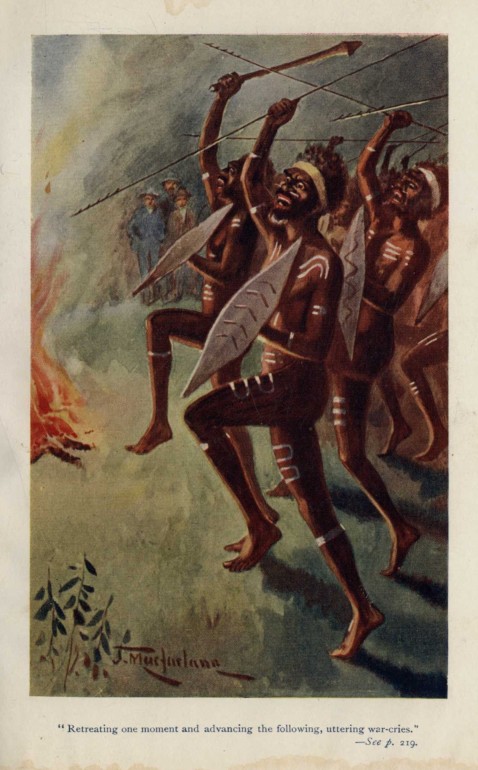
"Retreating one moment and advancing the following, uttering war-cries."—See p. 219.
"Tell me, Joe, me bhoy, did ye or Sahndy here shute the most b-i-rr-ds?"
"Honours are easy, Denny."
"Begorra! phwat th' divvil's thot?"
"It means that each shot an equal quantity."
"An e-qu-a-al quantitee! Be jabers, wheres did ye put 'em?"
"Put what?"
"Whoi, th' pair iv e-qu-a-al quan—— Be Saint Michael, it's a new sort iv a b-i-rr-d ye've shuted!"
Denny was not so dense as he pretended to be.
"You're a downy cove, Denny," laughed Joe, who caught a twinkle in the young Irishman's eye.
"That's true for ye, Joe," retorted the wit, surveying himself; "but, bhoys, why doan't ye's take me wid youse? Sure an' it's a foine shot Oi am."
"That's news, Denny. Didn't know you'd ever let off a gun."
"Manny an' manny's th' wan Oi've seen me farther bang off, annyways. Did youse never hear tell iv me farther's shutin'? Shure he was a sealabrity in Killarney!"
"Never. Tell us."
"Well, la-ads, wan da' he was rowin' th' Dook iv Dublhin, who was a g-rr-a-at sport, on th' woild la-a-kes iv Killarney. They was lukin' for dooks."
"Set a duke to catch a 'dook,' eh, Denny?"
"Be aisy, Marsther Joe. It's th' flyin' dooks Oi'me dascribin'. Be jabers! farther rowed about a tousan' moile, and th' only dook th' g-rr-a-at mahn shuted was a gull, though they was there in g-rr-a-at mobs."
"The gulls or the ducks, Denny?"
"If you'd 'a' bin there they wud 'a' bin two gulls, annyhow, me mahn."
"Good for you, Denny. Let him finish, Joe."
"Well, shure, saays farther at last, ses he, 'If y're Riall Hoiness wud let me have wan shot, maybe Oi'd bring ye luck.' An' he did it. So farther, he gits th' Dook's big gun, an' th' Dook he tuk th' pathles, an' bynby they see a mob iv dooks all in a loine acrost th' boat's bows, saalin' for all th' warld loike th' owld loin-iv-batthle ships in th' pictures, stim an' starn.
"'Howld aisy,' saays farther, ses 'e, whin they got abreast thim fowls. With that he pinted th' gun at th' la-adin' dook, an owld dr-a-ake be th' same token—pulled th' thrigger an' let her off. Wud ye bela-ave me, so quick was he that before all th' shot had got out iv th' way-pon he'd got her down to th' tail-most birr-d, an' betune you an' me an' little Garr-ge Washintong in th' Bible, ivry sowl iv thim dooks lay spaachless dead upon th' wather. Now thin, phwat div ye think iv that f'r shutin', ye gosoons?"
"Think of it, Denny," said Maggie, who had been standing at the kitchen door, unobserved of the boys, an amused listener. "Why, you'll be writing a book one day that will put the Kybosh on Baron Munchausen."
"Well, if iver Oi does, Miss Maggie," replied the incorrigible Irish boy, "Oi'll pit y'reself in as th' laaden acthress—Oi mane th' herr-owyne."
"Maggie!"
"Coming, mother."
CHAPTER XXIV
THE CORROBBERIE
"Deep in the forest depths the tribe
A mighty blazing fire have spread:
Round this they spring with frantic yells,
In hideous pigments all arrayed.
* * * * *
One barred with yellow ochre, one
A skeleton in startling white,
Then one who dances furiously
Blood-red against the great fire's light.
* * * * *
Like some infernal scene it is—
The forest dark, the blazing fire,
The ghostly birds, the dancing fiends,
Whose savage chant swells ever higher."
WILLIAM SHARP.
"Jacky and Willy want to know if they can have some raddle,[#] whitning, and blue: can they, dad?"
[#] Raddle: a red pigment used for marking sheep, etc.
"They're very reasonable, I maun say. And what are they aifter noo, the scamps?"
"Oh, I thought you knew, dad! There's going to be a grand corrobberie to-night. Old Tarpot has sent in a messenger for them to go out, and take this stuff with them, and——"
"Precious cool cheek on the pairt of Tarpot, and o' the boys as weel. Why couldna they come oure and ask me properly?"
"Dunno, dad."
"It's the blacks' way all over, dad," said Maggie.
"Dad, dad," interrupted Jessie, who was eagerly waiting a chance to get in a word, "you said, the last time there was a corrobberie, when you refused to let us go, that you would the next time. Now then, dado, you can't refuse to let us this time. Say you will. Ah, I know by your eyes you will say yes! You dear thing, it's worth a kiss and a hug."
When the ardent girl had bestowed these filial pledges she turned round to Sandy and the others, out of whose sails she had taken the wind in a manner.
"There now, young people, we are all going, for which I ought to be thanked. Only for my good memory, I'm afraid the dear man would have said no! wouldn't you, dadums? We'll make up a party, and Mr. Neville will, I am sure, be delighted at the exhibition."
"My stars, Jess, but you're gettin' 'em bad! You will be applying for a school teacher's billet next. Such consideration for Mr. Neville, too! Why——"
"Oh, brither mine, bless your poor thick skull; it's positively no use you trying to be funny—you simply can't. Oh, it'll be glorious fun," continued she, turning to the Englishman.
"But, Miss Jessie, please! In the first place, what is this corbobbery? Is that the way it is pronounced?"
"No, sir, it is not; though to be sure they do kick up a tremendous bobbery."
"Well, whatever the name, I suppose it stands for an aboriginal ceremonial or pastime?" said Neville smilingly.
"Exactly. Cor-rob-ber-ie is their Café Chautant, a free-and-easy; with this difference, though—all their performers appear in full dress; got up to kill by the aid of the tribe tonsorial artists and valets. The young bucks are perfect pictures, I do assure you; and as for the girls——"
"Don't take any notice of the saucy kid, Mr. Neville," broke in Sandy, who felt that he owed his young sister one. "She's only jigging you. It's their native dance and song by the firelight; she's right there. The men do the dancing, and the women simply play the music."
"Music! I had no idea that they were——"
"Musicians. Oh well, not exactly that. They beat time for the men. They, the men, are all painted up and armed. It's a sort of action song, but it's jolly fine, a tiptop sight, especially when there's a big mob of them. Sometimes four or five tribes get together for what they call the 'great corrobberie.' Then you see something; for there's generally ructions before they finish, particularly if there has been any grog in the camp. In that case they usually wind up with a fight, and then there's the killed and wounded to count when the cleaning-up's done. It's all right to-night, though. There will be only two tribes in it, and they've always been friendly. Would you like to come?"
"Come! I wouldn't miss it for the world. Yes, you may reckon on me for one—that is, of course, if your father is agreeable for us to go."
"I suppose, dad," said Sandy, turning to his father, "we may all go? It's to be held at the old spot."
"Oh, weel, I suppose you'd think me hard-herted if I said no? I'll jist mak' one condeetion, and that is, dinna interfere wi' the blacks. You maunna mak' ony attempt to boss them. Let them cairry oot things in their ain way."
"All serene, dad."
"Can the boys have the whitnin' and other things from the store?" repeated Sandy.
Consent is given, and the heart of Tarpot, the King of Bullaroi, is made glad with a goodly parcel of pigments.
That night after tea the party, including Denny Kineavy, mount their steeds and ride out to the corrobberie grounds, a matter of three miles.
It was situated on a lightly timbered box-tree flat, where a cleared space occurred forming a natural amphitheatre, wherein the aboriginal tribes foregathered periodically and disported themselves in their national characters and games at night time.
The blacks make a distinction in these festivals. There is the corrobberie and the cobborn (or great) corrobberie. It was one of the former that the whites were to witness. The latter occurred only at long intervals, and was a time of feasting as well as amusement; both feasting and play being prolonged often for weeks, and generally attended by all the tribes within a radius of hundreds of miles.
Each tribe would bring its song and dance (corrobberie), in many cases composed for the special occasion. This produced the exciting element of competition. A corrobberie of exceptional excellence would be learned by the other tribes, and on their return to their own country passed on to the surrounding tribes. Thus it happened sometimes that a corrobberie of singular merit travelled round and through the continent.
These folk-songs were associated with the dances, and treated on elemental themes, as war, the chase, the feast, love, birth, death. Often some humorous theme would be introduced, causing immense fun. As a rule each tribe had clowns, whose grotesque attitude and voice intonations were mirth-provoking to a degree. The Australian native manifests a keen appreciation of a joke and has an inborn tendency to laughter.
The preparations were far advanced by the time the station party arrived at the camp. The gins, to whom fell all labour of a manual sort, were lighting the fires, while the bucks were busy "dressing" for their parts.
The girls remained in the clearing talking to some of the old gins, while the males proceeded to the outskirts of the forest, where the work of adorning went on apace.
For this no pains were spared. The naked bodies of the dancers were treated by the tribe experts, and some fearfully and wonderfully startling effects were produced. Take His Majesty, Tarpot, as a sample. The ordinary court dress of the King consisted of a tattered police uniform, together with a crescent-shaped brass plate that adorned his breast, where it hung, suspended by a chain from his neck. The plate—presented to him on one occasion as a joke—bore upon it the inscription—
TARPOT, KING OF BULLAROI
But to-night Merri-dia-o is resplendent in a warrior's full rig. A hole bored through the cartilage of his nose peak displays the bone of an eagle's wing, about four inches long, the insignia of his maturity and dignity—his knighthood's spurs, so to speak.
Behold, then, athwart his nose, the polished bone, gleaming like ivory against the ebony background! His grey hair is trussed up, forming a big top-knot, and is adorned with the sulphur-hued crest of the white cockatoo, also with turkey-tail feathers. Wound several times round his somewhat corpulent body is a belt of human hair. This serves to hold the boomerang and other short weapons. A dingo-tail skin, split up the middle to the brush, and bound round the forehead with the brush erect and plume-like, gives grace and height to the stature. But the body and limb painting is the principal part. Each tribe has its devices. Pigments are largely used. The greater the number of colours the more fantastic is the effect.
When the boys strode up to the "dressing-room" where the tribe artiste were engaged, they found that most of the men had completed their adornments and were strutting about casting admiring or envious glances at one another. Merri-dia-o, however, was still in the hands of the dressers, and his markings were a triumph. Being a large-framed and portly fellow, he showed the designs to the best advantage. The colour scheme was brilliant, if nothing else. On his massive chest, which was whitewashed for a background, were drawn an emu and a kangaroo. The bird's plumage was bright blue, while the marsupial was as glaring as red ochre could make it. These cartoons covered breast and belly, the limbs being like animated barber's poles in red and white. On his back, upon a white ground, was coiled an enormous carpet snake, with erect head and protruding tongue. When seen in the corrobberie, armed with spears, shield, and boomerangs, this fantastic figure was without peer among the warrior-clowns, the whole effect being an extravaganza at once whimsical and wild.
By the time these preparations were ended the great central fire was blazing furiously, fed as it constantly was from a dry tinder stack.
The "orchestra," to the number of six, sat in a cluster behind the fire and beat time to the primitive measures. The musicians for the most part were old women, who were well-practised performers. Their instruments were as primitive as the songs they accompanied, consisting generally of a tightly folded opossum rug or a shield. These were operated upon by the palms of the hands or by sticks; a vigorous slapping of the thighs also gave variety to the combination. At any rate, a surprising din was raised.
It has been stated that two tribes participated. The Ding-donglas were the guests of the Bullarois, who had provided a grand supper of fat grubs, native yams, and roast kangaroo for the festivities.
According to immemorial precedence the visiting tribe "took the flure" first, and gave a most interesting and picturesque display. The subject of the corrobberie was an emu hunt, and was full of startling incident, presenting ludicrous aspects that created roars of laughter. The descriptive song was chanted in perfect time: a sort of runic lay, beginning in a low and monotonous key and gradually waxing louder as the chase progressed, finally ending crescendo in a cry of victory, what time the animal is overcome and slain.
The spectators, black and white, applauded most generously, our old friends Jacky and Willy being among the loudest. The station boys were in no ways different from their brothers in get up. For the moment they had abandoned the role of station hands for that of barbaric magnificoes.
The whites, especially the girls and Neville, who witnessed the spectacle for the first time, were delighted beyond measure. The silence following the huntsman's song was of short duration. The story-teller of the visiting tribe now advanced within the circle of light, and in sing-song tones recited one of their folklore stories.
THE COCKATOO'S NEST.[#]
[#] Tom Petrie's Reminiscences.
Once upon a time there lived happily together on an island three young aborigines, a brother and two sisters. This land was not very far from the mainland, and the three often used to gaze across at the long stretch of land, and think of journeying forth from their island home to see what it was like over there. They felt sure they would find lots of things to eat. So one day by means of a canoe they really did cross over, and began without loss of time to seek for 'possums, native bears, and so forth. In this search round about they at length espied a hollow limb, which looked uncommonly like a place where a nest would be, and so, going into a scrub near by, they cut a vine for climbing up. Up went the youth, while his sisters waited beneath. When he had cut open the limb, he found to his great joy a cockatoo's nest with young birds in it, and these latter he proceeded to throw down one by one to his sisters, the fall to the ground killing the poor things.
Now it so chanced that as the young fellow picked up the last little bird from the nest, a feather detached itself from its tail, and floating away on the air, at length settled fair on the chest of an old man asleep in a hut some distance away. This old man was really a ghost who owned the place, and the feather disturbed his rest and woke him up. Divining at once what was happening, he arose, and getting hold of a spear and a tomahawk, sallied forth to the tree, where he arrived before the young fellow had started to climb down. Seeing the birds dead, the old man was very angry, and said, "What business you take my birds? Who told you to come here?" He then commanded the tree to spread out and grow taller and taller, so that the young fellow could not get down, and, taking the dead birds, he put them in a big round dilly, and carried them to his hut.
Although the old man did not wait, the tree did his bidding, becoming immediately very wide and tall, and the young fellow tried his best to come down, but could not. So at last he started to sing to the other trees all around to come to him, which they did; and one falling right across where he stood, he was able to get to the ground that way. Somehow, though, in coming down he got hurt, and the gins had to make a fire to get hot ashes in order to cover him up there. He lay covered up so for half an hour, at the end of which time he was all right again.
Of course these three felt very indignant at the old man's behaviour, and they thirsted for revenge. So, calling all the birds of the air to them, they sought their assistance. These birds went in front, while the three cut their way through the thick scrub to the old man's hut; and ever as they went, to drown the noise of the cutting, the birds sang loudly, the wonga pigeon making a tremendous row with his waugh! waugh! waugh! When they had got nearly to the hut, the old man, who had been trying to make up for his disturbed sleep, heard the noise of the birds, and called crossly to them, "Here, what do you make such a noise for? I want to sleep!" But even as he spoke he was dozing, and presently went right off, suspecting nothing; and when the three reached the doorway, looking in, they saw him quite soundly sleeping. So the three clutched their weapons tightly,—the man his spear, and the women their yam sticks,—and advancing into the hut, they all viciously jobbed down at the old man, and lo! he was dead. His body was dragged forth and burned, and after the hut was robbed of the young cockatoos and all objects worthy of value it also was burned, and the three found their way back to the canoe, and departed home to their island laden with the spoil.
At the conclusion of the "yarn" the Bullarois retired to the trees fringing the clearing on the side directly opposite the audience. After a short harangue from Merri-dia-o, the braves, about twenty in number, fully armed and in their war-paint, issued from the forest, headed by their chief, shouting their battle-cry, gesticulating wildly, and making a great clatter with their weapons. Advancing upon the foe, now in line and now in sections, they battled with the enemy, crouching one moment behind their shields to receive the shower of imaginary spears thrown by their assailants, the next springing erect and casting, as it were, their weapons of offence. Following up this round, they bore upon the visionary foe and engaged in personal encounter. Retreating one moment and advancing the following, uttering war cries and fierce challenge, hurling coarse and stinging epithet, they gradually approached the fire; the gins meanwhile beat time, giving coherence and harmony to the bellicose proceedings.
There was such reality in the battle-play, the men were so earnest, their cries so passionate, their taunts so bitter; in short, there was such a ring of sincerity, such a presentation of the actual, that the white spectators were carried away as in the drama when the master mummers live their parts.
The boys were in a condition of exultancy. They were inspired by the martial display to a participation of fellow-feeling with the warring company. Neville, too, was fairly captured by this weird yet fierce and savage sham-fight. The thrill of combat held him so strongly that he could not refrain from leaping to his feet and yelling with the rest—urging them, indeed, to greater slaughter.
It was different with the girls. Fear laid hold of them at the unwonted sight. At first they joined in the hurrahs, but when the fighters neared them, and it seemed, as was indeed the case, that the very actors were being carried away by frenzy and battle-lust, their tongues ceased and a cold chill of apprehension seized them.
The warriors are now right up, fronting the fire. In a few minutes the grand finale will have been enacted, and the curtain rung down. Unfortunately, however, one of the young men has a quarrel with a youth belonging to the visiting tribe. In the culminating point of this sham fight he sees his enemy among the crowd of onlookers, and, urged by his excited feelings, he directs insulting remarks full at this man, who, running out into the clear space in front of the fighters, returns these with interest. This so enrages the Bullaroi youth that, darting from the ranks, he slings his spear full at the enemy, and transfixes him in the breast. Loud cries of consternation come from the women, and a moment's awful stillness from the men. Then, as if by magic, the Dingdonglas have risen in their wrath, arms in hand. The play has vanished, and downright fight and bloody battle ensues. Spears hurtle and boomerangs swish through the air; the crash of nulla-nulla on shields supplants the music of the orchestra, the while the gins flee in sheer terror from the bloody scene to their huts in the forest, rending the air with their shrill screams as they speed.
But what of the whites?
They stand a few moments horrorstruck at the raging human cyclone. At first the grim reality seemed unreal, just as previously the sham battle-action appeared real. Joe is the first to size up the situation. Not only are the blacks in blood-red earnest, but there is actual peril to the spectators. The combatants are surging to and fro in the strife of conflict, and circling as though in a vortex. At any moment the spectators might be drawn into the battle zone through the movements of the belligerents.
"Come, Mag, Jess, quickly!" cries that youth, seizing the girls as he speaks and drawing them away. "The brutes are at it in real earnest. Come! we must bolt to the trees. Great Cæsar, look at that!" A spear whistled through the air and impaled itself in a tree near by.
Just then, one of the fighters detached himself from the scrum and came bounding up to the little group, spear extended. As he seemed to be on hostile intent, the youths lined up in front of the girls, ready to defend them and grapple with the foe. On nearing, Sandy knew him to be Willy the station boy. Willy, loyal to the family, came to entreat them to leave the field. There was little fear of any direct attack upon them, though it were hard to say what turn the savage mind might take. The apparent danger was from fugitive spears and boomerangs. So Willy paused but to cry out, "Take 'em girls to horses: safe there; no safe here. Go!" and then skipped back to his band, throwing himself heart and soul into the fray. For the hour the boy was as great a savage as any of the young men of the tribe.
The girls, now really terrified, need no pressure to leave; so they scurry from the field and reach their horses, some distance beyond spear reach. There they watch the tide of battle as it ebbs and flows until it dies, which it is not long in doing, from its very violence.
When the casualties were reckoned it was found that most of the combatants had received bruises or gashes, limbs were broken, but the only fatalities were those of the lads who began the quarrel. Now that the fight is over, both sides settle down to supper in the best of humours. The slate has been cleaned in this primitive fashion, and now friendships are renewed over handfuls of luscious tree-grubs and hunches of roast kangaroo. To-morrow there will be weeping in common over the biers of the departed braves.
"Well, Denny, what do you think of this dreadful corrobberie?" exclaimed Jessie to the Irish boy as they rode home about midnight.
"Phwat div Oi think iv it, Miss Jassie? Whoi, it's been a lovely foight, shure. Och, they're the very divils ontoirely! Nivir seen sich a bit of divarsion since Oi left owld Oireland, bedad! Begorrah, it'd ta-ake owld Tipperary itself to bate it."
"Do you know what I've been thinking of, Denny?" continued the mischievous girl.
"Nawthin' but lovely thoughts, Miss Jassie."
"You of course are the best judge, Denny, being an Irishman. What I was thinking was this: scratch an aboriginal, and you have an Irishman."
"Och, dear-a-dear, Miss Jassie, to maline me poor counthrymen loike that! Troth, then," cried the lad, with a serio-comic air and the suspicion of a wink, "there's one thing indade which Irishmen have in common wid these poor naggurs."
"What is that, Denny?"
"We both suffer at the hands of Saxon landlords."
And Jessie had no answer.
CHAPTER XXV
IN THE BUSHRANGERS' CAVES
"In Xanadu did Kubla Khan
A stately pleasure-dome decree,
Where Alph the sacred river ran
Through caverns measureless to man
Down to a sunless sea."
KUBLA KHAN.
"Joe!"
Silence.
"J-o-o!"
No answer.
"J-o-o-o!"
Profound stillness, broken only by a buzzing fly.
"If you don't answer within five seconds, an' short ones at that, look out for squalls. You're only 'possumin', you rascal!"
Presently a hurtling pillow, and not too soft a one either, struck Joe Blain, who lay flat on his back, with open mouth, closed eyes, and deaf ears. The missile hit him fair and square on the face, hermetically sealing his breathing apparatus for a moment.
A muffled sound, a quick contortion of the body, and an instinctive clutch of the hands got rid of the obstruction, which in a twinkling described a trajectory that impinged on Tom's left ear.
"Well, what's in the wind, now?" asked Joe, after this customary exchange of shots, which was an everyday occurrence.
"I've an idea, Joe."
"Howly Moses, you don't mean it! Terrible, terrible! Where did you catch it?"
"Catch your grandmother's sister's cat! Only, you're such a numskull, I'd try an' put it in your head."
"What! my grandmother's sister's——"
"No, you ass; a simple idea!"
"Then I'll bet tuppence it's simple enough, you goat!"
After this complimentary interchange Tom proceeded: "When we went out to the caves the other day, we said we'd return before the holidays were ended, an' we've come to the larst day, ole man. Ding-bust it! we'll have to make for home to-morrer, an'——"
"Ugh! don't mention it! Go on about the caves."
"Well, then, that day we went out—— Oh Joey! shall we ever forget the sight of 'Fevvers' rollin'——?"
"Look here, Hawkins, if you can't spit out that idea of yours quick an' lively, you'd better swallow it! If you think to waste my valuable time——"
"Your time wasted! Pish! Listen, then. I vote we go out to the caves an' have a look round for the place where Ben Bolt kep' his horses. It'd be no end of a lark for us to find, after the police an' others have given it up. What say?"
"There's not much in your notions, Hawkins, generally speaking; still, you've struck ile this time, sonny. Gewhillikins! it's all right. Let's have a talk with ole Sandy about it."
"Oh, he's sure to be nuts on it! He's always talkin' about the mystery."
"Up, guards, an' at 'em! as Cromwell sang out at the battle of Marathon," quoth Joe, in slight historical confusion, as he tumbled out of bed.
They dressed quickly and then rushed out to find Sandy, who had risen earlier to yard the horses. Sandy was nothing loth. Indeed, he was as eager as the others, if not more so. He had often brooded over the puzzle, and discussed it at times with his mates, but oftener with himself. Like the others, he had theories.
"I've got to take the harrow to the cultivation paddock after breakfast, an' then I'll be free."
"Can't you take it now?" suggested Tom. "Good hour yet to breakfast. You'll have whips of time, an' we'll help you."
Sandy was agreeable, and the boys soon hoisted the harrow on to the cart. They returned in good time for breakfast, and got Mr. M'Intyre's consent.
"Best take us with you, Sandy."
"Girls 'd only be in the way, Mag."
"Thanks, me brither! Just wait till you ask me to cut your lunches!"
"Oh, mother'll do that."
"Yes; rin to your mither and hold on to her apron-strings. For selfishness and for cheek, commend me to a brother! You're all alike. I expect Tom and Joe are no better at home, for all they put on mighty innocent airs here," prattled the girl, in mock sarcasm.
"I hope you'll count me in, boys?" said Neville. "I have intimated to Mrs. M'Intyre that I shall be forced to tear myself away from her unbounded hospitality,"—"Fevvers" was still a trifle stilted,—"but she will not hear of my leaving till the end of the week. You know," he went on, "I did not have an opportunity—the last time I—er—we were out there—and——"
"You lassoed an Englishman with a stock whip," broke in Jessie the tease.
"And behaved like a brick," interposed Maggie, who noticed the involuntary wince on the part of the Englishman. This was, indeed, a sore spot; but he was growing rapidly in grace.
Neville winced under Jess's sally, but took it in good part. "It's all part of the breaking-in process, Miss Jessie. I believe I can dismount now a little more gracefully. I shall be glad of an opportunity to see the famous bandit's caves. It will be something to relate in England."
It did not take the boys long to get ready. Half an hour later the party was en route for the caves, determined to solve the puzzle.
"You'll do nothing rash, boys?" said the careful mother at parting, "Have you enough candles?"
"Plenty; also ropes and tucker. Don't worry about us, mother; we may not be back till near bedtime—depends on what luck we have."
"You've got a scheme, Sandy, I s'pose?" remarked Joe, as they jogged along the road.
"Yes, Joe, I've an idea; but of course only testing it will prove its worth. The caves are situated in a spur running north and south. The opening, we know, is on the east side. Nothing bigger than a wallaby or a dingo, save of course a man, can squeeze through that opening. Either there is another and separate cave adjacent, where the 'rangers stalled their horses, or there is an easier entrance somewhere in the spur that has a connection with the ones we have already visited."
"You must remember, though, Sandy, that Inspector Garvie and his men spent days in searching the locality, an' how are we chaps to do in a day what they failed to do after several days, and with black trackers, too?"
"I'm not likely to forget that."
"I vote, then," said Joe, "we go straight to the caves an' explore 'em first."
"It'd take us all day to search those ravines and bluffs on the west side," added Tom, "so I'm in favour of Joe's proposal."
"I'm not sure that I should have a voice in this matter," spoke Neville. "You fellows will have to settle it between yourselves. Whatever you decide upon will be agreeable to me."
"Matter's decided, then," answered Sandy. "Joe and Tom are for the caves direct. Honestly speaking, although I would dearly love a try at the western side, for I'm convinced that the outlet lies there, I think, on the whole, we'd better stick to the caves, giving them first show, anyhow."