XVIII EXPERIENCES IN HOLLAND
Reading edition
But I was not yet quite out of the woods.
I now knew that I was in Holland, but just where I had no idea. I walked for about thirty minutes and came to a path leading to the right, and I had proceeded along it but a few hundred yards when I saw in front of me a fence exactly like the one I had crossed.
"This is funny," I said to myself. "I didn't know the Dutch had a fence, too." I advanced to the fence and examined it closely, and judge of my astonishment when I saw beyond it a nine-foot fence apparently holding live wires exactly like the one which had nearly been the death of me!
I had very little time to conjecture what it all meant, for just then I heard a guard coming. He was walking so fast that I was sure it was a Dutch sentry, as the Huns walk much more slowly.
I was so bewildered, however, that I decided to take no chances, and as the road was fairly good I wandered down it and away from that mysterious fence. About half a mile down I could see the light of a sentry station, and I thought I would go there and tell my story to the sentries, realizing that as I was unarmed it was perfectly safe for me to announce myself to the Dutch authorities. I could be interned only if I entered Holland under arms.
As I approached the sentry box I noticed three men in gray uniforms, the regulation Dutch color. I was on the verge of shouting to them when the thought struck me that there was just a chance I might be mistaken, as the German uniforms were the same color, and I had suffered too many privations and too many narrow escapes to lose all at this time.
I had just turned off the road to go back into some bushes when out of the darkness I heard that dread German command:
"Halt! Halt!"
He didn't need to holler twice. I heard and heeded the first time. Then I heard another man come running up, and there was considerable talking, but whether they were Germans or Hollanders I was still uncertain. Evidently, however, he thought the noise must be a dog or the wind.
Finally I heard one of them laugh and heard him walk back to the sentry station where the guard was billeted, and I crawled a little nearer to try to make out just what it all meant. I had begun to think it was all a nightmare.
Between myself and the light in the sentry station I then noticed the stooping figure of a man bending over as if to conceal himself, and on his head was the spiked helmet of a German soldier!
I knew then what another narrow escape I had had, for I am quite sure he would have shot me without ceremony if I had foolishly made myself known. I would have been buried at once and no one would have been any the wiser, even though, technically speaking, I was on neutral territory and immune from capture or attack.
This new shock only served to bewilder me the more. I was completely lost. There seemed to be frontier behind me and frontier in front of me. Evidently, however, what had happened was that I had lost my sense of direction and had wandered in the arc of a circle, returning to the same fence that I had been so long in getting through. This solution of the mystery came to me suddenly, and I at once searched the landscape for something in the way of a landmark to guide me. For once my faithful friend, the North Star, had failed me. The sky was pitch black and there wasn't a star in the heavens.
In the distance, at what appeared to be about three miles away, but which turned out to be six, I could discern the lights of a village, and I knew that it must be a Dutch village, as lights are not allowed in Belgium in that indiscriminate way.
My course was now clear. I would make a bee-line for that village. Before I had gone very far I found myself in a marsh or swamp, and I turned back a little, hoping to find a better path. Finding none, I retraced my steps and kept straight ahead, determined to reach that village at all costs and to swerve neither to the right nor to the left until I got there.
One moment I would be in water up to my knees and the next I would sink in clear up to my waist. I paid no attention to my condition. It was merely a repetition of what I had gone through many times before, but this time I had a definite goal, and, once I reached it, I knew my troubles would be over.
It took me perhaps three hours to reach firm ground. The path I struck led to within half a mile of the village. I shall never forget that path; it was almost as welcome to my feet as the opposite bank of the Meuse had seemed.
The first habitation I came to was a little workshop with a bright light shining outside. It must have been after midnight, but the people inside were apparently just quitting work. There were three men and two boys engaged in making wooden shoes.
It wasn't necessary for me to explain to them that I was a refugee, even if I had been able to speak their language. I was caked with mud up to my shoulders, and I suppose my face must have recorded some of the experiences I had gone through that memorable night.
"I want the British consul," I told them.
Apparently they didn't understand, but one of them volunteered to conduct me to the village. They seemed to be only too anxious to do all they could for me; evidently they realized I was a British soldier.
It was very late when my companion finally escorted me into the village, but he aroused some people he knew from their beds and they dressed and came down to feed me.
The family consisted of an old lady and her husband and a son who was a soldier in the Dutch army. The cold shivers ran down my back while he sat beside me, because every now and again I caught a glimpse of his gray uniform and it resembled very much that of the German soldiers.
Some of the neighbors, aroused by the commotion, got up to see what it was all about, and came in and watched while I ate the meal those good Dutch people prepared for me. Ordinarily, I suppose, I would have been embarrassed with so many people staring at me while I ate, as though I were some strange animal that had just been captured, but just then I was too famished to notice or care very much what other people did.
There will always be a warm place in my heart for the Dutch people. I had heard lots of persons say that they were not inclined to help refugees, but my experience did not bear these reports out. They certainly did much more for me than I ever expected.
I had a little German money left, but as the value of German money is only about half in Holland, I didn't have enough to pay the fare to Rotterdam, which was my next objective. It was due to the generosity of these people that I was able to reach the British consul as quickly as I did. Some day I hope to return to Holland and repay every single soul who played the part of Good Samaritan to me.
With the money that these people gave me I was able to get a third-class ticket to Rotterdam, and I am glad that I didn't have enough to travel first-class, for I would have looked as much out of place in a first-class carriage as a Hun would appear in heaven.
That night I slept in the house of my Dutch friends, where they fixed me up most comfortably. In the morning they gave me breakfast and then escorted me to the station.
While I was waiting in the station a crowd gathered round me, and soon it seemed as if the whole town had turned out to get a look at me. It was very embarrassing, particularly as I could give them no information regarding the cause of my condition, although, of course, they all knew that I was a refugee from Belgium.
As the train pulled out of the station the crowd gave a loud cheer, and the tears almost came to my eyes as I contrasted in my mind the conduct of this crowd and the one that had gathered at the station in Ghent when I had departed a prisoner en route for the reprisal camp. I breathed a sigh of relief as I thought of that reprisal camp and how fortunate I had really been, despite all my suffering, to have escaped it. Now, at any rate, I was a free man and I would soon be sending home the joyful news that I had made good my escape.
At Einhoffen two Dutch officers got into the compartment with me. They looked at me with very much disfavor, not knowing, of course, that I was a British officer. My clothes were still pretty much in the condition they were when I crossed the border, although I had been able to scrape off some of the mud I had collected the night before. I had not shaved nor trimmed my beard for many days, and I must have presented a sorry appearance. I could hardly blame them for edging away from me.
The trip from Einhoffen to Rotterdam passed without special incident. At various stations passengers would get into the compartment and, observing my unusual appearance, would endeavor to start a conversation with me. None of them spoke English, however, and they had to use their own imagination as to my identity.
When I arrived at Rotterdam I asked a policeman who stood in front of the station where I could find the British consul, but I could not make him understand. I next applied to a taxicab driver.
"English consul—British consul—American consul—French consul," I said, hoping that if he didn't understand one he might recognize another.
He eyed me with suspicion and motioned me to get in and drove off. I had no idea where he was taking me, but after a quarter of an hour's ride he brought up in front of the British consulate. Never before was I so glad to see the Union Jack!
I beckoned to the chauffeur to go with me up to the office, as I had no money with which to pay him, and when we got to the consulate I told them that if they would pay the taxi fare I would tell them who I was and how I happened to be there.
They knew at once that I was an escaped prisoner and they readily paid the chauffeur and invited me to give some account of myself.
They treated me most cordially and were intensely interested in the brief account I gave them of my adventures. Word was sent to the consul-general, and he immediately sent for me. When I went in he shook hands with me, greeting me very heartily and offering me a chair.
He then sat down, screwed a monocle on his eye, and viewed me from top to toe. I could see that only good breeding kept him from laughing at the spectacle I presented. I could see he wanted to laugh in the worst way.
"Go ahead and laugh!" I said. "You can't offend me the way I feel this blessed day!" And he needed no second invitation. Incidentally, it gave me a chance to laugh at him, for I was about as much amused as he was.
After he had laughed himself about sick he got up and slapped me on the back and invited me to tell him my story.
"Lieutenant," he said, when I had concluded, "you can have anything you want. I think your experiences entitle you to it."
"Well, Consul," I replied, "I would like a bath, a shave, a hair-cut, and some civilized clothes about as badly as a man ever needed them, I suppose, but before that I would like to get a cable off to America to my mother, telling her that I am safe and on my way to England."
The consul gave the necessary instructions, and I had the satisfaction of knowing before I left the office that the cable, with its good tidings, was on its way to America.
Then he sent for one of the naval men who had been interned there since the beginning of the war and who was able to speak Dutch, and told him to take good care of me.
After I had been bathed and shaved and had a hair-cut, I bought some new clothes and had something to eat, and I felt like a new man.
As I walked through the streets of Rotterdam, breathing the air of freedom again and realizing that there was no longer any danger of being captured and taken back to prison, it was a wonderful sensation.
I don't believe there will ever be a country that will appear in my eyes quite as good as Holland did then. I had to be somewhat careful, however, because Holland was full of German spies, and I knew they would be keen to learn all they possibly could about my escape and my adventures, so that the authorities in Belgium could mete out punishment to every one who was in any respect to blame for it. As I was in Rotterdam only a day, they didn't have very much opportunity to learn anything from me.
The naval officer who accompanied me and acted as interpreter for me introduced me to many other soldiers and sailors who had escaped from Belgium when the Germans took Antwerp, and as they had arrived in Holland in uniform and under arms the laws of neutrality compelled their internment, and they had been there ever since.
The life of a man who is interned in a neutral country, I learned, is anything but satisfactory. He gets one month a year to visit his home. If he lives in England, that is not so bad, but if he happens to live farther away, the time he has to spend with his folks is very short, as the month's leave does not take into consideration the time consumed in traveling to and from Holland.
The possibility of escape from internment is always there, but the British authorities have an agreement with the Dutch government to send refugees back immediately. In this respect, therefore, the position of a man who is interned is worse than that of a prisoner who, if he does succeed in making his escape, is naturally received with open arms in his native land. Apart from this restraint, however, internment, with all its drawbacks, is a thousand times—yes, a million times better than being a prisoner of war in Germany.
It seems to me that when the war is over and the men who have been imprisoned in Germany return home they should be given a bigger and greater reception than the most victorious army that ever marched into a city, for they will have suffered and gone through more than the world will ever be able to understand.
No doubt you will find in the German prison-camps one or two faint-hearted individuals with a pronounced yellow streak who voluntarily gave up the struggle and gave up their liberty rather than risk their lives or limbs. These sad cases, however, are, I am sure, extremely few. Nine hundred and ninety-nine out of a thousand of the men fighting in the Allied lines would rather be in the front-line trenches, fighting every day, with all the horrors and all the risks, than be a prisoner of war in Germany, for the men in France have a very keen realization of what that means.
But to return to my day in Rotterdam.
After I was fixed up I returned to the consulate and arrangements were made for my transportation to England at once. Fortunately there was a boat leaving that very night, and I was allowed to take passage on it.
Just as we were leaving Rotterdam the boat I was on rammed our own convoy, one of the destroyers, and injured it so badly that it had to put back to port. It would have been a strange climax to my adventure if the disaster had resulted in the sinking of my boat and I had lost my life while on my way to England after having successfully outwitted the Huns. But my luck was with me to the last, and while the accident resulted in some delay, our boat was not seriously damaged and made the trip over in schedule time and without further incident, another destroyer having been assigned to escort us through the danger zone in place of the one which we had put out of commission.
When I arrived in London the reaction from the strain I had been under for nearly three months immediately became apparent. My nerves were in such a state that it was absolutely impossible for me to cross the street without being in deadly fear of being run over or trampled on. I stood at the curb, like an old woman from the country on her first visit to the city, and I would not venture across until some knowing policeman, recognizing my condition, came to my assistance and convoyed me across.
Indeed, there are a great number of English officers at home at all times "getting back their nerve" after a long spell of active service at the front, so that my condition was anything but novel to the London bobbies.
It was not many days, however, before I regained control of myself and felt in first-class shape.
Although the British authorities in Holland had wired my mother from Holland that I was safe and on my way to England, the first thing I did when we landed was to send her a cable myself.
The cable read as follows:
Mrs. M. J. O'Brien, Momence, Ill., U. S. A.:
Just escaped from Germany. Letter follows.
Pat.
As I delivered it to the cable-despatcher I could just imagine the exultation with which my mother would receive it and the pride she would feel as she exhibited it among her neighbors and friends.
I could hear the volley of "I told you so's" that greeted her good tidings.
"It would take more than the Kaiser to keep Pat in Germany!" I could hear one of them saying.
"Knew he'd be back for Christmas, anyway," I could hear another remark.
"I had an idea that Pat and his comrades might spend Christmas in Berlin," I could hear another admitting, "but I didn't think any other part of Germany would appeal to him very much."
"Mrs. O'Brien, did Pat write you how many German prisoners he brought back with him?" I could hear still another credulous friend inquiring.
It was all very amusing and gratifying to me, and I must confess I felt quite cocky as I walked into the War Department to report.
For the next five days I was kept very busy answering questions put to me by the military authorities regarding what I had observed as to conditions in Germany and behind the lines.
What I reported was taken down by a stenographer and made part of the official records, but I did not give them my story in narrative form. The information I was able to give was naturally of interest to various branches of the service, and experts in every line of government work took it in turns to question me. One morning would be devoted, for instance, to answering questions of a military nature—German methods behind the front-line trenches, tactics, morale of troops, and similar matters. Then the aviation experts would take a whack at me and discuss with me all I had observed of German flying-corps methods and equipment. Then, again, the food experts would interrogate me as to what I had learned of food conditions in Germany, Luxembourg, and Belgium, and as I had lived pretty close to the ground for the best part of seventy-two days I was able to give them some fairly accurate reports as to actual agricultural conditions, many of the things I told them probably having more significance to them than they had to me.
There were many things I had observed which I have not referred to in these pages because their value to us might be diminished if the Germans knew we were aware of them, but they were all reported to the authorities, and it was very gratifying to me to hear that the experts considered some of them of the greatest value.
One of the most amusing incidents of my return occurred when I called at my banker's in London to get my personal effects.
The practice in the Royal Flying Corps when a pilot is reported missing is to have two of his comrades assigned to go through his belongings, check them over, destroy anything that it might not be to his interest to preserve, and send the whole business to his banker or his home, as the case may be. Every letter is read through, but its contents is never afterward discussed nor revealed in any way. If the pilot is finally reported dead, his effects are forwarded to his next of kin, but while he is officially only "missing" or is known to be a prisoner of war they are kept either at the squadron headquarters or sent to his banker's.
In my case, as soon as it was learned that I had fallen from the sky it was assumed that I had been killed, and my chum, Paid Raney, and another officer were detailed to check over my effects. The list they made and to which they affixed their signatures, as I have previously mentioned, is now in my possession and is one of the most treasured souvenirs of my adventure.
My trunk was sent to Cox & Co. in due course, and now that I was in London I thought I would go and claim it.
When I arrived in the bank I applied at the proper window for my mail and trunk.
"Who are you?" I was asked, rather sharply.
"Well, I guess no one has any greater right to Pat O'Brien's effects than I have," I replied, "and I would be obliged to you if you would look them up for me."
"That may be all right, my friend," replied the clerk, "but according to our records Lieutenant O'Brien is a prisoner of war in Germany, and we can't very well turn over his effects to any one else unless either you present proof that he is dead and that you are his lawful representative, or else deliver to us a properly authenticated order from him to give them to you."
He was very positive about it all, but quite polite, and I thought I would kid him no more.
"Well," I said, "I can't very well present proofs to you that Pat O'Brien is dead, but I will do the best I can to prove to you that he is alive, and if you haven't quite forgotten his signature I guess I can write you out an order that will answer all your requirements and enable you to give me Pat O'Brien's belongings without running any risks." And I scribbled my signature on a scrap of paper and handed it to him.
He looked at me carefully through the latticed window, then jumped down from his chair and came outside to clasp me by the hand.
"Good Heavens, Lieutenant!" he exclaimed as he pumped my hand up and down. "How did you ever get away?" And I had to sit right down and tell him and half a dozen other people in the bank all about my experiences.
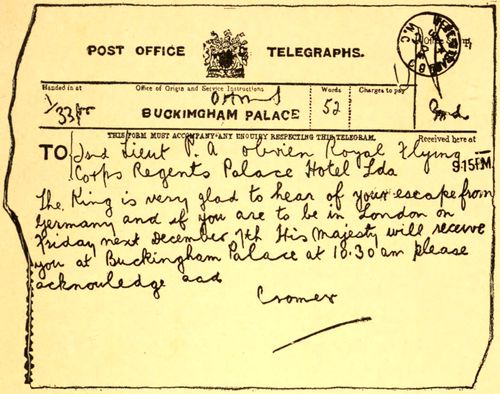
COPY OF TELEGRAM INVITING LIEUTENANT O'BRIEN TO MEET KING GEORGE
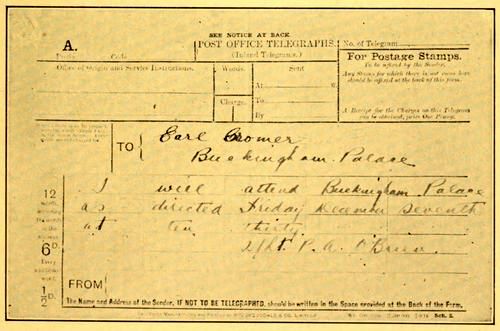
COPY OF TELEGRAM SENT BY LIEUTENANT O'BRIEN IN ANSWER TO AN INVITATION TO MEET KING GEORGE
I had been in England about ten days when I received a telegram which, at first, occasioned me almost as much concern as the unexpected sight of a German spiked helmet had caused me in Belgium. It read as follows:
Lieut. P. A. O'Brien, Royal Flying Corps, Regent's Palace Hotel, London:
The King is very glad to hear of your escape from Germany. If you are to be in London on Friday next, December 7th, His Majesty will receive you at Buckingham Palace at 10:30 a.m. Please acknowledge.
Cromer.
Of course, there was only one thing to do and that was to obey orders. I was an officer in the army and the King was my commander-in-chief. I had to go, and so I sat down and sent off the following answer:
Earl Cromer, Buckingham Palace, London:
I will attend Buckingham Palace as directed, Friday, December 7th, at 10:30.
Lieutenant Pat O'Brien.
In the interval that elapsed I must confess, the ordeal of calling on the King of England loomed up more dreadfully every day, and I really believe I would rather have spent another day in that empty house in the big city in Belgium, or, say, two days at Courtrai, than go through what I believed to be in store for me.
Orders were orders, however, and there was no way of getting out of it. As it turned out it wasn't half so bad as I had feared; on the contrary, it was one of the most agreeable experiences of my life.