III CAPTURED BY THE HUNS
Reading edition
I shall not easily forget the 17th of August, 1917. I killed two Huns in a double-seated machine in the morning, another in the evening, and then I was captured myself. I may have spent more eventful days in my life, but I can't recall any just now.
That morning, in crossing the line on early morning patrol, I noticed two German balloons. I decided that as soon as my patrol was over I would go off on my own hook and see what a German balloon looked like at close quarters.
These observation balloons are used by both sides in conjunction with the artillery. A man sits up in the balloon with a wireless apparatus and directs the firing of the guns. From his point of vantage he can follow the work of his own artillery with a remarkable degree of accuracy and at the same time he can observe the enemy's movements and report them.
The Germans are very good at this work and they use a great number of these balloons. It was considered a very important part of our work to keep them out of the sky.
There are two ways of going after a balloon in a machine. One of them is to cross the lines at a low altitude, flying so near the ground that the man with the anti-aircraft gun can't bother you. You fly along until you get to the level of the balloon, and if, in the mean time, they have not drawn the balloon down, you open fire on it and the bullets you use will set it on fire if they land.
The other way is to fly over where you know the balloons to be, put your machine in a spin so that they can't hit you, get above them, spin over the balloon, and then open fire. In going back over the line you cross at a few hundred feet.
This is one of the hardest jobs in the service. There is less danger in attacking an enemy's aircraft.
Nevertheless, I had made up my mind either to get those balloons or make them descend, and I only hoped that they would stay on the job until I had a chance at them.
When our two hours' duty was up, therefore, I dropped out of the formation as we crossed the lines and turned back again.
I was at a height of fifteen thousand feet, considerably higher than the balloons. Shutting my motor off, I dropped down through the clouds, thinking to find the balloons at about five or six miles behind the German lines.
Just as I came out of the cloud-banks I saw below me, about a thousand feet, a two-seater hostile machine doing artillery observation and directing the German guns. This was at a point about four miles behind the German lines.
Evidently the German artillery saw me and put out ground signals to attract the Hun machine's attention, for I saw the observer quit his work and grab his gun, while the pilot stuck the nose of his machine straight down.
But they were too late to escape me. I was diving toward them at a speed of probably two hundred miles an hour, shooting all the time as fast as possible. Their only chance lay in the possibility that the force of my dive might break my wings. I knew my danger in that direction, but as soon as I came out of my dive the Huns would have their chance to get me, and I knew I had to get them first and take a chance on my wings holding out.
Fortunately, some of my first bullets found their mark and I was able to come out of my dive at about four thousand feet. They never came out of theirs!
But right then came the hottest situation in the air I had experienced up to that time. The depth of my dive had brought me within reach of the machine-guns from the ground and they also put a "barrage" around me of shrapnel from anti-aircraft guns, and I had an opportunity to "ride the barrage," as they call it in the R. F. C. To make the situation more interesting, they began shooting "flaming onions" at me.
"Flaming onions" are rockets shot from a rocket-gun. They are used to hit a machine when it is flying low and they are effective up to about five thousand feet. Sometimes they are shot up one after another in strings of about eight, and they are one of the hardest things to go through. If they hit the machine it is bound to catch fire and then the jig is up.
All the time, too, I was being attacked by "Archie"—the anti-aircraft fire. I escaped the machine-guns and the "flaming onions," but "Archie" got me four or five times. Every time a bullet plugged me, or rather my machine, it made a loud bang, on account of the tension on the material covering the wings.
None of their shots hurt me until I was about a mile from our lines, and then they hit my motor. Fortunately I still had altitude enough to drift on to our own side of the lines, for my motor was completely out of commission. They just raised the dickens with me all the time I was descending, and I began to think I would strike the ground before crossing the line, but there was a slight wind in my favor and it carried me two miles behind our lines. There the balloons I had gone out to get had the satisfaction of "pin-pointing" me. Through the directions which they were able to give to their artillery, they commenced shelling my machine where it lay.
Their particular work is to direct the fire of their artillery, and they are used just as the artillery observation airplanes are. Usually two men are stationed in each balloon. They ascend to a height of several thousand feet about five miles behind their own lines and are equipped with wireless and signaling apparatus. They watch the burst of their own artillery, check up the position, get the range, and direct the next shot.
When conditions are favorable they are able to direct the shots so accurately that it is a simple matter to destroy the object of their attack. It was such a balloon as this that got my position, marked me out, called for an artillery shot, and they commenced shelling my machine where it lay. If I had got the two balloons instead of the airplane, I probably would not have lost my machine, for he would in all probability have gone on home and not bothered about getting my range and causing the destruction of my machine.
I landed in a part of the country that was literally covered with shell-holes. Fortunately my machine was not badly damaged by the forced landing. I leisurely got out, walked around it to see what the damage was, and concluded that it could be easily repaired. In fact, I thought, if I could find a space long enough between shell-holes to get a start before leaving the ground, that I would be able to fly on from there.
I was still examining my plane and considering the matter of a few slight repairs, without any particular thought for my own safety in that unprotected spot, when a shell came whizzing through the air, knocked me to the ground, and landed a few feet away. It had no sooner struck than I made a run for cover and crawled into a shell-hole. I would have liked to have got farther away, but I didn't know where the next shell would burst, and I thought I was fairly safe there, so I squatted down and let them blaze away.
The only damage I suffered was from the mud which splattered up in my face and over my clothes. That was my introduction to a shell-hole, and I resolved right there that the infantry could have all the shell-hole fighting they wanted, but it did not appeal to me, though they live in them through many a long night and I had only sought shelter there for a few minutes.
After the Germans had completely demolished my machine and ceased firing I waited there a short time, fearing perhaps they might send over a lucky shot, hoping to get me, after all. But evidently they concluded enough shells had been wasted on one man. I crawled out cautiously, shook the mud off, and looked over in the direction where my machine had once been. There wasn't enough left for a decent souvenir, but nevertheless I got a few, such as they were, and, readily observing that nothing could be done with what was left, I made my way back to infantry headquarters, where I was able to telephone in a report.
A little later one of our automobiles came out after me and took me back to our aerodrome. Most of my squadron thought I was lost beyond a doubt and never expected to see me again; but my friend, Paul Raney, had held out that I was all right, and, as I was afterward told, "Don't send for another pilot; that Irishman will be back if he has to walk." And he knew that the only thing that kept me from walking was the fact that our own automobile had been sent out to bring me home.
I had lots to think about that day, and I had learned many things; one was not to have too much confidence in my own ability. One of the men in the squadron told me that I had better not take those chances; that it was going to be a long war and I would have plenty of opportunities to be killed without deliberately "wishing them on" myself. Later I was to learn the truth of his statement.
That night my "flight"—each squadron is divided into three flights consisting of six men each—got ready to go out again. As I started to put on my tunic I noticed that I was not marked up for duty as usual.
I asked the commanding officer, a major, what the reason for that was, and he replied that he thought I had done enough for one day. However, I knew that if I did not go, some one else from another "flight" would have to take my place, and I insisted upon going up with my patrol as usual, and the major reluctantly consented. Had he known what was in store for me I am sure he wouldn't have changed his mind so readily.
As it was, we had only five machines for this patrol, anyway, because as we crossed the lines one of them had to drop out on account of motor trouble. Our patrol was up at 8 p.m., and up to within ten minutes of that hour it had been entirely uneventful.
At 7.50 p.m., however, while we were flying at a height of sixteen thousand feet, we observed three other English machines which were about three thousand feet below us pick a fight with nine Hun machines.
I knew right then that we were in for it, because I could see over toward the ocean a whole flock of Hun machines which evidently had escaped the attention of our scrappy comrades below us.
So we dove down on those nine Huns.
At first the fight was fairly even. There were eight of us to nine of them. But soon the other machines which I had seen in the distance, and which were flying even higher than we were, arrived on the scene, and when they, in turn, dove down on us, there was just twenty of them to our eight!
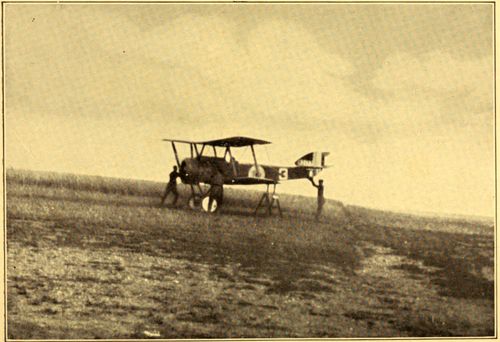
THE AEROPLANE WHICH LIEUTENANT O'BRIEN USED IN HIS LAST BATTLE WITH THE HUNS WHEN HE WAS BROUGHT DOWN AND MADE PRISONER
Four of them singled me out. I was diving and they dove right down after me, shooting as they came. Their tracer-bullets were coming closer to me every moment. These tracer-bullets are balls of fire which enable the shooter to follow the course his bullets are taking and to correct his aim accordingly. They do no more harm to a pilot if he is hit than an ordinary bullet, but if they hit the petrol-tank, good night! When a machine catches fire in flight there is no way of putting it out. It takes less than a minute for the fabric to burn off the wings, and then the machine drops like an arrow, leaving a trail of smoke like a comet.
As their tracer-bullets came closer and closer to me I realized that my chances of escape were nil. Their very next shot, I felt, must hit me.
Once, some days before, when I was flying over the line I had watched a fight above me. A German machine was set on fire and dove down through our formation in flame on its way to the ground. The Hun was diving at such a sharp angle that both his wings came off, and as he passed within a few hundred feet of me I saw the look of horror upon his face.
Now, when I expected any moment to suffer a similar fate, I could not help thinking of that poor Hun's last look of agony.
I realized that my only chance lay in making an Immermann turn. This maneuver was invented by a German—one of the greatest who ever flew and who was killed in action some time ago. This turn, which I made successfully, brought one of their machines right in front of me, and as he sailed along barely ten yards away I had "the drop" on him, and he knew it.
His white face and startled eyes I can still see. He knew beyond question that his last moment had come, because his position prevented his taking aim at me, while my gun pointed straight at him. My first tracer-bullet passed within a yard of his head, the second looked as if it hit his shoulder, the third struck him in the neck, and then I let him have the whole works and he went down in a spinning nose dive.
All this time the three other Hun machines were shooting away at me. I could hear the bullets striking my machine one after another. I hadn't the slightest idea that I could ever beat off those three Huns, but there was nothing for me to do but fight, and my hands were full.
In fighting, your machine is dropping, dropping all the time. I glanced at my instruments and my altitude was between eight and nine thousand feet. While I was still looking at the instruments the whole blamed works disappeared. A burst of bullets went into the instrument board and blew it to smithereens, another bullet went through my upper lip, came out of the roof of my mouth and lodged in my throat, and the next thing I knew was when I came to in a German hospital the following morning at five o'clock, German time.
I was a prisoner of war!