IV CLIPPED WINGS
Reading edition
The hospital in which I found myself on the morning after my capture was a private house made of brick, very low and dirty, and not at all adapted for use as a hospital. It had evidently been used but a few days, on account of the big push that was taking place at that time of the year, and in all probability would be abandoned as soon as they had found a better place.
In all, the house contained four rooms and a stable, which was by far the largest of all. Although I never looked into this "wing" of the hospital, I was told that it, too, was filled with patients, lying on beds of straw around on the ground. I do not know whether they, too, were officers or privates.
The room in which I found myself contained eight beds, three of which were occupied by wounded German officers. The other rooms, I imagined, had about the same number of beds as mine. There were no Red Cross nurses in attendance, just orderlies, for this was only an emergency hospital and too near the firing-line for nurses. The orderlies were not old men nor very young boys, as I expected to find, but young men in the prime of life, who evidently had been medical students. One or two of them, I discovered, were able to speak English, but for some reason they would not talk. Perhaps they were forbidden by the officer in charge to do so.
In addition to the bullet wound in my mouth, I had a swelling from my forehead to the back of my head almost as big as my shoe—and that is saying considerable. I couldn't move an inch without suffering intense pain, and when the doctor told me that I had no bones broken I wondered how a fellow would feel who had.
German officers visited me that morning and told me that my machine went down in a spinning nose dive from a height of between eight and nine thousand feet, and they had the surprise of their lives when they discovered that I had not been dashed to pieces. They had to cut me out of my machine, which was riddled with shots and shattered to bits.
A German doctor removed the bullet from my throat, and the first thing he said to me when I came to was, "You are an American!"
There was no use denying it, because the metal identification disk on my wrist bore the inscription, "Pat O'Brien, U. S. A. Royal Flying Corps."
Although I was suffering intense agony, the doctor, who spoke perfect English, insisted upon conversing with me.
"You may be all right as a sportsman," he declared, "but you are a damned murderer just the same for being here. You Americans who got into this thing before America came into the war are no better than common murderers and you ought to be treated the same way!"
The wound in my mouth made it impossible for me to answer him, and I was suffering too much pain to be hurt very much by anything he could say.
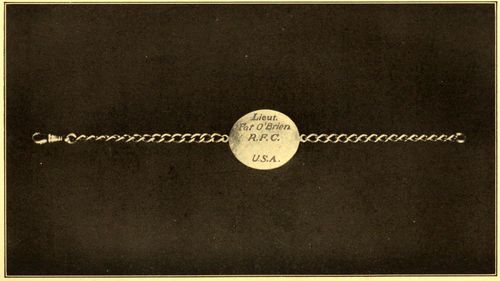
THE IDENTIFICATION DISK WORN BY LIEUTENANT O'BRIEN WHEN HE WAS CAPTURED BY THE HUNS. IT REVEALED TO THEM THAT HE WAS AN AMERICAN
He asked me if I would like an apple! I could just as easily have eaten a brick.
When he got no answers out of me he walked away disgustedly.
"You don't have to worry any more," he declared, as a parting shot; "for you the war is over!"
I was given a little broth later in the day, and as I began to collect my thoughts I wondered what had happened to my comrades in the battle which had resulted so disastrously to me. As I began to realize my plight I worried less about my physical condition than the fact that, as the doctor had pointed out, for me the war was practically over. I had been in it but a short time, and now I would be a prisoner for the duration of the war!
The next day some German flying officers visited me, and I must say they treated me with great consideration. They told me of the man I had brought down. They said he was a Bavarian and a fairly good pilot. They gave me his hat as a souvenir and complimented me on the fight I had put up.
My helmet, which was of soft leather, was split from front to back by a bullet from a machine-gun and they examined it with great interest. When they brought me my uniform I found that the star of my rank which had been on my right shoulder-strap had been shot off clean. The one on my left shoulder-strap they asked me for as a souvenir, as also my R. F. C. badges, which I gave them. They allowed me to keep my "wings," which I wore on my left breast, because they were aware that that is the proudest possession of a British flying officer.
I think I am right in saying that the only chivalry in this war on the German side of the trenches has been displayed by the officers of the German Flying Corps, which comprises the pick of Germany. They pointed out to me that I and my comrades were fighting purely for the love of it, whereas they were fighting in defense of their country, but still, they said, they admired us for our sportsmanship. I had a notion to ask them if dropping bombs on London and killing so many innocent people was in defense of their country, but I was in no position or condition to pick a quarrel at that time.
That same day a German officer was brought into the hospital and put in the bunk next to mine. Of course, I casually looked at him, but did not pay any particular attention to him at that time. He lay there for three or four hours before I did take a real good look at him. I was positive that he could not speak English, and naturally I did not say anything to him.
Once when I looked over in his direction his eyes were on me and to my surprise he said, very sarcastically, "What the hell are you looking at?" and then smiled. At this time I was just beginning to say a few words, my wound having made talking difficult, but I said enough to let him know what I was doing there and how I happened to be there. Evidently he had heard my story from some of the others, though, because he said it was too bad I had not broken my neck; that he did not have much sympathy with the Flying Corps, anyway. He asked me what part of America I came from, and I told him "California."
After a few more questions he learned that I hailed from San Francisco, and then added to my distress by saying, "How would you like to have a good juicy steak right out of the Hofbräu?" Naturally, I told him it would "hit the spot," but I hardly thought my mouth was in shape just then to eat it. I immediately asked, of course, what he knew about the Hofbräu, and he replied, "I was connected with the place a good many years, and I ought to know all about it."
After that this German officer and I became rather chummy—that is, as far as I could be chummy with an enemy, and we whiled away a good many long hours talking about the days we had spent in San Francisco, and frequently in the conversation one of us would mention some prominent Californian, or some little incident occurring there, with which we were both familiar.
He told me when war was declared he was, of course, intensely patriotic and thought the only thing for him to do was to go back and aid in the defense of his country. He found that he could not go directly from San Francisco because the water was too well guarded by the English, so he boarded a boat for South America. There he obtained a forged passport and in the guise of a Montevidean took passage for New York and from there to England.
He passed through England without any difficulty on his forged passport, but concluded not to risk going to Holland, for fear of exciting too much suspicion, so went down through the Strait of Gibraltar to Italy, which was neutral at that time, up to Austria, and thence to Germany. He said when they put in at Gibraltar, after leaving England, there were two suspects taken off the ship, men that he was sure were neutral subjects, but much to his relief his own passport and credentials were examined and passed O. K.
The Hun spoke of his voyage from America to England as being exceptionally pleasant, and said he had had a fine time because he associated with the English passengers on board, his fluent English readily admitting him to several spirited arguments on the subject of the war which he keenly enjoyed.
One little incident he related revealed the remarkable tact which our enemy displayed in his associations at sea, which no doubt resulted advantageously for him. As he expressed it, he "made a hit" one evening when the crowd had assembled for a little music by suggesting that they sing "God Save the King." Thereafter his popularity was assured and the desired effect accomplished, for very soon a French officer came up to him and said, "It's too bad that England and ourselves haven't men in our army like you." It was too bad, he agreed, in telling me about it, because he was confident he could have done a whole lot more for Germany if he had been in the English army.
In spite of his apparent loyalty, however, the man didn't seem very enthusiastic over the war and frankly admitted one day that the old political battles waged in California were much more to his liking than the battles he had gone through over here. On second thought he laughed as though it were a good joke, but he evidently intended me to infer that he had taken a keen interest in politics in San Francisco.
When my "chummy enemy" first started his conversation with me the German doctor in charge reprimanded him for talking to me, but he paid no attention to the doctor, showing that some real Americanism had soaked into his system while he had been in the U. S. A.
I asked him one day what he thought the German people would do after the war; if he thought they would make Germany a republic, and, much to my surprise, he said, very bitterly, "If I had my way about it, I would make her a republic to-day and hang the damned Kaiser in the bargain." And yet he was considered an excellent soldier. I concluded, however, that he must have been a German Socialist, though he never told me so.
On one occasion I asked him for his name, but he said that I would probably never see him again and it didn't matter what his name was. I did not know whether he meant that the Germans would starve me out or just what was on his mind, for at that time I am sure he did not figure on dying. The first two or three days I was in the hospital I thought surely he would be up and gone long before I was, but blood poisoning set in about that time and just a few hours before I left for Courtrai he died.
One of those days, while my wound was still very troublesome, I was given an apple; whether it was just to torment me, knowing that I could not eat it, or whether for some other reason, I do not know. But, anyway, a German flying officer there had several in his pockets and gave me a nice one. Of course, there was no chance of my eating it, so when the officer had gone and I discovered this San Francisco fellow looking at it rather longingly I picked it up, intending to toss it over to him. But he shook his head and said, "If this was San Francisco, I would take it, but I cannot take it from you here." I was never able to understand just why he refused the apple, for he was usually sociable and a good fellow to talk to, but apparently he could not forget that I was his enemy. However, that did not stop one of the orderlies from eating the apple.
One practice about the hospital which impressed me particularly was that if a German soldier did not stand much chance of recovering sufficiently to take his place again in the war, the doctors did not exert themselves to see that he got well. But if a man had a fairly good chance of recovering and they thought he might be of some further use, everything that medical skill could possibly do was done for him. I don't know whether this was done under orders or whether the doctors just followed their own inclinations in such cases.
My teeth had been badly jarred up from the shot, and I hoped that I might have a chance to have them fixed when I reached Courtrai, the prison where I was to be taken. So I asked the doctor if it would be possible for me to have this work done there, but he very curtly told me that though there were several dentists at Courtrai, they were busy enough fixing the teeth of their own men without bothering about mine. He also added that I would not have to worry about my teeth; that I wouldn't be getting so much food that they would be put out of commission by working overtime. I wanted to tell him that from the way things looked he would not be wearing his out very soon, either.
My condition improved during the next two days and on the fourth day of my captivity I was well enough to write a brief message to my squadron reporting that I was a prisoner of war and "feeling fine," although, as a matter of fact, I was never so depressed in my life. I realized, however, that if the message reached my comrades, it would be relayed to my mother in Momence, Illinois, and I did not want to worry her more than was absolutely necessary. It was enough for her to know that I was a prisoner. She did not have to know that I was wounded.
I had hopes that my message would be carried over the lines and dropped by one of the German flying officers. That is a courtesy which is usually practised on both sides. I recalled how patiently we had waited in our aerodrome for news of our men who had failed to return, and I could picture my squadron speculating on my fate.
That is one of the saddest things connected with service in the R. F. C. You don't care much what happens to you, but the constant casualties among your friends is very depressing.
You go out with your "flight" and get into a muss. You get scattered and when your formation is broken up you finally wing your way home alone.
Perhaps you are the first to land. Soon another machine shows in the sky, then another, and you patiently wait for the rest to appear. Within an hour, perhaps, all have shown up save one, and you begin to speculate and wonder what has happened to him.
Has he lost his way? Has he landed at some other aerodrome? Did the Huns get him?
When darkness comes you realize that, at any rate, he won't be back that night, and you hope for a telephone-call from him telling of his whereabouts.
If the night passes without sign or word from him he is reported as missing, and then you watch for his casualty to appear in the war-office lists.
One day, perhaps a month later, a message is dropped over the line by the German Flying Corps with a list of pilots captured or killed by the Huns, and then, for the first time, you know definitely why it was your comrade failed to return the day he last went over the line with his squadron.
I was still musing over this melancholy phase of the scout's life when an orderly told me there was a beautiful battle going on in the air, and he volunteered to help me outside the hospital that I might witness it, and I readily accepted his assistance.
That afternoon I saw one of the gamest fights I ever expect to witness.
There were six of our machines against perhaps sixteen Huns. From the type of the British machines I knew that they might possibly be from my own aerodrome. Two of our machines had been apparently picked out by six of the Huns and were bearing the brunt of the fight. The contest seemed to me to be so unequal that victory for our men was hardly to be thought of, and yet at one time they so completely outmaneuvered the Huns that I thought their superior skill might save the day for them, despite the fact that they were so hopelessly outnumbered. One thing I was sure of: they would never give in.
Of course it would have been a comparatively simple matter for our men, when they saw how things were going against them, to have turned their noses down, landed behind the German lines, and given themselves up as prisoners, but that is not the way of the R. F. C.
A battle of this kind seldom lasts many minutes, although every second seems like an hour to those who participate in it and even onlookers suffer more thrills in the course of the struggle than they would ordinarily experience in a lifetime. It is apparent even to a novice that the loser's fate is death.
Of course the Germans around the hospital were all watching and rooting for their comrades, but the English, too, had one sympathizer in that group who made no effort to stifle his admiration for the bravery his comrades were displaying.
The end came suddenly. Four machines crashed to earth almost simultaneously. It was an even break—two of theirs and two of ours. The others apparently returned to their respective lines.
The wound in my mouth was bothering me considerably, but by means of a pencil and paper I requested one of the German officers to find out for me who the English officers were who had been shot down.
A little later he returned and handed me a photograph taken from the body of one of the victims. It was a picture of Paul Raney, of Toronto, and myself, taken together! Poor Raney! He was the best friend I had and one of the best and gamest men who ever fought in France!
It was he, I learned long after, who, when I was reported missing, had checked over all my belongings and sent them back to England with a signed memorandum—which is now in my possession. Poor fellow, he little realized then that but a day or two later he would be engaged in his last heroic battle, with me a helpless onlooker!
The same German officer who brought me the photograph also drew a map for me of the exact spot where Raney was buried in Flanders. I guarded it carefully all through my subsequent adventures and finally turned it over to his father and mother when I visited them in Toronto to perform the hardest and saddest duty I have ever been called upon to execute—to confirm to them in person the tidings of poor Paul's death.
The other British pilot who fell was also from my squadron and a man I knew well—Lieutenant Keith, of Australia. I had given him a picture of myself only a few hours before I started on my own disastrous flight. He was one of the star pilots of our squadron and had been in many a desperate battle before, but this time the odds were too great for him. He put up a wonderful fight and he gave as much as he took.
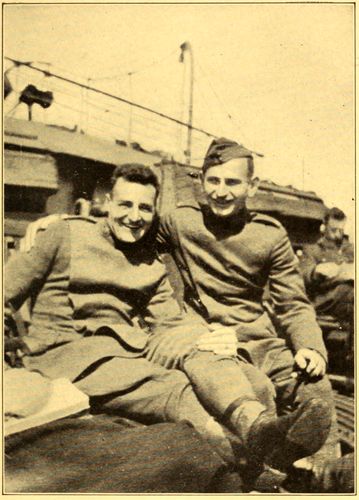
LIEUT. PAUL H. RANEY OF TORONTO AND LIEUT. PAT O'BRIEN
(Raney was killed in action before the eyes of O'Brien, who was a prisoner of war. This picture, found on the body of Raney when he fell behind the German lines, was handed to O'Brien to identify the victim.)
The next two days passed without incident and I was then taken to the Intelligence Department of the German Flying Corps, which was located about an hour from the hospital. There I was kept two days, during which time they put a thousand and one questions to me. While I was there I turned over to them the message I had written in the hospital and asked them to have one of their fliers drop it on our side of the line.
They asked me where I would like it dropped, thinking perhaps I would give my aerodrome away, but when I smiled and shook my head they did not insist upon an answer.
"I'll drop it over ——," declared one of them, naming my aerodrome, which revealed to me that their flying corps is as efficient as other branches of the service in the matter of obtaining valuable information.
And right here I want to say that the more I came to know of the enemy the more keenly I realized what a difficult task we're going to have to lick him. In all my subsequent experience the fact that there is a heap of fight left in the Huns still was thoroughly brought home to me. We shall win the war eventually, if we don't slow up too soon in the mistaken idea that the Huns are ready to lie down.
The flying officers who questioned me were extremely anxious to find out all they could about the part America is going to play in the war, but they evidently came to the conclusion that America hadn't taken me very deeply into her confidence, judging from the information they got, or failed to get, from me.
At any rate, they gave me up as a bad job and I was ordered to the officers' prison at Courtrai, Belgium.